Wednesday, February 07, 2007

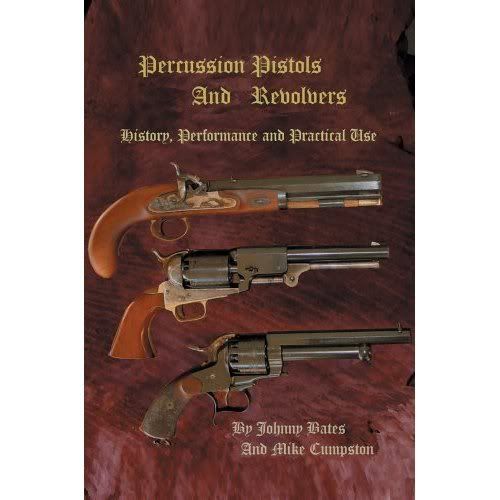
Book Review - Percussion Pistols and Revolvers

Title: Percussion Pistols and Revolvers
Author(s): Mike Cumpston and Johnny Bates
ISBN: 0595357962

To be frank I thought I'd read just about every sort of muzzleloading "how to" book there is. Then I subscribed to the Sixgunner Forums nominally the home of one John Taffin and frequented by Mike Cumpston.

Mike was posting a lot about his acquisitions and shooting of various cap'n'ball revolvers and his accompanying photos were absolutely excellent. So, when I discovered he'd just been writing a synopsis of the chapters he was writing for this book I had to have a copy.

It was well worth the money. 26 chapters in 195 pages may seem a little thin to some, but the information is concisely presented and the illustrations are anything but gratuitous. Mike and Johnny cover every major reproduction cap lock pistol or revolver. They also have appendices on the following:
  • Italian Proof Marks by Year of Manufacture
  • Colts Recommended Loads
  • 19th Century Combustible Cartridges
  • Petition for Frontier Protection
  • The Irish Code
  • 44 Cap & Ball Revolver
If there is anything bad to say about the book it is all on the publisher. The print is a bit small for some and the photos fail to demonstrate Mike's excellent photographic skills being too small and in black & white. This is one peeve I have and something I simply can't understand. They seem to insist on softbound, B&W photos, in short as cheap a production as possible. Why are most publishers convinced that shooters want cheap books? I don't, I want a quality book, even hardbound, and good clear photographs.

That said, this book is worth the $16.95 retail (and would be worth the difference for larger, color photos). Messers Cumpston and Bates are to be congratulated on good work well done.

Let One Hundred Flowers Bloom, Let One Hundred Thoughts Contend

This was a campaign begun by Mao, actually the gang of 4, in the People's Republic of China (PRC, aka COMMUNIST China) which encouraged free expression. After a bit the free thinkers were rounded up and put in prison. I guess you could say they picked the flowers. So it is with the former Mayor of DC, Marion Barry's plan to loosen gun laws for a bit.

Barry aims for gun-ban hiatus
By Gary Emerling, THE WASHINGTON TIMES, February 7, 2007
D.C. Council member Marion Barry yesterday introduced legislation that would suspend the District's 30-year ban on handguns, providing gun owners a 90-day period to register weapons they would then be allowed to legally own.
"We are in the midst of a gun-violence epidemic," said Mr. Barry, Ward 8 Democrat. "We need to see gun violence as an emergency in the District of Columbia."
Mr. Barry's bill, which only applies to pistols, would allow D.C. residents with no criminal record to register guns for 90 days from the law's enactment. After the 90-day period, current gun restrictions would be reinstated.

Barry spokesman Keith Perry said the bill is "an acknowledgment that people do have guns" in the District and would help police better track weapons used in the commission of crimes.

The District has some of the toughest gun laws in the nation and restricts ownership of most guns that were not registered before 1977. Privately owned rifles and shotguns must be kept at home and stored unloaded, disassembled or bound by a trigger lock or a similar device.

Mr. Barry's proposal would increase the penalties for possessing an unregistered weapon in the District from a maximum of one year in prison and a $1,000 fine to 15 years in prison and a $10,000 fine.

A second offense could result in 30 years in prison and a $20,000 fine, according to the bill.

Mr. Barry, who was robbed at gunpoint in his Southeast apartment in January 2006, cited statistics that said police had confiscated 2,656 guns last year, with 51 percent of those weapons being seized east of the Anacostia River.

A recent Metropolitan Police Department report on homicides from 2001 to 2005 states that 901 of 1,126 homicide victims, or about 80 percent, were fatally shot.
Mr. Barry, who served four terms as D.C. mayor, also referenced the recent shooting deaths of D.C. teenagers Cynthia Gray and Taleshia Ford, both 17, in urging support for the measure.

"We all get outraged ... and we all go home," Mr. Barry said. "Nothing is done to get the guns off the streets of Washington, D.C."

Mr. Barry's bill was co-sponsored by council members Jim Graham, Ward 1 Democrat; Kwame Brown, at-large Democrat; and Tommy Wells, Ward 6 Democrat. It was referred to the Committee on Public Safety and the Judiciary.

Mr. Brown acknowledged that the bill "needs some working and flushing out" but that it was a proactive approach to taking guns off of city streets.

"To me, it's the end result," he said. "How do we get guns off the streets of the District of Columbia, get public input and find out how we can make the streets safer?"

Phil Mendelson, at-large Democrat and chairman of the public safety committee, said he had reservations about aspects of the bill. He said the 90-day period during which people who have owned illegal guns can register their weapons seems "counterproductive."

"The intent is right, to deal with gun violence," Mr. Mendelson said. "The amnesty thing, I think, goes against the need to reduce the number of guns in our city." He said the bill would likely be considered during the course of a larger hearing on gun violence.

Peter Hamm, a spokesman for the Brady Campaign to Prevent Gun Violence, said yesterday the organization was not sufficiently familiar with Mr. Barry's bill to give an opinion on it but that the measure could be a tough sell in the District.
"It seems like a real uphill struggle for Mr. Barry to get a lot of broad support for something like this," Mr. Hamm said. "Washington, D.C., is suffering from a lot of gun violence lately and to say, 'Let's bring more guns into the equation as a solution,' doesn't sound like it makes a great deal of sense."

Chris W. Cox, chief lobbyist for the National Rifle Association, also said Mr. Barry's proposal was a surprise and that the organization would study the bill.
"Obviously, we support efforts to allow law-abiding residents of the District to own firearms," Mr. Cox said. "And we will continue in those efforts."
Congressional attempts to repeal the District's gun ban in recent years have been criticized as attacks on the District's right to home rule.

In 2004, the House of Representatives voted in favor of repealing the city's restrictions on gun ownership and registration, even though the measure was opposed by the District's mayor, 13 council members, the police chief and the city's congressional delegate. The bill was not brought to a vote in the Senate.

A federal appeals court heard arguments in December about whether the District's decision to prohibit residents from owning guns is a violation of the Second Amendment. That decision is pending. A U.S. District judge rejected the argument, brought by six D.C. residents, in 2005.
Oh, I do feel sorry for anyone foolish enough to want to live in the District of Columbia.

Department of Interior Arrogance

The Department of the Interior doesn't believe that states which issue concealed carry permits (aka concealed handgun permits as here in VA) know what they are doing and want you to disarm when you enter a national park. This is what we got in response to a petition for them to honor VA CHPs.


What these folks don't realize is that the parks exist inside other political entities the citizens of which have acted to ensure that certain rights can be exercised and that the DOI via the NPS are denying exercise of those rights.

Let's go get 'em. Contact your Senator and Representative to move on already introduced legislation so that you can exercise your rights everywhere in your state and reciprocating states.

John Linebaugh's Website is Up and Running

For those who might not know it, John Linebaugh has a web site and it is up and running. There's video and the seminar schedule. Look for more as time passes.

Tuesday, February 06, 2007

Socks

That's right socks. Don't give me that look. Every infantryman with any experience at all knows that socks are equal in importance to his boots, perhaps more so in a way as they require constant maintenance. Socks need to be dry, to keep the foot warm, to move moisture away from the foot so that blisters don't form and to cushion the foot.

In the army we were issued or bought from the clothing sales store a wool blend sock. Some soldiers didn't like them because they said the wook itched. I wore them all the time. They were cheap, available, comfortable and didn't require any thought. I just reached into the drawer and pulled out a pair and put them on my feet. In good condition, those socks kept my feet warm enough and comfortable enough in any boot or shoe.

But later, after re-marrying, my new wife insisted that I maintain some sense of fashion, that is I shouldn't wear OD green socks with everything. I could see her point and like lots of men, most men, I let her buy my underwear and socks. Funny, but in that process cotton came to be the dominant fiber in my sock drawer. I got used to it, in part because I might change socks 3-4 times a day as I transitioned from physical training (PT) clothes to work uniform and back again, often twice a day and then to civilian clothes. But then I retired.

I retired from regular PT as well. When I put on socks in the morning that was it until I undressed for my shower in the evening. Cotton doesn't cut it. If I did any work, my socks would become soaking wet and stay that way, not good for feet or shoes! In the winter, even the best boot socks sans wool left me cold, literally. Now I'm revolting (again, literally) and I rebelled, and started looking for the ideal sock for everyday wear. Yes, I prefer wool. Guess what I found.

Well, when I was a kid wool socks weren't really more expensive than the cotton variety. At least that's how I remember it. But now? Oh, boy! The prices sure have taken a turn upward. A pair of Smartwool medium weight hiking crew socks goes $16.95 a pair. Oh, but they are comfortable! Made of merino wool, the sales lady/owner of the local dealer fawned over these especially as I was buying two pair. I might get two more pair as well...

Woolrich makes some comfortable socks also of merino wool. I prefer the Dayhiker shown in the first photo. Only $14 a pair. My youngest daughter got me two pairs of these for Christmas. I think I'm going to wear them out. I really do like them.

Of course LL Bean sells a wool sock. My oldest daughter got me a pair of those. I wore them yesterday and they are just as comfortable as the Smartwool product (and might even be made by Smartwool or their vendors). Their midweight goes $13.50 a pair.

Altogether that's pretty consistent pricing. I don't know why they are so priced. I know that the wool producers are griping that they aren't getting much for their product so it must not be on the materials end. I imagine that there are enough smart folks out there that demand is high. I suggest you join the rest of us who've (re-) discovered wool socks and just a bit of heaven on earth and get at least one pair for your Saturday excursions.

I Have GOT to Get a Grip (or My Obsession with Grips)

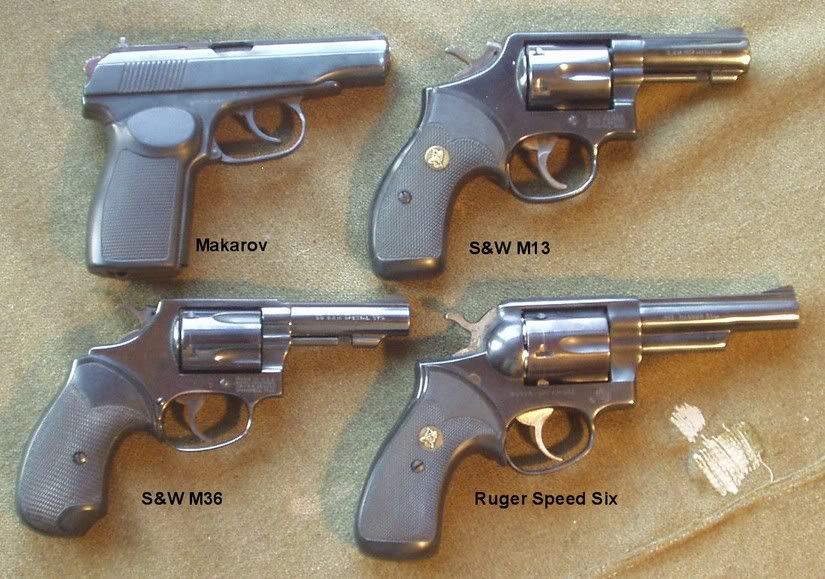
I have several revolvers and I've been through the all rubber all the time stage of my life. First it was just available (the S&W M629), then it was needed to avoid the sting of recoil (the S&W M13 3" .357 Mag), and then it was to make all the grips the same (the S&W M36) or to make them big enough and "tacky" enough to hold on to (the Ruger SpeedSix and Colt Combat Commander). I even forced Dad into this with Pachmayr grip set for his Ruger MK II 10". Yikes. What is really embarassing is that, over time, I've probably spent enough on grips to buy a couple of good handguns and all these grips were unsatisfactory. I must note the following...

The good things about rubber.

#1 Rubber is available everywhere. If you need a grip you can likely find somebody somewhere who makes a set for your gun.

#2 Rubber is cheap. Relatively. Oh, you might spend $30 for rubber grips but wood will most often cost more.

#3 Rubber is durable. It lasts. It can take a beating and even protect your gun without showing the wear and tear that wood will show under similar circumstances. Unlike some wood finishes, it is unfazed by exposure to the elements.

#4 Rubber is quiet. If you are one of those folks who's constantly bumping into things this might help you avoid embarrassing noises.

The bad things about rubber.

#1 Rubber is ugly, butt ugly (pun intended). Ok, so I'm not so wrapped up in beauty that I'll spend $250+ for stag or fossilized mastodon ivory or some such thing. Wood, even plain old walnut is good enough.

#2 Rubber is too tacky. No, I'm not referring to looks again. I'm referring to how it grabs at my clothing. Let's face facts. Most of my handguns are intended to be at least part time concealed carry pieces. Grips which grab clothing and make it hang funny, ie noticeably different from the norm, are not a good thing.

#3 Rubber grips inevitably seem to be too big or at least bigger than necessary. For my 629, no rubber grip was really usable for my hands. I just could not shoot that gun double action comfortably with any rubber grip. For other guns they bulk up the gun reducing concealability.

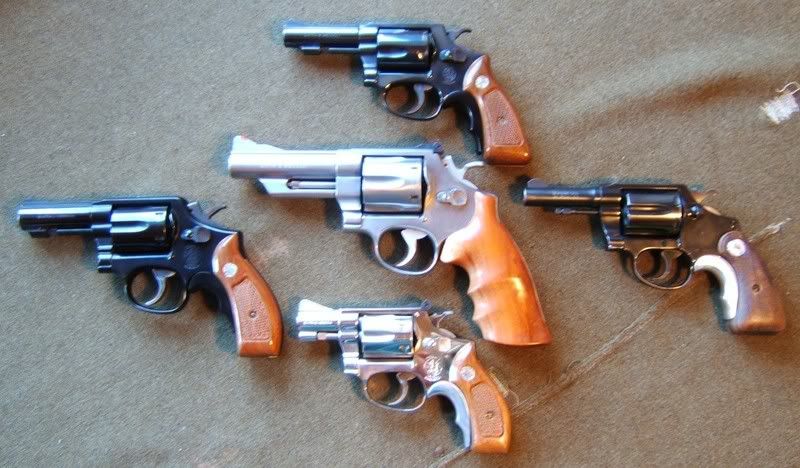
So, as you can see, I've figured out that the minuses exceed the positives and I've made some changes. You might also notice some other similarities. Pictured here is a S&W 629 (center), S&W M34 (center bottom) and from there clockwise an S&W M13, S&W M36, and finally my recently oft mentioned Colt Detective Special.

Yes, I've gone back to the factory grips with the addition of a Tyler-T grip adapter. At about $25 each these are not much less than a Pachmayr grip but oh the feeling!

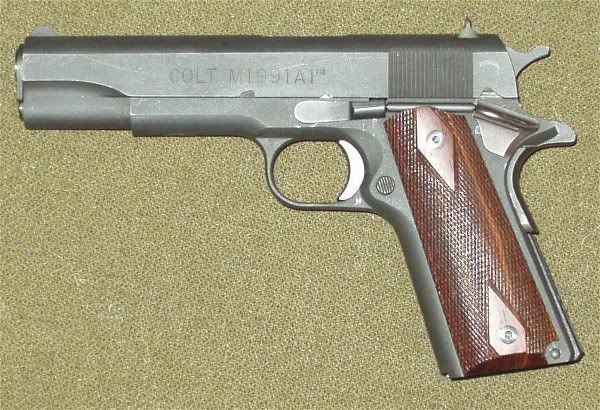
I've done the same to most of my autopistols as well such as with this Colt. No, I've never noticed a lack of control with one exception. The Hogue grips on the 629. That grip is slick. DA shooting is fine but when I change my grip to cock the gun it will slide about. Perhaps I haven't learned the trick to the task. But for every other gun, handling has been improved and I think appearance and the pleasure of ownership has increased as well.

Now I just need to correct my poor Speed-Six's grip and get that MK II a good set of wood. More money I know, but look on eBay for some real deals if you want rubber grips. All mine will be going there soon!

Monday, February 05, 2007

The Marlin "Trapper" .30-30 and Law Enforcement

A forum friend provided the information. Nothing has been changed (except, perhaps, spelling).

I have a Marlin .30-30 "Spikehorn" Model 336 with the handy, 16.5-inch barrel. Oddly, off a double-sandbag rest at 100 yards it holds a tighter group than a 1980's-vintage 20-inch barreled Marlin 336, and a 1970's era Winchester 20-inch Model 94 I have. I was interested in your posted comment that the stiffness of the shorter barrel may benefit accuracy. I never thought of that, but then I'm not much of a rifleman, honestly.

I have a Williams 5-D receiver sight on it, as I do all my leverguns, and it's zeroed for the Federal Cartridge 125-grain .30-30 jhp factory load, since that load and the Winchester 150-grain jhp are the only .30-30 loads we're permitted to use for anti-personnel use.

As you'd know, I use the .30-30 mostly for cleanly euthanizing road-injured livestock and, since that normally (for me) involves head and neck shots, the little 125-grain jhp does an excellent job. I nevertheless keep some 170-grain loads with me for the occasional full-grown steer or horse that gets hit by a vehicle. Anybody who thinks they can cleanly euthanize a road-injured horse with a 9mm or .40 cal pistol is asking for some real trouble, especially when the owner of the animal is watching you and expecting you to do it cleanly.

I just wondered about the 170-grain .30-30's out of that little barrel when I'm needing to shoot something deer-sized or a bit larger out to, say, 100 yards. Wasn't sure how the lower velocity that the short trapper barrel would give would effect the 170's impact at a distance. I figured you have experience with using a trapper length levergun on deer at that distance...so I thought I'd ask.

FWIW, the factory 125-grain jhp is the most accurate factory load I've tried in all my .30-30's. It's great on feral dogs at a distance since it's flat-shooting enough to be more forgiving of my mistakes in range-judging. This past deer season I shot a little 120-pound whitetail buck at a measured 90 yards with it, as he quartered toward me. The 125-grain jhp smacked him on the near-side shoulder and staggered the little buck backwards almost onto his ass.

He recovered and ran off about 30 yards on three legs before banging into a tree and falling down for good. The bullet wrecked his shoulder-joint, took out the top of both lungs and blew lung-colored blood froth out a quarter-sized exit hole on his off-side ribs. When we skinned him out, there was a 12-inch circle of bloodshot meat surrounding the entrance hole, so it must have really hit him hard even at 90 yards. I guess I always expect light bullets to lose their velocity and energy quickly over any sort of distance.

I grew up using lead cast .30-30's as a farm gun (along with a .22 rimfire), and the only "hunting" bullets I ever saw in .30-30 as a kid were Remington Core-Lokt's. I have no idea now whether they were 150's or 170-grainers. We used to drive to the hardware store and they'd sell us 4 or 5 bullets...we didn't even have to buy the whole 20-round box. I'm sure you remember those days. :-)

The 125-grain Federal jhp's are the one .30-30 factory jhp that have exposed lead at the tip of the bullet, and I noticed that the spring pressure of the tubular magazine would slightly deform the noses on the little jhp's when I left the magazine loaded for long periods. I wondered naturally if the deformation of the noses would effect accuracy and expansion.

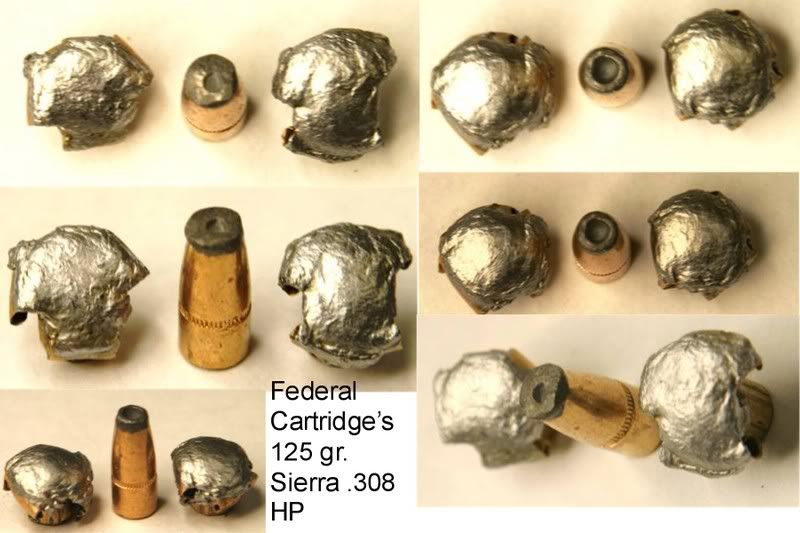
A long time friend is an R&D engineer at Federal Cartridge, and he agreed to test their 125-grain jhp's for me in gelatin. He deliberately deformed the noses on some of the test bullets, and compared them to non-deformed ones during the test. Attached are the photos he sent me, Hobie.

It appears that the slight deformation the magazine spring does to those 125-grain jhp's has no practical effect on their mushrooming (or "upset', as he calls it) in the target. The deliberately deformed test bullets expanded into an irregular shape, instead of the perfect toadstool like the non-deformed ones did at 100 yards.

If you scroll from right-to-left at the bottom of the page, you'll see the results of the test-groups for accuracy from a test-barrel at 200 yards. The deformed test bullets, he told me, delivered a 200 yard group that was only .9-inch larger than the non-deformed group. He said also that the 125-grain .30-30 (catalog 3030C) is their most accurate .30-30 bullet.

I know I'll never be enough of a rifleman that a .9-inch decay in accuracy at 200 yards will ever be a problem for me. Anyway, that's all the experience I have with the factory 125 jhp's.

In our testing, the Winchester 150-grain jhp (Catalog X30301) and the Federal Cartridge 125-grain jhp (Catalog 3030C) both penetrated through 4 layers of cotton denim into calibrated ordnance gel about the same penetration distance as the .40 S&W pistol ammo we issue here. (155 grain Federal jhp's.)

The only catch is, these two .30-30 loads are unloading some 1,800 foot-pounds of striking energy into the target over that penetration distance, compared to the 400 or so foot-pounds delivered by the .40 S&W pistol ammo.

The Winchester load penetrated about 14.5-inches on the average and fragmented in the classic "lead snowstorm" described by Dr. Vincent DiMaio in his book "Gunshot Wounds", which is a standard reference text in forensic pathology. The Federal Cartridge 125-grain jhp load penetrated and average of 13.5-inches in the denim-covered gel.

The Federal 125-grain .30-30 jhp zipped right through auto glass during some testing we did at a local auto salvage yard. No sweat on using it at roadblocks. That little 125-grainer is a toughly constructed bullet, which probably accounts for its giving such good penetration on whitetails, in spite of its light weight.

Both of these loads should make an "urban safe" home defense load for an American householder who has the ever-popular .30-30 carbine handy. Abdul and Rasheed will be bringing their terror show to our neighborhoods a lot sooner than any of us would like, and its best that we be ready. Not all of us can afford an AR-15 rifle, and the .30-30 can be made to do.
And this is the response our correspondent got from Federal Cartridge...

Keith - here are some photos of bullet expansion with and without nose deformation. The unfired bullet is an example of how much the noses were deformed for this test.

Scott Schamber / Federal Cartridge


Sunday, February 04, 2007

Obsessive Grip Changes

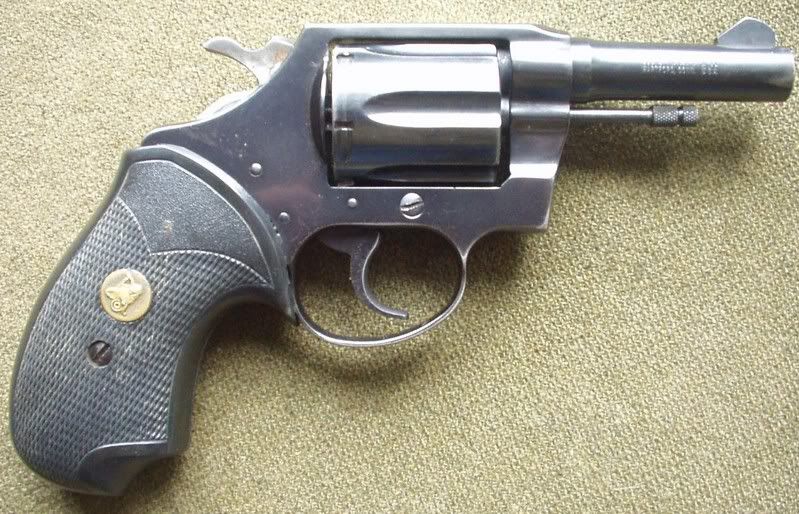
I must be going nuts lately. I bought this 3" Colt Detective Special a couple of months ago and it came with Pachmayr Compac grips. Now, those were UGLY on this gun and they had put me off buying this particular gun for quite a while. However, it locks up tighter than a tick on a fat dog and I knew it would be a good gun so I took it home.

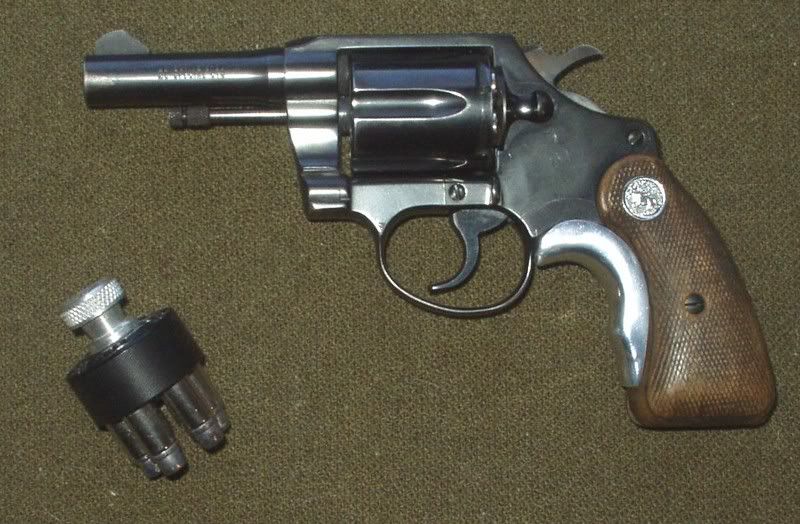
I immediately began to look for better grips and found a pair of Herrett's Ace grips but the fellow sent me Shooting Stars which had never been fit to a gun instead. Then another fellow gave me the grips shown in the second photo. These are apparently the late DS grips and they fit well and so that is what I used. Meanwhile I tried to get a pair of Ajax grips but the fit of those was so horrendous and they were so thin that I returned them. All that is documented elsewhere.

Still, although I was carrying the DS almost everyday, I didn't like the grips. Oh, they worked well enough but they didn't give the appearance or feel that I was really looking for.

So, one day I was looking through the Sportsmans Guide (just before throwing it away) and saw an ad for DS grips. Only $20 but used grips. Knowing "the guide" but feeling desperate I placed my order and was surprised and pleased to find the grips in the mail just 5 days later. Even better was that they fit my gun. Unfortunately, no grip screw. So, back on line I went to Gun Parts Corp. for a grip screw. I noted that different screws were listed for the various models including the Agent, Cobra, Detective Special and Police Positive Special. I ordered the two different screws feeling that one had to fit. One did but I'll be darned if I know which it is! So now I could attach the grips as shown but I also needed a Tyler-T Grip Adapter for the DS to get the feel that I wanted.

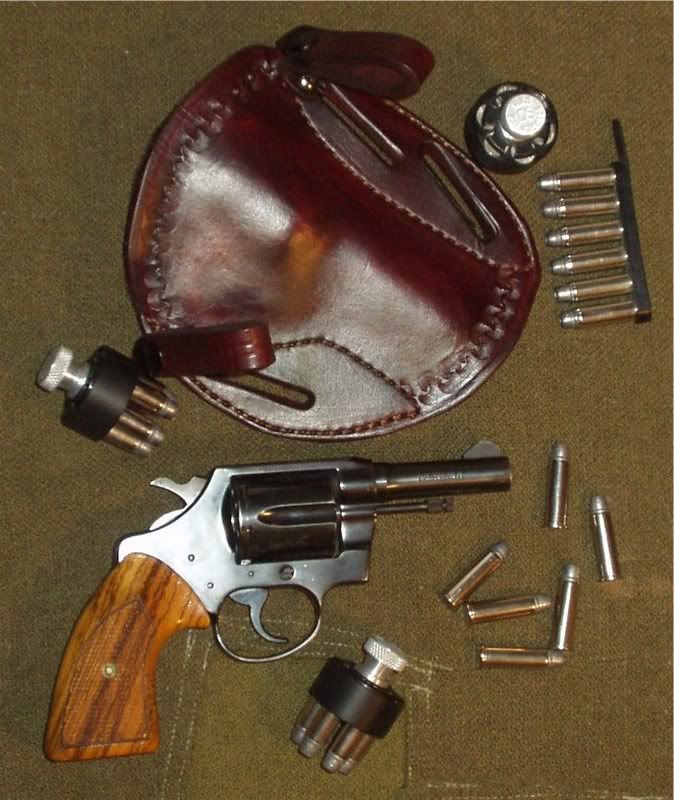
To get the setup I wanted shown to the left, I needed the Tyler-T. As I've also documented, getting one direct from Tyler is possible but can take quite a long time. This is a surprisingly small business and they fill orders as received with little if any stock on hand. So, I went to D&J Gun Repair of Sterling, VA for a Colt DS Tyler-T grip adapter (#5) but they didn't have a black anodized one on hand so I got a polished one. Paid by PayPal (yeah, anti-gun PayPal) I received my Tyler-T in two days! Now that's service! The result is what you see to the left. Oh my, but does it feel better in my hand. Ok, so the grip adapter shines like the capitol dome but it feels good. As I type this it is resting on my side in the Simply Rugged Silver Dollar with Inside-Out straps. In my pocket I have a HKS speedloader (as shown), and the gun and speedloader are filled with Winchester's version of the FBI load. Quite a confidence builder as I sit alone in the store.

However, these grips (stocks is actually the correct term) need some work. If you clicked on the photo to see the larger version, you might notice that the checkering is well worn and if you look at the front bottom corner you might see that the right panel of the stocks doesn't match the left. What you don't see is that the right stock has "69" painted in white. Worn, the number is readily visible and was probably a rack number for whatever gun the stock panel originally graced. What apparently happened is that Sportsmans Guide got a lot of stocks in and makes up pairs as they go along. Not to worry, these are minor glitches to be expected with used stocks and they are still a better fit to gun and each other than the new Ajax grips!

Anyway, I'm looking forward to many years of companionship from this friend. Now all I have to do is to refinish (rechecker?) the grips and everything will be A-OK. Or maybe I'll look for a pair of like new grips on eBay...

Saturday, February 03, 2007

Knife Rights

Knife Rights (formerly U.S. Knife & Tool Association) is seeking members to support the the right to use edged tools in the US. In Europe and the UK these rights have remarkably been curtailed to the point of idiocy.

Amazing that this is necessary to support common sense. I guess what we really need is a common sense rights group supporting the right to act rationally.

Wednesday, January 31, 2007

WV now has a West Virginia Citzens Defense League

Good news from Jim Snyder of the VCDL...

The West Virginia Citizens Defense League held its first
organizational meeting on Saturday, January 27, 2007, near Morgantown,
West Virginia. Details are available online at www.wvcdl.org

Jim Mullins, President of the West Virginia Citizens Defense League,
wrote:


I wanted to inform you of this meeting because, like the VCDL, the WVCDL intends to be a state-level Second Amendment advocacy organization that will seek to protect and, where necessary, restore the rights of law-abiding West Virginia gun owners. I admire the work of VCDL and hope that we will be able to work together on issues of mutual concern when they arise.

Although anti-gun legislation rarely, if ever, makes progress in our Legislature (one notable exception was the passage of a State Capitol carry ban in 2002, whose repeal we intend to seek), there are many areas where West Virginia laws need to be improved.

In addition to crafting pro-gun legislation, WVCDL will seek to generate the necessary public pressure on individual legislators and the legislative leadership to force committee action on pro-gun bills. In preparation for forming WVCDL, I met individually with about one-third of the members of our state Senate and the Speaker, majority leader, and minority leader of our House of Delegates to introduce myself and the WVCDL.

Our real work now lies ahead in spreading the word of our existence and building the membership base necessary to promote our legislative efforts. We would appreciate any assistance you may be able to provide. We wish you the best of luck with your efforts and we are willing to assist you when and where we can.

Sincerely,

Jim Mullins, President
West Virginia Citizens Defense League
info@wvcdl.org

If you have any friends or family members in WV, let them know about WVCDL and how to contact them.

We certainly hope WVCDL succeeds in improving WV's gun laws.


I would like to add that WVCDL might be just as important to those of us living in western Virginia who visit the Mountain State regularly to see family, for business, or for recreation. I think I'll make a donation to them ASAP.

Tuesday, January 30, 2007

Fathers, Sons, Hunting, Shooting and Memories

I was out and about hunting (VA's late muzzleloading season goes through Jan 6, 2007) and as I went to where I was going I passed many places full of memories of my father. That's always a good time, I had a great dad.

Dad was a forester who worked for the US Forest Service from 1955 until his retirement about 1984. He worked on the Monongahela, Daniel Boone and George Washington National Forests, for Job Corps, fought forest fires as far away as New Mexico and before that had served his country in the US Army (1945-47 and 1951-52) and worked 6 months for the Soil Conservation Corps. Raised on a dairy farm near Cooperstown, NY during the depression, Dad knew about hard work and treasured everything he had. He also made a lot of sacrifices for his children.

Of course he liked being outdoors and most of my fondest memories have something to do with the outdoors. However, I wasn't of hunting age until we were living here in VA and so it was here that I got to go out with him and have the grand adventures with gun in hand that boys and young men so treasure. Very nearly everywhere I go in this area that I have already visited at least once with my dad I will be reminded of a wonderful adventure. I'm sure that Dad didn't think that many of these excursions were memorable. Many times we would be so busy looking that we wouldn't shoot. We just liked being there! I do remember though.

Dad told me about his shooting experiences. I have the shotgun with which he killed his first squirrel. It is an old Western-Field bolt action .410 chambered for the 2½" shell and sans serial number. His dad couldn't always get 2½" shells and so would sometimes just shoot 3" shells in it. The worst thing was that the 3" shells wouldn't work through the magazine! I, being a bit more careful than Grandpa, have a supply of 2½" ammunition for the gun but I've never taken the gun hunting. I suppose I ought to remedy that next year...

When Dad came back from his military service (May 1945 - May 1947) he bought a used Stevens (Tru-Test branded) 16 ga. SxS shotgun and used it for all his hunting and skeet shooting. Interestingly, the skeet and trap range at which he shot was adjacent to a small private airfield at which he took flying lessons. We went there once and some of the fellows with whom he had shot skeet were there, shooting skeet. Gotta love that!

The first shooting I ever did with Dad was Grandpa's Winchester 62A. Dad would stop at the hardware store in Fly Creek and pick up a box of .22 shorts. He'd set up a can on a stick and try to teach me to shoot. The stock was too long and I'd have trouble getting my head in the correct position so would try to "sight" down the side of the barrel. Of course this didn't work. Great fun though! And yes, there was no hearing protection. We did that every summer when we visited Grandpa until I finally caught on and satisfied Dad that I had safety understood.

With all that done I was allowed to go groundhog hunting on my own. I killed a few. I'd been with Dad and Grandpa when they killed a few, too. More fun. I was also allowed/encouraged to kill the starlings in Grandpa's yard and to shoot crows. Yet more fun. But it would be a couple of years before I got a shotgun (courtesy of my Aunt Ginny) and went dove and quail hunting.

(to be continued)

Linebaugh Seminars - UPDATED

From the Sixgunner forums comes this info on the Linebaugh Seminars.

Jackson MS is 11-12-13 May 2007 and the host of that seminar is Rob Millette.
Rob can be reached at 1-601-845-2351 or e-mail to rjmillette@juno.com

Carthage IL is 18-19-20 May 2007 and the host is Todd Corder ph 309-458-6464 e-mail is lalaland@adams.net

Cody WY is June 13, 14, 15 & 16; Contact John himself at 307-645-3332 or 899-0574

Eustace TX (near Dallas) is April 27, 28 & 29

One other seminars is pending but not confirmed yet.
$200 for all three days.

I would love to attend one... Perhaps I'll see you there!

Monday, January 29, 2007

Where and How to Buy Guns?

Disclaimer: I fully expect that everyone will conduct all purchases of firearms in full compliance with Federal, State and local laws, ordinances and regulations. This post has nothing to do with avoiding such compliance but only with locating reasonably priced firearms for purchase.

I've bought at shops, from individuals, from folks on forums (3X without problems, thank you VERY much) and from Gunbroker and GunsAmerica. I have agonized over some deals, not because they weren't fair but because I didn't have enough money set aside but I made it happen. I've paid fair market value mostly but sometimes just a bit more and sometimes a bit less. Once or twice I got VERY good deals because the seller was in extremis and I could do no more.

I did buy a gun at a gun show. That was 22 years ago! Why? Because the guns I'm interested in ARE priced higher at the show than I can pay elsewhere EVEN with transfer fees in some cases. Yes, I do see the same guns show after show. I've asked a couple of fellows and their answer was I've got to get what I've got in it. "Well, how much is that?", I ask. Well darn, the guy bought it new 15 years ago but his cost was TODAY's NIB price. Hmmmmm. I don't think so. I always let him talk to some other folks. We used to see guns at shows that you never saw elsewhere. That is no longer so.

Nowadays there are really four good options.

1 - Buy from your local dealer. Hopefully he'll have gotten what you want for stock or, failing that (most likely), will be able to order what you want. He'll probably charge full MSRP or...
2 - You can go on-line to GunsAmerica.com or Davidson's, find exactly what you want and have it shipped and transferred through your local dealer (provided they aren't going to rip you off).
3 - You can go to an on-line or national auction house and bid on the item. This happens to me a lot as I like odd stuff. Then it must still be transferred through the local.
4 - You can haunt the various gun forums for-sales and find, maybe, the odd-ball stuff that you just can't live without and, again/always, have it transferred through the local guy.

The thing is that some local guys aren't in touch with reality. They think they are still competing with the other store owners within a 50-mile radius of their shop (not of your home) and are ignoring the fact that lots of shops are thoroughly hooked on the internet and dealing all across the country. They think they are losing business by doing a transfer but ignore the business they lose by not doing the transfer. And, of course, we can't help but mention the arrogant, self-righteous, idiots that populate every sector of the small-business world. How some of these folks make enough to keep the lights on is impossible to fathom. Still, one can find a FFL holder to do the transfer for a reasonable price by looking at the Shotgun News, Auction Arms or GunBroker lists of such dealers. That person will likely treat you well, or at least, well enough.

No matter whether you are buying from an on-line auction, forum or retailer, from a correspondent or distant friend some things need to be said. Let me approach this as an ethical seller on auction sites. First, this applies to any collectible/high dollar item.

#1 photos of the object from all sides
#2 photo(s) of fault(s)
#3 photo(s) of all additional items if applicable.

These things document what EXACTLY is being sold. This is important because

#1 Not all sellers are familiar with all the correct jargon for a particular item
#2 Not all buyers are familiar with all the correct jargon for a particular item
#3 Everybody sometimes mis-speaks.

A complete description is important to the buyer (and thus for the seller) because it provides clues as to the true nature of the item. The complete description is important to the seller because every word (or combination of words)adds a search term or phrase for the buyer. Correct spelling is critical to sellers in order to ensure the maximum number of views of the item and to the buyer to ensure that the seller has at exercised at least some care in correctly describing the item. While one can fine jewels in mis-spelled descriptions and titles most often it shows that the seller is sloppy. Sloppy/poor spelling many times translates into sloppy description and perhaps sloppy ethics. Knowledgeable sellers watch their spelling for that reason.

However, verbosity is not good. It obscures the details and often is the basis for post-sale conflict.

E.g. ".38 Colt Police Pos, good condition." is an inadequate description. Sans good photos you haven't a clue what is really being sold. ".38 Special, Colt Police Positive Special, 4 inch barrel, blue finish, NRA Good condition, SN: D9001xx. Blue wear on muzzle and cylinder from holster/carry, stock checkering worn on right panel, no visible rust, no end-shake, locks up tight, bore clean, scratch on backstrap (see photo). Comes with box (see photo), holster, 2 HKS speedloaders, 4 Bianchi speed-strips." Which description would you prefer?

People who go on and on about their use of the item, unimportant history of the item ("my grandpa shoot a buncha squirrels wid it"), and such things are often trying to obscure the description either because they are ignorant or because they are hiding something.

Buyers need to ask questions BEFORE bidding. Non-communicative sellers might be a warning sign. Certainly an individual seller (as opposed to a dealer) is problematic. Sellers who can't support a sale shouldn't post an auction and individuals would seem to be more anxiously watching the in-box because they need the sale. Shops might only check the mail 3X a day IF they don't have a customer at the counter. Still, they should directly answer the questions.

Those questions should be pointed and saved with the answers until/if the transaction is completed (a benefit of e-mail vs phone conversations). E.g. "How deep is the scratch? Can your thumbnail catch on it?" with an answer such as, "my thumbnail can feel it but it doesn't really catch on it. Maybe .001" or less," or "no, thumbnail doesn't catch but you can feel the irregularity. Looks like a key was pushed against the backstrap at some point. Here's another photo from a slightly different angle..." You certainly don't want no response or something like, "the photo shows the scratch, what more do you want?"

If you want to correct a seller in his description such as with the cartridge or model cite the reference. This will let the seller KNOW you know. I've seen auctions taken down after a message but also left up and become a blocked bidder for that seller...

One could go on and on but in my experience these seem to be the major points. I know they should also be self-evident, but... how many times have you read a post such as "I just got this XXXXXX from gunbroker. How much is it worth?"

That last can be avoided by means of thorough research. You do have books, don't you? Otherwise you might be dependent on internet experts which may or may not be a good thing. You must know what you are getting and be able to properly assess the condition. Condition can be everything.

At any time that either buyer or seller detect something "wrong" they should back out. Politely is better but don't go through with a questionable transaction. Period. It costs far more to both parties to rectify a poorly handled transaction than is reasonable. As always, attention to detail is important. Take care of all the little things and the big things will take care of themselves is most often true.
Q&A - .38-55 Reloading

I found this question in my mailbox this morning:
Hello-
I have a stupid question for you about reloading the 38-55. I live here in Mississippi and they have made it legal to muzzloader hunt with this caliber. Bullets are extreemly hard to find so I'm fixing to start reloading my own. Problem is that I don't know which die set to purchase. A friend of a friend is reloading his own 38-55 bullets and has a problem with the .377 bullets. Seems his dies are sizing the cases to .375 or .376 and is causing major problems with the .377 bullets. What dies do you suggest or what sollution did you come up with for this problem?


My answer:
Bullets are available from a number of different sources. Lube is important if using cast bullets, are you shooting black powder or smokeless? If smokeless you don't need to worry about lube. Try Cast Performance, Beartooth, Barnes, Montana Bullet Works, and Mt. Baldy Bullets. All have a net presence. You can also go to Buffalo Arms (www.buffaloarms.com) for components and ammo.

As to the bullet seating problem. The .38-55 is a relatively straight case and dies are always sold in three die sets. The first resizes and decaps, the second die bells or flares the case to seat the bullet and the third seats the bullets and crimps. The sizing die SHOULD reduce the inside diameter of the case to about .375" to ensure that a good grip on the bullet. Not so important in a single-shot except for consistency of bullet release, this can be critical in some leveractions. The belling or flaring operation is critical to proper seating of bullets, particularly cast bullets, in the case. It should be just enough to start the bullet in the case without being so much as to excessively work the case mouth. RCBS dies simply bell the case mouth but others, notably Lyman, expand the case mouth in cylindrical form so that the bullet can actually seat a bit to start. Properly starting the bullet is important because the bullet base can't have any imperfections. Imperfections, such as a dented edge on one side, will cause inaccuracy. Some people prefer the M die from Lyman because it expands the case mouth concentrically without depending on the bullets to do that as seated (as the RCBS dies do). Properly adjusted, I've never had a problem with the RCBS dies but it really is a personal preference. I would also say that it is a must to properly trim cases to a uniform length AND to chamfer the cases AFTER the belling operation.

As to which dies to get, I've always used RCBS without problems. Redding and Lyman also have good dies. Some folks are enthusiastic about Lee dies for both price and the Lee Factory Crimp Die (FCD). Every once in a while a reloader has a problem because his rifle's chamber is at one end or the other of the tolerances and the dies are at the opposite end. E.g. dies at the max and a chamber at the min can cause big problems. In my experience this seldom happens regardless of manufacturer.


Question:
What is this new length and when was the change in the dies? What is the correct length - of what?


My answer:
Let's see, this can be confusing. .38-55 original length 2.129", current 2.075". .375 Win 2.010". The reformed/fireformed .30-30 I have goes 2.005" after trimming enough to square up the case mouth.

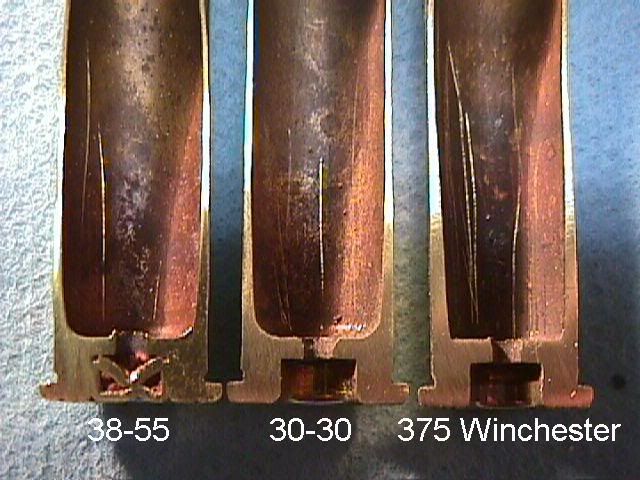
I don't know when the dies were changed. My dies, I got about 1975 (IIRC) and then when I got some new brass with my new .38-55 and went to load it discovered the cases were shorter than my CIL brass. RCBS told me only that the case dimension had changed "many years ago". HOWEVER, it seems that the chambers are still all cut to the original length. I think the current length is just to use the same cup as the .375 Winchester. The .375 Winchester being shorter has the brass in the case wall. The photo, courtesy of Norm Johnson, shows that there really is a diffence in case wall thickness.

Saturday, January 27, 2007

Daisy Model 40 "Defender"


This is just too cool. First, a member of leverguns posted about a BB gun Joe Salter has for sale. To sum up, here's his write-up...
This all metal lever action air gun has an overall plum brown patina with some minor pitting and original blue in protected areas. The full length wood stock is fair to good with minor marks and blemishes. The original cloth sling is still attached and in tact and the gun comes complete with the adjustable front sight blade as well as the socket bayonet. According to Neal Punchard in his work daisy air rifles and BB guns the slings are very difficult to find and the bayonets are rare and worth as much as or more than the rifle. See page 16 of the aforesaid work. This piece is working and with some TLC could be improved by the careful removal of the surface petina. The bayonets are very rare due ot the fact that they were often taken away from children and lost or thrown away. A scarce and seldom found BB rifle.
So, I'm poking around looking for articles on kids and guns or photos of kids with guns and I find this!  A boy all dressed up in what might be his dad's WWI uniform with his Daisy Model 40 Defender sans bayonet (I guess his parents didn't quite trust him either!) and standing proudly at right shoulder arms. What serendipity!

The source of the photo of the boy is this short biography of Major Bradley Van Deusen. I would like to thank the author, Mary P. Van Deusen for her marvelous site. All this came from a search and a comment about a BB gun...

WWI rallied Americans and businesses alike.  Daisy was no exception and quick to produce a military look-alike rifle designed by Charles Frederic Lefever, the Model 40 Defender, and marketed it to the "Future Defenders of America". They followed suit with their own model during WWII with the Model 140 Defender with the same type advertising campaign.  It was first produced in 1916 shortly before the United States officially became involved in the war.  The Model 40 Defender was a 50-shot lever-cocking model with a nearly full-length wooden stock.  This rifle also included a canvas sling and a rubber-tipped, metal bayonet.  Today, the slings are difficult to find.  The bayonets are also rare and worth as much - sometimes more - than the rifle itself.  Measuring 37-inches in length, the Model 40 Defender had a blued-metal finish.
The magazine has to be removed from the gun for loading. It holds 50 BBs under spring tension, so there is never a dry fire as there can sometimes be with gravity-feed. All the guns from 1913 to about 1930 had lead BB magazines for 0.175-diameter air rifle shot. When Daisy switched to steel BBs, the size was reduced to 0.171 to 0.173, and a new type of shot holder had to be installed in the magazine.

I believe the 40 used the same magazine system as the 140 so to load...
Place the gun in your left hand, grasping the barrel up by the muzzle; with your right hand, place your thumb and forefinger around the knurled rim of the shot tube and twist it counter-clockwise until it comes competely loose, extract the shot tube from the barrel shroud. Place the gun down carefully; grasp the shot tube , turning it around until you see a tab like device attached to a spring. Pull the tab down, and near the end of the shot tube you will see an opening opposite of the tab; load the tube with up to 50 BB's, reinsert into the muzzle and carefully turn the shot tube clockwise until it is firmly seated; sometimes you have to 'play' with it for awhile until it is firmly seated on the air tube cylinder that is at the bottom of the barrel. Now you are ready to cock the lever and away you go. As a safety precaution, make sure the gun is not cocked prior to attemping the removal of the shot tube; getting shot with a BB at close range is not exactly a pleasant experience.
- Daisy Air Rifles & BB Guns The First 100 Years by Neal Punchard