Everyone loves the Sharps rifles particularly the 1874 model which is all the rage when produced by Shiloh or C. Sharps. Mostly chambered in .45-70 or larger/longer cartridges burning blackpowder and weighing 8½ pounds and more, these guns are the darling of anachronistic hunters and BP silhouette competitors. Still, some wished for smaller lighter guns chambered for smaller cartridges with all the charm of the side-hammer breachloaders. Fortunately, one company had stepped into the "breach" so to speak.
Little Sharps Rifle Manufacturing Company has been producing such a gun for a bit now. However, the price has been, well, above the means of some desiring such a gun. $3250 is what they've been charging for their handmade 20% smaller version of the 1874 Sharps rifle. Now, they have an Italian made copy of their gun, at a much lower price point. Just the thing to be in the reach of "the rest of us" who can't or won't spend quite that much for the experience of shooting a smaller Sharps rifle. While the handmade version is available in many suitable cartridges, the Charles Daly version will initially be offered only in .38-55 and .45 Colt, two of the most, deservedly, popular cartridges they could have chosen. The price is right, too. $1229.00.
Links:
- Guns of the Old West article, "Son of a Sharps" by Ron Harris
- Charles Daily Little Sharps from Gunblast.Com
Tuesday, January 29, 2008

Friday, January 25, 2008
S&W 642 joins the family...
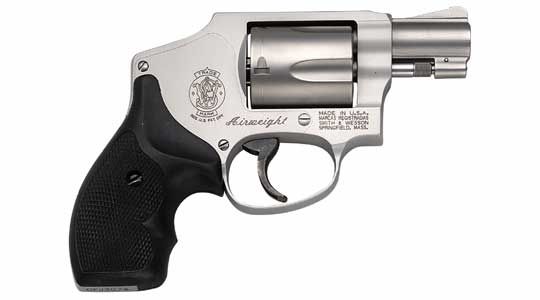 Oh, I can hear you now. Nobody is going to rob your store, nobody like that goes over there, nobody would do anything to hurt you, just give them the money, etc. Well, it is just the one person in the store. The store is isolated. There is no view from outside the store. Many of our items are high dollar, low risk to transfer, even on e-Bay. We are just off the interstate and there have been several (many for this area) robberies of hotels and such just off the interstate as opportunistic thieves get their traveling money. There are edged weapons in the store as part of the stock. I get a bit on "edge" every time I show bladed weapons to people I don't know, particularly the "odd" ones. Oh, yeah, every once in a while. But truth be told it isn't the "odd" ones that get you. So for me, it is more important to go home at the end of the day and, frankly, there isn't enough cash in there to bother with, most folks pay with plastic. It is all about going home to the wife.
Something had to be done. Oh, I already have a couple of .38 Special guns but my preference for the 3" barreled guns for shooting has left me without a gun that will drop in my pocket. I really needed such a gun for work which would allow me to be armed with no indication that I was. Additionally, I like all steel guns. Let's face it, those are a bit heavy for the pocket and will flat drag a bathrobe off (while out walking the dog), that can be embarassing and in more ways than one!
The above photo was taken from the S&W site for the 642. My gun is an older one without the lock. That was very important to me. I just don't see a need and don't need the complication.
 This gun also doesn't have the grip safety of the original Model 40 as shown in this S&W photo of the Model 40 Classic. This the gun I really wanted but, truth be known, only for my "collection" of J-frame S&Ws. However, this gun is heavier by 6 ounces (a lot in a pocket) just like any other all steel gun, and more expensive with an MSRP of $765, $236 more than the MSRP for my gun and $335 more than what I actually paid for my NEW revolver!
One thing I didn't like was the rubber grips. Not that they won't work. As you can see in the photo, these are shaped right to give one a good grip and handle recoil. But, when the gun is carried in a pocket, those things just grab cloth and make for problems. I switched those out for a pair of old wood S&W stocks from a M34-1 RB and a Tyler-T adapter. This combo looks good enough and works. One can now order a brushed aluminum adapter that will more closely match the finish on this gun.
The ammo, the only ammo, I intend to use is the 158 gr. lead hollowpoint "FBI" load. I've got a couple of boxes of the Winchester and Federal (discontinued) versions. I also provide a good copy with my handload of 5 gr. Unique under either the Hornady or Speer swaged 158 gr. lead hollowpoints.
 |
| My 642 |
Holster? Currently I've got a Simply Rugged Silverdollar Pancake and an old S&W leather shoulder holster but I find I'm just dropping it in my right front pants pocket either in the Silverdollar or not depending on the pocket. Rob Leahy also makes a pocket holster, a better solution, and I'm going to order one of those ASAP. The pocket holster will help break up the outline of the gun in a pocket and make certain it is properly oriented for a reasonably fast draw.
Why the 642? That is a good question. As I said, I've wanted either an original or new Classic Model 40 for a long time. These guns are compact, reasonably accurate, have a good reputation for quality and durability. The design beats the 49 or 649 Bodyguard (shown to the left) because the completely enclosed hammer of the Model 40 or 642 allows less lint and trash into the action. Such things are bad for a pocket gun.
 |
| 649 aka "Bodyguard" |
The big downside, for some at least, is that the gun must be fired double-action but that is exactly how one will be shooting when "stuff" happens. I don't see it as a downside unless I'm trying to hit a squirrel at 25 yards. I'll just have to see just how much practical accuracy I can wring from the gun but what I already know is that it is capable of dealing with 2-legged assailants at 30 feet or less. The gun is with me right now, at work, and I feel much better than I did with my .45 in the truck...
Saturday, January 19, 2008
AR-15s, aka "EBR" get yours NOW...
I know I'll be getting one again soon. I'm pretty much decided on a 1-7" twist barreled 5.56mm shooter and I'm going to have some 77 gr. quality handloads ready to go along with a low powered duplex reticle scope sight on the flat top with fold-em flat back up "iron" sights just in case... It will also have a short 16-and-some" barrel and telescoping buttstock (I'd prefer the old aluminum type). I'm only getting it for one reason...
In any case I'm researching parts suppliers. A friend has an upper from Lewis Machine and Tool. Sounds cool but if the upper works and it is a good barrel it will suit me.
Yesterday, I was over at Dominion Outdoors and saw that they had a few EBRs, specifically AR-15 variants/copies. Looked at them all including an Eagle Arms AR-10. Some money in the pocket and here comes the S&W MP-15, flat-top, folding sights, collapsable (albeit plastic) stock, 1-9 twist. And S&W has a promotion where you get one you can get a Sigma for $99 (about what they SHOULD cost!) $1099 for the rifle + $99 for the pistola + $59.90 tax for $1257.90 and the $2 NICS check.

I then went over the Nuckols' Gun Works and looked at theirs. They have a couple of Bushmasters including a short flattop with carry handle and 1-9 twist. Price was the same as for the MP-15 at Dominion. That's not bad for retail but I think one could do better and now I'm stuck on the 1-7 twist. I walked out with something else instead.
I'm thinking that whatever you do, now is the time to do it.
In any case I'm researching parts suppliers. A friend has an upper from Lewis Machine and Tool. Sounds cool but if the upper works and it is a good barrel it will suit me.
Yesterday, I was over at Dominion Outdoors and saw that they had a few EBRs, specifically AR-15 variants/copies. Looked at them all including an Eagle Arms AR-10. Some money in the pocket and here comes the S&W MP-15, flat-top, folding sights, collapsable (albeit plastic) stock, 1-9 twist. And S&W has a promotion where you get one you can get a Sigma for $99 (about what they SHOULD cost!) $1099 for the rifle + $99 for the pistola + $59.90 tax for $1257.90 and the $2 NICS check.
I then went over the Nuckols' Gun Works and looked at theirs. They have a couple of Bushmasters including a short flattop with carry handle and 1-9 twist. Price was the same as for the MP-15 at Dominion. That's not bad for retail but I think one could do better and now I'm stuck on the 1-7 twist. I walked out with something else instead.
I'm thinking that whatever you do, now is the time to do it.
Ok, Another Neat but SHORT One
I thought this one of the Colt firing was pretty good. I love these things...
Neat 1911 Animation
The parts are to blueprint specs. Pretty darn good modeling but some assembly misses the tricks to get things together in the real world. VERY NEAT so I thought I'd post it here.
Tuesday, January 08, 2008
January 7, 2007 CREDIT CARD PROCESSING COMPANY REJECTS FIREARMS INDUSTRY
REFUSES TO PROCESS TRANSACTIONS . . . Citi Merchant Services and First Data Corp. are refusing to process any credit card transactions between federally licensed firearms retailers, distributors and manufacturers -- a move which will severely limit available inventory of firearms and ammunition to military, law enforcement and law-abiding Americans.
The first company to be affected by this decision appears to be firearms distributor CDNN Sports Inc.
"We were contacted recently by First Data/Citi Merchant Services by a June Rivera-Mantilla stating that we were terminated and funds were being seized for selling firearms in a non-face-to-face transaction," said Charlie Crawford, president of CDNN Sports Inc. "Although perfectly legal, we were also informed that no transactions would be processed in the future, even for non-firearms. I find this very frightening."
To voice your concern to Citi Merchant Services and First Data Corp., please contact June Rivera-Mantilla at 631-683-7734 or her supervisor Robert Tenenbaum at 631-683-6570.
To change to an NSSF-affiliated credit card processing program, contact Payment Alliance International at 1-866-371-2273 (ext. 1131).

The first company to be affected by this decision appears to be firearms distributor CDNN Sports Inc.
"We were contacted recently by First Data/Citi Merchant Services by a June Rivera-Mantilla stating that we were terminated and funds were being seized for selling firearms in a non-face-to-face transaction," said Charlie Crawford, president of CDNN Sports Inc. "Although perfectly legal, we were also informed that no transactions would be processed in the future, even for non-firearms. I find this very frightening."
To voice your concern to Citi Merchant Services and First Data Corp., please contact June Rivera-Mantilla at 631-683-7734 or her supervisor Robert Tenenbaum at 631-683-6570.
To change to an NSSF-affiliated credit card processing program, contact Payment Alliance International at 1-866-371-2273 (ext. 1131).
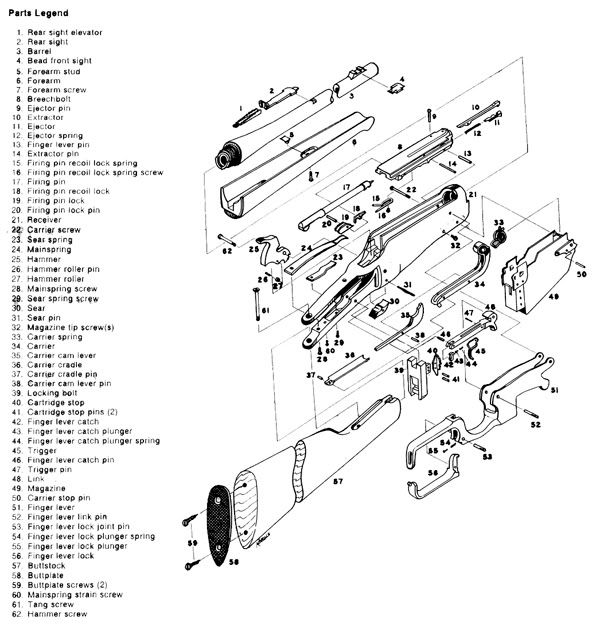
Browning 1895 .30-40 Rifle

Once upon a time I was a 10 year old enthralled by firearms of all types and the history they helped to make. One day, somehow, my dad got a copy of Bill Riviere's paperback on shooting, "The Gunners Bible". In that book was a photo of a customized Winchester M1895 in .30-40. Oh, that gun was to die for. Give me some cold rainy day when I was forced inside and I'd stare a that photo for hours dreaming of hunts for moose, elk and big bears. So this was a gun I'd wanted for a long, long time when money in my pocket finally corresponded to the availability of a new gun, made by Miroku in Japan for Browning in 1985 and in .30-40Krag (.30 US) to boot! What a thrill!
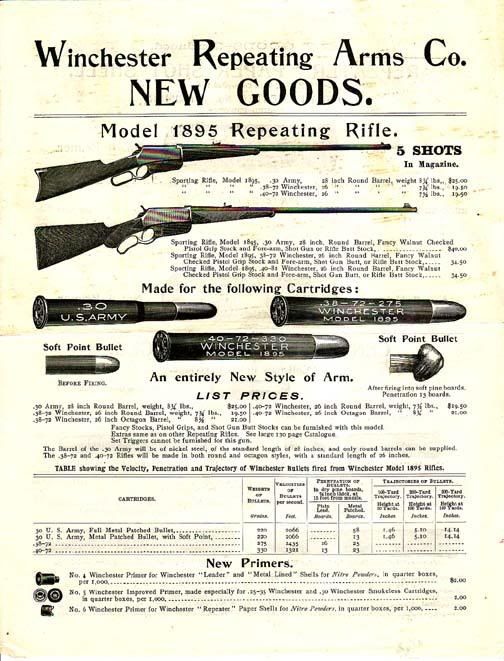 The Winchester 1895 was developed by John Browning for Winchester to load from a box magazine instead of a tube under the barrel. This allowed the Model 1895 to be chambered for military cartridges with spitzer (pointed) projectiles, and the rifle was used by the militaries of a number of nations including the US, Great Britain, and Imperial Russia. The Russian production models could also be loaded using charger clips, a feature not found on any other lever-action rifle. By far, the greatest numbers of the rifles were made for the Russian military. There were also produced in sporting rifle and saddle ring carbine versions. There were some famous users of the 1895 rifle of which the most well known would have been President Theodore Roosevelt. First, he carried one such rifle to Cuba which was chambered in .30 US. Later, both he and his son Kermit used the rifles chambered in .405 Winchester on his famous African safari. Ned Frost, a famous guide out of Cody, Wyoming, carried an 1895 SRC.
  My rifle is as we'd expect for a Browning gun. Well made and well finished. She is just beautiful if a bit plain. With her 24" barrel, she's a bit longer than any other levergun in my safe. Yes, she has that distinctive (and advantageous) box magazine "hanging" below the receiver and some will balk at that as an impediment to comfortable carry. However, I find that the rifle balances right at the forward edge of the magazine and so it functions to provide the stop that keeps the rifle slipping through the hand and is in no way as uncomfortable for single handed carry as one might imagine it to be. When shooting the gun is every bit the lovely siren I imagined she might be.
 The action is both smooth and tight with no rattling. Cartridges run through with little effort and, so far, no problems. Indeed, this action is about the smoothest of any of the famous Winchester levergun actions I've ever tried. Even new, it is slick and fast. Both round nose and spire point bullets are just the thing with neither providing problems of safety or in feeding. No problems in accuracy either! Groups of factory 180 SP ammo shoots into 2-3" at 100 yards with the issue open sights.
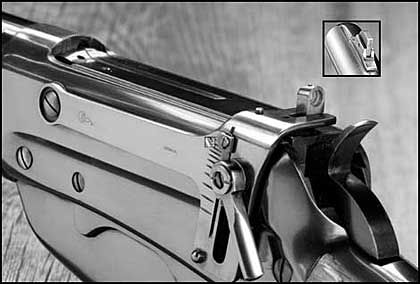 I expect that it will do some better after I get a good aperture sight such as the Lyman 38 reproduction I bought. Just need to get the gun to Jon Ritenour in Harrisonburg to drill and tap it for the one screw necessary to mounting. This sight promises to be both more traditional and to provide a greater range of elevation adjustment. That elevation adjustment might just come in handy with the wide range of bullet weights usable in the .30-40 cartridge. Mine came from a private seller who got this Ukrainian sight from Buffalo Arms. These sights are imported from the Ukraine and may not be currently available except from buyers who've not yet installed their sights.
 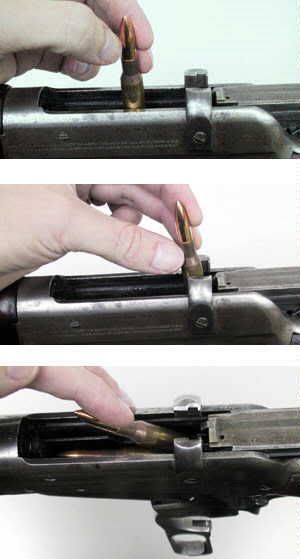 Loading of the 1895 action is obviously not done the same way as the tube fed leverguns but it isn't quite the same as other box magazine guns either. There's a particular methodology used that ensures proper feeding of rimmed cartridges from the box magazine by ensuring the rim of each cartridge is ahead of the following cartridge.
 Ammunition? What about the .30 US (aka .30-40 Krag), is it effective? To what more popular cartridges does it compare? Is it hard to load? These are the questions I often hear.
In fact, the .30 US (aka .30-40 Krag) is extremely similar to the .303 British cartridge in both case form and in ballistic performance. So too, when loaded with bullets of the same weight, it is ballistically similar to the .300 Savage and .308 Winchester.
Of course, then, it is very effective on most North American game. I might prefer something bigger for the great bears such as the Grizzly and Polar bears but for everything else it will do nicely. The cartridge is no more difficult to handload than any other cartridge as there are no issues with the brass whatsoever. Powders suitable for similar sized cartridges as noted above will work in the .30 US as well. Bullets suitable for this cartridge and the 1895 action are also numerous and available. Standard primers are all that are needed to light the fire.
Monday, January 07, 2008
Chaparral 1876 Ammo
Chaparral has released the specs for the ammo they will be importing for the 1876 rifles and carbines. Fingers crossed as to when it will come in...
Tuesday, January 01, 2008
Happy New Year!
I wish for all my friends and visitors many safe and happy days on the range, hunting, boating, fishing and with their children and grandchildren. And for those of you doing what I used to do, defending the United States and freedom all around the world, thank you. I live every day to earn this life you've given me.
Friday, December 28, 2007
CE Gunshow at Augusta Expoland in Fishersville, VA Tomorrow
There will be a gunshow tomorrow and I hope to be there at 1100. Look for the guy with the SpanAm haversack.
Monday, December 24, 2007
Lyman 457192A in hand
My newly made mold, Lyman 457192A, arrived today. I'm excited. Now the grease grooves aren't quite as big as I expected but we'll just have to see how she does. No, I haven't cast any yet, it only arrived about 25 minutes ago!
Thursday, December 20, 2007
.25 Stevens Rimfire
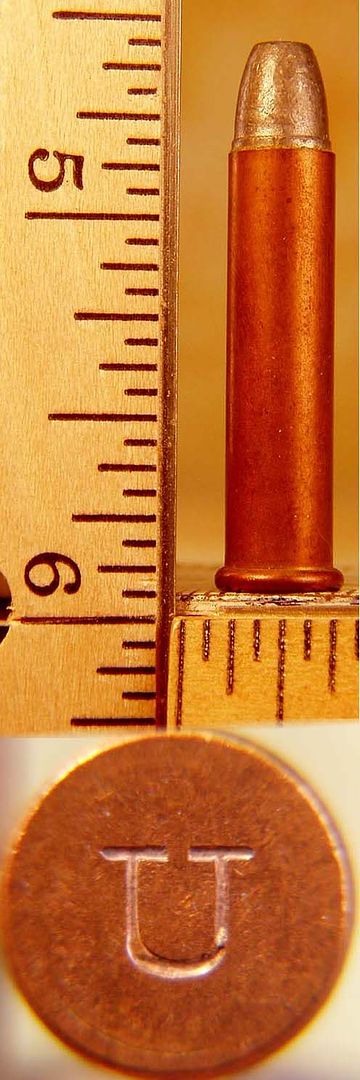 I remember reading Elmer Keith and his comments about the .25 Stevens (which I think he liked for small game). Recently I bought Rimfire Rifleman and in the back is a drawing of the .25 Stevens rimfire. That only served to excite me a bit and I started to do a little research.
It seems that most authorities agree that the .25 Stevens was introduced in 1900 despite some references which would seem to indicate 1890 or so. In any "case" this was a joint development of J. Stevens and Peters Cartridge. Stevens chambered the the "Crackshot" No. 15 and "Favorite" rifles for the cartridge. Remington and Winchester also chambered rifles for the cartridge.
The original load was a 67 gr. lead bullet over 10-11 gr. of blackpowder. Later loads were offered with both semi-smokeless and smokeless powders the later being used exclusively when the round was discontinued in 1942 (likely due to to the war). The inside lubricated bullet was offered in both solid and hollow point ersions. In response to the calls by many gun writers for a high velocity load, Remington reputedly did development work on an improved version, the .267 Remington Rimfire, with a rumored MV of 1400 fps with the 67 gr. bullet. Unfortunately, nothing came of it and with the introduction of the .22 WRFM, there was little need.
The cartridge had a very good reputation, even Elmer Keith liked it, on small game without ruining meat. The negatives were the relatively high cost and high trajectory.
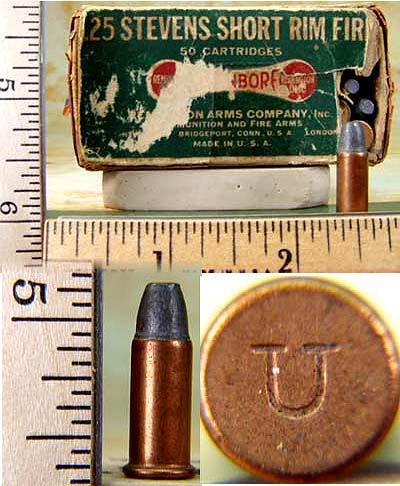 Of course, the high cost being a consideration, there was also a .25 Stevens Short which initially used 4.5-5 gr. of BP. It could be fired in any rifle chambered for the longer .25 Stevens.
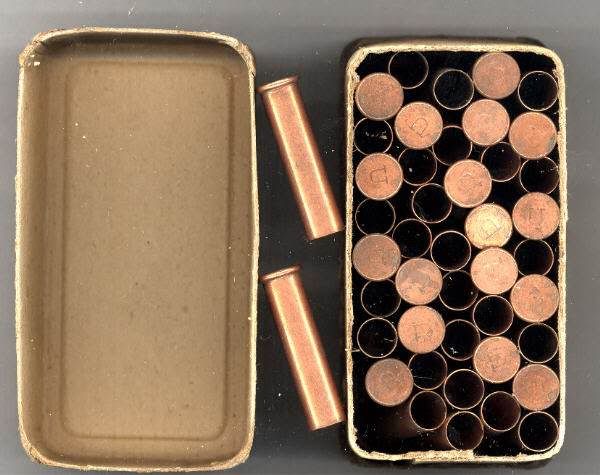
Interestingly, there were even empty primed cases offered. I'd like to read of actual experience(s) of those who used these and why. I know I've often read of shooters who wanted to try loading their own .22 WRFM or 5mm Remingtons. They almost always seem to believe that they could develope more accurate and effective loads if only they had the chance. Perhaps that was the reasoning here and the ammo company saw a chance to make a sale.
 This would be about an ideal small game cartridge, especially today. However, I'm not so unrealistic as to think that the tooling and marketing costs would be prohibitive. Certainly, no new rifles (other than custom conversions of exhisting guns) would be made. Even Contender couldn't be used because the bigger diameter of the rim moves the rim away from the firing pin. I do think that ammo could be sold for the existing guns then again, that may be the last vestige of my rifle loonie self hoping for the best that will never come. After all, if Elmer Keith couldn't make it happen...
Thursday, December 13, 2007
.308 Winchester Die Sets - Hard to get?
Well, that's what I've been told, that, ".308 Winchester die sets are hard to get," and "we can order some in." But they either aren't or they haven't because I just went on MidwayUSA and ordered the die set. Easy as pie and in stock. Must not be a high profit item...
Visit to "New" Local Gunshop
Dominion Outdoors of Stuarts Draft, VA finally moved to their new building near the interstate. They had their "grand opening" last weekend. I finally got to go over today.
First, it is a beautiful building. Everything is laid out neatly and displayed wonderfully. However, (and you knew this was coming) they must have had an illiterate rack the ammo as they have mixed up calibers and cartridges, mixed up handgun and surplus. They have no Accurate Arms powders, few die sets or little other reloading equipment. Oh they have lots of guns. But the prices, well, lets just say they have some moderately high prices. Archery? Yes, indeed they have archery equipment. I suggest that traditional archers save their gas though. Did I mention prices?
Well, the prices are just fine. After all they have prominently displayed advertising for a lending institution so that you can borrow money to pay for whatever you take out of there.
But it won't be me taking anything out the door. I noticed they have a lot of what they had before. By that I mean before the 4th of July. Not anything I want or need. Heck, they didn't even have a set of .308 Winchester dies... Now what's up with that?
First, it is a beautiful building. Everything is laid out neatly and displayed wonderfully. However, (and you knew this was coming) they must have had an illiterate rack the ammo as they have mixed up calibers and cartridges, mixed up handgun and surplus. They have no Accurate Arms powders, few die sets or little other reloading equipment. Oh they have lots of guns. But the prices, well, lets just say they have some moderately high prices. Archery? Yes, indeed they have archery equipment. I suggest that traditional archers save their gas though. Did I mention prices?
Well, the prices are just fine. After all they have prominently displayed advertising for a lending institution so that you can borrow money to pay for whatever you take out of there.
But it won't be me taking anything out the door. I noticed they have a lot of what they had before. By that I mean before the 4th of July. Not anything I want or need. Heck, they didn't even have a set of .308 Winchester dies... Now what's up with that?
Wednesday, December 12, 2007
Thoughts on Reloading the 1876 .45-75 - Smokeless Powder Suitability
There is some controversy about using smokeless powders for loading the .45-75 Winchester cartridge, at least when used in the 1876 rifle. No less authorities than Mike Venturino and Dan Phariss have written and/or spoken out against the practice. Yet, loading "data" has been presented in Cartridges of the World and Ten-X and Buffalo Arms are producing ammunition loaded with smokeless powder(s). Owning a .45-75 in a reproduction Winchester 1876 Saddle Ring Carbine (SRC) this is a subject that naturally interests me.
Let us start by saying that the intent is not to exceed black powder cartridge velocities. As I will no doubt repeat later, somebody will want to "improve" velocities but that is not my intent.
One of the major arguments held by many shooters is along the lines of "why anyone would want to shoot anything but BP as in originals?" This argument has two basis. One is the historical accuracy, i.e. the reason for shooting these old guns and their reproductions, is compromised by using smokeless powders. Another is that there appears to be some sort of cachet attached to the use of black powder as if it is more manly (for want of a better word) to use the "real" thing. I frankly think that these "arguments" are inconsequential. Not all shooters of these guns are wedded to living history. Not everyone has reliving their forefathers' lives as a priority. Not all shooters' egos are threatened by using smokeless powder in lieu of "holy" black powder. There are shooters, perhaps a majority, who feel that at least some use of smokeless in their guns is a practical consideration.
While one correspondent felt that anyone could order black powder in quantities as small as 5 lbs and that therefor there was no "excuse" for using smokeless I have to believe he was wrong. There are shooters or possible shooters of these guns who live where possession of black powder is prohibitive for one reason or another. In as much as these cartridges must be reloaded, smokeless is the only other option.
I know that Mr. Venturino has mentioned in his writing that he felt that black powder was safer in the original guns. I sort of feel the same way but we have to realize that the Winchester factory produced smokeless loads for many of these cartridges and were using earlier powders with which they had less experience. None of those cartridges are known to have destroyed guns. Still, those old guns are now no less than 118 years old and the steels used are perhaps not in good condition for containing even black powder. Indeed, many of them have been used hard over that period of time. That does not apply to the reproductions as they are both newly made and constructed of well developed steels with which we have much experience. Yet another concern is that there is no hard data for these cartridges in these rifles. Certainly that is a concern. There will inevitably be some yahoo who will try to get just a bit more velocity out of his gun and use a powder or charge which is unsuitable. Likely, too, is that eventually some reloader will make a mistake and drastically overload a cartridge. Of course, these things happen now with smokeless in "modern" arms.
A corollary to this is the argument that one voids the warranty on your gun if you shoot these reloads. Interestingly, this is true of nearly every firearm for which we reload and that is not considered a impediment to reloading those cartridges in those guns.
Some of the concern about smokeless powders seems to be a concern that the pressure curve of smokeless powders will more highly stress the gun than the pressure curve of black powder. The idea is that the smokeless powder pressure will spike more quickly thus imparting an especially severe shock to the firearm. This contrasts with the seeming lack of concern for the pressure curve of the black powder substitutes such as Pyrodex or Triple Seven (often referred to as 777). One correspondent, John Kort, had this to say:
Even Mr. Venturino in the October 2006 Guns Magazine article "Cimarron's centennial model: at last! The Winchester 1876 .45-60 is reborn. Cowboy action shooters get a 10-shot bio-bore repeater" said,
Another comment was made by a restorer of these and other old guns. Known as Colt1849 on the Leverguns.com forum, he had this to say:
As to the discussion and consideration of smokeless powders in the .45-75 Winchester 1876 reproductions, I'm sure it will continue, by naysayers and supporters alike.
Links:
- A (Very) Short Course in Internal Ballistics
Let us start by saying that the intent is not to exceed black powder cartridge velocities. As I will no doubt repeat later, somebody will want to "improve" velocities but that is not my intent.
One of the major arguments held by many shooters is along the lines of "why anyone would want to shoot anything but BP as in originals?" This argument has two basis. One is the historical accuracy, i.e. the reason for shooting these old guns and their reproductions, is compromised by using smokeless powders. Another is that there appears to be some sort of cachet attached to the use of black powder as if it is more manly (for want of a better word) to use the "real" thing. I frankly think that these "arguments" are inconsequential. Not all shooters of these guns are wedded to living history. Not everyone has reliving their forefathers' lives as a priority. Not all shooters' egos are threatened by using smokeless powder in lieu of "holy" black powder. There are shooters, perhaps a majority, who feel that at least some use of smokeless in their guns is a practical consideration.
While one correspondent felt that anyone could order black powder in quantities as small as 5 lbs and that therefor there was no "excuse" for using smokeless I have to believe he was wrong. There are shooters or possible shooters of these guns who live where possession of black powder is prohibitive for one reason or another. In as much as these cartridges must be reloaded, smokeless is the only other option.
I know that Mr. Venturino has mentioned in his writing that he felt that black powder was safer in the original guns. I sort of feel the same way but we have to realize that the Winchester factory produced smokeless loads for many of these cartridges and were using earlier powders with which they had less experience. None of those cartridges are known to have destroyed guns. Still, those old guns are now no less than 118 years old and the steels used are perhaps not in good condition for containing even black powder. Indeed, many of them have been used hard over that period of time. That does not apply to the reproductions as they are both newly made and constructed of well developed steels with which we have much experience. Yet another concern is that there is no hard data for these cartridges in these rifles. Certainly that is a concern. There will inevitably be some yahoo who will try to get just a bit more velocity out of his gun and use a powder or charge which is unsuitable. Likely, too, is that eventually some reloader will make a mistake and drastically overload a cartridge. Of course, these things happen now with smokeless in "modern" arms.
A corollary to this is the argument that one voids the warranty on your gun if you shoot these reloads. Interestingly, this is true of nearly every firearm for which we reload and that is not considered a impediment to reloading those cartridges in those guns.
Some of the concern about smokeless powders seems to be a concern that the pressure curve of smokeless powders will more highly stress the gun than the pressure curve of black powder. The idea is that the smokeless powder pressure will spike more quickly thus imparting an especially severe shock to the firearm. This contrasts with the seeming lack of concern for the pressure curve of the black powder substitutes such as Pyrodex or Triple Seven (often referred to as 777). One correspondent, John Kort, had this to say:
Regarding smokeless in toggle link actions, let’s take a look at the Winchester 1873 first. The truth is, that Winchester introduced smokeless ammunition for use in the 1873 Winchester rifle beginning way back in 1895. I have yet to hear of a ’73 rifle that failed using factory smokeless ammunition.
The powder that Winchester initially used for their 1873 cartridges was DuPont No. 2 Bulk smokeless which is similar in burning rate to today’s 4227. Shortly after 1900, they switched to “Sharpshooter” which was initially produced by Laflin & Rand, then DuPont and finally Hercules. Smokeless cartridges for the ’73 used this powder up until the 1950’s. It’s burning rate is similar to today’s 2400.
Note: Alliant has published smokeless data for the .44-40 with no disclaimer that it shouldn’t be used in a ’73 Winchester rifle.
I have a ’73 Winchester that was made in 1882. I shoot both smokeless and b.p. ammunition in it. To date, it’s hammer has dropped on about 2,500 hand loaded smokeless and 1,000 b.p. cartridges. Smokeless cartridges were loaded with slower burning 4227 which were pressure tested at a ballistics lab and produced pressures within the SAMMI MAP (max average pressure) specifications for the .44-40. It’s still working great.
Now on to the ’76.Winchester began their development of smokeless ammunition for b.p. cartridges in the late 1893-1894 time period. They started introducing these types of smokeless cartridges in late 1894 and development continued over the next few years until all the smokeless b.p rounds were complete….all, that is, except for the ’76 cartridges.
Why? Well, unfortunately, by that time, the ’76 had pretty much run it’s course, so there was no effort made to develop smokeless cartridges for it. The one exception was the .50-95, which was offered in a smokeless version for a short period of time before 1900.
Until such time as there is empirical data for smokeless powder taken in a ballistic lab for the ’76 cartridges, users, unfortunately are on their own.
Some folks have interpolated data from the .45-70, of which there is data generated in ballistic laboratories for lower pressure smokeless loads. Stepping back to the late 1800’s…initially, DuPont No. 1 bulk smokeless was used in factory smokeless cartridges. Under a 400 gr. bullet, the charge weight was 28 grs. and was indicated to produce velocities and pressures similar to 70 grs. of black. DuPont No. 1 was similar in burning rate to 4198. Thus, the 40% rule was born (28/70). In other words, as a rule of thumb, with 4198, use a charge that is 40% of the charge weight of b.p.
Let’s see how that works out.
The Lyman ballistic laboratory recorded the following .45-70 loads for velocity and pressure. The similarity is remarkable!
From the Lyman Cast Bullet Handbook:
Bullet weight: 420 grs.
70.0 grs./ FFG / 1,268 f.p.s. / 16,400 C.U.P.
28.5 grs./ 4198 / 1,267 f.p.s. / 13,900 C.U.P.
Interesting that less pressure was produced with the smokeless load.
Even Mr. Venturino in the October 2006 Guns Magazine article "Cimarron's centennial model: at last! The Winchester 1876 .45-60 is reborn. Cowboy action shooters get a 10-shot bio-bore repeater" said,
...if you use some commonsense, there is no reason they can't be fired with proper smokeless powder handloads. Because of their toggle-link breech-locking system these new Model 1876s still are not strong rifles, but shooting smokeless powders in them with loads duplicating black powder velocities and pressures will be no problem.and
So how do you go about coming up with a smokeless powder load for a cartridge like the .45-60, for which no recognized reloading manual offers data? First, I looked up the ballistics of original black powder .45-60 factory loads. A reprint of an 1899 Winchester catalog said from a Model 1885 Winchester Single Shot rifle with 30" barrel the .45-60 s 300-grain bullet should be doing 1,271 fps. They also said such a load would penetrate 11 1/2 pine boards of 1" thickness at 15.but he also says about the old iron-framed guns
My pick of smokeless powder for reloading almost all antique and/or obsolete big-bore rifle cartridges with lead alloy bullets is Accurate's 5744. Therefore, I began working with it and the RCBS bullet. When a charge weight of 24 grains was reached, the 28" barrel of the new Model 1876 gave a velocity of 1,267 fps. I figured that was right on the money and started shooting on paper with that charge and both RCBS and Oregon Trail bullets.
Since originals are so old, and most of their receivers likely forged of iron instead of steel, I recommend they only be fired with black powder ammunition.Clearly, Mr. Venturino has taken a reasoned and balanced approach to the question. Can we not do the same?
Another comment was made by a restorer of these and other old guns. Known as Colt1849 on the Leverguns.com forum, he had this to say:
Had the opportunity to look at a Winchester 1876 that had a serious over charge of smokeless shot through it, causing a complete separation of the case and head. Barrel right at the chamber area was blown out at the bottom, about 3 inches of the bottom half of the barrel was in pieces. This caused a secondary detonation of the cartridge in the mag tube. Mag tube had a “banana peel” split the first few inches, then split along the top seam for about 6 inches. Forend was completely shattered, what remained was toothpicks. Frame had split & expanded in the barrel threaded area to almost the lifter area. What did surprise me as that the links held with no measurable distortion or damage.
Understand that the shooter walked away from this mishap. Someone turned a $4000 gun into scrap very quickly.
Let's return to this concept of pressure "spikes", i.e. a rapid peaking pressure curve. There is a belief that this spike increases breach thrust and thus strains the weak toggle link system. However, I can't see that the pressure maximum, aka spike, if lower (as John mentions above) can create greater shock to the system. That simply makes no sense particularly when we compare one cartridge to itself on the same system. The idea that the more rapidly rising pressure increases the case head velocity in creating breach thrust doesn't bear out on other systems. E.g. in the Contender system, breach thrust is widely held to be important and frames can be stretched. Yet, when chambered for cartridges such as the .50-70 use of smokeless powder is considered no different than the use of black powder. It is the peak pressure that matters, not the pressure curve.
Case body taper does have an effect on breach thrust, we can see this in various cartridges such as the .22 Jet or .25-35 Winchester. Yet, we are comparing one case, one pressure maximum, in one system. If we look at a max pressure of 18K CUP, how does the pressure curve affect the breach thrust?
So what powders are appropriate? John Kort recommends using nothing faster than 2400 and I have to say that I agree. Indeed, you'll not see data using such powders in cartridges of similar capacity. I also prefer loading density approaching 100% as closely as possible (as I do for all cartridges) but at least exceeding 50%. I am not a fan of fillers of any type. So what powders does that give us? Well, clearly we can follow Mr. Venturino's lead of using AA5744 and the tried and true substitute of IMR or Hodgdon 4198 (H4198 is actually slightly slower than the IMR product). Also long used is the very bulky IMR SR 4759. However, I will leave the details for the loading table.As to the discussion and consideration of smokeless powders in the .45-75 Winchester 1876 reproductions, I'm sure it will continue, by naysayers and supporters alike.
Links:
- A (Very) Short Course in Internal Ballistics
Subscribe to:
Posts (Atom)


