The Stonewall Rifle and Pistol Club had a "Varmint" shoot this Sunday. Actually a centerfire benchrest competition with rifles shooting targets from 100 to 300 yards distant and pistols firing at targets at 50 and 100 yards, this competition brought out 23 competitors and 29 entries in the various classes.
I only shoot the pistol class using a 10" .223 Remington barrel with a Burris scope set at 9-power (the allowable limit according to the rules). My current load is the Hornady flat base 53 grain match bullet (discontinued) over 20 grains of H4198 lit by CCI small rifle primers in Hornady brass. It is really challenging to see the targets even at 100 yards so that one can correctly place the bullets for maximum score. I was very pleased to increase my score by 25 points from the last match. However, I was not very close to the #1 and 2 in the match.
Showing posts with label Handguns. Show all posts
Showing posts with label Handguns. Show all posts
Monday, July 18, 2016

Tuesday, May 31, 2016
Notes from the range...
This past Sunday I shot a varmint pistol course at Stonewall Rifle Pistol Club. This is some sort of pistol, no more than 9-power telescopic sight, off a rest, at 50 and 100 yards. It was interesting in that:
- I did not prepare but used some loads that I'd loaded for the 21" Contender barrel some years ago
- I was able be zeroed at 50-yards in 4-shots.
- I was hanging in there after the first card at 50-yards
- I was not adequately careful with my 10" barrel on the rest and let it come back too far and it opened up the bag on which the forearm was resting. That shot was a zero and the deconstructed bag probably cost me placing in the match.
- I have already come up with a better rest solution that will prevent a repeat of this act.
If you are open to learning every experience can offer a lesson to learn. I learned something here.
On Monday Nana said I should go to the range so I did. I am going to reiterate that one has to experiment with rimfire guns to find ammunition that is reliable AND accurate. The SIG Sauer 938-22 greatly preferred the Winchester bulk hollow-points that you find in the 333 and 555 boxes to the Federal round-nose equivalent.
- I did not prepare but used some loads that I'd loaded for the 21" Contender barrel some years ago
- I was able be zeroed at 50-yards in 4-shots.
- I was hanging in there after the first card at 50-yards
- I was not adequately careful with my 10" barrel on the rest and let it come back too far and it opened up the bag on which the forearm was resting. That shot was a zero and the deconstructed bag probably cost me placing in the match.
- I have already come up with a better rest solution that will prevent a repeat of this act.
If you are open to learning every experience can offer a lesson to learn. I learned something here.
On Monday Nana said I should go to the range so I did. I am going to reiterate that one has to experiment with rimfire guns to find ammunition that is reliable AND accurate. The SIG Sauer 938-22 greatly preferred the Winchester bulk hollow-points that you find in the 333 and 555 boxes to the Federal round-nose equivalent.
Thursday, October 08, 2015
.327 Federal in the Single-Seven
Last year I bought a Lipsey's Special, Single-Seven Ruger in .327 Federal. This 7-shot gun is based on the frame of Ruger's long popular Single-Six .22 rimfire. The cylinder window dimensions have been slightly enlarged and the cylinder dimensions likewise increased to fill the window which permits the chambering of 7 of the .32 caliber cartridges and handling the pressures those cartridges will generate.
Factory ammunition available since my purchase has been limited to the Federal American Eagle loaded with 85 and 100 grain soft-nosed bullets. While these two bullets are of different weight, the design for both seems to be the same and one can't tell the difference by simply looking at a loaded cartridge. This hasn't proven to be as accurate as I think the pistol should be and so I decided to load a known quality bullet, the Hornady 100 gr. XTP.
So, I think I can still shoot alright but the gun is just not going to group worth a fig. I did not want a cast bullet gun and I suspect it will be a pain to find a mold to cast a bullet big enough in diameter to work with the cylinder and bore.
Factory ammunition available since my purchase has been limited to the Federal American Eagle loaded with 85 and 100 grain soft-nosed bullets. While these two bullets are of different weight, the design for both seems to be the same and one can't tell the difference by simply looking at a loaded cartridge. This hasn't proven to be as accurate as I think the pistol should be and so I decided to load a known quality bullet, the Hornady 100 gr. XTP.
| Bullet | Powder | Powder Charge | Muzzle Velocity | Muzzle Energy |
| Hornady 100 gr. XTP | AA-7 | 9.4 gr. | 1462 fps | Muzzle Energy |
| Hornady 100 gr. XTP | AA-9 | 13.0 gr. | 1572 fps | Muzzle Energy |
| Hornady 100 gr. XTP | 2400 | 11.5 gr. | 1405 fps | Muzzle Energy |
| Hornady 100 gr. XTP | H110 | 13.5 gr. | 1525 fps | Muzzle Energy |
| Hornady 100 gr. XTP | Longshot | 6.7 gr. | 1402 fps | Muzzle Energy |
 |
| However, the gun wasn't shooting well and so I sent it back to Ruger who did some work and returned it within a week. This first is the test target they sent with the invoice. They shot this test at 15-yards. |
 |
| Today, I shot the gun with the Federal factory 100-grain bullet load. This is what 3 cylinders full looks like after being shot at 25-yards. |
 |
| I also shot some of my reload of the 100-grain XTP over 9.4-grains of AA-7. This is that target. |
 |
| Needless to say I was not happy. Is my eyesight to blame? Can I not shoot today? Poor trigger management? Had it with me so I got out my Garthwaite CCO and 5 magazines (6-7 rounds each) of mixed brand "white-box" ball. This is that target. |
So, I think I can still shoot alright but the gun is just not going to group worth a fig. I did not want a cast bullet gun and I suspect it will be a pain to find a mold to cast a bullet big enough in diameter to work with the cylinder and bore.
Thursday, September 24, 2015
Single-Seven and Ruger's customer service
Wrote Ruger about the problems with the Single-Seven and got a quick response. Called as instructed and got an RMA number and shipping label e-mailed to me. Sent the revolver back on Tuesday afternoon. Ruger says 2-3 week turn-around. So far they have lived up to their reputation for wonderful customer service. Not every mass produced item is going to be perfect. I'm optimistic about this and will note progress as it occurs.
Thursday, September 17, 2015
Range day...
 |
| 14 shots at 25-yards, 100 gr. Federal load |
When I first shot it I had nothing but Federal factory 85 gr. bulleted ammunition and was later able to get some of the 100 gr. bulleted ammunition. Both bullets are flat-nose soft-points (jacketed) and look the same while in the case but the 85 gr is obviously a bit shorter. Some cases seemed to be a bit fat near the case head and didn't chamber easily but now I am convinced that one must precisely locate the cylinder to avoid the rim rubbing on the side of the loading cut in the recoil shield. That is not too great a difficulty to prevent me from liking the gun, but...
I noticed with both loads that it seemed there would be 6 or 7 different groups on the target. I am not an "expert" shot but I can usually kill squirrels with pistols at up to 25-yards despite the inevitable vision changes that come with old age and I have to ask, how can I get 6-7 different groups if I can't shoot the gun well enough to get the one group one would expect? I thought perhaps that the chambers differed significantly from one another.
You can see those differences in a couple of ways aside from the 6-7 different groups. One way is in the burn marks on the front of the cylinder. Because of the size of the cylinder and the quantity of gas produced by the cartridge one has distinctive burn marks on the side of the cylinder by each chamber where some gas is directed down the side of the cylinder by the top strap. This is likely where the "spitting" is mostly originating. I don't know if this is avoidable or not but in any case the patterns of these burn marks are different for each chamber and the larger marks come from those chambers with the apparently largest throats.
Yes, those throat dimensions differ for each chamber. I don't have a set of plug gauges, the ideal way to check this out, but I do have a variety of bullets intended for this cartridge and/or its .32 caliber brethren (.32 S&W, .32 S&W Long, .32 HR, and .32-20). I tried the "drop test" in that I took each of those bullets, measured them with my dial calipers (after ensuring they were properly calibrated) and found that there were 2 chambers whose throats were considerably tighter than the other 7. These 2 chambers also had the smallest burn marks on the side of the cylinder. Both the Speer and Hornady 100 gr. bullets marked .312" and measuring .3115-.3112" dropped all the way through every throat but for those two chambers. I was a bit surprised that cast bullets of the same dimensions did not and don't know why this is so but suspect the lube gripped the throats just enough to prevent their passing. The barrel throat does not permit these same bullets to get so far as to pass the ogive.
That's not the only problem with this gun though. Sometimes, especially immediately after shooting, the action will not cycle. My impression is that something has been knocked out of kilter inside. My first thought was that fired primers were dragging on the recoil shield or that the case head itself had hung up on one of the slight hole edges in the recoil shield. However, I was able to duplicate this "freezing" or "locking up" of the action with an empty chamber even without the cylinder installed.
So, what to do? Well, the gun was bought new, has not been altered, has never had other than factory ammo fired in it and it isn't good enough so it is going back to Ruger. It won't be fired again until it comes back from them.
Thursday, September 03, 2015
Range day...
Back to the range this afternoon with the M1 rifle. Easy to stay on a 1/2 silhouette at 100 yards with some loads grouping into ragged silver dollar sized groups. Was able to shoot another 1½-inch group with the .223 10-inch Contender. Took the new Contender with 10-inch .22 LR barrel and even did pretty well with it at 100 yards shooting a 3-inch group with the scope set at 4-power. All shooting with of the .22 LR was done with Winchester PowerPoint ammo. Easy to keep on a squirrel head out to 50-yards.
I am going to switch from H4895 to IMR 4064 for the M1, .30-06 loads. Both versions of 4895 being more difficult to get right now I'd rather save what I have for other cartridges.
We had a bit of a thundershower but while we listened to and watched the fireworks for about 30-minutes we only had about 5-10 minutes of rain and not really enough to wet anything.
I am going to switch from H4895 to IMR 4064 for the M1, .30-06 loads. Both versions of 4895 being more difficult to get right now I'd rather save what I have for other cartridges.
We had a bit of a thundershower but while we listened to and watched the fireworks for about 30-minutes we only had about 5-10 minutes of rain and not really enough to wet anything.
Saturday, August 29, 2015
Another Contender...
Picked up the $310 Contender. Got the Weaver 92A base, Z-rings, Weaver 1.5-4X scope and mounted same after removing Aimpoint Mark III and base. I don't know why the previous owner felt the need on a .22 LR barrel, but he drilled and tapped it for the forward screws on the base even though he had the rear 4 on the Contender barrel. Anyway, I put in some filler screws. Shot some Aguila Colibri in it. Quiet enough that the wife and dog didn't pay any attention to it 20 feet away from them on the other side of the closed basement door. I now have an understudy barrel for the BR/Varmint pistol AND another frame for Contender carbines.
Friday, August 28, 2015
Range day...
Color me green, with envy.
Today I drove out to the range for the Thursday follies and stopped along the way, about 3 miles from the range, at a friend/co-workers house to drop off some bullets he'd been looking for but couldn't find. I pulled up and he stuck his head out of his "shop" to welcome me.
Now "shop" to describe this place of nirvana is totally inadequate but I am sure it meets the need of maintaining operational security. It is a typical old (about 1940-1950 vintage) outbuilding/garage measuring about 14x18 feet. It now has a period built standard 36" door. Stepping inside is a trip to a shooter's man cave dream world. Just inside to the right is a small wood stove. Behind that is a flat screen TV. Directly in front of the door facing the TV is a nice comfortable looking green easy chair. To the left is some shelving with the first of various shooting paraphernalia. Between the rafters, pasted to the bottom of the "attic" floor are targets and between some of the rafters shelves have been placed on which boxes of bullets have been carefully stacked. A HUGE Ft Knox gun safe takes pride of place along the left wall while on the right is a work bench with a neat little drill press, vices, tool boxes and so forth. Along the back wall is the loading bench with a double hung window just above it. To the right between the work bench and the loading bench are shelves filled with powder, loaded ammo and dies, on the left wall between the safe and loading bench are hung hunting clothes, and other stuff we all seem to accumulate.
I've always wanted such a place and have a very poor facsimile in my basement. My friend doesn't think he's rich but it seems to me that he is very well off indeed.
Time at the range was pretty good. There were already 2 others there shooting varmint rifles. I shot my M1 rifle at 100 yards. I was principally interested in the different points of impact for various loads out of various sorted cases. A clip of ball ammo drifted across the middle of the target roughly centered on the point of aim. The 8-rounds 155 gr. Sierra HPBT Match bullet over 46 gr. of H4895 cut a ragged just left of the point of aim with a group of about 1½-inches total. The rest of the ammo, loaded in Lake City, RP and Winchester brass using the Sierra 150 gr. HPBT Match over 47 gr. of H4895 made a pattern of about 5-inches total diameter centered about 4-inches above point of aim. Since the goal is to use the same point of aim for both factory ball and my reloads I think I'll be reducing the powder charge to 46 gr. of 4895 for my test. However, I've been really going through the H4895 and have about 9 lbs of IMR-4895 to use so may also switch to that. I have lots of brass to load and will likely need at least one more .30-cal ammo can in which to put up clipped reloads.
Shooting the 10" .223 Contender is improving. The load is 20 gr. H4198 under the 52 gr. Hornady HPFB Match (2250). This flat base bullet has been discontinued but it seems to be a good one. I have improved to the point that I can consistently shoot 5-shot groups of about 3" with some half that. I find it difficult to use the long eye relief scope and am still learning how to hold the gun on the bags for maximum steadiness.
I did make a Gunbroker purchase of a used Contender with a 10" .22 LR barrel and intend to use the rimfire barrel to practice more but I haven't received the barrel yet despite having delivered the MO and FFL last Thursday. THAT is a bit of a bummer.
Today I drove out to the range for the Thursday follies and stopped along the way, about 3 miles from the range, at a friend/co-workers house to drop off some bullets he'd been looking for but couldn't find. I pulled up and he stuck his head out of his "shop" to welcome me.
Now "shop" to describe this place of nirvana is totally inadequate but I am sure it meets the need of maintaining operational security. It is a typical old (about 1940-1950 vintage) outbuilding/garage measuring about 14x18 feet. It now has a period built standard 36" door. Stepping inside is a trip to a shooter's man cave dream world. Just inside to the right is a small wood stove. Behind that is a flat screen TV. Directly in front of the door facing the TV is a nice comfortable looking green easy chair. To the left is some shelving with the first of various shooting paraphernalia. Between the rafters, pasted to the bottom of the "attic" floor are targets and between some of the rafters shelves have been placed on which boxes of bullets have been carefully stacked. A HUGE Ft Knox gun safe takes pride of place along the left wall while on the right is a work bench with a neat little drill press, vices, tool boxes and so forth. Along the back wall is the loading bench with a double hung window just above it. To the right between the work bench and the loading bench are shelves filled with powder, loaded ammo and dies, on the left wall between the safe and loading bench are hung hunting clothes, and other stuff we all seem to accumulate.
I've always wanted such a place and have a very poor facsimile in my basement. My friend doesn't think he's rich but it seems to me that he is very well off indeed.
Time at the range was pretty good. There were already 2 others there shooting varmint rifles. I shot my M1 rifle at 100 yards. I was principally interested in the different points of impact for various loads out of various sorted cases. A clip of ball ammo drifted across the middle of the target roughly centered on the point of aim. The 8-rounds 155 gr. Sierra HPBT Match bullet over 46 gr. of H4895 cut a ragged just left of the point of aim with a group of about 1½-inches total. The rest of the ammo, loaded in Lake City, RP and Winchester brass using the Sierra 150 gr. HPBT Match over 47 gr. of H4895 made a pattern of about 5-inches total diameter centered about 4-inches above point of aim. Since the goal is to use the same point of aim for both factory ball and my reloads I think I'll be reducing the powder charge to 46 gr. of 4895 for my test. However, I've been really going through the H4895 and have about 9 lbs of IMR-4895 to use so may also switch to that. I have lots of brass to load and will likely need at least one more .30-cal ammo can in which to put up clipped reloads.
Shooting the 10" .223 Contender is improving. The load is 20 gr. H4198 under the 52 gr. Hornady HPFB Match (2250). This flat base bullet has been discontinued but it seems to be a good one. I have improved to the point that I can consistently shoot 5-shot groups of about 3" with some half that. I find it difficult to use the long eye relief scope and am still learning how to hold the gun on the bags for maximum steadiness.
I did make a Gunbroker purchase of a used Contender with a 10" .22 LR barrel and intend to use the rimfire barrel to practice more but I haven't received the barrel yet despite having delivered the MO and FFL last Thursday. THAT is a bit of a bummer.
Thursday, July 23, 2015
Range day...
Range day was interesting. Got reminded of something I knew (that loads worked up on one Contender frame MIGHT need to be shot on that frame or maybe the headspace will be wrong and they won't fire), saw my new Fowler target cratered by a .243 Ackley (70 gr. HP at almost 4000 fps), and remembered that my old 7mm TCU 10" was probably last shot at 50, not 100 yards... I did take a couple of photos of the cratered plate. I have to download the photos and the other computer where I do that is giving me fits. That 7mm TCU was shooting about 4" high. The .30 Herrett really shot well once I moved it to the correct frame which also required moving the butt stock since one frame was set up for the 10". Neat that you can do all that at the bench with no more tools than the one TC tool. The 7mm TCU didn't kick too much but I bet this .223 barrel kicks some less. The new scope should be here by Monday (might already be at the store) and we'll see where we stand.
Thursday, June 18, 2015
Range day...
It was a short range day today. Took the FT Ruger .45 with the ACP cylinder installed and shot up a box of 50 rounds of ACP loaded with 7 gr. Unique under the 200 gr. Hornady Combat Match semi-wadcutter bullet. This stuff was loaded many years ago for the Combat Commander. As expected it shot low as the gun was zeroed for the 255 gr at about 1000 fps. However, I was surprised at how low it shot. The load did group well though.
I also shot the adjustable sight Bearcat. It seemed zeroed for 25 yards as well but each chamber seemed to have its own group. 18 shots fired and there were 6 distinct 3-shot groups. Interesting.
Didn't have much time to do more.
I also shot the adjustable sight Bearcat. It seemed zeroed for 25 yards as well but each chamber seemed to have its own group. 18 shots fired and there were 6 distinct 3-shot groups. Interesting.
Didn't have much time to do more.
Thursday, June 04, 2015
Range day...
Got to shoot today so took the nickeled S&W M34. Shot over 75 rounds, maybe as many as 100 rounds being a mix of 20-year old Federal HVHPs and Winchester Dynapoints and new Federal HVHP. I was surprised to find that the Federal, old or new, required a slight push to fully seat in the cylinder and would drag on the recoil shield sometimes very badly. The Dynapoints dropped right into the chamber and didn't drag at all. I guess this will ensure the Dynapoints get designated for this gun.
Also shot the Browning 1911-22. That gun is about the best one I have to shoot up that old Russian Junior ammo. It seems to love that ammo. Doesn't do badly with the Federal or Dynapoints either. For such a little gun it is pretty accurate. I think it will shoot better than I can shoot it right now. The small sights are a real challenge for me.
After having difficulties with the open sights on the 34 and 1911-22 I thought I would go back to my Tactical Solutions conversion on Combat Commander frame. This has a Burris Fastfire mounted. I think that sight is great for seeing a sight but it doesn't seem to easily give me much precision. While I could hit a head sized target at 50 yards I couldn't tell you where I would hit it. The target looked more like it had suffered several strikes from #4 buck than having been shot with a precision firearm.
When I got there a buddy (he's 75) was shooting his Rock Island .22 TCM. He has 2, one with the 5" barrel and one with a 4¼" barrel. John is a very experienced reloader. He says that he is having problems finding a bullet that is accurate in his reloads. He has tried several. The 5" barrel keyholes! If I understood correctly, I don't think it does this with factory ammo though. He was shooting at a measured 27 yards. His groups were in the 2½-3" range.
Also shot the Browning 1911-22. That gun is about the best one I have to shoot up that old Russian Junior ammo. It seems to love that ammo. Doesn't do badly with the Federal or Dynapoints either. For such a little gun it is pretty accurate. I think it will shoot better than I can shoot it right now. The small sights are a real challenge for me.
After having difficulties with the open sights on the 34 and 1911-22 I thought I would go back to my Tactical Solutions conversion on Combat Commander frame. This has a Burris Fastfire mounted. I think that sight is great for seeing a sight but it doesn't seem to easily give me much precision. While I could hit a head sized target at 50 yards I couldn't tell you where I would hit it. The target looked more like it had suffered several strikes from #4 buck than having been shot with a precision firearm.
When I got there a buddy (he's 75) was shooting his Rock Island .22 TCM. He has 2, one with the 5" barrel and one with a 4¼" barrel. John is a very experienced reloader. He says that he is having problems finding a bullet that is accurate in his reloads. He has tried several. The 5" barrel keyholes! If I understood correctly, I don't think it does this with factory ammo though. He was shooting at a measured 27 yards. His groups were in the 2½-3" range.
Thursday, May 21, 2015
Smith & Wesson customer service, repair service and a Model 34...
Hard to believe but about 8-years ago I bought a nickeled, Smith and Wesson Model 34 2-inch. While I shot it a bit I held back on my posts as I tried to work out some problems I had with the gun. It may have extracted a bit harder than it should with a couple of different loads but more importantly, to the point that any other problems were completely overshadowed, was that after a couple of cylinders full the cylinder was almost impossible to turn at one point. A not so close examination of the outside of the cylinder showed that there was one point on the outside circumference of the cylinder face was just rubbing the barrel root and this was exacerbated by the buildup of powder residue. After some pondering and the natural distractions of life I decided it would be best to have Smith and Wesson do the repair. I contacted them and got some information on how to send the gun and packed it. Then something else came up and I was further delayed. Another attempt was in order and so off went another e-mail to verify the previous instructions which were now a couple of years old.
I had been trying to get S&W to communicate with me for a couple of weeks on how to get this revolver repaired before finally receiving a message that indicated that they would send a call tag for it. I followed up with S&W on March 3 but didn't hear back from them for a couple of weeks. On my birthday I got the gun shipped to Smith and Wesson via FEDEX. April 25th I received a bill, in the mail, for the charges for evaluation of my revolver ($58.00). Saturday I got notice it had been shipped and they tried to deliver it today but I'll have to wait until Thursday to get it. Communication has been pretty much non-existent on their part unless asking for money. The folks at S&W never bother to let me know what was wrong, work that needed to be done, etc. It was 2-days shy of 2-months since I sent the gun to them.
The gun was FINALLY delivered today after a week of missed meetings, etc. The crane definitely has a changed relationship to the frame and the cylinder has the same relationship to the barrel through a complete rotation. I'm betting I was right about the bent crane. Of course I had to test fire the gun. Then, aw heck, cases stick! Out comes the chamber iron and all is now well. Well, except it shoots a bit high at 21 feet. We'll work that out later. Some of that is probably the nickeled front sight against the particular target. I'm breathing a little easier now. 2 months from first contact with S&W to having the gun back in my hands. No charge aside from the evaluation.
I had been trying to get S&W to communicate with me for a couple of weeks on how to get this revolver repaired before finally receiving a message that indicated that they would send a call tag for it. I followed up with S&W on March 3 but didn't hear back from them for a couple of weeks. On my birthday I got the gun shipped to Smith and Wesson via FEDEX. April 25th I received a bill, in the mail, for the charges for evaluation of my revolver ($58.00). Saturday I got notice it had been shipped and they tried to deliver it today but I'll have to wait until Thursday to get it. Communication has been pretty much non-existent on their part unless asking for money. The folks at S&W never bother to let me know what was wrong, work that needed to be done, etc. It was 2-days shy of 2-months since I sent the gun to them.
The gun was FINALLY delivered today after a week of missed meetings, etc. The crane definitely has a changed relationship to the frame and the cylinder has the same relationship to the barrel through a complete rotation. I'm betting I was right about the bent crane. Of course I had to test fire the gun. Then, aw heck, cases stick! Out comes the chamber iron and all is now well. Well, except it shoots a bit high at 21 feet. We'll work that out later. Some of that is probably the nickeled front sight against the particular target. I'm breathing a little easier now. 2 months from first contact with S&W to having the gun back in my hands. No charge aside from the evaluation.
Thursday, May 14, 2015
Range day...
Had the Single-Seven to the range this afternoon and put 4 cylinders full through it (I was kinda pressed for time). The first cylinder was all over the place. I shot that first cylinder from the bench, then I stood up and shot from the standing leaning against a range shed supporting post to steady myself and the gun would actually group but still, it is more like several groups in different places as if each chamber is shooting its own group. Further, the firing pin strikes every primer off center. I wonder how much that might affect accuracy. Ammunition today was the Federal 100 gr. load instead of the 85. Both bullets are the flat point soft nose. You can't tell them apart looking at a loaded round. Maybe handloads will be better...
I am not very found of these Federal loads. Some rounds seem to have a "bottleneck" in the case about 3/8" above the rim. When you drop them in the chamber, some will just drop in and some will "hang up" right at that point. Also, when shooting, the cylinder will sometimes drag and I am pretty certain this is a primer dragging across the recoil plate.
The club president was there this afternoon and he thinks the trigger pull is pretty darn heavy. I think I will take it in and measure it tomorrow at work. I didn't think it was all that bad.
I also took the CCI A17 ammo to try in the Contender .17 HMR barrel. It shot quite a bit higher than the standard .17 HMR ammo I was trying earlier but grouped inside of 1 inch at 100 yards despite my use of my old Weaver 1.5-4.5 scope on a standard small-bore target.
I am not very found of these Federal loads. Some rounds seem to have a "bottleneck" in the case about 3/8" above the rim. When you drop them in the chamber, some will just drop in and some will "hang up" right at that point. Also, when shooting, the cylinder will sometimes drag and I am pretty certain this is a primer dragging across the recoil plate.
The club president was there this afternoon and he thinks the trigger pull is pretty darn heavy. I think I will take it in and measure it tomorrow at work. I didn't think it was all that bad.
I also took the CCI A17 ammo to try in the Contender .17 HMR barrel. It shot quite a bit higher than the standard .17 HMR ammo I was trying earlier but grouped inside of 1 inch at 100 yards despite my use of my old Weaver 1.5-4.5 scope on a standard small-bore target.
Thursday, April 30, 2015
Range day...
Had a good afternoon at the range despite the rain (we got ½").
First I shot the Colt Government Series 80 MKIV .380 with a mix of ammo which included most current production. The Tula does NOT feed and will NOT chamber but all the brass and aluminum cased stuff functioned just fine. That stuff also shot to point of aim at 30 feet. Good enough.
Then I got out the SIG Sauer 938-22. This is one of those guns that had promise but doesn't seem to live up to it. First problem I had with the gun is that it only came with one magazine. FINALLY got a couple of more magazines even though SIG has been showing out of stock for months. These magazines are made in Israel which surprised me but might be in part of the next problem, which I had today. With two different brands of ammo/loads, the second round from the magazine wouldn't pick up and every once in a while it would do this on the next to the last round. Supposedly of 10-round capacity I thought perhaps this meant that I should load 9 or 8. Nope, did the same thing. Have to figure this one out. Then I finally got the sights dialed in. This has been a problem as the sights were initially resistant to screw adjustment (this is the adjustable sight version) as in, one couldn't turn the screws. Soaking in oil fixed that but the adjustment seems "iffy". The next disappointment is that this gun is NOT minute of squirrel head capable at much over 25 feet. I suppose that it is only intended as a trainer for the 9mm gun but one would think that it could do better than this. It is fun to shoot but the Browning 1911-22 is more accurate.
Then I got around to shooting, for the first time, my 4" Ruger Redhawk. A friend was cleaning out his stock of no longer needed loading stuff and passed on to me a bunch of brass and bullets including some .44 Mag reloads. Yeah, I know, don't shoot somebody else's reloads but sometimes you just gotta live dangerously. In any case this was in a Redhawk, if ever there was a gun with a margin of safety... Anyway, one load was with the the 240 gr. Sierra JHC and the other with what appears to be the Hornady 180 gr XTP. Well, I guess I haven't shot a big bore sixgun for a while despite my shooting of .44 and .45 Ruger SAs. I was a bit "surprised". The JHC load came back with authority but not too bad but the XTP load was a fire-breather, literally. I was shooting at 25 yards and I do believe that the muzzle blast would dry the target. Quite impressive. No, I'm not going to shoot the rest of them.
First I shot the Colt Government Series 80 MKIV .380 with a mix of ammo which included most current production. The Tula does NOT feed and will NOT chamber but all the brass and aluminum cased stuff functioned just fine. That stuff also shot to point of aim at 30 feet. Good enough.
Then I got out the SIG Sauer 938-22. This is one of those guns that had promise but doesn't seem to live up to it. First problem I had with the gun is that it only came with one magazine. FINALLY got a couple of more magazines even though SIG has been showing out of stock for months. These magazines are made in Israel which surprised me but might be in part of the next problem, which I had today. With two different brands of ammo/loads, the second round from the magazine wouldn't pick up and every once in a while it would do this on the next to the last round. Supposedly of 10-round capacity I thought perhaps this meant that I should load 9 or 8. Nope, did the same thing. Have to figure this one out. Then I finally got the sights dialed in. This has been a problem as the sights were initially resistant to screw adjustment (this is the adjustable sight version) as in, one couldn't turn the screws. Soaking in oil fixed that but the adjustment seems "iffy". The next disappointment is that this gun is NOT minute of squirrel head capable at much over 25 feet. I suppose that it is only intended as a trainer for the 9mm gun but one would think that it could do better than this. It is fun to shoot but the Browning 1911-22 is more accurate.
Then I got around to shooting, for the first time, my 4" Ruger Redhawk. A friend was cleaning out his stock of no longer needed loading stuff and passed on to me a bunch of brass and bullets including some .44 Mag reloads. Yeah, I know, don't shoot somebody else's reloads but sometimes you just gotta live dangerously. In any case this was in a Redhawk, if ever there was a gun with a margin of safety... Anyway, one load was with the the 240 gr. Sierra JHC and the other with what appears to be the Hornady 180 gr XTP. Well, I guess I haven't shot a big bore sixgun for a while despite my shooting of .44 and .45 Ruger SAs. I was a bit "surprised". The JHC load came back with authority but not too bad but the XTP load was a fire-breather, literally. I was shooting at 25 yards and I do believe that the muzzle blast would dry the target. Quite impressive. No, I'm not going to shoot the rest of them.
Thursday, April 23, 2015
Range day...
I had a great range day. Took the .17 HMR Contender to zero. Easy to shoot and quick to sight in, the .17 was right on out to 75 yards with both the 17 and 25 gr. bullets. I can see why some folks just love this cartridge. The factory Contender barrel was clearly accurate despite my shooting from a supported sitting position without a solid rest. This should be an outstanding pest killer. It is almost unfortunate that I have no pests I can use this to eliminate.
I also took the Browning 1911-22 out. I also had a box plus 10 of the old Russian Junior ammo (in the green box). This is not usually the best of ammo. Steel cased and subject to sometime contamination of the powder charge by the bullet lube, it is NOT known for accuracy particularly after all these years (at least 25 years since I purchased it). However, in the little Browning pistol it was surprisingly accurate and functional. There were zero failures to fire, feed, extract or eject which I sometimes have with this ammo from other pistols. I was able to hit fist sized rocks and dirt clumps very easily at 25-35 yards. I think this might be my ammo of choice with this pistol. A good thing because I have a couple of bricks of the stuff!
I also took the Tactical Solutions 1911 conversion with Burris FastFire. I was shooting both Federal and Winchester ammo in that gun but it is dirty and would not function with any reliability for the first 5 rounds in either magazine so I put it up.
Today's weather was not exactly what one would call shooter friendly. While the temperature was a relatively nice 51° at the range, the wind has been blowing 20-40 mph all day long. That really made it feel colder, particularly in shade at the bench.
I also took the Browning 1911-22 out. I also had a box plus 10 of the old Russian Junior ammo (in the green box). This is not usually the best of ammo. Steel cased and subject to sometime contamination of the powder charge by the bullet lube, it is NOT known for accuracy particularly after all these years (at least 25 years since I purchased it). However, in the little Browning pistol it was surprisingly accurate and functional. There were zero failures to fire, feed, extract or eject which I sometimes have with this ammo from other pistols. I was able to hit fist sized rocks and dirt clumps very easily at 25-35 yards. I think this might be my ammo of choice with this pistol. A good thing because I have a couple of bricks of the stuff!
I also took the Tactical Solutions 1911 conversion with Burris FastFire. I was shooting both Federal and Winchester ammo in that gun but it is dirty and would not function with any reliability for the first 5 rounds in either magazine so I put it up.
Today's weather was not exactly what one would call shooter friendly. While the temperature was a relatively nice 51° at the range, the wind has been blowing 20-40 mph all day long. That really made it feel colder, particularly in shade at the bench.
Thursday, April 16, 2015
Range day...
FINALLY got to shoot both the adjustable sight Bearcat and the Single-Seven .327 at the range today.
98 rounds downrange of the Federal 85 gr. load with somewhat mixed results. The gun will apparently group but not from the bench today, oddly I did MUCH better both for grouping AND for proper placement (horizontal and vertical) from standing! My eyes are not up to 50-yard sight target alignment, at least in today's light (overcast and some light rain) and groups ran from about 6" to about 2 feet (the later from the bench and those way to the left of the target in as much as one could determine the group center). I tried busting clay target parts on the berm but couldn't quite get the range and missed them all. One thing I noticed was the gun was rough, sometimes really dragging as the cylinder turned and the ammo seemed "uneven" as in chambering it seemed as if there were tight spots in the chambers or fat spots on the brass. After the 98-rounds there was NO turn ring.
The Bearcat suffered through some old Russian steel-cased Junior "target" ammo and did some better with Federal American. The steel cases ejected with effort but the brass cases slid out slick as snot. I did about as well on the clay pigeons on the berm with the little (should I say "tiny") Bearcat as with the Single-Seven actually hitting a piece or two from 50-yards. 50-rounds of each was fired and the old Junior ammo was obviously suffering from age.
All in all a fun time!
98 rounds downrange of the Federal 85 gr. load with somewhat mixed results. The gun will apparently group but not from the bench today, oddly I did MUCH better both for grouping AND for proper placement (horizontal and vertical) from standing! My eyes are not up to 50-yard sight target alignment, at least in today's light (overcast and some light rain) and groups ran from about 6" to about 2 feet (the later from the bench and those way to the left of the target in as much as one could determine the group center). I tried busting clay target parts on the berm but couldn't quite get the range and missed them all. One thing I noticed was the gun was rough, sometimes really dragging as the cylinder turned and the ammo seemed "uneven" as in chambering it seemed as if there were tight spots in the chambers or fat spots on the brass. After the 98-rounds there was NO turn ring.
The Bearcat suffered through some old Russian steel-cased Junior "target" ammo and did some better with Federal American. The steel cases ejected with effort but the brass cases slid out slick as snot. I did about as well on the clay pigeons on the berm with the little (should I say "tiny") Bearcat as with the Single-Seven actually hitting a piece or two from 50-yards. 50-rounds of each was fired and the old Junior ammo was obviously suffering from age.
All in all a fun time!
Thursday, July 31, 2014
The Sig-Sauer P938-22
I had high hopes for the Sig-Sauer P938-22. A parallel development of the P938 9mm subcompact pistol, it was reportedly intended to first be a conversion kit for the 9mm pistol but was actually introduced prior to the conversion. I suppose that Sig-Sauer rightly saw that the market for dedicated .22 Longrifle pistols was larger than the market for conversions. With all the lip-service given to the idea of training with the .22 rimfire that duplicates the full-caliber gun most owners of these guns devote minimal time (and ammunition) to practice and many simply load and carry the guns right out of the box. Certainly not wise but it is the likely reality.
I had been pondering the little P938 but couldn't bring myself to "drop the hammer" on one. However, when given the opportunity to purchase a P938-22 pistol at a good price I impulsively leaped at the opportunity. I should have given it more thought.
The P938-22 arrived at my dealer and I completed the transfer. I took the pistol home. It sat in the box, in the safe, for two weeks. I then had an opportunity to shoot the gun. I pulled some ammo that was available and loaded the single magazine that came with the gun with the first ammo to be tried. That was the old CIL .22 LRN which must have come from the early 1960's that is it is now 40-50 years old and has been stored in unknown conditions. Every round went downrange and produced a group at 33 feet (10 yards) of about 4-5 inches centered about 3 inches to the left of target center. Ok, so the ammo works fine in 3 rifles and 2 other pistols/revolvers producing squirrel killing usable groups but maybe this ammo just doesn't go with this ammo. Well neither did R-50, 30-year old (and carefully stored, tried and true) Winchester 40 gr LRN High-velocity, or Winchester Power Points. Nor did the point of impact change much, if at all. I thought that this would be the time to adjust the "adjustable" sights.
I suppose that age hasn't lessened my naivete. I fully expected the adjustable sights to adjust. No go. Neither right nor left more than one "click". That is, the sight would adjust one click right from the original setting and then one click left from that. Not much adjustment when you need to move it about 3-inches at 10 yards. Nor could I decrease or increase elevation, not at all and I mean, not at all. The elevation screw refused to turn. There are no locking screws, just the elevation screw dead center top of the sight and a windage screw on the right of the leaf. I must be missing something... UPDATE: I finally got the sights to adjust. I am still not certain why the sight's adjustment screws resisted adjustment but after soaking several weeks in Kroil something broke loose and they now seem to work properly.
Ok, when all else fails, read the instructions. Another fail. The instruction manual is not for the P938-22 but for the 9mm version, the P938. Oh, but there's a P938-22 card insert! All is well, right? No. The card insert is concerned with the peculiarities, compared to the parent P938, of dis-assembly and assembly. No help with the sights.
I mentioned that I loaded the one magazine. That's all they ship with this .22 pistol. That's all they ship with all their pistols. Pistols are around because the advantage they have over revolvers is that one can rapidly reload via the box magazine so it would seem apropos that the pistol would come with at least 2. No. Sig-Sauer apparently can't clear enough profit unless they charge you a minimum of $38 and change (plus shipping because no firearms distributor has these in stock) per plastic magazine. Irritating but it seems to be an industry standard as Browning ships the 1911-22 with just one lonely magazine as well as do other manufacturers. As things stand now, I'm not all that sure I want to invest in my usual minimum of 6 magazines per pistol.
This is a good time to note that you might need more magazines than usual. The pistol slide does remain open on an empty magazine, but only because the bottom of the slide is stopped by the follower. The follower does not push the slide lock/slide release up as the slide lock/slide release's "tab" is made for the 9mm magazines and too short to reach the .22 follower which is in the middle of the magazine and magazine well. Indeed, the wall of the magazine would prevent even a lengthened tab from touching the magazine follower as they are made now. This has to accelerate wear on the follower. However, further wear is caused if one simply removes an empty magazine as the rear of the follower then drags across the bottom of the slide face until there is insufficient contact to retain the slide and it slides forward to close.
I had been pondering the little P938 but couldn't bring myself to "drop the hammer" on one. However, when given the opportunity to purchase a P938-22 pistol at a good price I impulsively leaped at the opportunity. I should have given it more thought.
The P938-22 arrived at my dealer and I completed the transfer. I took the pistol home. It sat in the box, in the safe, for two weeks. I then had an opportunity to shoot the gun. I pulled some ammo that was available and loaded the single magazine that came with the gun with the first ammo to be tried. That was the old CIL .22 LRN which must have come from the early 1960's that is it is now 40-50 years old and has been stored in unknown conditions. Every round went downrange and produced a group at 33 feet (10 yards) of about 4-5 inches centered about 3 inches to the left of target center. Ok, so the ammo works fine in 3 rifles and 2 other pistols/revolvers producing squirrel killing usable groups but maybe this ammo just doesn't go with this ammo. Well neither did R-50, 30-year old (and carefully stored, tried and true) Winchester 40 gr LRN High-velocity, or Winchester Power Points. Nor did the point of impact change much, if at all. I thought that this would be the time to adjust the "adjustable" sights.
I suppose that age hasn't lessened my naivete. I fully expected the adjustable sights to adjust. No go. Neither right nor left more than one "click". That is, the sight would adjust one click right from the original setting and then one click left from that. Not much adjustment when you need to move it about 3-inches at 10 yards. Nor could I decrease or increase elevation, not at all and I mean, not at all. The elevation screw refused to turn. There are no locking screws, just the elevation screw dead center top of the sight and a windage screw on the right of the leaf. I must be missing something... UPDATE: I finally got the sights to adjust. I am still not certain why the sight's adjustment screws resisted adjustment but after soaking several weeks in Kroil something broke loose and they now seem to work properly.
Ok, when all else fails, read the instructions. Another fail. The instruction manual is not for the P938-22 but for the 9mm version, the P938. Oh, but there's a P938-22 card insert! All is well, right? No. The card insert is concerned with the peculiarities, compared to the parent P938, of dis-assembly and assembly. No help with the sights.
I mentioned that I loaded the one magazine. That's all they ship with this .22 pistol. That's all they ship with all their pistols. Pistols are around because the advantage they have over revolvers is that one can rapidly reload via the box magazine so it would seem apropos that the pistol would come with at least 2. No. Sig-Sauer apparently can't clear enough profit unless they charge you a minimum of $38 and change (plus shipping because no firearms distributor has these in stock) per plastic magazine. Irritating but it seems to be an industry standard as Browning ships the 1911-22 with just one lonely magazine as well as do other manufacturers. As things stand now, I'm not all that sure I want to invest in my usual minimum of 6 magazines per pistol.
This is a good time to note that you might need more magazines than usual. The pistol slide does remain open on an empty magazine, but only because the bottom of the slide is stopped by the follower. The follower does not push the slide lock/slide release up as the slide lock/slide release's "tab" is made for the 9mm magazines and too short to reach the .22 follower which is in the middle of the magazine and magazine well. Indeed, the wall of the magazine would prevent even a lengthened tab from touching the magazine follower as they are made now. This has to accelerate wear on the follower. However, further wear is caused if one simply removes an empty magazine as the rear of the follower then drags across the bottom of the slide face until there is insufficient contact to retain the slide and it slides forward to close.
Thursday, April 03, 2014
Webley MK IV .38/200 (aka .380 Revolver or .38 S&W)
 |
| Webley MK IV .38 opened for loading |
The main reason for the desired change from .455-inch to .380-inch was that handgun marksmanship and handling are training intensive skills. This fact was painfully emphasized early in the First World War after the long serving professional British Army had been decimated in the 1914 and 1915 offensives and replaced by conscripts without shooting experience. The conscript force did not have sufficient time to be competently familiarized and trained with the big .455 MK VI. It was decided that a lighter pistol of smaller caliber would have been more suitable. Webley & Scott submitted a sample .380 revolver to the War Office on July 19th, 1921, along with 200 rounds of modified .38 Smith & Wesson (S&W) ammunition. The revolver was a modified Webley MK III hinged frame, self-ejecting pocket model. New features included a detachable striker for the hammer and a removable sideplate cover. The ammunition was modified to use lead bullets of over 200 grains in weight.
Based on the War Office's evaluation, a new MK IV model was submitted in January, 1922, and received favorable reports from the Army's Small Arms School. The revolver was generally liked for its lighter weight and shorter barrel and was considered to be a better service weapon than the .455 MK VI Webley, provided that a projectile of sufficient stopping power could be provided.
 |
| Schematic for MK IV |
Meanwhile, all was not well at Webley & Scott. The government Small Arms Committee, on August 30th, 1922, directed RSAF Enfield to arrange the manufacture of the new revolver. This they did, making no changes to the Webley MK IV worthy of note, except eliminating certain manufacturing features to speed production, and a subtle reshaping of the grip. Webley & Scott was understandably upset by this turn of events - when they were shown the engineering drawings of the RSAF Enfield revolver, no design acknowledgment was given to Webley & Scott!
Despite this, two .380 Webley & Scott MK IV revolvers were sent to the Small Arms School in March 1924, and underwent trials from September 4th to 11th, 1924. These guns, one with a 6 inch barrel and one with a 5 inch barrel, achieved 1 inch groups at 10 yards and 2 inch groups at 20 yards.
By 1927, Webley & Scott became aware that their design for the MK IV had been pirated by the government as the "Pistol, Revolver, No. 2 Mk. 1," and that there was no intention by RSAF Enfield to have the new revolver manufactured by Webley & Scott. Webley & Scott sued the government for their development costs, but were denied. They were eventually awarded about 50% of their claim by the Royal Commission on Awards to Inventors, but the War Office took umbrage to the claim, and concluded the relationship which had provided Britain with her service pistols for so long.
 |
| Manual available from Cornell Publications |
Use of the commercial Webley MK IV by many police forces around the globe, notably those in Britain, Israel, Canada, and Australia, continued as late as the 1970's, and in some places continues today, a fine testament to this outstanding revolver.
While British military .380 ammunition is available, the Webley MK IV shoots well with US commercial .38 S&W ammunition. Although the point of impact vs. point of aim may vary due to the lighter bullets used in the US commercial ammunition (146 grains as opposed to 178 or 200), group sizes can be quite satisfying.
This particular revolver is marked "S P F 5131" on the top of the "knuckle" or grip frame hump, i.e. it was issued to the Singapore Police Force. 5131 is the agency's "rack" number. As received it had apparently been converted to double action only. Not all SPF guns have been so altered. It is an earlier import though and lacks the cross-bolt safety or importer markings made mandatory on later imported lots.
I was certain I could convert it back to SA/DA from DA only. I was pretty certain that this would only require a new hammer with the sear notch. I think it is safe to say that I assumed too much.
I ordered a replacement hammer from Apex Gun Parts and it came right away. Got gun and hammer the same day but a couple of days passed before I was able to mess with it. This is not a particularly difficult gun to work on. However...
 |
| The No. 2 Mk. I Revolver |
This gun has a hammer safety lever and two related parts (including the hammer safety lever) almost like the Enfield No. 2 MK I revolver. The hammer was modified to function with the hammer safety lever but if you take it out, i.e. omit only the safety lever, then either hammer function just fine. I decided to give it a rest and ponder the problem a bit.
So, one day some friends came by the militaria shop and I pulled out the revolver to show them how simple it was to take apart and reassemble. Using a dime to remove the cam lock screw I showed them how the gun was field stripped. I then reassembled the gun and, intending only to tighten the screw "finger" tight managed to turn the head right off. It was back to Apex Gun Parts for 2 of what they call the "cam fixing screw". It appears that I am now accumulating parts for this model gun. The cam fixing screw/cam lock screw arrived and it is a simple matter of removing the left side cylinder hinge screw and, while holding everything in place with the left hand, removing the cam lever and then using a pair of needle-nosed pliers to turn out the headless screw (the cam lever slipped right off over the headless screw), replacing the cam lever and cylinder hinge screw and then the cam fixing/cam lock screw. All back to normal now, I continued to ponder the work needed to return the single-action capability.
It seems to me that what was wrong with this gun was that there was insufficient room on the hammer for the trigger to engage the sear. Rather than stoning the sear itself, I used the stone to judiciously (I hoped) remove enough metal to give the trigger room to engage the sear without actually touching the sear. This seems to have worked. The gun has now been through 100 single-action dry fire cycles without failure.
This gun is a bit peculiar to the type. While the Enfield has a hammer block (which one can see in the above illustration/schematic) which is a flat metal bar operating in a slot machined to the right interior of the revolver frame from the area of the trigger to the level of the barrel catch, the Webley revolvers made to fill wartime exigencies did not have this nor did many of the revolvers made after the war for issue to various police agencies. This one does. Interestingly, the hammer was clearly modified after production without refinishing although the frame was clearly produced for this modification. To provide a "stud" on which the linkage connecting the trigger to the block could rotate, a screw was added to the right side of the pistol which is unthreaded inside the pistol to provide that "stud" or pin. No effort was made to inset the screw head in the revolver frame and it stands strong and proud. While it is a bit of an eyesore it doesn't interfere with the hand or fingers in firing. The hammer block itself has the appearance of an allen wrench flattened on the short leg with a hole through that flattened portion by which it is attached to the linkage at the trigger. The hammer body holds that part of it against its connecting stud on the link. For what it is worth, the gun will function without this part just as well as with it. It does complicate reassembly of the hammer and trigger but all this can be done without a third hand or vise.

I seem to remember that his gun was a .38 (the .38 S&W) but all that I have seen in my research are .32s (for the .32 S&W Long). The Brits don't seem to have worried much about terminal ballistics in their choice of revolver chamberings. However, to give credit where credit is due, these cartridges are at least as good as the .32 ACP, .380 ACP/9mm Kurz or 9x18 Makarov cartridges with which these guns are contemporary in military usage.
Now I can begin acquiring and loading ammunition for this revolver. One of the most intriguing loads is the old Super Police 200 gr. bulleted load.

I really wanted to duplicate the load but given the current state of affairs I wanted to use a powder which could be stretched to load several hundred cases and would be relatively easy to replace later. Bullseye does the trick and 2.0 grains under a 200 gr. lead bullet from Matthews seems to duplicate the British load quite well. It does seem to hit with more authority than the standard U.S. load using the 145 grain bullet.
Wednesday, January 29, 2014
Smith and Wesson K-22 Masterpiece
 |
| K-22 Masterpiece dated to 1948 with box |
Production of the .22 on the M&P frame began in 1930 right at the beginning of the Great Depression.This would seem to be a bad time to introduce a high-quality handgun with a premium price. Christened the K-22 Outdoorsman in 1931, that revolver is now referred to as the K-22 First Model, and knowledgeable shooters and military and police training programs eagerly bought the revolver.
Original specifications were for a six-shot, K-frame revolver with a 6-inch round barrel, Circassian walnut grips and a Smith & Wesson medallion. Single-action trigger pulls were regulated to be 3 to 4 pounds. The 35-ounce revolver was guaranteed to shoot within 1 1/2 inches at 50 yards. The last of 17,117 K-22 First Models left the factory on 28 December 1939.
The new, improved K-22 Masterpiece replaced the First Model. Improvements included a shorter, faster action, a new micrometer-adjustable rear sight and a built-in, anti-backlash trigger. Despite the price of $40, quite a lot of money at that time, the revolver sold well. Unfortunately war was coming and Smith & Wesson had to redirect its resources and production efforts to supplying the British with M&P revolvers chambered in .38/200. Only 1,067 Second Models (collectors’ nomenclature) were produced in 1940 before all production efforts went to support World War II.
After the war, consumer desire for the K-22 made it clear that there was going to be a long-term demand for a quality rimfire revolver. Carl Hellstrom was first hired by the Wesson family in 1939 as shop superintendent then took over as president of Smith & Wesson in 1946 immediately after which he started implementing some cost-saving practices to the production line, as well as design improvements to individual products. Among those changes were the installation of a ribbed barrel on all K-frame target models—which swelled the weight of the new iteration to 38.5 ounces—with a new micrometer-click adjustable sight that did not have to be polished and was even to the frame, and a new anti-backlash trigger that no longer required the tedious and time-consuming fitting of the first Masterpiece series. The Masterpiece nomenclature was retained, partly because it was popular and partly because Smith & Wesson truly believed that it had produced a masterpiece revolver.
In 1949, a 4-inch barrel version, the K-22 Combat Masterpiece was introduced. Later it was to be called the Model 18. It was a great little trail gun, but sales paled compared to the 6-inch barrel version, and it was discontinued in 1985. My first K-22 was a 4-inch which I still have. I really enjoy squirrel hunting with it as well as range time. It is a great companion gun.
 |
| K-22 with Tactical Solutions conversion on Combat Commander frame |
Wednesday, October 23, 2013
Colt Concealed Carry Officer's Model .45 ACP
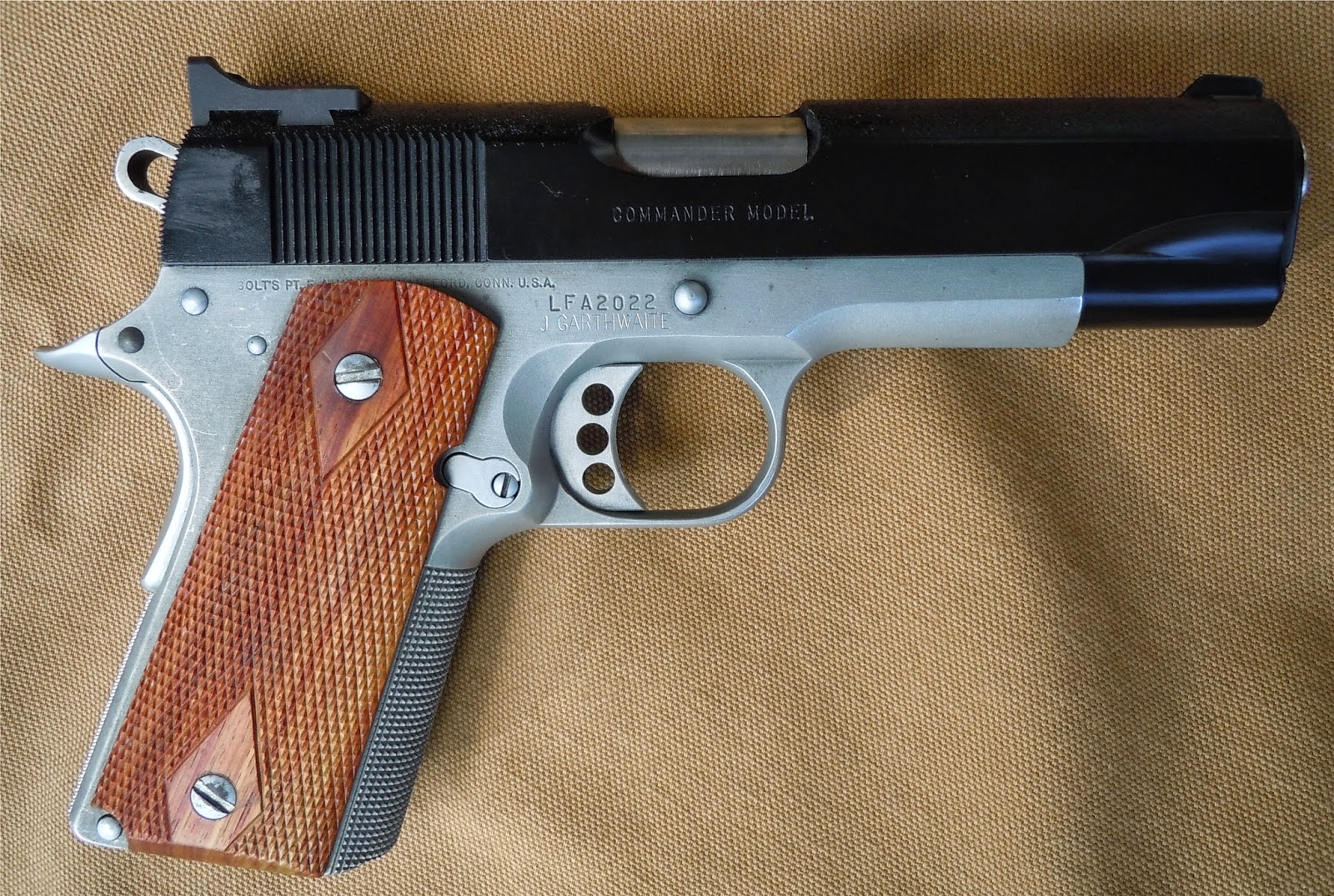
One of those smiths is Jim Garthwaite. I have read articles about him and/or his guns, indeed I've read all the articles shown on his website. He was the Pistolsmith of the Year in 2004. Mr. Garthwaite does work on 1911 and Browning High Power pistols. He also has been doing classes in which the participants build their own guns.
My friend, Rob Leahy of Simply Rugged Holsters, told me about a Garthwaite CCO at Bucky O'Neill's Guns in Prescott, AZ. Although rob said he'd get photos the work load at his shop was too great but he assured me that I'd like the gun. Knowing Rob, I took the leap of faith and called Dave at Bucky's to order the gun sight unseen. I am all into the gun for less than the price of the Gunsite CCO, which is simply a production gun. Further, the few of his guns I have seen for sale have been asking $2500 or more.
Well, it took a bit longer than expected. While they received my money, and FFL, in a timely manner, shipment was somehow delayed a bit and I didn't receive the gun until this week. Today was the first day I had time to shoot and photograph it.
As you can tell from the photo this gun is literally a Colt Commander slide (1991A1) on a Colt Officers' Lightweight frame. The front sight is dovetailed and a Heinie rear sight has been installed. The top of the slide was stippled and the rear of the slide was checkered. Also checkered was the steel (stainless I presume) main spring housing and the front strap. I'm personally pleased that the front of the trigger guard was not checkered. The trigger is like that on my Officers' Lightweight ACP but the feel is different. The gun has a National Match bushing. I haven't had it apart yet so I haven't looked at who made what component.

You'll note the vertical stringing and "lost" rounds outside the "group". That trigger is pretty light and crisp which I'm obviously not accustomed to! Then the stringing I think is due to the slight difficulty I had in shooting the gun quickly. Recoil seems to be snappier in this than in the Officers' Lightweight, I think because the gun is just about as light but the bullets are getting more velocity out of the longer barrel. That's just my perception. Recoil is not at all physically bothersome in that it is not at all painful. In comparison I think that a S&W M13 shooting full on 125 gr. .357 Magnum loads with the factory stocks can be painful.
The ammunition used was a mix of ball (Winchester white box) and Federal Hydrashocks. Nary a slip twixt mag and chamber or chamber and ground with any of it or any magazine (Wilson, Chip McCormick and Colt factory). I'll check 230 gr. Golden Sabers next.
Links:
- Massad Ayoob: The Colt Concealed Carry Officers and its niche-mates
- How About the CCOs by Wiley Clapp
Subscribe to:
Posts (Atom)