Showing posts with label Memorial. Show all posts

Tuesday, May 31, 2022

Memorial Day

There are many who have served. Many bear scars or rest forever in foreign soil as a result of their service. Many families are forever changed by the loss of these men and women. It is for these cherished national heroes that we take time this day to mark their graves and remember their names.

In Flanders Fields
By: Lieutenant Colonel John McCrae, MD (1872-1918) Canadian Army

In Flanders Fields the poppies blow
Between the crosses row on row,
That mark our place; and in the sky
The larks, still bravely singing, fly
Scarce heard amid the guns below.

We are the Dead. Short days ago
We lived, felt dawn, saw sunset glow,
Loved and were loved, and now we lie
In Flanders fields.

Take up our quarrel with the foe:
To you from failing hands we throw
The torch; be yours to hold it high.
If ye break faith with us who die
We shall not sleep, though poppies grow
In Flanders fields.
Those who have been lost in the Global War on Terror.

In remembrance of my grandfathers and father who have served...


PVTJohn BalchEllis' Co., 3d New HampshireAmerican Revolution
PVTJohan Joost BeckerSchoharie Cty MilitiaAmerican Revolution
CPTJonathan BixbyConnecticut ContinentalsAmerican Revolution
PVTJoel BlanchardSenterts Regt New Hampshire MilitiaAmerican Revolution
Smith & FarrierFrancis Boole17th Light Dragoons (GB)American Revolution
PurserGeorge BrodieRoyal Navy (GB)
CPTOrrin Lawrence BrodieNew York National Guard
WWI, WWII
CornetJohn BuckMilitiaKing Philip's War
LT & PVTArchibald CampbellCOL Gage & 1st and 16th Regts Albany Cty MilitiaF&I and American Revolution
PVTThomas DrakeSouthold TrooperKing Philip's War
PVTWilliam DrakeCPT Hunt's Weymouth CompanyCanadian Expedition of 1690
PVTRichard DwelleyScituate MilitiaKing Philip's War
PVTCharles Henry FlintCompany H 194th NYVICivil War
CPTThomas FlintMilitiaKing Philip's war
CPLDaniel Ford16th New Hampshire Regiment of MilitiaAmerican Revolution
MAJJohn FreemanEastham Company and 3rd Regiment (Mass)King Philip's War
PVTCharles GliddenExeter GarrisonAug-Sep 1696
CPTRichard GliddenNew Hampshire Militia1688 & 1696
PVTRichard GliddenCPT Sommersbee's Company New Hampshirre MilitiaFrench & Indian War
PVTRobert GliddenCPT Gilman's Company New Hampshire MilitiaFrench & Indian War (Apr-Oct 1858)

Horatio GrantUS Army, FT Jay, NY1823
CPTMatthew Grant4th Company 19th Connecticut RegtAmerican Revolution

Jacob Heens
American Revolution
LTNathaniel HerrickFrye's RegimentAmerican Revolution
MAJEphraim HildrethChelmsford County MilitiaAmerican Revolution
PVTAbraham Jaquith II*CPT Wheeler's MilitiaKing Philip's War
PVTJacob Kendall5th Regt New Hampshire MilitiaAmerican Revolution
SGTBarent Keyser2nd Regt Tyron Cty MilitiaAmerican Revolution
PVTAbraham KimballStickney's Regt New Hampshire MilitiaAmerican Revolution
CornetBenjamin KimballMassachusetts MilitiaKing Philip's War
PVTHiram H. Kimball10th Hvy Arty & E/69th NYSVCivil War
PVTJonathan Lamson5th Regt New Hampshire MilitiaAmerican Revolution
PVTSamuel LamsonCOL Tyng's Reading CompanyF&I War
SGTJohn LeavittMassachusetts MilitiaKing Philip's War
LTSamuel LeavittNew Hampshire MilitiaKing Philip's War
PVTBenjamin Lewis JrColonel Nichols' regiment New Hampshire militiaAmerican Revolution
1LTBarney Alonzo ParslowCompany D 134th NYVICivil War
SGTDonald Fancher Parslow16th IN 1st IDWWII, Korea
PVT/DrummerHenry Parslow1st and 3rd Regts, COLs Snyder,PawlingAmerican Revolution
PVTHenry Parslow*15th Regt NY Militia1812
QM SGTHenry Parslow2nd NY Hvy ArtilleryCivil War
GENFreegift PatchinConnecticut & New York MilitiasAmerican Revolution
SGTJoab PondCPT Oliver Pond's Co. Massachusetts MilitiaAmerican Revolution
CPTJonathan PooleReading Co. Massachusetts MilitiaKing Philip's War
LTJohn PooleReading Co. Massachusetts MilitiaKing Philip's War
ArtificerPeter V. Race15th & 50th New York EngineersCivil War
CPTGeorge Richtmeyer3rd Co. 15th Regt. Albany Cty MilitiaAmerican Revolution
PVTJacob Schaeffer15th Regt Albany Cty MilitiaAmerican Revolution
MatrossKoert Van SchaickCPT Barnes ArtilleryAmerican Revolution
SGTAaron ThayerWorcester County MilitiaFrench and Indian War, American Revolution
LTPelitiah ThayerMendon County MilitiaAmerican Revolution
1LTWilliam Hathaway Van Cott102nd Regt US VolunteersCivil War
PVTJacob Van DykeCTP Struback's CompanyAmerican Revolution
PVTJohan Joost Warner Jr15th Regt Albany Cty MilitiaAmerican Revolution

* - died in service


Thursday, June 06, 2013

D-Day

About to land Omaha Beach...
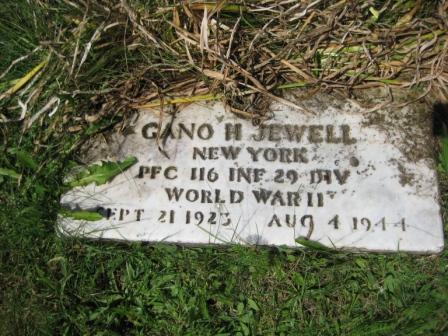
June 6, 1944.  D-Day.  The "invasion" of "fortress" Europe (the French refer to it as the embarkation).  Among the units embarking was the 116th Infantry Regiment attached to the 1st Infantry Division.  I had thought that among the men landing that day was PFC Gano Haines "Sonny" Jewell who was assigned in mid-July to the aid station of the 2nd Battalion 116th Infantry.  2 months later PFC Jewell would be dead but on this day in 1944 he was apparently in or enroute to England awaiting assignment as a replacement in one of the combat units and to begin the long and difficult job of freeing Europe.

Sonny was my Dad's first cousin and the only child of Harold and Julia (Parslow) Jewell. They were particularly close and I believe that Sonny's death was at least partially influential in Dad's decision to enlist as soon as he was able. I remember Dad talking about Sonny and some of their "adventures". He also talked about following his mother and aunt when they went to pick up Sonny's body. Even 40 years later there was real sadness in Dad's voice.

I wish I had a photo of Sonny.  I've only seen a couple and only one of him in uniform.  About 1985 a former NCOIC of the 116th Medical Detachment, Winston Morris, came into my office and showed me a copy of his photograph of Sonny taken the day before his death.  He was going to send me a copy but for one reason or another that never happened.

As a representative of all those men who risked all on that day, we honor our cousin Sonny.
The Otsego Farmer
Friday, September 1, 1944

WESTV1LLE

Friends of Mr. and Mrs. Harold Jewell of Schenectady, formerly of this place, will regret to learn that their only son, Gano, is reported missing in action in France. Mrs. Henry Hesch and Mrs. Fred Ottaway are spending several days with their sister and brother, Mr. and Mrs. Jewell.


The Otsego Farmer
Friday, October 27, 1944

Mrs. Webbs Nephew Is Killed In Action

Pfc. Gano H. Jewell, son of Mr. and Mrs. Harold G. Jewell of No. 13 Cromer Avenue, Schenectady, previously reported missing in action, was killed August 4th while serving as a field medical man in France the War department informed the parents. He was a nephew of Mrs. Kenneth Webb of Whig Corners, Mrs. Fred Ottaway of Westville, and Kenneth Jewell of Milford.
A graduate; of Nott Terrace High school. Private Jewell enlisted in the army reserve in November, 1942, and was called in active duty in July, 1943, while a Sophomore at Union College. Following his basic training at Camp Grant, Illinois, he was graduated from Technician and advanced Technician courses at O'Reilly General hospital, Springfield, Mo.
After serving a short time at Fitzsimmons General Hospital, Denver; Col., he was stationed at Camp Reynolds, Pa , before going overseas in May, 1944.

The Otsego Farmer
Friday, April 22, 1949

Westville

GANO JEWELL BURIAL

The body of Pfc. Gano Jewell of the Army Medical Corps, who made the Supreme Sacrifice in France on August, 1944 was brought to Westville cemetery for burial, Saturday afternoon.
Funeral services were held in the Union College chapel in Schenectady. Pfc. Jewell was the only son of Mr. and Mrs. Harold Jewell of Schenectady and a nephew of Ernest Jewell, Kenneth Jewell, Mrs. Fred Ottaway and Mrs. Henry Hesch, all of this place.

I originally posted this on 6 Jun 2011...  

Saturday, January 05, 2013

John Noveske killed in vehicle crash

John Noveske, owner of Noveske Rifleworks, Inc. is dead.
FATAL TRAFFIC CRASH - HIGHWAY 260 WEST OF GRANTS PASS
Posted: January 5th, 2013 9:23 AM

Oregon State Police (OSP) is continuing the investigation into Friday night's single vehicle fatal traffic crash along Highway 260 (Lower River Road) west of Grants Pass that resulted in the death of a Grants Pass man.

According to Sergeant Tyler Lee, on January 4, 2013 at approximately 9:13 p.m., a 1984 Toyota Land Cruiser driven by JOHN NOVESKE, age 36, from Grants Pass, was westbound on Highway 260 near El Camino Way. As the vehicle negotiated a right curve, it traveled across the oncoming lane onto the dirt highway shoulder until it struck two large boulders. The vehicle rolled and NOVESKE was ejected.

NOVESKE, who is the owner of a local rifle manufacturing company, was not using safety restraints and was pronounced deceased at the scene.

OSP troopers from the Grants Pass and Central Point offices are continuing the investigation. Trooper Ryan Neuenschwander is the lead investigator.

OSP was assisted at the scene by Rural Metro Fire Department, ODOT and AMR ambulance. No photographs for release.


Saturday, December 15, 2012

Bill of Rights Day

The Bill of Rights, came into effect as Constitutional Amendments on December 15, 1791. You should read them you might not get to enjoy them for long.

First Amendment – Establishment Clause, Free Exercise Clause; freedom of speech, of the press, and of assembly; right to petition

Congress shall make no law respecting an establishment of religion, or prohibiting the free exercise thereof; or abridging the freedom of speech, or of the press; or the right of the people peaceably to assemble, and to petition the Government for a redress of grievances.

Second Amendment – Militia (United States), Sovereign state, Right to keep and bear arms.

A well regulated Militia, being necessary to the security of a free State, the right of the people to keep and bear Arms, shall not be infringed.[60]

Third Amendment – Protection from quartering of troops.

No Soldier shall, in time of peace be quartered in any house, without the consent of the Owner, nor in time of war, but in a manner to be prescribed by law.

Fourth Amendment – Protection from unreasonable search and seizure.

The right of the people to be secure in their persons, houses, papers, and effects, against unreasonable searches and seizures, shall not be violated, and no Warrants shall issue, but upon probable cause, supported by Oath or affirmation, and particularly describing the place to be searched, and the persons or things to be seized.

Fifth Amendment – due process, double jeopardy, self-incrimination, eminent domain.

No person shall be held to answer for a capital, or otherwise infamous crime, unless on a presentment or indictment of a Grand Jury, except in cases arising in the land or naval forces, or in the Militia, when in actual service in time of War or public danger; nor shall any person be subject for the same offence to be twice put in jeopardy of life or limb; nor shall be compelled in any criminal case to be a witness against himself, nor be deprived of life, liberty, or property, without due process of law; nor shall private property be taken for public use, without just compensation.

Sixth Amendment – Trial by jury and rights of the accused; Confrontation Clause, speedy trial, public trial, right to counsel

In all criminal prosecutions, the accused shall enjoy the right to a speedy and public trial, by an impartial jury of the State and district wherein the crime shall have been committed, which district shall have been previously ascertained by law, and to be informed of the nature and cause of the accusation; to be confronted with the witnesses against him; to have compulsory process for obtaining witnesses in his favor, and to have the Assistance of Counsel for his defence.

Seventh Amendment – Civil trial by jury.

In suits at common law, where the value in controversy shall exceed twenty dollars, the right of trial by jury shall be preserved, and no fact tried by a jury, shall be otherwise re-examined in any court of the United States, than according to the rules of the common law.

Eighth Amendment – Prohibition of excessive bail and cruel and unusual punishment.

Excessive bail shall not be required, nor excessive fines imposed, nor cruel and unusual punishments inflicted.

Ninth Amendment – Protection of rights not specifically enumerated in the Constitution.

The enumeration in the Constitution, of certain rights, shall not be construed to deny or disparage others retained by the people.

Tenth Amendment – Powers of States and people.

The powers not delegated to the United States by the Constitution, nor prohibited by it to the States, are reserved to the States respectively, or to the people.

Saturday, May 26, 2012

The real Memorial Day and Barney Alonzo Parslow

If you were looking for a Memorial Day post today you're out of luck.  I will write something on the REAL Memorial Day, the 31st, and not on some weekend selected to make it easier on employers and to give people 3 consecutive days off.  It is MEMORIAL day...

134th monument, Gettysburg
One of the people we are supposed to be memorializing on the holiday is my 2xGreat-Grandfather Barney Alonzo Parslow (1841-1920) .  One of our many, many grandfathers who has served, Alonzo (as he was known to most) enlisted on 21 July 1862 to fight the slavers and served in the 134th New York Volunteer Infantry.  He started as a private but quickly rose to First Sergeant and then was commissioned a Second Lieutenant in D Company.  It was as a 2LT at Gettysburg that he was wounded on 1 July (the day before his birthday).  A musket ball/bullet struck him 2" above the right nipple and exited just below the right shoulder blade.  When the Confederates (North Carolina 21st Regiment was directly in front of the 134th) pushed his unit back, he was moved across Steven's Run and lay there, untreated, until 5 July.  After being evacuated, treated and briefly assigned to the Invalid Corps in Washington, D.C., Alonzo returned to his unit, now in the western theater.  Again with D Company and as 1st Lieutenant, Alonzo participated in the Chattanooga campaign.  However, active duty was apparently too much for him and he was discharged for disability on 30 September 1864.  A year later he married and lived out his life in Blenheim, Schoharie County, New York raising 9 children. 

In 1913 Alonzo traveled back to Gettysburg for the 50th Anniversary of the battle where he pointed out where various members of the unit had been wounded, killed or gone missing.  He was 73 and had 7 more years to live.  While he didn't die during the war, he lived with the effects of his wound all the rest of his life.

Monday, April 30, 2012

We've been informed of the passing of Bob Edgar

I did not know him but I have seen the result of his work.  Such people should be more widely known so this is repeated for your enlightenment.

Bob Edgar
CODY, Wyo. — One of the last chapters of the American Old West closed Friday evening, April 20, with the passing of Bob Edgar, 72, of Cody, Wyo., founder of the Old Trail Town Museum and an internationally acclaimed historian, archaeologist, artist, author, naturalist and conservationist.

Robert Wilburn Edgar was the firstborn of Paul G. Edgar and Marjorie (Downer) Edgar on July 27, 1939, at their rustic home at the base of Polecat Bench northeast of Powell, Wyo. An early love of the outdoors and awareness of local history was infused into young Bob and his brother Larry at a very early age when the family resided at the small oilfield company town in Oregon Basin. Bob and Larry spent countless hours in the sandstone and cedar breaks of the Badlands until the family moved to Cody in 1950 with younger sister Helen and soon brother David completed the Edgar family.

Bob was educated in the Cody public schools, graduating Cody High School in 1957 and attending Northwest Community College in Powell to study art and archaeology, receiving an Associates Degree in 1961. Bob married Janice Birchfield in 1959 and had two daughters, Cathy and Susan. Later Bob married Terry Deutch of Sheridan, had their daughter, Sherri.

In his self-made career, Bob Edgar received many awards and accolades, accruing a long list of national and international recognition from the Smithsonian Institution all the way down to local service clubs and everything in between: Governor's awards, state archaeological society awards and serving as Vice President of same, NWCC Distinguished Alumni, American Travel Writer's Phoenix Award for distinguished conservation, serving on the state of Wyoming BLM Advisory Board, and many other meritorious accolades.

Bob Edgar became a world class sharpshooter, being gifted with extraordinary eyesight and hand control plus an intimate knowledge of weaponry. Years of practice and hundreds of thousands of spent rounds honed his skills to the confidence level of being able to shoot objects from people's mouths and hands at 40 paces with a Colt .45.

There are far too many projects or collaborations in Bob Edgar's professional life to list here, but a few major milestones stand out. Bob Edgar and George Dabich assisted by Larry Edgar were the principal excavators of the Mummy Cave project 35 miles west of Cody beginning in 1963. Mummy Cave yielded an unbroken archaeological and climatological record going back over 9,000 years, including the discovery of a very well preserved pre-Columbian human mummy.

Of the myriad events that occurred at Old Trail Town, the pinnacle came in June 1974, when the remains of John "Liver Eatin'" Johnston were reburied there, beginning the pioneer cemetery that today holds seven notable frontiersmen. Johnston was the real-life model for the 1972 Robert Redford film "Jeremiah Johnson." Redford himself came to Cody to act as pallbearer for the man he portrayed onscreen, whose grave was in danger of being lost to a freeway project in Lancaster, Calif.

It was Edgar's association with the Pitchfork Ranch that provided a core building block for Old Trail Town. In 1971 Bob Edgar and Frances Belden established "The Museum of the Old West," a 501(c) 3 Non-Profit Foundation. The Belden family had an impressive collection of Plains Indian artifacts and beaded clothing and many historical items. Frances Belden endowed the Museum of the Old West with the funds to build a fireproof building and display cases to house the Belden collection, which is now the centerpiece of the exhibits. Thankfully, Old Trail Town is now part of "The Museum of the Old West," with a future as far as anyone can see.

Robert Wilburn Edgar was preceded in death by his parents, Paul and Marjorie Edgar; his first wife Janice "Jan" Birchfield Edgar; second wife, Terry Deutch Edgar; and niece Cori Edgar.

Survivors include brother Larry (Jan) Edgar of Meeteetse; sister Helen (Joseph) Edgar Sowerwine Venier of Wapiti; brother David Paul (Ramona) Edgar of Wasilla, Alaska; daughters Catherine (Rodney) Edgar Godard Dahlgren of Powell, Wyo., Susan (Mike) Edgar Ward Welker of Pueblo, Colo.; Sherri Lynn Edgar of Cody, and Jill Roberts of Billings; 10 grandchildren; two great-grandchildren with a third on the way; as well as many nieces and nephews.

Those wishing to memorialize the life and work of Bob Edgar past, present and future can contribute to the Museum of the Old West Foundation, P.O. Box 546, or 1831 DeMaris Drive, Cody, WY 82414. Contributions are tax deductible and used exclusively for the maintenance and advancement of Trail Town and the Museum of the Old West.

Cremation has occurred with ashes being dispersed privately at locations dear to the deceased, with a portion reserved for a monument at Old Trail Town. Public services there will be Saturday, May 12, at 1 p.m. (non-denominational) with remembrances to follow. Old Trail Town will be open free of charge to the public that day. For all else that happened along the trail of his life, Bob Edgar's heart never failed him. It always faced the West.

Friday, November 11, 2011

Sunday, September 11, 2011

My Pearl Harbor

When I was a kid my mom would tell me about where she was and how she heard about the attack on Pearl Harbor.  Pretty much the same story they were working in the yard when her mother came out to tell them about the attack and everyone knew this meant war.  Mom was 8 but she never forgot that singular moment. 

Now, I'd lived a while before a certain 11th of September.  I'd seen the Cuban Missile Crisis, the whole war in Vietnam (some of it from a vantage point in the Republic of Korea), and the assassination of John F. Kennedy and Pak Chung-hee.  Still, as I sat at my computer semi-watching the new-to-me Fox News Channel I was more than a bit disconcerted to hear of the plane crash into the World Trade Center. 


They only told us about it at first. Many recalled the B-25 that had crashed into the Empire State Building during WWII (July 1945). However, that had happened in fog/heavy cloud cover and it was a clear day in New York City. The impact of the 2nd plane immediately put to rest any ideas of there being any accident. Everybody knew what and why. Only fools expected any other perpetrators to be named. Although we'd been attacked many times before, this act is what started the war against radical Islamists.


Now 10 years later people have apparently been working hard to put the facts of the case out of their minds. There are still conspiracy theorists, so-called "truthers" (some of whom have actually been in the Obama administration), and apologists for the terrorists who say it was our egregious behavior which is at the root of their antagonism. The truth is though that 10 years ago a radical Islamist group attacked us, again, because we are not like them and they wish to destroy us. History tells us this will never end for them unless they are dead. We aren't working hard enough to make that happen so, perhaps, 10 years from now we will still be in conflict with these people. Whatever happens we shouldn't forget those of us who have died in this war.


Sunday, May 29, 2011

Memorial Day 2011


There are many who have served. Many bear scars or rest forever in foreign soil as a result of their service. Many families are forever changed by the loss of these men and women. It is for these cherished national heroes that we take time this day to mark their graves and remember their names.

In Flanders Fields
By: Lieutenant Colonel John McCrae, MD (1872-1918) Canadian Army

In Flanders Fields the poppies blow
Between the crosses row on row,
That mark our place; and in the sky
The larks, still bravely singing, fly
Scarce heard amid the guns below.

We are the Dead. Short days ago
We lived, felt dawn, saw sunset glow,
Loved and were loved, and now we lie
In Flanders fields.

Take up our quarrel with the foe:
To you from failing hands we throw
The torch; be yours to hold it high.
If ye break faith with us who die
We shall not sleep, though poppies grow
In Flanders fields.
Those who have been lost in the Global War on Terror.

In remembrance of those of my own family who have served...

PVTJohn BalchAmerican Revolution
Johan Joost BeckerAmerican Revolution
CPTJonathan BixbyConnecticut ContinentalsAmerican Revolution
Smith & FarrierFrancis Boole17th Light Dragoons (GB)American Revolution
PVTLawrence BroderickCold War
CPTOrrin Lawrence BrodieWWI, WWII
Archibald CampbellAmerican Revolution
Seaman 1stJohn Elton DavisUSS PrincetonWWII
SPCJustin Lee Davis10th MtnGWOT
PVTErasmus Dortch*21st Alabama Infantry RegimentCivil War
T4John Clarence DortchADAWWII
CPLDaniel Ford6th Connecticut RegimentAmerican Revolution
Horatio GrantUS Army1823
PVTCharles Henry FlintH/194th New York InfantryCivil War
Jacob HeensAmerican Revolution
LTNathaniel HerrickFrye's RegimentAmerican Revolution
MAJEphraim HildrethChelmsford County Militia
PFCGano H. Jewell*2d Bn 116th Inf RegtWWII
PVTHiram H. Kimball10th Hvy Arty & E/69th NYSVCivil War
1LTBarney Alonzo ParslowD/134th New York InfantryCivil War
SGTDonald Fancher Parslow16th IN 1st IDWWII, Korea
PVT/DrummerHenry Parslow1st and 3rd Regts, COLs Snyder,PawlingAmerican Revolution
PVTHenry Parslow*1812
QM SGTHenry Parslow2nd NY Hvy ArtilleryCivil War
GENFreegift PatchinConnecticut & New York MilitiasAmerican Revolution
PrivateChapman R Philen*38th Alabama InfantryCivil War
ArtificerPeter V. Race15th & 50th New York EngineersCivil War
CPTGeorge Richtmeyer3rd Co. 15th Regt. Albany Cty MilitiaAmerican Revolution
PVTJacob Schaeffer15th Regt Albany Cty MilitiaAmerican Revolution
MatrossKoert Van SchaickCPT Barnes ArtilleryAmerican Revolution
Adam SwartAmerican Revolution
LTAdam ThayerMassachusetts MilitiaAmerican Revolution
PVTPelitiah ThayerMassachusetts MilitiaAmerican Revolution
2LTLeonard Boole Van Cott*119th NY Infantry Regt.Civil War
1LTTheodore Sedgewick Van Cott71st NYVICivil War
1LTWilliam Hathaway Van Cott102nd Regt US VolunteersCivil War
Jacob Van DykeAmerican Revolution
PVTJohan Joost WarnerAmerican Revolution

* - died in service


Saturday, February 26, 2011

In Memoriam - Robert Rene Monast (SFC, USA Ret)

ARRINGTON — Robert Rene Monast, 52, of Arrington, died Friday, Feb. 25, 2011, at his residence. He was born May 26, 1958, in Massachusetts, a son of Shirley Day Monast and the late Roger A. Monast.

A member of the 82nd Airborne, he was a recruiter, retiring in 1996 with 21 years of service. Since then, he worked in construction.

In addition to his mother he is survived by his wife, Tammy M. Monast of Arrington; one son, Robert Monast Jr. and his wife, Whitney, of Staunton; three daughters, Kerri Wood and husband, Andy, and Julie Stokes, all of Waynesboro, and Kristina Monast of Lovingston; four stepchildren, Kenny and Christina Wyant, and Suzanne and Scott Hewitt; four sisters, Gail Bilbo and Bonnie Raines, both of Waynesboro, Pam Reed and husband, Charlie, of Sherando, and Janet Geary of Pennsylvania; two brothers and their wives, Roger and Susan Monast of Florida and Michael and Becky Monast of Lovingston; four grandchildren, Gage Wood, Shuggie Monast, Wyatt Wood and Hailey Stokes; 12 nephews; and 7 nieces.

A service will be conducted at noon Thursday, March 3, 2011, at McDow Funeral Home by Mr. Bob Gaylor and Mr. Mac Blackwell. Interment will follow in Riverview Cemetery, with military honors.

Active pallbearers will be Chris Bilbo, Tommy Gunn, Robbie Harada, Eric Lang, Jamie McLean and Bobby Monast.

Honorary pallbearers will be Charlie Reed and Kenny Wyant.

The family will receive friends from 7 to 8:30 p.m. Wednesday at McDow Funeral Home.

Memorial contributions may be made to the the family to assist with final expenses.

Condolences may be shared online at www.mcdowfuneralhomeinc.com.


Bob Monast was always a good friend to me. We met in February 1981 when I went into the armory to enlist in the National Guard. Two years later we began a fruitful partnership that took Detachment 1 Company A 3-116th Infantry from 0% to 100%+ strength in less than 3 years. When Bob left for an in-service recruiting position about 1993 he had enlisted something more than 900 soldiers in the Virginia National Guard. He always gave at least the outward appearance of being upbeat and positive and we had some interesting experiences with some of the prospects that came to his office.

Monday, September 13, 2010

2LT Caitlyn LeClerc

Newly commissioned 2LT LeClerc with her parents
On September 6th she was a passenger in a GMC driven by another LT with another young man in the back seat. The driver lost control of the SUV and rolled into a rock wall. She and the boy in back were not wearing seat belts and were both ejected from the vehicle. The coroner said she was killed instantly.

Not mentioned is that this family has served this country extensively including military service.  Also, this family is obviously grieving this loss.  Please pray for the family and if you would like to, please leave your message of condolence here.  
Leavenworth, Kan. —

Catilyn LeClerc
21, Leavenworth
2nd Lt. Caitlyn Victoria LeClerc, 21, died Monday, Sept. 6, 2010, from injuries suffered in an automobile accident when she was returning to school from a Labor Day vacation at the Lake of the Ozarks.

She was born Jan. 7, 1989, weighing only two pounds but proved she was a fighter from the beginning and became so strong that although she was only five feet two inches tall and weighted 110 pounds she could do 88 pushups in two minutes. She always made her own rules and brightened the lives of all she met.
Caitlyn was a 2007 graduate of Leavenworth High School where she was a member of the National Honor Society, the ROTC Drill Team Commander and Prom Queen. She was a 2010 graduate of Wentworth Military Academy where she excelled in both academic and military leadership skills. She was awarded the Outstanding Company Commander award for individual leadership and service. She commissioned a 2nd Lt. in the United States Army at her graduation in May. She was also a member of the Missouri National Guard 35th Combat Aviation Brigade.

Caitlyn had just begun classes at the University of Missouri to complete her degree in International Studies.

Caitlyn is survived by her father and mother, Dr. Byron and Teresa LeClerc; and her brothers, Alex age 23, Thomas age 11 and her little sister, Grace age 11
Visitation will be from 6 to 8 p.m. Thursday, Sept. 9, 2010, at the R.L. Leintz Funeral Home. The rosary will be prayed at 5:30 p.m. Mass of Christian Burial will be at 10 a.m. Friday, Sept. 10, 2010, at Immaculate Conception Catholic church with Rev. David McEvoy, O.Carm., as celebrant. Inurnment will be at Resurrection Cemetery. Memorials are suggested to the Wounded Warrior Project.
and
Columbia woman dies in car crash

Published September 7, 2010 at 11:11 a.m.
Updated September 7, 2010 at 1:36 p.m.

A one-vehicle accident early yesterday in southwest Missouri claimed the life of a Columbia woman and left the driver facing charges of vehicular manslaughter and assault.

Caitlyn V. LeClerc, 21, died in the incident that happened shortly after 8 a.m. yesterday when a 2003 GMC driven by John S. Dulaney, 21, of Columbia, ran off Highway 39 south of Viola in Stone County, according to a report by Trooper Terry Bible of the Missouri State Highway Patrol. The car overturned, and LeClerc was pronounced dead at the scene by Stone County Coroner Jim Fohn.

Dulaney and a second passenger, Robert A. Carter of Columbia, suffered serious injuries and were taken by helicopter to Springfield for treatment, Bible said.

After Dulaney was tested for alcohol, he was arrested on suspicion of involuntary manslaughter by intoxication, felony assault and careless and imprudent driving resulting in an accident. He was released to St. John’s Hospital in Springfield for care, Bible said. No formal charges had been filed as of early today.
Please, reinforce to your children that they should wear their seatbelts, not drive after drinking or be driven by those that have been drinking and be a true friend to others by enforcing those standards.

Thursday, August 26, 2010

In Honor of the Mad Piper - Bill Millin

Via Lawdog we are informed of the passing on 17 August 2010 of Piper Bill Millin, piper for Lord Lovat at Pegasus Bridge.


It is men such as these that we should emulate in our own lives.

Obituary: Bill Millin, piper
Published Date: 20 August 2010
By CHRIS MAIR

Bill Millin, piper.
Born: 14 July, 1922, in Regina, Saskatchewan, Canada.
Died: 17 August, 2010, in Torbay, Devon, aged 88.

On Sword Beach during the D-Day Normandy landings in 1944, as German troops opened fire on his comrades, Bill Millin marched up and down along the shore playing Highland Laddie on his bagpipes.

William Millin was the eldest son of Mr and Mrs John Millin. The family crossed the Atlantic in 1925, settling in Shettleston, Glasgow. They lived on Gilmerton Street and Millin was educated at Budhill School, Shettleston. He played the bagpipes in the Boys' Brigade band before joining the Queen's Own Cameron Highlanders as a piper and a commando. His first public piping session was in 1940, an event run to raise funds for the construction of a Spitfire.

Millin, as his mother put it, "was always a good fighter", hence his position as Piper of the 1st Special Service Brigade (redesignated, 1st Commando Brigade in December 1944), a commando unit. The unit consisted of some of the toughest men from the Army and the Royal Marines, all of whom were trained in wilderness survival, close combat, navigation, weapons, demolition and crucially, amphibious assaults.

On 6 June, 1944 Millin, along with his fellow commandoes approached Sword Beach, Normandy as part of the D-Day landings which would see the largest amphibious invasion of all time as 160,000 troops entered France to fight the Nazis.

1st Special Service Brigade was commanded by Brigadier Simon Fraser, the 15th Lord Lovat. Lovat was a passionate and patriotic Scot, and Millin was his personal piper. Lovat was also a fan of the Scottish tradition whereby a piper played his comrades into battle, a tradition banned by the military hierarchy. However, as Lovat not quite factually pointed out: "That was the English Army."

Millin climbed aboard his landing craft with 21 men, including Lovat, and sat as the vessel followed the course of the Hamble River out toward the Solent. He was in the leading boat and Lovat had asked him to play the troops out in to open sea. As they sailed up the Hamble Millin piped The Road to the Isles. He stood proud on the bowsprit as the music was pumped through the loudhailer. As the thousands of transport craft gathered for the mass assault on the French beaches, Millin's pipes could be heard above all else. As the sea became rougher and the craft less stable Millin stopped piping and the Channel crossing began.

Following a fitful night's sleep, the men made their way to the deck and prepared for what, for some, would be the last charge of their short lives. Millin recalled an air of calm aboard their small craft: "Everyone was behaving normally, I mean checking their kit, putting their kit on… We all got up on deck and we stood in the freezing wind watching the shoreline.

Then the order came to get ashore, and no one was shouting that they were afraid or shouting that they were going to kill all these Germans. All people wanted really was to get off."

Millin followed Lovat, watching the tall man crash into the waves, and then watched a man behind take a bullet to the face and sink. Millin saw that as a sign to hurry along and he launched himself into the waves. As his kilt (a 100-year-old one his father had worn in the Great War) rose up he started piping Highland Laddie.

Once Millin had finished that first tune Lovat requested another. "Well, when I looked round - the noise and people lying about shouting and the smoke, the crump of mortars, I said to myself, 'Well, you must be joking surely.' He said, "What was that?" and he said 'Would you mind giving us a tune?' 'Well, what tune would you like, Sir?' 'How about The Road to the Isles?' 'Now, would you want me to walk up and down, sir?' 'Yes. That would be nice. Yes, walk up and down.'"

What transpired has since gone down in military history as an iconic moment. Millin strode up and down the beach piping rallying tunes for his friends. The Germans were perplexed by the sight and did not shoot at him.

As the troops moved inland Millin found himself almost alone on the beach, but as he had not been told to stop playing he ran up and followed the men, playing them all the way to Pegasus Bridge, piping Blue Bonnets Over the Border.

On 10 June, Millins's luck ran out; although he wasn't shot himself, his bagpipes were hit by shrapnel and their war came to an end. In 2001 those same pipes, along with his family kilt, commando beret and knife, the military kit of the "mad piper", were donated to the National War Museum of Scotland.

Following the war Millin was offered employment on the Lovat estate, but grew restless and joined a theatre, where he played his pipes, before retraining as a mental health worker in the late 1950s. He spent the rest of his working life as a care worker, moving to Devon in 1963 and frequently returned to pay his respects the friends who lost their lives in Normandy.

In 1962 a film, The Longest Day, told Millin's incredible story. He was played by Pipe Major Laspee, the Queen Mother's official piper. Millin suffered a stroke in 2003 and had been living in a nursing home in Dawlish since. There is currently a fundraising campaign to construct a bronze statue on Sword Beach to commemorate Millin's heroics on 6 June, 1944.

William "Bill" Millin's wife Margaret predeceased him and he is survived by their son John.

Saturday, May 15, 2010

Outdoor Writer Suicides

My recent interest in Phil Sharpe was instigated by a wide-spread belief that he had shot himself. Apparently, many other outdoor/shooting writers have done so. How many? Why? I had a morbid curiosity about the subject. A search ensued...

Jacques P. "Jack" Lott (b. 15 Jul 1920 d. 12 Aug 1993) - Writer, gun crank and inventor of the .458 Lott cartridge.  Author of Big Bore Rifles. Friend of Frederick Russell Burnham's family and owned many of his guns. Jan Libourel has said that it was because he was "he was old, alone and in failing health".
- Buff Busters by Kevin E. Steele
- Why Magazine Big Bore Rifles are Best Part 1 by Jacques P. Lott
- Why Magazine Big Bore Rifles are Best Part 2 by Jacques P. Lott
- Don't Send Your Guns to an Early Grave by Jack Lott
- Big Bore Rifles by Jack Lott


Captain Edward Carthart "Ned" Crossman (1889 - 1939)- was a very prolific gun writer and the only writer of his era to make a living of writing for magazines. He was the dean of gun writers for the period from WW1 to his death, which is impressive as the era included Whelan, Hatcher & Klephart. His first magazine contribution was in 1904 and he was a regular in "Arms and the Man" and its successor "American Rifleman" from that point.

Born in Iowa, son of Leander C. Crossman whose was born in 1853, soon after his parents John Alexander Crossman and wife Mary Cathcart emigrated from Pennsylvania to Iowa in about 1850.  Leander was raised on the western frontier and, like most boys of this era and his age, learned to use firearms early in life to gather food, provide protection, and on occasion, recreation. By the time he had grown to adulthood he had become a well known rifleman of his day, making his name as a member of the Muscatine Guards-Company C of the 9th Regiment of the Iowa National Guard.

"Ned" followed in his father’s footsteps as a rifleman.  The family moved the California where Ned first came to public notice, at the relatively young age of 23, when his first contribution to Arms and the Man, the predecessor of the National Rifle Association’s flagship publication, The American Rifleman was published in 1904. He was a prolific writer, with a fund of information and interests that was both broad and deep, allowing him to write for a wide variety of magazines from outdoor publications to Scientific American. Once he had tasted the life of a free lance outdoor writer he never looked back and never really had any other main means of employment to support his family.

He was very active in the establishment of the Los Angeles Rifle and Revolver Club and served for many years as its secretary. He met and married Blanche Brown. Their only child Edward Bishop Crossman, called Jim for reasons unknown, was born on July 8, 1909. The family’s domestic life was a bit out of the ordinary as the trio often left their base in Los Angeles to roam the wild back country of the west ranging from New Mexico to Oregon in pursuit of game, adventure, and material for Ned’s columns.

April 6, 1917 General Peyton March, Chief of Staff of the Army, signed orders creating “The Small Arms Firing School of Instruction of Officers and Enlisted Men in Rifle and Pistol Shooting” with Lieutenant Colonel Morton Mumma as commandant. In recognition of his skill and knowledge as a marksman Crossman was ordered to active duty as a captain where he would join the great smallbore rifleman T.K. “Tackhole” Lee, long range specialists the likes of William Leusher and James Keogh and a host of others at Camp Perry, Ohio. After the war, Crossman stayed in the Army while still penning articles for the popular outdoor press. He was recognized for his technical knowledge and writing skill and so, in 1919, detailed to Daytona Beach, Florida to serve under Lieutenant Colonel Glenn P. Wilhelm in checking the range tables of the 30 caliber M1 cartridge and determining its actual maximum range. Crossman was able to publish the program and conditions for the first smallbore national matches in the June 28, 1919 Arms and The Man.

Crossman had been mustered out of the Army soon after his tour at Daytona when it was discovered that he had developed stomach ulcers, but his attachment to his days in the service were so strong that he would often use the honorific of ‘captain’ in the ensuing years. He branched off into a relatively new field of firearms forensics. He soon became associated with the Bureau of Forensic Ballistics, eventually dealing with over 200 cases. When his son Jim graduated from California Institute of Technology in 1931 he joined his father in his practice.

On the 18th of October in 1938 Ned was driving home through a blinding dust storm. In the limited visibility their auto was broadsided by a truck near Indio and Ned, unhurt, was horrified to see that Blanche had suffered a broken neck. She passed three days later. Ned was disconsolate and blamed himself for his wife’s death. He slipped into depression. Three months after the accident Ned closed the doors of the garage at his 142 South Rockingham Road home, slid behind the wheel of his car, shifted into neutral, set the brake, turned on the ignition, and calmly sat back awaiting the inevitable.

Paul Curtis -  is among the first “modern day” gun writers. Curtis was the Arms and Ammunition Editor for Field & Stream. Curtis wrote three books: Sporting Firearms of Today in Use – 1922, American Game Shooting – 1927 Sportsmen All – 1938. Game and Gunning was printed in 1934 and contributed to one other.

Curtis Wife, Mrs. Mabel Curtis, is the lady written of who on an extended hunt in Canada in 1935 stuck a tang sight in her eye while shooting a Model 99 Savage uphill. She had to ride out of the wilderness to seek medical attention and had to be one tough person. Elmer Keith wrote about this incident several times and it made a lasting impression on me.

M. A. Eibert - Drowned himself in Fleigel Lake, WI.

Ted Trueblood (b. 26 Jun 1913 - d. 12 Sep 1982) - wrote for over 40 years about natural resources and conservation demonstrating an ability to attract readers from across the country.  Called "The Dean of Outdoor Writers." Ted Trueblood was born in Boise, Idaho. He grew up on his parents' farm near Wilder, where he later graduated from high school in 1931, the same year that he sold his first article. Trueblood attended the College of Idaho for two and a half years. He married Ellen Michaelson in 1939. Together, they had two sons.
He moved to New York to work with Field and Stream, where he served as fishing editor.  In 1947 after the death of a neighbor he returned to Idaho  "determined to hunt, fish, and write about it." He wrote, "Why work hard and save money and then die before I had a chance to enjoy the things for which I had been saving?"  Trueblood wrote and published  The Angler's Handbook (1949), The Fishing Handbook (1951), Ted Trueblood on Hunting (1953), The Hunter's Handbook (1954), and finally, The Ted Trueblood Hunting Treasury (1978.) Trueblood was also well known for his conservation efforts, as evidenced by the number of awards he won: American Association for Conservation Information: Award of Merit (1963), Idaho Wildlife Federation's Conservationist of the Year (1973-74), U.S. Department of the Interior: Conservation Service Award (1975). He was also involved with the Save Our Public Lands project, and served as president of the River of No Return Wilderness Council, and was a member of several other conservation groups.  He committed suicide after a long bout with cancer.

Henry William Herbert - (b. bef. 1831 - d. 1858) perhaps the most popular outdoor sporting writer before the Civil War under his pen name Frank Forester.  He came to the United States in 1831 and he spent the following eight years working as a professor of Latin and Greek.  He co-founded the American Monthly Magazine in 1833.  In 1839 Herbert began writing for the American Turf Register under the alias “Frank Forester.” As Forester, he published The Warwick Woodlands, or Things as They Were There Ten Years Ago (1845), My Shooting Box 1846, The Deerstalkers (1849), Frank Forester’s Field of Sports of the United States, and British Provinces, of North America (1849), The Quorndon Hounds; or A Virginian at Melton Mowbray (1852), The Complete Manual for Young Sportsmen (1856), and Frank Forester’s Horse and Horsemanship of the United States and British Provinces of North America (1857). These books also highlighted Herbert’s artistic ability--he drew many of the illustrations found within them. Herbert committed suicide in 1858. His wife left him after only a few weeks of marriage and her departure brought on a fit of depression, which ended when he shot himself.

Guy Waterman - (b. 1933 - d. 6 Feb 2000 ) Born in New Haven, Conn., and educated at George Washington University, Waterman worked his way through college as a jazz pianist. He spent the 1950s in Washington, D.C., working for the Chamber of Commerce and the U.S. Senate as an economist and legislative assistant. Waterman moved to New York City in 1961 and worked another decade as a speech writer for General Electric Co., also contributing speeches to three U.S. presidents. In 1973, Waterman moved with his second wife and co-writer, Laura Johnson Waterman, to East Corinth, Vt., to live on a 40-acre farm where they grew their own food, chopped their own firewood and made their own maple syrup without electricity, plumbing or central heating. Together they wrote the books Backwoods Ethics: Environmental Concerns for Hikers and Campers and Wilderness Ethics and had worked on A History of Mountain Climbing in the Northeast. Waterman also co-wrote Woods Trails, a monthly column in New England Outdoors, and contributed articles to various outdoor magazines. Despite losing two of his three sons in fatal mountain-climbing accidents, Waterman climbed all 48 of New Hampshire's peaks higher than 4,000 feet in the winter and from all four points of the compass, according to a friend. Found to have committed suicide near the summit of Mt. Lafayette in New Hampshire.

Friday, May 14, 2010

Major General Julian S. Hatcher

Julian Sommerville Hatcher (June 26, 1888 – December 4, 1963), was a noted firearms expert and author of the early twentieth century. He is credited with several technical books and articles relating to military firearms, ballistics, and autoloading weapons. His premier works are Hatcher's Notebook and Book of the Garand, along with Textbook of Pistols and Revolvers and Pistols and Revolvers and Their Uses. He was also a pioneer in the forensic identification of firearms and their ammunition. Hatcher retired from the United States Army as a Major General. Afterward, he served as Technical Editor of the National Rifle Association's "American Rifleman" magazine.

Hatcher was born in Hayfield (Gainsboro), Virginia and graduated with honors from Annapolis in 1909 after which he voluntarily transferred from the Navy to the Army's coast artillery. He married Eleanor Dashiell and together, they had three children. As Chief of the Small Arms Division in the Ordnance Department and the Assistant Commandant of the Ordnance School before and at the beginning of World War II, he worked closely with Springfield Armory as an engineering trouble-shooter in resolving early production issues associated with the early iterations of the M1 Garand Rifle.

In 1916, the Hotchkiss M1909 Benet-Mercie machine gun was in general use with the U.S. Army and was seeing action during the Punitive Expedition against the bandit Pancho Villa. Reports of its use in Mexico indicated the gun was not functioning properly. Investigation revealed that the chief problems were the 30-round metallic feed strips used in the gun and inexperienced gunners. It was Lieutenant Hatcher who was sent to the border to solve the problems. Finding the cause in a lack of gunner training he established the Army's first machine gun school and trained crews. Soon, the Benet-Mercie proved to be an effective weapon.

Canfield says Hatcher was later instrumental in developing a solution to the vexing problem of brittle metal in early M1903 receivers built by Springfield and Rock Island Arsenals. His solution was to drill a hole in the receiver adjacent to breech. Dubbed the "Hatcher Hole", the modification was typically added to receivers at overhaul.


- Textbook of Pistols and Revolvers
- Machineguns: Mechanism, The Practical Handling Of Machine Gun Fire, Machine Gun Tactics
- Book of the Garand
- Hatcher's Notebook or the digital copy
- Firearms Investigation, Identification and Evidence
- Reloading Information from the American Rifleman Vol. 1

Thursday, April 22, 2010

Claude Phillip Diehl Jr., SFC, USA, Ret.

The obituary was published today...


HARRISONBURG — C. Phillip Diehl Jr., 58, of the Mountain Valley area, passed away Tuesday, April 20, 2010. Phillip was born Feb. 22, 1952, in Rockingham County, and was the son of Claude Sellers Diehl and Hazel Pauline Beverage.

Mr. Diehl graduated in 1970 from Montevideo High School. He served our country for 34 years in the Virginia Army National Guard and retired in April 2006 as sergeant first class. He was a member of Mountain Valley United Methodist Church, where he was a trustee. He was a former member of the VFW in Harrisonburg and the 29th Division Association.

He is survived by his wife, Judy Gibson Diehl. They were married Sept. 23, 1989.

Also surviving are one son, Christopher Alan Diehl and wife, Layna, of Mountain Valley; two stepchildren, Neil Daniel Roadcap and wife, Jennifer, of Broadway and Angela Renee Akey and husband, Thomas, of Charlottesville; two brothers, Michael "Mickey" Diehl and wife, Nancy, of Mountain Valley and Larry Diehl and wife, Victoria, of Waynesboro; one sister, Deborah D. Miller and husband, Bob, of New Hope; and five grandchildren, Grayson, Gavin, Josh, T.J. and Tyler.

A funeral service will be conducted at 11 a.m. Saturday morning at Mountain Valley United Methodist Church, with Pastor Erich Bennett officiating. Burial will follow in the church cemetery. The family will receive friends from 6 to 8 p.m. Friday evening at the funeral home.

In lieu of flowers, donations may be made to Mountain Valley United Methodist Church, 11583 Mountain Valley Road, Harrisonburg, VA 22802.

Online condolences may be sent to the family at www.kygers.com.
I am almost literally at a loss for words. Reports are that Phil took his own life. He was certainly wrestling with demons but when and where they had taken over his life, if they did, I can't say. For all the years I'd known and worked with him there was no hint of such things.

Oh, there was a bit of rowdy soldier type kidding and ribald humor but that was far and away overshadowed by a quiet and persistent dedication to accomplishing the mission. I well remember the many times Phil would hear the latest self-promotional mission statement from some commander at some level above us or the resultant administrative requirement and simply chuckle a bit, make a wry comment and move on. There were times we shared quarters, transportation and some of it less comfortable by far than our beds at home and he was always ready to join in joke or laugh at the circumstance. There were times when he demonstrated a wicked sense of humor and others when he brought others back to the compassion they ought to have felt.

There were several instances when Phil helped me or I helped him or we teamed up to help somebody else. It struck me that no matter what he might really think, Phil would always screw up to working with anyone (maybe even me!). Although he had started later than I in the full-time/active duty thing he was always professional.

This Saturday they will lay Phil to rest. I'm afraid that he's left his family without so much peace. I've prayed that they find the peace with his passing that they deserve and I hope God grants them that.

Thursday, April 15, 2010

Philip Burdette Sharpe, Writer and Ballistician

LIFE Magazine photo:  Sharpshooter, Phil Sharpe
Somebody asked about the mystery (so it is often reported) around the death of 1930s-1950s gun writer Phil Sharpe. For example, on page 105 of Dangerous Game Rifles, Terry Weiland makes note of the allegation that alcoholism drove Sharpe to suicide. Of course, I thought that was a challenge I could meet so I did some research. It appears the cause of death was simply a heart attack.

The paper's announcement of his death (The Gettysburg Times, Wed, Jan 25th, 1961)...

PHILIP SHARPE, BALLISTICIAN, DIES SUDDENLY

Philip Burdette Sharpe, 57, internationally known ballistics expert and author, died at 3:30 o'clock Tuesday afternoon at the Warner hospital where he had been admitted at noon after suffering a severe heart attack.
Mr. Sharpe lived along the Lower Tract Rd. in Liberty Twp., near Emmitsburg. He had suffered an earlier heart attack in 1957.
He was a veteran of World War II having served as a Captain in Army Ordnance, and since the war had lived near Emmitsburg where he imported custom made rifles from Denmark, did ballistics testing work and wrote technical works and fiction.
Active in Community
Before his initial heart attack he had been active in community affairs. He was a past commander of the Veterans of Foreign Wars at Emmitsburg and a member of the Francis X. Elder American Legion Post there and of the Emmitsburg Lions Club.
He was also vice-president of the Outdoor Writers Association. Until recently he was a staff writer for the National Rifle Association in which he held a life membership. He was also a member of the Campfire Club of America. Most of his writing on been on ballistics and other technical subjects, but he also had done some fiction writing.
He conducted a business as an importer of rifles from Denmark, guns that had been designed to his specifications for cartridges developed by his own firm of Sharpe and Hart.
Burial at Arlington
Mr. Sharpe was born in Portland, Maine and was a son of the late Elias and Jennie (Clark) Sharpe. Surviving are his widow Marguerite Burby Sharpe, and two children, Phyllis and Philip Jr., both residing in Massachusetts. A brother also survives, Maurice, Cape Elizabeth, Me.
Mr. Sharpe was inducted December 22nd, 1942 and was discharged May 15, 1946, after having served as a captain in the ordnance department of the army. His overseas service was in the European theater where he was chief of the small arms unit in the enemy equipment intelligence service. After he returned to the states following the war, he bought a home near Emmittsburg and set up his business there.
Funeral services Friday morning at 10:30 o'clock at the Wilson Funeral Home in Emmitsburg with Rev. Philip Bower Emmitsburg Lutheran Pastor, officiating. Interment with military honors in the Arlington National Cemetery. Friends may call at the funeral home in Emmitsburg Thursday evening after 7 o'clock.

The Feb 3, 1961 entry in Time Magazine's Milestones column...
Died. Philip B. Sharpe, 57, author and firearms expert who financed his early research by writing detective and adventure stories and who during World War II proved the feasibility of a curved-barrel rifle for house-to-house fighting by putting six shots in an 8-in. bull's-eye at 75 yds. while firing around a corner; of a heart attack; in Emmitsburg, Md.

From the National Cemeteries burial locator:
SHARPE, PHILIP BURDETTE
CAPT 9392 TECH SVC UNIT ORD MAINT MDDIFT DET ABERDEEN PRO
DATE OF BIRTH: 05/16/1903
DATE OF DEATH: 01/24/1961
BURIED AT: SECTION 3 SITE 2417-C
ARLINGTON NATIONAL CEMETERY
C/O DIRECTOR ARLINGTON, VA 22211
(703) 607-8000


This inquiry really piqued my interest in the subject of this rather well-known author's life. I couldn't help but wonder just why his death in what seems to be rather ordinary circumstances to be labeled as "mysterious". In my research I found several other references/questions about his "mysterious" death. There seems to be a lot of interest in his life, particularly among those of us who grew up using his books as a major source of information.

I have discovered the following (exclusive of his professional life):

Philip Burdette Sharp was born in Portland, Maine on 16 May 1903 to Elias and Jennie (Mabelmaylor Clark) Sharpe. Both his parents hailed from New Brunswick, Canada from which they emigrated in 1894 and 1896 respectively. Phil's parents were married in 1897. He had one younger brother Maurice E. (b. 12 Jun 1906 d. 14 May 1997). The family stayed in Portland where Elias worked as an upholster, bed springer, house carpenter and, finally, building contractor. This was a family pursuing the American dream.

He attended Portland University, specifics I don't yet know, and in Oct 1928 married Lotta Marguerite Burby at Portsmouth, NH. In 1930, Phil and Maurice were working for the newspapers. Phil as a journalist and Maurice as a copywriter. Phil and Marguerite (as she was known) divorced in 1936. I'm not yet aware of the circumstances. They had had no children.

Phil must have had a wicked sense of humor as he wrote a letter to LIFE magazine which was published in the Jan 22, 1940 (a lot of things happened to Phil in Jan...) which stated his opinion that there were few if any pretty school teachers. This apparently got something going and in Feb 12, 1940 issue, LIFE responded with an article with a "spread" of attractive school teachers.

Sometime in 1940 Phil married Ethel Marie Harmon and in August 1940 they moved to Fairfield, PA between Emmitsburg, MD and Gettysburg, PA. The 20 acre farm had been selected by Phil as the ideal place to pursue his shooting interests. On 10 Sep 1941 they had a daughter, Phyllis Eileen. On 2 Sep 1943, Philip B. Sharpe Jr. was born. It was during this period that Phil answered the call of his country at war and was sworn in as an ordnance officer serving in both the U.S. and European theater as a small arms expert analyzing small arms.

In 1947 Phil had a severe case of pneumonia. His wife picked him up from the hospital to take him home to fully recover. Imagine his surprise when she took him into a nearly empty house devoid of even the heat or cook stoves! She had also removed hay, chickens and other farm stock! She then turned right around and left for their house on Cape Cod with the kids. Apparently his mailman finally brought him some food. From Jan 1948 through Jan 1955 the two apparently continued their rather acrimonious separation and divorce proceedings. He tried to have her committed and she tried to take him for everything he had. However, she even appealed the final divorce decree issued in Jan 1955.

During this period he had his first heart attack and lost part of his right middle finger to a lawn mower accident. He wasn't to be denied a chance at a happy home life however, and RE-married his first wife, Marguerite, on the 25th of Jan 1955 in Frederick, MD. By October of 1955 Marguerite was presiding over the VFW Auxiliary meeting. In 1958 Phil and Marguerite celebrated their 30th wedding anniversary.

It seems that he was very involved in many civic groups and, after his service in WWII, in the VFW and American Legion. I don't think that the Gettysburg paper missed very much in the way of his activities and his name appears frequently with at least two extensive articles about his "gun farm".

I have found nothing to substantiate the rumor that alcoholism lead to his suicide. From all accounts that I can find, he was admitted to the hospital with a heart attack and a heart attack was what killed him.

Marguerite passed 16 Mar 1983 and is interred with her husband.  I don't know when Ethel died.  Although both Phyllis and Phil Jr. are deceased, I have found that there are other descendants including great-grandchildren. We wish them the best and hope that they might appreciate their grandfather's accomplishments.


He wrote "Complete Guide to Handloading" and "The Rifle in America" as well as many magazine articles.

- Real Detective Tales and Mystery Stories [v 9 #4, October 1926] ed. Edwin Baird (Read Detective Tales, Inc.; Chicago, IL, 25¢, 8¼" x 11¼" pulp, cover by Andrew Bensen) from ToC. pg 61 · Trapped!
- The Author & Journalist [v17 # 2, February 1932] ed. Willard Hawkins (The Author & Journalist, 20¢, 32pp+) pg 7 · Ben Ames Williams Discusses Titles
- Mystery Novels Magazine [v 3 #6, June 1936] (15¢, 128pp, pulp)pg 112 · The Bronze Arrow
- Street & Smith’s Western Story Magazine [v171 #5, February 18, 1939] (Street & Smith Publications, Inc., 10¢, 128pp, pulp) [Richard Fidczuk] pg 78 · The Bullard Rifle
- All Western Magazine [v 7 #20, December 1933] ed. Carson W. Mowre (Dell Publishing Co., Inc., 10¢, 112pp, pulp) [Tom Daniels] pg 115 · Burnin’ Powder
- Street & Smith’s Western Story Magazine [v163 #6, March 26, 1938] (Street & Smith Publications, Inc., 10¢, 128pp, pulp) [Richard Fidczuk] pg 36 · Running the Buff
- Street & Smith’s Western Story Magazine [v166 #1, June 25, 1938] (Street & Smith Publications, Inc., 10¢, 128pp, pulp) [Richard Fidczuk] pg 92 · The “Colt” Frontier
- Street & Smith’s Western Story Magazine [v164 #6, May 7, 1938] (Street & Smith Publications, Inc., 10¢, 128pp, pulp) [Richard Fidczuk] pg 71 · The Evans Rifle Tells Its Story
- Street & Smith’s Western Story Magazine [v167 #4, August 27, 1938] (Street & Smith Publications, Inc., 10¢, 128pp+, pulp) [Richard Fidczuk] pg 80 · Those Old Ballads
- Street & Smith’s Western Story Magazine [v168 #3, October 1, 1938] (Street & Smith Publications, Inc., 10¢, 128pp, pulp) [Richard Fidczuk] pg 73 · The Henry Rifle
- Street & Smith’s Western Story Magazine [v169 #3, November 12, 1938] (Street & Smith Publications, Inc., 10¢, 128pp, pulp) [Richard Fidczuk] pg 91 · The Early Winchesters
- Street & Smith’s Western Story Magazine [v170 #4, December 31, 1938] (Street & Smith Publications, Inc., 10¢, 128pp, pulp) [Richard Fidczuk] pg 42 · The Sharps Rifle
- Street & Smith’s Western Story Magazine [v172 #3, March 18, 1939] (Street & Smith Publications, Inc., 10¢, 128pp+, pulp, cover by H. W. Scott) [Richard Fidczuk] pg 44 · Early Remington Rifles
- Street & Smith’s Western Story Magazine [v171 #1, January 21, 1939] (Street & Smith Publications, Inc., 10¢, 128pp, pulp, cover by Saunders) [PSP/Richard Fidczuk] pg 52 · The S. & W. Lemon Squeezer
- Street & Smith’s Western Story [v218 #5, March 1948] ed. John Burr (Street & Smith Publications, Inc., 25¢, digest) asst. ed. J. L. McCulloch. from TOC. [JL] pg 50 · New Generation of Shooters
- Throwin’ Lead, (column) All Western Magazine Jul 1935-Oct 1938 Tells you how to convert those old military rifles into high powered sporting guns.
- Guns and Gunners, (column) Street & Smith’s Western Story Magazine 1940-1949
- The Thompson Sub-Machinegun
- Taming a Wildcat Cartridge, Guns Magazine, May 1956


The Adams County (Pennsylvania) Historical Society has a collection of Philip B. Sharpe manuscripts/papers.


In the 1951 edition of Gun Digest, Mr. Sharpe reports that he left the service in 1946, found the Pennsylvania farm and moved there in 1947. This doesn't quite jive with the public record. However the Gun Digest article has photos and specifics on his farm and range setup. Pretty neat.

Monday, February 08, 2010

Raid on Schenectady

320 years ago today my ninth great-grandmother was killed (shot and burned) by French and Indians at Schenectady, New York. Her daughter, my eighth great-grandmother, survived the attack. Also killed was my tenth great-grandfather and one of my eighth great-granduncles whose brains were dashed out against the wall. I thought that I might take the time to remember Engeltie Barentse Blom Vrooman, Hendrick Meese Vrooman, and Heindrick Vrooman by including this account of the raid. At the conclusion you will find a list of those killed and carried away to Canada.

The fate of Schenectady was sealed in the middle of January, 1690, when 114 Frenchmen and 96 Sault and Algonquin Indians, most of who had been converted by the Jesuits, started from Montreal to attack English outposts to the south. It was part of a master plan of Count Frontenac, governor to Canada, to fulfill the commission of French King Louis XIV to "build a new empire in America."

They came down across the frozen reaches of the St. Lawrence and finally, in about six days, down to a point at what is now Fort Edward, where the French officers held council on the plan of attack. It was here that they began to compromise with the Indian leaders on the feasibility of attacking Schenectady instead of the original objective, Fort Orange (Albany).

Another journey of about 17 days down to the Mohawk Valley brought the war party scarcely two miles from the fur-trading post beside the Binnekill on February 8. It was about four o'clock in the afternoon and a blizzard came howling down from the north-west, icy winds swirling snow about the would-be attackers as they huddled in a final council near what is now Alplaus.

The French leaders, Lieutenants Le Moyne de Sainte Helene and Daillebout de Mantet, ordered Indian scouts to cross the Mohawk and see what precautions the Dutchmen had made against the enemy attack. The French were well aware that attack warnings had been posted in the valley communities and they did not know how well the Schenectady stockade might be garrisoned.

The Dutchman's fireside on that night of Feb. 8, 1690, glowed with the radiance of humble content. Within the raftered room, its floor and ceiling reflecting Holland cleanliness, he warmed himself before the crackling logs. He was smugly certain that his house was safe from attack - on a night such as this, even the foolhardy Frenchmen would not be expected from the frozen north regions.

The scouting party sent to spy on the objective returned to the Alplaus encampment about 11 p.m. and reported to the French commanders that no one was guarding the stockade; even the north gate facing the river had been left open. This information and the extreme cold, prompted the decision to attack at once rather than wait until 2 a.m. as originally planned.

The half-frozen invaders crossed the river on the windswept ice and soon were inside the stockade, forming a cordon around the houses that now were quiet with sleep. Suddenly, the high-pitched war cries of the warriors split the silence, the signal for a bloody massacre that was to last fully two hours.

Houses were quickly put to the torch and inhabitants who came stumbling out in their nightclothes were shot or tomahawked and their scalps taken by the shrieking Indians. Neither woman nor children were spared, and soon their bodies lay along the snow-covered streets, Illuminated now by the fitful glow of the burning dwellings.

Adam Vrooman (my 9th great-grandfather), whose house stood on the west corner of Front and Church Streets, fought so desperately that his life and property were spared by the French. It was a tragic stand by the valiant Dutchman, however. His wife and child were killed and his son Barent and a Negro servant were carried away as captives.

About 60 persons were killed outright, including 10 women and 12 children. Some managed to escape from the burning stockade area to seek shelter with families some miles distant. It is said that many of these died of exposure in the bitter cold before they got far.

The ride of Simon Schermerhorn to warn Albany of the French invasion often is sited as a testimony to the stamina of the Dutch settlers. When the massacre started, Simon mounted a horse and managed to escape by the north gate. Though wounded, he made his way through the snow-drifted Niskayuna Road until he reached Albany about 5 o'clock the next morning. Later, a party of Albany militia and Mohawk warriors pursued the northern invaders and killed or captured 15 or more within sight of Montreal.

A grim scene greeted the first streaks of dawn as the French rounded up their prisoners and spare horses and supplies to begin the long trek back to Canada. The ruins of the burned homes were steaming mounds beside the blackened chimneys; victims still lay in blood-stained snow where they had been killed or dragged.

A party had been sent across the river early that Sunday morning to the Sanders mansion in Scotia. "Coudre Sander" (John A.) Glen was told that he would have the privilege of choosing his relatives from among the prisoners in return for having been kind to some French captives when they were in the hands of the Mohawks a few years earlier. Glen claimed as many "relatives" as he dared.

The French and Indians left early in the afternoon with 27 prisoners and 50 good horses.

The utter helplessness of the Schenectady inhabitants during the massacre - many offered no resistance since they had no time even to seize their weapons - was shown by the fact that only two of the enemy were killed and one severely wounded. However, aside from the fact that a long and difficult sortie into the English territory had been accomplished, it is doubtful that French authorities considered the mission a great success.

By capturing Albany, and perhaps destroying it, the French might have succeeded in detaching the Iroquois from the English besides holding the key to the navigation of the Hudson. But it was not done, and now the whole English province was stirred up like a hornet's nest over the carnage wrought at Schenectady.

The Dutch village which had begun its settlement in 1662 had suffered a setback so severe, that three decades later, there was some doubt it would be rejuvenated. The uncertainty of future safety of border inhabitants and the utter dejection which prevailed after the massacre raised serious doubts among the survivors as to the expediency of rebuilding the village and cultivating the soil.

The township had been depopulated since the massacre. Records of 1698, for example, listed 50 men, 41 women, and 133 children - or a total of 224 persons - living in the area from Niskayuna to the Woestyne.

So for the decade that followed the massacre and closed out the 17th century, Schenectady and its inhabitants presented an unhappy, but industrious, picture of a settlement determined to rise like a Phoenix out of the ashes.

The Schenectady Massacre:

Settlers Killed and Captured
This is a list of people who were killed and captured by the French and Canadian Indians who invaded Schenectady, NY on the 9th of February 1689/90 that was posted on the Dutch Colonies Mail List.

YE PEOPLE KILD AND DESTROYED BY YE FRENCH OF CANIDA AND
THERE INDIANS AT SKINNECHTADY TWENTY MILES TO YE
WESTWARD OF ALBANY BETWEEN SATURDAY AND SUNDAY YE
9TH DAY OF FEBRUARY 1689/1690


Aertse, Jorls shott and burnt 1

Alexander, Robt souldr of Capt. Bulls shott 1

Alolff, Mary wife of Cornelis Viele Junr Shott 1

Andries, Daniel & George 2 souldiers of Capt Bull 2

Bratt, Ands Arentse shott & Burnt & also his childn 2

Christoffelse, David & his wife with 4 Children all burnt in there house 6

Church, Serjt of Capt Bull's Compy 1

de Goyer, Jan Roeloffse burnt in ye house 1

Gerritse, Sander ye sonne of Hysbert Gerritse kild & burnt 1

Grant, Ralph a souldler in ye fort shott 1

Harmense, Frans kild 1

Hessellng, Robt shott 1

Jansse, Barent Killd & Burnd his sonne kild 2

Janz, Antje doughter of Jan Spoor kild & burnt 1
Marc ellis, Gerritt and his Wife & childe kiled 3

Pleterse, Wm kild 1

Potman, Joh: kild his wife kild & her scalp taken off 2

Schaets, Reynier and his sonne kild 2

Skermerhoorn, Johannes ye sonne of Symon 1

3 negroes of Symon Skernerhoorn 3

Talmidge, Enos Leift of Capt Bull kild & burnt 1

Tassemaker, Dome Petrus ye Minister kild & burnt In his house 1

Teunise, Sweer shott & burnt his wife kild & burmt 2

4 negroes of ye said Sweer Teunise ye same death 4

Van Eps, Jan and his sonne & 2 of his chilkren kild 4

a negro of dito Van Eps 1

Viele, Mary wife of Dowe Aukes & her 2 children killd 3

and his negro Woman Francyn 1

Vroman, Engel the wife of Adam Vroman shot & burnt her child the brains dashed out against ye wall 2

Vroom an, Hind Meese & Bartholomeus kild & burnt 2
2 negroes of Hind Meese ye same death 2

Wemp, Myndert killd 1
a french girl Prisoner among ye Mohogs kild 1

a Maquase Indian kild 1
In all 60

LYST OF YE PERSONS WHICH YE FRENCH AND THERE INDIANS HAVE
TAKEN PRISONERS ATT SKINNECHTADY AND CARIED TO CANIDA
YE 9TH DAY OF FEBRUARY 1689/90

Baptist, Jan sonne of Jan Van Epps 1

Bouts, Stephen adopted sonne of Geertje Bouts 1

Burt, David belonging to Capt Bull's Compe 1

Gerritse, Stephen ye sonne of Gysbert Gerritse 1

Groot, Abraham, Claes, Dyrck, Phillip & Symon

all 5 sonnes of Symon Groot 5

Harmense, Claes sonne of Franse Harmense 1

Janse, Arnout sonne of Paulyn Janse 1

Marks, Joseph of ye Capt Bull's Compe 1

Purmurent, Lawrence sohne of Claes Lawrence Purmurent

Switts, Isaak Connellse & his eldest Sonne 2

Teller, Johannes and his negro 2

Vedder, Albert & Johannes sonnes of harme Vedder 2

V iele, Arnout ye sonne of Arnout Corn Viele ye Interpr 1

Vroman, Barent ye sonne of Adam Vroman & ye neger 2

Webb, John a souldier Belonging to Capt Bull 1

Wemp, John sonne of Myndt Wemp & 2 negroes 3

a negro of Barent Janse
In all 27

Sunday, January 17, 2010

In Memoriam - Jeff Stamper

Jeff Stamper is reported to have died in his sleep of natural causes.  I would like to take a moment for a few words about Mr. Stamper.

I knew him through a couple of internet forums.  We did business a couple of times and for his part, all was satisfactory.  He was a good person with whom to chat/correspond and with whom to do business.  I know that he truly loved his family and his life.  If you believe that the good die young, then that might well explain why he was so soon taken from us.  I think he had indeed learned what he needed to learn from this life and can only hope that he was needed elsewhere.  I was looking forward to actually meeting him this spring.  That won't be for a while.  I believe he's gone to heaven and I do so hope that I will, too.  We will then have quite a bit to discuss. 

Saturday, June 06, 2009

D-Day - June 6, 1944

65 years ago today my father's first cousin, PFC Gano H. "Sonny" Jewell stepped off a landing craft and moved ashore somewhere along Omaha beach on the coast of Normandy, France. If he ever had an opportunity to tell anyone in the family of his experiences by letter I will never know of it. Sonny died August 7, 1944 near Vire, France while attending to the wounded in the aid station for 2nd Battalion 116th Infantry.

I do not know the exact dates, but sometime in 1943 Sonny enlisted in the U.S. Army because he felt he was getting a free ride while a pre-med student at Cornell University. He felt he had to do his part. I suppose that he did. He was an only child and his parents felt his loss all the rest of their lives. But, they were not bitter. By the time I knew them I think they had learned to take some small joy from everyday things. And yet, even in those few hours I spent with them, Sonny was mentioned during each meeting. They did not forget.

Even after their passing, my father would mention Sonny. I think he thought of him often. I think, too, that Sonny's death was a big reason that Dad had enlisted just as soon as he was able to do so on VE Day. Dad served 3 years 2 months.

I was once visited by the NCOIC of the Regimental aid station at that time, Winston Morris, who showed me a photo of Sonny taken by Winston the day before Sonny was killed. I never got a copy of the photo, but I will remember him sitting on the edge of a foxhole for the rest of my life. We've since learned that Sonny was wounded the day before he was killed by the same means that later caused his death, that being artillery fire.

In 1994 I was honored to be chosen as a member of one of two honor platoons sent by the 116th Infantry to France for the commemoration of the 50th anniversary of the D-Day landings. Referred to, by the French, as the embarkation rather than invasion (one does not invade one's allies and France was our ally) we were feted and honored as were the veterans wherever we went. At one point we were approached by a young woman with her 8-year old son and asked for our autographs. In one city we marched down the street over a mile to the point where a ceremony was to be held. If you could call it a parade it wasn't much of one. There was a single military band, us and some veterans. The streets were lined with applauding crowds. They hung from windows and filled the sidewalks. The people of Normandy remember the sacrifice.

I hope that as you go through this day you will take a moment to remember young men of 65 years ago and their struggle through surf, sand, bullets and fear to destroy one of the most evil tyrants of our time. Mention them in your prayers. Pray too for their grandsons and granddaughters who defend us now.


- Witness to War