Ithaca Model 37 Repeater Serial Number Listing by Year
Year All Model Guns
1937 1 to 3,500
1938 to 10,000
1939 to 18,350
1940 to 34,400
Standard Model Solid Rib* Skeet* Trap*
1941 to 50,900 70,000-71,500 80,000-80,400 88,000-88,150
1942 to 62,900 71,501-72,199 80,401-80,899
WW II
1946 62,901 to 69,999 72,200-73,150 80,900-81,899 88,150-88,300
90,000 to 115,350
1947 to 157,150 73,150-74,700 81,900-82,499 88,300-88,760
1948 to 202,950 74,701-78,300 82,500-83,414 89,065-89,619
1949 to 302,500 78,301-79,999 83,415-83,964 89,620-89,969
Special Serial Number sequence for Solid Rib guns discontinued 310,000-310,099
1950 to 348,000 83,965-83,999 310,100-310,179
1951 to 413,000 84,000-84,169 310,180-310,404
1952 to 504,000 84,170-84,189 310,405-310,429
1953 to 544,000 84,190-84,399 310,430-310,619
509,600-509,649 509,650-509,699
All Model Guns Model 37-S discontinued
after 1953 Special Serial Number sequence for 37-T guns discontinued
1954 to 574,000
1955 to 602,000
1956 to 652,000
1957 to 704,000
1958 to 727,000
1959 to 759,000
1960 to 777,000
1961 to 797,000
1962 to 820,000
1963 ** to 867,000
1964 to 891,000
1965 to 927,000
1966 to 966,000
1967 to 999,500
1968 to 1,042,000
1969 to 371,091,500
1970 to 371,150,500
1971 to 371,211,500
1972 to 371,275,000
1973 to 371,339,000
381,000,001 to 381,030,000
1974 to 371,405,500
1975 to 371,517,500
1976 to 371,596,000
1977 to 371,626,000
1978 to 371,648,000
1979 to 371,678,000
1980 to 371,709,000
1981 to 371,728,100
1982 to 371,758,700
1983 to 371,850,800
1984 to 371,871,500
1985 to 371,882,000
1986 to 371,889,000
* In 1941, the Company reserved blocks of serial numbers for the Solid Rib model, the Skeet model, and the Trap Model. The initial sequence for the Solid Rib model gun was 70,000 to 79,999 - 80,000 to 89,999 for the Skeet model and 88,000 to 89,000 for the Trap model. The special sequences for the Solid Rib model was abandoned by 1949 when they were included in the general Pump listing. The Trap model was returned to the general list by 1954 as the Target Grade. The Skeet model was discontinued after 1953.
** Ithaca introduced interchangable barrels commencing with serial number 855,000
Showing posts with label Ithaca. Show all posts
Showing posts with label Ithaca. Show all posts
Friday, January 08, 2010

Thursday, October 30, 2008
Ithaca M37 Riot Shotgun
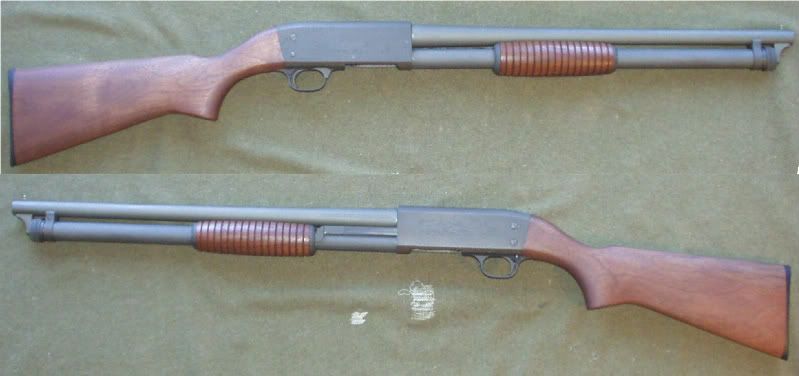 |
| Ithaca Model 37 Riot - right and left side views |
"It" is a 1964 manufactured Ithaca M37 Featherlight, parkerized 12 gauge riot gun with 2-3/4" chamber, 20" barrel and full-length/7-round magazine. UNFIRED, formerly mint and NIB (I've ruined that by simply removing the barrel), this gun has a left-hand safety. That will be changed. It is unfortunate, but I've already discovered that putting my finger on the trigger it automatically pushes the current safety to the ON position, blocking the trigger and making this combat shotgun unshootable. Fortunately, the Ithaca M37 safety is easy to reverse requiring only a bit of screwdriver work (properly fitting screwdrivers, please), time and a right hand safety button. I think this is likely the reason this gun remained in unfired condition.
The Ithaca 37 Featherlight is a legend in the world of pump-action shotguns. The gun was designed by the famous firearms designers John Browning and John Pedersen and first sold as the Remington Model 17. The Model 17 was a 20-gauge of trim proportions which was later redesigned and refined into the popular Remington Model 31 which was replaced by the Remington 870 which is still made.
 After World War One, the Ithaca Gun Company was searching for a pump-action shotgun to produce and compete with the Winchester Model 12. Ithaca waited for Remington Model 17 patents to expire in order to produce that gun. After preparing for production of the Ithaca model 33, they found more Pedersen patents that would not expire until 1937 so, along with the introduction date, they changed the model designation from 33 to 37.
The Great Depression and approaching world war wasn't the best time to introduce a sporting shotgun. That the M37 soldiered through the war proves it is a sound design. Production of many sporting guns ceased during this same period.

This configuration is pretty much limited to use as a self-defense or police firearm. The 7-shot magazine makes it illegal for hunting in most states and most game. Being mostly out of production now, or at least at low production levels compared to some other shotguns, there aren't a lot of accessories out there. I kinda like that. While I have a fully accessorized, modular Winchester 120 (their successor to the M37's competitor the Winchester M12) I like the almost retro simplicity of this shotgun.
Disassembly
Before attempting disassembly, unload the magazine and chamber. To empty the magazine, push in the spring shell stop (13) on the inside of the receiver. Ease the shells out one by one. Pull back on the slide release on the forward side of the trigger guard, and pull back the slide handle to empty the chamber.
To re- move the barrel (1), pull back on the slide release and pull the slide handle assembly (12) to the rear to open the breech. Pull up the magazine nut pin (2) and use it as a lever to rotate the magazine nut (3) until the projection on it is free of the barrel lug. The magazine nut pin was furnished only on guns built prior to 1955. On later-built guns having no pin, simply rotate the magazine nut (Fig. 1).
The barrel is joined to the receiver by an interrupted thread. When the magazine nut is free of the barrel lug, give the barrel a one-quarter turn in the direction shown (Fig. 2) and pull it free of the receiver. The magazine tube and slide handle assembly will remain attached to the receiver.
The stock (53) must be removed before disassembling the action. First remove the buttplate screws and buttplate. The stock is attached to the receiver by a stock bolt (26) that has a square head with a slot so that it can be removed with a long screwdriver or socket wrench (Fig. 3).
With the stock removed, turn out the trigger plate screw (17) (Fig. 4) and slide the trigger plate group to the rear (Fig. 5) and out of the receiver. Remove the carrier screw lock screws (56) and carrier screws (55) from the receiver. Hold the receiver bottom up with the magazine to the left, and with a punch pull the slide pin (33) toward the body (Fig. 6) until the slide bar can be pulled forward from engagement with the slide (35). Pull the slide, breechblock (52) and carrier (42) together rearward out of the receiver.
The top extractor (47) is retained by a powerful spring. To remove it, use a thin punch to push the spring plunger back; at the same time push the extractor out of its seat (Fig. 7). The bottom extractor (43) can be removed easily by driving out its hinge pin (48). To remove the firing pin from the breechblock, first drive out the check pin (49). Then the firing pin and spring (51 and 50) can be removed easily rearward.
Reassembly is in the reverse order.
After about 20 min. including time figuring out WHICH pin punch to use for what AND moving the vise from one bench to the other, I've got a right-hand safety on the Ithaca M-37. Just in time, maybe, well, you know what I mean...
Gunpartscorp.com got the part to me in 4 days start to stop including a Sunday. A record. Correct part and fast...
I had a left-hand Ithaca M-37 safety with large button which I offered for sale here and on a couple of forums. As I believe I noted above, I HAD to switch because putting my finger on the trigger often pushed the safety button to the safe position. Not good in the middle of "use". I had a lot of interest (I was a bit surprised) but folks didn't want to pay as much as Numrich Gun Parts was charging for a used right-hand safety. I sold it for $20 shipped. $25 was too much for anyone but they wouldn't even give a counter-offer. In as much as it seems critical for certainty of use to have the correct safety and the left hand safety seems to be much rarer than the right, AND there are a lot of people out there looking for the left-hand safeties, this might not have been a good move on their part.
Links:
- Ithacagun Featherlight
- Manual - a PDF from Steve's Pages
Subscribe to:
Posts (Atom)


