Tuesday, September 20, 2011
Whip it out, jump and shout...
I have carried a knife since I was 7 or 8 when Dad gave me a Case boy scout knife for my birthday. Sadly, that treasured companion is in a rocky crevice at the bottom of Lake George in New York. Since then others have tried to replace it. The two shown here have done that.
The first in daily duties performed is the Leatherman K2 Juice. I don't think there's a day that goes by that it doesn't come out of the pocket for a necessary chore. Every once in a while I sharpen the un-serrated blade. The serrated blade is seldom used but cuts like the devil when it is used. The saw blade has even parted a 2x4 but that did take time. A smaller piece of wood suits it better. The pliers are used all manner of things not suited to fingers be they hot, sticky, small or simply disgusting. The screw drivers are of useful sizes and temper and also see a lot of use. The small straight blade can be used in eyeglass repair and this alone makes them useful.
The next is a stainless Spyderco Delica. It replaced a Zytel handled Delica that lept off my pocket at the movie theater never to be seen again. It hasn't cut much but it is always ready. In some ways it is a back up for a bigger friend. I did once carry an Endura but Virginia law is such that I thought I'd stick with the shorter bladed Delica.
That bigger friend is a S&W 642. Sans lock but with the MIM parts, this is a good gun and rides every day in the Simply Rugged pocket holster.
Monday, June 08, 2009
'Splain this to me...
There is something about the date stamp. Why STAMP the date (of which the year is blurred) when you can simply edit it in the word processor? As an old admin guy (as well as lazy infantryman), I'm wondering if they decided to change the date, used whiteout and then stamped over the old date before reproduction and distribution. Then again, why wouldn't they just change the date, in the word processor, and distribute via e-mail or web-site for the unit to print and make copies where necessary. Yes, Virginia, there are electronic signature files...
Saturday, June 14, 2008
Little Hatchet in Need of Handle
I'd like to get it set up and make it available to my grandson and granddaughter as a tool with which they can learn to use the hatchet at a young age (parents permitting). It is just such a neat thing. Unfortunately, I don't know the maker and don't think that I have the skill to make a handle from scratch as my paternal grandfather would have done.
In my research I have found at least one really neat source for tool handles and that is the House Handle Company of Cassville, MO. You really need to look at this company's wares.
Thursday, June 28, 2007
Burn some time in the AC...
Friday, June 08, 2007
Nifty Illustrations of Firearms Operation
1 - Genitron S&W M66
2 - STI International 1911
AND sword parts
1- Katana parts
Wednesday, May 09, 2007
Cold Steel Proof Videos
Why? Because even the cheap stuff like the Canadian Belt Knife I reviewed earlier is a great product and it only costs you $10 or so. That defines inexpensive but it is a GOOD knife. How much better are all these other products.
If you can't buy a knife you can watch the videos. Now there's an evenings entertainment. The only thing better would be to have half-covered , leather and mail clad amazons doing the cutting.
What do I want? I'd like the 1917 Cutlass, the Warrior Katana, the Dragonfly Wakazashi, the Scottish Dirk, the Scottish Broad Sword, the Boar Spear, a couple of Finn Bears, and the San Mai Gurkha Kukri. They also have this neat Swiss Halbred in the catalog as a closeout for $50 and shipping but I haven't got the $50! Oh, drat.
No, it isn't as if I need any of it, particularly a halbred, but darn if I just find edged weapons fascinating.
Tuesday, May 08, 2007
Wristbreaker
Ames Mfg. Co.
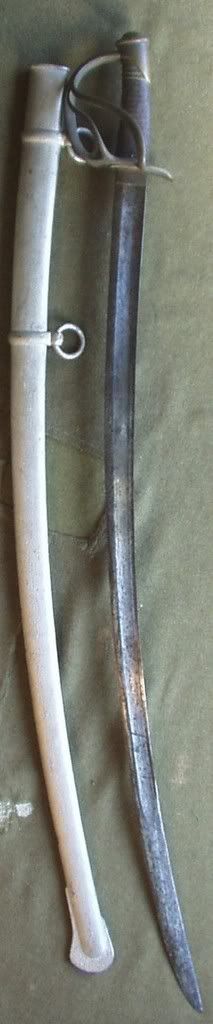
The Ames Company started production of military contract swords in 1832 with the M1832 foot artillery sword, and ended with the M1906 cavalry saber in 1906. Ames produced more swords for the American military than any other company before or since, totalling over 200,000 swords in service by the end of the Civil War. In that time, at least ten different manufacturing marks were used on the swords. A little knowledge of the company history helps place a date range for when each stamp was used. When the company started producing swords it was led by Nathan P. Ames, and most marks reflected that fact. In 1847, Nathan died and left the company to his brother James. The markings on the blades were immediately changed from N.P. Ames to Ames Mfg. Co. In 1848, the town of Cabotville was incorporated into Chicopee, Massachusetts, and the marks were once again changed to reflect this. I have, however, seen blades dated as late as 1850 that still bear the Cabotville stamp, as the old dies were probably used until they were worn out.
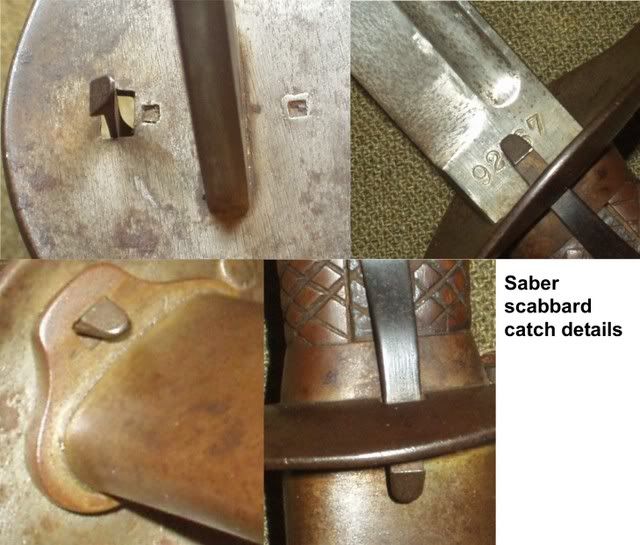
The M1832 foot artillery swords, being Ames's first swords, were stamped with the eagle trademark already common on their other products. The attached picture shows most of the important details of the sword, except for the fact that the scabbard stud appears to have been removed and two carrying rings were attached. I have also observed several examples dated 1835 that do not bear an inspector’s initials on the blade. In most cases the marks will show some wear from being rubbed by the scabbard, and may be partially or mostly obliterated. Dates found on this sword range from 1832 to 1862, and I have included pictures of swords from every decade included in that span. The early models of this sword were marked as having been made in Springfield instead of Cabotville. The M1841 cutlass (dated 1842-1846) is the only other military issue Ames sword marked this way. The cutlass has been seen to list either the Springfield or Cabotville address, although these swords lack the eagle mark.
Ames’ second contract was for the M1833 dragoon saber. A rather clumsy weapon, it was quickly replaced. The marks on this saber appear to have actually been engraved into the blades, rather than stamped. In cursive script, they read N.P. Ames/Cutler/Springfield/year, and are dated from 1834 to 1839.
The 1840 models of cavalry, NCO, light artillery, and musician swords tend to have identical styles of marks for corresponding years. This trend continues when the 1860 models of cutlass and cavalry saber are introduced. The 1840 models’ were originally marked with N.P. Ames/Cabotville/date in the 1840s, followed by Ames Mfg. Co. /Cabotville/date around 1847, then by Ames Mfg. Co/Chicoppee/Mass in the 1850s. The latter mark was also used through the Civil war on some cavalry sabers. Sometime in the late 1850s (the earliest I have seen was 1859), Ames started using a new mark on all enlisted models that was carried through the Civil War. The words Made by/Ames Mfg. Co/Chicopee/Mass are enclosed within an unraveled scroll, and initials/US/date is stamped on the opposite side of the blade. This scroll mark is usually very weak, and often has been partially worn down by the scabbard—this is a feature that helps in authenticating the sword. I have also seen one other Ames mark, which I've seen repeatedly, but only on M1860 cavalry sabers dated 1864. The mark is shaped like an arc with the words Ames Mfg. Co/Chicopee,/Mass.
This is the sword that comes to mind when one imagines the illustrious cavalry charges of the Civil War. This sword was used in the US from 1840 through the Mexican War, the Civil War, and finally the Plains Indian Wars of the 1870's and 1880's. The sword was not loved by the Cavalry - officers and troopers alike - and earned the name "The Ole Wrist Breaker". The weight of the sword gave the impression that, when wielded strongly in a downward stroke, the momentum developed could not be slowed by the frail human wrist; therefore "breaking the wrist"! It replaced the US Model 1833 "Dragoon" Saber.
The "Light" Cavalry Saber of 1860 (aka New Model) was meant to replace the 1840 Heavy Cavalry, but this was not to come until long after the Civil War. The designations Heavy and Light do not necessarily refer to the weight of the sword; they do, in fact, refer to the "shock" impact delivered during a "charge". A Heavy Cavalry unit was more "heavily armed" whereas a Light Cavalry unit was "lightly" armed.
This sword, by far, is one of the most pleasing to own and display.
The specimen that I have is of brass hilt construction, with brown (almost black) leather-wrapped grip, and twisted brass retaining wire.
The Model 1840 is another derivation from French patterns - likely the Modele 1822 Cavelerie - and there are many variations (mainly imports), with some having iron hilts (forged steel) finished "in the black".
Saturday, April 21, 2007
More Knives, Knives, Knives...
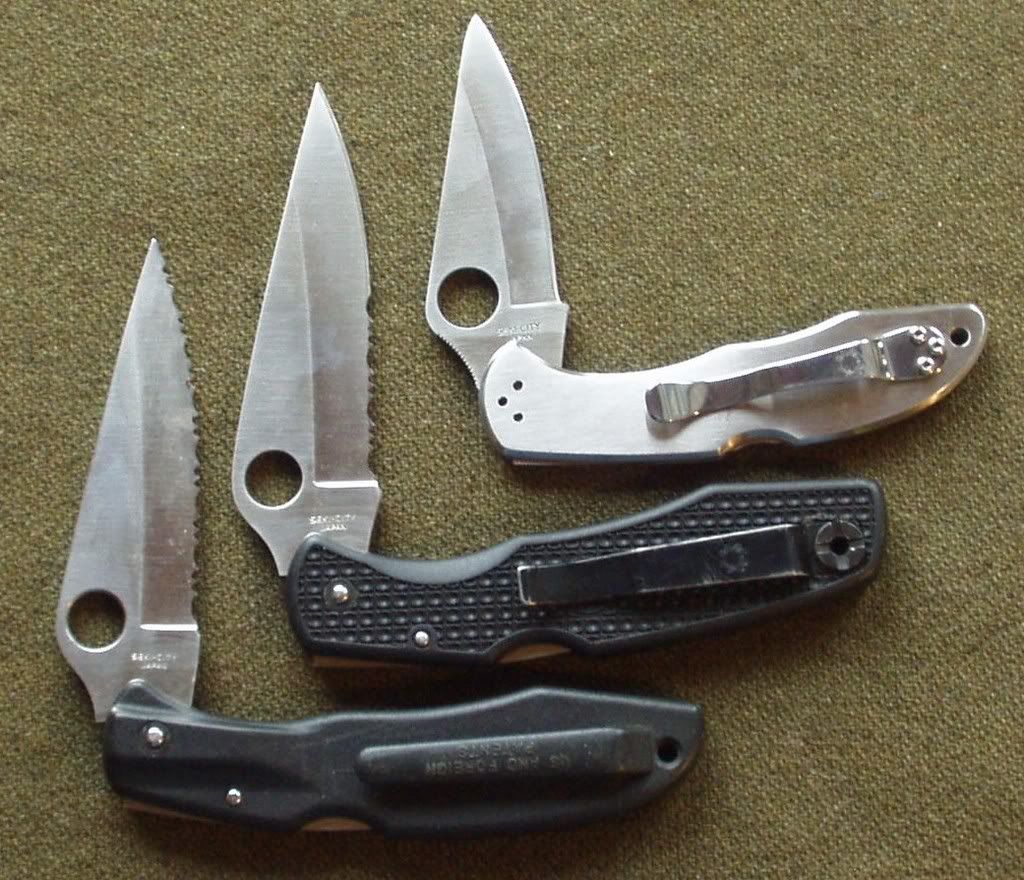
Yep, I messed up on this one. Too many knives I suppose. I do indeed have an Endura with the combo edge. An older knife, it has the metal clip on the reinforced fiberglass handle but I quit using it because the clip would tear the heck out of my pants pockets. The newer Endura with the integral clip doesn't do that. Neither does the Delica with the stainless steel clip but that is because the clip has had all the edges rounded so that they don't cut the material.
For those who might be confused, from top to bottom, Delica, Endura w/metal clip, Endura w/integral reinforced fiberglass clip.
Sunday, April 15, 2007
Ontario Pilot Survival Knife
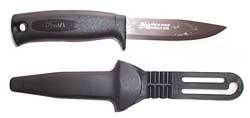
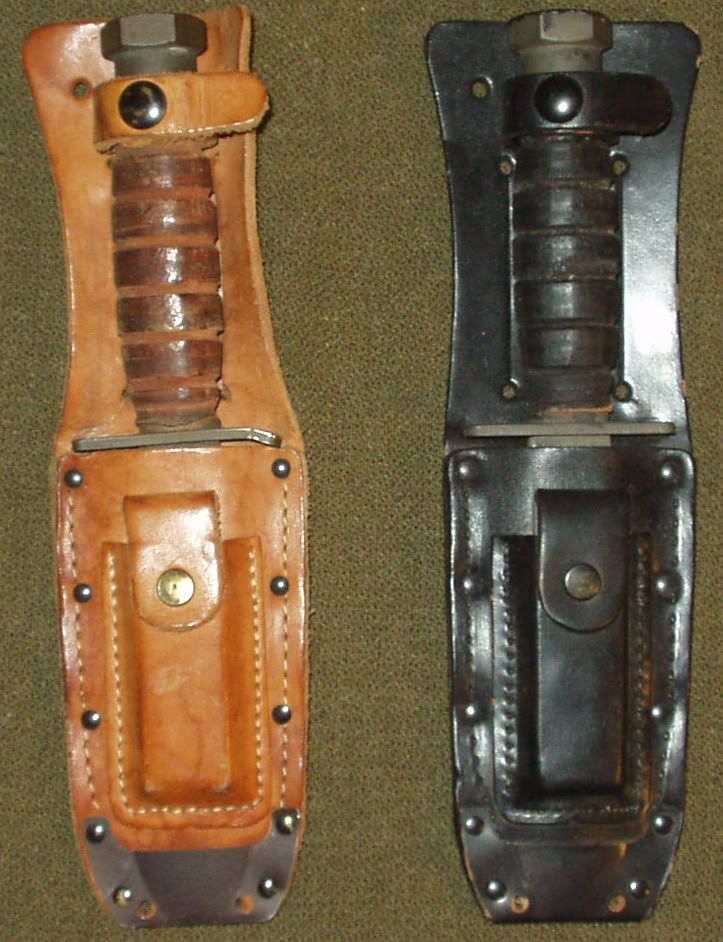
They both have good sharp edges, now, and the sheathes have been waterproofed. The left with a common leather waterproofing formula and the right one with a waxy dye. Made in 1986 and 1987 respectively, these once retailed for about $15 but I understand that with these sheathes, these knives now retail for about $60. Yes, I'm glad I found them. They now rest in the bin with the rest of my knives. 19 quarts of knives...
Someday, some grandkids are going to be mighty happy with all those cool knives.
Friday, April 13, 2007
Cold Steel Canadian Belt Knife - UPDATE
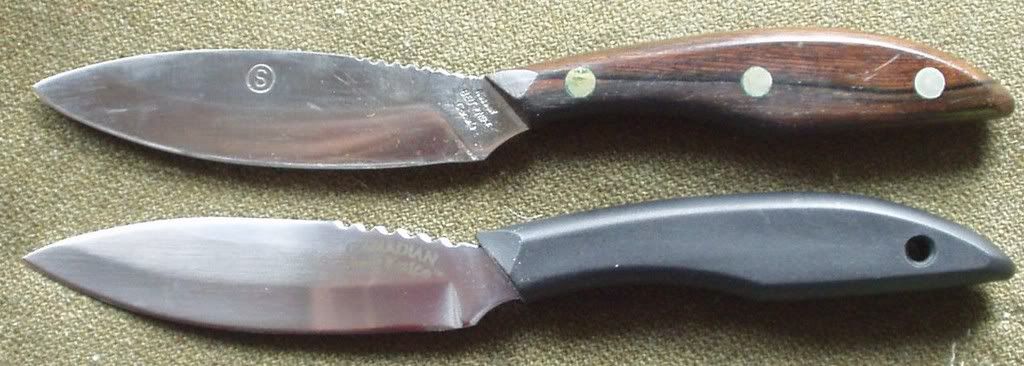
Look at the photo. The Cold Steel (CS) copy of the Russell Canadian Belt knife is directly next to my 1972-3 made knife. Let's go point by point.
While the original is a full tang knife, the CS isn't. At least you can't see the tang hidden in the molded polypropylene handle. The original has a nice wood grip but I was impressed by the CS handle which seems much denser than I expected. At least that's the impression despite the weight of the knife, much less than the original even though the dimensions are so close that the CS knife can use the original's sheath. However, the CS knife's handle is just a shade larger which is only apparent when the knives are side-by-side. The original does lack one thing the CS knife has, a lanyard hole.
Frankly, I had to work to get the edge on my original to be as good as the CS knife edge was out of the box. I can't yet speak as to how durable the CS knife edge is but the original's will hold up very well in normal hunting duties.
You might note that the famous Russell elliptical blade, which has won awards for design, is really just a single edge spearpoint blade (the handle off-set gives it added functionality). One can easily stick "things" with it. Note also that the butt has a nice striking point and the grip won't slip in your hand. Gives one thoughts that it might be a bit more versatile than first thought.
The sheaths are different as one would expect for the price difference. My original sheath is a well-crafted leather pouch and the CS knife comes with a nylon pouch that is just good enough for carrying the knife. One could invest in a Kydex pouch but unless one makes it oneself the cost would be more than the knife. As it is this is a good inexpensive knife that should do a fine job for the outdoorsman.
One thing that is clear is that the CS knife is made in Taiwan. This may be important to some users. As to purchasing the knife, I just did a search for "cold steel canadian belt knife" on Froogle and sorted by price. Only because the knife was out of stock at the cheapest provider did I pay $9.31 per knife. Compared to the $16-something MSRP, this is a great price.
Ghurka Kukri (Khukuri)
"The Origin of the Kukri"
Kukri is the now accepted spelling; “Khukuri” is the strict translation of the Nepali word. Either way the thing itself is the renowned national weapon of Nepal and the Gurkhas.
A Nepali boy is likely to have his own kukri at the age of five or so and necessarily becomes skilful in its use long before his manhood. By the time a Gurkha joins the army, the kukri has become a chopping extension of his dominant arm. This is important, because it is not the weight and edge of the weapon that make it so terrible at close quarters so much as the skilled technique of the stroke; it can claim to be almost impossible to parry.
It is important to remember that the kukri is a tool of all work, at home in the hills and on active service it will be used for cutting wood, hunting and skinning, opening tins, clearing undergrowth and any other chore. From this it is plain there can be no truth in the belief that a Gurkha must draw blood every time before he may return the kukri to its sheath.
The oldest known Kukri appears to be one in the arsenal museum in Kathmandu, which belonged to Raja Drabya Shah, King of Gorkha, in 1627. It is interesting to note that it is a broad, heavy blade. However it is certain that the origins of the kukri go far further back. There is one tenable story that Alexander’s horsemen carried the “Machaira”, the cavalry sword of the ancient Macedonians, in the fourth century BC on his invasion of north-west India. Its relationship with the kukri is plain. A third century sculpture, of which only a much later Greek copy exists, shows what is probably a Scythian prisoner of war lying down his arms. The weapon looks amazingly like a modern kukri.
In 1767 Prithwi Naraayan Shah, King of Gorkha, invaded the Nepal valley: In September 1768 Kathmandu surrendered and Prithwi Narayan became the first King of Nepal. That his troops defeated much larger forces must be credited at least in part to their unusual weapon, the kukri. It is reasonable to suppose that this was the beginning of the universal custom of Nepalese troops carrying the kukri, a custom that spread in time to Gurkhas serving in the British and Indian Armies. It was carried also by many other hill units, regular and irregular: Assam Rifle Regiments, Burma Military Police, the Garhwal and Kumaon Regiments. In the Burma campaign of World War those British troops who did not carry a machete carried a kukri, and nowadays the Singapore Police Force also carry them.
Most hill villages in earlier days would have a Smith (or Lohar of the Kami clan) who forged kukris for the people: now there is a good deal of mass production, though the best are still made by skilled craftsmen. In World War II Gurkha recruits were issued with mass-produced government kukris but nearly all brought back their own from their first leave. Weight, balance and fit are crucially important.
The blades of ordinary kukris vary much in quality. Many are made perforce from inferior steel and cannot hold a sharp edge: Good ones are forged from railway track and old motor vehicle springs. The best are forged from the finest continental steel and can be of the highest quality, fluted and damascened. The scabbards are made of wood covered in leather with a protective metal cap over the point. Two pockets on the back holding a blunt steel for sharpening the blade or striking sparks from flint (the chakmak) and a little knife (the karda) used for skinning small game or as a penknife, some also have a little purse for the flint.
Most handles are made of wood, often walnut or pat-pate (talauma hodgsoni). They are secured to the handle either by rivets through a two-piece hilt or by the tang inserted through a one-piece grip and riveted over the cap. In a good example the scabbard (dap) may be adorned with cloth-work or engraving and the hilt made of bone, ivory, horn or metal probably decorated.
Village working kukris are much coarser affairs, often with heavy wooden scabbards and comparatively clumsy blades.
Piuthan in the west and Bhojpur in the east are well known cnetres of kukri manufacture: Choosing examples from east to west and from the 18th Century onwards, we can see many styles and several types. The long, slender blade is characteristic of early work and of eastern Nepal; the shorter, round-bellied weapons are common later and in western districts: but there are exceptions to this rule.
There is no specific set of dimensions, but the standard length of service and general use kukris is twelve or thirteen inches. A Kothimora kukri may be any reasonable size though many of the best are service length.
The most impressive are the ceremonial and sacrificial blades. They must be capable of cutting cleaning through the powerful neck of a water buffalo. They tend to be twice the length and weight of a soldier’s kukri with the hilt to fit a two-handed grip.
One interesting curiosity is the ‘kukri-bayonet’ for the old tower musket. There is a drawing in Perceval London’s book “Nepal”, Volume 1 page 96, of a Nepalese Guard of Honour (of between 1813 & 1837) at the present, muskets complete with kukri-bayonets: But each soldier had his own fighting kukri in his belt. So clumsy a weapon must have been for ceremonial purposes only.
The notch (kaura) in the blade near the hilt arouses much interest. Although it may certainly act as a check to excessive blood on the hilt, and be used to catch and neutralise an enemy blade, it is essentially a Hindu religious and phallic symbol. There is a strong analogy with the hand-guard of the crusader sword, which protected the sword-hand but equally represented the Christian cross and was commonly used as the guarantee of an oath- the right hand being placed on the cross with such words as “by these hilts”. Reference will later be made to myths but it is suitable to say here that the “Kaura” or notch is not an ingenious sight with which to aim an about to be thrown kukri. Except in desperation, as a man might hurl his empty rifles in a last defiance at the enemy; a kukri is never thrown: the Gurkha prefers to keep it in his hand.
The religious significance of the kukri must not be forgotten. In 1948 Maharaja Padma Shamser Jangbahadur Rana, Prime Minister and Supreme Commander of Nepal, wrote, “The Khukri is the national as well as the religious weapon of the Gurkhas. It is incumbent on a Gurkha to carry it while awake and to place it under the pillow when retiring. As a religious weapon it is worshipped during the Dasain (the most important Hindu festival) and other times whenever any sacrifice is to be made.
In the Army Dasain is of the greatest importance: During it the regiment’s arms are blessed, and goats and buffaloes are sacrificed in the process – not now in this country. At home in Nepal goats dedicated to various causes are despatched and then proved and chosen experts ceremonially sacrifice a male buffalo in the name of the regiment. The large kukri “Konra” (in the village) is used because the head must be cleanly severed with one blow. When that is achieved, which is nearly always, the blessing of the gods lies on the people for the ensuing year. If the stroke fails, leaving even so little as an inch of the dewlap uncut, bad luck will follow. It is custom the custom to honour the successful headsman with a “Pheta” (white turban) bound round his forehead, an honour much valued.
Associated Myths & Legends
The kukri has somehow produced a fertile crop of myths and legends in the western world; and the most impossibly wild amongst them are the most tenaciously believed. Two already mentioned are that a kukri once drawn in whatever circumstances must taste blood before it is resheathed. Also that a Gurkha, if he possibly can, will take careful aim through the symbolic “kaura” or notch and then hurl the weapon like a boomerang, snick off the enemy’s head and casually snatch the kukri out of the air as it returns. If the first of these were true no Gurkha would survive to adulthood: He would lose pints of blood every day as he chopped wood, sharpened a wooden peg, opened a tin of beans and slashed down encroaching undergrowth. After each task he would have to shed some of his own blood. The second fails to stand the test of a little thought. Much as anyone would hate to be in the path of a flung kukri, one would hate much more to oppose one in the hand of an angry Gurkha.
Not very different is the story (set variously in China, Italy, Burma and the North West Frontier) of the Gurkha coming suddenly on the enemy soldier. Naturally he struck first – the decapitating blow. “Yah, missed!” said the enemy. “Try shaking your head,” came the reply.
Finally a true story told by General Sir (later Field Marshal Viscount) W J Slim.
“Early in his command of 14th Army he encouraged constant patrolling by all forward units. One Gurkha patrol on return presented themselves before their General, proudly opened a large basket, lifted from it three gory Japanese heads, and laid them on his table. They then politely offered him for his dinner the freshly caught fish which filled the rest of the basket.”
Nepal, the Gurkha, and the Kukri: The three of them are inseparable in reputation, and the Gurkha Soldier keeps his kukri as he keeps his honour – bright and keen.
Links:
- Cold Steel San Mai Kukri
- Cold Steel Kukri Machetes
- Khukuri House
- Northern Virginia Bando Association
Wednesday, April 11, 2007
Leatherman's Products
The Leatherman Mini-Tool was my second Leatherman purchase was a direct result of my satisfaction with the first tool and a need/desire to have a smaller tool. It was pretty good but having to unfold it to use the pliers and not having the leverage (not quite despite it being advertised as full sized pliers) of the larger tool caused me to put it away.
The Leatherman Wave was my 4th multi-tool. It was a gift from an outgoing commander who felt that I'd been an asset during his command tour (and rightly so!). Best darn gift I've ever received in the military. Many thanks to then Captain Patterson. I really liked the Wave because like the Gerber multi-tool I'd been issued it had rounded handles that didn't test one's ability to withstand torture while using the pliers and unlike the Gerber, couldn't/wouldn't pinch the palm if the plier jaws slipped off the work or when the wire cutters snipped through the work. Quite nice to use and it came in a wonderful leather pouch. Class act all the way. I have to wonder how the market changed so that this tool has been discontinued.
The Leatherman Juice is a series of slightly different tools in size and configuration targeted at more upscale recreational users. They are also treated to anodized aluminum scales in various colors to generate interest in the display cabinet... I've got a KF-4 in my pocket as I write this and am very pleased. If there is any gadget it doesn't have that I think it should that would be scissors. Not to worry, Leatherman makes a juice with scissors and I have one but it hasn't been so important to me that I've bothered to break it out of the vacuum pack! Of course the KF4 or Solar is the one Juice that's been discontinued! I like it because it is about the perfect pocket size tool, the screwdrivers all work, the pliers work as they should, and the knife blades are good enough to replace the SAK.
I bought a Squirt for my daughter this past Christmas. She's an enthusiastic user and says it has proven to be very handy while still being unobstrusive on her key chain!
Tim Leatherman did have a bit of a problem with many in the sporting world when he decided to support John Kerry for President. I e-mailed him about his stand and how it might affect his sales. We started a regular little correspondence for a while and he was always polite but firm in his beliefs. I don't think we'll be well served by boycotting him and based on his buyer demographic, we're not likely to affect his sales all that dramatically. For certain, he makes about the best multi-tool out there. Frankly, I take a bit of pleasure in using his tools to do the good work and support my ideas and the right thought.
Thursday, April 05, 2007
Canadian Belt Knife from Cold Steel
Wednesday, April 04, 2007
Knives, Now Hatchets
The first are these three. The one I've had the longest is the oldest in style. From the bottom we have a tomahawk I bought from Dixie Gun Works in 1975. I used to take my lunch at Mission Account at FT Hunter-Liggett, CA to throw at an old stump out front of the compound. Then I started hunting the ground squirrels who were mocking me from their holes on either side of the stump. After about 1000 throws I actually brained one of the little buggers! I think that the Native Americans and Mountain Men didn't throw these things, they kept them firmly in hand. Much more certain in execution! Mine is on the second handle. The first I still use as a mold mallet.
I've not used the next two at all although I've had them for some time. The middle hatchet is a common mass produced item from one of the big box stores. Nothing special and apparently not useful as I've not got any wear on the blade!
The second is a Fiskars using the latest in metalurgic and fabrication technologies. The Fiskars handle will supposedly resist destruction even when run over by a truck (shown in one of their promotional films). I got this one to carry in the truck but the Woodman's Pal has generally proved to be more useful. At least enough so that I've never used the Fiskars hatchet. Still it is a cool thing. You might notice some similarities to Gerber's product...
Then, of course, I've some full size working axes. These I've used! Sometimes, although it is a bit more work, it is a bit less trouble to grab the ax than to fire up the chainsaw. One doesn't need to worry with the noise or fuel either. I've single bitted and double-bitted axes. The double-bitted are good because not only do they look cool and let the Walter Mitty in us think that we're Paul Bunyan but each edge can be sharpened differently so that one edge is for splitting and the other for cutting or just to have a replacement edge or one edge that can be used next to "obstacles".
Axes and hatchets are fun but clearly not all that important to me.
Wednesday, March 28, 2007
Yet More, Knives, Knives, Knives....
I've used this machete which is of much better quality than many of today's manufacture and with a neatly tooled scabbard to boot, and I've used it a lot. Still, it is in good condition. In many ways this is like a short sword and indeed there are still some who would use it as such. In any case the steel is of good quality easily taking an edge but holding that edge for a reasonable period.
I seldom use it anymore though. Mostly I use either an Army issue type or a Woodsman's Pal for such tasks. I'd rather preserve this old friend for another day. It is seldom enough that one finds a blade of this quality in this condition to waste in on vines and fence rows.
The Collins Company has a long and storied history so much so that a book was written on the subject, Collins Machetes and Bowies: 1845 - 1965, by Daniel Edward Henry which, because it is out of print, now sells for more than $95 a copy!
Next is a current, standard issue US Army machete. The 18" blade is about 1/8" thick and the handle is of plastic as is the sheath. Included on the sheath is a an integral sharpener. I've used this particular machete for about 15 years. These things are hell for stout and I've never seen one broken, yet. Mine was made by Ontario and is used as you can tell by the grime on the blade. This thing is great for reaching where the Woodman's Pal can't so that you can avoid spines and stickers. I don't care how tough you might think you are spines and stickers can be really irritating so why put up with such if you don't have to!
The History of the Woodman's Pal®The Woodman's Pal is probably the best tool for clearing wire fence lines as the it is realtively easy to keep the edges from striking the metal wire. This keeps the working edges sharp longer making for easier, more efficient work. Anything to cut my time doing chores, well I'm all for that. As you can see I actually use mine!
Frederick Ehrsam was not only an expert on edge tools used throughout the world. By the time he settled in Pennsylvania, in the 1930's, the Swiss National was also an experienced architect, artist, engineer, manufacturer, and woodsman.
Over the next ten years, all these skills would be used in the creation of a tool that would eventually influence modern forest and land management.
Professionals in the forest and field relied heavily on the machete for clearing brush and blazing trails. Other tools were also needed to thin, trim, chop, and prune.
Frederick Ehrsam saw the need for a single implement that could not only perform the task of each as well or better, but could eliminate drawbacks like awkward weight or bulk, lack of balance or versatility, and designs unsafe for the inexperienced user. In 1941, Frederick Ehrsam introduced the Woodman's Pal®. Professionals in forestry, agriculture, and horticulture quickly recognized it as a historic achievement.
This new tool did not go unnoticed by the US Military. The Woodman's Pal® or "LC-14-B" in military terms, was standard issue from the early part of World War II through Desert Storm. G.I.'s and the US Army Signal Corp. relied heavily on the Woodman's Pal for land clearing operations. At the time of the Vietnam War, the Woodman's Pal® was designated the "Survival Tool, Type IV" and was issued in air crew survival kits.
I have lots of knives, as you've seen, but I've not told you about the multitools. That is for another time...
Friday, March 23, 2007
A Sword for Service
| My Type 32 "Otsu" Sword |
| The Chape |
The sword has survived nearly 100 years quite well as evidenced by the fact that the serial number on the scabbard (shown here) and the blade match. The scabbard is in good condition and the quality is apparent in that the brazed seam (it was stamped as one piece, folded over and brazed) is in excellent condition. Also, the throat of the scabbard is brass lined to protect the blade.
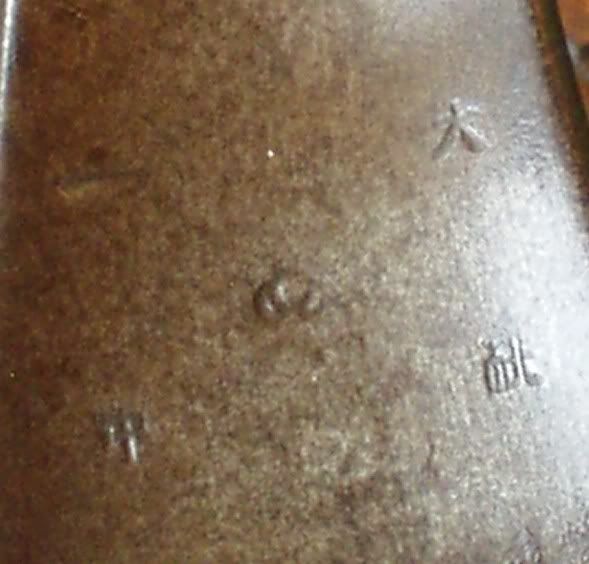
| Guard Marks |
These Japanese sabers, introduced in the late 19th Century, have arsenal/machine made blades with serial numbers on the ricasso and will commonly have arsenal stamps on the guard. The hilt back strap on Type 32 model (such as this one), introduced in 1899 and produced until 1945, is checkered steel (commonly blackened). The wood grips are also checkered. There is a leather finger loop on the inside of the guard. The blades have a long, wide fuller running the total length of the blade. The scabbards are steel with a single suspension ring. These are commonly mislabeled as 1886 cavalry sabers. The type 32 replaced the earlier enlisted men's swords and the brass hilt Type 25 Cavalry & NCO sword. There are two lengths, the longer 33" bladed sword being for Cavalry NCOs and enlisted men while the shorter 30.5" bladed sword was for other branch NCOs. This has the shorter blade.
| As it should be... |
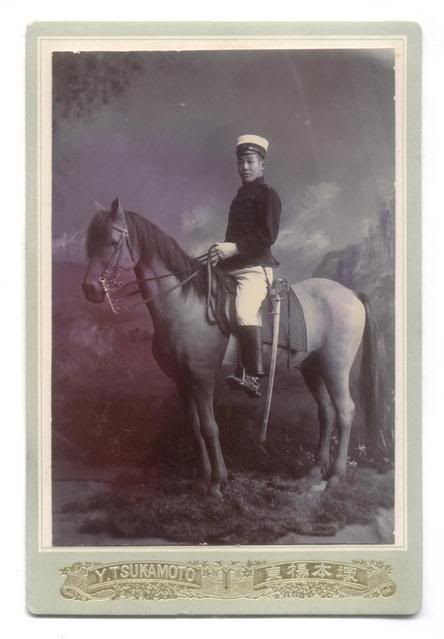
These are using swords/sabers not the dress items one often sees from about this period in Europe. During the Russo-Japanese war, battles were fought almost entirely with sword and lance backed up by artillery. Amazing but apparently both sides needed to conserve ammunition! Here's a pic of a cavalry officer of the period.
Links:
- Russo-Japanese War Research Society
- Notes on the Russo-Japanese War
-
Tuesday, March 20, 2007
More Knives, Knives, Knives...
The other is one of the Leatherman Juice series. This is the KF4. I've had several Leathermen (dang I'll have to hunt those up, too!) but this is about an ideal balance for pocket carry and useability. Not only does it have blades (serrated and plain) but file, screwdrivers (phillips and blade), saw, pliers, wirecutter and awl. Since Tim Leatherman came out with tools I've had one with me most everyday. I use them, too. Great idea.
There will be more, I've got swords, multi-tools and more knives...
Knives, Knives, Knives
| RH-32 |
| Marble's Ideal |
| Buck 112s |
| Gerber Sportsman II |
| Parachutist's knife |
| Military 4-bladed utility |
| Gerber LST II |
| Spyderco Endura |
| Assorted Swiss Army Knives |
| Gerber Guardian |
I have more but those will have to wait until later.
Monday, March 19, 2007
An Interesting Thing..
Saturday, March 03, 2007
Spyderco Joy
I carried an Endura with the combo edge for many years in the military. I would clip it inside the top of the front button row on the BDU jacket. That left it readily available and concealed from everyone. A perfect, last ditch back up just in case somebody tried to use me for access to the unit arms vault.
Now that I'm a civilian, I have admit that I more closely adhere to certain rules and laws. In Virginia 3 inches is the maximum length of a hidden blade including a folder. In truth, I got the Endura when there was no Delica and bought the Delica as soon as it came out and carried the Delica in civvies while the Endura stayed with the uniform. The 2-7/8 inch blade of the Delica is all one needs to make a slashing attack and get away from an attacker and is more than enough blade length to cut strapping such as seatbelts in an emergency. The very sharp Spyderco edge Even cuts through heavy rope in a heartbeat. Unfortunately, I lost my Delica! The integral clip on my fiberglass reinforced handle apparently slipped off it's mooring and took the knife elsewhere. I was heartbroken.
Unfortunately, the clip is at the wrong end for me. When I pull the knife from the pocket I like the knife to have the thumbhole (patented by Spyderco) under my thumb. The position shown in the photo doesn't allow that when the knife is clipped into my right front pants pocket. I needed to change the position of the clip.
Spyderco has some thoughtful designers because they know that any given clip position won't work for all their users. Being able to move the clip is a big plus. Spyderco also uses a neat 3 screw arrangement to fasten the clip to the knife. If you prefer, you can remove the clip all-together! Great versatility. What Spyderco doesn't mention anywhere is that the screw heads are TORX heads.
As you know I mentioned before that I just started wearing my new bifocals. The T6 size head of these screws is so small that I couldn't see that they were a TORX head and wasted a lot of time looking for a proper fitting hex key. Finally, I was looking at the screw heads and hit the correct focal point with the glasses and noticed the distinctive shape of the TORX head. Viola! But a T10 (available in the wrench sets now available as are the hex sets) was too big. So a search of the local hardware stores finally turned up the necessary T6 bit which was used this morning to satisfy my soul. My C11 now resides, safely, in my right front blue jeans pocket. Oh JOY!