
Showing posts with label SelfDefense. Show all posts
Showing posts with label SelfDefense. Show all posts
Sunday, August 19, 2012
Need some training?

Tuesday, January 03, 2012
Smith and Alexander Main Spring Housing for Lightweight Officers' ACP
 |
| Lightweight Officer's ACP with Lanyard Loop |
Thursday, December 22, 2011
Colt Officers' Lightweight...
 |
| The new to me gun... |
For a long time I was dead set against these guns because previous experience led me to believe that the short barrel just didn't work with the old Browning mechanism. Lately, however, a couple of friends have demonstrated that their guns are dependable. So, I wanted one but I wanted to go all the way on the concealment theme and get a lightweight. This has proved to be a problem.
I'd been following them on Gunbroker.com and when I finally ran across one with the box for a reasonable to me starting bid I jumped in. Anticipating its momentary arrival, I've ordered some coco-bolo stocks and spare magazines. The wood is pretty indeed and I think it does much more for the gun than the rubber. As you can see, I got more than the basic Lightweight Officers' ACP and this one is the enhanced model with the cut-out behind the trigger guard so that you can grip it just a bit higher.
|
| With new stocks and lanyard loop |
I've got a Milt Sparks Summer Special (which I've now been told won't be here before 1 July) and a Simply Rugged Cuda holster ordered for this gun.
Wednesday, September 21, 2011
Walgreens Pharmacy Robbery Gone Wrong
A few months ago now, a Walgreens pharmacist defended himself and his customers and employees by shooting back at two men attempting an armed robbery of his store. Walgreens fired him as a result. Whether they are concerned about liability if one of their employees shoots somebody or if they don't give a damn about the lives of their employees or customers I don't suppose we will really know until we have audio and video of the board meetings concerning this. What we do know is that armed resistance to aggression works as it did here.
It apparently bothers the company that the pharmacist who was dismissed for not allowing his own murder or an influx of hillbilly heroin into the local economy decided to release the video of that incident. David Hardy has a link to the incident but I couldn't view it using his link so tracked the video down and here it is. Please note that the electric doors were an obstacle for the criminals and they had problems breaking contact.
It apparently bothers the company that the pharmacist who was dismissed for not allowing his own murder or an influx of hillbilly heroin into the local economy decided to release the video of that incident. David Hardy has a link to the incident but I couldn't view it using his link so tracked the video down and here it is. Please note that the electric doors were an obstacle for the criminals and they had problems breaking contact.
Monday, February 28, 2011
A Rifle to Full-fill Your Civic Duty?
You might or might not see the connections between my last few articles. I'll leave it up to the reader to draw conclusions as to my point(s).
Back in 1999 there was much consternation over the Y2K event and anticipated difficulties that would accompany computer failures cascading around the world. Even before this, there were people who had coined an acronym for such events, TEOTWAWKI or The End Of The World As We Know It. But they weren't the first, various religious groups have long fore-told of the end of the world, the apocalypse, and today there are those who use the Mayan calendar and Nostradamus in an attempt to convince that the end times will come on December 21, 2012. Of course one can simply look at the news from the middle east with the people in countries such as Tunisia, Egypt, Jordan, and Libya as well as our own states of California, Wisconsin and Indiana to see a trend to unrest and civil upheaval. Such things give one pause, at the least, and make the wise person consider preparations to avoid problems if such things happen in their area.
What preparations? Well, certainly it depends on what you believe will happen but there are some very basic things one can do that aren't outrageous and can be useful even if nothing happens. Ensuring one has enough food for 2-3 months on hand, that one can purify water, that one can generate electricity and/or have light at night if the electricity is cut off, that there is at least some extra fuel for vehicles and some medical supplies on hand (for treatment of injuries and continuing medicinal care) are all important and things we should do in the event of natural disasters. I'm not going to address those here. I'm going to talk about something else that one should do and that is having the means to defend oneself and protect one's other preparations.
I would even submit that self-defense (including the defense of one's family) is a civic duty. At the least it will free police and National Guard responders to deal with other things which helps the entire community. It is codified in the militia laws for those men aged 16-55 (although the ages may differ state-to-state). Certainly, one should live up to one's responsibility to one's own family (and friends) and self-defense demands the appropriate tool.
I know that there are those who will advocate the shotgun and/or handgun for this purpose as they do now for self-defense in the home or concealed carry. Unfortunately the effective range of the shotgun is insufficient for the single user and most people using a handgun are simply going to be out-gunned by any attacker outside their home using anything else due to their inability to hit targets at greater than armed robbery distances. I'm sure there are exceptions and I feel the shotgun and handgun are excellent for certain applications. However, I think that the single firearm, where only one will be used, for this application is the rifle. What rifle? Now that might be a conundrum...
One characteristic of such a rifle is that it should be chambered for a common cartridge. I further submit that it should be a cartridge common in the midst of such a circumstance. Some cartridges might always be stocked by the local gun store but did you know that FEMA and standard police policy is to secure your local gun store in the event of extreme civil unrest? You're just not going to be able to run out and buy a couple extra boxes of .243 Winchester and such. What I'm talking about is what you can store up quite a bit of or easily find "on the street" in such a circumstance.
Certainly, the most common cartridge is the .22 LR but some people won't have confidence in it even though the Israeli Defense Force has actually used it to eliminate riot agitators. One can store quite a large stock of .22 LR in a small space and it is easily moved if that becomes necessary. It is likely that your neighbors might have a box or two (50-100 rounds) in a drawer some place and it might be possible that a looter driven off might drop a box or two that you could recover. What other cartridges might we consider?
Well, number two would have to be the .223 Remington or 5.56mm NATO. Police use it, the National Guard and all other military organizations use it and it is tremendously popular among younger shooters. It will be everywhere. It is cheap enough that you can stock a realistic quantity at relatively low cost and certainly other people will do so. It is VERY likely to be available at any given place during such an emergency.
What else is out there? For pistol cartridges available in carbines both the 9mm NATO (Luger) and .40 S&W are used by the military and police. Other rifle cartridges used certainly include the .308 Winchester or 7.62x51mm NATO (used in police counter-sniper rifles and military medium/GP machine-guns). You might even count the .30-06 due to the wide distribution of M1 Garand rifles and CMP ammunition. Certainly there are going to be regional differences. E.g. in some localities the .30-30 (.30 WCF) is ubiquitous and a rifle chambered for it might be a reasonable choice. In any case reason/logic must be applied to the choice as there is no room for sentiment or nostalgia. This is an important decision as it will determine what rifle is used.
So the next question is, what rifle to use? The first requirement is most certainly that it be a repeater. Let's face it, a single-shot requires an extremely high-level skill set on the part of the user and that for use against the average group. Just about any single user would be overcome by a group of any size or higher than average skill level. Remember, this isn't about being fair or nice, it is about winning, it is about survival. So what sort of repeater?
A bolt action is simple and usually robust. Unfortunately the magazine capacity of 4-5 rounds is usually not sufficient and non-military surplus arms lack any method for rapid reloading. One nearly ideal bolt action gun is the British #4 or SMLE rifles. Unfortunately acquiring their ammunition might be problematic. There are usable .223 rifles but they might better be used in the counter-sniper role than as general defensive weapons.
The lever action really only applies to such as the .30-30 or rimmed pistol cartridges such as the .357 Magnum and .44 Remington Magnum. If you have one it could be useful but if you have to start from scratch for this purpose they might not be best choice, again due to ammunition availability. Properly managed they can be very effective in defending against groups of "bandits". There are some chambered for the .22 LR and .308 Winchester but none chambered for the other choices and the cost of some of those rifles is right up there with any AR system rifle.
As an aside, there is only one pump action rifle with detachable magazine for the .223/5.56mm cartridge and that is made by Remington. In some localities it might be necessary to buy this action type but there is a reason that there is only one such made and sold in the USofA.
The truth is that the standard for modern self-defense rifles is a semi-automatic such as the AR15 type. It is a huge advantage for most people both in terms of trigger control and delivering repeat fire to have a semi-automatic firearm. Choosing an AR15 type rifle provides the added benefits of interchangeable magazines on a proven system designed for the .223/5.56mm cartridge. One can get interchangeable uppers for other cartridges for other uses but those would be a secondary use. We're talking about the primary purpose of which is self-defense.
Other reasonable semi-auto options would include the Ruger Mini-14s, the M-14 such as the Springfield Armory rifles and carbines and the M1 Garand. The reason to get any of these isn't price or interchangeability of magazines (clips for the Garand) but for reasons of availability, familiarity (thus avoiding additional training time) or a need for greater range (the .308 and .30-06 will greatly outrange the .223/5.56mm cartridge). Rural folks may have or feel there is a real need for the latter.
So, we have a rather truncated discussion of the subject, for the moment, but it comes down to this, an AR15 type rifle in .223/5.56mm is my choice. It will shoot bullets from 55 to 77 gr. and uses any readily available military or police ammo in the standard magazines (if that should become necessary). It is light, compact (telescoping stock and 16-1/4" barrel). It will do for me.
Wednesday, October 13, 2010
Don't Talk to Police
Well, in specific instances such as when you are being investigated, just shot somebody in self-defense, etc you need to keep your mouth shut. I might have posted this before but was motivated to do so again because of this blog post and comments on a forum.
I know that most people will be wanting to do the right thing, tell the truth, etc but the fact of the matter is that the police don't believe you and have to do their own investigation. That's the best case scenario. Depending on where you live and who you appear to be to the police you might have to deal with varying degrees of prejudice, incompetence, and/or corruption. If you are particularly paranoid you can see how even if the local system (including the jury) absolves you criminally and/or civilly, the Feds might jump in to prove a point.
I want to add that this is particularly difficult for me to write because I have so many friends who are or have been policemen and/or agents in some enforcement agency. They are my friends because THEY are reasonable and intelligent and able to make reasonable and intelligent decisions. This isn't about them. This is really about their ambitious supervisors and those co-workers who are without a shred of decency or are marginal performers. There are just too many of those people to take chances and it only takes one to ruin your life.
Links:
- What Every Gun Owner Needs to Know about Self-Defense Law PDF
Now here's some info from Masaad Ayoob, expert witness on firearms and shooting incident dynamics...
Saturday, September 18, 2010
"Why I Carry a Gun" by Anonymous
People also ask why..?
Why Carry a Gun..??
I don't carry a gun to kill people.
I carry a gun to keep from being killed.
I don't carry a gun to scare people.
I carry a gun because sometimes this world can be a scary place.
I don't carry a gun because I'm paranoid.
I carry a gun because there are real threats in the world.
I don't carry a gun because I'm evil.
I carry a gun because I have lived long enough to see the evil in the world.
I don't carry a gun because I hate the government.
I carry a gun because I understand the limitations of government.
I don't carry a gun because I'm angry.
I carry a gun so that I don't have to spend the rest of my life hating myself for failing to be prepared.
I don't carry a gun because I want to shoot someone.
I carry a gun because I want to die at a ripe old age in my bed, and not on a sidewalk somewhere tomorrow afternoon.
I don't carry a gun because I'm a cowboy.
I carry a gun because, when I die and go to heaven, I want to be a cowboy.
I don't carry a gun to make me feel like a man.
I carry a gun because men know how to take care of themselves and the ones they love.
I don't carry a gun because I feel inadequate.
I carry a gun because unarmed and facing three armed thugs, I am inadequate.
I don't carry a gun because I love it.
I carry a gun because I love life and the people who make it meaningful to me.
Police protection is an oxymoron. Free citizens must protect themselves. Police do not protect you from crime, they usually just investigate the crime after it happens and then call someone in to clean up the mess.
Personally, I carry a gun because I'm too young to die and too old to take an butt whoopin'
Friday, September 17, 2010
Bug out or bug in, guns and other "stuff"
Whether one should be bugging out or hunkering down in response to disaster are big topics lately. It seems that, just as in the 1950s when backyard nuke shelters were all the rage, uncertain times now have people looking to plan for the very worst they can imagine. There are, given certain circumstances of natural or man-made disasters, advocates for either course of action.
Staying in place means that you have all your assets such as stored food, cash, water, ammo, clothing, furniture, etc. All can help you survive. Even if you don't use it yourself any property can be traded for other things you might really need. People never think of it but some sandbags and a shovel might be a useful adjunct to whatever firearm you have. Another benefit is the friends and family you might have in your established location. Neighbors who know and trust you aren't bad either.
As to firearms, something to carry always to get you to the heavy artillery which can reach out but deal with multiples and reload rapidly. For a lot of people that will be a 5.56/.223 autoloader though some will be better served with a .30-something autoloader.
Again, a good defensive position is a force multiplier. It was an old saw in the military that the defender could resist a force at least 3 times their number.
As Rob Leahy puts it:
Bugging out, i.e. being mobile, is supposed to help you avoid those problems but it comes with problems of its own. First and foremost you are exposed to attack because you have no defensive positions but those you happen to be on when attacked. When you "bug out" you leave your home and you leave your friends, family, contacts and "stuff". You have limited supplies because you can't carry but so much. Also, you are likely to be moving through an area where you have no ties to the local population (who might help). Family and friends (real friends, not nodding acquaintances) can mean the difference between survival and becoming plant food. Remember also, that in leaving you are abandoning the largest part of assets you've accumulated over your lifetime. The idea really is that you will re-establish yourself in an unpopulated area. There are those who support the concept. I well remember Bradford Angier's book, "How to Build Your Home in the Woods".
Wherever you are you must have, as said before, food, water, heat (in cold weather), shelter (including shelter from attack i.e. defensive positions), and sanitation facilities (i.e. toilets). Firearms might be necessary to keep these things for yourself not to mention to keep you alive. Any injury is to be avoided and is potentially life threatening. Merely having medical supplies isn't enough, you have to have the skill to use them correctly and without waste.
Many ridicule such considerations as a waste of time. Is it? Ask those who have lived through hurricanes, wildfires, earthquakes, floods and riots. Did reasoned preparations help them? Of course they did.
The first thing you need is water. Without water all other choices lose their "optional" status. Stores of water, means of purification and an idea where you might get more if you need to are things you should have ready and on hand.
You need flexibility. You may have decided to hunker down and ride it out but if something happens to destroy that you need the option to move. Having a plan to bug out and fuel in a vehicle capable of going makes it a more reasonable option if worst comes to worst and you have to move.
Of course flexibility also means you have to have the means to stay and ride it out.
I think the #2 thing you need (after water) is sanitation. If the water system fails, if the sewers back up or simply don't flow, you still need to rid yourself of waste. I suggest a shovel for a hole in the back yard. If you only have a few days, you can deal with it. If it lasts longer than that, so can the neighbors. I'd put some lime in a nice safe dry place to spread on "it" to keep the disease carrying vectors (flies) off "it".
Then you need food. You'll probably want to cook it as well, particularly if you do the smart thing and start on the refrigerated and frozen stuff if you've lost all power. If you put back canned foods, for extended needs, you will need to rotate it. This pretty much mandates that you actually eat what you store not just buy some food because it is edible and in a can. This is particularly true for those with dietary concerns or picky and stubborn children (or mentally challenged adults).
Which brings us to medical supplies. You must be able to treat cuts and puncture wounds. You absolutely can't have infection and you must be able to stop the bleeding. It is probably a good idea to have meds for those with chronic conditions. Aspirin is always handy. Remember that you won't be able to depend on access to a doctor and/or hospital.
You also need shelter. Shelter isn't just a roof over your head. It must get you out of the heat to conserve water and it must keep you out of the cold. People can survive what we consider extreme temperatures but you must be prepared for the weather in your area. Particularly in cold climates you must be prepared to depend on your clothing to keep you warm. Don't be like the fashion conscious teenagers I see who are wearing no coats in winter because they are counting on a quick transition from building to transportation to keep them warm.
Firearms? You need a handgun to have with you all the time. It will get you to the heavy artillery. In town? Get a shotgun. In the country? Maybe a shotgun AND a rifle. There should be enough arms to arm every person in your group who can shoot and adhere to the "rules of engagement", i.e. the law.
If you can do all this, you just need enough on hand to continue without outside assistance.
Staying in place means that you have all your assets such as stored food, cash, water, ammo, clothing, furniture, etc. All can help you survive. Even if you don't use it yourself any property can be traded for other things you might really need. People never think of it but some sandbags and a shovel might be a useful adjunct to whatever firearm you have. Another benefit is the friends and family you might have in your established location. Neighbors who know and trust you aren't bad either.
As to firearms, something to carry always to get you to the heavy artillery which can reach out but deal with multiples and reload rapidly. For a lot of people that will be a 5.56/.223 autoloader though some will be better served with a .30-something autoloader.
Again, a good defensive position is a force multiplier. It was an old saw in the military that the defender could resist a force at least 3 times their number.
As Rob Leahy puts it:
Unless you make your move BEFORE disaster strikes, you might be stuck. many western metro areas can be crippled with a couple car wrecks at the big stack style interchanges. Phoenix officials revealed their big emergency preparedness plan- walk away. HAH! Smack dab in the middle of the Sonoran desert. That will be ugly.We can interpret that to mean a good defensive position includes heat, food and water. This has always been true. However static defenses are subject to siege. You must either outlast the siege or you must destroy that enemy. Likely, you can't do either without help of some kind. In the past nature has helped those besieged by subjecting the besieger to disease and horrible weather. Sometimes, friends/allies have attack the siege forces from behind and destroyed their ability to feed or water themselves.
South Central Alaska is worse off; 80 percent of the homes built in the last 20 years are solely dependent on natural gas for heat (Thank you 5 Star energy ratings). If a Quake breaks a gas line a BUNCH of folks are gonna freeze.
Bugging out, i.e. being mobile, is supposed to help you avoid those problems but it comes with problems of its own. First and foremost you are exposed to attack because you have no defensive positions but those you happen to be on when attacked. When you "bug out" you leave your home and you leave your friends, family, contacts and "stuff". You have limited supplies because you can't carry but so much. Also, you are likely to be moving through an area where you have no ties to the local population (who might help). Family and friends (real friends, not nodding acquaintances) can mean the difference between survival and becoming plant food. Remember also, that in leaving you are abandoning the largest part of assets you've accumulated over your lifetime. The idea really is that you will re-establish yourself in an unpopulated area. There are those who support the concept. I well remember Bradford Angier's book, "How to Build Your Home in the Woods".
Wherever you are you must have, as said before, food, water, heat (in cold weather), shelter (including shelter from attack i.e. defensive positions), and sanitation facilities (i.e. toilets). Firearms might be necessary to keep these things for yourself not to mention to keep you alive. Any injury is to be avoided and is potentially life threatening. Merely having medical supplies isn't enough, you have to have the skill to use them correctly and without waste.
Many ridicule such considerations as a waste of time. Is it? Ask those who have lived through hurricanes, wildfires, earthquakes, floods and riots. Did reasoned preparations help them? Of course they did.
The first thing you need is water. Without water all other choices lose their "optional" status. Stores of water, means of purification and an idea where you might get more if you need to are things you should have ready and on hand.
You need flexibility. You may have decided to hunker down and ride it out but if something happens to destroy that you need the option to move. Having a plan to bug out and fuel in a vehicle capable of going makes it a more reasonable option if worst comes to worst and you have to move.
Of course flexibility also means you have to have the means to stay and ride it out.
I think the #2 thing you need (after water) is sanitation. If the water system fails, if the sewers back up or simply don't flow, you still need to rid yourself of waste. I suggest a shovel for a hole in the back yard. If you only have a few days, you can deal with it. If it lasts longer than that, so can the neighbors. I'd put some lime in a nice safe dry place to spread on "it" to keep the disease carrying vectors (flies) off "it".
Then you need food. You'll probably want to cook it as well, particularly if you do the smart thing and start on the refrigerated and frozen stuff if you've lost all power. If you put back canned foods, for extended needs, you will need to rotate it. This pretty much mandates that you actually eat what you store not just buy some food because it is edible and in a can. This is particularly true for those with dietary concerns or picky and stubborn children (or mentally challenged adults).
Which brings us to medical supplies. You must be able to treat cuts and puncture wounds. You absolutely can't have infection and you must be able to stop the bleeding. It is probably a good idea to have meds for those with chronic conditions. Aspirin is always handy. Remember that you won't be able to depend on access to a doctor and/or hospital.
You also need shelter. Shelter isn't just a roof over your head. It must get you out of the heat to conserve water and it must keep you out of the cold. People can survive what we consider extreme temperatures but you must be prepared for the weather in your area. Particularly in cold climates you must be prepared to depend on your clothing to keep you warm. Don't be like the fashion conscious teenagers I see who are wearing no coats in winter because they are counting on a quick transition from building to transportation to keep them warm.
Firearms? You need a handgun to have with you all the time. It will get you to the heavy artillery. In town? Get a shotgun. In the country? Maybe a shotgun AND a rifle. There should be enough arms to arm every person in your group who can shoot and adhere to the "rules of engagement", i.e. the law.
If you can do all this, you just need enough on hand to continue without outside assistance.
Wednesday, July 28, 2010
Pistolet Makarova by Bulgaria - UPDATED
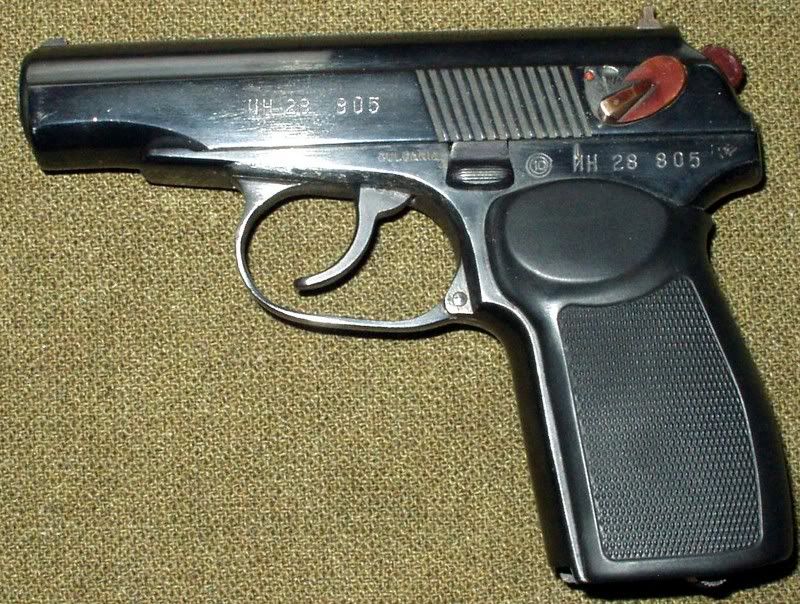 I was once asked about the Bulgarian Makarov. I like the pistol and said so. I thought I'd post a few of my observations about my pistol here.
First, it is accurate, reliable and relatively inexpensive. Mine cost $159 but I think you'll pay at least $250 today. The best ammo, cheaper than reloading, came from Dan's Sporting Goods at $60 per 500, shipped. You couldn't beat that and I tried. I've got dies, 250 Starline cases (excellent brass) and Hornady XTP. Still, reloading was more expensive than the Barnaul 95 gr. hollow-points from Dan's and you have to hunt down those valuable brass cases. The Barnaul is steel cased and Berdan primed, hardly a practical reloading proposition. Now, with the change in the Euro/Dollar exchange rate and diversion of the ammo to various hot spots, you might re-look reloading.
With carbide dies, reloading is really a snap. I'm sure you could set up a progressive press to load vast quantities of this cartridge. I used the Hornady XTP bullets over 4.1 gr. of Unique using a CCI small pistol primer for 927 fps 181 fpe. In contrast the Barnaul 95 gr. load produces 1025 fps and 222 fpe. Federal ball produced 965 fps and 195 fpe. Silver Bear ammo using the 120 gr. bullet produced 932 fps 232 fpe. Obviously one can do better ballistically than with my handloads, but they are accurate.
For accessories like my Fobus paddle holster we used to have Makarov.com, another well run business. The fellow who ran this knows his products and provided fast service together with good product. Unfortunately, they are no longer in business.
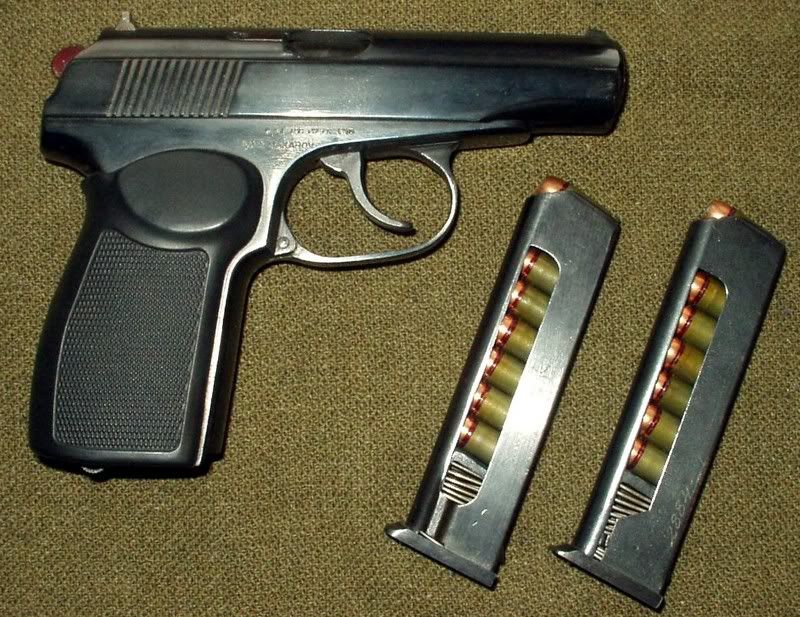 The pistol has possibilities I didn't consider when I first saw it while in the military. It is relatively light for a field pistol. It fits my hand well with the Pearce grips. The Fobus paddle holster is light and comfortable AND it secures and protects the pistol properly. It is accurate. I got groups, two-handed standing, of 2 inches at 25 yards and I have killed a groundhog at a measured 80 yards with a single shot in the chest (a little to the right of center). There was some luck involved (no doubt!) but it wasn't all luck. I believe the cartridge is at least as effective as the .38 Special and that is enough gun for most people, particularly in the east. It isn't particularly loud. It doesn't kick too much which is good for new shooters and those who are recoil sensitive. It is safe, having a double action and de-cocking safety that seems very sturdy. I think that this makes it a good bedside gun, at least during the summer when an intruder is less likely to be wearing a bulky winter coat. Fixed sights mean they probably won't go out of adjustment.
The down side is that, while the grip fits me and my average size hand, it could easily be too big for those with smaller hands. The Pearce grips are actually a bit bulkier than issue but they are also much more comfortable.
The sights that it comes with are very basic. Non-adjustable except by drifting in the dovetail, the rear sight has sharp edges that might not be compatible with some clothing. I ever so slightly "broke" the corners and edges on my pistol's sights. The rear blade has a nice square notch but these are black on black sights. Some people prefer the dots, etc. The good news is that after market adjustable and night sights are available but they can cost nearly as much as the pistol. My eyesight isn't such that I really benefit from such sights.

Bulgarian Makarovs were made at the state military factory in Kazanlak, aka factory number 10. That is why the Bulgarian pistols are marked with a 10 inside a double circle on the left of the frame. Production began in 1970, continued under direct Russian oversight in 1975 and in 2000 the date codes were eliminated and replaced with numerical dates immediately following the serial number.
Man At Arms Magazine reported the following information about the serial numbers that owners will find interesting:
Bulgarian Makarovs have unusual serial numbers composed of three groups of characters: two capital letters, two numbers, and then an additional sequence of numbers. The two numbers in the center indicate the year of manufacture, but in a slightly confusing way. You add those two numbers to the year 1960 to ascertain the year of manufacture. For instance, a center number "31" would indicate a manufacture year of 1991 because 31+60=91. By the way, the final group of numbers is the actual serial number, while the two letters are a code indicating the production batch that the serial number belongs to.

Parts List
1) Slide
2) Ejector
3) Main spring
4) Trigger
5) Trigger transfer bar
6) Magazine
7) Hammer spring
8) Sear
9) Disconnector
10) Hammer
Field Stripping - After removing the magazine and emptying the chamber, pull the trigger guard down in the front and move it to the right (as seen with the bore pointed away from you). Pull the slide all the way back and lift the rear of the slide. The slide will now come forward and off. Now remove the return spring off of the barrel. Reassemble in reverse order.
original post 3/7/07
This is a video showing the gun as used by a Chinese policewoman. It is "graphic" although less so than a Sam Peckinpah movie. However, to view you might need to sign in to YouTube and verify your age...
Friday, January 29, 2010
Diamondback Arms DB380

The DB380 is the only gun that Diamondback Arms makes. It is a .380 ACP chambered small pistol designed to compete with the Ruger LCP, Kel-Tec P3AT, Taurus PT738, S&W Bodyguard 380, Kahr P380, SIG P238 and Magnum Research Micro Eagle.
It is a striker fired, locked breech, .380 chambered, polymer framed pistol with an MSRP of $430. Likely street price will be something less. I've heard that it will actually retail for about $350 which is competitive with the LCP.
I haven't shot one but I have gotten to handle one a bit and dry fire it. It has several features going for it. The first is that the size is about perfect as it is small but I can easily get a grip on it. Also, the sights are actually usable. Neither would be great shakes for the gun if the trigger wasn't also lovely. It is no great trick to keep sights on target all the way through the trigger pull. This is the first pocketable .380 that I have actually considered buying.
An interesting aside. It was suggested that the Kel-Tec P3AT magazines would work in the DB380. While the baseplate is much smaller on the P3AT magazine, it does work in the DB380. By the way, the first magazines were made by Mecgar. Quality mags are needed in a semi-auto pistol and Mecgar makes a quality magazine. The pistols are now shipping with magazines of a different make but no problems with these magazines have been found.
Links:
- Diamondback Firearms DB380 Semi-Auto .380 ACP Pocket Pistol by Jeff Quinn
Addendum - I got to test fire one of these with a mix of ammo. The owner was complaining that it wouldn't feed anything. With me shooting it fed everything, mixed or not, hollowpoints and FMJ. I think he's limp-wristing it. I like it.
Saturday, January 09, 2010
Tactical Shotguns
A friend wrote and asked me to help with a particular video. While looking for that video I found this one. I'd never seen the show, don't know who has. I don't think I can get it on my service. So, I posted here.
Sunday, November 15, 2009
While the Cains might be living the good life...
...the rest of us have to deal with "civilization". Here's some cogent words on how to do just that.
Monday, November 02, 2009
Smith and Wesson Bodyguard Airweight (pre-38)
 The Bodyguard Airweight (aka pre-Model 38) was introduced in 1955. That's when I was "introduced". It has the built-up frame to shroud the hammer. This was intended to minimize hammer spur snags on clothing when drawn while allowing manual cocking if desired. I don't suppose that, given the intended use, it is surprising that the airweight/alloy frame version was introduced before the all steel version. The 5-shot cylinder is steel. Most barrels are 2-inches.
 My gun came to me from a local collector who was moving it on and was accompanied by its original box. It doesn't have the tools.
Saturday, October 31, 2009
Smith and Wesson 49

Mine is the blued steel version (they were also factory nickeled) and has the usual 2-inch barrel (3-inch barreled guns are rare).
Sunday, October 04, 2009
Smith and Wesson J-Frame Model 36-1

The Smith and Wesson Model 36 is a .38 Special chambered revolver made on the "J" frame. The "J" frame was developed from the slightly smaller "I" frame used for .32 S&W chambered revolvers by slightly lengthening the cylinder window to hold a longer cylinder needed to chamber the .38 Special cartridge. These have been around a long time now. The gun was introduced at the International Association of Chiefs of Police (IACP) conference held in Colorado Springs, Colorado, in October 1950, as the Chief's Special. When Smith & Wesson went to a number system in 1957, the Chief's Special was designated the Model 36. They have a good reputation for reliability but aren't considered extremely accurate.
The .38 Special chambering was good for me as I had a quantity of ammunition I'd loaded for the Security-Six. At the time, much of it was 148 gr. wadcutters over 2.7 gr. Bullseye. These worked great for practice and as a small game load. Yes, I hunted with the gun. My other load was the Speer swaged 158 gr. HP over 5 gr. of Unique. This is a good solid load and the one which was kept in the gun when fulfilling the self-defense role. A couple of squirrels fell to this gun and load. The range was very short but it still gave me a good bit of confidence.
Over the years I did try Pachmayr Compac rubber grips but returned to the factory wood and then got a Tyler-T grip adapter. Good move on my part as this improved the grip while maintaining a compact grip profile that was slick and didn't catch on clothing.
I really liked this gun. It is a good one and was later augmented with the Smith and Wesson Model 13. In the back of my mind was the idea that I'd be willing to get another. I don't know why, I just liked the model. It is small but capable.
The Smith and Wesson M36 3" barrel is one of my favorite guns. I think it has perfect balance for the frame, has adequate ballistic performance for the .38 Special cartridge, gives a better sight picture, is as easy to conceal (unless you're putting it in a pocket) and has the feel of a full size revolver.
What you see here is a pair of 36-1s. The earlier one is the bottom of the two (without the Tyler-T grip adapter). It has a pinned barrel and was made about 1977. The upper, later 36-1 was made in 1982 and shows the un-pinned barrel. There is little else to distinguish the two.
M36 history begins with the very popular .38/32 (.38 S&W) Terrier I-frame revolver. The I-frame was a 5-shot hand ejector double action revolver. Its great popularity was the result of small size and light weight, but it wasn't strong enough and cylinder was not long enough for the more powerful .38 Special round. Popularity of the Detective Special demonstrated a probable demand for a gun the size of the Terrier but able to handle the .38 Special. Smith and Wesson lengthened the cylinder and frame of the I-frame, and beefed it up a bit. They dubbed it the J-frame. Within the past few years the cylinder has again been lengthened to handle the .357 Magnum cartridge.

The 36 has had "derivatives" which have become very popular. The Bodyguard (Model 38, the Airweight version and 49), the Centennial (Models 40, 442 and 642) and in .22 LR (Models 34, 43 and 63), some of which I've written about earlier.
Friday, August 14, 2009
S&W M19-5 2½-inch Round-butt

Built on what is now known as the K-frame (slightly modified), this .357 Magnum revolver was an answer to police demands for a revolver that was easy to carry for officers while still having additional "punch" over the .38 Special round nose ammo which was the standard for many years. Border Patrolman and ace shooter Bill Jordan lobbied for this revolver and after a year's experimentation by Smith and Wesson was presented with the first Combat Magnum (as it was known before model numbering by Smith and Wesson) on 15 November 1955. I was ALMOST 8 months old at the time so I know this was 54 years ago. Even after over a half-century, this model is among the most well-liked of the Smith and Wesson line. However, the company moved to the heavier L-frame to address concerns with the guns shooting loose or cracking forcing cones in using the more modern heavy 125-gr. bulleted .357 Magnum loads.
I have long wanted one of these revolvers in the 2½-inch version. This is due to how I see the .357 Mag/.38 Special +P loads' purpose. I see it as a concealed carry round. I personally prefer to carry .40-something if I am able to open carry on my belt. In that use the 2½-inch round-butt version suits better just as the fixed sight Models 13 and 65 3-inch have previously served.

I've already had to change the grips again. I put a set of Pachmayr Compacs on it but have the standard RB stocks with a Tyler-T grip adapter headed this way.
Friday, June 05, 2009
Shotgun Effectiveness
I don't know how long this will remain available but the Shotgun World Forum has a post with photos of the penetration of various loads, birdshot to slugs, in gelatin. Draw your own conclusions.
Thursday, May 14, 2009
Armed Citizens' Legal Defense Network, LLC
I bought the July/August 2009 (dang, that's early isn't it?) issue of American Handgunner for another article but I thought a blurb on page 105 was interesting.
What it addressed was a creation of Marty and Gila Hayes, the Armed Citizens' Legal Defense Network, LLC. A self-described "self-help group" the advisory board includes Massad Ayoob, Dennis Tueller, Tom Givens and John Farnam. Direct from the home page (just follow that link!)
What it addressed was a creation of Marty and Gila Hayes, the Armed Citizens' Legal Defense Network, LLC. A self-described "self-help group" the advisory board includes Massad Ayoob, Dennis Tueller, Tom Givens and John Farnam. Direct from the home page (just follow that link!)
The Network’s goal is to prevent miscarriages of justice through—
o Educating members about the legalities of using deadly force for self-defense and how to interact with the criminal justice system after a shooting.
o Creating a nationwide network of attorneys and legal experts which the member can draw upon in the event of a self-defense shooting.
o Granting financial assistance from a separate non-profit foundation to members who are facing unmeritorious prosecution or civil action after a self-defense incident.
If you possess a gun for defense of yourself and your family, we urge you to seriously consider joining the Network. Preparation to survive the second attack—the legal aftermath of a justifiable defense shooting—is a vital element in your defense preparations. Ignore it at your own peril.
Wednesday, April 22, 2009
20 ga. vs. 12 ga. for self-defense
What the gentleman (Mr. Massad Ayoob) is talking about is the use of the 20 ga. rather than the 12 ga. for self-defense due to the reduced recoil of the 20 ga. compared to the 12 ga. People of smaller stature will likely (although not necessarily so with a properly fitted gun) find the 20 ga. easier to control than the 12 ga. This is important in firing follow-up shots in the event of a miss or multiple assailants (and, no, we're not talking zombies but home invasion).
Many times the 20 ga. guns, when built on 20 ga. frames, are much lighter and so easier to handle for that reason as well. Perhaps then the recoil reduction won't be the main thing, but rather the ease of handling the slightly smaller and lighter gun will be.
It is VERY important to note that every person is different. Even of the same height and weight they may well have different proportions as well as pain tolerance levels and these both affect how any given firearm handles for them. How a gun handles is often important in the level of confidence it gives the user. Confidence can be critical in how we handle crisis. I know of no more immediate crisis than the need to defend your life or the lives of loved ones with a firearm. Every advantage that you can have increases the odds that you will win and the criminal will lose. That is down to the nitty gritty and about as basic as it gets.
Hat tip to Xavier.
Friday, February 20, 2009
Gun Safes
I was looking into my safe a while back and wondering how I was going to fit gun in there. The idea that I might need another safe crossed my mind... Maybe I need a better safe.
Gun Safes are a recurring topic on all the gun forums. Even many of us "old" timers who can remember when high security was a lockable glass front cabinet now have as good a safe as we can afford. The questions usually revolve around fire-protection, capacity, resistance to forced entry (the reason for any safe), and cost. Secondary concerns to most include weight and the related ease of installation (or removal for those who move often) while remaining resistant to illicit removal. For some, the ability to hide the safe for aesthetic reasons is also important.
Fire-protection is something that has been discussed ad naseum. It seems that every brother and his cousin has a differing opinion as to the relevance of fire protection, the time a safe must be resistant to what temperature to be effective, and whether all that will matter in a fire with the fire-fighters pouring thousands of gallons of water on the flames and your safe! I suggest reading and re-reading the manufacturer's specifications to understand what you can expect from any given model.
Where that safe will be in your home has got to be important as well. Currently, my safe is on the second story of my home. If we have a catastrophic fire it will likely drop 2 stories to the basement. That alone can't be good for the guns inside. Having the gun safe "pre-positioned" in the basement isn't a good option either as no home's sump pump can handle the amount of water put on the fire. Likely the basement will become a large pool, at least for a while. With the safe on an upper story the contents have some small chance of surviving the firemen's shower. Those who are able to set their safe on a ground level slab might have the problem licked.
You can never have too much capacity, ok, you can but many of us underestimate how big a safe we need. Some of the layouts don't allow packing our particular firearms that tightly together or for but so many longer than average guns. I've yet to meet anyone with a safe who says they wish they had bought a smaller model. Most do wish for a larger safe. The larger safe might not be easy or easy enough for the owner to move but it is more cost effective than two or more safes. So how big?
Well, my first safe was a Treadwell horizontal or chest type. It came with a rack for 12 long guns and has some room at one end for the storage of additional items. I have my handguns, in plastic storage cases factory issue or otherwise as necessary, stacked there. I had guns resting on the racks between other guns to up my capacity but this wasn't ideal.
There's one other practical matter as well. How do you tell your wife that you've accumulated so many guns that the gun safe she bought you that was "big enough for me for the rest of my life" or some such is too small and that you need a second safe? How do you justify that rather large purchase given that you may not be discussing your hobby with your partner. Unfortunate, yes, but uncommon? No. I don't have any ideas about that. Maybe you should just give up and confine yourself to but so many guns...
Here are some Safe/Vault manufacturers/brands
You might also like to watch this video from Rogue Safe Company...
And this excellent post at AR-15.com
Gun Safes are a recurring topic on all the gun forums. Even many of us "old" timers who can remember when high security was a lockable glass front cabinet now have as good a safe as we can afford. The questions usually revolve around fire-protection, capacity, resistance to forced entry (the reason for any safe), and cost. Secondary concerns to most include weight and the related ease of installation (or removal for those who move often) while remaining resistant to illicit removal. For some, the ability to hide the safe for aesthetic reasons is also important.
Fire-protection is something that has been discussed ad naseum. It seems that every brother and his cousin has a differing opinion as to the relevance of fire protection, the time a safe must be resistant to what temperature to be effective, and whether all that will matter in a fire with the fire-fighters pouring thousands of gallons of water on the flames and your safe! I suggest reading and re-reading the manufacturer's specifications to understand what you can expect from any given model.
Where that safe will be in your home has got to be important as well. Currently, my safe is on the second story of my home. If we have a catastrophic fire it will likely drop 2 stories to the basement. That alone can't be good for the guns inside. Having the gun safe "pre-positioned" in the basement isn't a good option either as no home's sump pump can handle the amount of water put on the fire. Likely the basement will become a large pool, at least for a while. With the safe on an upper story the contents have some small chance of surviving the firemen's shower. Those who are able to set their safe on a ground level slab might have the problem licked.
You can never have too much capacity, ok, you can but many of us underestimate how big a safe we need. Some of the layouts don't allow packing our particular firearms that tightly together or for but so many longer than average guns. I've yet to meet anyone with a safe who says they wish they had bought a smaller model. Most do wish for a larger safe. The larger safe might not be easy or easy enough for the owner to move but it is more cost effective than two or more safes. So how big?
Well, my first safe was a Treadwell horizontal or chest type. It came with a rack for 12 long guns and has some room at one end for the storage of additional items. I have my handguns, in plastic storage cases factory issue or otherwise as necessary, stacked there. I had guns resting on the racks between other guns to up my capacity but this wasn't ideal.
There's one other practical matter as well. How do you tell your wife that you've accumulated so many guns that the gun safe she bought you that was "big enough for me for the rest of my life" or some such is too small and that you need a second safe? How do you justify that rather large purchase given that you may not be discussing your hobby with your partner. Unfortunate, yes, but uncommon? No. I don't have any ideas about that. Maybe you should just give up and confine yourself to but so many guns...
Here are some Safe/Vault manufacturers/brands
- Browning
- Cannon Safe
- Gun Vault
- Hall's Safe Company
- Liberty Safes
- Rogue Safe Company
- Sentry Safe
- Zanotti Armor
You might also like to watch this video from Rogue Safe Company...
And this excellent post at AR-15.com
Subscribe to:
Posts (Atom)


