Showing posts with label Reproductions. Show all posts

Saturday, May 14, 2011

Merwin Hulbert Comeback?

I hope they are! These guns are some of the neatest, most intriguing frontier era revolvers I've ever laid eyes on. I'd like one but have to admit to myself I could never afford an original much less one I'd dare shoot all the time! Click on the pic to go to the company web site.

12/28/07 2135


***********


Today we have an update. For those who are really eager for the gun, drop some cash on them now. For myself, I'm waiting until they are actually in production.
Hello to all our M&H Faithful.

I guess after 18 months of getting to this point I was more jubilant than specific in our email release. Also, it seems to have gone out with our poor webmaster's email as the header, so he's been drowning in responses last night and this morning.

First, let me respond to several of the comments, concerns, and questions received in the last 24 hours.

1)The first Serial number sold will be SN 101. First come first served.

2)All deposits will go to our accounts which are held with Bank of America and or our backup accounts at Wells Fargo. Both of these banks are as stable as any in the country at the moment.

3)Use of deposits: The deposits will go towards expenses relating to production,sales, and core costs, and NOT salaries, vacations, corporate jets, million dollar pool parties with playboy bunnies, etc.

4)When? Good question. I believe in being open and honest with our customers so do I have an X date? No, but 12 months is the farthest out we are looking at currently for standardized production. I am looking at a date much sooner then that, but I don't want to over-promise and under-deliver.

5)Who? Who will be making these? Our production plan is the best, most reliable one we could think up. We are working with proven current manufacturers. Some of which I guarantee you have made the products you own currently, either directly or through R&D. So as we don't swamp them with emails, calls, etc. I'm not going to release their names, but they have a history of success and they are helping us to get up and going and when we are these partnerships will continue and most of the manufacturing equipment they are designing will be shipped in-house to a central location. This way we can start quickly and cost effectively, but your guns will be made on the same machines be they early production or one 5 years from now.

6)Movies? Yes, we have SEVERAL movies that have caught wind of this and requested immediate samples.

7)Pictures? Yes, more pictures are coming shortly. The top strap 4th model is very close in appearance to the S&W Top Break and the open top is the one in our logo.


And finally, a direct link to the order site follows. It is secured and also goes directly through Authorize.net to Bank of America, so secured straight through to the account.

http://www.merwinhulbertco.com/order.php?prod=MerwinHulbertFireArm


We'll be in touch soon!


Mike

It has been just a little over a year since my original posting.

12/31/08 1700


***********


Today we received an update from the company via a posting at Paco's Leverguns Forum. We appreciate Mike's willingness to communicate with his potential customers. The news about the Savage 99 is interesting, too!

I'm always happy to see discussions about the company. We had a few internal reasons for the deposit, but I'm happy to say we aren't counting on them as the funding source for our production. For those of you out there that don’t want to drop a 20% deposit, emails stating thoughts and intent to Sales@MerwinHulbertCo.com would be appreciated. I definitely understand the skepticism as I've heard about Merwin's coming from all sorts of sources and I've been personally told by the Italians that they are almost impossible to make. We are taking the approach of working with the folks in the industry that really do the design work for the major companies out there. Of particular interest, through our larger operation we are finishing up the project to help Savage bring back the 99 which should be at next years shot.

Happily we've had several folks come out of the blue with fixes, updates, etc. that should help us avoid issues like the Black Powder lock ups that have been reported here and most famously by Mike V, but not cause major issues with the look of the historic models. Speaking of historic models, yes, that does mean we have modern models on the way. One finally teaser here, after 3 years of extensive research we are pretty close to a good formula or two for real black powder, not that stuff out there these days. That too should help with the fouling as well as helping you actually get 40 grains into a 44-40 case without having to scrounge for questionable balloon head cases.

357 Mag in the open top will be thoroughly tested and we are considering out options there, S-7 steel being one of those. We have a few open tops that have had catastrophic failures. The barrels survive, the cylinders survive, but the center pin/rod fails at about the same point, where the cuts are deepest, every time we've seen along with the front lip of the frame bending. The top strap models don’t have any issues of this type. It is interesting to note, we’ve never seen a scalloped cylinder that has shown any signs of stress cracks, even on the blown revolvers we’ve examined.

Well folks, again, I appreciate all the discussion about the company, and I look forward to keeping in touch with all of you as things progress. I’m hoping to get these out as soon as possible as I’ve got Hollywood on me as well, so with the silver screen calling, over a 1000 buyers, 2 dozen dealers, and 3 exporters calling, we’ve got all the incentive to get going and get it done.
and this
Our order system is pretty easy, if you want 15 different barrels with 3 different calibers, order it and we'll make it. Part of the beauty of the design is that we don't have to caliber the revolver until the order comes in the door. So you tell us what you want, we pull the right frame size, the cylinder(s) you need and the barrel(s) you request and out the door they go. Same will go for the new revolvers. Dealers will be provided with cut-a-way example, on loan from the company, so that we can be sure they always have a test gun on hand. Ideally we'd like to drive most of the orders to an on demand basis so that the customer gets what they want and the dealers don't have to tie up capital in inventory. When production is in full swing we should be able to get delivery down to less than 10 days and hopefully down to significantly less than that.

2/2/09

"If you haven't been keeping up with the far more frequent updates in www.merwinhulbertco.com's Forum section, here's the facts:

"1. The Merwin 2nd Model Open-Top (1876-1880) Pocket Army and Frontier Army are completely designed in SolidWorks CAD (same program S&W and Ruger use for their pistols) by the engineering team, have had plastic prototypes run from the CAD to test their fit with the original revolvers we laser-scanned and hand-measured, and are being checked over by our West Point-educated Weapons System Engineer of 40 years gunmaking/ammunitionmaking experience. The parts can start running from that CAD at the team of shops (mostly in Montana) in our supply chain across March-May with the revolvers assembled, finished and tested at our riflemaking plant in Wyoming this summer.

"2. The Third Model top-strap double action Merwin Pocket Army & Frontier Army are mostly designed (we standardized on the best Merwin solutions across the models so there's really not a lot of changes) and CAD will wrap up in March so we expect those to be finished guns in the Fall. Not sure when or if we'll make the 4th Model TopStrap, that'll depend on sales and serious requests.

"3. The website is getting a long awaited overhaul including the order form which has driven us nuts even more than it's bothered you. We assumed too much Merwin Hulbert knowledge of customers and gave too many confusing options. It'll be a lot clearer. We're also adding more Merwin history and other useful content as well as making it far easier to update (it was taking 6-12 months for no good reason.)

"4. While we'll be adding video down the road, there's a good intro to Merwins already on www.YouTube.com from the NRA Museum's Curators Corner with longtime collector/auctioneer/Museum Director Jim Supica lucidly explaining and demonstrating the Merwins.

"5. It's taken way longer than folks that have never manufactured anything seem to think it should take (or assume manufacturers fill up a warehouse or two with finished products before trying to sell any, assuming there's a real and ready demand.) In real terms it's gone pretty fast as we're bringing back a proven design made in the hundreds of thousands for roughly 20 years. Which leaves us puzzled at the demand for working prototypes as though this was a new untried design. We are prototyping for assuring measurement errors didn't creep in from the originals (a few did, 2/1,000ths of an inch for fit of the grip panels) but are going straight to final parts from the CAD. We've made some subtle strengthening choices to a few parts but it's all original Merwin designs...the 9 designers or more who came up with this series of big .44 revolvers were very smart guys we're not going to second-guess. Metallurgy and precision are of course better given this era's choices. We make the proof ammunition for many of the large gunmakers as well as some of the biggest rounds in the world for rifles (up through .700 Nitro Express which has a 1,000 grain slug) so we're more obsessive than most about strength and reliability.

"6. Calibers (this has changed between feedback and engineering): .38 Special, .44 Special, .44-40 Winchester, .45 ACP, and we're still debating how to chamber for .45 Long Colt but not allow the smallest version of the .454 Casull to be used (while the top strap would likely be strong enough, we don't want to stress the open-top design with magnum loads since we assume you'll shoot these a lot.)

"7. Barrels have been designed so all of our models can have a set of 3 interchangeable barrels (or just 1 or 2, your choice) at 3.5", 5", and 7" lengths. Those were both historically accurate (well 5.5" is actually more historical for Merwins, but more of you wanted shorter than longer barrels so we went to 5"). You really can change the barrels in a few seconds and without a tool, a feature still basically unknown with only a few semi-automatics like the SIG and Glock offering barrel switches or the long out of production Dan Wesson revolvers. Barrels have been one of the most significant challenges to this since a Merwin barrel isn't just a steel pipe with 5 lands and grooves threaded on one end but part of the whole front of the gun and rifling revolver barrels is a mostly lost art. That's a step we're having revolver barrel rifling experts do (you already probably own some of their pistols) even though we have our own Pratt & Whitney cut rifling and button rifling inhouse
for rifles.

"8. When the new order form on the website goes up in the next few weeks, I urge you to place your orders (we'll honor your place for what you sent in already but want to confirm with the new specifications and your own interest.) Like anything ordered over the web (shipped to the FFL dealer you use), you'll pay by credit card for it, satisfaction is guaranteed (as you know Mastercard and Visa help you on that too) and we're offering a 5 year warranty on parts and workmanship. Service and repair will be available at our factory in Wyoming (but Merwin parts vary so much even within the original series of big .44's that new parts fitting your originals will be more varied than any of us expected, even with all of the parts on the new Merwins coming from original parts.

"9. We've lined up a few dealers that really focus on the CAS market in the U.S. and Europe but we expect that 98% of the Merwins will be sold directly from the website and then shipped to your favorite FFL dealer for whatever transfer fee he charges for that service and in compliance with local and federal laws since these are fully functional modern guns that happen to be 1876-1886 designs unlike say cap and ball revolvers.

"We appreciate your continuing interest and helping us figure out what to make. Let us know if you still want one or two, what you want (from what we're making above, we're past wish lists but those were quite helpful early on.) You'll be seeing these in a lot of magazine and television coverage (far more than we expected early on) but not a lot of ads-this is a small, craftsmanship project of one of our divisions rather than the next major handgun maker in the world roll-out. We expect to sell 1000-2000 of these a year and would rather make them right than often and durable rather than cheap. This confuses a lot of folks but not you. If you're ready for the revolver that most police chose back then as well as the one many of the West's top pistoleers adopted after years of shooting everything else in mortal combat, let us know. "

Al Jones
VP Marketing & Sales
Merwin Hulbert & Co.
al@merwinhulbertco.com
This message was sent by: Merwin, Hulbery & Co., 6209 Mid Rivers Mall Drive, 315, Saint Charles, Missouri 63304

The referenced video: http://www.nationalfirearmsmuseum.org Merwin Hulberts forgotten six-gun of the Old West. Jim Supica, director of the National Firearms Museum, joins John Popp to showcase the Colt Single-Action Army, or the classic six-gun, and similar Remington and Smith & Wesson models. Supica also brings a lesser-known gun from the 1880s that was manufactured by a company called Merwin Hulbert.


2/26/10

Now another update...
It's been awhile and as the Merwin Hulbert & Co. revolvers go into the later stages of production, with shipping deposited orders starting in November (we solved the barrel-making problems finally, that was a logjam for everything.)

Obviously the economy is quite a bit different from when you placed the order and everyone's circumstances change.

We've also clarified and changed what the initial Merwin line is from the very broad questions on the old order form you responded to. Base pricing though remained in tact as did additional barrels, we've got a lot more finish options worked out, black rubber grips are standard then as now, calibers are .45LC, .45ACP/AutoRim, .44 Special/Russian, .44-40WCF, and .38 Special, barrel lengths are 3.5, 5.5, and 7 inch, and the 4 frame styles are open-top Pocket Army, open-top New Army (sometimes called Frontier, like an 1860 Colt), solid-frame (sometimes called Third Model, it's the slimmer top-strap like a Colt SAA or S&W K-Frame) Pocket Army and New Army. All single action right now, double action versions of the solid-frame will be out in the first half of 2011. We're making 4 revolvers a day so it'll be awhile, and each gets proof-tested, functionality-tested, and accuracy tested before shipping. If you want to upgrade to real elephant ivory grips installed at the factory, that's $395 and no hassle.

We'll be sending you an 8-page catalog on the Merwins that explains what's available and other stuff of interest about them in greater depth than we've gotten onto the website yet.

You can decide what you'd like with what you know now and place an order by mail, fax, e-mail, etc. (and shortly the new website order form will be up) along with payment (unless it's a double action, then just send a deposit.) We've been developing and building these on our money, just like any other made-to-order product, it's not COD. The Merwins are Satisfaction Guaranteed, if not return the gun for a full refund (if it's been used normally, i.e. blowing it up with hot hand-loads or driving over it with a loaded horse trailer, nope, but we can repair it and replace what's damaged. 5 Year Warranty on parts and labor, like I keep saying we're a gunsmith-driven company and focused on making them right before they go out the door to you.

The Merwins are entirely made in the USA, not just assembled, renamed, or reboxed here. These are made literally on the Oregon Trail used by the covered wagons headed to California, Oregon, and Utah. The factory in Glenrock, Wyoming is about a two day ride from Butch Cassidy & the Sundance Kid's Hole in the Wall hideout..smack dab in the middle of the Real Old West. It's two days ride from Fort Laramie. The cattle drives that inspired "Lonesome Dove" came through here from Texas to Montana. Range wars right through here (SW of the Johnson County War, Tom Horn was a range detective hereabouts.) Fetterman Fight, Wagon Box Fight, Hayfield Fight, Red Cloud's War, that's all hereabouts. You take Old West authenticity differently when it immerses you every day.

We're only considering the orders received with a deposit as dead serious orders (and first in line,) and the orders without a deposit we're considering you telling us what you would buy but not having committed to it, essentially a market survey. We hope you've been checking the Forum section on www.merwinhulbertco.com for updates and look forward to hearing from you at sales@merwinhulbertco.com as we do from so many every day (it's a highlight, not a hassle.)

We look forward to hearing from you, especially after you've had a chance to look at the catalog, and appreciate your continued interest and patience.
23 Sep 2010


More info...
Dear Merwin, Hulbert & Co Customers, Collectors and Friends,


Before we get into the progress in production, I want to address the change in the leadership of the Merwin, Hulbert & Co project. As some of you may or may not know, I started this odyssey back in 2006. After receiving almost unanimous discouragement from most folks in the manufacturing industry and the experts in the collector world I decided I had hit upon an idea worth following up on, for if one thing is almost certain in the world its if all the insiders and experts think something is a lousy idea, its probably worth its weight in gold. Along the line, Al Jones joined the project and for the last 3 years has been involved in the company and for the last 2 years did a lot of the heavy lifting and communication building. In fact he help setup this service that I'm using to talk to you now. Merwin's return definitely owes a page or two in the history books to Al. Another almost universal truth to go with the one above is that things change and teams change and as many of you may have heard, Al has left the team. I know this is concerning to many, perhaps borderline scary if you've got a full paid order in place, however, I wanted to contact you all to reassure you that Al's departure doesn't effect manufacturing in anyway. Al is a jack of many trades, however he wasn't involved in running the machines, handling the fitting, or engineering, so production is unaffected. I'm going to step back in to direct control over this division I started so hopefully I can fulfill Al's roll without much interruption. As time goes on I'll introduce other members of the team that have been in the background during this time that you can speak with as well.

Now on production, perhaps the biggest mistake we've made to date, and as the CEO I have to step up here and say the biggest mistake I permitted to happen for lack of more definitive intervention was the setting of delivery dates. This was never permitted under company policy. I've been around this industry my whole life and the one thing that gun companies are unilaterally guilty of and perhaps notorious for are unkept delivery dates. How long was Ruger suppose to come out with a 10/17 in 17 HMR? How about the Winchester 94 takedowns? How many times did that not happen? I even have the 2006 Catalog with lovely pictures of that one. Add to it that we are a small "new" player and up pop onerous images of other companies like Dan Wesson that failed multiple times, Wildey who was eaten alive by his own investors a few times, Fletcher-Bidwell Spencers and the list continues. So, I thought I was clear as to why we wouldn't do the same damn thing, yet here we are. The only fix to this that I can see, and I have to say I've been "test marketing" since yesterday in the 50 or so emails I answered directly before getting this system back online is to tell the complete truth of where we are at, what's take up our time and where we are going.

Many of you have already seen pictures of our frames, side plates, trigger guards, hammers, triggers, etc. Yes, we have all of those done. Cylinders are done as well. Barrels forgings are now in as well. Where we are at, at this very second, is the center Cylinder pin/post. In the Merwin this is a fairly significant part as it attaches via threads directly to the frame and holds not only the cylinder, but the barrel as well. Finally, the rim that extracts the cartridges is part of the back side of this pin and through that same shroud the hand that advances the cylinder passes in a vertical slot in the circular ring that contacts the rim of the cartridges. A lot of machining for what on something like a Colt is just a simple pin you could substitute with a nail if you had to. So this would seem fairly simple still, just machine it and thread it and thread the frame and screw them together. However, the issue here is the timing. Like that vertical cut for the hand, if that is off by a tiny amount the hand will bind and wear and the cylinder won't advance properly. Don't forget the cuts under the cylinder or out along the barrels travel area, those have to be oriented as well. Okay, so a simple solution would seem to be to thread it, tighten and mark it, then unscrew, machine and re-attach. Yes, this works, but what if your center pin breaks. We are using a far stronger alloy than the originals, but still this is one area, especially on open tops that we've seen a lot of damage as after all its a long thin post with cuts out of it. with the barrel unlocked its unsupported. Trip midway through an ejection cycle and hit in the right spot and it could bend or break no matter what we make it out of. If we used the process I just described the only option is to have it sent in and have a new part mated to it as the process above only makes a custom part, so no center pin is interchangeable with any other center pin. Don't like the sound of that? Neither do I. I'd much rather know that the center pin on a revolver made today could be replaced by one made 10 years from now. This requires that the threads in the frame start at the same point with in a few thousands and that the same happens on the center pin, with the added difficulty on the pin of all the other cuts having to be timed to the threads. As we have two parts that means the tolerance or "slop" on each part is additive meaning both have to be held to a very tight range or it won't work. Add to this it must be torqued down or "crushed" in so we have to know how much both the pin and/or frame will give with the required torque so it doesn't go out of alignment when we apply the torque. So we've got timing in the threads which is a machining and setup problem, the other machining on the pin having to line up with the other cuts in the frame, the deflection of the metal under torque, etc. So basically this simple process of threading the pin into the frame becomes a complex item in and of itself. Sure we could go the quicker way I first described, but I haven't been pouring everything I have into this and making you fine folks wait for just what works or what is good enough. I think you are all here because you want the best, and I'm here to make the best. Unfortunately, the best takes time, frequently in ways and delays that can't always be predicted.

So in conclusion, I can't give you a firm delivery date. In fact, the next delivery date I want anyone of you to hear is the one on the shipping invoice with tracking number that you'll receive when its sitting on the shipping counter ready to go out to your dealer, or your shop if you are a dealer. What I do plan on doing is using this service that we pay for monthly anyway and actually use it as often as is practical to communicate to you exactly where we are at, what is going on, and what is or isn't done. I apologize to those of you that were given a delivery date as it shouldn't have happened and I hope I've shown can't happen with any accuracy. Once we have all the bugs worked out of the system and are in continual production, then we'll be able to give rough delivery dates followed by certain dates at time of shipping, until then anything I'd say, even with the full picture on my desk here is nothing more than a guess. I'd rather tell you where we are and leave the guessing up to you. I will tell you from here, even having a completed piece doesn't mean we are a go. We have testers who will ring them out for us and I'll be doing that myself. When I have one with about 5,000 rounds through it without fail, then I will announce we are in full production, until then we are in production line testing. This is a bit different then prototyping as prototyping allows you to use any method you wish. Production line testing is what it sounds like, basically you are testing the manufacturing methods with no cheating allowed.

I'll end now by thanking you all for your patience, your enthusiasm, and of course your business. Thank you for taking the time to read this and I look forward to talking to you all again in the near future. I am going on the road to check in with the facilities and suppliers, so if you do write, I'll do my best to get back to you as soon as I can, but I might be delayed a bit over the next week or so. Until then, we'll follow Bat's advice and take our time as quickly as possible in getting these done and ready for you.


Sincerely,


Mike

Michael H Blank
CEO
Merwin, Hulbert & Co., LLC


Recently found on the net, this is the configuration of Merwin & Hulbert I'd like to have...


Wednesday, November 03, 2010

1876 SRC Sight "Improvement"

The front sight on the 1876 SRC repro is way too low making the gun shoot way too high.  It might be correct but it isn't usable, at least for me. 

Ok, so after much consideration and reasoned examination of the various options for permanent, semi-permanent and genuinely temporary fixes I decided to try the JB Weld method. After all, it has the seal of approval from the local red-neck crowd (some actually suggested using carefully applied and folded duct tape!).

The end result was higher front sight that resembles a mid-19th century bayonet lug more than a front sight HOWEVER I took it out today and I was able to bust head size rocks at about 90-80 yards with it and the TEN-X ammo I took with me. FWIW, 2 Pyrodex loads I also tried seemed to strike about 2-3" lower at the same range. Kinda hard to see through the smoke though.  As long as the sight stays on, it is good enough for this years deer hunt!

So, I put the rifle up and went squirrel hunting with a .32-20 revolver (sorry Mike) but was skunked except... I had a single doe come down the trail and past me. I did nothing (not in season here) and enjoyed watching her trying to figure out what I was. It does bother me that there were no others around.

Sunday, January 10, 2010

Webley Bulldog, an old fascination and a new project


MANY years ago I had acquired some books on guns one of which was a recap of the famous Stagecoach collection. In it was a Bulldog revolver. It looked purposeful, sturdy and interesting. Years after that came the movie "The Wind and the Lion" in which a character pulls his Bulldog revolver to defend the heroine and uses it to good effect, until he empties the cylinder.  How unfortunate that it looks like it was really an RIC or Metropolitan Police!  No matter.  These two things have put the love of the Webley Bulldog in my soul.

Of course, the Bulldog shows up in other movies. In "Joe Kidd" Helen arms herself with one and holds her Webley Bulldog on Sheriff Bob Mitchell (Gregory Walcott) in the courthouse. In "Unforgiven" English Bob has to give up his Bulldog to the Sheriff before he's beaten.  In the recent movie "Sherlock Holmes" Doctor Watson and Sherlock Holmes manage to fire a cylinder full of ammo each.  There's even a hint of black powder smoke. Apparently, Peter O'Toole carries one in a 2008 movie, "The Iron Road". 


The ammo?  A great example of the type of cartridges for which the bulldogs were chambered is the .455 Webley.  Ok, so these were mostly chambered for the .44 Webley.  Still this was a short stubby, large caliber cartridge producing rather sedate velocities from even longer barreled guns, these are cartridges for sitting room distances.  These were guns for self-defense.

Most all of this ammo used black powder, the propellant of the time.  Most all of the bullets used were lead and most likely swaged projectiles with round noses.  Neither black powder nor the lack of hollow-points (or, alternatively, a big flat meplat) would be accepted by modern users.  Perhaps something could be done about this, but not in original guns.

It is also an unfortunate truth that President Garfield was killed with an American made copy of this gun.  Long a resident of the Smithsonian, it has been on the MIA role for almost an equally long time now. 

Perhaps it is this fascination with the Bulldog that is manifest in my accumulation of modern snub-nose revolvers. I certainly have been accumulating quite a few of those lately. Unfortunately, I seldom see one of the Webley revolvers much less one for sale.  I want one.  Moreover, I want to shoot it.  I might even want to carry it!  How to do this?  Perhaps a project is in order.  How about building a new Webley Bulldog from modern materials?

Now before you go ape on me and point out that Charter Arms has just such a revolver let me reiterate that I want to re-create the Webley British Bulldog.  I think the .44 Special is a bit long a cartridge for what I want.  Maybe the .44 Russian will work, maybe the .45 AR, maybe the .45 Cowboy.  I think the original .455 Webley and predecessors are just too hard to get brass for and also, the appropriately sized barrel blanks might be much easier to acquire with .451"-.452" groove diameters.


I got Mr. Layman's book yesterday and read it last night after work. Worth every penny for the excellent illustrations as well as the information some of which is applicable to other interests! I also discovered that Mr. Layman and I had some things in common other than gun interests. Great read but I've already started to go back over certain sections, there was a lot to absorb! I'll have to write a detailed book review.

Links:
-Webley Solid Frame Revolvers - 2008 by Black, Ficken & Michaels
-THE BRITISH BULLDOG REVOLVER The Forgotten Gun that Really Won the West by George Layman
-Those Confusing .455s by Chris Punnett

Wednesday, December 30, 2009

Colt Burgess from Taylor's

Taylor's of Winchester, VA is supposed to release the Colt Burgess carbine. At least one has shown up on GunsAmerica but Taylor's still doesn't have a page on their web site. These guns are made by Uberti and while the accompanying photo of the prototype that made the rounds this past spring shows some great color in the color case hardening, the photo accompanying the sale on GunsAmerica  (the receiver shot shown below) was the more usual washed out tones that Uberti seems to produce now.  These rifles which seem to have a street price of about $1100-1200.  I've not seen any yet in other than .45 Colt.  Contrasted with an original which is asking $6000, perhaps more, this is one instance where a reproduction is a viable alternative for somebody, like me, who wishes to experience shooting this design.


While these initial guns are chambered for the CAS popular .45 Colt,  I've been told that there are some .44-40 (.44 WCF) guns.  I would have to have a .44-40 carbine.  Although I don't want to load for any more cartridges at this time, I can't see getting this gun in a cartridge for which it was never chambered.   I would get this gun for the same reason I got the 1876 SRC, because it let's me experience something I couldn't afford to experience otherwise.

The 1883 Colt-Burgess rifle was designed by Andrew Burgess.  He was one of the most prolific of gun designers of the time with 894 firearm patents.  Born January 16, 1837 in Dresden, NY, he was the grandson of a Hessian deserter!  Per family tradition the family farm in Dresden was next to Matthew Brady's farm.  That explains why Burgess was apprenticed to Brady in 1855.  Although his professional career began as an ambrotypist, he was awarded his first firearms patent in 1871 for an improvement to the Peabody rifle.  Burgess appears to have left the photographic trade in 1876.  His last patent was granted in 1906 and he died December 19, 1908.

Mr. Burgess first designed the Whitney lever-action, then the Marlin 1881 and the Colt 1883 rifles.  Per Ken Waters:
The Whitney-Burgess was the first repeating rifle to appear in .45-70 caliber - not the Marlin - preceding the 1881 Marlin by at least two (and possibly three) years.
Burgess established his own company in 1892. The Burgess Gun Company manufactured slide action shotguns and rifles operated by a unique pistol grip prior to their being purchased by Winchester repeating Arms Company in 1899.  Winchester commonly bought out competing firms when possible.  However, his gun designs were produced by many companies and the guns served throughout the world. 

In the 1883 catalog the carbines were listed for $25 and rifles for $27-29 depending on barrel configuration. Only 6, 403 Colt-Burgess guns were produced. The Model 1883 was discontinued in 1884 after just 16 months in production. The story I've heard for the longest time is that Winchester trotted out its Mason revolvers and threatened to get into the revolver business if Colt didn't get out of the levergun business. A "gentlemen's agreement" was reached and neither company produced the "other's" guns.

I'm glad for the chance to shoot one of these guns.


Links:
- Colt Burgess Innards
- Classic Rifles - The Colt Burgess by Ken Waters
- Burgess Shotguns
- Uberti's Burgess

Reference:
- "Lever Action Magazine Rifles derived from the patents of Andrew Burgess” by Samuel L. Maxwell

Wednesday, December 09, 2009

Guns & Ammo Mag on Uberti's .50-95 1876 Rifle

I have rushed this to "print". You might say this article is currently in draft form. While I want to put up the article, time limits require me to return to the subject later.

I never expected to write about this. I was in the grocery yesterday and stopped by the magazine rack to see what was what and after noticing the general dearth of magazines saw that Guns and Ammo magazine finally had enough articles to warrant buying a copy. This magazine has really declined in volume and quality over the past few years and is now owned by the same people that own Shooting Times magazine.

One of those articles that attracted me enough was the article, Uberti's 'Big .50'. While I didn't read it in the store, it seemed to have a lot of column space and some good photos. Unfortunately, in reading I found myself very disappointed and a bit worried for those who might read the article and misinterpret it. I feel there are enough mis-steps in the article to warrant concern. The article is written by Ken Kempa. I don't know Mr. Kempa and I can't say that I've ever read anything else he has written. None of my comments or my observations could possibly be colored by a prejudice for or against Mr. Kempa.

Before I begin, I must point out that I don't have a .50-95 but do have the Chaparral NWMP SRC in .45-75 WCF. I feel that what I've learned in studying my rifle and loading for my rifle is applicable to the "Uberti 'Big .50'". I'd also like to point out that there are others with questions about this article.

I had to note that Mr. Kempa starts the article thusly,
I am a modern shooter and hunter, hooked on scope, stainless actions and barrels, and synthetic stocks. Having used black-powder muzzle-loaders on and off over the past 35 years, I would rather be shooting smokeless cartridges.
That pretty much lets us know just what experience Mr. Kempa brings to the table in loading BP cartridges or in dealing with rifles designed in this period.

One of the first errors he makes is that, as he says,
... many sources I checked with indicated that loads up to 29,000 psi would be a reasonable upper limit.

I don't believe this is true. Based on what I've read and the discussions I've had with other shooters the true upper limit is 20-22,000 PSI for this cartridge. In Lyman's Reloading Handbook, Brian Pearce does say that he thinks that the reproduction rifles are capable of handling 28,000 PSI loads but this isn't 29,000 PSI. Mr. Pearce's is the only such opinion I've read. So, I have to wonder if the "29,000" is a typo or editing error. This is particularly important for the Winchester toggle-link action as they aren't particularly strong. However, Mr. Kempa also says that he doesn't exceed 20,000 or 26,000 PSI according to QuickLOAD in any of his loads. Which loads had which calculated pressure the article doesn't say. I wish this hadn't been omitted.

If I may repeat myself, produced from 1876 until 1886 approximately 63,871 1876s of all types were built. The last 1876 rifle left the factory in 1897 and was likely made up of various unused parts. Most popular among collectors (and bringing the highest prices) are the SRCs and the Express rifles. Some of this is due to the relative rarity of the two types. E.g. only 1600 SRCs were produced for the NWMP and at one point they reported only 970 some were functional! The English Express rifles (those in .50-95 often referred to as "cat guns") are even more rare.

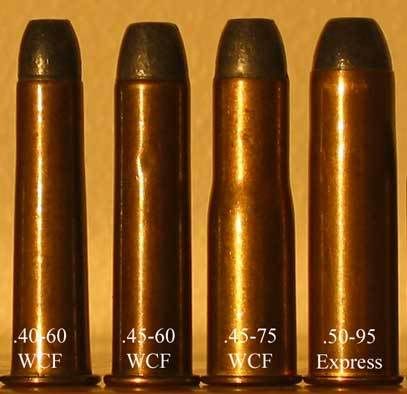
Longer (and heavier) than the 1873 but still using the same basic action design, the 1876 (called the Centennial because it was introduced in the 100th year of the USofA) couldn't handle the .45-70 Government cartridge. Winchester's fix was to use a fatter, bottle-neck cartridge of .45 caliber using a lighter bullet to nearly match the .45-70-405 cartridge's terminal ballistics. This it did. Winchester later produced the 1876 also chambered for 3 other cartridges as shown. One of those cartridges is the .50-95 WCF.

According to Cartridges of the World, the .50-95 is essentially and improved repeating rifle version of the .50-70 Government cartridge which was popular with buffalo hunters at the time of introduction. It is a necked up version of the .45-75 WCF. Built on the Express Rifle concept of using lighter bullets at higher velocities to flatten trajectories, the .50-95 had a degree of popularity with hunters after thin-skinned dangerous game such as leopards and tigers. One particular configuration of the rifle with shotgun butt, button mag and 22-24" round barrel in .50-95 is even known as the "cat" rifle.

The .50-95 was loaded with bullets of approximately the same weight as the .45-75 WCF, i.e. 300-350 gr., in deference to the action strength. Perhaps this is the place to point out that Mr. Kempa uses jacketed bullets, specifically the Barnes .510" 300 and 450 gr. Originals for his loads. In one case the jacketed bullet will increase pressures and the 450 is not only jacketed but a heavy bullet for this cartridge. The jacketed bullets are not a problem in-so-far as the barrel steel is concerned. I wouldn't want to ever use jacketed bullets in an original barrel as they are much softer and wear could become a problem.

As to lead bullets, only those 350 gr. bullets (actually weighed at 339 gr.) as loaded in the Ten-X ammunition Mr. Kempa acquired for the test were used. While he states,
No leading ever appeared when shooting 60 rounds of Ten-X's ammo.
the accompanying photo clearly shows a lead ring at the muzzle and lead in the rifling grooves at the muzzle. I am thus lead (pun intended) to believe that Mr. Kempa doesn't shoot cast bullets enough to recognize leading when he sees it.

Of course the .50-95 was originally loaded with black-powder but the cartridge was provided with smokeless powder loads as the world transitioned from black-powder use in the early 1900s. I've written my views on loading smokeless powder in this action. Suffice to say that I think smokeless is ok, but you can't exceed pressures for which the action was designed. I don't subscribe to the pressure wave form concerns some have. Mr. Kempa uses AA5744, AA2015, H4895, IMR4227, IMR4198, IMR3031 and Vit N133.

Even the rather conservative Mike Venturino uses AA5744. IMR4198 has long been used at 40% of the BP charge to load cartridges originally loaded with black-powder. However, once again, Mr. Kempa doesn't say which loads produced what pressures. This is vitally important. Some correspondents have pointed out that one or two of the loads might actually approach 40,000 psi.

One of the things that make me wonder at Mr. Kempa's reasoning in loading is his constant comparison with his .50 Alaskan rifle. The wording used makes me think that he doesn't realize that this .50 isn't like his 50 just because it is a .50 and that he is making no allowances for the rifle action even though he says he is. The loads used reinforce my unease.

He is also testing all these loads for accuracy at 50 yards. A small point, but I have to wonder why. These rifles in other chamberings have been successfully used on courses of fire including targets at 300+ yards.

His one photo caption says,
Big gun, big game: Suitable quarry for a .50-95 Model 1876 lever action would include species up to the American bison in size.
I wouldn't use the low sectional density bullets of the .50-95 on bison. These bullets are the same weight or lighter than those used in the .45-75 which also uses light for caliber bullets but which have better sectional density in .458" caliber. Penetration is what one needs on bison and I don't think you'd get what you need from a 300 gr. .50 caliber bullet.

I find how he talks about recoil to be curious, too.
Due to the weight of the rifle, recoil wasn't an issue at all. I would rate the top loads as being comparable to slug loads in a 12 gauge; all other lesser loads wouldn't give most shooters anything to worry about.
I find it hard to believe that he equates these loads from a 10½ pound rifle as the equivalent of 12 ga. slug loads fired from your typical 7-7½ lb. 12 ga. shotgun. Perhaps he's thinking perceived recoil as he's somewhat abused by the crescent buttplate.

I'm going to clip this article but for once it won't be for the information I can glean from it but for use as a necessary reference when I'm questioned about it and need to refute some point or another.

That said, if a .44 Magnum 1873 "reproduction"/copy is being produced, I'm thinking the author is thinking the 1876 will handle these pressures just fine.  I think that's a leap of faith but what do I know.  

It is my opinion that the 1876 is the equal of the Trapdoor in handling pressure. That said, SAAMI standard for the .45-70 is 28K PSI/CUP (same in this one cartridge) but the industry loads to about 18K PSI. Since long ago tests showed that the bottle-necked cartridges produce about 2K PSI more than the otherwise same straight case we have THE reason and explanation the ORIGINAL developers of the 1876 and .45-75 WCF reduced bullet weight. BUT, we now have one company making a .44 Rem mag on the basic toggle-link action. What does this tell us? Not much.

There are smokeless powders with which we have long-term experience in use as replacements (not substitutes) for smokeless. IMR & H 4198, AA5744, IMR SR4759, and IMR 3031. We also know that Winchester produced smokeless powder loads for most every BP cartridge EXCEPT the .45-75. However, Winchester's experience would seem to support the idea that such loads can be safe while providing identical external and terminal ballistic performance. This is important because at any time any one of us may find ourselves unable to acquire BP for any number of reasons. Railing against the use of other than BP is useless. Those who have the rifles will be trying to shoot them. Better to have safe data available than not. I think you agree with that.

The oft repeated rule on use of IMR 4198 seems to be valid. Old tests in other cartridges consistently show that the pressure curve as well as the spike using charges based on this formula are not as severe as with BP. I intend to experiment with that, finally, but I sure wish my "insider" could confirm the data!

Saturday, March 07, 2009

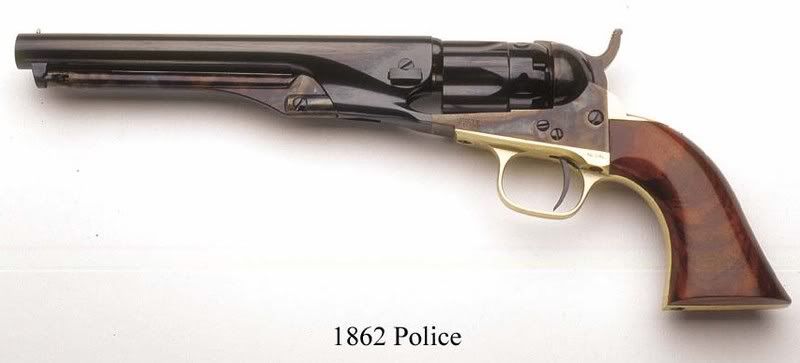
Colt 1862 Police by Uberti

In the redesign of the Colt pistols in the 1858-1861 time period Colt came out with stream-lined versions of the .44 "Army" caliber, .36 "Navy" caliber service pistols and moved on to the pocket guns such as the 1849. The other major design feature of these guns is a ratchet loading lever designed to ease loading of the bullet. Improvements in materials had also permitted the smaller cylinder and overall lighter gun in the .44 1860 "Army" revolver by means of using the rebated cylinder on the basic 1851 sized frame. This technique was applied to the 1849 in increasing the caliber from the rather anemic .31 to .36 caliber. Thus the 1862 Police and Pocket Navy were born.

Produced concurrently and apparently in the same serial number range with the Pocket Navy (with it's octagonal barrel and old style loading lever), this 1862 Police revolver set the standard for quality. Approximately 28,000 were produced. Barrel lengths were 3½, 4½, 5½ and 6½ inches. You might not think of this as pocket size but pockets were different then. Still, the 5½ and 6½ inch guns might have been better carried in a holster. I'm sure some few found their way into various hiding places in the home. Originals can now sell for $2,000+ depending on condition and provenance. A reproduction is a much better choice for a shooter.

Finding a shooter isn't much of a problem. Colt's guns are all so popular that reproductions have and are being built by several companies including the world renowned Uberti firm. This particular revolver is an Uberti and has the 6½ inch barrel. It seems a good copy of the Colt. I would have preferred a 4½ inch barrel but that length is no longer in production. The guns are petite. Very much so. In grip size they are comparable to Ruger's Bearcat and, in today's world, they can serve much the same functions. I think it is about ideal in size for a trapline gun, for training young shooters, or for introducing young shooters to blackpowder/percussion revolvers. As things are now, it is pretty cheap shooting but gives a young shooter familiarity with slightly greater recoil (which can be managed by adjusting the powder charge) and with how the components interact.

Of course, some accessories are necessary with a "cap 'n' ball" revolver. First, one must have a nipple wrench. The Uberti guns no longer ship with a wrench (as I believe they once did) and you have to get it separately. You can get the appropriate wrench from Dixie Gun Works (among others). Another need is some method of carrying and measuring powder. A flask does this in one go and works well in loading the revolver. Cleaning tools and materials for the .38 Special will work and are no great trick to find. A holster can be a different story.

Every handgun needs a holster and this was really the first thing I went looking for. It wasn't hard to find a maker for a flapped holster. However, I didn't want a lot of excess bulk and feel that a California or Slim Jim style would be both very usable and very period appropriate. Unfortunately, they aren't easily found. Nearly every possible maker is a custom proposition. However, Dixie does have a Slim Jim for the 1862.

Loading the guns is no great bother. Despite the trouble Rooster Cogburn had (and he should have known better as "cap 'n' ball" guns were much more common in the west than you might have been led to believe) it is easy peasy so long as you follow some rules.

#1 is to thoroughly clean the gun of oils. It is particularly necessary to remove any possible petroleum products from the nipple, chamber and barrel. Again, thoroughly clean to avoid contamination of the powder charge.

#2 is to use only blackpowder or proven substitutes in these guns. I often hear stories of shooters using smokeless powder and wrecking guns. I'll be using Pyrodex P to save my BP for another gun but Triple 7 is usually easy to find.

#3 get the proper size cap. Remington #11s fit my pistol right well.

#4 use the proper size ball. For .36 caliber percussion revolvers a .375" or .380" ball is correct. These are the guns in which our .38 cartridges began their evolution and the groove diameters make them .38s. Hornady makes a swaged ball which I prefer since I can save my casting time for other things. However, one can get molds and cast your own bullets if you prefer. Given today's political climate, you might want to have that option.

Once you have the readies in position, loading is, really, simple. I fire a round of caps through the gun to ensure that the nipples are clear and dry (from the last cleaning). The revolver is brought to half-cock and the cap residue is removed from the nipples. Each chamber is charged and a ball then seated before moving to the next chamber. One chamber is left empty to provide an empty nipple on which to rest the hammer. Then, all chamber mouths are filled with a lubricating and protective grease. There are many products which can be used including Wonder Lube. Whatever you use, be aware that many appropriate lubes will melt in summer heat. That usually isn't a good thing. The revolver is now ready to fire.

These guns use a notch in the hammer nose as the rear sight and it can move around a bit. I believe Elmer Keith shimmed the sides of the hammer to prevent this in his guns.

As one would expect, ballistic output isn't all that great. Still, the guns have their uses and they are certainly interesting.

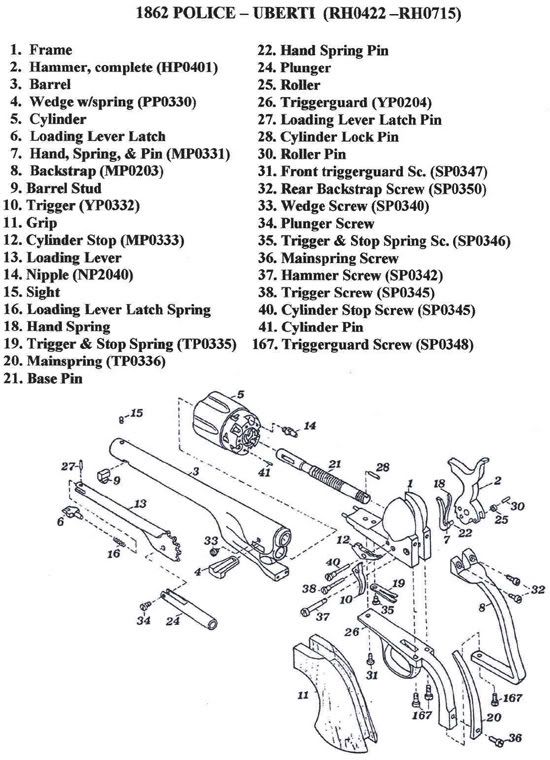
Perhaps I'm in the minority but I consider cleaning these guns a snap. Every step presumes an UNLOADED gun. First, push the barrel wedge out, right to left. It will be prevented from falling completely out by the wedge screw. Pull the barrel off the front of the frame. You might have to wiggle it a bit, particularly on a new, tightly fitted gun. Place the hammer on half cock and slide the cylinder forward off the base pin. Remove the nipples. This is all the disassembly required for normal cleaning.

I like to use HOT water for cleaning but some BP substitutes such as Triple 7 purportedly don't require it. I have a small bucket of hot water into which I place the cylinder and nipples. With a tight fitting jag and patch combination, I place the the barrel into the bucket muzzle first and swab from the breech end. After thorough cleaning I place the breech end of the barrel about 1-2 inches into the water and scrub all exposed surfaces clean using a toothbrush. This usually only takes a minute or two. I lay the parts on an old towel (do NOT use the wife's best towels for this!) and spray with WD-40. I then put the bore swab and toothbrush to work on the cylinder and nipples. The nipples also get the flash hole scrubbed with a pipe cleaner. All parts get laid on the towel and sprayed with WD-40. The receiver is scrubbed with the wet toothbrush and then wiped clean with a towel or T-shirt and WD-40. All parts are then wiped dry. The base pin is greased (do not use a grease containing a petroleum product) and the gun reassembled.

Wednesday, January 14, 2009

Winchester 1876 SRC NWMP Reproduction - Revised

I'm making every effort to keep this post as the up-to-date and complete accounting of this rifle/carbine. If you see something missing, please, drop me an e-mail.

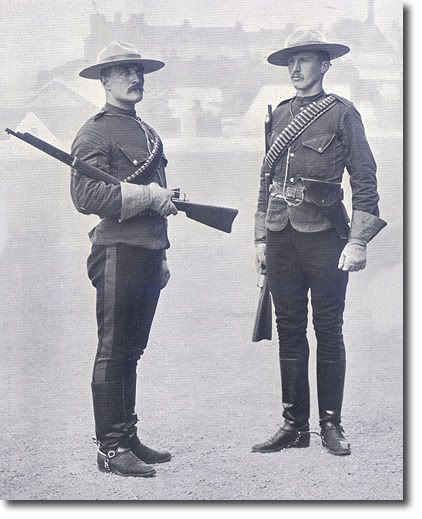
For many years I have been entranced by the stories surrounding the Royal Canadian Mounted Police and a predecessor unit, the North West Mounted Police. The idea of the lone Mountie (trooper) patrolling vast reaches of the rugged Canadian heartland with his odd mix of English and American firearms simply caught my imagination. Canada has some beautiful country and I could easily imagine myself and my dog team out in the middle of that wild country.


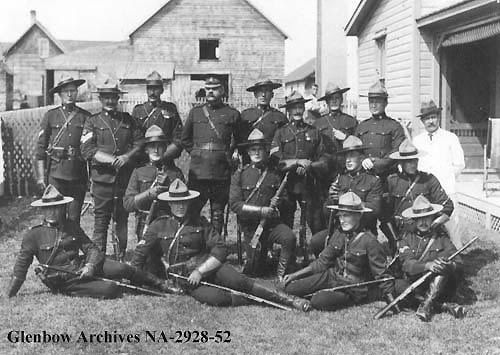
Look at these fellows on the left. Fit, proud, why wouldn't I want to emulate that rugged individualism in service. Note that these fellows, as are the men in the next photo, are holding the 1876 SRC!


Of course the reality of the times was different. Mounties often worked together, sometimes in rather large (for Canada) units. They not only patrolled the back country but kept order in towns and along routes to the gold fields and they suppressed insurrections. I'm sure that the 1876 Saddle Ring Carbines (SRCs) that they carried were well worn for a reason! Still, I wanted one of those carbines.


Back in the day, Winchester was producing the very popular 1873 rifle and carbines which were chambered for the .44 WCF (aka .44-40) cartridge which moved a 200-220 gr. bullet at about 1200 fps. Experienced hunters know that this isn't exactly the first choice for game such as elk, bison or grizzly bear. Ned Roberts reports in his "The Man and the Boy" stories how his .44-40 was not nearly as good as his .45 muzzleloading double rifle in killing black bear due to the heavier bullets and larger powder charge of the "old fashioned" gun. So, hunters out in the western US were demanding and buying rivals of the Winchester just for hunting. Winchester wanted to compete in the marketplace and hence the 1876.


Produced from 1876 until 1886 approximately 63,871 1876s of all types were built. The last 1876 rifle left the factory in 1897 and was likely made up of various unused parts. Most popular among collectors (and bringing the highest prices) are the SRCs and the Express rifles. Some of this is due to the relative rarity of the two types. E.g. only 1600 SRCs were produced for the NWMP and at one point they reported only 970 some were functional! The English Express rifles (those in .50-95 often referred to as "cat guns") are even more rare.


Like all Winchesters of the era, a multitude of options were available. Some were produced in one configuration and returned to be modified (adding the dust cover to early guns was one popular modification) to another configuration. In some cases, they were pulled from stock and modified to meet an order. Add to that all the "parts guns" that were made up after regular production ceased in 1886 and one should expect a startling array of variations.


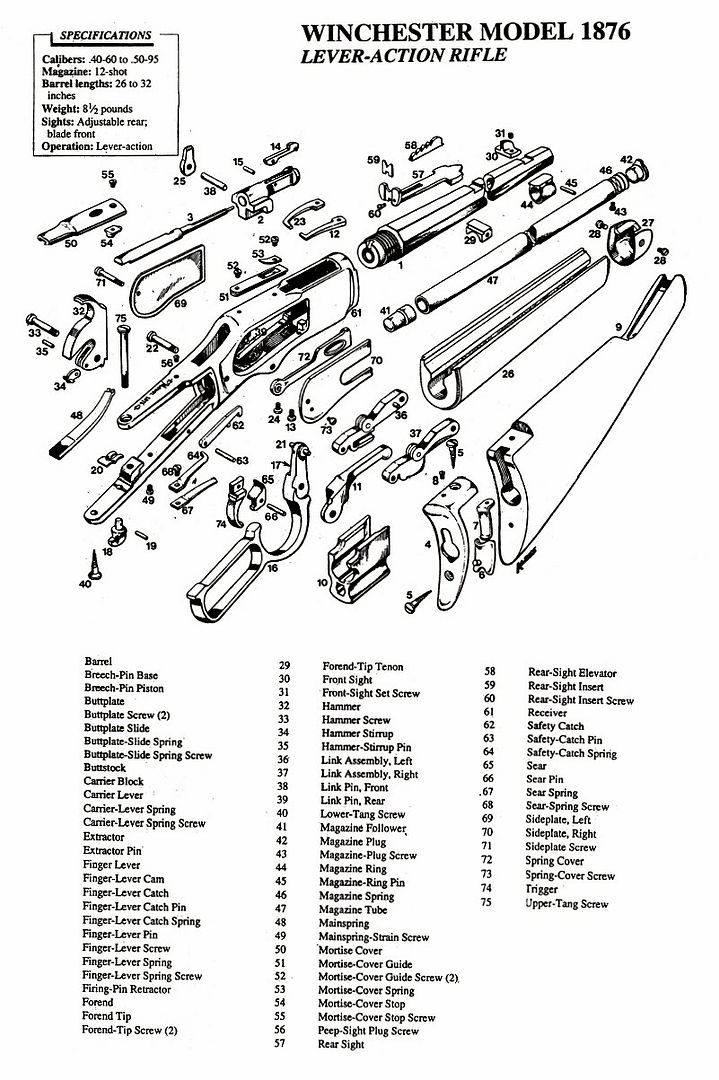
Longer (and heavier) than the 1873 but still using the same basic action design, the 1876 (called the Centennial because it was introduced in the 100th year of the USofA) couldn't handle the .45-70 Government cartridge. Winchester's fix was to use a fatter, bottle-neck cartridge of .45 caliber using a lighter bullet to nearly match the .45-70-405 cartridge's terminal ballistics. This it did. Winchester later produced the 1876 also chambered for 3 other cartridges as shown. Of course my gun had to be a .45-75 as were the NWMP guns. Unfortunately, this will make brass and ammunition difficult to find and more expensive than the .45-60 which can be formed from the cheap .45-70 Government cartridge.


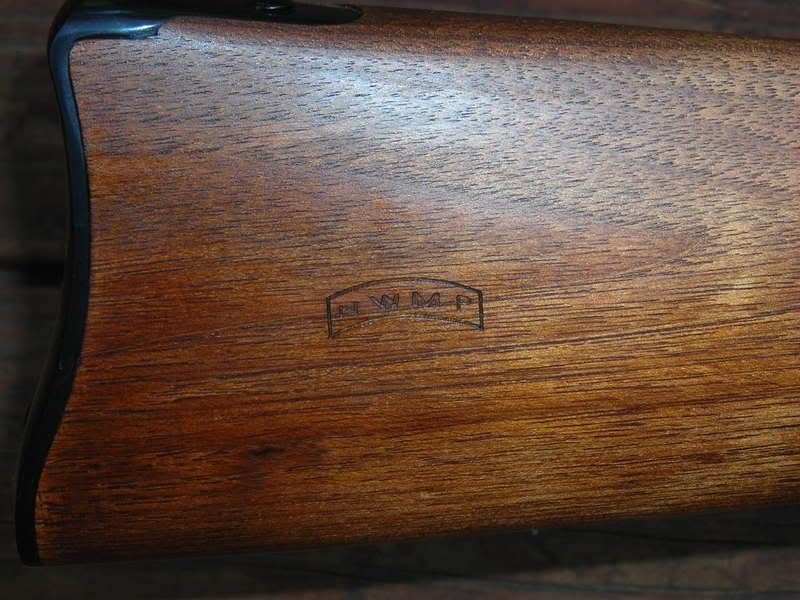
When the Parliament of the Dominion of Canada authorized the North West Mounted Police on May 23, 1873, to stop the liquor traffic among the Indians, they had to have rifles. The single-shot Snider-Enfield breech loader was sufficent cause for them to want a replacement and 50 of the 1876 Saddle Ring Carbines (SRCs) were tried in service. These were acquired through the I. G. Baker Company and 50 were in use by 1878. In 1880 another 100 guns were received. 300 of the SRCs came in the 1882 order and another 100 in 1883. In 1885, the largest group of SRCs was received by the NWMP, that being 446 guns. More were likely purchased but the records are incomplete. The marking shown in the photo to the right (as on the reproduction) wasn't uniformly applied so it might not be legible and some carbines don't have it at all. Later carbines had the "Spanish meter" sight which is very similar to the "military wind gauge" sight but not identical. Range markings on this sight are in meters. My reproduction has this sight as well as the NWMP stock stamp.


Now that I've received my gun I can tell you a little bit about it. The rifle weighs 8-1/2 lbs, has a 22 inch barrel and is otherwise as described. Of course it has the Italian proof markings but they are on the bottom of the receiver. Also on the receiver bottom are the serial number and rifle catalog number. The cartridge/chambering is marked on the barrel between the rear of the back sight and forward edge of the receiver. The barrel is also marked with the patent dates and the importer and maker name. Some folks might not appreciate their location or form but they are pretty unimportant to me.


The finish of the gun is pretty good. The oiled finish on the wood (walnut?) stock is average and seems to be in keeping with the original guns. Only the made-for-the-English guns had varnished furniture. The bluing is even and looks pretty good. There is a finish flaw on the loading gate where the rifle was loaded and test fired. This is mostly due to the different material/metal used for the spring steel loading gate. It should eventually wear to look like an original. The finger lever latch is very stiff. I haven't been able to turn it into position yet. Then again, I'm not forcing it and it isn't used when shooting.

Spanish Meter Sight
Sights are critical on any rifle and experience has shown that the issue sights on this gun need improvement. They might be correct as to dimensions compared to originals but they don't suit the rifle. The gun shoots way high and needs a higher front sight. This was initially remedied by building up the front sight with JB Weld and blackening it with a Sharpie. Classy, huh. I'd like to install a penny from the period of the same total sight height but haven't gotten to it. That will be some work and I want to know exactly how I will do it before starting any cutting. The rear sight is the Spanish Meter sight as specified by the NWMP. However, all the edges are a bit "soft" or rounded. I expect that it is a casting/injection molded part which was not so carefully buffed before bluing. I might take a file to it to "sharpen" the edges on the sight notches. It should look like this one on a Turnbull restoration.

Reloading/handloading is almost a requirement with the .45-75. Brass is the most critical and difficult to find component. There is properly headstamped brass out there. However, the influx of reproductions has created a surge in demand and stripped the market of most of this brass. If you find cases it might be a good thing to buy them then and there.


Of the properly headstamped brass, Venturino reported that the Bertram brass (which came un-necked) had to be reamed and fire-formed before use. I understand the the Bertram brass now comes formed. His fireforming load was 12 gr. of W231 under a .457" roundball. Mr. Venturino also notes that COL is critical. You can't be very far off before experiencing feeding problems.


Jamison International made a run of .45-75 brass and supplied both Buffalo Arms and Ten-X with the brass they use in making their ammunition (note: Ten-X is now using Bertram brass with a corresponding rise in cost). It has a good reputation for working in original and the Chapparal reproductions. Unfortunately for the .45-75 shooter, Jamison has some big government defense contracts and is concentrating on supplying those now and for the forseeable future. Usable brass can be made from several other currently manufactured cases.


The cheapest of these, although it is a seasonal production item, is .348 Winchester brass. Nonte says to do this: "Expand neck to hold .456" bullets: Trim to 1.88" length; Size full length; Fire form; use .456" bullets" but it is a bit more complicated than that. The details are what will get you on this and you can lose quite a bit of brass in the forming if you don't pay attention to the details. Venturino addresses this in some detail in Loading Leverguns of the Old West.


Brass can be had in two ways. One is that .348 Winchester cases can be formed by full length sizing them in a .45-75 die.


Venturino also says that these will get the shooter by, but are not perfectly correct for either the Model 1876's chamber or its extractor. The cases may form a slight bulge about 1/4 inch ahead of the rim, and sometimes an extracted case will fall back on top of the cartridge lifter instead of being ejected from the action. So, I don't know if results will be entirely satisfactory for all shooters in all guns. I think that you can do it relatively easily it being necessary only to trim to length, form, fire-form and load and the cases work in my carbine.


Paco Kelly gives his instructions thusly:


It is not a hard conversion because the .348 case is smaller by a hair in all dimensions except length. The only catch I found was after trimming when running the cut down .348 case thru the 45/75 die; first do it without the primer/neck sizer rod, then the second time do it with the rod in. that way you remove the small part of the tighter neck left after trimming without ruining the case. Also use a super slick case lube inside the neck area.

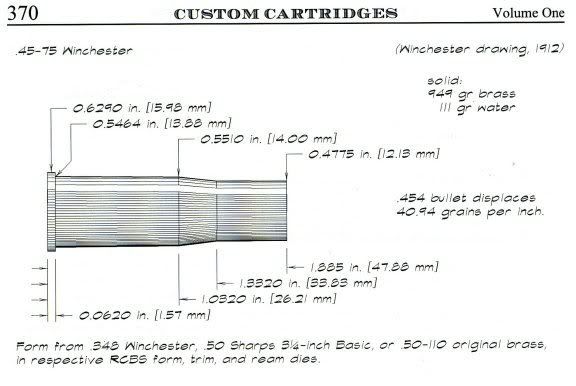
The 45/75 case length is 1.895" so the .348 case must be cut back to 2.0 inches. you need the extra 1/10th of an inch length because the case will shrink slightly in fireforming. so remove approx. .250" off the .348 case neck, chamfer well. Then run it thru the 45/75 die as described above.

The other dimenstions of the .348 case are very close to those of the 45/75. .348 rim diameter is .603", the 45/75 rim diameter is .616", the head diameter (just above the rim) of the .348 is .547" and the 45/75 is .560". the difference in size in both these measurements for the two above is about the same .013", the thickness of a thick human hair. So no problem.

Just like the rim thickness of the .348 is 065" and the 45/75 is .070" which is less than half a human hair difference. So then use a fireforming load. The .348 cases's beauty is its strength once made then it will last forever at 45/75 pressures. Remember, once fireformed the cases set the resizing die so it doesn't touch the new shoulder, ever.

45/75 CASE DIMENSIONS...
CASE LENGTH 1.895"
HEAD DIA. .560"
RIM DIA. .616"
RIM THICK .070"
NECK LENGTH.550"
CASE OVERALL LOADED LENGTH 2.25" CASE HOLDS 5 CCs OF WATER
Another brass source or alternative cases for forming the .45-75 are the .50-70, .50 Alaskan and .50-90 Sharps cases from Starline. I think the .50-70 forms up as too short (see far right case in the photo below) but the .50 AK case is 2.1" long and requires trimming only .22" and is cheaper than the much longer .50-90 Sharps.

Here's some dimensional info.

.348 Win.50 Alaskan.50-90 Sharps
Rim Diameter.603".6015".651"
Rim Thickness.0665".067".064"
Case Head Dia.546".545".5585"

Ok, to summarize the steps...
1 - trim .50-90 or .50 AK case to 1.90" using tubing cutter. Be careful because technique is required here as well.
2 - lube the case.
3 - run the case into the .45-75 full-length sizing die.
4 - anneal
5 - run the case through the expansion die
6 - remove lube (I use alcohol pads, I like ALL the lube off my cases).
7 - final trim
8 - LOAD!


Properly lubricated, a .50-90 case trimmed to 1.88" and run through the Lee full-length sizing die lengthens enough for a final trimming back to 1.88" but requires no fire-forming. Once a quantity of cases is made up one can do as Paco suggests and reset the die to just resize the neck (partial full-length resize) thus lengthening brass life. One important note about the .50-90 cases is that the rim diameter must be turned down to function through the magazine tube.


As to sizing it bears repeating that the shoulders in my chamber seem to be forward of those in the sizing die. This could result in working the brass excessively. I'm thinking that the rifle manufacturers used the original chamber dimensions from original rifles and the die makers used the cartridge dimensions as published by Winchester and, as with many BP cartridges of the time, there's some slop to allow for reliable functioning despite fouling. I will probably partial full-length size these cases. If you look at the 2nd and 3rd case from the left in the below photo you can see just what we are talking about here... (click on the photo to go to a larger version) The fired cases have a different shoulder configuration.


Anyway, dies are needed to work that brass. As I write this the Lee Pacesetter 3 die set is $25.99. Lyman's Classic set goes for $41.99, RCBS wants $229.99 for theirs. RCBS has the forming die set for .348 to 45-75 for $412.99. CH Tool & Die offers the 45-75 3-die set (includes FL sizer, expander and seater) for $101.45. For forming 45-75 brass from .348W, CH sells three step sized expander plugs for $13.30 each and $8 shipping. The expander die body only is $13.30. That is a total of $61.20, incl. shipping for the complete form die set.
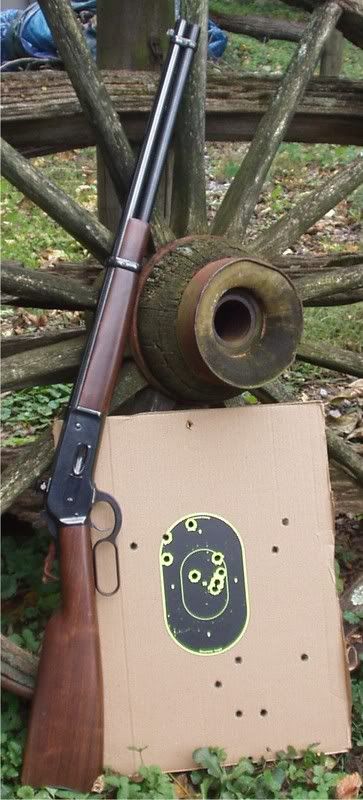

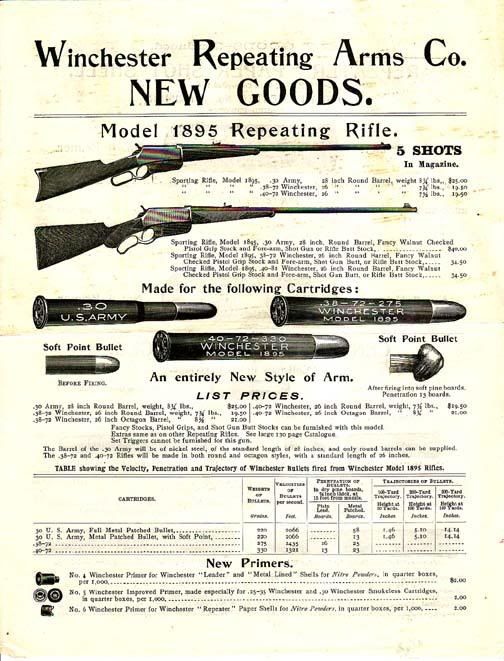
Bullets are, of course, also a requirement. I was planning to use the Lyman 457122 (I understand that the FP mold number was 457192 and the HP is the 457122) from Mt. Baldy Bullets but will likely cast them myself. This is a hollow point, plain base bullet and 330 gr. but is of the correct length with the crimp groove in the correct place. I went ahead and purchased this mold and have high hopes for both the HP version and perhaps a solid/flat point version. The Lyman 457122 HP weighs 336 gr. cast of 1/20 alloy and as somebody else noted would, if not a hollowpoint (that is the Lyman 457192), duplicate the original bullet very closely. the good news is that we were able to get together a limited run of the Lyman 457192 and Lyman will be using the original cherry. Now that I've received my Lyman 457192 I'll be casting some bullets soon.


Venturino tried the RCBS 45-300FN and RCBS 45-325FN the latter of which is about the best weight 345 gr. cast from 1/20 alloy. BUT he says he got groups measured in FEET! One has to wonder why. I think .458" bullets are more likely correct. Venturino says that even the old originals all had .457" groove diameter. and so I've got some on the way from various sources. Other possible molds for this rifle are Lee's 457-340-F and 457-325-F. I've got one of the latter which I received via Chris C. They seem to do well but I've not yet done any group shooting. Will be switching to SPG to lube all bullets when my current stick of lube in the sizer runs out. Until then the cast bullets I lube will be used with smokeless only.


A short note about lube. Some correspondents are telling me that 1.5-1.7 gr. of lube will work with blackpowder. I suggest switching to SPG as that lube will work with all possible powders and simplify bullet preparation.


Powder is another requirement. I plan on using IMR SR4759, AA5744, IMR 3031, IMR or H-4198 and good old black powder. The action will not permit nor will I try to push velocities above original velocities. That would probably be 1200-1300 fps in the short 22 inch carbine barrel. I know that there is a lot of discussion out there about the choices of powders for this cartridge with some decrying the use of any smokeless powders and even some foolhardy individuals pushing the envelope. It seems to me that the loads used should not exceed 18K CUP although Brian Pearce expresses a different opinion in Lyman's 49th edition. Therein he states that the modern reproductions (he uses Chaparrals) 28K CUP is the upper limit. One should be able to duplicate original velocities with like weight bullets and thus equal original performance. That should be good enough for deer and black bear even if the ballistics aren't impressive by today's standards.


Crimping is another concern particularly for shooters using original bullets over smokeless powder. Why? Because the original bullets are designed to be crimped over the front band and the bullet supported by a case full (and compressed) charge of black powder. Smokeless won't fill the case and some fear that the bullet will be set back in the magazine resulting is an unintended and disastrous pressure increase. Orville C. Loomis in his article, "Shooting the .45-75 Model 1876" in the Summer 2001 issue of Blackpowder Cartridge News says that the crimp made by his original tool is very similar to that made by the Lee Factory Crimp Die (FCD). That being the case, one can order a FCD from Lee for less than $30. Chris C., Grizzly Adams and I have ours.


Suggested Loads (these come from various sources including Cartridges of the World, The Home Guide to Cartridge Conversions, The Legacy of Leverguns, Shooting Leverguns of the Old West, Blackpowder Cartridge News)and Lyman Reloading Handbook, 49th ed. however, I am not responsible for either the data presented or for your use thereof. You are on your own as to what is suitable and safe. Many experts recommend only blackpowder be used in original rifles and the reproductions are so new that I've not seen any comments on the subject from commonly accepted authorities.


BulletWeight PowderCharge Weight Velocity Energy
Lyman 4571223302400


20.0
unknownunknown
Lyman 457122330XMP5744


21.5
12801274
Lyman 457122330IMR4198


26.0
1310unknown
Lyman 457122330AA2015


41.0
1508unknown
Lyman 457122330Trail Boss


15.5
1212unknown
Lyman 457122330H4895


43.0
1480unknown
Lyman 457122330Triple7 FFG


36.7
1307unknown
Lyman 457122330GOEX FFg


70.0
14421524
Liberty 458-300FP 350IMR 3031


43.0
unknownunknown
Lead300IMR SR4759


24.0
13001126
Hornady HP300IMR SR4759


26.0
14001306
Lyman 456192350IMR 4198


24.0
13801480
Lasercast FP300IMR 3031


44.0
unknownunknown


I now have quite a bit of ammunition together and need to do more shooting! I've had the gun out shooting the fireforming loads as well as a few using bullets from an original Winchester mold sent to me by Grizzly Adams. Those bullets weighed 364 gr. lubed and sized and both they and my fireforming loads using 300 gr. jacketed bullets I normally use for the .45-70 seemed pretty accurate. While I didn't shoot them at targets I did use the crotch of a 3" diameter Sycamore about 80 yards distance on the upper bank of Mom's farm pond. This is a tree I'm going to have to take down anyway so topping it with the NWMP carbine was no problem for the environment and it was no problem with the rifle either. The sights held for horizontal dispersion as I could see the tree shake with every round but it was a bit difficult with that sighting point and the sights to hold the vertical. Now that I have a stock of 20-1 alloy, I'm looking to get some more bullets cast and take my current stock of 500+ cases and really give the gun a workout.


Because of the popularity of NCOWS and SASS cowboy action shooting and reenacting, Chaparral and Uberti have decided there is a market for reproduction rifles and carbines, and some producers have stepped in the breech as it were and offered the things necessary to cartridge reloading. Many resources can be found on the net. Here are a few.


On-line articles on the 1876 Winchester:
- The Winchester Model 1876 by Kirk Durston
- John Boy's info on forming and loading with BP
- Winchester Toggle Link 101 by Larsen E. Pettifogger


Books on the 1876 Winchester:
- The Winchester Book by George Madis
- Shooting Lever Guns of the Old West by Mike Venturino
- Winchester by R. L. Wilson
- Winchester Lever Action Repeating Firearms Volume 1 The Models fo 1866, 1873 and 1876 by Arthur Pirkle


Sources for all things 1876 Winchester:
- Buffalo Arms - brass, loaded ammunition (smokeless and blackpowder), bullets, dies, rifles
- CH Tool and Die - dies
- GAD Custom Cartridges - loaded ammunition
- Graf & Sons - brass, dies
- Midway USA - brass, dies, molds
- Mount Baldy Bullets - Lyman 457122 cast bullets lubed with SPG
- Nevada Western Firearms - exclusive sellers of the NWMP carbines in the USofA.
- Old West Reproductions - custom, authentic copy of NWMP saddle scabbard
- Ten-X Ammunition - loaded ammo (smokeless and Triple-7)


Please send your corrections, comments or additions to me, Hobie via e-mail.


UPDATE -- Rowdy Fulcher has made a neat video concerning his 1876 rifle. It is worth a look and posted here for your enjoyment.


Tuesday, March 04, 2008

Browning 1886 SRC

Shown to the left is my Browning 1886 Saddle Ring Carbine (SRC) together with the first target I shot using the newly mounted Williams Foolproof Receiver Sight (FP-71). You can disregard the bullet holes from outside the c-more target as those were from earlier experiments. Just note the tight 5-round group at the center. That's what this gun can do with this sight. I love it.

The Winchester 1886 from which it is derived, there are a couple of slight differences in the mechanism, was designed by John Browning for Winchester. It had to be done, after all Marlin's 1881 in .45-70 was taking market share from the Winchester 1876 because it was chambered for the real thing, the .45-70 Government cartridge.

The Browning guns were made by Miroku in Japan. They are quality throughout and good guns. The finish is excellent. You might notice that there is a difference in the profile of the buttstock. I've no idea why Browning or Miroku made the decision to do that. So, while it confounds and/or disturbs some hard-core afficianados of the 1886 it is of no issue for me. When I put this gun to my shoulder the sights align as they should and it settles into my shoulder as it should. All's well!

I've shot this gun with the factory loads in both the 405 gr. at 1200-1300 fps and 300 gr. at 1800 fps versions and prefer the latter, slightly. So, when I set up to handload/reload for the cartridge I tried to duplicate that 300 gr. bulleted "express" loading. It was easy to do with 54 gr. of H322 and using either the Speer or Sierra 300 gr. bullets made for this application I was right on the money velocity-wise. This was born out on target as using any of these loads, even mixed in a magazine full, produces the tight targets on point of aim at 100 yards. I like that.

I did get the gun for a bit more oomph and if that is necessary, I expect that I will use Elmer Keith's load of 53 gr. of IMR-3031 to push a 405 gr. bullet like Remington's to about 1800 fps. That should do for my purposes.

Tuesday, January 29, 2008

Charles Daly Little Sharps

Everyone loves the Sharps rifles particularly the 1874 model which is all the rage when produced by Shiloh or C. Sharps. Mostly chambered in .45-70 or larger/longer cartridges burning blackpowder and weighing 8½ pounds and more, these guns are the darling of anachronistic hunters and BP silhouette competitors. Still, some wished for smaller lighter guns chambered for smaller cartridges with all the charm of the side-hammer breachloaders. Fortunately, one company had stepped into the "breach" so to speak.

Little Sharps Rifle Manufacturing Company has been producing such a gun for a bit now. However, the price has been, well, above the means of some desiring such a gun. $3250 is what they've been charging for their handmade 20% smaller version of the 1874 Sharps rifle. Now, they have an Italian made copy of their gun, at a much lower price point. Just the thing to be in the reach of "the rest of us" who can't or won't spend quite that much for the experience of shooting a smaller Sharps rifle. While the handmade version is available in many suitable cartridges, the Charles Daly version will initially be offered only in .38-55 and .45 Colt, two of the most, deservedly, popular cartridges they could have chosen. The price is right, too. $1229.00.

Links:
- Guns of the Old West article, "Son of a Sharps" by Ron Harris
- Charles Daily Little Sharps from Gunblast.Com

Tuesday, January 08, 2008

Browning 1895 .30-40 Rifle


Once upon a time I was a 10 year old enthralled by firearms of all types and the history they helped to make. One day, somehow, my dad got a copy of Bill Riviere's paperback on shooting, "The Gunners Bible". In that book was a photo of a customized Winchester M1895 in .30-40. Oh, that gun was to die for. Give me some cold rainy day when I was forced inside and I'd stare a that photo for hours dreaming of hunts for moose, elk and big bears. So this was a gun I'd wanted for a long, long time when money in my pocket finally corresponded to the availability of a new gun, made by Miroku in Japan for Browning in 1985 and in .30-40Krag (.30 US) to boot! What a thrill!

The Winchester 1895 was developed by John Browning for Winchester to load from a box magazine instead of a tube under the barrel. This allowed the Model 1895 to be chambered for military cartridges with spitzer (pointed) projectiles, and the rifle was used by the militaries of a number of nations including the US, Great Britain, and Imperial Russia. The Russian production models could also be loaded using charger clips, a feature not found on any other lever-action rifle. By far, the greatest numbers of the rifles were made for the Russian military. There were also produced in sporting rifle and saddle ring carbine versions. There were some famous users of the 1895 rifle of which the most well known would have been President Theodore Roosevelt. First, he carried one such rifle to Cuba which was chambered in .30 US. Later, both he and his son Kermit used the rifles chambered in .405 Winchester on his famous African safari. Ned Frost, a famous guide out of Cody, Wyoming, carried an 1895 SRC.

My rifle is as we'd expect for a Browning gun. Well made and well finished. She is just beautiful if a bit plain. With her 24" barrel, she's a bit longer than any other levergun in my safe. Yes, she has that distinctive (and advantageous) box magazine "hanging" below the receiver and some will balk at that as an impediment to comfortable carry. However, I find that the rifle balances right at the forward edge of the magazine and so it functions to provide the stop that keeps the rifle slipping through the hand and is in no way as uncomfortable for single handed carry as one might imagine it to be. When shooting the gun is every bit the lovely siren I imagined she might be.

The action is both smooth and tight with no rattling. Cartridges run through with little effort and, so far, no problems. Indeed, this action is about the smoothest of any of the famous Winchester levergun actions I've ever tried. Even new, it is slick and fast. Both round nose and spire point bullets are just the thing with neither providing problems of safety or in feeding. No problems in accuracy either! Groups of factory 180 SP ammo shoots into 2-3" at 100 yards with the issue open sights.


I expect that it will do some better after I get a good aperture sight such as the Lyman 38 reproduction I bought. Just need to get the gun to Jon Ritenour in Harrisonburg to drill and tap it for the one screw necessary to mounting. This sight promises to be both more traditional and to provide a greater range of elevation adjustment. That elevation adjustment might just come in handy with the wide range of bullet weights usable in the .30-40 cartridge. Mine came from a private seller who got this Ukrainian sight from Buffalo Arms. These sights are imported from the Ukraine and may not be currently available except from buyers who've not yet installed their sights.


Loading of the 1895 action is obviously not done the same way as the tube fed leverguns but it isn't quite the same as other box magazine guns either. There's a particular methodology used that ensures proper feeding of rimmed cartridges from the box magazine by ensuring the rim of each cartridge is ahead of the following cartridge.

Ammunition? What about the .30 US (aka .30-40 Krag), is it effective? To what more popular cartridges does it compare? Is it hard to load? These are the questions I often hear.

In fact, the .30 US (aka .30-40 Krag) is extremely similar to the .303 British cartridge in both case form and in ballistic performance. So too, when loaded with bullets of the same weight, it is ballistically similar to the .300 Savage and .308 Winchester.

Of course, then, it is very effective on most North American game. I might prefer something bigger for the great bears such as the Grizzly and Polar bears but for everything else it will do nicely. The cartridge is no more difficult to handload than any other cartridge as there are no issues with the brass whatsoever. Powders suitable for similar sized cartridges as noted above will work in the .30 US as well. Bullets suitable for this cartridge and the 1895 action are also numerous and available. Standard primers are all that are needed to light the fire.