Recent forum discussions gave me the idea that I might like to set down my ideas on rifle sights. I've got strong prejudices/preferences just as many other folks do and I think it should be helpful to articulate those thoughts.

Because so many folks kid me about it I suppose that my liking/preference for the Williams Foolproof receiver sights is well known. I like it because although the Foolproof is made of aluminum it is sturdy, simple, and has no "extra" parts to come undone. I'm a big supporter of the KISS principle. It is also light and the finish is durable. Even in today's world of sometimes sloppy or overseas manufacturing, these sights are made in the USofA and consistently well done.

Williams also makes the 5D sight. This sight isn't as sophisticated as the Foolproof in that it doesn't have click adjustments. One simply loosens the lock-down screws and slides the sight about to adjust. With practice this can be easy and for those who never feel a need to rezero for any reason (especially if you only shoot one load), this sight will suffice. You'll note that it looks very much like the Foolproof and the sight bases (the part that attaches to the rifle) are, in fact, the same. The biggest advantage this sight has over the Foolproof is price. Normally you can get it for a little over
one-half the price of a Foolproof from the same vendor.

Williams makes yet another receiver sight, the Guide Receiver sight. As you can see this doesn't mount to the side of the rifle but to the top of the receiver or barrel. The weakness of this sight is primarily in the range of available adjustment. As you can see in the photos, both windage and elevation adjustment is very limited when compared to the Foolproof and 5D. The Guide Receiver Sight is nothing more than an adaptation of the Guide Open Sight with an aperture. Very clever are those engineers at Williams Gunsights. The Guide Sight has one or two advantages. The first is price over the Foolproof. The second is subjective and is that the base on the side of the rifle is eliminated providing a "cleaner" look.

A Williams Guide Receiver Sight mounted on an NEF rifle. Courtesy of Junior Doughty
I've never had any problems with the Williams sight save one. When I buy them used they sometimes come minus the mounting screws. A quick call or letter to Williams gets a set of screws for that particular sight.
Then there is the Lyman series of sights. Lyman has been making tang and receiver sights for a LONG time. It is very interesting to look at the evolution of the aperture sight as built by Lyman as it begins with simple tang sights and the muzzleloader era to sophisticated click adjustable receiver sights and from all steel to aluminum. However, I'm going to limit myself to sights I'd use for pump and lever action rifles.

I actually started with a Lyman #2 tang sight on the Winchester M62A shown in the photo. This was actually the very first rimfire I ever shot! This isn't the best photo, but I have one old Lyman and one new Marbles mounted on my Winchester pump action .22 rifles. These sights are pretty good and practical on the .22s.

The tang sights are fine for soft recoiling firearms and they do increase the sight radius over that possible with the receiver sights but I can't say that I (that's me, some folks don't have these problems) like them for heavier recoiling for a couple of reasons. First, since they sit on the tang they tend to slide by the hand while not permitting the same grip one would take on the gun's wrist if they weren't there. This can result in distracting abrasions. Second, the tang sight sits awfully close to the eye and it does make me a bit nervous in the prone position (I think prone is a bit more likely circumstance than using high angle fire with a big-bore rifle).
However, the Lyman sight I'm most likely to have use of is the 66. The 66LA is the sight intended for the Winchester and Marlin lever actions. It looks very much like the WB sight which is for the Winchester 1886 lever action. Although these were once made of steel, they are now aluminum.

I have a Lyman. I got it for and it is mounted on my 336T. The Lyman's have the ability to be zeroed out so that one can adjust from a known point and back again. this should be an advantage over the Williams. Unfortunately the system used is a separate sliding plate(s) retained by screw(s). You can see the elevation plate in the above photo. In my "lemon" the elevation plate screw stripped the threads on the aluminum base. As machinists know, not all alloys are created equal and the Lyman aluminum alloy is apparently NOT the equal of the alloy used in the Williams sights. Perhaps, too, the tap and or drill weren't correct and the hole slightly oversize.
When I contacted Lyman (who do nothing via e-mail or so it seems, a definite no-no in today's market) I was basically told tough luck. No offer to make it right, nothing. So, I simply adjusted the sight and epoxied the plate in place. Otherwise there was nothing wrong with the sight. The Lyman 66LA costs about the same as the Williams Foolproof. It is click adjustable and some folks prefer the small knobs (one could buy a Williams Foolproof with the Target Knobs option which is more expensive). I think the biggest advantage the Lyman has over the Foolproof is the plunger which is a quick release which allows the bar to be removed from the base and returned to zero. The Foolproof can't do that.

The Lyman and other receiver sights made of steel including the Redfields are to be preferred if only because they are nostalgic. There is just something special about a steel sight. There are many who believe that a steel sight is more durable than any aluminum sight.
For many years, most models of guns were drilled and tapped for receiver or tang sights. It was no great thing to mount one of these, go zero it and then go hunting. A new front sight was seldom required. Now, one must have the side of the receiver drilled and tapped by a gunsmith at up to $50 a hole (when you can't do it yourself). Is it any wonder that popularity of the aperture sight has declined?
There are some who say that the Lyman and Williams sights are prone to snag (snag what, how?) or bend or get knocked off and they prefer other systems. I personally don't know anything that snags stuff more than a scope sight or tang sights. I suppose you could bend the horizontal bar but don't you have to work at it? Yes, I know one fellow that broke a Williams Foolproof off a Ruger M77. But look at the rest of his stuff, he beats the hell out of all of it!
There are other folks who make aperture sights. These are mostly like the Williams Guide Receiver Sight in concept in that they are mounted on top of the receiver. Most REQUIRE a new front sight and indeed, this is usually a part of the package. They have the same weaknesses and strengths of the WGRS. There are also specialty aperture sights made to mount on scope sight mounts as emergency replacements for scope sights. That has got to be a good idea.
As to scope sights for lever actions, well, they seem out of place to me. They negate the handling and compact characteristics of the leveractions that attracted me. If one must have a scope sight on a levergun I'd suggest as compact a scope as possible. I'd probably go for one of the Weaver 2½X fixed power scopes that I use on my Contender carbines.


 Today I received my sight from HikerLT. I saw over on Gunboards.com that he had one he'd bought from Buffalo Arms. Made by Parts Unknown, Inc. of 206 Oxford St., Winnipeg, Manitoba, Canada R3M 3J6 (Phone & FAX: 204-487-7185), these sights are the affordable option to an original climbin' Lyman even at $225 US.
 Front Sights - Surprisingly Overlooked?
 The bead front sight is shown here to illustrate the difference. With this sight the contrasting metal is intended to provide a round circle which at least partially subtends the target. Because the part of the sight used for aiming is round it is next to impossible to consistently locate it vertically on the target or to notice canting. An inability to do either of these things can contribute to a degree of inaccuracy not present with the post. However, the bead is fast to use as one simply looks through the aperture and lays the bead on the target (covers th
 e target) and shoots. Some folks prefer it.
 Of course, some prefer to have both sight types available. The Beech Combination was created for just such a need.With the hood up a bead type sight is available and with the hooded bead folded to the down position a post type sight is made visible. Another benefit of the sight is that the two sight types can be used for different ranges without adjusting the rear sight. The one shown here is from Buffalo Arms and also adjustable for windage.
 Another means of having the availability of different front sights is the globe sight.
 The one shown to the right has a spirit level so the shooter knows if he is canting (tilting) the rifle. These sights come with or can utilize a number of inserts with different front sight forms as shown in the photo to the left. The rings are used by target shooters and are sized to correspond with regulation bullseye targets at various ranges. One looks through the peep, places the front sight on the target so that just a ring of white shows all around the bull between the bull and the sight ring. This allows for extreme precision and consistancy in the sight picture. The post forms are used in the same way as any other post. There are even cross-hair inserts for those desiring such.
 Because so many folks kid me about it I suppose that my liking/preference for the Williams Foolproof receiver sights is well known. I like it because although the Foolproof is made of aluminum it is sturdy, simple, and has no "extra" parts to come undone. I'm a big supporter of the KISS principle. It is also light and the finish is durable. Even in today's world of sometimes sloppy or overseas manufacturing, these sights are made in the USofA and consistently well done.
 Williams also makes the 5D sight. This sight isn't as sophisticated as the Foolproof in that it doesn't have click adjustments. One simply loosens the lock-down screws and slides the sight about to adjust. With practice this can be easy and for those who never feel a need to rezero for any reason (especially if you only shoot one load), this sight will suffice. You'll note that it looks very much like the Foolproof and the sight bases (the part that attaches to the rifle) are, in fact, the same. The biggest advantage this sight has over the Foolproof is price. Normally you can get it for a little over one-half the price of a Foolproof from the same vendor.
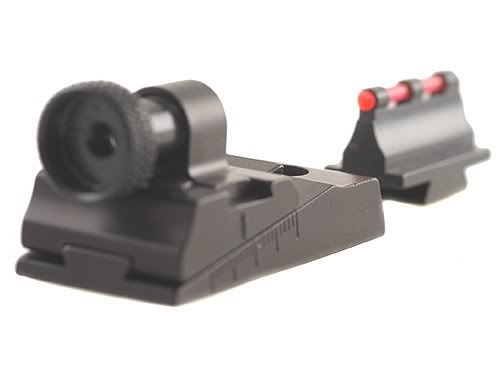 Williams makes yet another receiver sight, the Guide Receiver sight. As you can see this doesn't mount to the side of the rifle but to the top of the receiver or barrel. The weakness of this sight is primarily in the range of available adjustment. As you can see in the photos, both windage and elevation adjustment is very limited when compared to the Foolproof and 5D. The Guide Receiver Sight is nothing more than an adaptation of the Guide Open Sight with an aperture. Very clever are those engineers at Williams Gunsights. The Guide Sight has one or two advantages. The first is price over the Foolproof. The second is subjective and is that the base on the side of the rifle is eliminated providing a "cleaner" look.
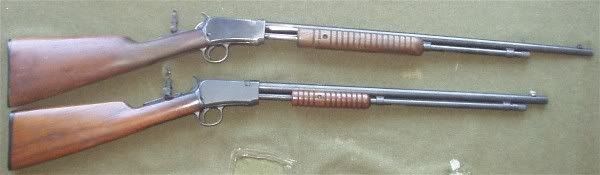 I actually started with a Lyman #2 tang sight on the Winchester M62A shown in the photo. This was actually the very first rimfire I ever shot! This isn't the best photo, but I have one old Lyman and one new Marbles mounted on my Winchester pump action .22 rifles. These sights are pretty good and practical on the .22s.
 The tang sights are fine for soft recoiling firearms and they do increase the sight radius over that possible with the receiver sights but I can't say that I (that's me, some folks don't have these problems) like them for heavier recoiling for a couple of reasons. First, since they sit on the tang they tend to slide by the hand while not permitting the same grip one would take on the gun's wrist if they weren't there. This can result in distracting abrasions. Second, the tang sight sits awfully close to the eye and it does make me a bit nervous in the prone position (I think prone is a bit more likely circumstance than using high angle fire with a big-bore rifle).
 I have a Lyman. I got it for and it is mounted on my 336T. The Lyman's have the ability to be zeroed out so that one can adjust from a known point and back again. this should be an advantage over the Williams. Unfortunately the system used is a separate sliding plate(s) retained by screw(s). You can see the elevation plate in the above photo. In my "lemon" the elevation plate screw stripped the threads on the aluminum base. As machinists know, not all alloys are created equal and the Lyman aluminum alloy is apparently NOT the equal of the alloy used in the Williams sights. Perhaps, too, the tap and or drill weren't correct and the hole slightly oversize.
 The Lyman and other receiver sights made of steel including the Redfields are to be preferred if only because they are nostalgic. There is just something special about a steel sight. There are many who believe that a steel sight is more durable than any aluminum sight.


