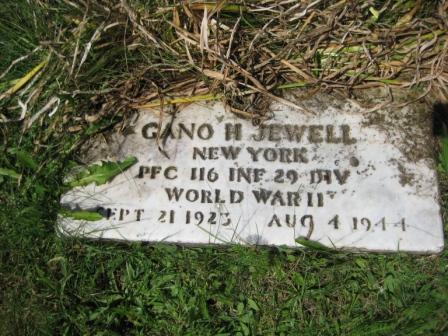
I have a fairly good idea of my ancestors who served but hadn't made a list of those of my son-in-law's family. Thought I'd do that.
Of course, his dad served (as did his uncle Fred). I thought I'd go back a bit to see what I could document. I will make additions and corrections as I go along...
Received my copy of the Rock Island Auction catalog and seemed to be immediately drawn to lot 1535. This is an M1 Rifle (Garand) with a unique blast deflector reportedly locally fabricated and used only in Alaska. This is a gas-trap rifle. A photo of the blast deflector is shown below. Bruce Canfield's new book doesn't seem to mention it but it is possible I've overlooked that somehow. Very interesting to me. It would seem that it would have to be removed for operator cleaning. The catalog copy says that only 3 are known to exist. I've never seen or heard of one before. Accordingly, this rifle's estimate is between $30,000 and $50,000!
June 6, 1944. D-Day. The "invasion" of "fortress" Europe (the French refer to it as the embarkation). Among the units embarking was the 116th Infantry Regiment attached to the 1st Infantry Division. I had thought that among the men landing that day was PFC Gano Haines "Sonny" Jewell who was assigned in mid-July to the aid station of the 2nd Battalion 116th Infantry. 2 months later PFC Jewell would be dead but on this day in 1944 he was apparently in or enroute to England awaiting assignment as a replacement in one of the combat units and to begin the long and difficult job of freeing Europe.
Sonny was my Dad's first cousin and the only child of Harold and Julia (Parslow) Jewell. They were particularly close and I believe that Sonny's death was at least partially influential in Dad's decision to enlist as soon as he was able. I remember Dad talking about Sonny and some of their "adventures". He also talked about following his mother and aunt when they went to pick up Sonny's body. Even 40 years later there was real sadness in Dad's voice.
I wish I had a photo of Sonny. I've only seen a couple and only one of him in uniform. About 1985 a former NCOIC of the 116th Medical Detachment, Winston Morris, came into my office and showed me a copy of his photograph of Sonny taken the day before his death. He was going to send me a copy but for one reason or another that never happened.
As a representative of all those men who risked all on that day, we honor our cousin Sonny.
The Otsego Farmer
Friday, September 1, 1944
WESTV1LLE
Friends of Mr. and Mrs. Harold Jewell of Schenectady, formerly of this place, will regret to learn that their only son, Gano, is reported missing in action in France. Mrs. Henry Hesch and Mrs. Fred Ottaway are spending several days with their sister and brother, Mr. and Mrs. Jewell.
The Otsego Farmer
Friday, October 27, 1944
Mrs. Webbs Nephew Is Killed In Action
Pfc. Gano H. Jewell, son of Mr. and Mrs. Harold G. Jewell of No. 13 Cromer Avenue, Schenectady, previously reported missing in action, was killed August 4th while serving as a field medical man in France the War department informed the parents. He was a nephew of Mrs. Kenneth Webb of Whig Corners, Mrs. Fred Ottaway of Westville, and Kenneth Jewell of Milford.
A graduate; of Nott Terrace High school. Private Jewell enlisted in the army reserve in November, 1942, and was called in active duty in July, 1943, while a Sophomore at Union College. Following his basic training at Camp Grant, Illinois, he was graduated from Technician and advanced Technician courses at O'Reilly General hospital, Springfield, Mo.
After serving a short time at Fitzsimmons General Hospital, Denver; Col., he was stationed at Camp Reynolds, Pa , before going overseas in May, 1944.
The Otsego Farmer
Friday, April 22, 1949
Westville
GANO JEWELL BURIAL
The body of Pfc. Gano Jewell of the Army Medical Corps, who made the Supreme Sacrifice in France on August, 1944 was brought to Westville cemetery for burial, Saturday afternoon.
Funeral services were held in the Union College chapel in Schenectady. Pfc. Jewell was the only son of Mr. and Mrs. Harold Jewell of Schenectady and a nephew of Ernest Jewell, Kenneth Jewell, Mrs. Fred Ottaway and Mrs. Henry Hesch, all of this place.
It is official. I've been asked to again help with the 116th Infantry Regiment Museum and Foundation property. I think I'll be able to do that now and of course I'd like to help.
Long before I gave 15 years to The Regiment, my first cousin once removed, Gano H. "Sonny" Jewell gave his life in service to his country while serving as an medic in the 2d Battalion 116th Infantry aid station outside Vire, France on August 4, 1944. "Sonny" left college to enlist and do his part and his death was likely just one of the motivating factors which drove my father to enlist on VE-day when farm labor was released from enlistment restrictions. I think it will be a good thing for me to do this in remembrance of him.
The museum will be moving into some of the space currently occupied by The Spoils of War, a store at which I work. This space has kindly been donated by the Shueys, father and son, both members of the Regiment. This is about 1000 square feet of retail space AND they will be donating another 1500 square feet or so of storage space. Quite a thing to do, I think.
Today I heard that some (?) officers in "The Stonewall Brigade" didn't care for the unit's history. One, a Minnesotan, felt that the sobriquet was supportive of slavery. Well, I'm here to tell you that Sonny was proud to serve in the 116th and so was I and his great (my great-great) and great-great (my great-great-great) grandfathers served in the Union Army in the Civil War. In fact the following six grandfathers are mine and are known to have served in the Federal forces (U.S. Army during the American Civil War):
- 1LT Barney Alonzo Parslow - D Company, 134th New York Infantry
- PVT Henry Parslow (Barney's dad) - K Battery, 2d New York Heavy Artillery
- 1LT William Hathaway Van Cott - C Company, 102nd Regiment U.S. Volunteers
- PVT Charles Henry Flint, H Company - 194th New York Infantry
- PVT Hiram H. Kimball - E Company 69th New York State Volunteers
- PVT Peter V. Race - 15th and 50th Regiments New York Engineers
It is history, that's all. No one living is responsible for any of the acts committed by any person at that time. The men serving their country generally acted honorably. They should be honored and that is what the museum will do.
While the iconic image of this particular war (1899-1902 or the earlier conflict in 1880-1881) is the stolid Boer rifleman defending hearth and home from the British interlopers the truth is something a bit different.
We discovered in our reading that it was true that factions of the Boers had pushed for the second war and manipulated events to that end and so too, had factions within the British Empire. The motivation was the immense wealth in the gold and diamonds within what is now South Africa and Zimbabwe (Rhodesia).
While I was aware of the "policy" of apartheid and that this had really begun early in the colonization of the Cape Colony/South Africa, I was not aware of the intense segregation of the Dutch and English colonists. We might also note that while the English presented themselves as the world's light leading men from slavery, English interests worked with the Dutch to preserve apartheid until only recently.
What had really interested me for some years was the Boer military system.
The Boer 'commando' system evolved from the early defence system at the Cape. Each district was divided into three wards or more, with a field cornet for each ward and a commandant taking military control of the entire district.
The burghers elected these officers, including the commandant-general of the Transvaal. When mobilised, a burgher had to be prepared with his horse, rifle and 50 (later 30) rounds of ammunition and food enough to last for eight days, after which the government would provide supplies. Assembled burghers formed a 'commando'.
Except for the artillery and the police in the second Boer War, no uniforms were worn, the burghers preferring drab everyday clothes. The Boer force is the classic example of a citizen army, because virtually the entire white male population of the republics between the ages of sixteen and 60 was conscriptable for unpaid military service.
This apparently worked well for the first Boer war but it proved lacking during the later 1899-1902 war. Indeed, the British eventually overwhelmed the Boer forces with superior manpower, artillery and industrial capacity. Even though the Boers resorted to guerrilla action in order to continue the war they were combat ineffective once their capitals were captured. While the loose system of command and control enabled a rapid switch to guerrilla operations it was also the cause of several defeats and ill-chosen tactical and strategic decisions which resulted in the need for it. For example, the British were able to provide good, rapid and continuous medical care for their wounded (for that time period) while the Boers could not. Such was the disparity that it was normal for the Boers to abandon their wounded to the British knowing that they would receive care they couldn't provide.
This is readily apparent in the photo of the Royal Munster Fusiliers. The soldiers are well supplied and there are a number of medical personnel caring for soldiers taken from the firing line.
From the beginning the Boers lost the initiative or failed to exploit weaknesses on the part of British forces. While the Boers launched their pre-emptive invasion of Natal to exploit the known weakness in British manpower, they allowed themselves to be bogged down in the Seige of Ladysmith. In effect, British forces in Ladysmith fixed the Boer forces so that there was sufficient time to bring in reinforcements through Cape Town. There are a number of other vignettes which illustrate the Boer weaknesses (despite their excellent artillery gunners and the supposed advantage given them by their use of the charger fed Mauser rifles). One of those is the Siege of Mafeking.
Baden-Powell (L) w/artillery built during siege
Commander of the British forces was Colonel Robert S. S. Baden-Powell (yes, the Boy Scouts' own Baden-Powell). He was widely lauded as the "Hero of Mafeking" and promoted for his defense of the town. However, for me, the lesson learned here is that Boer command and control wasn't up to taking this town defended mostly by other citizen soldiers but led by career British officers. Military discipline and leadership won the battle here. I think the lesson might well be applied to other circumstances as might be promoted by dissidents in diverse places.
Harry 'Breaker' Morant sailed to Australia in 1883 at the age of 19 and became a skilled horsebreaker hence the handle of 'Breaker'. In 1902 he was convicted at a court martial of murdering 12 Boer prisoners and was executed by a British firing squad.
The subject of the film "Breaker Morant" starring Edward Woodward, Somerset-born Morant was among thousands of men from Australia who volunteered to fight against Dutch settlers in South Africa. This was a sometimes savage guerrilla campaign, when numerous atrocities were committed by both sides. Morant and another Lieutenant in the Bushveldt Carbineers named Peter Handcock are said to have intercepted a group of eight prisoners being brought in for questioning and was accused of ordering them to be shot at the side of the road as well similarly summarily executing other Boers who had waved a white flag of surrender.
In 2010, Queen Elizabeth was petitioned to pardon Morant which she refused to do.
I saw the film, "Breaker Morant" while stationed in the Republic of Korea. Now there's an audience to which to play this subject. All soldiers, sailors, airmen or Marines and all trained, some extensively, in the law of land warfare. Several in the audience I knew to be field grade officers. It seems to me, although my memory might be a bit dodgy, that the main facts of the case are correctly shown in the film. At the time as well as now, I appreciated the apparent accuracy of clothing and equipment used. The Boer wars have long been an interest of mine and seen in that light alone, it is an interesting film.
However, to that audience, it was certainly a reminder of the duty's requirements when we thought we might at any time be fighting a rather implacable foe proven to have committed many atrocities of their own. I thought that it was pretty sobering.
For those of you who might be interested, the Boers used a large number of different rifles and carbines as was necessary. The British used the Long Lee-Enfield and Lee-Metford rifle and Lee-Enfield carbines (adopted in 1896). That's a Long Lee-Enfield that Edward Woodward as Morant is holding in the photo to the right.
Jedediah Hotchkiss (b. November 30, 1828 – d. January 17, 1899), was also known as Jed. He was an educator and the most famous cartographer and topographer of the American Civil War. His detailed and accurate cartography of the Shenandoah Valley is considered a principal factor in General Thomas J. "Stonewall" Jackson's victories in the Valley Campaign of 1862.
Jedediah Hotchkiss was born on November 28, 1828, to Stiles and Lydia (Beecher) Hotchkiss in Windsor, NY. He lived and went to school in Windsor, graduating from the Windsor Academy. He was teaching school in Lykens Valley, PA, by his 18th year of age. In 1847, at the age of 19, he and a friend traveled to the Shenandoah Valley, mostly on foot. On this trip Hotchkiss met Henry Forrer who owned the Shenandoah Iron Works. A year later he would return the valley as the Forrer family tutor. That led to opening his own school in Mossy Creek in 1852. He also began surveying and continued his own studies in a variety of subjects. In 1859 he and his brother founded a new school in Churchville named Loch Willow.
In exploring his adopted home, he began the hobby of map making and developed the skill that would make him invaluable to the Confederate Army.
A transplanted New Yorker, Jedediah Hotchkiss became the most famous of Confederate topographers. In 1861 he gave up teaching and offered his services as a map maker to General Garnett in western Virginia. After serving at Rich Mountain and mapping out General Lee's planned campaign in the mountains, he fell ill with typhoid fever. In March 1862 he joined Stonewall Jackson in the Shenandoah Valley as a captain and chief topographical engineer of the Valley District. Often personally directing troop movements he took part in the actions of the Valley Campaign and at Cedar Mountain, Chantilly, Harpers Ferry, Antietam, and Fredericksburg. At Chancellorsville he found the route by which Jackson was able to launch his surprise flank attack on the Union 11th Corps. After the death of his chief he served the next two commanders of the corps, Generals Ewell and Early, but was frequently assigned to work for Lee's headquarters. In this dual role he served at Gettysburg and in the Mine Run and Wilderness campaigns.
Accompanying Early to the Shenandoah, he served through the campaigns there until after the disaster at Waynesborough. He gave himself up upon notification of Lee's surrender. By now a major, he was arrested but General Grant had him released and returned his maps. Grant even paid for the right to copy some of them for his own reports. Most of the Confederate maps in the atlas of the Official Records were drawn by Hotchkiss. After the war he was energetic in trying to develop the economy of his adopted state. Also involved in veterans' affairs, he authored the Virginia volume of Confederate Military History.
After the war, Hotchkiss taught school for two years before opening an office as a civil, mining and consulting engineer. With his wide knowledge of Virginia, he helped obtain the foreign and Northern investment of millions of dollars for the state.
He visited England and Scotland to encourage emigration to Virginia and worked ceaselessly to popularize the new notion of the public school system.
He was one of the "distinguished men of the South" who collaborated in the writing of the 12-volume "Confederate Military History", single-handedly composing the 1,295 pages of the Virginia volume. It is obvious that New York's loss of Jed Hotchkiss' public spirit was Virginia's gain.
Called by his peers "a well rounded Christian character of beautiful purity and cheerfulness", Hotchkiss also has the unsung place as the eyes of one of the world's most celebrated military geniuses (General Stonewall Jackson). In part, each of the hundreds of monuments in the name of Stonewall Jackson throughout the South also honors Jed Hotchkiss.
On January 17, 1899, at age 71, Jedediah Hotchkiss died at his home (437 East Beverley Street) in Staunton, VA.
Today's initiation of attacks on the forces of Moammar Gadhafi in Libya made me think about all the wars in which the U.S. has been involved in my lifetime. First, there's the Korean War (you can call it a "police action" but it is a war) which is still on-going despite the truce. Then, you had the "Cold" War, Vietnam, Panama, Grenada, the Gulf War, the Yugoslavic war(s), the Global War on Terror, the Iraq War, the Afghanistan War, and, now, the Libyan war. As I sit and think, we've not really been at "peace" in my lifetime even though there's plenty of "anti"-war protesters (who are actually agents of all our enemies and at war with the U.S.). Heck, even the current President who campaigned against "the" war has continued and even escalated the war in Afghanistan and started this war with Libya.
But what interests me for the moment and what I want to talk about here is the changes in weaponry that have occurred over that time period. Some call them improvements but...
First, there's the pistols. We've gone from the 1911A1 to the Beretta M9 (or is it M9A1?), from .45 cal to 9mm because you can carry the same ammo as our enemies and more of it (but you don't really) and because the leadership thinks close combat isn't influenced by how quickly your enemy hits the dirt and that you don't.
Second, we've had like improvements in rifles, switching from the M1 Garand .30-06 rifle to the M14 7.62mm NATO to the M16 and its derivatives in 5.56mm NATO. That was so much of an improvement that there are efforts within and without the military to modify the 5.56mm cartridge to come closer to equal-lying the old .30 caliber rounds in terminal ballistic performance.
Grenades and other individual explosive devices haven't changed that much except in shape and size with some improvement in quality or uniformity of fragmentation. We have had improvements with grenade launching moving to the M79 then M203 systems for the individual soldier and the Mk19Mod3 40mm grenade launching machine gun.
Likewise we've seen some improvements in light and general purpose machine guns with the M249 and M240 being fielded replacing the M60 and older M1919A4 guns. Some soldiers would disagree, but their just grousing as soldiers do, right?
The biggest changes have been in targeting systems for munitions delivered by artillery and aircraft. Those big changes are in Global Positioning Systems (GPS) and with the remote controlled aircraft for targeting both stand-off distances and accuracy are greatly enhanced protecting the lives of American servicemen and women. For those instances where targets are moving operators can light them up with a laser and ordnance can be flown directly into the target. These systems have been revolutionary and are THE reason that the U.S. has been militarily pre-eminent. How long this might last is in question, but for now...
On September 6th she was a passenger in a GMC driven by another LT with another young man in the back seat. The driver lost control of the SUV and rolled into a rock wall. She and the boy in back were not wearing seat belts and were both ejected from the vehicle. The coroner said she was killed instantly.
Not mentioned is that this family has served this country extensively including military service. Also, this family is obviously grieving this loss. Please pray for the family and if you would like to, please leave your message of condolence here.
Leavenworth, Kan. —
Catilyn LeClerc
21, Leavenworth
2nd Lt. Caitlyn Victoria LeClerc, 21, died Monday, Sept. 6, 2010, from injuries suffered in an automobile accident when she was returning to school from a Labor Day vacation at the Lake of the Ozarks.
She was born Jan. 7, 1989, weighing only two pounds but proved she was a fighter from the beginning and became so strong that although she was only five feet two inches tall and weighted 110 pounds she could do 88 pushups in two minutes. She always made her own rules and brightened the lives of all she met.
Caitlyn was a 2007 graduate of Leavenworth High School where she was a member of the National Honor Society, the ROTC Drill Team Commander and Prom Queen. She was a 2010 graduate of Wentworth Military Academy where she excelled in both academic and military leadership skills. She was awarded the Outstanding Company Commander award for individual leadership and service. She commissioned a 2nd Lt. in the United States Army at her graduation in May. She was also a member of the Missouri National Guard 35th Combat Aviation Brigade.
Caitlyn had just begun classes at the University of Missouri to complete her degree in International Studies.
Caitlyn is survived by her father and mother, Dr. Byron and Teresa LeClerc; and her brothers, Alex age 23, Thomas age 11 and her little sister, Grace age 11
Visitation will be from 6 to 8 p.m. Thursday, Sept. 9, 2010, at the R.L. Leintz Funeral Home. The rosary will be prayed at 5:30 p.m. Mass of Christian Burial will be at 10 a.m. Friday, Sept. 10, 2010, at Immaculate Conception Catholic church with Rev. David McEvoy, O.Carm., as celebrant. Inurnment will be at Resurrection Cemetery. Memorials are suggested to the Wounded Warrior Project.
and
Columbia woman dies in car crash
Published September 7, 2010 at 11:11 a.m.
Updated September 7, 2010 at 1:36 p.m.
A one-vehicle accident early yesterday in southwest Missouri claimed the life of a Columbia woman and left the driver facing charges of vehicular manslaughter and assault.
Caitlyn V. LeClerc, 21, died in the incident that happened shortly after 8 a.m. yesterday when a 2003 GMC driven by John S. Dulaney, 21, of Columbia, ran off Highway 39 south of Viola in Stone County, according to a report by Trooper Terry Bible of the Missouri State Highway Patrol. The car overturned, and LeClerc was pronounced dead at the scene by Stone County Coroner Jim Fohn.
Dulaney and a second passenger, Robert A. Carter of Columbia, suffered serious injuries and were taken by helicopter to Springfield for treatment, Bible said.
After Dulaney was tested for alcohol, he was arrested on suspicion of involuntary manslaughter by intoxication, felony assault and careless and imprudent driving resulting in an accident. He was released to St. John’s Hospital in Springfield for care, Bible said. No formal charges had been filed as of early today.
Please, reinforce to your children that they should wear their seatbelts, not drive after drinking or be driven by those that have been drinking and be a true friend to others by enforcing those standards.
It is men such as these that we should emulate in our own lives.
Obituary: Bill Millin, piper
Published Date: 20 August 2010
By CHRIS MAIR
Bill Millin, piper.
Born: 14 July, 1922, in Regina, Saskatchewan, Canada.
Died: 17 August, 2010, in Torbay, Devon, aged 88.
On Sword Beach during the D-Day Normandy landings in 1944, as German troops opened fire on his comrades, Bill Millin marched up and down along the shore playing Highland Laddie on his bagpipes.
William Millin was the eldest son of Mr and Mrs John Millin. The family crossed the Atlantic in 1925, settling in Shettleston, Glasgow. They lived on Gilmerton Street and Millin was educated at Budhill School, Shettleston. He played the bagpipes in the Boys' Brigade band before joining the Queen's Own Cameron Highlanders as a piper and a commando. His first public piping session was in 1940, an event run to raise funds for the construction of a Spitfire.
Millin, as his mother put it, "was always a good fighter", hence his position as Piper of the 1st Special Service Brigade (redesignated, 1st Commando Brigade in December 1944), a commando unit. The unit consisted of some of the toughest men from the Army and the Royal Marines, all of whom were trained in wilderness survival, close combat, navigation, weapons, demolition and crucially, amphibious assaults.
On 6 June, 1944 Millin, along with his fellow commandoes approached Sword Beach, Normandy as part of the D-Day landings which would see the largest amphibious invasion of all time as 160,000 troops entered France to fight the Nazis.
1st Special Service Brigade was commanded by Brigadier Simon Fraser, the 15th Lord Lovat. Lovat was a passionate and patriotic Scot, and Millin was his personal piper. Lovat was also a fan of the Scottish tradition whereby a piper played his comrades into battle, a tradition banned by the military hierarchy. However, as Lovat not quite factually pointed out: "That was the English Army."
Millin climbed aboard his landing craft with 21 men, including Lovat, and sat as the vessel followed the course of the Hamble River out toward the Solent. He was in the leading boat and Lovat had asked him to play the troops out in to open sea. As they sailed up the Hamble Millin piped The Road to the Isles. He stood proud on the bowsprit as the music was pumped through the loudhailer. As the thousands of transport craft gathered for the mass assault on the French beaches, Millin's pipes could be heard above all else. As the sea became rougher and the craft less stable Millin stopped piping and the Channel crossing began.
Following a fitful night's sleep, the men made their way to the deck and prepared for what, for some, would be the last charge of their short lives. Millin recalled an air of calm aboard their small craft: "Everyone was behaving normally, I mean checking their kit, putting their kit on… We all got up on deck and we stood in the freezing wind watching the shoreline.
Then the order came to get ashore, and no one was shouting that they were afraid or shouting that they were going to kill all these Germans. All people wanted really was to get off."
Millin followed Lovat, watching the tall man crash into the waves, and then watched a man behind take a bullet to the face and sink. Millin saw that as a sign to hurry along and he launched himself into the waves. As his kilt (a 100-year-old one his father had worn in the Great War) rose up he started piping Highland Laddie.
Once Millin had finished that first tune Lovat requested another. "Well, when I looked round - the noise and people lying about shouting and the smoke, the crump of mortars, I said to myself, 'Well, you must be joking surely.' He said, "What was that?" and he said 'Would you mind giving us a tune?' 'Well, what tune would you like, Sir?' 'How about The Road to the Isles?' 'Now, would you want me to walk up and down, sir?' 'Yes. That would be nice. Yes, walk up and down.'"
What transpired has since gone down in military history as an iconic moment. Millin strode up and down the beach piping rallying tunes for his friends. The Germans were perplexed by the sight and did not shoot at him.
As the troops moved inland Millin found himself almost alone on the beach, but as he had not been told to stop playing he ran up and followed the men, playing them all the way to Pegasus Bridge, piping Blue Bonnets Over the Border.
On 10 June, Millins's luck ran out; although he wasn't shot himself, his bagpipes were hit by shrapnel and their war came to an end. In 2001 those same pipes, along with his family kilt, commando beret and knife, the military kit of the "mad piper", were donated to the National War Museum of Scotland.
Following the war Millin was offered employment on the Lovat estate, but grew restless and joined a theatre, where he played his pipes, before retraining as a mental health worker in the late 1950s. He spent the rest of his working life as a care worker, moving to Devon in 1963 and frequently returned to pay his respects the friends who lost their lives in Normandy.
In 1962 a film, The Longest Day, told Millin's incredible story. He was played by Pipe Major Laspee, the Queen Mother's official piper. Millin suffered a stroke in 2003 and had been living in a nursing home in Dawlish since. There is currently a fundraising campaign to construct a bronze statue on Sword Beach to commemorate Millin's heroics on 6 June, 1944.
William "Bill" Millin's wife Margaret predeceased him and he is survived by their son John.
I also got this info on lubricating the Garand, M1 Rifle on the CMP site.
How We Reassemble The Feed / Action Assembly The M1 Garand
One of the most important things to remember about the M1 Garand's operation is that the old rifles really like to be properly lubricated. When originally manufactured M1s were made in such a way that they could be fired dry, (and this was done a lot in the Korean war thanks to the very frigid temperatures being incompatible with the grease), with 50 years worth of wear on most M1s our opinion is that it is a good idea to lubricate fairly meticulously. We have been lucky in that our local surplus store has been stocking a grease known as Plastilube. This is one of the two lubricants (the other being Lubriplate) that we hav seen recommended for use with the M1 most often. In the photos below you will see what is probably too much grease being illustrated. We did this for photographic clarity as smaller amounts did not show up well because of the fill-flash. Begin by lubricating the receiver, specifically the area where the operating rod will slide. then grease the inside area of the receiver where the bolt will be moved back and forth as well as the areas where the bolt lugs lock down.
Next lubricate the bolt. Grease the bottom lightly and then the sides as well as the lugs. Basically any portion of the metal that will come into moving contact with other metal parts gets a little bit of lubrication.
When you have lubed these areas of the rifle sufficiently, replace the bolt.
How We Reassemble The Feed / Action Assembly The M1 Garand
When we have the bolt and the rear part of the receiver properly lubricated we turn our attention to putting the bolt back in place. To do so simply angle the bolt about 5 degrees counter clockwise, tilt it upwards about 10 or so degrees and then starting with the rear of the bolt I gently jiggle it into place.
When the rear of the bolt slips into the receiver you can then drop the front down. Slide the entire bolt assembly back and forth to assure that it moves freely and to confirm that the orientation is right. The bolt should slide easily in the greased wells and it should rotate into the locked position when moved forward.
If the bolt is in place correctly begin the process of installing the Operating Rod.
How We Re-Assemble The Feed / Action Assembly The M1 Garand
The Operating rod goes in next. Before placing it on the rifle however - lubricate the area where the bolt lug will ride and underneath the 'flat' area just behind where the spring is inserted. This is the area that comes in contact with the bottom of the barrel.
Now gently insert the Operating Rod carefully into the Gas Cylinder. Hold the Oprod at the most shallow angle you possibly can in order to make insertion easier and to avoid any chance of bending it.
When the Operating Rod is in the correct general position turn the rifle right-side-up and hook the handle end of the rod to the bolt and into the receiver.
To do this simply slide the bolt to the rear so that the lug of the bolt is just barely under the forward edge of the rear sight cover spring. I then gently rotate the operating Rod up and into position. To fasten the Operating Rod in - thread the bolt lug into the side of the Operating Rod and with a firm right, inward, and down pressure push the Operating Rod into the notch below the windage knob. Then tilt the weapon forward and backward. If the Bolt and Operating Rod do not slide easily as a unit (using the force of gravity alone) then something is out of place. Once the operating Rod is in position assemble the smaller parts of the mechanism.
Now that the lubricant wont be in the way, grease the 'swollen' part of the barrel where the Operating Rod will ride.
Having completed most of the assembly, all that is left to finish up is to put the Operating Rod Spring and the Follower Rod in. Take a few minutes to very lightly oil the spring to help keep corrosion down. Also oil the Follower Rod Except for the 'fork' end. When the parts are lubricated insert the spring into the Operating Rod. The end of the spring without the Follower Rod goes in first of course.
I needed to provide a friend with instructions and found this at the CMP site.
Field Stripping The M1 Garand
Few things in life are easier than field stripping an M1 Garand Rifle. Just as people were impressed many years ago with how easy it is to tear down a Model 1911 Colt pistol, they are smitten with the elegant simplicity of the M1 Garand.
Check to make sure the rifle is unloaded! Note the W.W.II era blood drive poster. You don't need a transfusion from doing something stupid.
The first thing to do when preparing any work on any firearm, and indeed any time you so much as pick up a firearm is to 'clear' it. This simply means checking it fully and completely to make sure that it is not loaded and that no rounds, or shell casings remain in the magazine or chamber.
Even after clearing the weapon still make damn sure that the muzzle is always pointed in a safe direction. Never handle weapons when exhausted or under the influence of anything stronger than Pepsi-Cola.
If you ever run across any firearm that you are not 100 percent sure exactly how to check it to make sure it is unloaded, DON'T touch it. Get help from someone who knows what they are doing. When the weapon is totally safe start field stripping by removing the trigger group...
Removing The Trigger Group First, release the bolt and let it slide forward in a controlled manner.
Rotating the trigger guard up and forward (toward the muzzle).
Next invert the weapon and firmly pull back (toward the buttstock) on the rear portion of the trigger guard. On milled triggers some people place a dowel through the hole in the rear portion of the guard in order to obtain a little more leverage.
Pull up and forward (toward the muzzle) on the trigger on the trigger guard. Since we have previously cleared the weapon, we do not have to cock it. However had the weapon foolishly not been cleared, performing this action would have cocked the hammer and locked it into the down position.
Lifting the trigger group out of the rifle
Next pull straight up on the trigger guard. This will free the trigger group from the buttstock of the rifle. It does not take a lot of pulling to do this. If anything sticks at this point there may be a problem.
Now set the trigger group aside in a safe place and then prepare to go to the next step:
Removing the buttstock from the rifle...
Removing The Stock From The Rifle After setting the trigger group aside grab the forward handgrip with one hand in order to hold the barrel and receiver in position. Grab the buttstock somewhere around the comb and carefully rotate the buttstock up and off of the receiver legs.
Note how the stock is rotated off of the receiver
Note the relationship of the ferrule to the front handgrip on the receiver.
We now have three distinct groups of parts. The barrel and receiver group, the buttstock, and the trigger group.
If you want to disassemble the rifle further you need to detail strip it.
Designed by John Cantius Garand (1888–1974), the M1 was an en-bloc clip fed, gas-operated, air-cooled, semiautomatic rifle chambered for the .30-06 cartridge. It was adopted by the U.S. Army on January 9, 1936. After a redesign to correct a major problem, the Marine Corps began employing the M1 in November of 1940. 4,000,000+ M1 rifles were constructed between 1942 and 1945 by Winchester Repeating Arms and Springfield Armory.
The M1 saw extensive service in World War II and the Korean War, and was officially removed from service in 1957 (replaced by the M14), although it was employed by Allied nations in the Vietnam War. I saw rifles in active service with the Republic of Korea Army as late as 1979 but have read that they were used by reservists until very recently. Approximately 100,000 of those ROK rifles will be re-imported soon.
I've been wanting one of these rifles for a while but always managed to convince myself not to buy one. The weight, chambering, use, and price always seemed to work against it. However, it is an iconic rifle, one that is a must have for either the shooter of the .30-06 cartridge (for which I have much brass), the militaria collector, or somebody who enjoys "classic" rifles. I guess that now includes me. So, for the past couple of years I've been working my way to sufficient funds for the purchase of a Civilian Marksmanship Program Garand.
However, as it seems often happens, when I actually got to the site to get the forms to order the rifle the CMP had managed to lay out some rather tempting bait for me guaranteed to take more of my money than I planned.
The CMP Special is virtually a new Garand with CMP cartouche. It is beautiful and it has nothing of the commemorative, "gold" "inlaid" trash one sees about it but is a purely military gun. I had to have it. So, just about the middle of January I finally got all the paperwork together and sent it off. I expected to have to wait until the first of May but then got word it would only take about 60 days or the first of April and then, suddenly it seemed, notice that it shipped on the 9th of February! That was exciting but then an intense relationship with the FEDEX tracking page ensued. I was somewhat disappointed when it wasn't delivered as forecast but the rifle has now arrived and we will now begin accumulating the necessary accouterments.
This particular rifle was rebuilt by CMP on a receiver first manufactured as a rifle in July 1943. One can only wonder at the history this particular receiver has seen.
Aside from ammunition, one has needs and "needs" with this rifle. One definitely needs the en-bloc chargers aka "clips". Without them the rifle is nonfunctional. The clips are available in single round, 2-round, 5-round and standard 8-round types (a partial list of manufacturers below).
En-bloc clip/charger manufacturers
Maker
Code
Aggressive Engineering Corp
ACE
Aggressive Engineering Corp
AGE (1&2)
All Metal Products
AMP
Austrian
5mm hole
Barry L Miller Eng Inc
BLM
Borg Warner
B-W
Borg Warner
BR-W (1-7)
Danly Machine Co
Danly (side of clip)
Dominion Arsenal Quebec
DAQ
Fedders Mfg
fE
Fedders Mfg
fF
Haerens Ammunitions Arsenal
HA
International Silver
IS (1-5)
Israel Military Industries
IMI
Italian or Danish
L&H 81
Italian
LP (1955,1956&1961)
Julius Maurer
JMO (68-74)
Lerio Patent Cup Co.
C
Nationalist China
58
Nationalist China
C*
Northwest Metal
NW
Manfacture D"Armes St Etienne
MAS
Metaalwaren Fabrik Tiburg
MFD
Murik & Ball Zeist
MBZ
Northwest Metal
NW
Serini France
S.F.
Stanley Works
S
Stanley Works
SW
Springfield Armory
SA (large or small or with dashes)
Thomas French & Co
TF&S
R Wallace & Sons
W (4 or 5)
Wade Electric Products
WEP
Winchester Repeating Arms
WRA
Winchester Repeating Arms
WRA Eductional
I'm going to have to sort it out with this list...
5 Stamp Unknown - might be an S for Stanley Works but uncertain at this point
5mm hole. - Austrian
After those one is really talking about "needs" aka wants or desires.
- Sling: The rifle was issued with a cotton canvas such as was first issued in 1943. This sling is very similar to the green nylon slings issued with the M16 rifles prior to adaptation/issue of the black "silent" sling. This sling would be correct for the Korean War period.
- Carry Case: I want a period case but I also want quality. I've not yet decided how to go with this.
- Bayonet: The correct bayonets, i.e. those used during the life of the rifle include the M1905, M1942, M1, M1905E1, and M5. I have a Springfield Armory 1905 made in 1906 (bright finish sans scabbard) but it won't go on the rifle. Not sure exactly why it doesn't work as the ring fits and latch works. Nothing seems out of spec, but... I really want an M1 or M1905E1.
Loading for the Garand is an exercise in balance. One needs to ensure that there is enough but not too much pressure at the gas port. Original M2 Ball ammo moved a 150 gr. flat-based spire-point bullet at 2700 fps. The long-time ideal powder has been IMR4895. With that in mind I've been looking for a load I could "mass" produce for my rifle. Here follow some of those suggested loads. Bullets are seated to a cartridge overall length of 3.34"
Bullet
Weight
Powder
Weight
Velocity
Energy
Sierra MatchKing
150 gr.
IMR4895
47.0 gr.
2650 fps
______
Sierra MatchKing
150 gr.
IMR4895
48.5 gr.
2700 fps
______
Sierra Int. HPBT
168 gr.
IMR4895
47.5 gr.
2670 fps
______
Note: Energy figures are really a moot point for such ammunition. Differences in velocity are likely the result of using different brass in different rifles.
"Trust in God and fear nothing." Captain Lewis A. Armistead
"A free people ought to be armed." (President George Washington, Jan 14 1790, Boston Independent Chronicle.)
"Necessity is the plea for every infringement of human freedom. It is the argument of tyrants; it is the creed of slaves." (William Pitt,Nov. 18, 1783)
"Stand your ground. Don't fire unless fired upon, but if they mean to have a war, let it begin here."Captain John Parker, Apr. 19, 1775
The Four Rules
1. All guns are always loaded. 2. Never let the muzzle cover anything you are not willing to destroy. 3. Keep your finger off the trigger until your sights are on the target. 4. Be sure of your target and what is behind it.
The FTC seeks to regulate blogs which advertise product or advocate for certain political views. The author of this blog is not compensated by any company for use, review, remark, link to, or mention of of any product on this or any other blog at any time or in any amount. Products shown, mentioned, reported, demonstrated, or linked to from this blog are those which the author has found to be of high quality, useful, interesting or otherwise needed by himself, family, or friends because of personal experience and the mentions, reports, demonstrations and links are meant to benefit readers but are not to be construed as an endorsement of the product, service or information provided.
Political comments, whether they be the views of the author or opinions on the views, policies or actions of political figures, parties or organizations, formal or informal, are solely those of the author and protected under the 1st Amendment to the Constitution of the United States of America.
This blog is therefore not covered by the FTC restrictions in any way, shape or form.
Legal Disclaimer
This blog is a journal intended to inform and entertain my grandchildren. The reader is solely responsible for the correct use and/or application of any and all load data or other information provided herein. Neither the author, sources, nor my heirs or assigns are in any way responsible for the misuse or misapplication of the contents of this blog. It is the reader's responsibility to comply with law and regulation in effect at the place where application of the included information is attempted.