Back to the range this afternoon with the M1 rifle. Easy to stay on a 1/2 silhouette at 100 yards with some loads grouping into ragged silver dollar sized groups. Was able to shoot another 1½-inch group with the .223 10-inch Contender. Took the new Contender with 10-inch .22 LR barrel and even did pretty well with it at 100 yards shooting a 3-inch group with the scope set at 4-power. All shooting with of the .22 LR was done with Winchester PowerPoint ammo. Easy to keep on a squirrel head out to 50-yards.
I am going to switch from H4895 to IMR 4064 for the M1, .30-06 loads. Both versions of 4895 being more difficult to get right now I'd rather save what I have for other cartridges.
We had a bit of a thundershower but while we listened to and watched the fireworks for about 30-minutes we only had about 5-10 minutes of rain and not really enough to wet anything.
Showing posts with label Milsurp. Show all posts
Showing posts with label Milsurp. Show all posts
Thursday, September 03, 2015

Friday, August 28, 2015
Range day...
Color me green, with envy.
Today I drove out to the range for the Thursday follies and stopped along the way, about 3 miles from the range, at a friend/co-workers house to drop off some bullets he'd been looking for but couldn't find. I pulled up and he stuck his head out of his "shop" to welcome me.
Now "shop" to describe this place of nirvana is totally inadequate but I am sure it meets the need of maintaining operational security. It is a typical old (about 1940-1950 vintage) outbuilding/garage measuring about 14x18 feet. It now has a period built standard 36" door. Stepping inside is a trip to a shooter's man cave dream world. Just inside to the right is a small wood stove. Behind that is a flat screen TV. Directly in front of the door facing the TV is a nice comfortable looking green easy chair. To the left is some shelving with the first of various shooting paraphernalia. Between the rafters, pasted to the bottom of the "attic" floor are targets and between some of the rafters shelves have been placed on which boxes of bullets have been carefully stacked. A HUGE Ft Knox gun safe takes pride of place along the left wall while on the right is a work bench with a neat little drill press, vices, tool boxes and so forth. Along the back wall is the loading bench with a double hung window just above it. To the right between the work bench and the loading bench are shelves filled with powder, loaded ammo and dies, on the left wall between the safe and loading bench are hung hunting clothes, and other stuff we all seem to accumulate.
I've always wanted such a place and have a very poor facsimile in my basement. My friend doesn't think he's rich but it seems to me that he is very well off indeed.
Time at the range was pretty good. There were already 2 others there shooting varmint rifles. I shot my M1 rifle at 100 yards. I was principally interested in the different points of impact for various loads out of various sorted cases. A clip of ball ammo drifted across the middle of the target roughly centered on the point of aim. The 8-rounds 155 gr. Sierra HPBT Match bullet over 46 gr. of H4895 cut a ragged just left of the point of aim with a group of about 1½-inches total. The rest of the ammo, loaded in Lake City, RP and Winchester brass using the Sierra 150 gr. HPBT Match over 47 gr. of H4895 made a pattern of about 5-inches total diameter centered about 4-inches above point of aim. Since the goal is to use the same point of aim for both factory ball and my reloads I think I'll be reducing the powder charge to 46 gr. of 4895 for my test. However, I've been really going through the H4895 and have about 9 lbs of IMR-4895 to use so may also switch to that. I have lots of brass to load and will likely need at least one more .30-cal ammo can in which to put up clipped reloads.
Shooting the 10" .223 Contender is improving. The load is 20 gr. H4198 under the 52 gr. Hornady HPFB Match (2250). This flat base bullet has been discontinued but it seems to be a good one. I have improved to the point that I can consistently shoot 5-shot groups of about 3" with some half that. I find it difficult to use the long eye relief scope and am still learning how to hold the gun on the bags for maximum steadiness.
I did make a Gunbroker purchase of a used Contender with a 10" .22 LR barrel and intend to use the rimfire barrel to practice more but I haven't received the barrel yet despite having delivered the MO and FFL last Thursday. THAT is a bit of a bummer.
Thursday, June 11, 2015
Range day...
Had a pretty good range day but...
First, I took the M1 rifle out with some Lake City M2 and she did pretty good. The weight of the rifle makes it pleasant to shoot from the bench. Then I shot the SIG Sauer 938-22 and got it zeroed with the Winchester Dynapoints. She does ok at 25 yards and practice with the trigger helps a lot. I do NOT like the 3-dot sights. I may black them out as the dots give a confusing sight picture, at least for my eyes. I might black out the dots on the rear sight first, just to see what that does.
Then I wanted to shoot up some .45 ACP somebody gave me that was loaded with a light load under some 200 gr. plated RN bullets. I took my Ruger FT .45 Colt/ACP with the ACP cylinder for just this purpose. No go. The cartridges wouldn't go the last 1/4 to 5/16ths of an inch into the chambers. Poorly resized. No, I won't give you the name of the fellow who did this. I am going to try to recover these but we will just have to see if this will be doable without pulling all the bullets and dumping the powder.
Two of the club officers were out there shooting. One shoots only cast bullets and was trying cast in the 6.5-284 Winchester! The other brought his Schultz and Larsen .22, Anschutz Exemplar pistol and XP100. Lots of fun shooting!
Thursday, March 15, 2012
Colt 1911 carried in WWI
I have recently had the unique opportunity to work with, disassemble, clean, a un-messed with WWI Colt manufactured 1911. The serial is 2838**. The right side of the slide is marked "MODEL OF 1911.U.S.ARMY". So this pistol was produced prior to the "black army" pistols but it still exhibits some rather rough machine work where careful finishing doesn't matter.
The first two characteristics of this pistol that leaped out at me were that the firing pin stop was squared off at the bottom as is the currently the rage in some circles (to return to the 'original' design like JMB intended and to soften recoil) and the 19 vertical slide serrations on either side of the rear of the slide (only) are plenty sharp and not only aggressively 'grab' the bare fingers but do so to gloved hands as well. I don't remember this as being true of the well-worn 1911A1s I had in my arms room but I suppose I could be mistaken.
I also noted the small sights but they aren't really new to me as all the 1911A1s we had in service had very similar sights.
I, being a bit of a curmudgeon, like the flat main spring housing and don't mind that it is smooth. I have put flat MSHs on my own Colts. I can get along with the long blued steel trigger but I do prefer the shorter 1911A1 trigger.
This gun has no peening of the locking lugs. The barrel to bushing fit was so tight that I had a bit of a time separating them. The inside shows the rapid and rougher machining of wartime production.
When the current owner first acquired the pistol it was in EXCELLENT condition. Unfortunately, something happened and the pistol had a bit of fine red rust develop along the exterior of slide and on the frame and trigger. That has been removed but it resulted in a bit of a finish problem you might see in the photo(s).
Sunday, July 31, 2011
Spencer

These guns came out just in time for the American Civil War 1861-1865 and about 200,000 rifles and carbines were made. Almost exclusively used by the Federal army because only the North could produce the cartridges, the carbine particularly made itself felt on the battlefield in cavalry vs infantry engagements such as at Gettysburg. There has long been a great deal of romance attached to this arm and consequently they are a favorite of collectors. That said, a number have been converted to centerfire so that reenactors and other interested individuals can fabricate ammunition using available centerfire cases the original rimfire cartridges having been long out of production. This demand in turn resulted in the production of reproduction Spencer rifles and carbines.
Most all that I've handled, including the two examples that were displayed at the 116th Infantry Museum, have shown signs of hard use. Ammunition was produced through to the 1920s and I have no doubt that was when most of the guns were finally reaching the point that they were irreparable.
Below you can see a couple of videos my friend "Perry Owens" of merry old England has done on the Spencer.

Thursday, March 24, 2011
M1 Carbine Stuff...
 |
| Correct M1 Carbine Gas Piston |
It will be an easy fix. All that is needed is the correct gas piston and the gun should operate as intended.
Now, why did somebody do this? Well the owner said it was to comply with New Jersey law but I've been told that New Jersey law does NOT prohibit semi-automatic rifles. We thought perhaps it was to comply with a hunting regulation such as those in Pennsylvania which don't allow semi-auto firearms. We just don't know why this particular gun was altered.
 |
| 1969 Ad for the Gas Piston Dummy |
Tuesday, March 01, 2011
Interesting things at work...
I don't just work at a gun shop, I also work at a place called "The Spoils of War". We began as a gallery for the work of James Dietz whose works our parent company publishes (We now also publish Larry Selman). We have expanded, and now the store also functions as the headquarters for a minor empire of military fine art prints including those not published by ourselves. Our storefront has, since I started there in October 2001, sold a variety of military collectibles. The only thing in which we don't deal is functional firearms of newer than 1898 manufacture. Let me repeat, we don't sell firearms there...
However, we do sometimes have non-functioning, dewat, replica and reproduction arms as well as pre-1898 originals. We also keep our ears to the ground and are often aware of individual sellers who have firearms appropriate to our interest. It is a unique benefit of this job to have access to some wonderful things because sometimes people bring things by just to show off. Among those things recently were those items shown following.

The Model 1941 Johnson Rifle
 The 1941 Johnson Rifle was an American made, short recoil, 10-round rotary magazine, semi-automatic rifle designed prior to WWII. The designer was Melvin Johnson. Made in .30-06 and 7x57mm Mauser, the rifle was used by the U.S. Marines, who used rifles originally ordered by the Netherlands for issue to the KNIL in the Dutch East Indies and by the anti-Castro Brigade 2506 in the Bay of Pigs invasion of Cuba. Only about 20,000 of these were produced and an unknown number were lost in combat. I have personally only seen 5 or 6 of these and only had an opportunity to handle two of them including the one here which recently passed by the shop.
The Johnson rifle competed with the Garand but lost out for various reasons. It has some faults and in some ways is better than the Garand. I'm sure that the Marines liked that it could be loaded with the same clipped ammunition as the M1903 rifles that were so prevalent in the Corps until later in the war. Some liked that it held two more rounds than the Garand.
There is, as one might expect a web site dedicated to the rifle, http://www.johnsonautomatics.com/.
 |
| The German MG-08 |
 |
| MG-42 |
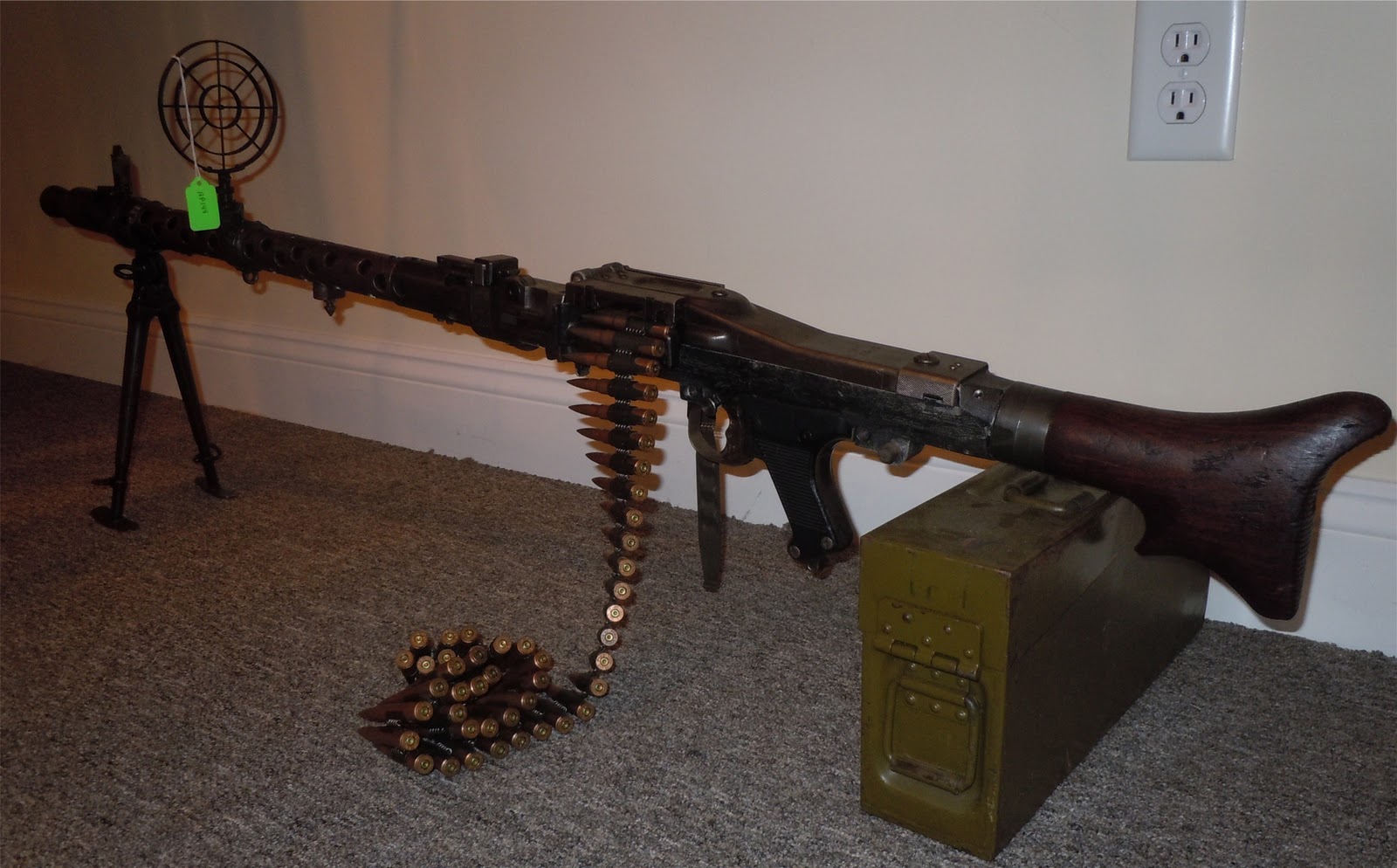 |
| The German MG-34 |
 |
| The Luger or German P-08 |
Friday, February 04, 2011
Enfield No. 2 MK I Revolver


I think I'll keep my eyes open for a Colt Police Positive in .38 S&W if I find I can't live without a revolver so chambered.
Serial numbers and dates of manufacture for the Enfield No. 2.
1929-1931 1-A Prefix
1932 A-B
1933 B-C
1934 C-D
1935 D-E
1936 E
1937 E-F
1938 F
1939 F-H
1940 H,I,J,K,L
1941 L,M,N,O,P
1942 Q,R,S,T,U,V
1943 V,W,X,Y,Z,ZA,ZB
1944 ZB,ZC,ZD,ZE,ZF,ZG,ZH
1945 ZH,ZI,ZJ
Friday, January 14, 2011
M1 Garand Sights
What about the rear sights. Collectors are always fussing about the rear sights on the M1 Garand. The rear sight assembly has five parts you need to worry about 1) aperture, 2) base, 3) cover, 4) windage knob and 5) elevation knob and pinion. See Figure 3 for both the windage (A) and elevation knobs (B) which are the most important elements.
 How do you know your rifle has the correct rear sight particularly when you realize that neither drawing number nor the serial number was marked on the individual parts. Basically, there are four combinations of these parts to make the rear sight and they are distinguished primarily, but not completely, by the way the windage knob was manufactured and secured. In the early rear sight, the windage knob could be removed by screwing out the windage knob flush nut. Soldiers complained that the knob often came loose and allowed changes in windage, or else fell off altogether and it or its spring or lost.
To remedy this, the Ordnance Department replaced the flush nut with a lock bar that could be tightened down and held in position by a spring. The problem with this arrangement was that if a soldier had to make a windage adjustment quickly, he often could not do without a tool to loosen the lock bar.
To solve this problem, the Ordnance Department ordered the locking bar to be replaced with the original flush nut but one that was held captive on the windage knob shaft so that it could not fall off. This solved the problem but this fix was not applied until World War II had ended.
The fourth type of rear sight, by the way, was that developed for the National Match M1 Garands. It has the captive flush nut but windage adjustments are made in increments of 1/2 minute of angle. To accomplish this, the thread on the shaft is double that on the normal M1 windage knob shaft.
Each click of either elevation or windage changes the strike of the bullet approximately one inch on the target for every 100 yards of range, over its effective range.
Windage can be adjusted 16 clicks to the right or to the left of center index, and elevation can be adjusted from 0 to 72 clicks.
Sighting-In
1. Windage zero.
Center your rear sight according to the index marks on the receiver and sight base. Center the front sight in the dovetail. Under no-wind conditions, fire a group at 100 yards. If the group is not centered, loosen the front sight and move it opposite to the direction of the group error. Repeat as necessary.
2. Elevation
For simple "Battle-Zero," Zero-in at 25 yards, then come up 1 click. This effectively zeros-in for 200 yards. This should result in groups centered on a 4" diameter from 0 to 400 yards.


How do you know your rifle has the correct rear sight particularly when you realize that neither drawing number nor the serial number was marked on the individual parts. Basically, there are four combinations of these parts to make the rear sight and they are distinguished primarily, but not completely, by the way the windage knob was manufactured and secured. In the early rear sight, the windage knob could be removed by screwing out the windage knob flush nut. Soldiers complained that the knob often came loose and allowed changes in windage, or else fell off altogether and it or its spring or lost.To remedy this, the Ordnance Department replaced the flush nut with a lock bar that could be tightened down and held in position by a spring. The problem with this arrangement was that if a soldier had to make a windage adjustment quickly, he often could not do without a tool to loosen the lock bar.
To solve this problem, the Ordnance Department ordered the locking bar to be replaced with the original flush nut but one that was held captive on the windage knob shaft so that it could not fall off. This solved the problem but this fix was not applied until World War II had ended.
The fourth type of rear sight, by the way, was that developed for the National Match M1 Garands. It has the captive flush nut but windage adjustments are made in increments of 1/2 minute of angle. To accomplish this, the thread on the shaft is double that on the normal M1 windage knob shaft.
Each click of either elevation or windage changes the strike of the bullet approximately one inch on the target for every 100 yards of range, over its effective range.
Windage can be adjusted 16 clicks to the right or to the left of center index, and elevation can be adjusted from 0 to 72 clicks.
Sighting-In
1. Windage zero.
Center your rear sight according to the index marks on the receiver and sight base. Center the front sight in the dovetail. Under no-wind conditions, fire a group at 100 yards. If the group is not centered, loosen the front sight and move it opposite to the direction of the group error. Repeat as necessary.
2. Elevation
For simple "Battle-Zero," Zero-in at 25 yards, then come up 1 click. This effectively zeros-in for 200 yards. This should result in groups centered on a 4" diameter from 0 to 400 yards.
Standard Issue Rear Sight
National Match Rear Sight
Start zeroing by ensuring the windage index on the rear sight base is aligned with the center line of the witness marks on the base of the service rifle's receiver.
Thursday, January 13, 2011
M1 Rifle - Garand - Troubleshooting...
| Operating Stage | Malfunction | Probable Cause | Remedy |
| Loading | Cartridge clip inserts only with difficulty. | Deformed cartridge clip. | Replace the clip. |
| Broken clip ejector. | Replace the clip ejector. | ||
| Interference between bullet guide and follower arm. | Replace the faulty part. | ||
| Bolt releases before clip is latched into place. | Worn or broken clip latch. | Replace the clip latch. | |
| Worn or broken clip latch spring. | Replace the clip latch spring. | ||
| Excessive radius on operating rod or operating rod catch. | Replace the faulty part. | ||
| Bullet guide is too high at the accelerator bearing point. | Replace the bullet guide. | ||
| Bolt does not release when clip is latched into place. | Burs or insufficient radius on operating rod or operating rod catch. | Repair or replace the faulty part. | |
| Bullet guide is too high at the accelerator bearing point. | Replace the bullet guide. | ||
| Operating Stage | Malfunction | Probable Cause | Remedy |
| Feeding and Chambering | Failure to feed ammunition. | Lack of lubrication of moving parts within the action. | Clean and lubricate the moving parts. |
| Defective or worn parts within the action. | Replace the faulty parts. | ||
| Failure to chamber ammunition. | Lack of lubrication of moving parts within the action. | Clean and lubricate the moving parts. | |
| Dirty chamber. | Clean the chamber. | ||
| Defective or dirty ammunition. | Replace or clean the ammunition. | ||
| Bolt fails to close tightly and lock into place. | Dirty chamber. | Clean the chamber. | |
| Dirty locking recesses in chamber. | Clean the locking recesses. | ||
| Lack of lubrication of moving parts within the action. | Clean and lubricate the moving parts. | ||
| Damaged or deformed cartridge. | Remove damaged cartridge, inspect other ammunition. | ||
| Extractor does not open far enough to pass over the cartridge rim, or ejector is frozen in place. | Clean the bolt assembly, replacing parts as needed. | ||
| Operating rod is binding, possibly against the stock. | Replace the operating rod if it is misshapen, or remove wood from the stock as needed. | ||
| Weak or broken operating rod spring. | Replace the faulty part. | ||
| Damaged or deformed bolt or receiver. | Replace the faulty part. | ||
| Insufficient headspace. | Verify correct chamber reaming and headspace. | ||
| Operating Stage | Malfunction | Probable Cause | Remedy |
| Firing | Slam fire (gun fires on its own as the bolt closes) or out of battery fire (other unintended firing when bolt is not closed and locked). | Defective ammunition. | Remove defective cartridges, inspect other ammunition. |
| Wrong ammunition. | Unload and remove inappropriate cartridges, inspect other ammunition. | ||
| Incorrect chamber dimensions or headspace. | Correct the chamber dimensions, or replace the barrel and properly headspace the new chamber. | ||
| Pressure on trigger does not release the hammer. | Deformed trigger, pin, or hammer. | Replace the faulty part. | |
| Hammer falls but does not fire. | Light strike of the firing pin on the primer. | Replace the hammer spring. | |
| Hammer spring housing damaged. | Replace the hammer spring housing. | ||
| Firing pin defective, including not protruding far enough from bolt face when struck. | Replace the firing pin. | ||
| Trigger group defective. | Replace the trigger group. | ||
| Defective ammunition. | Remove defective cartridges, inspect other ammunition. | ||
| Operating Stage | Malfunction | Probable Cause | Remedy |
| Ejecting | Bolt does not unlock or open. | Plugged gas port or dirty gas cylinder. | Clean the gas port and gas cylinder. |
| Gas cylinder lock screw leaking gas. | Clean and tighten gas cylinder lock. If it has a leaking valve, replace it. | ||
| Gas cylinder loose on operating rod piston, leaking gas. | Measure cylinder and piston: Gas piston: 0.525" min. o.d. Gas cylinder: 0.532" max. i.d. Replace gas cylinder if necessary. | ||
| Chamber dirty, or moving parts dirty or lacking lubrication. | Clean chamber and action, lubricate moving parts. | ||
| Barrel external diameter too small at gas port, leaking gas. | Replace the barrel. | ||
| Follower arm pin worn. | Verify follower arm pin hole diameter, replace follower arm pin. | ||
| Follower arm bent or out of tolerance. | Replace follower arm. | ||
| Operating rod disengages from the bolt while cycling. | Operating rod lug is worn, or the operating rod spring is kinked. | Replace the operating rod or spring. | |
| Receiver guide rail for operating rod is excessively worn. | Replace the receiver, or rebuild the receiver's guide rail. | ||
| Failure to extract cartridge from chamber. | Dirty chamber. | Clean the chamber. | |
| Defective ammunition. | Remove defective cartridges, inspect other ammunition. | ||
| Broken extractor. | Replace the extractor. | ||
| Failure to eject the extracted cartridge. | Broken ejector pin or spring. | Replace the faulty part. | |
| Ejector is binding within the bolt. | Clean bolt assembly, including ejector hole. Inspect ejector and remove any burs. | ||
| Short recoil (bolt is not pulled back far enough). | See "Short recoil" section below. | ||
| Failure to eject cartridges in correct direction, 30-60° to right of firing direction. | Inadequate lubrication of moving parts. | Lubricate the moving parts. Cartridges should eject to roughly 30-60° to right of firing direction. As the action becomes dirtier and less well lubricated, the direction will shift further to the right and then continuing around to the rear. | |
| Operating Stage | Malfunction | Probable Cause | Remedy |
| Cycling, reloading next round, ejecting empty clip | Short recoil — the bolt is not retracted far enough to complete the cycle. | Ammunition does not develop adequate gas port pressure to cycle the action. | Gas port pressure should be 6000±2000 p.s.i. Faster-burning powder may not develop adequate port pressure without developing dangerously high chamber pressure. Always use appropriate ammunition! |
| Carbon built up in gas port or gas cylinder. | Clean the gas port and gas cylinder. | ||
| Undersized or out of round operating rod piston. | Replace the operating rod. | ||
| Oversized gas cylinder. | Replace the gas cylinder. | ||
| Barrel external diameter too small at gas port, leaking gas. | Replace the barrel. | ||
| Operating rod is binding, possibly against the stock. | Replace the operating rod if it is misshapen, or remove wood from the stock as needed. | ||
| Gas cylinder lock screw leaking gas. | Clean and tighten gas cylinder lock. If it has a leaking valve, replace it. | ||
| Weak or broken operating rod spring. | Replace the faulty part. | ||
| Burs on bolt binding in the receiver. | Remove the burs from the bolt. | ||
| Damaged or deformed receiver. | Replace the receiver | ||
| Bolt cycles very firmly but does not chamber the next round. | Excessive gas port pressure cycles the bolt so forcefully that it slams shut again before the follower can lift the next round into the bolt's path. | Gas port pressure should be 6000±2000 p.s.i., slower-burning powder may develop excessive port pressure when loaded to produce desired velocities. Always use appropriate ammunition! | |
| Hammer is not cocked to fire the following round. | Defective trigger group. | Replace the trigger group. | |
| Failure to eject the empty cartridge clip. | Clip ejector worn, weak, or broken. | Replace the clip ejector. | |
| Operating rod catch deformed or broken. | Replace the operating rod catch. | ||
| Premature cartridge clip ejection. | Worn cartridge clip detents. | Replace the cartridge clip. | |
| Weak clip latch spring. | Replace the clip latch spring. | ||
| Worn clip latch. | Replace the clip latch. | ||
| Bent follower rod or worn follower rod forks. | Replace the follower rod. | ||
| Worn follower arm. | Replace the follower arm. | ||
| Worn or deformed operating rod catch or bullet guide. | Replace the faulty part. | ||
| Follower rod rubs on operating rod catch. | Replace the deformed part — follower rod, clip latch, or operating rod catch. | ||
| Bolt is not held rearward after firing the last round, and the clip is jammed by the bolt and held inside the action. | Bolt is not moving far enough rearward. | See the "short recoil" section above. | |
| The clip latch is binding. | Replace the clip latch. | ||
| Operating rod catch or operating rod is bent or deformed. | Replace the faulty part. |
Proper Operation:
- Loading
- Starting with a completely unloaded gun, the operator pulls back on the operating rod handle until the bolt locks in the fully open position. Two mechanisms hold will hold the bolt back:
- The operating rod catch engages a notch on the operating rod, under the rear of the barrel. This prevents the operating rod traveling forward and bringing the bolt with it.
- The follower raises far enough to block the bolt itself.
- An en-bloc clip filled with 8 cartridges is inserted into the space between the bolt and chamber, and pressed down into place. This presses the follower down into the action, but the operating rod and bolt are still held back by the operating rod catch. The clip locks into place, although it could be released by depressing the long clip latch down the left exterior of the receiver.
- Starting with a completely unloaded gun, the operator pulls back on the operating rod handle until the bolt locks in the fully open position. Two mechanisms hold will hold the bolt back:
- Feeding and chambering a round
- The bolt is pulled back slightly, and the operating rod catch now disengages because the follower has been depressed.
- The bolt is released and allowed to slam shut, pulled by the operating rod. This strips the top cartridge out of the clip and pushes it into the chamber.
- The bolt should fully close and lock, rotating slightly to its right with the locking lugs engaging their recesses in the receiver.
- The bolt face is firmly against the rear face of the cartridge case.
- The bolt's extractor is snapped into the groove around the base of the cartridge case.
- The bolt's ejector is depressed into the bolt body.
- Firing
- The trigger is pulled, disengaging the trigger lugs from the hammer hooks and allowing the the hammer to swing forward under the pressure of the hammer spring.
- The hammer strikes the tang of the firing pin, which extends through the bolt. The forward point of the firing pin strikes the primer and fires the round.
- Ejecting the fired cartridge case
- As the bullet passes the gas cylinder port near the muzzle, hot gases are directed through that port into the gas cylinder. That pushes against the piston formed by the forward end of the operating rod, driving the operating backward. The gas port pressure needed for operation is 6000±2000 p.s.i. (41,370±13,790 kPa).
- The rearward action of the operating rod unlocks the bolt (rotating it back slightly clockwise, as seen from the rear) and driving the bolt back.
- The extractor, a small spring-tensioned hook around the bolt face, pulls the now empty cartridge back by the groove around its base.
- The ejector, a small spring-tensioned piston extending from the bolt face, pushes against the cartridge base opposite of the point where it is hooked by the ejector, rotating the cartridge and ejecting it from the action.
- The rest of the bolt cycle, preparing the next round
- The bolt and operating rod reach the end of their range of travel, and the operating rod spring now brings them back forward "into battery", or back to the firing configuration. The next round is stripped from the clip and chambered.
- However, if that last round was the last one in the clip, the follower has moved upward far enough that the clip latch disengages and the operating rod catch engages. This has two results:
- The bolt and operating rod are locked back with the bolt open.
- The empty clip is ejected.
Tuesday, October 26, 2010
Shooting the Garand, a very short story...
I managed to take my M1 Rifle, aka the Garand, to Mom's and roughly zero it. No bench, I shot from sitting, but I could hit what I aimed at. We'll take it to the range and shoot from the bench to ensure it is properly zeroed. Ammo was LC69 ball.
Wednesday, July 28, 2010
Pistolet Makarova by Bulgaria - UPDATED
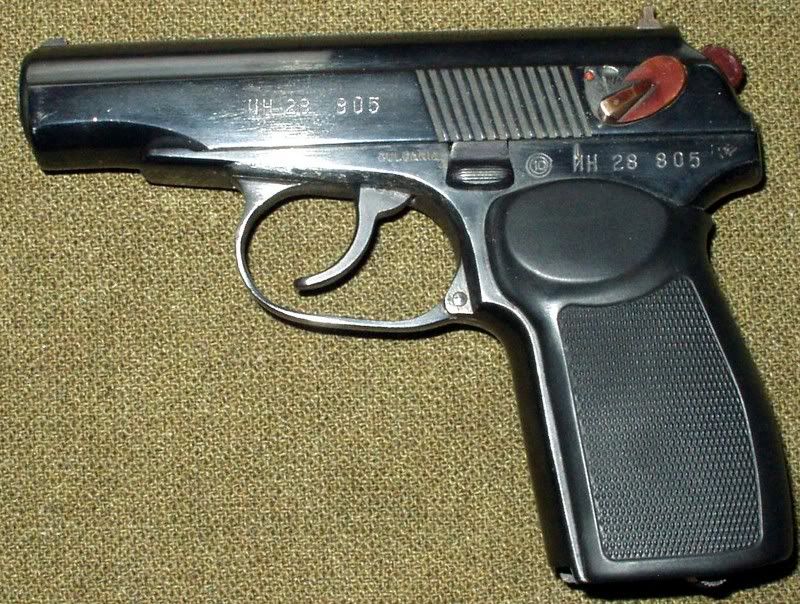 I was once asked about the Bulgarian Makarov. I like the pistol and said so. I thought I'd post a few of my observations about my pistol here.
First, it is accurate, reliable and relatively inexpensive. Mine cost $159 but I think you'll pay at least $250 today. The best ammo, cheaper than reloading, came from Dan's Sporting Goods at $60 per 500, shipped. You couldn't beat that and I tried. I've got dies, 250 Starline cases (excellent brass) and Hornady XTP. Still, reloading was more expensive than the Barnaul 95 gr. hollow-points from Dan's and you have to hunt down those valuable brass cases. The Barnaul is steel cased and Berdan primed, hardly a practical reloading proposition. Now, with the change in the Euro/Dollar exchange rate and diversion of the ammo to various hot spots, you might re-look reloading.
With carbide dies, reloading is really a snap. I'm sure you could set up a progressive press to load vast quantities of this cartridge. I used the Hornady XTP bullets over 4.1 gr. of Unique using a CCI small pistol primer for 927 fps 181 fpe. In contrast the Barnaul 95 gr. load produces 1025 fps and 222 fpe. Federal ball produced 965 fps and 195 fpe. Silver Bear ammo using the 120 gr. bullet produced 932 fps 232 fpe. Obviously one can do better ballistically than with my handloads, but they are accurate.
For accessories like my Fobus paddle holster we used to have Makarov.com, another well run business. The fellow who ran this knows his products and provided fast service together with good product. Unfortunately, they are no longer in business.
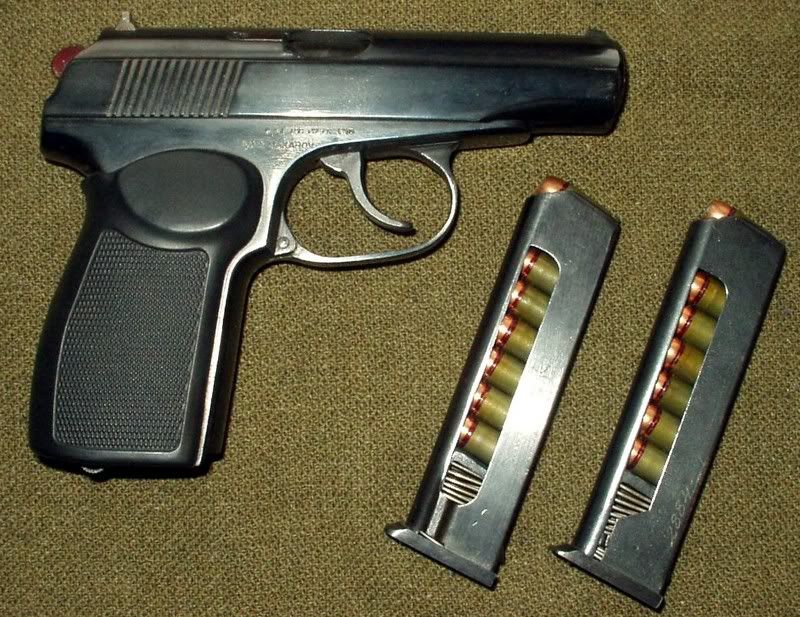 The pistol has possibilities I didn't consider when I first saw it while in the military. It is relatively light for a field pistol. It fits my hand well with the Pearce grips. The Fobus paddle holster is light and comfortable AND it secures and protects the pistol properly. It is accurate. I got groups, two-handed standing, of 2 inches at 25 yards and I have killed a groundhog at a measured 80 yards with a single shot in the chest (a little to the right of center). There was some luck involved (no doubt!) but it wasn't all luck. I believe the cartridge is at least as effective as the .38 Special and that is enough gun for most people, particularly in the east. It isn't particularly loud. It doesn't kick too much which is good for new shooters and those who are recoil sensitive. It is safe, having a double action and de-cocking safety that seems very sturdy. I think that this makes it a good bedside gun, at least during the summer when an intruder is less likely to be wearing a bulky winter coat. Fixed sights mean they probably won't go out of adjustment.
The down side is that, while the grip fits me and my average size hand, it could easily be too big for those with smaller hands. The Pearce grips are actually a bit bulkier than issue but they are also much more comfortable.
The sights that it comes with are very basic. Non-adjustable except by drifting in the dovetail, the rear sight has sharp edges that might not be compatible with some clothing. I ever so slightly "broke" the corners and edges on my pistol's sights. The rear blade has a nice square notch but these are black on black sights. Some people prefer the dots, etc. The good news is that after market adjustable and night sights are available but they can cost nearly as much as the pistol. My eyesight isn't such that I really benefit from such sights.

Bulgarian Makarovs were made at the state military factory in Kazanlak, aka factory number 10. That is why the Bulgarian pistols are marked with a 10 inside a double circle on the left of the frame. Production began in 1970, continued under direct Russian oversight in 1975 and in 2000 the date codes were eliminated and replaced with numerical dates immediately following the serial number.
Man At Arms Magazine reported the following information about the serial numbers that owners will find interesting:
Bulgarian Makarovs have unusual serial numbers composed of three groups of characters: two capital letters, two numbers, and then an additional sequence of numbers. The two numbers in the center indicate the year of manufacture, but in a slightly confusing way. You add those two numbers to the year 1960 to ascertain the year of manufacture. For instance, a center number "31" would indicate a manufacture year of 1991 because 31+60=91. By the way, the final group of numbers is the actual serial number, while the two letters are a code indicating the production batch that the serial number belongs to.

Parts List
1) Slide
2) Ejector
3) Main spring
4) Trigger
5) Trigger transfer bar
6) Magazine
7) Hammer spring
8) Sear
9) Disconnector
10) Hammer
Field Stripping - After removing the magazine and emptying the chamber, pull the trigger guard down in the front and move it to the right (as seen with the bore pointed away from you). Pull the slide all the way back and lift the rear of the slide. The slide will now come forward and off. Now remove the return spring off of the barrel. Reassemble in reverse order.
original post 3/7/07
This is a video showing the gun as used by a Chinese policewoman. It is "graphic" although less so than a Sam Peckinpah movie. However, to view you might need to sign in to YouTube and verify your age...
Thursday, September 10, 2009
Gun Digest Book of the AK and SKS by Patrick Sweeney

It was a good book providing adequate detail without mind numbing trivia and that would be all too easy to do. E.g. I've heard of people building AKs like some build ARs but wasn't quite sure what they had to go through to do so. Now I know. I fully understand how the AK is put together and what the really important differences are such as the rear trunnion affecting which type stock one could use.
If I have a criticism about the book it is that the editor must have taken a day or week off. Particularly towards the beginning there are a number of typographical errors, several of which could have been avoided with proper use of MS-Word spell check. If you can decipher the content despite these errors, and you SHOULD be able to, then it isn't all that big a deal. However, I have to take a moment to say that I think this basic editorial task is all too often ignored in modern day publishing houses as I see far too many such errors.
All in all a good book and a worthy introduction to the AK and SKS weapons systems.
Saturday, September 29, 2007
Krag Rifle and Sights
 A friend gave me a Pacific Gunsight Company receiver sight for a Krag rifle to sell for him. This is a neat bit of engineering in that the mounting point is a replacement cut off plunger (#12 in the schematic) which is part of the sight mount. Of course the sight picture is not different from any other such sight but this one avoids the need for a trip to a gunsmith for drilling and tapping the receiver.
Of course, this initiated a bit of research on this transitional (for the USofA) military weapon. Yes, it is transitional because it was with this weapon that the USofA first had a first-line general issue repeating rifle design. You might argue that the Winchester and Spencer leverguns of the Civil War and later, or Remington-Keene or Remington-Lee rifles were such but they were not an all service, across the board, general issue. The Krag was such a gun but it was also rather quickly superseded by the 1903 rifle.
I suppose it is unfortunate that even the Krag carbines never excited me enough to spend money on them. I could have had some good buys. The cartridge is a good one, mostly a US version of the .303 British or a rimmed .300 Savage. Sadly, the Krag is pretty much operating at the practical limits of the action. Even Uncle Sam, although he tried, couldn't up the performance of the .30 US (aka Krag) cartridge without causing a much increased rate of firearms failure as the single locking lug fractured under use of the slightly "improved", higher velocity military ammunition. While I don't hotrod the cartridge by any means, I don't have to worry with my Browning 1895.
 Back to the sight, I have to say it is difficult to find any information on the Pacific Gunsight Company on the net. You can find catalogs, some of Pacific Tool Company's reloading tools (same company?), references to a Redfield sight that mounts in exactly the same way, and a nifty no-gunsmithing peep sight for the Russian M91 Mosin-Nagant but no real history or other information.
I have photos of the sight and will list it with the other items on Gunbroker.com unless it sells first.
From our friend Charles G. we have the following info...
Hobie.... I have some knowledge and experience with the Pacific Krag sight in question. There apprears to have been at least two versions.
1. The earlier version elevated by backing off the thumb screw and raising and lower the slide. It was a by guess and by god kind of situation and the dickens to remove and get back in the right place. If you are going to remove the bolt of a Krag and clean from the breech, you have to remove the elevation slide.
2. The next version has a screw on the top of the elevation slide that can be used to raise and lower. There is also divot on the top of the base that holds the end of the screw. For that reason it is easy to remove and replace the elevation slide and return to zero.
I don't know when production ceased, but it was before WWII.
My first Krag came with a type 1 (above) Pacific sight that I used for a number of years.
About five years ago I replaced it with a type 2 I bought on ebay for $15.00. Two years ago I sold the older sight to a guy on the Castboolit board for $25.00 plus shiping.
I am heavy on Redfield Krag sights (sorry none for sale) so I have not followed the price of the sights for the past few years. The prices on all of the vintage sights have risen allot in recent years.
If I was selling one, I would ask $70 and take $50. If I were buying I would not go beyond $50.00. Those may not be current market prices, but that is what I would do.
I hope this helps a mite.. Charles
Monday, September 17, 2007
Misc Videos - DeLisle Carbine & M2 Carbine
US M2 Carbine - slightly better quality and editing. This video gives you a good feel for the rate of fire of these guns. They are firing the .30 M1 Carbine cartridge. The snow shots remind me of some of my time in Korea.
Sunday, August 26, 2007
Russian 3-line 1891 Rifle - UPDATED

I was given this rifle for services rendered. It is a Russian/Soviet M91. I won't bore you repeating the history of the firearm you will find in the link. This particular gun was obviously manufactured at the Tula arsenal in 1917 and property marked by the USSR. I was reading an article, "The Moisin-Nagant in Finnish Service" by Harris R. Bierman in Guns of the World - THE Complete Collectors' & Traders' Guide (ISBN 0-517-225182) and lo and behold I find a photo of a rifle like mine with sling swivels and sling like mine which Mr. Bierman ascribes to Finnish service. I need to relook all the marks and see what I can decipher. Knowing though that the Finns might not have marked rifles needing few to no modifications prior to re-issue to their army this might not be a big deal but it sure is interesting. You can find more about the rifle at 7.62x54R.net whence I acquired the following video.
Usage of this model all over the world is interesting, too. Most interesting to me is the use by AEF troops in North Russia and Siberia 1918-1920 (yes, to 1920 in Siberia). However, I've had a hard time finding photos on-line despite these links.
Related links:
- American Troops in Siberia
- My Grandfather in the AEF Siberia (not MY grandfather...)
 So, I finally got some photos of the rifle and they were reviewed by Cubrock. I quote
The sling may be Finnish. I’d have to see more of it to be sure. Finnish slings of that style have been around for sale for several years, so it is possible someone added that on. The sling swivels are definitely not Finnish and are of the style associated with Balkans service. Of course, anyone can bend a piece of wire to use as a swivel, so it could have been another country that did it.UPDATE---
The MADE IN USSR marking and the general mismatching of parts still makes me think that this gun went to the Spanish Civil War. The Soviets supplied a lot of weapons to the Spanish Communists who fought Franco. The Spanish guns also commonly have a flaming bomb proof on the stock or “MP-8” or both. The flaming bomb looks similar to the US flaming bomb, but is normally quite large and often has “MP-8” stamped in it. If your stock has such a mark, that removes all doubt where the gun went. I suppose it is possible that the gun went to Finland , but I don’t see any Finnish markings or modifications that would indicate that.

I think my gift is quite nice. I saw another, also sans cleaning rod, at a show today asking $149 but the guy was willing to take $125. M91/30s were asking $99, there was also one M38 and 3 M44s asking about $125 each. So assigning a value of $125 + $80 for bayonet and cleaning rod, makes me a happy camper. Now, to the range and see if it shoots!
UPDATE...
I got to the range today (8/29/07) and got to shoot the rifle some. Recoil is moderate with 180 and 206 gr. bullets. Rock busting at 25-50 yards was easy despite the open sights and my bifocal wearing eyes. The rifle would do for deer hunting, that's certain. However, that barrel heats up fast!
There was no indication of excessive headspace or other problems. One thing I know I need now is screws for the barrel bands.
2nd UPDATE...
Today I received my order of accessories from BuyMilSurp.com. For the 1891 I bought 5 stripper clips, oiler and cleaning kit with bag, chamber brush, rod extension/jag, "T" handle and muzzle protector. I now have one complete "stand" of arms with a value of about $250. While that about does it for me for the 1891 Mosin-Nagant series (I would never have bought the rifle), it certainly is an interesting item with many historical connections.
Here's a photo of US soldiers, Company D 23rd Infantry Regiment NYARNG, armed with the Mosin-Nagant. These are likely rifles contracted by Russia and abandoned after the 1917 Revolution.

Monday, August 20, 2007
Saturday, July 07, 2007
.303 Brit Ammo Carry
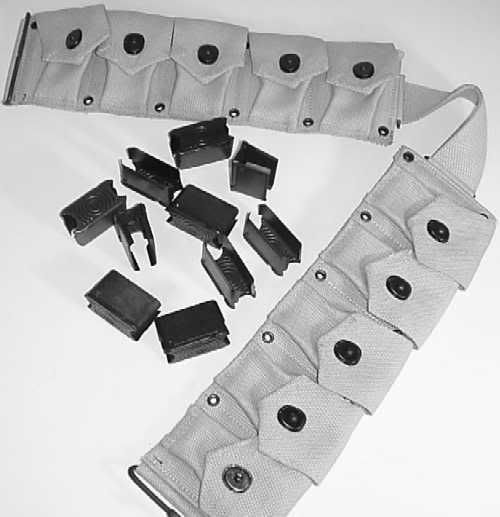 Having a No 4 MK I rifle and needing to have some "authentic" method of carrying a "few" rounds of spare ammo, I started to cast about for some sort of ammo belt. So the first thing I tried was the US issue ammo belt. 2 stripper clips of .303 fit quite well in each of the 10 pockets giving the bearer 100 rounds of .303 Brit and quite a load around the waist! However, access is quick and easy and the ammo is fairly well protected and not subject to corrosion while in the woven canvas belt.
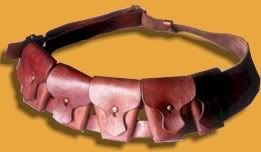 But frankly, I was thinking that the belt system was uncomfortable and one of those nifty "Light Horse" deals would be just the ticket. The first that I found was this 1917 made leather gear. The 1903 5-pocket bandolier, it cost me $35 at a gun show and I still think it was worth every penny. After a good working over with saddle soap, it seems to be in as good condition as when it was turned in to the supply sergeant after WWI! Worn over the left shoulder (to keep the right shoulder clear for the rifle butt), it is comfortable and bears the weight of 50 rounds of .303 British very well. However, I was concerned with verdigris and so don't store ammo in the bandolier. That is the same problem I have with my other neat piece of leather .303 gear. International Military Antiques sells a reproduction. Mine being original, I don't have any idea as to the quality of the repro, you're on your own. But I will repeat that the system works.
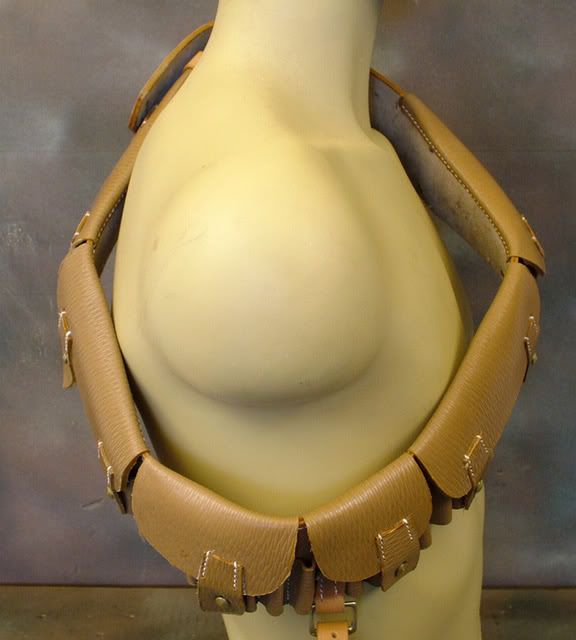 This bandolier, in which the .303 round are individually placed in the loops, is also leather and even more like to raise the ugly head of verdigris if one chooses to store brass cased ammunition in it. But, it works well for carrying ammo as well as providing rapid and easy access to that ammo. International Military Antiques sells this nifty reproduction. Not inexpensive but, unless you can produce one with your own leather working gear, worth the price.
Wednesday, April 25, 2007
British No. 4 Rifle & the .303 Brit Cartridge - UPDATED w/Video
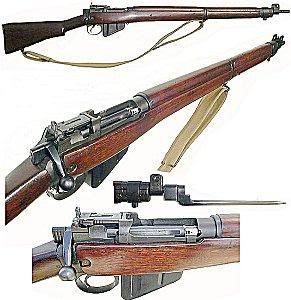 Glory, romance, effectiveness, dogged self-reliance are what come to mind when I lift a British No. 4 rifle. Yes, I like some bolt guns and my favorite is the Lee-Enfield and derivatives. It doesn't hurt that the .303 British cartridge is a great one!
.303 British is a rifle and machine gun cartridge first developed in Britain in the 1880s as a blackpowder round, later adapted to use cordite and then smokeless powder propellant. It was the standard British and Commonwealth cartridge from 1889 until the 1950s, when it was replaced by the 7.62 x 51 mm NATO round, and in the 1980s by the 5.56 x 45 mm NATO (.223 in) in most roles. It is a rimmed cartridge and is therefore not entirely suitable for use in modern automatic weapons, but remains popular due to the large number of surplus military rifles chambered for the round which have been released to the civilian market, many of which have subsequently been modified for sporting use.Further, the ballistics of the .303 Brit are very similar to our own .30-40 Krag (.30 Army) and the 7.65x53mm Argentine (Belgian) both of which are among my favorites. They all started a 215-220 gr. bullet at about 2100 fps and or a 174-180 gr. bullet at 2400 fps.
AS to loads, I don't think the powder used is all that important as you simply want the 174 gr. or 180 gr. bullet to start at 2400 fps. I've used IMR 4320, IMR 3031 (made for the .303), IMR and Hogdon 4895, IMR and Hogdon 4350, W748, W760, BL(C)2, and H335. All primers are the standard large rifle type except for the Winchester powders. There are several bullets that will do. I like the Sierra 180 gr. but the 174 gr. Match bullets do well for me, too (however some folks have had problems with boattailled bullets in 2-groove barrels). In reloading the .303 British for my rifles I attempt to duplicate factory ball. That's what the sights are set up for and I do not want to mess with the sights. If I need MORE gun I get more gun. That's 174 gr. @ 2400 fps. In creating loads that do so with minimum pressure and heat I believe I'll lengthen the service life of my rifle(s). In that use it seems to me that no ball powder beat IMR 4350. It gets the required velocity at relatively low pressure and seems to produce less heat in that the barrel doesn't heat up as quickly as with ball powders.
I have tried 150 gr. bullets and the fastest load in friend Mike's No. 4 used IMR 4320 under the Hornady 150 gr. for about 2700 fps. That was accurate and Mike used it at least once to head shoot a doe at a measured (and witnessed) 140 yards using issue stamped version sights. What, if anything, he did to his sights I don't know. The bullets I now use for the .303 British are either the 174 gr. MatchKing or the Sierra 180 gr. SPT.
I have two No. 4 rifles, one Mk I and one Mk I*, and Mike had a MK I*. We took these guns to a good location for 600 yard (and longer) shooting. From a seated position we were easily able to keep a magazine (10 rounds) on the bottom of a 5 gallon bucket at 600 yards. Range was checked with his laser range finder and the 600 yard sight setting was used (and it WORKED!).
Of these rifles, one was a Fazerkly arsenal FTR, one a Longbranch and one (Mike's) a $60 wonder (I don't remember the maker) from the old Rose's department store that had a stock that had obviously seen better days. In fact, he sanded it a bit to keep from getting splinters! Again, this gun was accurate enough that Mike headshot a doe at 140 yards (witnessed).
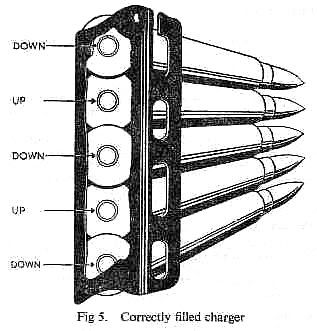 Of course if you want to load these guns quickly, you need to have chargers loaded and ready. Still readily available, the chargers have to be loaded a certain way to correctly function. See the illustration to the left.
We've used several 1¼" slings with these guns but the best sling really is the issue web job. Comfortable, instantly adjustable and durable. There are even reproductions made in Australia that are still reasonably priced for US customers. I'll have to post that link as soon as I find it.
Sights are a concern to many shooters. Not so much with these guns as even the crudest version of the rear aperture sight is plenty good enough. However, I prefer the full capability of the original, milled, sight usable to 2000 some yards. There is also a stamped version of that sight. Of course one could scope these guns and there is a "no modification" scope mount for these guns. But why? I think the aperture sight is fully capable to, as noted, over 600 yards. It would be interesting though...
These guns are relatively inexpensive and so is the ammo. This makes the No. 4 a reasonable TEOTWAWKI armament. Some like the Garands, M14s, M16s or FALs for their ability to put rounds down range without the exercise of working a bolt but the British Enfield will still do the job when necessary.
The .303 British cartridge is an excellent one for sporting use on large game such as deer and black bear. Ballistics with similar weight bullets are very similar to the .300 Savage, .308 Winchester, and .30-40 Krag, without the sometimes objectionable recoil the big magnums sometimes have. The cartridge has indeed been used for hunting since its release and on all North American game as well as many/most of Africa's game animals. It has only come up short on the largest of these.
There are a number of bullets suitable for reloading the .303 British and applicable to a number of uses.
1 - Hornady 150 gr. SP
2 - Sierra Pro-hunter 150 gr. SP
3 - Sierra Matchking 174 gr. HPBT (shoots really well but not applicable to some)
4 - Hornady 123 gr. SP
5 - Hornady 123 gr. FMJ (good for furbearers where legal)
6 - Sierra 180 gr. SP (my personal favorite in the .303 Brit)
7 - Hornady 174 gr. RN
8 - Speer Hot-cor 123 gr. SP
9 - Speer Hot-cor 150 gr. SP
10 - Sierra 125 gr. SP
11 - Hornady 174 gr. FMJ
12 - Speer 180 gr. RN
13 - Woodleigh 215 gr. RN (an outstanding bullet)
14 - Remington 180 gr. RN
15 - Barnes Triple-X 150 gr. Spire Point
16 - Woodleigh 174 gr. PP
I'd like to point out that in WWI, the Germans were convinced (when attacking British lines) that they were running into machinegun positions. This was due to the rate of fire from the SMLEs. Here's a video to give you an idea of what was possible.
Now this video is from R. Lee Ermey's new show on the History Channel. Part of the shooting is with a No1 MKIII.
Links:
- 303british.com
- Enfield King
Friday, March 16, 2007
Friend's 1902 Rolling Block - Updated
Found out some interesting info about the 1902 Roller. How did I find this out? Well, there's an article in this latest Blackpowder Cartridge News. Serendipitous that is.
First, the rifle is not chambered for the 7x57 Mauser. Like the .30-03 vs the .30-06 cartridge, the rifle is chambered for a slightly different Spanish 7mm Model 93 cartridge (aka 1893 7mm Mauser).
E.g. case length is 2.24" vs 2.235" (older vs newer) and length head to shoulder is 1.71" vs 1.470" (now that is the critical headspace length). Also, Winchester brass has a thinner rim and might work whereas Remington brass might not.
My friend is likely pumped to find this, I know I am.
Subscribe to:
Posts (Atom)


