Saturday, January 20, 2007

Colt Detective Special Grips

I was cruising through my copy of the Sportsman's Guide catalog before I threw it out (as I usually do) and saw that they had Colt DS/PPS stocks for the post-66 frame. At least that is how it was written up and I took a chance. Fingers crossed, I got the stocks only about 9 days after ordering! Double dose of shock, they were as advertised, used (VERY) and for the post 66 frame. They even FIT. Only trouble is they didn't come with a grip screw and seem to be threaded differently than the two sets of Herretts I have. The checkering is nearly worn smooth and it appears that either side came from a different set, ie this is a mismatched set.

So, who could re-cut the checkering (I don't know if I want to try it but might) and would this cost more than it is worth (likely)? I think I can get the bottoms to match. What would be the correct finish? Well, maybe I should just sand them smooth as was recommended several times. I could also finish with Tru-oil, also recommended.

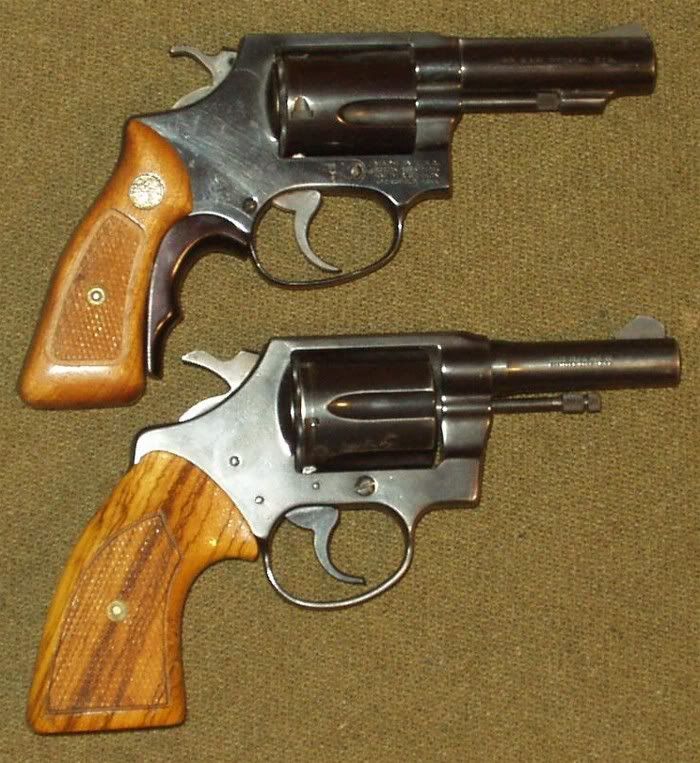
I love the gun, about the size and weight of the J frame S&W with one extra shot/chamber. However, I'm grip picky and would like the standard grips with a Tyler-T grip adapter. First, I need the standard grips, hence the purchase of these. This would give me a set-up even more like my S&W M36 as shown here. Whether or not the new set up would actually be more concealable is unknown but unlikely, I think I'll just think it less likely to "print".

"Pet Loads" by Ken Waters

Title: Pet Loads (8th Ed.)
Author(s): Ken Waters
ISBN: 1879356562


"Pet Loads" is a collection of Mr. Water's series of articles on loading various cartridges formerly published in "Handloader" magazine. There are also two supplements to this edition with articles published since the edition's release.

Mr. Waters has detailed reloading information and anecdotes about more than a hundred cartridges in this soft bound/paperback book. Not so obvious to the casual browser is that there is also a lot of information on various firearms associated with the cartridges covered and used to test the loads and many reloading techniques here as Mr. Waters records many decades of reloading experiences.

Because the articles were written over those decades of accumulating experience, some very popular cartridges have updates where Ken brings them up-to-date with new bullets and powders. One just can't the wealth of reloading experience with this number of cartridges, bullets, powders and primers not to mention reloading tools from any other book. A big plus is that Mr. Waters' writing style is easy to absorb and far from boring. Also, there is blank space provided for reader notes on their loading of the cartridge.

The only bad thing is that the photos are not well reproduced and in black and white. Some of this is because it appears that the articles were copied from the magazine and the magazine was around long before everything was done on a computer. Still there's sufficient detail for those hungry for knowledge.

Currently on sale at MidwayUSA for $30, the normal price is $48 and it is well worth the expense. I bought a first edition and passed it on when I got this one. The new owner did the same. Once you've read this book, most any reloader will agree, this is one must have book.

Friday, January 19, 2007

I'm Such a Wuss....

Yep it is all about me. I'm such a wuss. I wouldn't want to shoot a .375 H&H from the prone position!

"9 Yr Old Girl Takes Record Book Brown Bear" Gary Gustafson, Bear Hunting Magazine 01/14/2007
An urban legend about a young lady and a world-record brown bear has been circulating on the internet. Here is one version:

"This 9 year old girl from the Yukon killed the new world record brown
bear on the Alaskan Peninsula in October, 2006. Skull size 33 1/16", 11'
9" nose-to-tail. Estimated weight of 1,800 Lbs. No, this bear had not
killed anyone. It was the girls first-ever bear hunt!"


No, she was not from the Yukon and no, it was not a world record, but the true story is just as fascinating:

From "Biggest Bears Of 2006" in the March/April 2007 issue of Bear Hunting Magazine, due on newsstands late February 2007:

If the "biggest bear" is determined as a ratio of the size of the bear to the size of the hunter, Fern Spaulding-Rivers is probably setting records that will never be broken. The 10 year-old from Talkeetna, Alaska has already harvested great trophies of most of Alaska's major game species, and she is a handloading fanatic as well. Fern's larger caliber rifles have a muzzle brake and a recoil pad and she also wears a custom-made padded shooting vest from McCoy Shooting Armor to help her withstand big bore recoil. Fern was carrying her Remington 700 Stainless chambered in .375 H&H while brown bear hunting on the Alaskan Peninsula with her father and mother on May 10th, 2006 (when she was 9 years old). As the day progressed she and her father saw 11 bears. At one point, they were charged by a pack of wolves, and they had to dispatch some with the nearest at only 8 paces! Later, they spotted a big bruin in a gully at 32 yards. With all the excitement of the day beginning to show, Fern asked Larry to hold her legs steady while she shot because her knees were shaking. Fern rolled the bear with her first shot, but the bruin regained it's footing and tore off across the tundra. Shooting again from a prone position, Fern dropped the behemoth for good with a second 275 grain Barnes Triple-shock at 112 yards. The United States Fish and Wildlife Service measured the bear's hide at 11'4" from nose to tail. The skull has been officially scored at 29 1/16" Boone and Crockett. What does Fern think of bear hunting? "Do you know how big an 11' bear looks at 30 yds? It's kinda scary! They are about the size of a Volkswagen bus and when they swing their head to look your way they remind you of a T-Rex in Jurassic Park!" Her trophy brown bear now puts her in an elite class. Fern is a tremendous example to young hunters everywhere, and she is a great hunter regardless of her age.
That's Fern Spaulding-Rivers with her trophy in the photo...

Thursday, January 18, 2007

A Shooting Challenge

Posted on Leverguns Forum by ScottT:
Now, this is not a contest, nobody will see your scores unless you show them to somebody. But it is an experiment that I would like to see us conduct this year, just to see what can be done.

The challenge is only as expensive as you want to make it. There will be some ammo cost, but it will directly work in your favor.

Here is the challenge:

I challenge you to take ONE rifle and fire 1000 rounds through it this next year. It is preferable if the rifle is a lever gun, but not necessary. It can be a centerfire or a rimfire (saved you a heck of a lot of ammo money there!) but it should be a rifle with iron sights.

I know, I know......a number of you do not believe you can still shoot iron sight and some of you have never given it a serious try. Here is your opportunity to see what can be done. The irons can be anything that is not a scope. No glass.

These 1000rounds should be from field positions only. No bench rest here. If you want to shoot bench, that's fine, but do it with other rounds or rifles.

The target? A plain old cheap paper plate. Buy them at a discount house and the targets cost you very little.

The distance? You choose it depending upon your access to range facilities and your skill level. I'll shoot mine at 100yds. If you shoot well at 100yds, you might want to move it back to 150 or 200yds. If you have trouble with irons, you might want to move it up to 50yds. It doesn't matter, as long as you pick a distance and stick with it.

The position? Any field position you want to use. I'll do mine sitting since I take 90% of my shots at game from the sitting position.

Now this is some less than 100rds a month. But the rifle should be shot monthly. All 1000 rounds should be fired at the same sized plate, with the same load, with the same rifle, and at the same distance. Each shot should be carefully squeezed off. Call your shots as this will be a learning experience.

Shoot all you want outside of this experiment, but do not go plinking with this particular rifle. Shoot at deliberate targets and not tin cans or rocks. The paper will not lie to you.

It may be humbling at first, it probably will be if you have been shooting a lot from the bench. But I am willing to bet that if you keep up with the paper plates and put dates on them, you will see a definite improvement over the course of the year. Play with your rifle between sessions, get used to handling it and bringing it to bear on targets in your home. (unloaded of course!)

Get a good zero and stick with that one rifle.....I think you will learn something about yourself that you might not have suspected. Slow, disciplined rifle fire. I am very interested in the results.

I'm going to use my Shiloh. No point in anything else. I might shoot a lot more in working out zeroes at longer ranges, but I am looking forward to trying this out.

I like shooting steel too. But there is something about the paper that makes a difference. You can take it with you and you can know the size of your groups and you can compare over time. You cannot do that with steel.

Keep in mind that there is no real reference point on a paper plate. You hold center and squeeze.

Yes, a .22 will do as well as anything. Even a big rifle is no handicap and it will do me good to do this too.

I figure it this way. 100rds=1 lb of powder in Big Nose Kate. One box of primers and I have to cast the bullets. Seems like a small investment for a month's worth of shooting.

Peeps are fine, just no glass. Remember, this is really not a competition, but something to see what can be done with careful practice.

However many rounds per plate that you want. Just be consistant.

Post them if you want. This is not really a competition, I would rather see (1) if anybody actually does it and (2) if they see any improvement in their shooting.

I predict that there may be some improvement that is measureable on paper, but there may be a huge boost in confidence and comfort. There may be no gain at all for some people.

I'm going to do this and have decided on my Marlin 1894C but I won't be able to start until next week. I'm going to date all my plates too so that I can see what if any improvement I make.

Wednesday, January 17, 2007

Have a Gun for Self-Defense?

If you have a gun for self-defense it is implicit that you have decided that killing somebody who attacks you or your family is better than being killed or allowing a family member to be killed or injured. You need to read this article from PBS. Will it prepare you for a fatal shooting? I don't think so.

Now, I'm no expert on this. Yes, I was in the Army for over 27 years. Yes, I was an infantryman. Yes, I have had my CHP for nearly 15 years. But, I've never killed anyone. I've never been seriously shot at.

My Army training makes me think that I can align the sights on a human being and pull the trigger. I really don't want to do that but I have decided that my life is worth more than just about anyone else who would threaten to take it.

Lawdog says to be prepared for the aftermath. Have a lawyer, know to keep your trap shut and call 911 first, not later. But none of these things address something you will absolutely have to live with your whole life afterwards, yourself.

There's a lot to think about, a lot more than which whiz-bang gun or cartridge to carry/use. Do it.

Tuesday, January 16, 2007

Doug Turnbull Restoration

I've been considering the "restoration" of a couple of OT guns (a Parker Bros VHE and a Ithaca double) and have been looking around well aware that I'm going to need some $$$$ to do this right. Anyway, I ordered Doug Turnbull's Catalog and price list. If you think the net photos are something, wow! The internet can only show you 72 pixels per inch but these photos are something. Makes your mouth water and hands shake.

These two shotguns were passed down to me and owned by my maternal grandfather. He wasn't one to use a gun but as a tool and his wife was strongly opposed to having them in the house. When they no longer were needed to produce rabbits and keep the rabbits from the garden as they had been used when they were a young couple she insisted that they go to the attic. I heard a comment about them and their exile and asked if I could have them, buy them, clean them, etc. No was the only answer I got and I didn't get them until Grandma was moved to the home (Grandpa died in 1978). The 1906 Winchester and a Mossberg #4 were also in the attic and all had at least some rust on them. The Ithaca is the worst. I've no photos now but I suppose I should create some.

Oh, but the prices are something else. I'm glad the wood doesn't need to be replaced!

Clipping Articles and the Rediscovered Treasures

I have a system by which I keep no more than 4 years of most issues of magazines to which I subscribe. However, I no longer simply pass the magazines on or throw them out. As I get each new issue I pull the issue for that month from 4 years ago (I keep them in magazine binders such as the one pictured), review (i.e. re-read), and clip the interesting or useful articles. It is amazing how little is worth the effort in some magazines.

This month is a goody. I get the February 2007 issue of "Handloader" with articles on the .32 Winchester Special and .32-40, then, I get to pull the February 2003 issue with many other interesting articles.

The first of these articles is "Real Cowboy Loads for the .45 Colt" by Brian Pearce. While Mr. Pearce talks about Cowboy Action Shooting (CAS) it is to put the original loading of the .45 Colt and smokeless replacements in the proper context. He has actually chronographed the original loading of 40 gr. blackpowder (BP) for the 255 gr. lead bullet at 1000 fps. This shows that the original load was indeed more powerful than the smokeless powder replacement which pushed the same bullet at 850-870 fps.

I thought this article would be of interest to levergun shooters of the cartridge. My experience is that the modern load equals the old BP load but only when fired from a carbine.

The next article is by one of my favorite authors, Ross Seyfried. "Holland & Holland Paradox, a Reloading Miracle" is a wonderful tale of Mr. Seyfried's work with a Paradox gun. Oh what a wonderful gun and Mr. Seyfried has been persistent in learning to load for this gun.

I've always wanted one, and not insensitive to the cost of such a glorious gun, I clipped this article "just in case". I haven't gone much into detail on this one. My attempt would be a poor imitation indeed of Mr. Seyfried's writing. You can still get this issue and article for yourself.

The last article I thought clip-worthy was "Loading to the Aiming Point" by John Barsness. In this article Barsness addresses a personal interest of mine, loading reduced loads for rifles. In this article he illustrates the method through loading for the 9.3x74R, 6.5x54mm Mauser, .257 Ackley Improved, and .416 Rigby with others mentioned. he also mentions Townsend Whelen and his use and loading of reduced loads. I liked this article enough to consider it clip-worthy despite lack of loading data on cartridges I am loading.

Of course you could buy the back issues of "Handloader". They now have three ways to do so. The entire boxed set (#1 through #238) for $120 or one year for $19.95 or a single issue on DVD for $5.95. Digital form should provide quick searches and printing of only the pertinent information.
Monday, January 15, 2007

Hogdon Annual Manual 2007

I found it at the bookstore today and bought a copy. I will say that you shouldn't throw out your earlier issues. Some data has disappeared (such as for the .30-40) but the "magazine" is much thicker. Included are articles on the .30-30 and .45-70 by Layne Simpson and on the .38-40, .44-40 and .45 Colt by Jim Wilson. Also, due to Hogdon's purchase of IMR, there's some IMR data notably for Trail Boss in rifles and an article on that. Worth $8? I think so, but again, I'm not getting rid of my old issues which have data not included in this one.

UPDATE:

I keep finding data that was removed from this issue which could have been left in as it was HOGDON powder data. .32 S&W, .30-40, and more. Gone. What they did with the IMR data was list a separate entry for that like they cut and pasted the data from the IMR site. Also, the articles include Winchester data. There may be clues as to which powders (IMR and Winchester) will be dropped in favor of Hogdon brand OR the other way around. Some are duplicates like H110/W296, HP-38/W231 or near duplicats like IMR4227/H4227 (H4227 discontinuance already announced).

Saturday, January 13, 2007

1876 SRC Repros are Out!

It looks like they're here. See Gunblast.com for updates.

Wednesday, January 10, 2007

Ukranian Lyman Type 38 Sight Received

Today I received my sight from HikerLT. I saw over on Gunboards.com that he had one he'd bought from Buffalo Arms. Made by Parts Unknown, Inc. of 206 Oxford St., Winnipeg, Manitoba, Canada R3M 3J6 (Phone & FAX: 204-487-7185), these sights are the affordable option to an original climbin' Lyman even at $225 US.

UPDATED:

I thought I'd add some observations for those with questions.

Markings? My sight's only markings (other than windage and elevation "ticks") are a faint eletric pencil "148" on the long leg near the forward mounting screw. Is it a serial number? I don't know.

Apertures? This has the same type of flip change aperture as on the Lyman #1 sights. I like it. Very practical for a hunting rifle.

The windage adjustment is adjusted by means of the wheel to the right of the aperture. There is no mechanism to lock it in place. However, once adjusted a bit of loctite on the screw on either side of the aperture should hold it against inadvertent adjustment or those who just have to twirl knobs (if you allow such to pick up your gun).

Quality? I think the sight is of good quality. The technology is typical of the time and although the sight body appears to be a thick sheet of steel folded to have two portions at right angles to each other, there are numerous small and well fit parts to make the sight.

The list on these is $225 but an original sight is at least double that even for the Lyman 21 with is drift adjustable for windage rather than the more expensive 38 (screw adjustable windage).

Tuesday, January 09, 2007

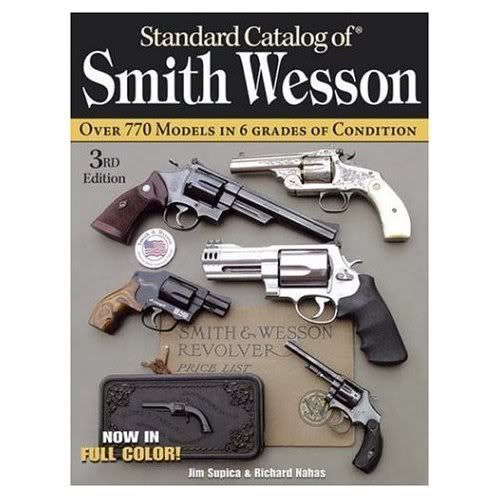
Standard Catalog of Smith & Wesson by Jim Supica and Richard Nahas

Title: Standard Catalog of Smith & Wesson
Author(s): Jim Supica and Richard Nahas
ISBN: 089689293X


Even if you have only a passing interest in Smith & Wesson firearms this is a must have book. Misters Supica and Nahas have done themselves proud on this 3rd edition with detailed explanations of terms and definitions including excellent illustrative photos. This is a BIG book too being oversize and 432 pages but not a one is wasted.

Now, I'm not knowledgeable enough to tell you that every model is described and pictured, that is why I got the book, but it certainly seems that way. Rifle, pistol and revolver, over 770 models as the cover notes. Also, variations and engineering & production changes are described listed chronologically with dates. Even belt buckles and such are listed. Of course there are serial number ranges by year. The book also provides prices by condition. While prices are always going to be subject to change, this provides at least a starting point for both buyers and sellers.

How well is this book organized? This book format should be duplicated for all manufacturers but I think Colts need the first. I've yet to find some bit of knowledge I need about the S&Ws that isn't given in this book. But organization isn't the only strong suit, it is well written and avoids being dull as most such catalogs tend to be.

The cost is $26.99 and free shipping from Amazon or you can buy it direct from the author and it is worth every penny.

Sunday, January 07, 2007

Murder of Crows Outside the Neighbor's House

I don't know what they are doing but it sounds as if they've cornered the neighborhood hawk in a cedar tree. Cacophonous is what it is. Crows, corvids in general, are interesting birds. A friend of the family had one as a pet. I was about 8-10 (can't remember) and they had raised the bird from a hatchling. He could "speak" and would follow the older son (my friend) around. We could run all over Elkins, WV and the crow would be there.

Now, as to why a group of crows is a murder I don't know. A similar group of rooks is a parliament. I think I've some reading to do.

Wednesday, January 03, 2007

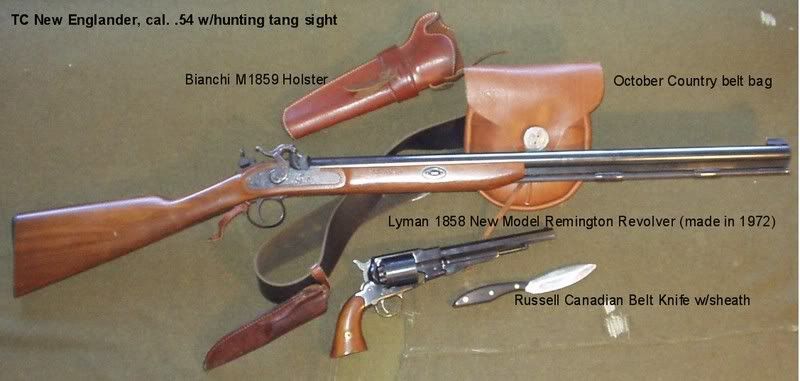
The TC New Englander

The New Englander seems to have been Thompson Center's response to the demand for a lower price point, high quality, single-trigger gun for deer hunters and came out at a time when the in-line had yet to make the big splash and wasn't even legal in some states. These guns came in .50, .54 and 12 gauge. I had thought they made a .45 but I can't find a reference supporting that. Individual barrels were available so that one could switch it up for different game. Of course the 12 ga. was a dandy and cost effective shotgun. The stock is plain walnut with a good straight grain and the fittings are plain cast steel as TCA does most all parts. Rifling is shallow compared to some muzzleloaders but has presented few problems. Twist rate is 1-48", an ideal compromise for round ball and conical in this caliber but totally unsuitable to the sabots commonly used today. The issue ramrod was an impregnated wood which I replaced with a special TC made rod. The replacement rod is stiffer AND more durable.

I got my New Englander from MidSouth Shooters' Supply for a whopping $154! In .54 caliber the gun is well balanced for carry, the balance point is at the barrel wedge. Same for shooting as it has just the right amount of "hang" to hold steady in off-hand after panting up a hill. The add-on TCA Hunter's Peep really helps improve sighting accuracy. The matching front sight is great but I painted the face of the "bead" in white for better visibility. This makes the sight combo usable in bright sun or dark forest.

Accouterments are necessary for every muzzleloader but the minimum can be used for this big bore rifle. I use the following accouterments:
  • Speed Loaders - I use both the Dixie type and the TC Quickshot. The Dixie type is merely a plastic tube with an internal diameter suitable to the caliber of ball/patched ball for which used with a cap that fits the other end of the tube to hold the powder twixt bullet/ball and cap. Works well but requires the capper. The TC Quickshot has an integral cap with provision for holding a cap or priming charge as well. The powder capacity of both speedloaders is approximately the same.
  • Capper - Made by Ted Cash, my straight line capper has come to be the prefered capper for this rifle.
  • Short Starter - This is a TC product but any other suitable for the caliber would work. It certainly helps to get the tight fitting conicals started in the bore as it gives something substantial to push against (the ball) to get the concicals going.
  • Nipple Wrench/Wedge Puller combo tool - This is a TC product made for all their traditional sidelock style muzzleloaders. Works a treat.
  • Shooting Bag - From October Country, this bag is for the belt and I only carry speedloaders, capper and short starter in it.

Does the .54 work, well, yeah! Even the antiquated round ball over the Virginia minimum charge of 60 grains of blackpowder or substitute will kill deer dead. The 12 ga. could be used with single ball just like a musket or trade gun for deer hunting and can also use shot.

I once tried to use a musket nipple to use musket caps to improve ignition. Not that anything was wrong, but I wanted "better". The musket nipple was a no go and the supposedly hotter musket caps actually provided hang fires. I've gone back to #11 caps and have perfect satisfaction. I heard that the musket nipples were brought out because some folks were having ignition problems with their #11 nipples. I have to say that I think they simply had a bad nipple. One that is too short will allow the primer flame to dwell too long at the bottom of the drum and not be hot enough to ignite a blackpowder substitute.

Over the past couple of decades we've had a trend away from traditional muzzleloaders to the point that manufacturers such as Thompson Center have discontinued the majority of traditional side-locks and might have several designs of in-lines. Still, the New Englander is a reliable companion in the field.

Tuesday, January 02, 2007

Toby Bridges Working Against Traditional Muzzleloaders

Much has been made lately of Toby Bridges and The North American Muzzleloading Hunting Association (NAMHA) and their stand to REQUIRE scope sights and ban traditional muzzleloaders in muzzleloading seasons. Trying to find out the truth of the matter my on-line research has come up with the following.

Apparently, Pedersoli puts stock in the reports despite Mr. Bridges denial:
"In the past we allowed Mr. Bridges to test our traditional ML rifles as well as our in-line ML rifles and he had our cooperation and limited sponsorship. Due to the new path Mr. Bridges has taken , in which traditional muzzle loading rifles would no longer have their current exclusive hunting period and in which in-line rifles would hunt at the same time as the traditional rifles, we have withdrawn our former support and sponsorship of Toby Bridges.

The Davide Pedersoli company has advised Mr. Toby Bridges to remove our company name from any list of sponsors who support his lobbying efforts because even though we manufacture in-line muzzle loading rifles, we strongly support the use of traditional types of flintlock and percussion lock rifles during hunting periods assigned to muzzle loading rifles.

We always believed that the hunting with muzzleloading guns, both traditional and modern black powder in-line rifles, could co-exist, even if two different muzzleloading hunting seasons would be more required. Certainly we never thought they could get into conflict with each other.
We regret Toby Bridge's decision which surprised us, considering that in the past he took important positions, which we could share, but absolutely not his last one.

The use of traditional muzzleloading rifles for hunting has all the historical, political and rational reasons to continue and to expand and cannot be forced to die, as Toby Bridges warns and predicts (and is trying to make happen) nor can be the enthusiasm and will of people who are dedicated to this traditional sector be disregarded. On the contrary, the traditional muzzle loading guns contributed surely much more than the modern in-line muzzleloading guns have to the muzzle loading hunting being accepted in our states. Rather than trying to promote the in-line rifles and push aside the exclusive hunting season for traditional percussion or flintlock rifles we should all be working to strengthen the separation of hunting seasons for archers, traditional muzzle loading rifles, the powerful in-line rifles and of course the modern cartridge rifles.

The in-line rifles are closer to the modern high power cartridge rifles and we hope that all government officials involved with making or changing hunting rules will recognize the big difference in power and range which in-line rifles (which use conical bullets) have over the traditional antique or replica rifles which use round ball bullets. Both archery hunters and traditional muzzle loading rifle hunters accept the great challenge and limitation of their hunting weapons, the need to stalk the game and get very close in order to make a clean killing shot. For the in-line rifle and modern cartridge rifle hunters a much different challenge is presented and the mixing of traditional and in-line rifles in the field at the same time would be unacceptable to the vast majority of traditional muzzle loading rifle users.

I read the letter Toby Bridges published in his web site in which he explained he has been misunderstood. I acknowledge his effort, however this letter gives me the opportunity to contradict Toby about the in-line rifles being the natural modern evolution of the muzzleloading guns.

The real modern aspect was when many years ago some of the American states opened the hunting season to the muzzleloading guns. This was a modernity sign! What happened later with the introduction of the in-line rifles and the continuous improvements to reach high performances, such as the use of pelletized substitute powder, waterproof ignition systems or sabot bullets, etc. made the modern muzzloading guns get closer to the modern cartridge gun performance. I am convinced that most of the hunters using in-line rifles are only taking advantage of this enhanced performance in a dedicated muzzleloading hunting season. I am also convinced that if the muzzleloading hunting season becomes an "open hunting season", several of the users of the in-line rifles will drop their rifles to hunt only with the modern ones.
I have to say that I am fond of the hunt in all its aspects, I am a hunter with modern guns, with cartridge guns, with muzzleloading traditional guns and with in-line rifles.

Davide Pedersoli is not against the modern in-line rifle hunting, which we consider as an alternative and different activity from the one with traditional guns . Without doubt, hunting with traditional guns must be protected and sustained in the spirit of the rules approved in many of the American states because it gives the American sportsman a hunting challenge and emotional satisfaction which no other type of gun can give."

Pierangelo Pedersoli, President

Davide Pedersoli & C.
Via Artigiani 57
I-25063 Gardone Valtrompia (Brescia) Italy
ph.030 8915000 fax 030 8911019
www.davide-pedersoli.com

There are several topics on several forums:

Historical Trekking
Goex Powder Forum
The Hunting Net
The High Road
Traditional Muzzleloaders Forum

And an article or two:

Crusading for muzzleloaders with scopes
Let's just eliminate Primitive Firearms Seasons altogether Part 1
Let's just eliminate Primitive Firearms Seasons altogether Part 2
Let's just eliminate Primitive Firearms Seasons altogether Part 3

The North American Muzzleloading Hunting Association has filed a civil
rights complaint alleging discrimination against the fish and game
departments of fifteen states that do not permit the use of "sight
correcting magnification" (riflescopes) during their special
muzzleloader hunting seasons.

According to the complaint, big game hunters in the United States are
becoming older as a group. With that maturation, NAMHA holds, there is a
natural deterioration of vision. Due to that accepted fact, it should be
only reasonable that older hunters be provided the equipment to see more
clearly.

In fifteen jurisdictions across the United States, however,
muzzleloading hunters are prohibited from using optical sights, despite
the fact that center-fire rifles, handguns and slug-loaded shotguns
permit optical sights. This, NAMHA holds, is discrimination against
muzzleloading hunters - discrimination that is due to age and sight
deterioration- items covered under the Americans with Disabilities Act
(ADA).

In a July 16 letter of complaint to Secretary of the Interior Dirk
Kempthorne NAMHA founder Toby Bridges pointed out, "If modern firearms
hunters in these states are given the right to hunt with a magnifying
telescopic rifle sight (scope), then the muzzleloading hunter has the
right to use the same sighting aid during a season established for
muzzle-loaded guns. For these states to deny that right is a clear cut
case of discrimination - due to age, due to sight disability and due to
segregation."

The July 27th reply from the Department of the Interior says: "We have
accepted your complaint for investigation under the authority of section
504 of the Rehabilitation Act of 1973, as amended, and Title II of the
Americans with Disabilities Act (ADA). Section 504 prohibits
discrimination on the basis of disability in programs or activities
receiving Federal financial assistance. Title II of the ADA prohibits
discrimination on the basis of disability in programs and activities
conducted by public entities whether or not they receive Federal
financial assistance. Each of the 15 Wildlife Agencies is subject to the
nondiscrimination requirements of both of these Federal laws. Under
separate cover, we have asked the FWS (Fish & Wildlife Service) to
investigate your complaint."

Since filing the complaint, the NAMHA says it has been contacted by
several of the named departments. Their reasoning for the no-scope
regulations are characterized by NAMHA as "the same old rhetoric and
reasoning that has been shot down and proven wrong in other states, "
from a potential over-harvest of game to the temptation to take longer
shots. In response, the Association says that precise shot placement is
key to a quick, clean and humane harvest, not a ban on optics.

Further, the NAMHA says game departments "haven't a clue" as to how much
game is lost to poor shot placement due to their open sights only
requirements.

The game agencies listed in the complaint are the Alaska Department of
Fish and Game; California Department of Fish and Game; Colorado Division
of Wildlife; Georgia Department of Natural Resources; Idaho Department
of Fish and Game; Kansas Department of Wildlife and Parks; Minnesota
Department of Natural Resources; Nebraska Game and Parks Commission;
Nevada Department of Wildlife; North Dakota Department of Game and Fish;
Oregon Department of Fish and Wildlife; South Dakota Department of Game,
Fish and Parks; Utah Division of Wildlife Resources; Washington
Department of Fish and Wildlife; and the Wisconsin Department of Natural
Resources.

Monday, January 01, 2007

Getting In Shape

Ok, New Year's resolution or not, I need to get back into decent shape. I can't run over 1½ miles, I weigh 206 pounds, my girth is overly noticeable.

First thing I'll cut back on the carbs and eat more protein. I'll exercise more and build more muscle mass. I'll walk more (it will probably help the dog, too!). I'll bike more and get the canoe out. I'll work more days on Mom's place.

This will help my shooting and ability to handle recoil. It will lengthen my shooting career. It will maybe help me be around to watch my grandkids shoot. That alone makes it worth the effort.