Sunday, April 15, 2007

Ontario Pilot Survival Knife

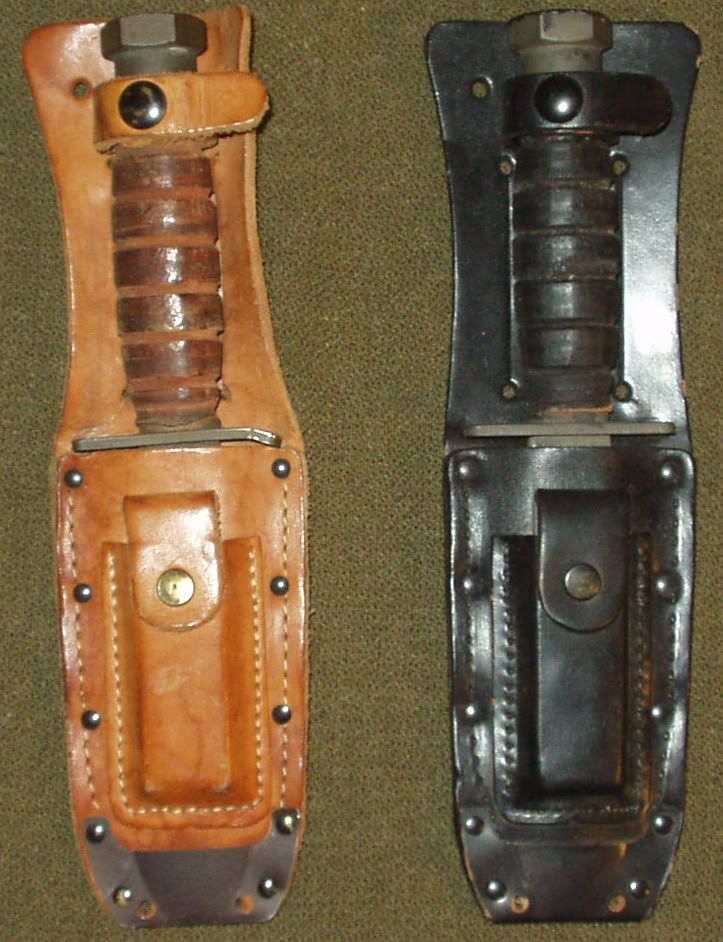
Actually, two knives. I thought I'd lost them and I thought they were Camillus made. Ontario is still in business so in that regard, perhaps I'm not so happy that they aren't Camillus knives but I am glad I found them.

They both have good sharp edges, now, and the sheathes have been waterproofed. The left with a common leather waterproofing formula and the right one with a waxy dye. Made in 1986 and 1987 respectively, these once retailed for about $15 but I understand that with these sheathes, these knives now retail for about $60. Yes, I'm glad I found them. They now rest in the bin with the rest of my knives. 19 quarts of knives...

Someday, some grandkids are going to be mighty happy with all those cool knives.

Browning Bushmaster

I bought this from my sister-in-law to give her some much needed money. She no longer needed the bow but I couldn't warm up to it. I tried to get my 3 children to enjoy it but they apparently couldn't warm to it either. It still rests in my home. We did manage to use up the arrows with which my sister-in-law passed it to us and to break, age related to the plastic used I think, the snap on bow quiver.

I suppose that I should use it, that is, not let it go to waste. This will entail a new quiver and arrows and adjusting it to the top of it's draw range or about 45 lbs which will make it legal for deer. It will also likely need a new rest soon. Interesting how the "improved" bow needs as much or more maintenance than the older bows...

Saturday, April 14, 2007

But There is Some Good News, from Ruger...

The Ruger Vaquero Montado is a 3-3/4" barreled, stainless steel, New Vaquero with a sort of Bisley style hammer and grooved forestrap. Oh, and chambered for the .45 Colt. Just too cool and from Davidson's Gallery of Guns for only $714.

Winchester Product Recall

PRODUCT WARNING AND RECALL NOTICE: WINCHESTER® WILDCAT® 22 & WINCHESTER® XPERT® 22


4/6/2007
Olin Corporation, through its Winchester Division, is recalling several lots of its WILDCAT® 22 (Symbol Number WW22LR) and XPERT® 22 (Symbol Number XPERT22) 22 Long Rifle rimfire ammunition.

Lot Numbers containing Letters: XN, YA, YB or YC

Through extensive evaluation Winchester has determined the above lots of WILDCAT® 22 and XPERT® 22 ammunition may contain double powder charges. Double powder charge weight ammunition may cause firearm damage, rendering the firearm inoperable, and subject the shooter to a risk of personal injury and/or death when fired.

DO NOT USE WINCHESTER® WILDCAT® 22 RIMFIRE AMMUNITION WITH LOT NUMBERS CONTAINING LETTERS XN, YA, YB or YC. The ammunition Lot Number is imprinted (stamped without ink) on the outside of the right tuck flap of the 50-round box, as indicated here:


DO NOT USE WINCHESTER® XPERT® 22 RIMFIRE AMMUNITION WITH LOT NUMBERS CONTAINING LETTERS XN, YA, YB or YC. The ammunition Lot Number is imprinted (stamped without ink) on the outside of the top tuck flap of the 500-round box, as indicated here:


To determine if your ammunition is subject to this notice, review the Lot Number. If the Lot Number contains the letters XN, YA, YB or YC return the ammunition to Winchester via United Parcel Service (UPS). Securely pack the ammunition into a corrugated cardboard box, write “CARTRIDGES, SMALL ARMS ORM-D” on the outside, and ship to:

Olin Corporation – Winchester Division
Tile Warehouse
Powder Mill Road, Gate 4A
East Alton, IL 62024
Attention: 22LR Recall

Please include your name, address, and phone number. Winchester will send you coupons good for replacement ammunition from your local Winchester dealer.

This notice applies only to WILDCAT® 22 and XPERT® 22 rimfire ammunition with Lot Numbers containing the letters XN, YA, YB or YC. Other Symbol Numbers or Lot Numbers are not subject to this recall and should not be returned to Winchester.

If you have any questions concerning this recall please call toll-free 866-423-5224 (U.S. & Canada), write to the above address, or visit our website at www.winchester.com.

We apologize for this inconvenience.

Friday, April 13, 2007

Cold Steel Canadian Belt Knife - UPDATE

I promised a report as soon as I got the knives and they came in April 12, just 6 days after I submitted my order. To say that I'm impressed is an understatement.

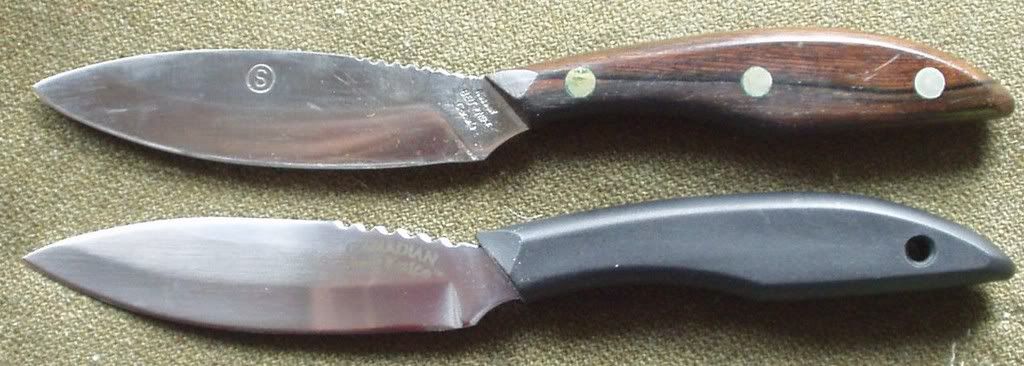
Look at the photo. The Cold Steel (CS) copy of the Russell Canadian Belt knife is directly next to my 1972-3 made knife. Let's go point by point.

While the original is a full tang knife, the CS isn't. At least you can't see the tang hidden in the molded polypropylene handle. The original has a nice wood grip but I was impressed by the CS handle which seems much denser than I expected. At least that's the impression despite the weight of the knife, much less than the original even though the dimensions are so close that the CS knife can use the original's sheath. However, the CS knife's handle is just a shade larger which is only apparent when the knives are side-by-side. The original does lack one thing the CS knife has, a lanyard hole.

Comparing the blades is interesting. The CS version is clearly a stamped blade and the major shaping of the blade was obviously done in the stamping. This includes the gimping on the back of the blade. There is also a bit of waviness in the grind not apparent on the original. Still, the CS blade is VERY sharp. The blades have nearly the exact same dimensions, the working portions of the blades being nearly identically ground, except... The transition at the heel (ricasso) is angled on the original and perpendicular to the blade edge on the CS knife. One other obvious difference is that the CS knife has a noticeably sharper point.

Frankly, I had to work to get the edge on my original to be as good as the CS knife edge was out of the box. I can't yet speak as to how durable the CS knife edge is but the original's will hold up very well in normal hunting duties.

You might note that the famous Russell elliptical blade, which has won awards for design, is really just a single edge spearpoint blade (the handle off-set gives it added functionality). One can easily stick "things" with it. Note also that the butt has a nice striking point and the grip won't slip in your hand. Gives one thoughts that it might be a bit more versatile than first thought.

The sheaths are different as one would expect for the price difference. My original sheath is a well-crafted leather pouch and the CS knife comes with a nylon pouch that is just good enough for carrying the knife. One could invest in a Kydex pouch but unless one makes it oneself the cost would be more than the knife. As it is this is a good inexpensive knife that should do a fine job for the outdoorsman.

One thing that is clear is that the CS knife is made in Taiwan. This may be important to some users. As to purchasing the knife, I just did a search for "cold steel canadian belt knife" on Froogle and sorted by price. Only because the knife was out of stock at the cheapest provider did I pay $9.31 per knife. Compared to the $16-something MSRP, this is a great price.
Ghurka Kukri (Khukuri)

This is one of those sold by Atlantic Cutlery in the mid 1980s. Real? I don't know. Made from old auto bodies? Again, I don't know. I did reprofile the edge, by hand using the Buck Knife sharpening guide and a good, large stone. That took the better part of 8 hours so I don't think the steel is that soft but at least now it is sharp enough to do some knife work. From the Brigade of Ghurkas:

"The Origin of the Kukri"

Kukri is the now accepted spelling; “Khukuri” is the strict translation of the Nepali word. Either way the thing itself is the renowned national weapon of Nepal and the Gurkhas.

A Nepali boy is likely to have his own kukri at the age of five or so and necessarily becomes skilful in its use long before his manhood. By the time a Gurkha joins the army, the kukri has become a chopping extension of his dominant arm. This is important, because it is not the weight and edge of the weapon that make it so terrible at close quarters so much as the skilled technique of the stroke; it can claim to be almost impossible to parry.

It is important to remember that the kukri is a tool of all work, at home in the hills and on active service it will be used for cutting wood, hunting and skinning, opening tins, clearing undergrowth and any other chore. From this it is plain there can be no truth in the belief that a Gurkha must draw blood every time before he may return the kukri to its sheath.

The oldest known Kukri appears to be one in the arsenal museum in Kathmandu, which belonged to Raja Drabya Shah, King of Gorkha, in 1627. It is interesting to note that it is a broad, heavy blade. However it is certain that the origins of the kukri go far further back. There is one tenable story that Alexander’s horsemen carried the “Machaira”, the cavalry sword of the ancient Macedonians, in the fourth century BC on his invasion of north-west India. Its relationship with the kukri is plain. A third century sculpture, of which only a much later Greek copy exists, shows what is probably a Scythian prisoner of war lying down his arms. The weapon looks amazingly like a modern kukri.

In 1767 Prithwi Naraayan Shah, King of Gorkha, invaded the Nepal valley: In September 1768 Kathmandu surrendered and Prithwi Narayan became the first King of Nepal. That his troops defeated much larger forces must be credited at least in part to their unusual weapon, the kukri. It is reasonable to suppose that this was the beginning of the universal custom of Nepalese troops carrying the kukri, a custom that spread in time to Gurkhas serving in the British and Indian Armies. It was carried also by many other hill units, regular and irregular: Assam Rifle Regiments, Burma Military Police, the Garhwal and Kumaon Regiments. In the Burma campaign of World War those British troops who did not carry a machete carried a kukri, and nowadays the Singapore Police Force also carry them.

Most hill villages in earlier days would have a Smith (or Lohar of the Kami clan) who forged kukris for the people: now there is a good deal of mass production, though the best are still made by skilled craftsmen. In World War II Gurkha recruits were issued with mass-produced government kukris but nearly all brought back their own from their first leave. Weight, balance and fit are crucially important.

The blades of ordinary kukris vary much in quality. Many are made perforce from inferior steel and cannot hold a sharp edge: Good ones are forged from railway track and old motor vehicle springs. The best are forged from the finest continental steel and can be of the highest quality, fluted and damascened. The scabbards are made of wood covered in leather with a protective metal cap over the point. Two pockets on the back holding a blunt steel for sharpening the blade or striking sparks from flint (the chakmak) and a little knife (the karda) used for skinning small game or as a penknife, some also have a little purse for the flint.

Most handles are made of wood, often walnut or pat-pate (talauma hodgsoni). They are secured to the handle either by rivets through a two-piece hilt or by the tang inserted through a one-piece grip and riveted over the cap. In a good example the scabbard (dap) may be adorned with cloth-work or engraving and the hilt made of bone, ivory, horn or metal probably decorated.

Village working kukris are much coarser affairs, often with heavy wooden scabbards and comparatively clumsy blades.

Piuthan in the west and Bhojpur in the east are well known cnetres of kukri manufacture: Choosing examples from east to west and from the 18th Century onwards, we can see many styles and several types. The long, slender blade is characteristic of early work and of eastern Nepal; the shorter, round-bellied weapons are common later and in western districts: but there are exceptions to this rule.

There is no specific set of dimensions, but the standard length of service and general use kukris is twelve or thirteen inches. A Kothimora kukri may be any reasonable size though many of the best are service length.

The most impressive are the ceremonial and sacrificial blades. They must be capable of cutting cleaning through the powerful neck of a water buffalo. They tend to be twice the length and weight of a soldier’s kukri with the hilt to fit a two-handed grip.

One interesting curiosity is the ‘kukri-bayonet’ for the old tower musket. There is a drawing in Perceval London’s book “Nepal”, Volume 1 page 96, of a Nepalese Guard of Honour (of between 1813 & 1837) at the present, muskets complete with kukri-bayonets: But each soldier had his own fighting kukri in his belt. So clumsy a weapon must have been for ceremonial purposes only.

The notch (kaura) in the blade near the hilt arouses much interest. Although it may certainly act as a check to excessive blood on the hilt, and be used to catch and neutralise an enemy blade, it is essentially a Hindu religious and phallic symbol. There is a strong analogy with the hand-guard of the crusader sword, which protected the sword-hand but equally represented the Christian cross and was commonly used as the guarantee of an oath- the right hand being placed on the cross with such words as “by these hilts”. Reference will later be made to myths but it is suitable to say here that the “Kaura” or notch is not an ingenious sight with which to aim an about to be thrown kukri. Except in desperation, as a man might hurl his empty rifles in a last defiance at the enemy; a kukri is never thrown: the Gurkha prefers to keep it in his hand.

The religious significance of the kukri must not be forgotten. In 1948 Maharaja Padma Shamser Jangbahadur Rana, Prime Minister and Supreme Commander of Nepal, wrote, “The Khukri is the national as well as the religious weapon of the Gurkhas. It is incumbent on a Gurkha to carry it while awake and to place it under the pillow when retiring. As a religious weapon it is worshipped during the Dasain (the most important Hindu festival) and other times whenever any sacrifice is to be made.

In the Army Dasain is of the greatest importance: During it the regiment’s arms are blessed, and goats and buffaloes are sacrificed in the process – not now in this country. At home in Nepal goats dedicated to various causes are despatched and then proved and chosen experts ceremonially sacrifice a male buffalo in the name of the regiment. The large kukri “Konra” (in the village) is used because the head must be cleanly severed with one blow. When that is achieved, which is nearly always, the blessing of the gods lies on the people for the ensuing year. If the stroke fails, leaving even so little as an inch of the dewlap uncut, bad luck will follow. It is custom the custom to honour the successful headsman with a “Pheta” (white turban) bound round his forehead, an honour much valued.

Associated Myths & Legends

The kukri has somehow produced a fertile crop of myths and legends in the western world; and the most impossibly wild amongst them are the most tenaciously believed. Two already mentioned are that a kukri once drawn in whatever circumstances must taste blood before it is resheathed. Also that a Gurkha, if he possibly can, will take careful aim through the symbolic “kaura” or notch and then hurl the weapon like a boomerang, snick off the enemy’s head and casually snatch the kukri out of the air as it returns. If the first of these were true no Gurkha would survive to adulthood: He would lose pints of blood every day as he chopped wood, sharpened a wooden peg, opened a tin of beans and slashed down encroaching undergrowth. After each task he would have to shed some of his own blood. The second fails to stand the test of a little thought. Much as anyone would hate to be in the path of a flung kukri, one would hate much more to oppose one in the hand of an angry Gurkha.

Not very different is the story (set variously in China, Italy, Burma and the North West Frontier) of the Gurkha coming suddenly on the enemy soldier. Naturally he struck first – the decapitating blow. “Yah, missed!” said the enemy. “Try shaking your head,” came the reply.

Finally a true story told by General Sir (later Field Marshal Viscount) W J Slim.

“Early in his command of 14th Army he encouraged constant patrolling by all forward units. One Gurkha patrol on return presented themselves before their General, proudly opened a large basket, lifted from it three gory Japanese heads, and laid them on his table. They then politely offered him for his dinner the freshly caught fish which filled the rest of the basket.”

Nepal, the Gurkha, and the Kukri: The three of them are inseparable in reputation, and the Gurkha Soldier keeps his kukri as he keeps his honour – bright and keen.


Links:
-
Cold Steel San Mai Kukri
-
Cold Steel Kukri Machetes
-
Khukuri House
-
Northern Virginia Bando Association

Wednesday, April 11, 2007

Leatherman's Products

Original Leatherman tool was the first multi-tool other than a Swiss Army Knife (SAK) that I ever bought. What a joy to have this with me every day. Yes, it was used every day. At the time, and because I also carried a SAK, I seldom used the blade. However, the pliers (including the wire cutter) and the screw drivers were very handy. I also used the can opener because I thought it was sturdier than the can opener on the SAK. That was, unfortunately, untrue as I found out one day while I was trying to open a tray pack meal on the back of a HumVee. The thing snapped off without any lateral pressure. The heavy (?) metal of the T-pack was just too much for it.

The Leatherman Mini-Tool was my second Leatherman purchase was a direct result of my satisfaction with the first tool and a need/desire to have a smaller tool. It was pretty good but having to unfold it to use the pliers and not having the leverage (not quite despite it being advertised as full sized pliers) of the larger tool caused me to put it away.

The Leatherman Wave was my 4th multi-tool. It was a gift from an outgoing commander who felt that I'd been an asset during his command tour (and rightly so!). Best darn gift I've ever received in the military. Many thanks to then Captain Patterson. I really liked the Wave because like the Gerber multi-tool I'd been issued it had rounded handles that didn't test one's ability to withstand torture while using the pliers and unlike the Gerber, couldn't/wouldn't pinch the palm if the plier jaws slipped off the work or when the wire cutters snipped through the work. Quite nice to use and it came in a wonderful leather pouch. Class act all the way. I have to wonder how the market changed so that this tool has been discontinued.

The Leatherman Juice is a series of slightly different tools in size and configuration targeted at more upscale recreational users. They are also treated to anodized aluminum scales in various colors to generate interest in the display cabinet... I've got a KF-4 in my pocket as I write this and am very pleased. If there is any gadget it doesn't have that I think it should that would be scissors. Not to worry, Leatherman makes a juice with scissors and I have one but it hasn't been so important to me that I've bothered to break it out of the vacuum pack! Of course the KF4 or Solar is the one Juice that's been discontinued! I like it because it is about the perfect pocket size tool, the screwdrivers all work, the pliers work as they should, and the knife blades are good enough to replace the SAK.

I bought a Squirt for my daughter this past Christmas. She's an enthusiastic user and says it has proven to be very handy while still being unobstrusive on her key chain!

Tim Leatherman did have a bit of a problem with many in the sporting world when he decided to support John Kerry for President. I e-mailed him about his stand and how it might affect his sales. We started a regular little correspondence for a while and he was always polite but firm in his beliefs. I don't think we'll be well served by boycotting him and based on his buyer demographic, we're not likely to affect his sales all that dramatically. For certain, he makes about the best multi-tool out there. Frankly, I take a bit of pleasure in using his tools to do the good work and support my ideas and the right thought.

Tuesday, April 10, 2007

Browning Nomad II


The Browning Nomad II is a recurve pulling 45 lbs at 28" and Dad purchased this from a dealer in Verona, VA in 1967 along with a dozen cedar arrows. I think he paid about $75 for the whole thing. I know the MSRP on the bow was about $64.75 in 1967 (only $47.50 in 1966). I can remember being quite impressed!

We used to stand in the front yard of our house in Bridgewater and shoot across the street into a dirt pile in a vacant lot. No, there were no calls to the police or such things. Indeed a couple of neighbors would step out and have a chat as we shot. A different time indeed.

Like all bows of the period one shoots off the shelf. Call me old fashioned but I prefer that. That shelf sure is a lot more sturdy than those little plastic rests they often use nowadays. Some people think they are too short and they will stack at the longer draw lengths. Long draw is not a problem for me so I never experienced that problem. On the other hand, the short length has some advantages. You will also find some folks that don't like the low draw weight but 45 lbs is the legal minimum here in VA and it is more than adequate for deer at reasonable ranges, i.e. ranges at which I can put an arrow into a vital spot on a deer.

I am wondering if I can find out some info about the bow based on the serial number. If you can help, please, write me.

You Can't Go Back

Thursday, February 12, 2004

Project will cater to weekly rentals
By KELLY BRUNI Staff Writer

FLY CREEK - A final site plan review for a special permit may be presented to the Otsego town planning board next month for a motel/hotel complex that could accommodate 140-200 Dreams Park visitors.

The Donney Brook Bungalows are to be located between Rte. 80 and Parslow Rd. in Oaksville. The property is owned by Ken Stabler and the site plan designs have been created by Beardsley Design Associates.

"We've been working on this project close to a year," said Tom Cormier, business manager for the project. "We've worked hard on it. I think it will fit in with this whole area."

The project consists of nine bungalows, each containing four, two-bedroom units, and a recreational center/rental facility. The recreational center would be open to the public as well as guests at the complex for different uses such as weddings or conferences, he said.

The bungalows are geared towards daily to weekly renters.

"It's built for a family," he said. They anticipate placing volleyball courts and horseshoe pits on the property.

Although they are looking to attract the Dreams Park visitors, Cormier also stated that they hope to attract people year-round. He proposed that businesses or organizations may consider the complex as a retreat.

A portion of property to the right of the complex is commercially zoned and designated for future projects, said Cormier.

"Our primary concern is the bungalows," he said.

They hope to begin construction this spring.

During previous discussions, Cormier said they had considered moving Parslow Road, however, because of a potential for public opposition, they have abandoned the idea.
More proof that you can't go back. You see, this spot between Parslow Road and route 80 was once a part of my grandfather's farm. Come summer we'd hunt groundhogs and once upon a time I speared one there, right where they are going to build bungalows. Nobody will know, nobody will care, and nobody will ever know the land in that way again.


You can't see it here but Parslow Road runs just north east of 80 and 28 and parallel to the two roads up to the intersection. We used to come in on 80 from the west and look for the US flag he always flew as we topped the hill.

I've no idea what became of the old house built in the early 1800s that was the Parslow family home for about 40 years. The last time I was there there were already houses down the road towards Cattown and the man who owned the property then had put a new basement under the old building. He has since died as well. I guess I shouldn't complain too much. I couldn't afford the taxes and couldn't stand the gun laws up there.

Handgun Hunter Magazine

Ok, I'm going to jump on a bandwagon, mostly for selfish reasons. Having seen this magazine mentioned on the Sixgunner forum, I ordered the last three issues without hesitation. I'm impressed. Handgun Hunter has more high quality photos (for us illiterates) than any other publication of which I'm aware including Single Rifle and Double Gun Journal. Published in Stafford, VA (another reason to support this fine magazine) by Gary Smith (who I do not know), everything about this magazine speaks to quality. The magazine is a full color publication, perfect bound, printed with a 100# cover and 60# inside pages. Heck I couldn't even find a spelling error (maybe I should read it again). I think that if this thing remains in publication it should be worth taking to the book binder for preservation... Check it out.

Thursday, April 05, 2007

Canadian Belt Knife from Cold Steel

I've long been a fan of the Russell Canadian Belt Knife from Grohmann of Pictou, Nova Scotia, Canada. By the way, that's a nice place to visit. I've had mine since 1973 and it has been well used and well cared for. Today I received my Rifle magazine and lo and behold there is a review of the Cold Steel Canadian Belt Knife. Cold Steel cut the cost by using a polypropylene handle and nylon sheath so that the MSRP is a pleasant $16.99. However, you can find the knife even cheaper than the Swedish Army knife or for as little as $9.27. I've got two on order but paid $9.31 each because I wanted immediate shipping. I'll test one and likely save the other for my grandson.

For Guns Requiring Standard Pressure Ammo

Tim Sundles at Buffalo Bore has STANDARD pressure ammo with +P or near +P performance. He's just released this but it is just the ticket for those of us antiquarians using old guns for self defense. He says that the bullets used in Item No. 20C/20 are so soft that he has to take special precautions in shipping the bullets. I've got two boxes on order and we'll see but these should be perfect for my Detective Special.

Wednesday, April 04, 2007

Knives, Now Hatchets

Axes are just as much fun as knives and machetes. I've accumulated several.

The first are these three. The one I've had the longest is the oldest in style. From the bottom we have a tomahawk I bought from Dixie Gun Works in 1975. I used to take my lunch at Mission Account at FT Hunter-Liggett, CA to throw at an old stump out front of the compound. Then I started hunting the ground squirrels who were mocking me from their holes on either side of the stump. After about 1000 throws I actually brained one of the little buggers! I think that the Native Americans and Mountain Men didn't throw these things, they kept them firmly in hand. Much more certain in execution! Mine is on the second handle. The first I still use as a mold mallet.

I've not used the next two at all although I've had them for some time. The middle hatchet is a common mass produced item from one of the big box stores. Nothing special and apparently not useful as I've not got any wear on the blade!

The second is a Fiskars using the latest in metalurgic and fabrication technologies. The Fiskars handle will supposedly resist destruction even when run over by a truck (shown in one of their promotional films). I got this one to carry in the truck but the Woodman's Pal has generally proved to be more useful. At least enough so that I've never used the Fiskars hatchet. Still it is a cool thing. You might notice some similarities to Gerber's product...

Then, of course, I've some full size working axes. These I've used! Sometimes, although it is a bit more work, it is a bit less trouble to grab the ax than to fire up the chainsaw. One doesn't need to worry with the noise or fuel either. I've single bitted and double-bitted axes. The double-bitted are good because not only do they look cool and let the Walter Mitty in us think that we're Paul Bunyan but each edge can be sharpened differently so that one edge is for splitting and the other for cutting or just to have a replacement edge or one edge that can be used next to "obstacles".

Axes and hatchets are fun but clearly not all that important to me.

Tuesday, April 03, 2007

The Roanoke Times Incident Continues...


CNN's Coverage

This coverage is surprisingly even but they get some things wrong. First, while the CHP/CWP is widely considered as a privelege it really is a right.

Also, Trejbal reported threats and there was a police response. This is the WAV of that call...

Monday, April 02, 2007

Winchester Model 72

In looking for background on the M72 I found this in "The Winchester Book" by George Madis.
For years dealers had been asking Winchester to make a reasonably priced tubular magazine repeater. Clip-fed magazine repeaters have the objection of a loose magazine to lose and rarely feed the Short, Long and Long Rifle cartridges interchangeably. In 1939 the model 72 was introduced to fill this demand.

At first production was on a standard rifle with two standard sight combinations. After production of less than one year, a "Gallery Special" was added to the listing. Standard rifles have 25 inch barrels. Gallery Special rifles are the same as the standard models but were chambered for the 22 Short only and are so marked.

Barrels of this model are made separate from the receiver and are threaded into the receiver. A sliding safety was provided. Earlier rifles will have the bolt handle bent downward, later arms have the handle bent downward and to the rear.

Earlier arms have a stock which is 1-5/8 inch thick. When production began after WWII, the stocks were 1-3/4 inch thick and forends were more rounded and tapered with a slightly more beavertail shape in some issues. Production of this model, as with some previous models, ceased in 1941 due to the war and began again in late 1946. Three quarter length magazines are found on this model. Some longer magazines, extending to within six inches of the muzzle, were assembled. Standard magazines are 7-5/8 inches from the muzzle. Attractive bolt handles (knobs) of ovoid shape are standard on this model. The first rifles made had the handles of round shape, but this was changed after production of a few hundred guns (sic).
Also...
Pistol grips and composition shotgun buttplates were standard. All steel parts except bolt fronts were blued.

Barrel markings are the same as the 69-A with the model marking changed. Latest of the rifles have a barrel marking:


WINCHESTER - MODEL 72A -
TRADEMARK - 22 S.L. OR L.R. -
MADE IN U.S.A.


A few barrels have the "made in U.S.A." following the model marking.

After production reached nearly 100,000 guns, triggers were grooved.

Early in production two sight combinations were offered. First was the number 32 open rear barrel mounted and series 75 front: A tin bead was attached to the front sight. Second to be announced to dealers was the rifle with a series 97 hooded ramp front with an 80A receiver moutned peep sight.
And...
In 1959 the model 72 and 72A were discontinued when production passed 161,000.

This model 72 Winchester was Dad's. I had thought that he may have bought it new after coming home from the Army (the first time) in 1947 but it seems to be an early gun. As you can see this seems to my eye to be a round bolt knob and it isn't swept back. However, the stock is about 1-3/4" wide. The barrel marking is also of the earlier type. The mag ends 6-7/8" from the muzzle. Does this gun exhibit a mix of features or was Winchester's production so varied that this is completely normal? Unfortunately for me, these rifles are unserialed and so it is yet more difficult to date. Hindsight being 20/20, I wish Dad had told me more of the history of these guns as I'm trying to do for my grandchildren.

To my mind the Model 72 is nearly the epitome of the bolt-action .22 LR. The trigger is more than adequate and the stock is comfortable in both carrying and shooting. Complete with the factory peep sight, this gun has taken numerous squirrels and rabbits, more than a few groundhogs and given many years of pleasure to two generations.