Tuesday, March 13, 2007

DC Gun Ban Unconstitutional

US Court Says Parts of DC Gun Law Unconstitutional By VOA News 10 March 2007
A U.S. appeals court has ruled that parts of a law banning guns in Washington, D.C. are unconstitutional.

Friday's ruling, decided in a two to one vote, struck down a provision that bans residents of the nation's capital from keeping handguns in their homes. The court said the ban violates the Second Amendment of the U.S. Constitution.

The amendment grants "the right of the people to keep and bear arms" and allows for a "well regulated militia."

The court also struck down a section of the law that requires owners of legally registered guns to disassemble them.
Follow the link to read the rest of the article.

Actually, the main, most important part of the ruling is that this court correctly held that the 2nd Amendment is an individual right. The antis are pitching a fit talking about activist judges. They need to research the word hypocrite, they are one.

S&W 422 Disassembly As Promised

Here it is with numbered steps.


Once you get the recoil spring guide retention "thingie" out you need to remove the disassembly tool and pull the recoild spring guide and spring from the front of the slide. Then you can remove the slide from the gun by sliding to the rear and lifting up.

When you reassemble you need to insert the recoil spring guide and spring into the front of the slide and then push it back far enough so that you can insert the disassembly tool between it and the receiver. Only after doing so can you push the slide forward and reinsert the recoil spring guide retainer. Then pull back the slid slightly and remove the tool.

No further takedown is needed for maintenance.

Now there's this video...

Monday, March 12, 2007

The Roanoke Times Realizes Error?

The Roanoke Times Removes Database of Handgun Permit Holders

March 12, 2007 — The Roanoke Times has decided to remove the online database of registered concealed handgun permit holders from its website.The newspaper is requesting the Virginia State Police, which provided the information, verify the data.“When we posted the information, we had every reason to believe that the data the State Police had supplied would comply with the statutes. But people have notified us that the list includes names that should not have been released,” said Debbie Meade, president and publisher of The Roanoke Times. “Out of a sense of caution and concern for the public we have decided to take the database off of our website.”The database was posted on roanoke.com on Sunday as part of a New River Valley editorial page column about open records. This column, as well as others that will be published this week, is part of a special focus on Sunshine Week, a national initiative to raise awareness about open government and freedom of information.

* * * * *

By virtue of their irresponsible behavior, many citizens may have been targeted for burglary. I wonder what liability the Roanoke Times might have.

Smith and Wesson 422

The Smith & Wesson 422 is an outgrowth/follow-on product from the Escort line of concealable .22 pistols. There was considerable charm to the unique Escort but it wasn't of a size to give adequate velocity to the .22 LR cartridge for hunters nor for a long enough sight radius for most shooters. There are all-stainless & alloy frames, long & short barrels, adjustable & fixed sights, 10 & 12 round magazines, plastic & wood stocks. The S&W 41 magazine is fully interchangeable. Wolff makes a reduced power recoil spring.

The action is unique in that the recoil spring is over the barrel so that the barrel sits low in relation to the hand and recoil, while mild, is more straight back and muzzle "flip" is reduced. The magazine release is absolutely ambidextrous as it is in the center of the forward grip frame. The safety is in the same position and identical in up front function to the Colt 1911 (I know, not INTERNALLY). The grip angle is similar to the Colt but not identical. The gun is easy to take down and clean. Some report lots of parts breakage but I haven't experienced that at all. At the time the pistol was introduced it was touted as being designed for modern manufacturing techniques to hold prices down but afterwards the Glock polymer frames were introduced and frame production became yet simpler, and cheaper. I think this is what pushed the gun out of production.

True, the Ruger .22 LR pistol is generally more accurate but not always and it is heavier except when compared to the all-stainless models. However, the 422's accuracy is fully squirrel capable as seen here. This is my favorite squirrel pistol to date and I have a Ruger MK II 10" barreled gun that shoots like a rifle. Why? Because it is light, because of how the safety works, and because it is sufficiently accurate for squirrels to 30 yards or so, about as far as I shoot at squirrels anyway. Both pistols and the Browning Buckmark have grips intended for full-sized/adult hands.

My favorite load for this pistol is the Winchester Dynapoint modified with a Hanned Line Small Game Bullet (SGB) tool to have a nice flat point. These kill squirrels dead with little to no meat loss and they are as accurate or more accurate than any other ammo out there in my pistol.

Prices vary widely due to the negative things said about the gun by the unknowing ranging from $75 to $300 depending on condition (of course) with some very good but dirty guns going for very low prices because the owner doesn't know how to take the gun down for cleaning. I've posted a quick "how to" on assembly disassembly of the S&W 422. Just click on the link to see it.

CHP Holder List On-Line "Courtesy" of the Roanoke Times

Shedding light on concealed handguns by Christian Trejbal seems to put forth this as a great civic service by The Roanoke Times and Mr. Trejbal. Some are livid. I think it is just silly. I know that this means that I can never go unarmed again. My comments to the Times follow.

* * * * *


Sadly, while you think you've done a great thing (and equated people with a background check to pedophiles in the process) it isn't so. Likely your choice to do this can put somebody at risk.

Once upon a time I was responsible for and the only access to a sizable number of government owned fully-auto weapons. I was threatened and told to get my CHP and did. Having that CHP, unknown to the possible assailants, made me more secure. It made those who might have been threatened by those weapons I safeguarded more secure. I don't suppose you considered that.

But there is the opposite result as well. Anyone not appearing on the list is an easier target for the criminal. I think that you think that criminals, particularly stalkers, can't read, can't use a computer and can't plan past their current meal. I hope you're right but that's not my experience.

Some people foolishly believe that everything that can be said must be said. Sometimes, it is better to keep your mouth shut even if you can say something, even if you have the knowledge to accurately report it. There is always somebody ready, willing, and able to take advantage of the blabber-mouth.

I might also add that you managed to insult a large number of people when you imply, without substantiation, that CHP holders can't manage their emotions sufficiently so that others must be cautious around them. In fact, I think the statistics bear out that there are more criminal acts by police officers than by CHP holders in the Commonwealth of Virginia. Perhaps you could research that.

My name, correctly spelled, is provided so that you can avoid me if you so choose.

Sincerely,

(name deleted for the blog, do some research)
SFC, USA Ret.

Saturday, March 10, 2007

Remington Rolling Block in 7mm Mauser (aka 7x57)

A friend of mine brought one by yesterday. A rifle, with original wood in very good condition, good bore (a little dark but apparently clean, as good as my 6.5x55 1896 barrel), and a serviceable action I was impressed. It has been a while since I picked up one and handled it and the infantryman in me was much more positive about this than a 1842 Musket sitting about 5 feet away. I could even see the sights fairly well through my new bifocals! Got to love that, right?

I wish I'd taken photos. This one is 7x57. It has a Mauser type bayonet attachment. It is a "two-bander" having two barrel bands. Flat, shotgun buttplate. The last patent date was 1905 or 1906 (my memory fails me now).

I suppose that these are about the coolest guns I can think of. Dead easy to operate, loads of historical connections, and, when properly set up, handy and accurate.

Per Holt Bodinson, "The original concept for a rolling block action was patented by Leonard Geiger in 1863 and was extensively refined and improved by Joseph Rider of Remington in the period from 1863 to 1865. The first production that got the final design off-and-running was for the U.S. Navy-ordered 50-caliber rolling block pistols in 1866 and carbines in 1867. It was not the domestic military trade that filled Remington's post Civil War treasury, it was the adoption of the rolling block military rifle by Denmark, Sweden, Norway and other nations." Also Holt says, "It saved Remington from financial ruin at the end of the Civil War. In continuous production for almost 70 years, millions were made. Without a doubt, it's the most successful, military, single-shot rifle ever fielded, and it has been appearing off-and-on in surplus circles for decades. It was named the "Remington System." We know it as the "Rolling Block."

Now, I've heard of problems with old guns and lockup, sloppy chambers, etc. But a properly examined rifle, carefully handled should be no problem for most gun wise shooters. My friend's rifle is the best of the breed in layout. Good stuff for a gun loonie.

Friday, March 09, 2007

Carbon Footprint Rebuffed

What's Your Real 'Carbon Footprint'? Thursday, May 11, 2006 By Steven Milloy

Remember when THE church sold indulgences. I'm not God but I am a thinker (to shamelessly copy somebody else) and I don't think that paying money to a guy with a funny haircut and a hair shirt got anyone out of hell. Neither will paying somebody to reduce carbon dioxide emissions by zero of any measure.

Maxpedition Versipack

These shoulder bags for Maxpedition look good to me. I've been using a US Army butt-pack with universal shoulderstrap as a sort of modern possibles bag. I carry all my hunting stuff in it and find it more comfortable than packing a ruck. Some folks like these and I've seen a couple out in the "wilds" of the mall (face it, Mrs. Hobie can make me go). they are using this as some sort of macho man-bag. I want to use it for hunting. I'm going to put an FRS in the cell-phone spot. A water bottle would be nice and there should be plenty of room for my other "stuff".

Wednesday, March 07, 2007

ZUMBO - UPDATE

Mr. Zumbo is apparently following "my" advice. (I know, I'm not the only person to suggest this.) He says he's going to fight the anti-gun zealots with all he's got. I can't vouch for the letter, I got it from Xavier, but I think that Mr. Zumbo is likely more trustworthy than O. J. Simpson and he likely will do as he says (unlike Simpson who's yet to look for his ex-wife's killer). I suggest that we take advantage of Mr. Zumbo. So, you read the letter and make up your mind.
February 28, 2007


Mr. Alan Gottlieb, Chairman
Citizens Committee for the
Right to Keep and Bear Arms
12500 N.E. Tenth Place
Bellevue, WA 98005


Dear Alan:

They say that hindsight is always 20-20. In my case, hindsight has been a hard teacher, like the father teaching the son a lesson about life in the wood shed.

I was wrong when I recently suggested that wildlife agencies should ban semiautomatic firearms I erroneously called “assault rifles” for hunting. I insulted legions of my fellow gun owners in the process by calling them “terrorist rifles.” I can never apologize enough for having worn blinders when I should have been wearing bifocals.

But unlike those who would destroy the Second Amendment right to own a firearm – any firearm – I have learned from my embarrassing mistake. My error should not be used, as it has been in recent days by our common enemies, in an effort to dangerously erode our right to keep and bear arms.

I would hope instead to use this spotlight to address my hunting fraternity, many of whom shared my erroneous position. I am a hunter and like many others I had the wrong picture in mind. I associated these firearms with military action, and saw not hunting as I have known it, not the killing of a varmint, but the elimination of the entire colony. Nothing could be further from the truth, but I know from whence it comes. This ridiculous image, formed in the blink of an eye, exerts an unconscious effect on all decisions that follow. In seeking to protect our hunting rights by guarding how we are seen in the public eye, I lost sight of the larger picture; missed the forest for the trees.

My own lack of experience was no excuse for ignoring the fact that millions of Americans – people who would share a campfire or the shelter of their tent, and who have hurt nobody – own, hunt with and competitively shoot or collect the kinds of firearms I so easily dismissed.

I recently took a “crash course” on these firearms with Ted Nugent, to learn more about them and to educate myself. In the process, I learned about the very real threat that faces all American gun owners.

I’ve studied up on legislation now in Congress that would renew and dangerously expand a ban on many types of firearms. The bill, HR 1022 sponsored by New York Rep. Carolyn McCarthy, is written so broadly that it would outlaw numerous firearms and accessories, including a folding stock for a Ruger rifle. I understand that some of the language could ultimately take away my timeworn and cherished hunting rifles and shotguns as well as those of all American hunters.

The extremist supporters of HR 1022 don’t want to stop criminals. They want to invent new ones out of people like you and me with the simple stroke of a pen. They will do anything they can to make it impossible for more and more American citizens to legally own any firearm.

Realizing that what I wrote catered to this insidious attack on fellow gun owners has, one might say, “awakened a sleeping giant within me, and filled him with a terrible resolve.”

I made a mistake. But those who would use my remarks to further their despicable political agenda have made a bigger one. I hope to become their worst nightmare. I admit I was wrong. They insist they are right.

Enclosed, you will find a check that is intended to be used to fight and defeat HR 1022. I also hope it inspires other gun owners to “do as I do, not as I say.”

I’m putting my money where my mouth should have been, and where my heart and soul have always been. I know the Second Amendment isn’t about hunting and never has been. My blunder was in thinking that by working to protect precious hunting rights I was doing enough. I promise it will never happen again.

I don’t know what lies over the horizon for me. I am not ready for the rocking chair.

I’m going to devote every ounce of my energy to this battle. I will remind my fellow hunters that we are first, gun owners. Whether we like it or not, our former apathy and prejudices may place that which we love, hunting, in jeopardy. I will educate fellow outdoorsmen who mistakenly think like I talked, even if I have to visit every hunting camp and climb into every duck blind and deer stand in this country to get it done. I was wrong, and I’m going to make it right.


Sincerely,
Jim Zumbo


Saturday, March 03, 2007

Spyderco Joy

I like the Spyderco line of knives. Good blade steel and geometry produce good working blades that last and are very sharp right out of the box. I've owned an Endura and Delica with the fiberglass reinforced handles. Strong, tough knives that will handle anything and light enough to carry anywhere. It doesn't hurt that the clip feature allows one to carry one readily accessible just about anywhere in the clothing.

I carried an Endura with the combo edge for many years in the military. I would clip it inside the top of the front button row on the BDU jacket. That left it readily available and concealed from everyone. A perfect, last ditch back up just in case somebody tried to use me for access to the unit arms vault.

Now that I'm a civilian, I have admit that I more closely adhere to certain rules and laws. In Virginia 3 inches is the maximum length of a hidden blade including a folder. In truth, I got the Endura when there was no Delica and bought the Delica as soon as it came out and carried the Delica in civvies while the Endura stayed with the uniform. The 2-7/8 inch blade of the Delica is all one needs to make a slashing attack and get away from an attacker and is more than enough blade length to cut strapping such as seatbelts in an emergency. The very sharp Spyderco edge Even cuts through heavy rope in a heartbeat. Unfortunately, I lost my Delica! The integral clip on my fiberglass reinforced handle apparently slipped off it's mooring and took the knife elsewhere. I was heartbroken.

Then, as a I mentioned earlier, I was in Hunter's Paradise and discovered that the shop was closing and selling everything at cost. There was one more C-11 (as shown) and I got it for $45. The Spyderco joy began.

Unfortunately, the clip is at the wrong end for me. When I pull the knife from the pocket I like the knife to have the thumbhole (patented by Spyderco) under my thumb. The position shown in the photo doesn't allow that when the knife is clipped into my right front pants pocket. I needed to change the position of the clip.

Spyderco has some thoughtful designers because they know that any given clip position won't work for all their users. Being able to move the clip is a big plus. Spyderco also uses a neat 3 screw arrangement to fasten the clip to the knife. If you prefer, you can remove the clip all-together! Great versatility. What Spyderco doesn't mention anywhere is that the screw heads are TORX heads.

As you know I mentioned before that I just started wearing my new bifocals. The T6 size head of these screws is so small that I couldn't see that they were a TORX head and wasted a lot of time looking for a proper fitting hex key. Finally, I was looking at the screw heads and hit the correct focal point with the glasses and noticed the distinctive shape of the TORX head. Viola! But a T10 (available in the wrench sets now available as are the hex sets) was too big. So a search of the local hardware stores finally turned up the necessary T6 bit which was used this morning to satisfy my soul. My C11 now resides, safely, in my right front blue jeans pocket. Oh JOY!


The knife with the clip in the "correct" position.

Friday, March 02, 2007

Mossberg Model 40


This rifle is another gun that was stored in Grandfather's attic for over 40 years. A bolt-action rifle chambered for the .22 Short, Long and Long Rifle cartridges, this gun has a tubular magazine under the 24 inch barrel. Apparently he got this from Doctor North because Grandfather couldn't see the sights on the Winchester 1906 well enough to shoot the groundhogs on his 12 acre farm. I can't imagine Grandfather keeping something that wasn't his but Mom told me that he'd borrowed the gun from the good doctor and never returned it. Of course all the principles are deceased.

In addition to the open sights, this gun has what is an apparently factory installed Mossberg scope sight and mount. This thing is interesting in that the adjustments are all made to the mount. The scope itself has no internal adjustments. Also the scope still has the original rubber eye cup. I would have thought there would have been a lot more deterioration in the attic where temps ranged from 0-150 degrees and humidity likely varied quite a bit as well. The reticule is fine wire crosshairs which are usable in the squirrel woods.

The gun also came with a stowable peep sight which went here. I used to have, might still have it, but I can't find it. Don't know what happened but I may have put the assembly in a "safe place". It is supposed to look like the one shown in this next photo. The two slots are matched by "ribs" on the back of the sight. The bolt screws into the hole shown. It is not click adjustable but that isn't to be expected on a lower price point item. Because of the age and "darkness" of the old scope sight, a peep sight would be welcome.

This image is of the correct sight. Even if I find mine, I know it isn't complete. If you happen to know where I could get such a sight or have such a sight for sale, please contact me.

My gun has the original varnish finish. Extremely practical and probably a cost saver for Mossberg at the time, it really isn't all that good looking.

The magazine is interesting in that the follower and spring protrude so that the follower can force the cartridges through the feeding mechanisms angles to a postion under the bolt. Interesting indeed as I don't know of another rifle that does this.

The action is attached to the stock with a single bolt. This is more than sufficiently strong for this sort of firearm and permits rapid disassembly for cleaning or moisture removal in the event of a good soaking. If it is overly tight, a coin makes a handy "screwdriver" for removal.

The Western Field .410 bolt gun has the exact same attachment method.

As you might be able to tell from this photo the bolt is very similar to the Western-Field .410 bore bolt-gun. The bolt knob is properly placed for rapid manipulation, if required. Again, the similarities continue in the stock design and finish (the aforementioned varnish). Those finger-grooves on the forearm are on both guns. The safety works identically to the Western Field bolt -action shotgun. The trigger guards may actually be the same part! You have to remember that these guns were produced to fill a lower price point and that profitability came from production cost savings made easier by commonality of parts.

Here is a photo of another Mossberg Model 40, not mine, with the complete and correct aperture sight. It makes for an interesting comparison.


Photobucket - Video and Image Hosting

...and here is the only schematic I've been able to find so far.
Photobucket - Video and Image Hosting


Links:
- National Mossberg Collectors' Association
- Havlin Sales and Service - Mossberg Parts

Thursday, March 01, 2007

Winchester Model 320


This was the first gun I ever bought all on my own. A day or two after I turned 18 I hied myself down to Nichols department store in Harrisonburg (or actually just south of Harrisonburg before annexation) and bought this brand new Winchester Model 320 bolt-action .22 LR chambered rifle for $53 and change out the door. Back then even a just barely legal, pimply faced kid with the readies in his pocket and his driver's license could walk into the store, fill out the form(s) and walk out (unescorted) with his rifle or shotgun and a box of ammo. Oh, life was grand. My buddy Ron was also sucked into the joy of the moment and bought a Savage .22. You can tell what our priorities were because this was a FRIDAY night. $53 was a big chunk of change to me. I'm thinking it was a couple of weeks' earnings.

The next day we went out to a farm on which I had permission to shoot. I introduced Ron and we went to the back 40 to try out our new guns. Great fun for me. I sometimes wonder if Ron still has his rifle after a career in the Air Force and two marriages.

So, I've had this rifle for 34 years. For many of those years it was my only .22 LR. I used it to take groundhogs, squirrels and rabbits. It wore just the open sights for a while, then I got a cheap 4x for either birthday or Christmas and then sold that about 1981 or 1982 and got a Bushnell 3-7X rimfire scope. With Winchester Power Points I've made some fantastic shots, this is a good shooting gun. I used it to try to teach my brother to shoot. It was a bit long in the stock for him though and he sometimes had a bit of a problem. Unfortunately, he never had the opportunity to get really good. We never thought that he would be taken so soon.

It is because of that connection to my brother, not because of my attachment to the gun, that it hasn't gone down the road in extreme times of financial stress. I have had a couple of "opportunities" which I've passed on selling this gun. I'd like to give this gun to my grand-son as a connection to his late great-uncle. I'm thinking that I'll give it to him on his 8th birthday. That's how old my brother was when he died.

I have 5 of the 5 round magazines but could never get myself to pop for the 10 rounders even when they could be had from Numrich/Gun Parts Corp. for a very modest amount. (Now they are an expensive item!) If someone would care to give me one of those 10 rounders that would be fine but I'm still not interested in buying one! 5 rounds is plenty with this gun. If you must have a 10-rounder you can buy a Triple K after-market magazine from AmmoClip.com or from Cheaper-Than-Dirt.

As you can see from this photo of the left side of the receiver, the gun is drilled and tapped for a receiver sight. I almost bought a Williams Foolproof (now that I regret) and would take one if I could find it. Unfortunately I haven't seen but one. I believe the Williams would be the FP-320. If you know where one is or have one to sell, feel free to contact me.

You can also see the strong, simple mount on the scope sight. It works well even though it hangs over the action opening. Ejection is not hampered as you might think it would be. I had to mount it that far forward for me, but it could be mounted a bit more to the rear of the action if that is what you want. There is a lot of flexibility here.

The Winchester 310 (single-shot) and 320 (clip fed) were made from 1971 to 1974 and about 27,000 were produced (about 13,544 of each). The MSRP was $44.95 and $57.50 respectively (so I got a pretty good deal!). Today a NIB 320 is asking $695! Most will trade hands for $200-350 depending on condition with the 310 getting something less. There supposedly is a 325 in .22 Winchester Magnum Rimfire but I've never seen one. The guns are supposedly very similar to the Kimber Model 82 rifles as the actions were made by the folks who later started Kimber, Omark (Sportco) in Australia. The action was originally designed and built by Jack Warne who sold out to Omark and then moved to the USA to start up Kimber Arms. I used to hear these describe as a poor man's Kimber (which sold for over $500 new or 10 times the cost of the 320). They share the same magazines with those for the 320 being with plastic rather than the aluminum followers.


Wednesday, February 28, 2007

Sears 12 Gauge Pump aka Mossberg


This gun came to me, first to sell for a friend and then, when I couldn't move this 24" slug gun quickly enough and offered to return it, as a gift to me. It came to this friend from his brother who, due to some legal problems, had to relinquish control of his firearms. Over the years those problems only worsened and my friend, more of a Zumboite, didn't want this gun in his home and certainly didn't want to return it to his brother.

It is a typical Mossberg pump produced for Sears to sell as a house brand. With the 24" barrel, rifle sights and cylinder choked smoothbore barrel it was once the epitome of the shotgun only area slug gun. It does indeed shoot Foster type slugs fairly well for a smoothbore. It also shot the old Winchester BRI type sabot slugs well. Both group into about 4" (or a little worse) at 50-75 yards. Brennekes do quite a bit better, extending this group size out to beyond 75 yards. But, to be honest, I never really thought of this gun to be any better or more long-ranged than my Pedersoli Brown Bess carbine. Unless I was truly hungry I'd be wanting to get right up within 50 yards of any deer and with shot, 25 yards is a long shot on small game with that wide open pattern.

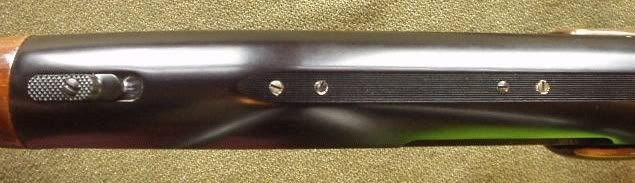
As you can see it is drilled and tapped for a top mount scope. this would be right handy if you could get better accuracy out of the gun. Now, I'm not particularly trigger sensitive but this one likely doesn't help much. I also don't think a scope helps a lot at 50 yards but then I've done a lot of shooting with open sights. I'd lean more towards a big ghost peep on the gun and have a Williams 5D for the purpose but never got around to installation. Rifles being permissable for big game, this shotgun just hasn't seen a lot of use.

You can also see the tang safety. Now that is handy. Right under the thumb this is one fast gun to bring into action.

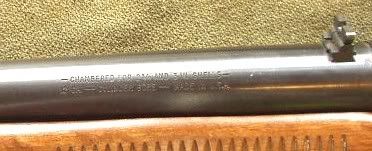
The Barrel marks are pretty standard. It is good to know that I can run the 3" maggie Brennekes through this gun. Those things are about as good as it gets in a 12 gauge smooth barrel. It also might help some with the low shot density due to the non-existant choke. Not much though. The recoil? It can influence your decision to pull the trigger. I've shot this one off the bench. After that, shooting from position was nothing!

All in all this is a pretty good gun, of Mossberg's usual workman quality but likely not as expensive when purchased new and capable of meeting most hunting requirements in VA. this is one I can't sell as if my friend wants it back, back it goes.

Tuesday, February 27, 2007

True-Test 16 Gauge Side by Side


This was Dad's shotgun, his almost only gun, for many years. As nearly as I can tell, he bought the gun shortly after his first discharge from the army in 1947. He used it to hunt grouse, shoot skeet (what we call international style now), as a prop when on the Forest Service float and maybe hunt deer. It is virtually unchanged from when he bought it, used, from somebody in the Cooperstown, NY area. The only thing that I've done is to replace the broken bead with a Pachmayr red-dot bead. I'll likely get a proper brass bead and replace that as well. The Pachmayr unit just doesn't look right.

The gun was made for True-Test, a hardware supplier, by Savage or Stevens and as it was used (even abused as we shall see), it was probably made pre-war. Consequently, quality is pretty good even for a bottom of the line double.

The 16 gauge was once very much more popular than now. It is still popular in Europe. Great as an all-arounder where lead shot is still permissable, this cartridge can be chambered in guns lighter than the 12s and not much heavier than a 20 but with more oomph than the 20. I guess this gun served Dad well for many years and was worth every dollar he paid.

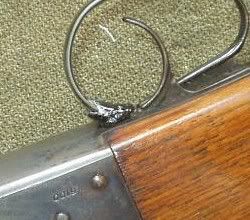
Interestingly, when he bought the gun it probably already had the trigger guard repair seen in the photo to the left. This is pretty interesting. I don't know exactly how it is broken. The Stevens guns I've seen (like my 20 gauge) have the front of the trigger guard bow screwed to the receiver. I can't see how this was attached but it is now imbedded in a wad of solder which has been painted black. If this was done before Dad bought the gun the repair certainly has held up well. Dad took it hunting for grouse, woodcock, and dove and it was moved in household goods at least 18 times!

This photo shows the "5100" mark on the right side of the receiver.This is the model number.

You can also see that the color case has survived pretty well. I think this is remarkable because Dad told me that he shot 100s of rounds of skeet with the shotgun. Apparently this was his passion right after he got out of the service. I wonder if he got interested while stationed in Italy (1945-47). I think that all that frivolity ended when he was accepted to Syracuse University in 1949 or 1950. With all the use I would have expected more wear. in any event there was no more skeet shooting until he took me to the skeet field when I was 14, in 1969. I often say that we loaded 50,000+ shotshells for skeet but who knows how many more than those 50K. He really enjoyed himself on the range. Good times.

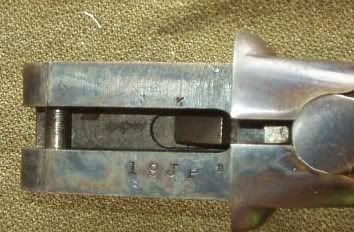
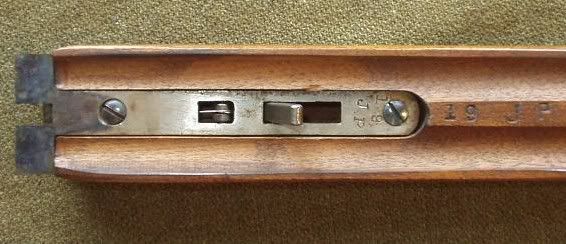
The water table is pretty much bereft of information. Only the stamp "19JP" (a serial) which I think is no more than an assembly mark. It also appears on the forearm and barrels breach. I don't know what the "K" means. The color case is very good here on this protected portion of the gun and this level of preservation is expected.

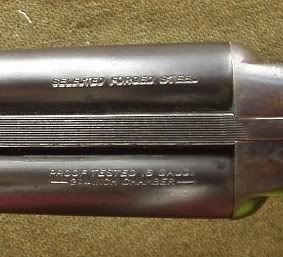
These marks on the barrels are important mainly in that it shows that the gun is chambered for the modern version of the 16 ga. shell, the 2-3/4" version. That's a real relief. Many guns have had their chambers lengthened, most with satisfactory results, but some are a bit dodgy. I'm just glad I can pick up ammo anywhere for this gun. Well, almost anywhere the 16 isn't all that popular in the US. Still, if all else fails you can get ammo on-line.

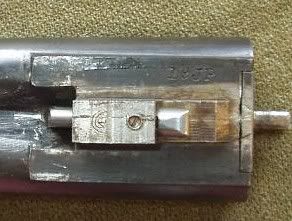
The breech marks aren't all that telling. Surprising to me is the "19JP" is here as well. Again, I don't think this is a serial but rather an assembly mark to keep all the parts for this particular shotgun together in this lot of shotguns for Tru-Test. The lump is also marked but the I think it is an incomplete stamp. It appears to be an oval with a "P" at the top but the mark fades towards the bottom (rear of the lump). There are no other marks.

The forearm is also marked "19JP" but the mark is more spread apart which is one reason I think that this is an assembly mark rather than a serial number. The mark appears on both the wood and the iron. That is the only mark on the forearm.

The wood on this gun, like my 20 ga., was refinished about 1971. As I remember it the original (?) finish was a varnish and had worn away in some places. The Tru-Oil finish we gave it back then has held up very well indeed. The pistol grip is very full with a tight radius. It has a much different feel than the Stevens 20 ga.

I did an internet search for history on the Tru-Test but found nothing but other guns and my own blog. That's a bit disappointing. If anyone knows anything about the Tru-Test gun purchases or can point me to a reference book, please do so by writing me.

Monday, February 26, 2007

My Bolt Action Shotgun


I present for your approval one each bolt action shotgun, made for Montgomery Wards, in .410 bore and that before the 3" .410 was at all widely accepted. This gun was bought (used I think) by Grandpa and Dad used it to kill his first squirrel. There's a pic of him with the gun, somewhere.

For certain this gun will win no awards for beauty, grace, or style, but it is a dependable gun having been in use for about 80 years. Made at a time when serial numbers weren't required and guns like this were basic commodities, this gun has no serial. Never transferred, it has never needed one. Again, it has the 2-1/2" chamber but I know that Grandpa used 3" shells in it. He said it kicked a bit more and that it wouldn't feed from the magazine. Feeds just fine with the 2-1/2" stuff of course. The story of this gun is intimately involved with that of the .410 bore cartridge.

The .410 bore, often incorrectly called ".410 gauge", is the smallest commonly available shotgun shell. .410 is the only popular shotgun cartridge named by bore rather than gauge, leading to some confusion. Base dimensions are roughly similar to the .45 Colt revolver cartridge but it is up to 3 inches in length which allows many single-shot firearms (such as the Thompson-Center Contender) and some revolvers (like the Taurus) chambered in .410 to use .45 Colt ammo. Many years ago it was also called the 36 gauge, Remington boxes of these shells can be found marked "(36 GA.) .410-2 1/2 IN. (12 MM)." However, the "36 Gauge" designation was very inaccurate, as a true 36 gauge gun would actually have a .506 inch bore diameter. They are available in 2 1/2 inch length containing 1/2 ounce of shot, and 3 inch length with 11/16 ounce of shot. The high brass 3 inch shell used to contain 3/4 ounce of shot, but was reduced to 11/16 ounce a few years ago. There is also a 1/5 ounce (around 86 grains) Foster type rifled slug load available for the .410 shotgun with a velocity of 1830 fps.

About 1904 the cartridge makes its appearance in catalogs and English proof houses. No one today knows who invented it. There is a good amount of speculation that the .410 was originally a rifle caliber, similar to the .444 Marlin. This might well be true, due to the rather recent discovery of older "rook rifles" that were originally rifles that were converted to shotgun use. The .410 shotshells originally came as a 2 inch cartridge. As time went on, the shell was expanded to 2 1/2 inches and a 3 inch cartridge, which was a move to accommodate more shot. With such a small shot charge, the .410 was originally intended to be a taxidermist's gun and "pot shooter". A pot shooter was a gun used to gather meat for the family pot. Again, since the shot charge was so small, there were less pellets that would damage the meat or specimen. What changed all of this was the recreational activity of skeet shooting. Skeet shooting is a clay target game shot with shotguns. As the game became more and more popular, the .410's success was assured.

I believe my gun was made for Montgomery Wards (now defunct but a long time mail order business) by Mossberg. You will see the similarities between this shotgun and the Model 40 rifle I have. Both use the same action albeit modified for the particular application. The 25-1/2" barrel on the gun is unmodified. You can see that rust has been present in the past. The front sight is a bead and there is a rear sight in the form of a broad "U". As you can see in the photo to the left, there is a strong crack in the stock. I don't know that this comes from shooting as this is an unstressed portion of the stock.

The action is extremely simple, locking with the bolt handle root and using a single strong spring as the ejector as you can see in this photo of the action from the top. The single-column magazine holds just 2 more rounds. With one in the chamber, this is a 3 shooter, max legal capacity for shotguns used on migratory game for a long time now. As I said before it is chambered for the 2-1/2" shell. While my grandpa shot 3" shells in it I don't suggest that anyone else do the same and I've accumulated some 2-1/2" ammo specifically for the gun. The safety is simplicity, one simply turns the big knob on the striker so that the hook on it engages in the receiver for safe, out for fire as shown in this last photo.


Links:
The mythical 36 gauge
Chuck Hawks