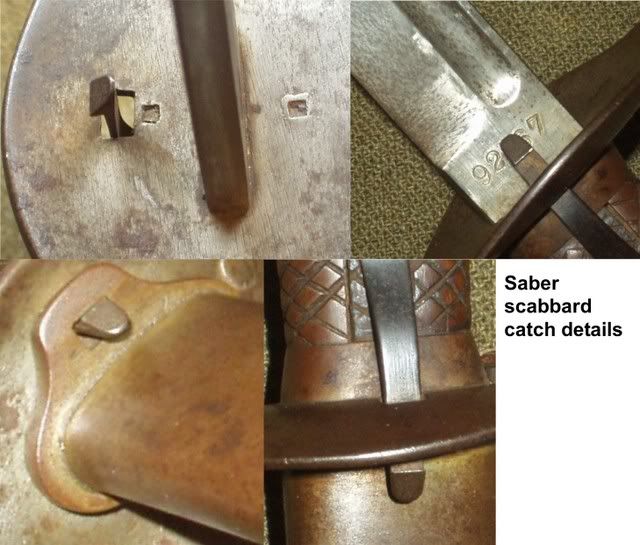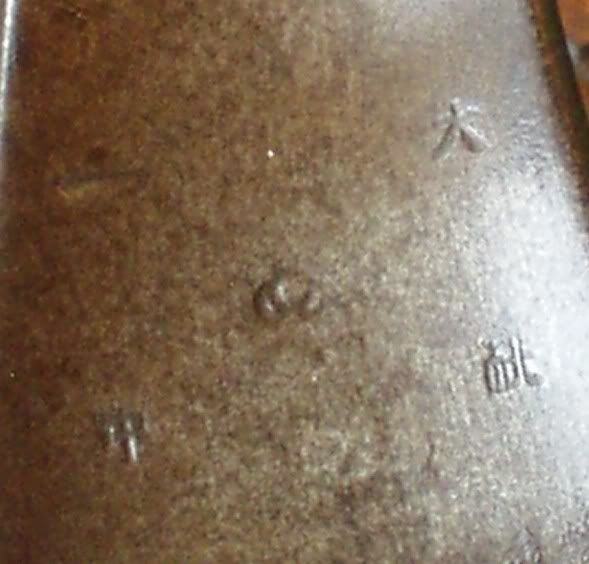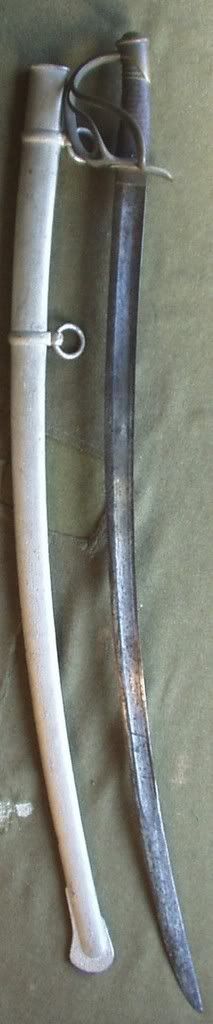
Another of "Uncle" Dave's treasures, this 1840 "Heavy" Cavalry Saber was apparently purchased by him from some surplus dealer perhaps Bannerman. For some reason I seem to remember some connection to Bannerman. This isn't outlandish as "Uncle" Dave lived upstate from New York City and Bannerman's Castle. I was shocked to discover this sword might be worth about $1200-1500!
I used to have many Walter Mitty type adventures when I was 12 or so. Just looking at that sword hanging on my bedroom wall would take me to places far away and exciting! I think that "Uncle" Dave felt the same way and that is how he was subtly portrayed by family members. I guess you had to be a bit of a spendthrift, not common in my family, to spend money on new guns and old swords! We might not be related but he seems very familiar to me for some reason.
Ames Mfg. Co.
The Ames Company started production of military contract swords in 1832 with the M1832 foot artillery sword, and ended with the M1906 cavalry saber in 1906. Ames produced more swords for the American military than any other company before or since, totalling over 200,000 swords in service by the end of the Civil War. In that time, at least ten different manufacturing marks were used on the swords. A little knowledge of the company history helps place a date range for when each stamp was used. When the company started producing swords it was led by Nathan P. Ames, and most marks reflected that fact. In 1847, Nathan died and left the company to his brother James. The markings on the blades were immediately changed from N.P. Ames to Ames Mfg. Co. In 1848, the town of Cabotville was incorporated into Chicopee, Massachusetts, and the marks were once again changed to reflect this. I have, however, seen blades dated as late as 1850 that still bear the Cabotville stamp, as the old dies were probably used until they were worn out.
The M1832 foot artillery swords, being Ames's first swords, were stamped with the eagle trademark already common on their other products. The attached picture shows most of the important details of the sword, except for the fact that the scabbard stud appears to have been removed and two carrying rings were attached. I have also observed several examples dated 1835 that do not bear an inspector’s initials on the blade. In most cases the marks will show some wear from being rubbed by the scabbard, and may be partially or mostly obliterated. Dates found on this sword range from 1832 to 1862, and I have included pictures of swords from every decade included in that span. The early models of this sword were marked as having been made in Springfield instead of Cabotville. The M1841 cutlass (dated 1842-1846) is the only other military issue Ames sword marked this way. The cutlass has been seen to list either the Springfield or Cabotville address, although these swords lack the eagle mark.
Ames’ second contract was for the M1833 dragoon saber. A rather clumsy weapon, it was quickly replaced. The marks on this saber appear to have actually been engraved into the blades, rather than stamped. In cursive script, they read N.P. Ames/Cutler/Springfield/year, and are dated from 1834 to 1839.
The 1840 models of cavalry, NCO, light artillery, and musician swords tend to have identical styles of marks for corresponding years. This trend continues when the 1860 models of cutlass and cavalry saber are introduced. The 1840 models’ were originally marked with N.P. Ames/Cabotville/date in the 1840s, followed by Ames Mfg. Co. /Cabotville/date around 1847, then by Ames Mfg. Co/Chicoppee/Mass in the 1850s. The latter mark was also used through the Civil war on some cavalry sabers. Sometime in the late 1850s (the earliest I have seen was 1859), Ames started using a new mark on all enlisted models that was carried through the Civil War. The words Made by/Ames Mfg. Co/Chicopee/Mass are enclosed within an unraveled scroll, and initials/US/date is stamped on the opposite side of the blade. This scroll mark is usually very weak, and often has been partially worn down by the scabbard—this is a feature that helps in authenticating the sword. I have also seen one other Ames mark, which I've seen repeatedly, but only on M1860 cavalry sabers dated 1864. The mark is shaped like an arc with the words Ames Mfg. Co/Chicopee,/Mass.
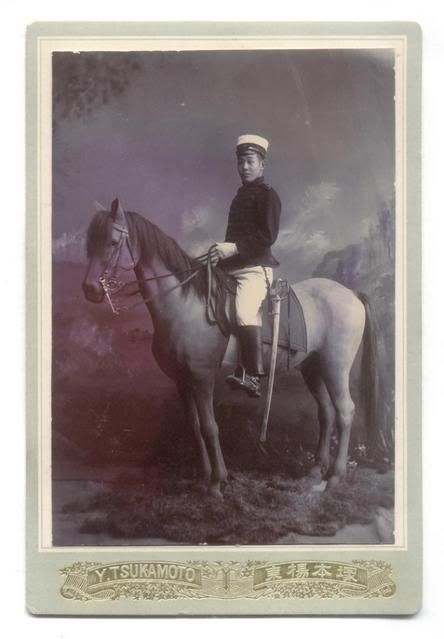
This is the sword that comes to mind when one imagines the illustrious cavalry charges of the Civil War. This sword was used in the US from 1840 through the Mexican War, the Civil War, and finally the Plains Indian Wars of the 1870's and 1880's. The sword was not loved by the Cavalry - officers and troopers alike - and earned the name "The Ole Wrist Breaker". The weight of the sword gave the impression that, when wielded strongly in a downward stroke, the momentum developed could not be slowed by the frail human wrist; therefore "breaking the wrist"! It replaced the US Model 1833 "Dragoon" Saber.
The "Light" Cavalry Saber of 1860 (aka New Model) was meant to replace the 1840 Heavy Cavalry, but this was not to come until long after the Civil War. The designations Heavy and Light do not necessarily refer to the weight of the sword; they do, in fact, refer to the "shock" impact delivered during a "charge". A Heavy Cavalry unit was more "heavily armed" whereas a Light Cavalry unit was "lightly" armed.
This sword, by far, is one of the most pleasing to own and display.
The specimen that I have is of brass hilt construction, with brown (almost black) leather-wrapped grip, and twisted brass retaining wire.
The Model 1840 is another derivation from French patterns - likely the Modele 1822 Cavelerie - and there are many variations (mainly imports), with some having iron hilts (forged steel) finished "in the black".