Got to shoot today so took the nickeled S&W M34. Shot over 75 rounds, maybe as many as 100 rounds being a mix of 20-year old Federal HVHPs and Winchester Dynapoints and new Federal HVHP. I was surprised to find that the Federal, old or new, required a slight push to fully seat in the cylinder and would drag on the recoil shield sometimes very badly. The Dynapoints dropped right into the chamber and didn't drag at all. I guess this will ensure the Dynapoints get designated for this gun.
Also shot the Browning 1911-22. That gun is about the best one I have to shoot up that old Russian Junior ammo. It seems to love that ammo. Doesn't do badly with the Federal or Dynapoints either. For such a little gun it is pretty accurate. I think it will shoot better than I can shoot it right now. The small sights are a real challenge for me.
After having difficulties with the open sights on the 34 and 1911-22 I thought I would go back to my Tactical Solutions conversion on Combat Commander frame. This has a Burris Fastfire mounted. I think that sight is great for seeing a sight but it doesn't seem to easily give me much precision. While I could hit a head sized target at 50 yards I couldn't tell you where I would hit it. The target looked more like it had suffered several strikes from #4 buck than having been shot with a precision firearm.
When I got there a buddy (he's 75) was shooting his Rock Island .22 TCM. He has 2, one with the 5" barrel and one with a 4¼" barrel. John is a very experienced reloader. He says that he is having problems finding a bullet that is accurate in his reloads. He has tried several. The 5" barrel keyholes! If I understood correctly, I don't think it does this with factory ammo though. He was shooting at a measured 27 yards. His groups were in the 2½-3" range.
Showing posts with label SmithandWesson. Show all posts
Showing posts with label SmithandWesson. Show all posts
Thursday, June 04, 2015

Thursday, May 21, 2015
Smith & Wesson customer service, repair service and a Model 34...
Hard to believe but about 8-years ago I bought a nickeled, Smith and Wesson Model 34 2-inch. While I shot it a bit I held back on my posts as I tried to work out some problems I had with the gun. It may have extracted a bit harder than it should with a couple of different loads but more importantly, to the point that any other problems were completely overshadowed, was that after a couple of cylinders full the cylinder was almost impossible to turn at one point. A not so close examination of the outside of the cylinder showed that there was one point on the outside circumference of the cylinder face was just rubbing the barrel root and this was exacerbated by the buildup of powder residue. After some pondering and the natural distractions of life I decided it would be best to have Smith and Wesson do the repair. I contacted them and got some information on how to send the gun and packed it. Then something else came up and I was further delayed. Another attempt was in order and so off went another e-mail to verify the previous instructions which were now a couple of years old.
I had been trying to get S&W to communicate with me for a couple of weeks on how to get this revolver repaired before finally receiving a message that indicated that they would send a call tag for it. I followed up with S&W on March 3 but didn't hear back from them for a couple of weeks. On my birthday I got the gun shipped to Smith and Wesson via FEDEX. April 25th I received a bill, in the mail, for the charges for evaluation of my revolver ($58.00). Saturday I got notice it had been shipped and they tried to deliver it today but I'll have to wait until Thursday to get it. Communication has been pretty much non-existent on their part unless asking for money. The folks at S&W never bother to let me know what was wrong, work that needed to be done, etc. It was 2-days shy of 2-months since I sent the gun to them.
The gun was FINALLY delivered today after a week of missed meetings, etc. The crane definitely has a changed relationship to the frame and the cylinder has the same relationship to the barrel through a complete rotation. I'm betting I was right about the bent crane. Of course I had to test fire the gun. Then, aw heck, cases stick! Out comes the chamber iron and all is now well. Well, except it shoots a bit high at 21 feet. We'll work that out later. Some of that is probably the nickeled front sight against the particular target. I'm breathing a little easier now. 2 months from first contact with S&W to having the gun back in my hands. No charge aside from the evaluation.
Wednesday, January 29, 2014
Smith and Wesson K-22 Masterpiece
 |
| K-22 Masterpiece dated to 1948 with box |
Production of the .22 on the M&P frame began in 1930 right at the beginning of the Great Depression.This would seem to be a bad time to introduce a high-quality handgun with a premium price. Christened the K-22 Outdoorsman in 1931, that revolver is now referred to as the K-22 First Model, and knowledgeable shooters and military and police training programs eagerly bought the revolver.
Original specifications were for a six-shot, K-frame revolver with a 6-inch round barrel, Circassian walnut grips and a Smith & Wesson medallion. Single-action trigger pulls were regulated to be 3 to 4 pounds. The 35-ounce revolver was guaranteed to shoot within 1 1/2 inches at 50 yards. The last of 17,117 K-22 First Models left the factory on 28 December 1939.
The new, improved K-22 Masterpiece replaced the First Model. Improvements included a shorter, faster action, a new micrometer-adjustable rear sight and a built-in, anti-backlash trigger. Despite the price of $40, quite a lot of money at that time, the revolver sold well. Unfortunately war was coming and Smith & Wesson had to redirect its resources and production efforts to supplying the British with M&P revolvers chambered in .38/200. Only 1,067 Second Models (collectors’ nomenclature) were produced in 1940 before all production efforts went to support World War II.
After the war, consumer desire for the K-22 made it clear that there was going to be a long-term demand for a quality rimfire revolver. Carl Hellstrom was first hired by the Wesson family in 1939 as shop superintendent then took over as president of Smith & Wesson in 1946 immediately after which he started implementing some cost-saving practices to the production line, as well as design improvements to individual products. Among those changes were the installation of a ribbed barrel on all K-frame target models—which swelled the weight of the new iteration to 38.5 ounces—with a new micrometer-click adjustable sight that did not have to be polished and was even to the frame, and a new anti-backlash trigger that no longer required the tedious and time-consuming fitting of the first Masterpiece series. The Masterpiece nomenclature was retained, partly because it was popular and partly because Smith & Wesson truly believed that it had produced a masterpiece revolver.
In 1949, a 4-inch barrel version, the K-22 Combat Masterpiece was introduced. Later it was to be called the Model 18. It was a great little trail gun, but sales paled compared to the 6-inch barrel version, and it was discontinued in 1985. My first K-22 was a 4-inch which I still have. I really enjoy squirrel hunting with it as well as range time. It is a great companion gun.
 |
| K-22 with Tactical Solutions conversion on Combat Commander frame |
Thursday, May 23, 2013
At the range with the Smith and Wesson Model 1905 4th change...
 |
| 1905 4th change with issue stocks |
When I got out there one of the other members was just cleaning up on the pistol range, another was mowing and two were up on the rifle range changing targets. I took advantage of the situation to get these two targets set up on the same frame and to put the frame out. I carefully measured the distance using my laser rangefinder and took a position at 15 yards.
I can often get within 15 yards of a squirrel and have done with this gun but I've only managed to bring one to bag. While plinking at dirt clods and fist size rocks made me think the gun had some potential left I had some doubt as to my actual ability to hit anything with it. I have some worries about my various eye issues (bifocals and developing cataracts) affecting my ability to sight accurately.
Taking my ammo can to the firing point I started shooting. Double action only on the right target and single action only on the left target, I alternated right to left for 8 cylinderfulls on each target, i.e. 48 rounds each. You will not see 48 bullet holes on each target. I used the 6 o'clock hold and this gun shoots a mite low with this load. Again, I should note that the sun was behind me but the sight reflected quite a bit of light and I often lost it in the rear sight.
 |
| Both targets on the range backer. Note the .30-something holes below the targets. |
After shooting I was looking at the targets and noticed that the bullet holes were dispersed very similarly no matter that I'd been shooting all DA on the right and SA on the left. So, I thought I'd try an experiment. Using the photo-editor software I clipped the two targets from the original photo, made the right or DA target 50% transparent and then overlayed the DA target on the SA target. The result is that you can see how some groups get bigger and, again, how little difference there was in using the two methods of shooting.
 |
| DA target overlayed on the SA target. |
Please note that while I matched up the center rings pretty well, there is a bit of "parallax" due to the original picture being centered between the targets. However, one can see all the shots recorded on both targets at one time. I thought it was pretty interesting.
I still like this gun. I might have to find a better example though, this one is pretty rough indeed.
Wednesday, August 22, 2012
Out to the range..
I went shooting yesterday with the 4" Outdoorsman (pre model 18), Colt Police Positive Target and Browning 1911-22. All ammo used was the Remington Golden bullet. I wanted to see if it shot close enough to the sights to be usable for squirrel hunting. After I get rid of this stuff, I have about 700 rounds remaining, I'm going to go back to the Winchester Power Points. I've ordered another case of that, just in case. Shooting at 7 and 10 yards (on the same target for each pistol), I shot at standard 25 yard pistol target centers. 7 yards is about the closest I can get to a wild squirrel and 10 yards is about average for my handgun squirrel kills. I used to think that I was quite a bit further but, after actually pacing off the distances, I found that I was getting quite a bit closer than I'd thought. Here's the results.
The first target is for the Colt. I had problem seeing the sights on all these guns but this less so than the others. As I write this I have developing cataracts and wear progressive bifocals. I hadn't thought that I was having problems, but I did yesterday. We'll just have to wait and see how this pans out. As you can see, even this bulk ammo was capable of pretty good accuracy from this revolver but was shooting a bit to the left. Not a problem to correct as the revolver has a windage adjustable rear sight, but I lacked the proper screwdriver to permit a sight change while I was at the range.


The first target is for the Colt. I had problem seeing the sights on all these guns but this less so than the others. As I write this I have developing cataracts and wear progressive bifocals. I hadn't thought that I was having problems, but I did yesterday. We'll just have to wait and see how this pans out. As you can see, even this bulk ammo was capable of pretty good accuracy from this revolver but was shooting a bit to the left. Not a problem to correct as the revolver has a windage adjustable rear sight, but I lacked the proper screwdriver to permit a sight change while I was at the range.

Then we have the target for the 4" Outdoorsman. The gun was sold to me as a Model 18 but isn't marked as such. Thus, it is a pre-18 or Outdoorsman as they were called. This one has a 4" barrel and has been much worked on. I was told that it would shoot, and I think it does shoot well. I was interrupted on the range and so lost track of where I was and switched pistols before I'd shot the allotted 30 rounds.

Lastly we have the target for the Browning 1911-22. These are cute little guns. Little is the operative word here. They are 85% of the size of a full-sized 1911 but they are also mostly of aluminum and so light as can be. The sights are also 85% of the original size making them pretty darn tiny. This pistol seems to me to fit into the "kit gun" category. It wants to group but properly seeing and aligning the sights seems difficult to me. I think it could work for squirrel hunting but I need more practice.

Thursday, July 26, 2012
Smith and Wesson Model 18
The Smith and Wesson Model 18 is a 4-inch barreled, blued steel, double action revolver, with adjustable open sights, and chambered for the .22 Long Rifle cartridge. the cylinder has six chambers. This is a .22 caliber version of the Model 15 Combat Masterpiece revolver. It has been popular as a training weapon for those who carried .38 Special and larger caliber revolvers because the Model 18 operates and handles the same way but uses low-recoil, inexpensive .22 rimfire ammunition.
I seem to have gotten on a .22 rimfire kick lately. When John M_____ let it be known that he was going to sell his gunsmith refined Model 18 I was interested but a bit hesitant to get yet another .22 pistol. Eventually I broke down and bought this revolver.
The serial is 211xxx, tapered bbl, raised rib, earlier and correct hammer. The 'smith, Charlie Thompson, does 'Camp Perry' level work. The gun was re-manufactured by Charlie to about zero working-allowance tolerances. The action is not too light, or 'target only' light as Thompson calls it. It has a new white outline rear sight.
Friday, May 06, 2011
Smith and Wesson Model 624
 |
| S&W M624 |
This makes my 5th .44 Special revolver but it is the only double action gun in which I would feel comfortable using the Skeeter load. I think the smaller L-frame 696 should be preserved with a slightly lighter load and it is certainly more pleasant to shoot that way.
I didn't get the box or papers with this gun but it should still hold its value well. I don't yet know whether or not I like the finger groove grips but they are original.
All of the Lew Horton guns had the serial prefix of "AHW" and this gun is an "ALV" which, interestingly enough, isn't listed for date in the 3d edition of the standard catalog. However one can easily see that this gun has no lock or MIM parts and uses the hammer mounted firing pin.
 |
| S&W 624 in Galco Holster |
I did get to shoot it some a couple of days ago and it did pretty well with the Winchester Silvertip load (which was very mild in recoil) and the "Skeeter Skelton" load of 7.5 gr. Unique under the 250 gr. Keith bullet. That last was clearly not a pussy cat but the recoil is very manageable and will be even more so with practice.
 |
| M624 with new shoes, Skeeter load and Silvertips |
A bit of an addendum... The following information was provided by a very thoughtful reader:
According to Skelton's ST article (10/85), here are the recall SN ranges for the Model 624 recall:
ADXXXX
AEXXXX
AFXXXX
AGXXXX
AHXXXX
ALVXXX (the “V” is not a typo)
N910000 thru N953000
Saturday, February 05, 2011
.45 Auto Rim

Since I bought my 25-2 Jovino Effector type revolver from my friend John H_____ I've been considering using the .45 AR for the first cylinder full in daily carry. I've been most interested in use of the 250 grain Keith bullet.
To start I bought a box of loaded .45 AR at a gun show and then ordered 200 pieces of Starline brass. I quickly found it necessary to order a roll-crimp seating die for my die set in order to properly crimp the Keith type bullets. It was also necessary to order the shell holders for both the press and the Lee AutoPrime due to the Auto Rim's unique rim thickness. It simply isn't practical to use or modify anything else. I have a lot of Unique because I use it in a lot of cartridges (.32 S&W, .38 Special, .41 Magnum, .44 Special, .44 Magnum, .45 Colt) so that is what I want to use. It would be reasonable to use some others like Universal, W231/HP38, PowerPistol and such but I'm going to start with Unique and change only if I can't get the performance I want.
| Bullet | Weight | Powder | Weight | Velocity | Energy |
| Keith | 255 gr. | Unique | 7.0 gr. | unknown | unknown |
| Keith | 255 gr. | W231 or HP38 | 6.0 gr. | unknown | unknown |
| FMJRN | 230 gr. | Unique | 6.5 gr. | unknown | unknown |
Links:
- Corbon .45 Auto Rim 160-gr. DPX at Highpowers and Handguns
- SMITH & WESSON'S 625-2 .45 AUTO RIM by JOHN TAFFIN
Wednesday, November 24, 2010
DeeBee's 34-1 - A Parkerized Wonder
 What a neat gun. It apparently has none of the problems my nickeled 34-1 has. The parkerization appeals to me even though I think I'll still want to get a blued and a stainless (Model 63) gun. It seems business like.
The first shooting with the gun was at about 20 feet with Aguila Colibris. You could have covered that group with a dime. Unfortunately it was a good 3 inches to the right. Further shooting in better light showed that the gun was shooting to the sights. Better light was the key here.
 I like the way this gun shoots and handles. The square grip does make a difference. You wouldn't think so but the square grip makes it feel like an entirely different firearm compared to the round butt.
One other good thing about getting this gun was that it pointed up a problem with my other 34-1. It has a problem with the cylinder binding on the barrel face. This older and re-finished gun has no such problem.
Tuesday, October 19, 2010
The Smith and Wesson Model 15-2
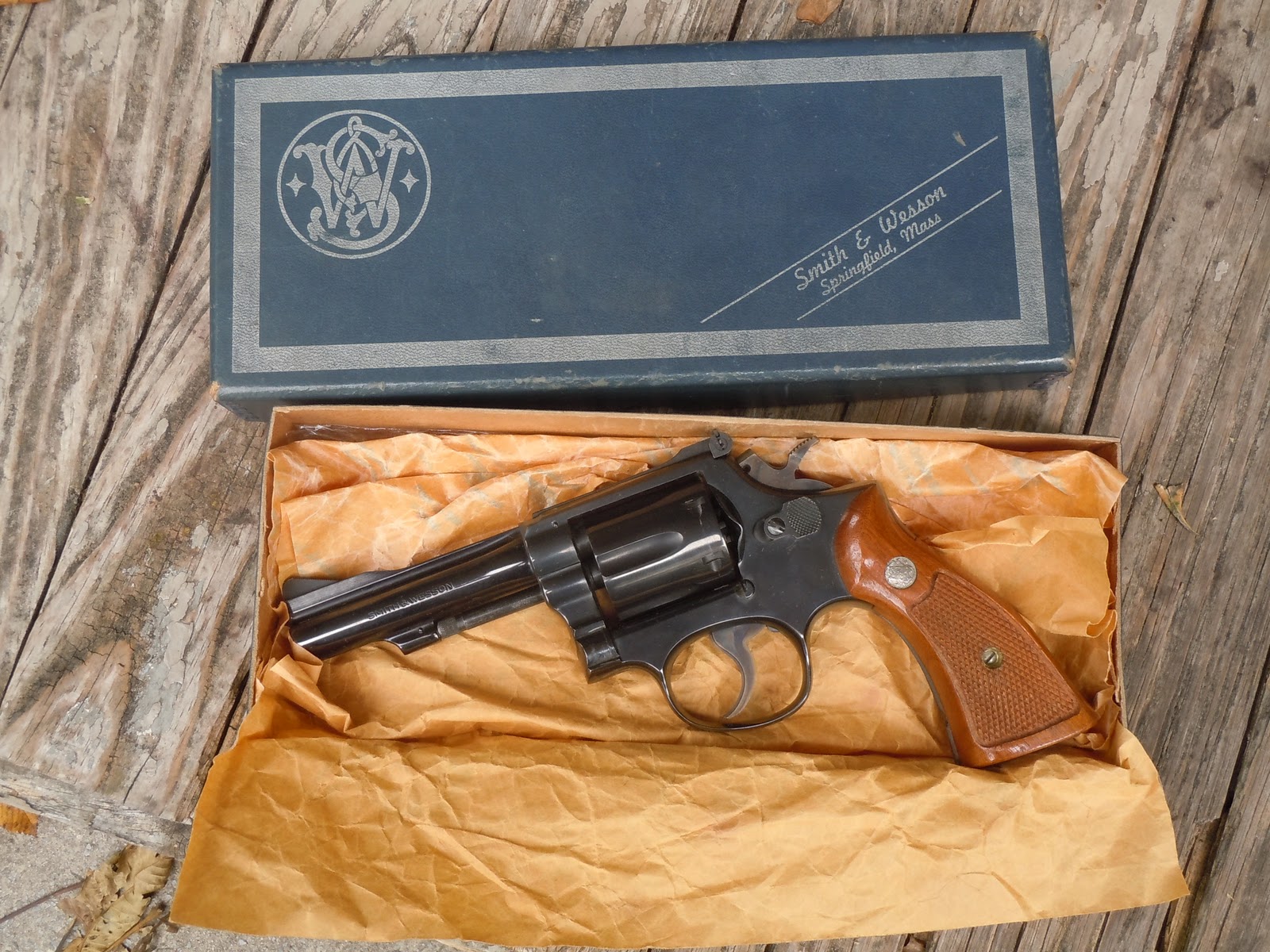
These aren't exactly the most sought after of firearms. They don't have the aura of the Colt Python. They aren't chambered for some whiz-bang cartridge. They are good solid working guns most people can handle and which fill most needs. Chambered for the now mundane .38 Special cartridge, these guns can't generate the excitement that comes with superior ballistic output. This one is special because it is NEW IN BOX. Apparently never fired, in the box with the tools. Yes, I'm thinking about shooting it.
What's the value? That's a question one must answer for many reasons including insurance. I think that such a gun could fetch $500 or more in the right market. I imagine that shooting it will lower the resale value. However, what is the value to me if it just sits in the safe?
Wednesday, September 22, 2010
S&W 1905
Smith & Wesson early K-frame models, identified by caliber/serial number
32/20 Hand Ejector First Model (1899), manufactured 1899-1902, serial numbers 1-5,331.
32/20 Hand Ejector Second Model (1902), manufactured 1902-1903, serial numbers 5,332-9,811.
32/20 Hand Ejector Model 1902 1st change, manufactured 1903-1905, serial numbers 9,812-18,125.
32/20 Hand Ejector Model 1905, manufactured 1905-1906, serial numbers 18,126-22,426.
32/20 Hand Ejector Model 1905 1st change, manufactured 1906-190?*, serial numbers 22,427-33,500*.
* factory records to do show exactly when 1905 1st change ended and 2nd change began.
32/20 Hand Ejector Model 1905 2nd change, manufactured 190?*-1909, serial numbers 33,501*-45,200.
32/20 Hand Ejector Model 1905 3rd change, manufactured 1909-1915, serial numbers 45,201-65,700.
32/20 Hand Ejector Model 1905 4th change, manufactured 1915-1940, serial numbers 65,701-144,684.
.38 Hand Ejector First Model (1899), manufactured 1899-1902, serial numbers 1-20,975.
.38 Hand Ejector 2nd Model (1902), manufactured 1903-1905, serial numbers 20,976-33,803.
.38 Hand Ejector Model 1902 1st change, manufactured 1902-1903, serial numbers 33,804-62,449.
.38 Hand Ejector Model 1905, manufactured 1905-1906, serial numbers 62,450-73,250.
.38 Hand Ejector Model 1905 1st change, manufactured 1906-190?*, serial numbers 73,251-.
* factory records do not show exactly when 1905 1st change ended and 2nd change began.
.38 Hand Ejector Model 1905 2nd change, manufactured 190?-1909*, serial numbers -146,899.
.38 Hand Ejector Model 1905 3rd change, manufactured 1909-1915, serial numbers 146,900-241,703.
.38 Hand Ejector Model 1905 4th change, manufactured 1915-1942, serial numbers 241,703-see notes 1905 4th change.
K-22 1st Model Outdoorsman, 19,500 manufactured 1930-1940, between serial numbers 632,132 - 682,419 in the .38 Hand Ejector series.
K-22 2nd Model Masterpiece, 1,067 manufactured 1940-1942, between serial numbers 682,420 - 696,952 in the .38 Hand Ejector series.
K-32 Hand Ejector First Model, 83 manufactured 1936-1941, between serial numbers 653,388-682,207 in the .38 Hand Ejector series.
Wednesday, July 21, 2010
Smith and Wesson Model 1905, 4th Change

This one is particularly "finish challenged". The original blue is missing from most surfaces and it has been replaced with a hopeful mix of bare steel and oil/steelwool removed patches of former rust. What little original blue remains is only a tease to tempt you to think what might have been nearly 100 years ago. The grips, mostly intact but for one split toe, are worn mostly smooth from use. The barrel is loose/can be turned by hand but held mostly in the correct position by the pin. To look at it it is a real dog of a revolver.

Last night's rather speedy foray at Mom's shooting facility (her pasture) gave me 3 hits in a row on a 6" square cinderblock face at about 75 yards, manually cocked off-hand. It had me fooled at first, I shot over the target! This thing shoots flat.
The ammunition used was a bonus. Several months ago, I bought several hundred rounds of .32 WCF from Jim ______ when he was moving from Missouri to Mozambique. Among those were a quantity of handloads using pistol primers. I intended to use the ammo in my 1894CL but discovered that the Marlin's firing pin was a hair short to ignite the pistol primers used in these loads. I have no such problem with this gun, and likely all that ammo will be shot up in this revolver.
Recoil is extremely mild as is the report. I bet this is one reason why the .32 WCF was so popular in both pistols and rifles "back in the day". Certainly it was worth what I have in it. I'm well pleased with this "ugly duckling".
Of course, Tam's is much nicer!
07/25/2010
Jim's load was 3.0 gr. Bullseye under the Lyman 3118 bullet. It is a mild load that still has oomph enough to deform the cast bullets when fired into a soft dirt bank at 60 yards or so. It is also accurate enough to take on Mr. Groundhog should he come out to play. I was plinking with it some at Mom's today. Not too hard to hit stuff the rather fine sights notwithstanding. The light does have to be right though. Recoil is inconsequential with this load. I've got lots more to shoot!
I then found out that Xavier had a 1905 4th change .32 WCF with some interesting marks. As you can see my gun does NOT have the "Made in U.S.A." mark and I suppose it should not be expected to. It certainly isn't worth $400 either!
Thursday, May 27, 2010
Smith and Wesson K-Frame Model 66-7
 |
| The Model 66-7 2½-inch |
Smith and Wesson apparently worked these over well as they are tight as a tick, timed right and every one of them has the 2 piece barrels. I thought the counter-bore might have been done to repair muzzle crown damage from cleaning but this is the manufacture method used on the 66-7. They have the lock (which you could see in my original photo) but did not come with the key nor did any literature accompany them.
When I got it it had the original Hogue grips. They are entirely too long but apparently that police agency used the same grips on all their revolvers. Every one of them I've seen has the grips, 2½ or 4-inch it doesn't matter. Anyway, I replaced those with a pair of wood stocks that were previously received in trade. They fit well enough, are more compact, and don't stick to my clothing or make me nauseous.
I had the gun up to Mom's and shot 3 cylinders full of my .38 Special load of the 158 gr. Speer swaged HP over 5 gr. Unique. Worked a treat. These tensioned 2-piece barrels apparently have quite a good reputation for accuracy.
The two piece barrel was developed by Herb Belin, S&W Handgun Product Manager for the X-Frame 500 to add strength for the big new cartridge it fires. A conventional S&W barrel is supported only at the barrel/frame interface with a crush fit while the two piece is supported at both ends. Since the interface at the forcing cone is not stressed it is also stronger there. The better accuracy is an additional benefit.
 |
| Muzzle View - 2-piece Barrel |

Friday, January 22, 2010
Has this story been told before?
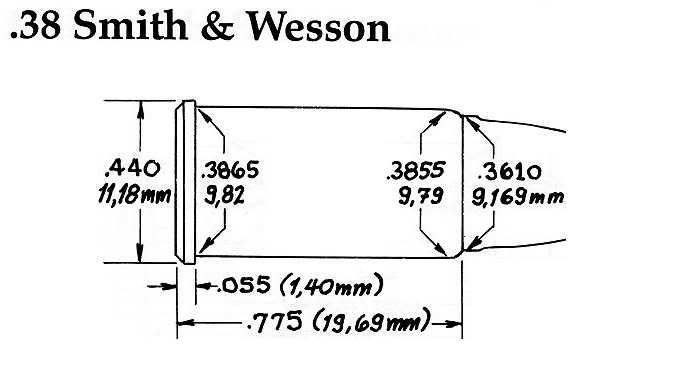 First we had the .36 caliber percussion revolver which really had a .375-.377" groove diameter. Then we had cartridge conversions which used heel type bullets of correct diameter for the bore which led to the cartridges being called .38 caliber. Then we had the inside lubed bullet due to Russian influence and practicality and the bullet fit in the same case came out to about .358". Then we had bores to match the new bullets but the cartridge name didn't change. Then the .38 Colt was lengthened and eventually we have the .38 S&W Special, .357 Magnum, .360 Dan Wesson and .357 Maximum. Of course the .357 Max is very similar to the .38 Extra Long but not to confuse things...

Isn't life interesting?
What IS really interesting is that the .38 Colt eventually won the .38 (actually .36) revolver cartridge war and the .32 S&W (actually .312) eventually won the .32 revolver cartridge war lengthening to become the .32 S&W, .32 S&W Long, .32 H&R and now the .327 Federal whereas the .32 Colt and .32 Long Colt have only now been given a new lease on life due to the vagaries of the cowboy action shooters.
 So, what is the real "genealogy" of the various .38 cartridges? Well...
There once was the ".36" caliber Colt revolvers (which established a standard of sorts), with .36" (nominally) bores but .375" (nominally) groove diameters. When brass cartridges became the in thing and the guns were converted, the cartridges used bullets that approximated the groove diameter. Due to the technology of the time, these were outside lubricated, heeled bullets like our modern .22 Long Rifle (and shorts and longs and CBs...) These bullets had drawbacks such as leaving lube in pockets where ammo was carried, picking up dirt and other trash, or worse, being wiped clean off! Also, when carried a lot, the bullets would come loose from the case. Something was bound to change.
 The Russians might have been the ones to get the ball rolling when they ordered a bunch of Smith and Wesson pistols but insisted that the cartridge for which they were chambered carry an inside lubricated bullet (the .44 Russian instead of the .44 American). The advantages of inside lubricated cartridges were obvious and immediately in demand. Makers at first tried to use these inside lubricated bullets in the old cartridges resulting in bullets severely undersized for the bores in which they were being shot. After a bit, the bores of the revolvers were adapted to the new cartridges by being reduced to .357" (nominal groove diameter measurement) but were still referred to as "thirty-eights". The .32s went through a parallel development but the cases were made a bit bigger to accommodate the necessary .312" bullets. Of course, the peculiarities of the market, relative popularity of certain firearms, and so forth worked to bring certain cartridges to the forefront. The .38 Colt became the .38 Long Colt became the .38 S&W Special (S&W's co-opting of the Colt military cartridge to their own benefit) which became the .357 Magnum which became the .360 Dan Wesson and the .357 Maximum. S&W tried their own .38 centerfire with the 36/38 caliber in the "Baby Russian" in 1876 (using .36 caliber bullets and .380" diameter brass and later referred to as the .38 S&W beginning about 1877) but it didn't achieve the same level of popularity (again, it uses a .361" bullet) nor did it become a military cartridge in this country which is why S&W didn't use it to create the "Special". However, the S&W cartridge did get military, para-military and police use elsewhere mainly in Great Britain and its colonies (and former colonies) as the .38/200 or .380/200 later known as the .380 MK I or MK II and I suppose somebody might find ammo marked with the metric designation as 9.1x20R.

On the other hand, S&W had started early with .32s in their rimfire .32 for the Model 2 and had so much market share that Colt switched from chambering their revolvers for the .32 Long Colt to the .32 New Police (a .32 S&W Long with a flat meplat on the bullet), so called to avoid putting the S&W name on their revolvers.
The cartridges from these two design paths have different case diameter so one has to know what is what when buying or reloading ammo. To further complicate the issue, there are rimfire equivalents and the cartridges were also used in various rifles. For example, the Marlin 1892 .32s chamber the .32 Colt Long and came with firing pins that could be used with either the centerfire or rimfire versions. However, some of those rifles have been rechambered to use the more easily found .32 S&W Long.

 So, to run the .32s down (for the centerfires) we have the .32 S&W which begat the .32 S&W Long which begat the .32 H&R which begat the .327 Federal. So far as I know, the .32 Colt begat the .32 Long Colt and then the line died.
We should note that many of these older cartridges were on the razor edge of absolute death until cowboy action shooting came along. That game certainly excited a lot of interest in the old cartridges both for reasons of nostalgia and because they are very mild recoiling and period correct.


Monday, November 02, 2009
Smith and Wesson Bodyguard Airweight (pre-38)
 The Bodyguard Airweight (aka pre-Model 38) was introduced in 1955. That's when I was "introduced". It has the built-up frame to shroud the hammer. This was intended to minimize hammer spur snags on clothing when drawn while allowing manual cocking if desired. I don't suppose that, given the intended use, it is surprising that the airweight/alloy frame version was introduced before the all steel version. The 5-shot cylinder is steel. Most barrels are 2-inches.
 My gun came to me from a local collector who was moving it on and was accompanied by its original box. It doesn't have the tools.
Saturday, October 31, 2009
Smith and Wesson 49

Mine is the blued steel version (they were also factory nickeled) and has the usual 2-inch barrel (3-inch barreled guns are rare).
Monday, October 19, 2009
Smith and Wesson Model 696
The first .44 Special on the L-frame, the 696 was introduced in December 1996 with serial prefix CBS2xxx. Shipped in the blue plastic case and fitted with Uncle Mike's Combat rubber grips. The gun has adjustable rear and red ramp front sight. Barrel length is 3". The 5-shot cylinder will accept ammo up to about 1.63" in overall length. One can handload this a bit above factory pressure levels. I thought that the Skeeter Skelton load of 7.5 gr. Unique under a 250 gr. Keith bullet should be acceptable. Glenn Fryxell thinks otherwise and I'm inclined to take the hint and move in that direction. There is a lot to recommend 200 gr. at about 900-950 fps and it is much better to take care of these fine guns.
I was fortunate enough to get this representative example from a long-time dealer. The photo shown is his.
 As you can see, this particular gun differs from the factory norm in a couple of aspects. First, it has been Magnaported. Hardly necessary for the .44 Special cartridge, this change does reduce the value of the gun to a collector but doesn't affect usefulness. The second change is in the stocks/grips. These would appear to give much the same feel as the old style magna stocks with a Tyler-T grip adapter but not quite so. They kinda expand fore and aft at the bottom giving the feeling of a walking cane handle. The gun apparently also had action work done by Magnaport. This could spoil me as I've never had a gun with other than a factory trigger. I've considered myself pretty inured to the standard trigger but this is so very nice.
I am fortunate in that this is a pre-MIM gun sans lock and with the hammer mounted firing pin. I am prejudiced against the internal locks. I also achieve an illogical comfort level when I see the hammer mounted firing pin. It just makes me feel good.
I recently saw a similar gun, without the Magnaporting, asking $950 on GunsAmerica.com. I got this gun for something less than that but it will be a wonderful representative example of an interesting platform for the .44 Special cartridge. Now to get a good holster for it...
Limited range testing with the "Skelton load" showed me that these stocks aren't quite the best for my use. I swapped on a pair of Pachmayr Compacs and those were somewhat better. The problem with the Smith and Wesson stocks that came with the gun is that they curve a bit to the front at the bottom of the grip. This seems to accentuate the feel of recoil.
Sights were right on and I was able to hit my favorite cinder-block face target at 80 yards for 5 of 5 shots. For those concerned about the "thin" forcing cone, no cracking can be seen. I didn't intend to use anything heavier than the Skelton load. That may change. I might use something a step below the Skelton load. I've had several people tell me that a regular diet of this load might not be in the best interest of the gun. I have a feeling they are correct. I think that loading 180-200 gr. something at 950 fps will be more than adequate for my purposes and better for the gun.
What I need to do now is find an appropriate bullet mold or supply. More later...
I've decided on the Gold Dot bullet and factory loads using that bullet. I got some in the Blazer aluminum cases and they are pretty darn nice. Will likely switch back to the original grips. These loads aren't quite as hot as even the Skeeter Load I tried at first.
Links:
- Smith & Wesson Model 696 - .44 Special Revolver
- AN ALL AROUND “FIELD REVOLVER"
- The Arms Room - Sunday Smith #37: Model 696-1, 2000
- Saint Wesson: S&W model 696 .44 Special
- SMITH & WESSON'S WINNING PAIR
- The .44 Special Revisited by Glen E. Fryxell
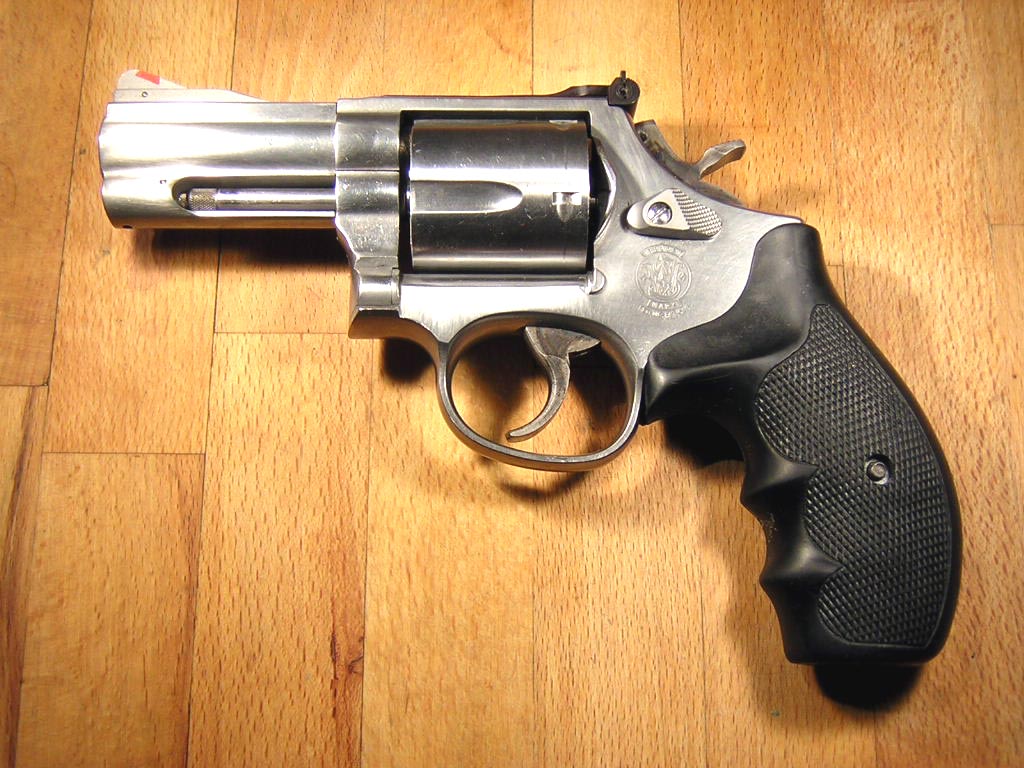 |
| The 696 as it came from the factory. |
Sunday, October 04, 2009
Smith and Wesson J-Frame Model 36-1

The Smith and Wesson Model 36 is a .38 Special chambered revolver made on the "J" frame. The "J" frame was developed from the slightly smaller "I" frame used for .32 S&W chambered revolvers by slightly lengthening the cylinder window to hold a longer cylinder needed to chamber the .38 Special cartridge. These have been around a long time now. The gun was introduced at the International Association of Chiefs of Police (IACP) conference held in Colorado Springs, Colorado, in October 1950, as the Chief's Special. When Smith & Wesson went to a number system in 1957, the Chief's Special was designated the Model 36. They have a good reputation for reliability but aren't considered extremely accurate.
The .38 Special chambering was good for me as I had a quantity of ammunition I'd loaded for the Security-Six. At the time, much of it was 148 gr. wadcutters over 2.7 gr. Bullseye. These worked great for practice and as a small game load. Yes, I hunted with the gun. My other load was the Speer swaged 158 gr. HP over 5 gr. of Unique. This is a good solid load and the one which was kept in the gun when fulfilling the self-defense role. A couple of squirrels fell to this gun and load. The range was very short but it still gave me a good bit of confidence.
Over the years I did try Pachmayr Compac rubber grips but returned to the factory wood and then got a Tyler-T grip adapter. Good move on my part as this improved the grip while maintaining a compact grip profile that was slick and didn't catch on clothing.
I really liked this gun. It is a good one and was later augmented with the Smith and Wesson Model 13. In the back of my mind was the idea that I'd be willing to get another. I don't know why, I just liked the model. It is small but capable.
The Smith and Wesson M36 3" barrel is one of my favorite guns. I think it has perfect balance for the frame, has adequate ballistic performance for the .38 Special cartridge, gives a better sight picture, is as easy to conceal (unless you're putting it in a pocket) and has the feel of a full size revolver.
What you see here is a pair of 36-1s. The earlier one is the bottom of the two (without the Tyler-T grip adapter). It has a pinned barrel and was made about 1977. The upper, later 36-1 was made in 1982 and shows the un-pinned barrel. There is little else to distinguish the two.
M36 history begins with the very popular .38/32 (.38 S&W) Terrier I-frame revolver. The I-frame was a 5-shot hand ejector double action revolver. Its great popularity was the result of small size and light weight, but it wasn't strong enough and cylinder was not long enough for the more powerful .38 Special round. Popularity of the Detective Special demonstrated a probable demand for a gun the size of the Terrier but able to handle the .38 Special. Smith and Wesson lengthened the cylinder and frame of the I-frame, and beefed it up a bit. They dubbed it the J-frame. Within the past few years the cylinder has again been lengthened to handle the .357 Magnum cartridge.

The 36 has had "derivatives" which have become very popular. The Bodyguard (Model 38, the Airweight version and 49), the Centennial (Models 40, 442 and 642) and in .22 LR (Models 34, 43 and 63), some of which I've written about earlier.
Wednesday, September 09, 2009
Smith and Wesson Models 13 and 65
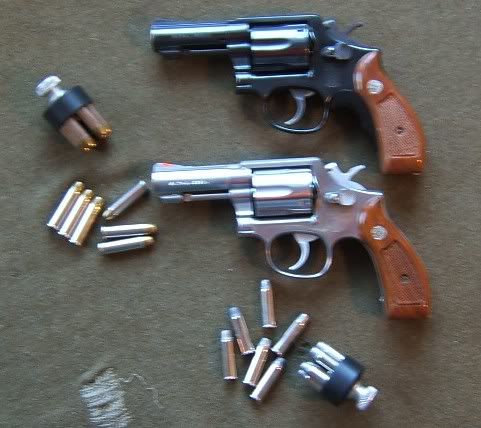
The M13 can be thought of as a Model 10(K-frame) .357 Magnum, with fixed-sights and blue steel finish. NOTE: Add adjustable sights and you have the Model 19. There was a comparable stainless gun, the Model 65 but more about that later. The M13 was manufactured from 1974 to 1999. It was the issue revolver for the FBI for several years. Both the square-butt 4" barreled and round-butt 3" barreled versions were produced.
The M65 is the stainless version of the M13 (as previously noted) and was produced from 1972 to 2004. I find it hard to believe that the stainless version came first. One hardly ever sees these for sale in shops. I found out that working in a gun shop is the way to score one of these fine guns. Our shop has had two in the last 9 months and I got one of them.
I think these guns offer a good combination of usability and portability and have the added benefit of being able to utilize a wide range of factory ammunition. From .38 Special wadcutters to the 125 gr. .357 Magnum barn-burners, these guns will handle them all (even if your ears won't!). Those .357 Magnums can hurt your hearing, wear protection.
These guns have a following and are appreciating in price better than any stock market investment (at least for the time being). An astute buyer with ready cash for investment can still sometimes find these guns for about $250-300 but more often they will be asking $350+. I think they are a bargain still because they are still less expensive than current factory production using MIM parts and suffering from the abomination of the internal lock.
Friday, August 14, 2009
S&W M19-5 2½-inch Round-butt
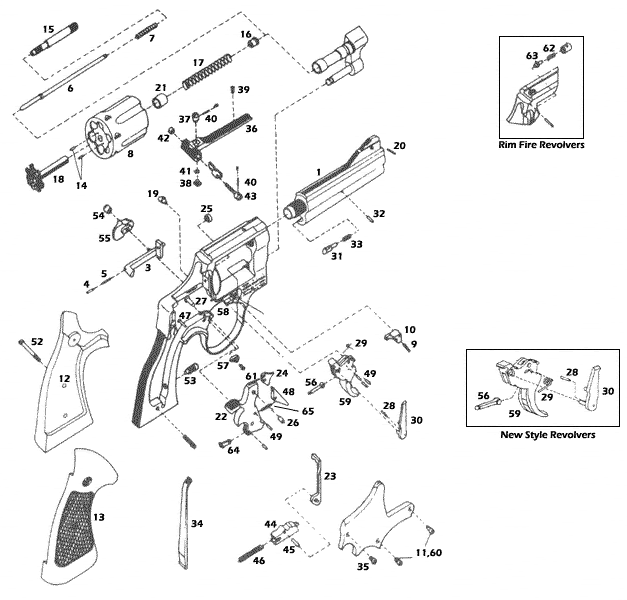
Built on what is now known as the K-frame (slightly modified), this .357 Magnum revolver was an answer to police demands for a revolver that was easy to carry for officers while still having additional "punch" over the .38 Special round nose ammo which was the standard for many years. Border Patrolman and ace shooter Bill Jordan lobbied for this revolver and after a year's experimentation by Smith and Wesson was presented with the first Combat Magnum (as it was known before model numbering by Smith and Wesson) on 15 November 1955. I was ALMOST 8 months old at the time so I know this was 54 years ago. Even after over a half-century, this model is among the most well-liked of the Smith and Wesson line. However, the company moved to the heavier L-frame to address concerns with the guns shooting loose or cracking forcing cones in using the more modern heavy 125-gr. bulleted .357 Magnum loads.
I have long wanted one of these revolvers in the 2½-inch version. This is due to how I see the .357 Mag/.38 Special +P loads' purpose. I see it as a concealed carry round. I personally prefer to carry .40-something if I am able to open carry on my belt. In that use the 2½-inch round-butt version suits better just as the fixed sight Models 13 and 65 3-inch have previously served.
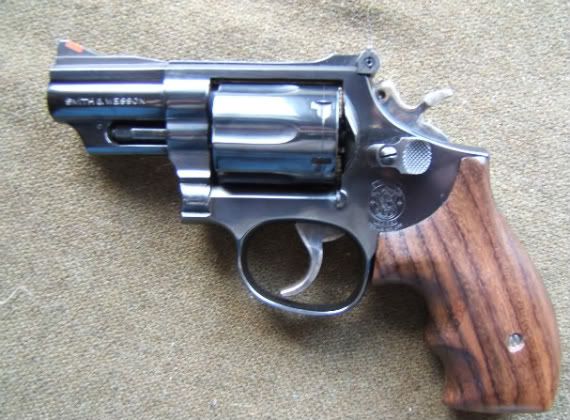
I've already had to change the grips again. I put a set of Pachmayr Compacs on it but have the standard RB stocks with a Tyler-T grip adapter headed this way.
Subscribe to:
Posts (Atom)