Showing posts with label Remington. Show all posts

Sunday, March 18, 2012

Remington Model 241

A few days ago I noted that Wayne F_________ told me that his uncle Carl F_________ had a Remington 241 he was wanting to sell.  I've been kinda interested in getting an example of the Browning SA22 for quite a long while.  I like the little short guns but let's face it, full-size guns are easier to shoot.  Anyway, I was told that this was an exceptional example but I thought I'd wait to pass judgement (in the form of exchanging money for gun, or not) until I'd gotten to see the firearm in question.

Yesterday Carl came by the shop to show me this and three other guns.

I'd like to note that Carl is a fine fellow.  A veteran of the Korean War as a member of the 187th Infantry Regiment (Rakkasans), Carl came home to the U.S. and had a career as an over-the-road truck driver.  He's been a lot of places and held his own with a lot of people and managed to keep body and soul together for over 80 years.  I like to think of him as a friend.  He also has and has had a wonderful knack for glomming on to some wonderful guns.

I wish I'd gotten a photo of the first gun he pulled out.  It was beautiful with about 98% condition, this was the nicest Colt New Service I've ever seen.  Chambered for the .45 Colt, Carl said that this would be one of the last guns he'd sell but he wanted to show me, just in case.  I think he's seeing the end of life approaching and wants to be prepared without coming out and saying so.  That sort of makes seeing and handling this treasure a real honor.  This was a later gun with the later version cylinder latch and checkered wood stocks.  It still had its original lanyard loop.  Made me think of Sergeant Preston of the Yukon!

He then took me out to his car to show me two rifles he had.  The first was an early M1 Carbine with the correct wood, sights and safety for early in the war and all original.  The cartouche was still visible as well.  VERY nice.  He also had a G33/40 rifle made in 1942.  This one had some of the wear one would expect from a rifle used in the rugged terrain where these units operated during WWII but the metal was in pretty good condition.

After looking at these play-pretties we got down to business on the rifle that had brought him to me in the first place.  A Remington 241 with some extras.  About 130,000 of the Model 24 and 24A guns were produced between 1922 and 1935 (some say to 1938). Then, coincidental with acquisition of Remington by Dupont, the 241 was designed as a product improvement and more than 107,000 of these were produced 1935 through 1951.  In redesigning the model 24 to the 241, the barrel quick release was moved to the side of the receiver and the parts were made slightly heavier (stronger) to handle the then new high speed ammunition.  This one is serial numbered 748__ (about 1947), has some really well-figured wood, a nifty Lyman receiver sight, the steel butt-plate, pistol grip cap and even an engine turned (jeweled) bolt.  I believe this would have been the Special grade gun with the sight.  Cost in 1940 would have been $42.15 for the gun and the Lyman sight would have been extra.  Just the rifle today would be $685 in our money or about the same as retail for the Browning .22 Auto.  The Lyman sights are often in the $100+ range.  This rifle being in excellent to fine condition, I'm very pleased to have it.


Of course it will go hunting, just like the 12CS and it might even take a turn at the metallic silhouette game.  I've shot it some more now and it will even function with the CCI .22 Quiet ammo!  Almost like having a silenced .22 and self-loading.  You can't beat that. 

Saturday, April 23, 2011

Making sense of Remington System rifles...

The Remington System, popularly known as the Rolling Block or "roller" for short, was once an extremely popular military and civilian single-shot rifle action. Recently, a young fellow brought me a rifle his family had taken in lieu of cash for work performed. As I looked at it it was a #4 Remington rifle, 80-85% with octagonal barrel caliber .32 rimfire. It was missing the front sight blade but otherwise could have been shot (if ammo was available). After some further research (after seeing the rifle) I was going to call him to let him know that he should value it at about $450. However, before I could call he called me.


What did he have to say? He had been looking on-line and thought that the screws (?) didn't look right for it to be a #4.  Before I talked to him again I wanted to do some more research so that I could either convince him that it was a #4 or give him a correct identification.  Then I thought that I'd just record my notes here...


The Remington system began with the Geiger split breech rifle about 1865. Too, late for the American Civil War the gun was further developed with an eye to overseas sales, mainly Europe and South America with additional civilian/sporting sales.


One thing that one discovers right from the get go is that there are within the broader categorizations even to models as sold by contract to various military organizations is that there are numerous variations (not different models) as Remington used up parts from other contracts or redirected other contracts which hadn't been paid for to newer clients/contracts. Remington did what other companies did at the time and that is they used intensive management oversight to maximize profits by way of minimizing waste. The used and reused parts as much as possible. Again, variations within variations within models within contracts...


So what actions were there?  Well, it seems that somebody has assigned numbers to the rolling block actions, 1, 2, 4, 5, and 6 (actually a falling block).

Remington #1 Rolling Block .43 Carbine, centerfire

The #1 Remington rolling block rifle is also known as the black powder cartridge rifle. Produced by Remington in both military and civilian models from 1866 to 1895 these large frame rolling block production  totaled well over 1 million rifles with a number of variations. 1.250" wide this is the largest of the Remington system actions.  This same action was also used on the 1-1/2 rifle.

No. 1-1/2 Action rifle, rimfire


The #2 Remington rolling block is a smaller scale civilian model sporting rifle using a receiver patterned after the 1871 Army pistol. A number of the parts are interchangeable with the 1871, 1891 and 1902 pistols as well as the #7 target rifle. This rifle was produced in a wide variety of  rim fire and center fire cartridges. The rim fire models with bar extractors are the most numerous.  1.125" wide it was used for smaller and less "powerful" cartridges than the #1 action.  It can be identified by the curved counter at the rear where it joins the stock.  

The #3 was actually a falling block action, the Remington-Hepburn.  

No. 4 rifle, for .22S, .22L, .22LR, .25 Stevens ("25-10"), .32S, .32L rimfires
The #4 Remington rolling block is the smallest of the rolling block rifles it is at once noticeably smaller if you've ever seen one of the larger actions. It was only produced in rim fire cartridges and may be found in the three variations shown here plus military and Boy Scout models. The quickest identifying feature is the mounting of Breech Block and Hammer on screws rather than pins. Early production #4s have tapered octagon barrels while the late takedown model was produced with a round barrel.

Model 1897 7x57mm Mauser Chambering, the #5

The #5 Remington rolling block rifles are also known as the smokeless powder cartridge rolling block rifles. Beginning production in 1896 they comprise the 1897, 1902, and 1910 models. While the #5 was produced in several smokeless center fire cartridges the vast majority of them are chambered 7mm Mauser.


No. 6 Rifle (a falling block), for small caliber rimfires such as the .22 LR
The #6 is not a true rolling block. It is a small scale falling block boys rifle. 

Tuesday, October 20, 2009

Remington Model 12CS


The Remington Model 12CS is chambered for the .22 Remington Special (Winchester Rimfire). Originally this model was designated "The New 22 Repeater" and did not have an actual model number assigned. The Model 12 was made from 1909 to 1936. It was first chambered for the .22 Remington Special cartridge in 1914. Designed by J. D. Pederson, approximately 832,000 guns were produced (in all chamberings). The grades offered were the 12A Basic Model, 12B Gallery Special, 12C Target, 12D Peerless, 12E Expert, 12F Premier, 12C N.R.A. Target Grades, 12CS, DS, ES, FS chambered for .22 Rem Special cartridges and quality of finish.

I acquired this example (apparently built in 1914) from a west coast collector who decided to move on to other collections. He remembered that I had expressed interest in the rifle when he got it. While I've never owned a Remington Model 12 before, it is really the cartridge and the tang sight that attracted me to this example.

Quite obviously the tang sight will help improve accuracy. It both doubles (or nearly so) the sight radius but I also find the aperture sight easier to use.

The cartridge is a whole other story. The .22 Winchester Rimfire was introduced with the Winchester 1890 rifle (a John Browning gun). It is interchangeable with the .22 Remington Special (which is how this rifle is marked). The big difference between this and other previous rimfire cartridges was the inside-lubricated bullet rather than the heel-type outside-lubricated bullet such as used in the .22 Long Rifle. The primary difference in the Winchester and Remington loadings is that Winchester had a flat-nosed bullet and Remington had a round-nosed bullet. Although it was declared obsolete after WWII, it seems to have made a comeback, mostly as a sub-load for .22 Winchester Magnum Rimfire guns. CCI still produces the cartridge and there are large quantities of a recent special run by Winchester still out there. CCI's load offers a 45-grain JHP at 1,300 fps and Winchester's is a 45-grain, Lubaloy coated, flatpoint bullet loading at 1,300 fps.

I am most fortunate to have come into a large quantity of the Remington Special cartridges. This will likely feed the rifle for its entire life with me.

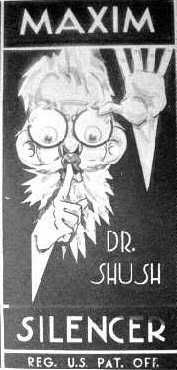
This particular rifle has another feature that is of interest. It is threaded for the Maxim silencer. Now called suppressors, in that halcyon age of practicality over hysterics, the silencer/suppressor was viewed for what it is, a practical method of reducing sound signature which might disturb neighbors or game. It has the added value of reducing hearing damage. I don't know how much that figured into the motivation to pay for such a thing, but it is certainly apropos today. Why this country has/persists in such a paranoid regard for suppressors can only be attributed to ignorant viewers of equally ignorant Hollywood films.

I'd like to find a "silencer" for my rifle but don't know if I will be able to. I think it would add immeasurably to the gun's usefulness in pest control. These are once again being made, for the US Maxim Silent Firearms Co. by Yankee Hill. I am still investigating as to whether or not Yankee Hill will thread their Maxims to the original 1/2"-20 thread.

As to handling characteristics, these rifles are not "boys" rifles but man-sized rimfire rifles. While compact and lively they don't have abbreviated butt-stocks. I think they are comfortable to shoot. I am excited to get this example and hope that it has a long life in this house.

Immediately after I picked up the rifle I took it out for some shooting. This baby is easy to hit with. It would be a great groundhog gun and a fantastic defender of the house garden with plenty of accuracy to head shoot rabbits and such. This is a wonderful firearm and I'm pleased as punch!

Links:
- Remington Model 12 variations 22 RF
- A Brief History of Remington Rifles and the Model 1
- What's with the WRF? It's back and it's still viable by Holt Bodinson
- Rimfire that wouldn't die: new ammunition from CCI sends the vintage .22 WRF back into the game fields by C. Rodney James
- On the Control of Silencers in the United States
- The Remington Society of America

Wednesday, May 20, 2009

Remington Model 51

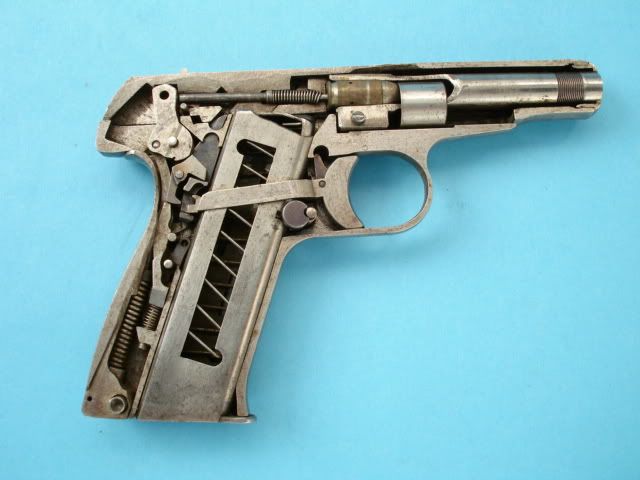
One of the coolest little .380 ACPs is the Remington Model 51. It FEELS good in the hand. I've shot one, once, a long time ago, but as I remember it it felt good in shooting. It looks modern but it is made with old time attention to detail. I think I read once that it undersold the Colt of that time (the 1908) by $5.00. That was a lot of money in 1930-something!  These guns were also made in .32 ACP. 

Today, a retired Virginia State Trooper brought one into the shop to see if we could get it apart for cleaning. It took a bit. We pushed the pin out the side then it was a free for all. Seems to me it takes both hands and a monkey to get the thing apart. You have to grasp the barrel AND slide and pull them apart and at the same time lift them from the frame. Must be a trick I don't know. At least I didn't know it until actually seeing the manual.  When in doubt, read the directions. Taking out the breech block is another push and lift exercise. THEN, to get the barrel out one has to get the timing of lifting the breech end of the barrel out while compressing the action spring. I think. Like I said it was a free for all.

The Remington Society is doing research on these pistols and has a research form. If you own one you might consider adding to the body of knowledge on these guns buy letting them know some details about yours. They also have a manual on the 51.

Tuesday, February 17, 2009

Nylon 66 Field Stripping and Cleaning

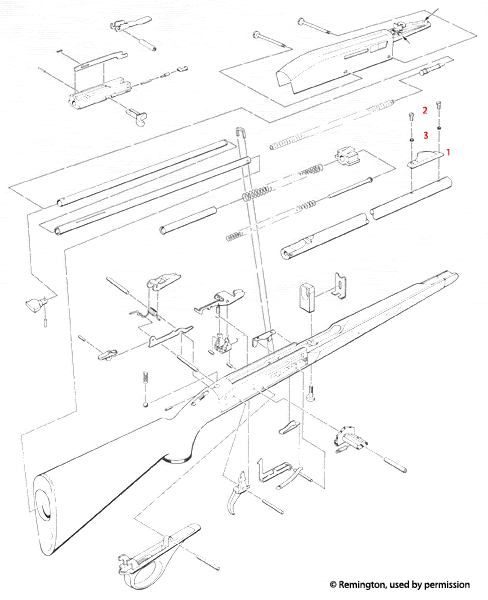
Just cock the gun and put the safety ON (THIS IS IMPORTANT!!!), remove the feed tube, pull the bolt handle straight out of the side of the gun, take out the two receiver cover screws and lift the receiver cover off (No parts will fly off when this is done...), loosen the barrel retainer and raise it up enough to slide the barrel forward and out of the stock, loosen the barrel retaining screw all the way and lift the barrel retainer out of the stock, then slide the bolt forward and out of the receiver / stock and you're done. Clean and re-assemble in reverse order.

A little background. In the 1960s Remington produced a line of synthetic stocked autoloading, lever action, and bolt action .22 rifles. Remington nylon stocks were made of a DuPont Nylon 66 series plastic called structural Zytel-101 that Dupont developed specifically for these rifles. (Remington Arms was then owned by DuPont.) They were advertised to not warp, crack, chip, fade, or peel for the life of the rifle.

Designed by W.E. Leek, C.H. Morse, and H.W. Young and introduced in 1959, the most successful and best known of the Remington Nylon series was the Nylon 66. It is a blowback operated, tubular magazine fed semi-automatic rifle chambered for the .22 Long Rifle cartridge. This rifle's receiver was actually nylon and the bolt ran on "self lubricating" nylon rails. The Owners Manual advises not to lubricate the action with gun oil. There is a blued sheet steel cover used to give the receiver a more normal appearance and a 19-5/8" barrel. The brass tubular magazine, which hold 14 cartridges, is in the butt stock of the rifle and is loaded through a recess in the plastic buttplate. The whole gun weighs only 4 pounds (empty).


Links:
- NylonRifles.com Everything about the Remington Nylon Rifles!

Wednesday, December 03, 2008

Dating Remingtons...

The following letters correspond to the month (first letter) and year of manufacture starting in 1921 and ending in 1972 (next one or two letters):


B-Jan M-1921 C-1934 SS-1947 G-1960
L-Feb N-1922 D-1935 TT-1948 H-1961
A-Mar P-1923 E-1936 UU-1949 J-1962
C-AprR-1924 F-1937 WW-1950 K-1963
K-MayS-1925 G-1938 XX-1951 L-1964
P-JunT-1926 H-1939 YY-1952 M-1965
O-JulU-1927 J-1940 ZZ-1953 N-1966
W-AugW-1928 K-1941 A-1954 P-1967
D-SepX-1929 L-1942 B-1955 R-1968
E-OctY-1930 MM-1943 C-1956 S-1969
R-NovZ-1931 NN-1944 D-1957 T-1970
X-DecA-1932 PP-1945 E-1958 U-1971
B-1933 RR-1946 F-1959 W-1972


Using barrel codes (such as those listed above) to date the manufacture are reliable on Remington rifles, as the company rarely changed barrels on a customer's rifle.

Using these barrel codes to date a shotgun is somewhat unreliable, as shotgun barrels are often interchanged at random. One needs to be sure that the barrel is original to the gun before trusting the Barrel Code listing, above.

Saturday, November 01, 2008

Uberti Remington New Model Army 5½-inch

The Remington New Model Army revolver was manufactured by E. Remington & Sons of Ilion, New York, from 1863 to 1875. An average of 10,000 per year were manufactured (most during the Civil War, 1863-1865) for an approximate total of 132,000 revolvers. This six-shot, .44 caliber revolver was the second most issued to Union soldiers pistol during the Civil War.  The New Model was proceeded by the Old Model Army, of which 12,000 were produced circa 1862. The Old Model had a dovetailed front sight, and the loading lever was cut so the cylinder could be removed without lowering the lever. The Army found both features unacceptable and the New Model Army features a loading lever that must be dropped for cylinder removal and a screw-in post front sight. One of the oddities of these revolvers is that the Old Model Army has a patent date of Dec 17, 1861 and the New Model Army, it's replacement, has a patent date of Sept 14, 1858! It is interesting to note that the reproductions most often use the dovetailed front sight of the Old Model Army but the New Model Army loading lever. 
Once upon a time in a place that now seems so far away called San Angelo, Texas, I bought a revolver.  Along for that ride, maybe an instigator now that I think about it, was my dear friend Perry Fuller.  Perry had taken me to a gun shop in downtown San Angelo as a break from the tiring classes at Goodfellow Air Force Base.  I suppose he didn't intend for me to buy a cap'n'ball revolver but I did.  This Lyman marketed, Italian copy of the Remington New Model Army was my first handgun of over .177" caliber.  With a can of DuPont 3F, some Remington caps, a can of Crisco lard and a popsicle stick I was all ready to go shooting. 
The two of us went out in the vicinity of Lake Nasworthy and proceeded to shoot up some cactii and an armadillo.  Not exactly responsible, but we were certain to watch our backstop!  I believe we also got a quail or two out there (which Perry's wife Amy graciously prepared for dinner!) using Perry's 20 ga. Ithaca M66 lever-action shotgun.  In any case, that was great fun and when I got home on leave I was eager to show Dad just how it worked.  He liked it but had one concern.  The grip size. 

Now my hands are about average in size but Dad's were pretty large.  He was 6' 1" and his hands were a little larger than one might think would be proportional.  That early NMA grip disappeared in those paws!  Even in my average sized mitts, the grips felt a bit on the small side.   The guns were supposed to be accurate reproductions of Civil War era revolvers used by men so why were the grips small?

Well, it seems that when the Italian gun makers first started to reproduce the guns, they were casting the frames and somehow while the copied the dimensions for the frames from originals there was a bit of shrinkage in the castings and the guns came out a bit on the small side in some dimensions.  Fast forward to about 2000 and correctly dimensioned guns were beginning to come on the market.  Now, Uberti produces a forged, steel frame version, some with color-cased frames.  Barrel lengths are not just in the 8" original length but also in 5-1/2", a more desirable length to modern CAS shooters. 

Taylor's & Co., Inc. of Winchester, Virginia distributes these guns but I'm sure you can get them from other firms like Dixie Gun Works.  The Uberti guns come in typical Uberti boxes.  There's the usual manual but also NRA and other literature included.  No nipple wrench is included and you will need one. 

Loading these guns is actually pretty straight forward.  It is a good primer (pun intended) for the budding reloader.  First, the gun must be cleaned to ensure there is no grease or oil in the chambers or nipples.  Excess oil should be removed and I strongly suggest that no petroleum based oils or greases be used on the gun as exposure to blackpowder (or substitutes) and heat can create a "tar" that can be terribly difficult to remove.  This fouling on the cylinder can tie up the gun in short order and is well avoided.  Also lay out your components/ensure you have everything you need before you start.  There is nothing so irritating as having to go find a component in the middle of the process.  Don't ask me how I know.  You will need:
 - .454" pure lead round balls or the correct conical bullets
 - #11 percussion caps
 - greased over-powder wads and/or grease/lard for application over the bullet.  This is important to both lubricate the bullet and to prevent accidentally igniting the powder charge from the front.
 - 2F or 3F BP or substitute
 - powder measure or flask with measure

I prefer to fire two caps on each chamber to ensure that all nipple flash holes are clean through and through and dry.  The fired caps are removed from the nipples and we move on to actual loading.

I charge and seat the ball/ball&wad one chamber at a time and then move on to the next chamber.  It is preferred to load only five chambers and leave one empty.  The gun is carried with the hammer resting on the nipple of this empty chamber.  To do this the gun is placed on half-cock so that the cylinder can rotate freely.  It is held muzzle up in my left hand so that can do the other tasks with my right.  A charge is measured and poured and the wad, then ball is seated using the loading lever.  Only after I've completed loading each chamber do I go back and apply the grease over the ball with the popsicle stick, tongue depressor or other suitably shaped applicator.  Excess grease is wiped off.  The gun, still held in my left hand is then capped and the cylinder rotated and the hammer let down on the nipple of the empty chamber.  The gun is now ready for carry and/or firing. 

Typical powder charges are 25-35 gr. (limited by the size of the chamber) and round-balls weigh about 144 gr.  Velocities are typically in the 700-850 fps range and produce energy levels about on par with .38 Special round nose lead ammunition.  However, the larger diameter pure lead ball gives better terminal performance.  Find the load your revolver likes best and you can likely shoot cloverleafs to some very interesting distances and you'll have a fine small to medium game revolver.  Conical bullets often give better penetration on target but less accuracy.  Molds are available from Lee, Lyman and others. 

After shooting, timely cleaning is strongly recommended.  It isn't necessary to completely disassemble the revolver after every shooting session.  My Lyman hasn't had that done in 25 years but a peek inside shows no BP buildup.  It is necessary to clean the cylinder (removing the nipples for a thorough cleaning), bore and exterior of the revolver.  Hot, soapy water is my preferred solvent.  Hot water helps heat the metal so that it dries more quickly.  After cleaning give it a protective wipe down with Bore Butter or other non-petroleum based oil. 

Thursday, June 19, 2008

I remember once-upon-a-time when —

12 year olds were expected to baby-sit younger kids. Since I was 12 and the oldest of this particular assemblage of kids, I was entrusted with their care AND because there was a big old deer that came out in an adjoining field, a 1903A3 as issued and a box (not just a mag full but a BOX!) of .30-06 ammunition. The home in which this rifle resided (and I hope it still does) was that of a WV game biologist. Now that is the good old days for me.

No, the deer never came out and yes, all the kids survived my dictatorship.


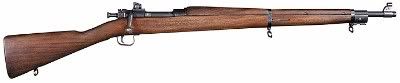
The U.S. Model 1903 Springfield Rifle replaced the Krag-Jorgensen and was the primary U.S. battle rifle until 1936, when it was replaced as the primary battle U.S. battle rifle by the M1 Garand. In 1942 Remington Arms redesigned the 1903 rifle using some stamped parts and that model was designated as the U.S. Model 1903A3.

Saturday, October 14, 2006

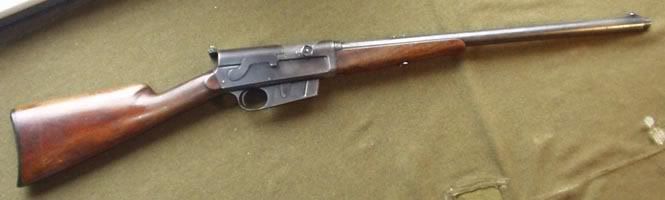
The Remington Model 8 - .35 Remington

My Remington Model 8 is chambered for the .35 Remington. I inherited it from my father. Dad inherited it from his father who inherited it from, so far as I know, the first owner/user. That was "Uncle" Dave and Uncle Dave was the gunny guy of that generation but he wasn't really an uncle. He liked the old stuff and guns like I do and like me he was willing to spend money on good guns and hunting. Uncle Dave's gun has a Lyman receiver sight, the factory rear sight has been removed, and is sighted for the Winchester factory 200 gr. Silvertip load (a box of which I still remember from my youth). My dad had to have a slip on recoil pad as the length of pull was entirely too short for his frame. Grandpa had the same slip on pad but his stated reason was that the gun kicked too hard without it. I don't know who put the pad on, but somehow I think it was Uncle Dave as he also put a pad on his Fox Sterlingworth 12 ga. I don't use it and the recoil doesn't bother me.

The Remington Model 8 is a Browning design. The first semi-auto sporting rifle produced by Remington, it was introduced in 1906. Discontinued in 1936 after 80,500 had been produced, the gun was produced in 4 chamberings, .25, .30, .32 and .35 Remington. It was also produced in 6 grades, No.1 Standard, No.3 Special, No.4 Peerless, No.5 Expert, and No.6 Premier. My gun is the Standard. The Model 8 was replaced by the Model 81 (chambered in .300 Savage, .30, .32 and .35 Remington) from 1936-1950. About 55,000 of the Model 81 were manufactured by Remington. The design was also used by FN but I'm unsure of production numbers. One seldom sees one of the FN guns here in the US.

Introduced in 1906 in the Remington Model 8 autoloading rifle, the .35 Remington is one of the few pure woods cartridges that can be considered successful. In addition to the Model 8, this excellent cartridge was once available in Remington Models 81, 14, 141, 720, 600, and 760, as well as the Winchester Model 70, Standard Arms Models G and M, the Mossberg Model 472 and a slide action rifle once made by Savage. Presently available in the Marlin Model 336 lever action, Remington Model Seven KS bolt action and the Remington XP-100 and T/C Contender handguns, the .35 Remington is still a favorite of those who believe it kills deer and black bear quicker than the .30-30 Winchester. Whether or not this is true is the stuff classic campfire debates are made of.

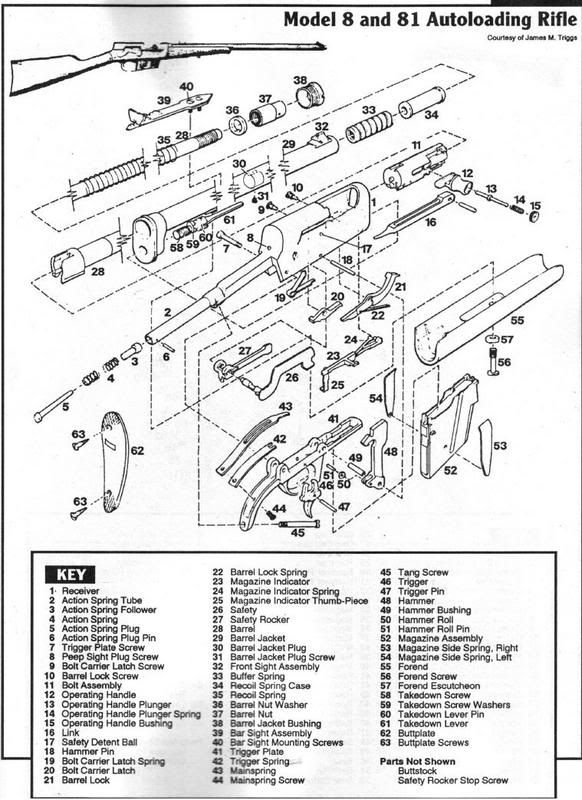
The Model 8 is recoil-operated has a rotating bolt and double, opposed locking lugs. The gun fires from a fixed 5-shot magazine (it is NOT detachable!) and is equipped with a bolt hold-open that engages after the last shot is fired. The autoloading action was made more revolutionary by the incorporation of a barrel that was shrouded in a full-length jacket. When the gun is fired, the barrel moves backward inside the shroud. It is a long recoil operated gun, not gas, like the Browning Auto-5.

Designed in a day when travel by train or bicycle was common, the 8-pound, 41-inch carbine was built on a take-down design for ease of transport and cleaning. Take down is accomplished by removing the forearm to access an integral barrel wrench. Once loosed, the wrench releases the barrel. As the barrel, including chamber and the open sights, remain in one piece, this feature does not negatively affect accuracy.

Even today the .35 Remington is second only to the .30-30 in popularity among those who prefer to head for the woods with a short lever action carbine hanging from their shoulders. Many years ago the .35 Remington was used on bigger game, but it is seen at its best when used on deer, black bear, and wild boar at ranges not exceeding 150 yards or so. At greater distances, the little .35 is handicapped by its moderate velocity and moderate accuracy from most of the rifles in which it has been available. However, when fired in a bolt action rifles such as the Winchester Model 70, Remington Model 600, and Remington Model Seven FS, the .35 Remington is as accurate a cartridge of similar caliber.

Links:
- The Great Model 8 & 81