Showing posts with label Ruger. Show all posts

Thursday, October 08, 2015

.327 Federal in the Single-Seven

Last year I bought a Lipsey's Special, Single-Seven Ruger in .327 Federal. This 7-shot gun is based on the frame of Ruger's long popular Single-Six .22 rimfire. The cylinder window dimensions have been slightly enlarged and the cylinder dimensions likewise increased to fill the window which permits the chambering of 7 of the .32 caliber cartridges and handling the pressures those cartridges will generate.

Factory ammunition available since my purchase has been limited to the Federal American Eagle loaded with 85 and 100 grain soft-nosed bullets. While these two bullets are of different weight, the design for both seems to be the same and one can't tell the difference by simply looking at a loaded cartridge. This hasn't proven to be as accurate as I think the pistol should be and so I decided to load a known quality bullet, the Hornady 100 gr. XTP.

BulletPowderPowder ChargeMuzzle VelocityMuzzle Energy
Hornady 100 gr. XTPAA-79.4 gr.1462 fpsMuzzle Energy
Hornady 100 gr. XTPAA-913.0 gr.1572 fpsMuzzle Energy
Hornady 100 gr. XTP240011.5 gr.1405 fpsMuzzle Energy
Hornady 100 gr. XTPH11013.5 gr.1525 fpsMuzzle Energy
Hornady 100 gr. XTPLongshot6.7 gr.1402 fpsMuzzle Energy


However, the gun wasn't shooting well and so I sent it back to Ruger who did some work and returned it within a week. This first is the test target they sent with the invoice. They shot this test at 15-yards.

Today, I shot the gun with the Federal factory 100-grain bullet load. This is what 3 cylinders full looks like after being shot at 25-yards.
 
I also shot some of my reload of the 100-grain XTP over 9.4-grains of AA-7. This is that target.


Needless to say I was not happy. Is my eyesight to blame? Can I not shoot today? Poor trigger management? Had it with me so I got out my Garthwaite CCO and 5 magazines (6-7 rounds each) of mixed brand "white-box" ball. This is that target.

So, I think I can still shoot alright but the gun is just not going to group worth a fig. I did not want a cast bullet gun and I suspect it will be a pain to find a mold to cast a bullet big enough in diameter to work with the cylinder and bore.

Thursday, September 24, 2015

Single-Seven and Ruger's customer service

Wrote Ruger about the problems with the Single-Seven and got a quick response. Called as instructed and got an RMA number and shipping label e-mailed to me. Sent the revolver back on Tuesday afternoon. Ruger says 2-3 week turn-around. So far they have lived up to their reputation for wonderful customer service. Not every mass produced item is going to be perfect. I'm optimistic about this and will note progress as it occurs.

Thursday, September 17, 2015

Range day...

14 shots at 25-yards, 100 gr. Federal load
Several months ago now I bought a new Ruger Single-Seven, 5½", stainless steel, .327 Federal, single-action revolver. I really haven't been all that enthused with it. I DO like the trajectory of the .327 Federal round and the light recoil and it holds the promise of being a good 100 yard varmint gun to carry in the field with the ability to shoot .32 S&W Long for edible small game. But...

When I first shot it I had nothing but Federal factory 85 gr. bulleted ammunition and was later able to get some of the 100 gr. bulleted ammunition. Both bullets are flat-nose soft-points (jacketed) and look the same while in the case but the 85 gr is obviously a bit shorter. Some cases seemed to be a bit fat near the case head and didn't chamber easily but now I am convinced that one must precisely locate the cylinder to avoid the rim rubbing on the side of the loading cut in the recoil shield. That is not too great a difficulty to prevent me from liking the gun, but...

I noticed with both loads that it seemed there would be 6 or 7 different groups on the target. I am not an "expert" shot but I can usually kill squirrels with pistols at up to 25-yards despite the inevitable vision changes that come with old age and I have to ask, how can I get 6-7 different groups if I can't shoot the gun well enough to get the one group one would expect? I thought perhaps that the chambers differed significantly from one another.

You can see those differences in a couple of ways aside from the 6-7 different groups. One way is in the burn marks on the front of the cylinder. Because of the size of the cylinder and the quantity of gas produced by the cartridge one has distinctive burn marks on the side of the cylinder by each chamber where some gas is directed down the side of the cylinder by the top strap. This is likely where the "spitting" is mostly originating. I don't know if this is avoidable or not but in any case the patterns of these burn marks are different for each chamber and the larger marks come from those chambers with the apparently largest throats.

Yes, those throat dimensions differ for each chamber. I don't have a set of plug gauges, the ideal way to check this out, but I do have a variety of bullets intended for this cartridge and/or its .32 caliber brethren (.32 S&W, .32 S&W Long, .32 HR, and .32-20). I tried the "drop test" in that I took each of those bullets, measured them with my dial calipers (after ensuring they were properly calibrated) and found that there were 2 chambers whose throats were considerably tighter than the other 7. These 2 chambers also had the smallest burn marks on the side of the cylinder. Both the Speer and Hornady 100 gr. bullets marked .312" and measuring .3115-.3112" dropped all the way through every throat but for those two chambers. I was a bit surprised that cast bullets of the same dimensions did not and don't know why this is so but suspect the lube gripped the throats just enough to prevent their passing. The barrel throat does not permit these same bullets to get so far as to pass the ogive.

That's not the only problem with this gun though. Sometimes, especially immediately after shooting, the action will not cycle. My impression is that something has been knocked out of kilter inside. My first thought was that fired primers were dragging on the recoil shield or that the case head itself had hung up on one of the slight hole edges in the recoil shield. However, I was able to duplicate this "freezing" or "locking up" of the action with an empty chamber even without the cylinder installed.

So, what to do? Well, the gun was bought new, has not been altered, has never had other than factory ammo fired in it and it isn't good enough so it is going back to Ruger. It won't be fired again until it comes back from them.

Thursday, July 02, 2015

Range day...

Went to the range today and learned some lessons, or not... Took the Single-Seven, .327 Federal and both Federal American Eagle factory loads, the 85 gr. and 100 gr. bulleted loads. I am pretty much decided to load the 100 gr. XTP so I was using the 100 gr. load to zero/sight-in. I was also using the opportunity to see how much the 85 gr. load POI would differ from the 100 gr. load and to just get some trigger time. A couple of interesting things...

First, this gun has a couple of screws loose, the ejector rod housing screw and the screw in front of the trigger guard both shot loose. I was having to tighten them after every cylinder full. THAT I can fix.

Second was how well it grouped, or didn't. I realize I am not the best shot in the world, my eyes are starting to fail me (cataracts) and I'm certainly not infallible! While I didn't have time to shoot groups with individual chambers it certainly seems as if certain of the individual chambers shoot very well with many cloverleafs but those groups are separated by at least two calibers from one another. Some chambers don't seem to quite stand up to that. My best group from a cylinder-full (7-shots) was about 3½ in a bit of an oval. This at 25-yards doesn't seem so good.

Third, I feel as if it is spitting a bit but it isn't, it is just a LOT of gas working there. It looks as if there is some top-strap cutting but I never bothered to look or simply can't remember if these things have a relief cut there. One thing for certain, the burn rings one often sees on the front of stainless cylinders (due to the contrast) cover the whole front of the cylinder and extend in a neat little pattern to the side of the cylinder. Since this pattern varies slightly from chamber to chamber it is clear that each chamber's relationship to the barrel is a bit different, one very much so. Discoloring due to heat extends to the base pin where it is exposed between the frame and face of the cylinder.

Had a great time, of course.

Thursday, June 18, 2015

Range day...

It was a short range day today. Took the FT Ruger .45 with the ACP cylinder installed and shot up a box of 50 rounds of ACP loaded with 7 gr. Unique under the 200 gr. Hornady Combat Match semi-wadcutter bullet. This stuff was loaded many years ago for the Combat Commander. As expected it shot low as the gun was zeroed for the 255 gr at about 1000 fps. However, I was surprised at how low it shot. The load did group well though.

I also shot the adjustable sight Bearcat. It seemed zeroed for 25 yards as well but each chamber seemed to have its own group. 18 shots fired and there were 6 distinct 3-shot groups. Interesting.

Didn't have much time to do more.

Thursday, May 14, 2015

Range day...

Had the Single-Seven to the range this afternoon and put 4 cylinders full through it (I was kinda pressed for time). The first cylinder was all over the place. I shot that first cylinder from the bench, then I stood up and shot from the standing leaning against a range shed supporting post to steady myself and the gun would actually group but still, it is more like several groups in different places as if each chamber is shooting its own group. Further, the firing pin strikes every primer off center. I wonder how much that might affect accuracy. Ammunition today was the Federal 100 gr. load instead of the 85. Both bullets are the flat point soft nose. You can't tell them apart looking at a loaded round. Maybe handloads will be better...

I am not very found of these Federal loads. Some rounds seem to have a "bottleneck" in the case about 3/8" above the rim. When you drop them in the chamber, some will just drop in and some will "hang up" right at that point. Also, when shooting, the cylinder will sometimes drag and I am pretty certain this is a primer dragging across the recoil plate.

The club president was there this afternoon and he thinks the trigger pull is pretty darn heavy. I think I will take it in and measure it tomorrow at work. I didn't think it was all that bad.

I also took the CCI A17 ammo to try in the Contender .17 HMR barrel. It shot quite a bit higher than the standard .17 HMR ammo I was trying earlier but grouped inside of 1 inch at 100 yards despite my use of my old Weaver 1.5-4.5 scope on a standard small-bore target.

Thursday, April 30, 2015

Range day...

Had a good afternoon at the range despite the rain (we got ½").

First I shot the Colt Government Series 80 MKIV .380 with a mix of ammo which included most current production. The Tula does NOT feed and will NOT chamber but all the brass and aluminum cased stuff functioned just fine. That stuff also shot to point of aim at 30 feet. Good enough.

Then I got out the SIG Sauer 938-22. This is one of those guns that had promise but doesn't seem to live up to it. First problem I had with the gun is that it only came with one magazine. FINALLY got a couple of more magazines even though SIG has been showing out of stock for months. These magazines are made in Israel which surprised me but might be in part of the next problem, which I had today. With two different brands of ammo/loads, the second round from the magazine wouldn't pick up and every once in a while it would do this on the next to the last round. Supposedly of 10-round capacity I thought perhaps this meant that I should load 9 or 8. Nope, did the same thing. Have to figure this one out. Then I finally got the sights dialed in. This has been a problem as the sights were initially resistant to screw adjustment (this is the adjustable sight version) as in, one couldn't turn the screws. Soaking in oil fixed that but the adjustment seems "iffy". The next disappointment is that this gun is NOT minute of squirrel head capable at much over 25 feet. I suppose that it is only intended as a trainer for the 9mm gun but one would think that it could do better than this. It is fun to shoot but the Browning 1911-22 is more accurate.

Then I got around to shooting, for the first time, my 4" Ruger Redhawk. A friend was cleaning out his stock of no longer needed loading stuff and passed on to me a bunch of brass and bullets including some .44 Mag reloads. Yeah, I know, don't shoot somebody else's reloads but sometimes you just gotta live dangerously. In any case this was in a Redhawk, if ever there was a gun with a margin of safety... Anyway, one load was with the the 240 gr. Sierra JHC and the other with what appears to be the Hornady 180 gr XTP. Well, I guess I haven't shot a big bore sixgun for a while despite my shooting of .44 and .45 Ruger SAs. I was a bit "surprised". The JHC load came back with authority but not too bad but the XTP load was a fire-breather, literally. I was shooting at 25 yards and I do believe that the muzzle blast would dry the target. Quite impressive. No, I'm not going to shoot the rest of them.

Thursday, April 16, 2015

Range day...

FINALLY got to shoot both the adjustable sight Bearcat and the Single-Seven .327 at the range today.

98 rounds downrange of the Federal 85 gr. load with somewhat mixed results. The gun will apparently group but not from the bench today, oddly I did MUCH better both for grouping AND for proper placement (horizontal and vertical) from standing! My eyes are not up to 50-yard sight target alignment, at least in today's light (overcast and some light rain) and groups ran from about 6" to about 2 feet (the later from the bench and those way to the left of the target in as much as one could determine the group center). I tried busting clay target parts on the berm but couldn't quite get the range and missed them all. One thing I noticed was the gun was rough, sometimes really dragging as the cylinder turned and the ammo seemed "uneven" as in chambering it seemed as if there were tight spots in the chambers or fat spots on the brass. After the 98-rounds there was NO turn ring.

The Bearcat suffered through some old Russian steel-cased Junior "target" ammo and did some better with Federal American. The steel cases ejected with effort but the brass cases slid out slick as snot. I did about as well on the clay pigeons on the berm with the little (should I say "tiny") Bearcat as with the Single-Seven actually hitting a piece or two from 50-yards. 50-rounds of each was fired and the old Junior ammo was obviously suffering from age.

All in all a fun time!

Wednesday, May 30, 2012

Interesting revolver find...

Every once in a while one hears of a hunter finding a rifle or shotgun leaning up against a tree.  Presumably, a hunter got his game, got excited and walked off without the gun and couldn't find it once he/she came to their senses.  Sometimes, people find a gun in the trash or in a ditch or down a storm sewer that has been tossed to get rid of evidence.  And every once in a while a person will actually recover a firearm lost overboard in some boating mishap.

This week a fellow brought in a Ruger Single-Six .32 H&R that he found buried in his front lawn...  It "came" with Pachmayr grips and the bluing is in fair condition, no pitting but with wear.  However, this new model gun won't always cock when the cylinder is in place and that's why he brought it in.

Saturday, January 14, 2012

New hammer for the new Ruger Flat-tops

I have a couple/three of the Ruger Flat-tops on the 50th Anniversary Flat-Top frame which is the size of the original Ruger Blackhawk but with the new lockwork.  Two are .44 Specials and one is a .45 Colt/.45 ACP.  All came to being courtesy of Lipsey's.  I get along well with all these guns.  However, I have been thinking that a lower hammer would be the ticket.  To that end I've been reading what I can and looking at comparisons of the various hammers Ruger installs on their single action revolvers.  Two of these interest most people wanting to make a similar modification.  These are the Bisley and Super Blackhawk hammers. Below, courtesy of Matt Olivier, we have, left to right: Old Army, Super Blackhawk, large frame Blackhawk, 357 Blackhawk, Single Six, Super Single Six, and Bearcat.


This gives a good idea of the relative heights of the spurs and sizes of the parts.  However, this photo lacks a direct comparison of the Super Blackhawk and Bisley hammers.  This next photo, from Whopist on Cast Boolits, does show the relative heights of the three hammers shown.


So it might be necessary to get a Bisley hammer and remove the excess metal that it has to blend with the ears on the Bisley grip frame.  This next photo from Whopist shows that.  If you look at the Bisley hammer you can see that the original hammer form has been drawn with a black marker.


I read in the same topic that:
On the thick transfer bar gun, ease the hammer down while holding the trigger and look at firing pin protrusion, see if your thin transfer bar revolver looks to have the same protrusion. If not, you may need to remove some metal from the top of the hammer to get a full strike from your pin.

Also, on the thick transfer bar revolver, with the hammer lowered on the transfer bar and the firing pin extended, see if the hammer drops a fraction to fully come to rest when you release the trigger. If it does, you have transfer bar pinch which will/could lead to a broken transfer bar. In this case you need to file some off the second step until you alleviate the pinch.

Then to further confuse things, on a midframe like the 44 special, Anv 357, New Vaquero, you have to look at how deep the hammer "sits" at rest. If you do a straight swap on a midframe, the hammer might not rest deep enough to fully retract the pawl. Then you get clicks from the pawl on the ratchet plus the reverse indexing pawl, 12 clicks per rotation. To fix this, you have to establish resting depth, then file the second step to alleviate the pinch.
Whether the differences between the thick and thin transfer bars will really be a problem or not has yet to be seen.  A Montado hammer would be close to ideal, if there was a blued version.

Another comparison of the various Ruger SA hammers...

I got two Super Blackhawk hammers but have yet to install either of them. I am one of those people who finds it hard to fix something that works.

How to do this?  It was supposed to be this simple and you might have seen these instructions elsewhere...
1) Remove the grips
2) Remove the five grip frame screws. Remember where the long one goes.
3) Separate the grip frame from the cylinder frame carefully. Don't lose the two small plungers. One is in the grip frame just forward of the trigger slot. The other is on the rear face just below and to the side of the hammer.
4) Depress the gate detent spring so the trigger pin can be removed (a gate detent spring tool ($20) is a BIG asset).
5) The hammer and trigger can now slide out.
Change the hammers and reverse directions for reassembly. 15 minutes and your done.

It was NOT that simple.  The instructions are in the manual and you should follow them.  The first time it took MUCH longer than 15 minutes, more on the order of 2 hours to both disassemble and reassemble.  The gate detent spring tool IS a big asset.

You must remove the main spring and you will eventually have to remove the trigger spring so you might as well do that also before removing the frame.  It is a bit of a juggle to put it back together and correctly install the mainspring strut and trigger spring.  On the New Vaquero and other guns with the lock, one captures the mainspring on the strut and then removes the grip frame to remove the mainspring (and trigger spring).  It just doesn't work any other way.

In reassembly, one needs to depress the detent spring just so as to slide the trigger pivot pin back into place.  It helps if the cylinder catch/bolt is flat against the detent spring as that means the pivot pin hole will not bind on the trigger pin.  Also, you need to be certain that the gate is closed and the detent spring leg is correctly positioned against the gate.  It might have a tendency to slide forward of the gate.

Was it worth the effort?  First, a Montado hammer will more correctly match the radius on the grip frame.  That might be more important to you than the fact that it is a stainless part (if you can get one).  The Bisley hammer is a bit lower yet and you can cut/file the radius to match the grip frame.  However, the lower hammer is a benefit as one can cock/uncock the gun without shifting ones's grip much at all.  For those with physical issues limiting dexterity, this might be very important.  Aside from learning HOW to do this, the parts are pretty much drop in.  That speaks volumes on the quality/concistency of Ruger's fabrication.

All this would be pretty pointless without photos, right?  Here's two.  The first is a side view of the Bisley hammer in my New Vaquero.  I have about $350 in the gun.  Yes, a bit ugly but the thing works.  Think of it as the Glock of Single Actions.

Ruger NV-44 .45 Colt New Vaquero, 2005 vintage with Super Blackhawk hammer installed
Ears and hammer radius don't match up...
The second photo is of the rear of the gun.  I'm trying to show the difference in the radius of the hammer and the grip frame at the "ears".  It kinda irritates me a bit so I don't know if I'll leave the Super Blackhawk hammer in the gun.  Because the Super Blackhawk is such a big gun, compared to this one, I am a bit surprised that the hammer for it is missing metal in this area.  However, dimensions elsewhere are correct and the hammer works just fine in the gun.  As I said before, a Montado hammer would do the same thing and match the grip frame but all the Montados I know about are stainless steel.  Also, at this time I don't know where to get a Montado hammer.

After a bit of shooting and dry fire I've really grown to like this modification.  The original hammer seems to have a spur more akin to the headgear on a longhorn bull than a Colt SA hammer and while there isn't much difference, the 1/8"-3/16" lower plane of the top of the Bisley hammer is a big help in smoothly and quickly cocking the gun.  I like it so much that I've ordered a Bisley hammer to modify for my .45 Colt Flattop.  It will rest a bit lower and have a bit more "style" than the Super Blackhawk hammer AND I'll be able to grind/file/shape the radius to match the frame "ears".

I've also discovered that the Montado hammers have become unobtainable.  Ruger apparently has made a corporate decision to not make them available as parts while still providing Bisley and Super Blackhawk hammers to the trade.  How and why they have made this decision is unfathomable to this simple-minded former infantryman.  To my mind, if it sells, make it and sell it.  If they made a blued version, I think it would sell very well for installation on the .44 Special and .45 Colt Flattops they've recently put on the market.  The lower hammer is a big plus to the older shooters, some with the beginnings of arthritis, who make up a big share of the market for these guns.

Originally published 20:00 2011-09-07.

Saturday, July 30, 2011

Bearcat Cylinders

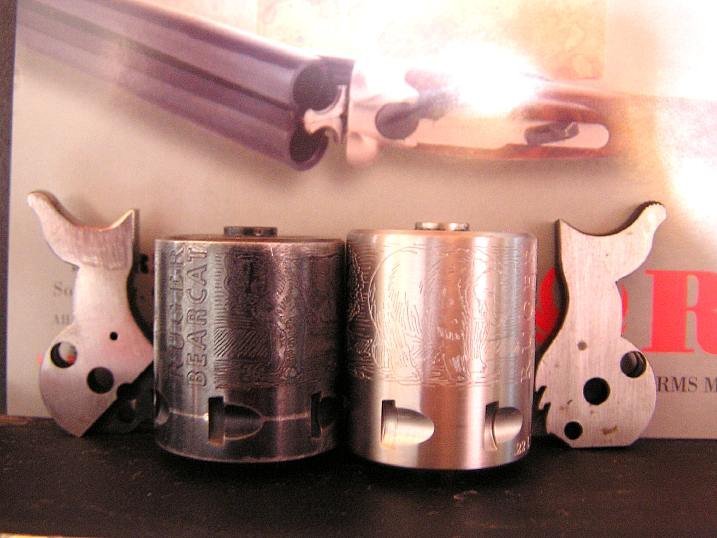
Carl Laco provided this photo comparing an old model Bearcat cylinder on the right with a new model Bearcat cylinder on the left.  Note the difference in length.

Based on this, I would think that a new model Bearcat would be one to re-chamber to .22 WRFM if one was so inclined.

Tuesday, July 12, 2011

The Ruger .45 Colt/.45 ACP New Model Flattop

The Ruger .45 Colt/.45 ACP New Model Flattop managed to find its way to the shop and into my truck.  At first blush it looks very good with fitting on par with the .44 Special FTs I have.  However, as I cocked the hammer I noticed a distinct grittiness.  The "gunfighter" faux ivory grips feel ok but I'll reserve judgement until later.  They do stand proud at the butt but very evenly so.  I may try the black grips that came on the .44 FTs, known as "cheese graters" to some, to see if the fit is any better.  I think it likely that I'm going to replace the stocks/grips on this gun simply to preserve the issue grips as they look as though they will stain or scratch easily.

The idea of a convertible gun is an old one.  In this instance, the price to me makes it a very attractive piece indeed.  In truth though, I seldom convert the guns I have.  I don't know quite why.  E.g. the USFA dome blue CCH SA has a .45 ACP cylinder and it has never even been in the gun. 

Thursday, June 02, 2011

Lipsey's does it again...

Lipsey's has prevailed upon Ruger to make 500 ea, blued and stainless, 5½" New Model Flattops in .45 Colt/.45 ACP (yes, a convertible). The Lipsey's dealer e-mail:
We are proud to announce the newest member of the Lipsey's Exclusive family of guns, the Ruger Blackhawk Flattop 45 Colt / 45 ACP Convertible.

This is the first Ruger Blackhawk Flattop chambered in the classic 45 Colt cartridge. As a bonus, we are including an additional 45 ACP cylinder. These highly anticipated revolvers will feature a blue finish, simulated ivory "gunfighter" style grips and adjustable sights. They will be built on the mid-size 357 Magnum frame and offered with a 5-1/2" barrel. A stainless steel version of the same revolver will follow shortly.

View them on the Lipseys.com Dealer website:
Blue - http://www.lipseys.com/itemdetail.aspx?itemno=RUKNVB-455X&items=exclusives
Stainless - Announcement to come
Read the full article explaining the thought process behind our newest Ruger Revolver
http://www.lipseysguns.com/post/Ruger-Blackhawk-Flattop-45-Colt-45-ACP-Convertible.aspx
Read the Gunblast.com article at http://www.gunblast.com/Ruger-Lipseys45Flattop.htm

Monday, May 16, 2011

Ruger Speed-Six Stainless 2-3/4"

Ruger Stainless 2-3/4"  Speed-Six
Years ago my first purchase of a center-fire revolver was a Ruger Stainless Security-Six.  It was a great gun and when I had to sell it to pay my lawyer for helping me keep my life I was pretty bummed.  Still, I was able to recover and later get another.  I got that first gun because I'd had a good experience with Dad's 4" blued Speed-Six.  I really liked the six series guns after owning my own Security-Six and so I wanted a matching stainless Speed-Six but with the 2-3/4" barrel.  One day at work, I lucked out and one walked in the door.  I got it.  It came with Hogue rubber which I think is ugly AND oversized.  I put the much smaller Pachmayr rubber on it (seen on left) that I'd taken off the 4" Speed-Six and waited.  I had to wait about 4 weeks but the former owner of the 2-3/4" gun brought me the factory stocks.  Add a Tyler-T grip adapter and we're good to go.  Well almost...

Speed-Six, Tyler-T and Speed Loader, all ready!
You see, the former owner must have had some sort of vision problem I don't share.  He'd painted the face of the rear sight with white enamel and then, he'd done the same to the face of the front sight.  How anyone sees white on white sights is beyond me.  A couple of quick blasts with Gun Scrubber and a scrubbing using an old toothbrush plus careful cleaning of the front sight's grooved face with a scribe and I had sights I could see and use.

Now what holster should I carry the old girl in?  Why a Bianchi Pistol Pocket made for the S&W 13, 65, 19 and 66 of course.  Works a treat.

Wednesday, May 11, 2011

Another Ruger Alphabet Bearcat...

Newest Bearcat
Once upon a time, ok, about 4 years ago, I managed to glom onto a long desired gun, a Ruger Bearcat.  I thought I was very fortunate to get an old model.  It was only coincidental that it was first year, "alphabet" gun.  They are called "alphabet" guns because Ruger, after producing the first thousand, made the next thousands by numbering them with a letter pre-fix and 001-999, changing the letter as each 3-digit number hit 999.  I know a couple of people who only collect these looking to have examples A-Z as it were.  I thought this one was neat because it is an "M" gun and M is for Madeline, my grand-daughter.  I hope she wants and I have the opportunity to give her this gun. Since I already have a "B" for myself I suppose that I now "need" to find a "K" for my grandson!

The condition is better than my other gun with only some slight bluing wear at the muzzle.  The loading gate spring tension is noticeably less than the earlier Bxxx gun.  However, when I got it it had every appearance of having been stored in a sheep shed.  This is one of those things that I was able to get by virtue of working in a gun shop.  A coworker needed money for another gun and had brought it in hoping to lure in another coworker but I was there first.  I'm glad of it, too!

I've got a nice little Simply Rugged sourdough pancake holster for the Bearcats.  Rob even included the neat inside out straps for it.

Friday, August 20, 2010

Ruger MKIII 22/45 RP

Catalog Number: P512MKIIIRP | Model Number: 10140 | Caliber: .22 LR
Material: Alloy Steel Finish: Blued
Rear Sight: Adjustable Front Sight: Fixed
Barrel Length: 5.50" Barrel Style: Bull
Length: 9.50" Height: 5.40"
Width: 1.00" Weight: 33.00 oz.
Twist: 1:16" RH Grooves: 6
Capacity: 10 Grip Frame: Zytel Polymer
MA Approved & Certified: No CA Approved: No
    Suggested Retail: $380.00    
I've been thinking I'd like to get one of these. I like that it has the 1911 grip frame angle, that it is .22 and that the grip panels have greater girth than the old style .22/45. What I don't like is the lock or that it takes different magazines than the MKII. Still, it should last the rest of my life. Then again, do I need another .22 LR pistol?

Wednesday, June 09, 2010

Lipsey's .44 Special 7½" Flat Top Ruger Blackhawk

Yesterday I made mention of the Lipsey's .44 Special 7½" Flat Top Ruger Blackhawk. I was a bit confused by a couple of serialization errors that Ruger was reported to have made. Tom R_________ was kind enough to take the time to straighten me out...
The 92 7.5 inch guns, I believe are stamped correctly at 520- . These guns are high polish blue, bisley grips, 7.5“ barrel, flat top, in 44 special.

They were to be stamped Serial # SH25-0** , a run of 100 guns for the Shootists,

I believe the first 90 or so got stamped with the correct Ruger serialization and another batch had to be produced for the Shootists serialization then sent to the engraver to be engraved Shootists 25th anniversary on the left and the Shootists motto on the right.
So what Cubrock got was a Shootist gun sans the Shootist's serial and engraving. That's really pretty neat. I got to coonfinger it and ensure that it got to a friend instead of sitting lost and lonely in my safe. That makes me feel good. Now I have to go to the dentist.

Friday, May 28, 2010

Ruger LCR Kaboom or Timing Issue?

Posted by Mike Lewis at LMS Defense Forum ...
I was conducting a Concealed Carry Handgun class on 1 May 2010. There was a student training with a Ruger LCR that she stated had less than 100 rounds previously fired through it. She was using CCI Blazer 158 grain TMJ +P ammunition, and had fired approximately 25 rounds so far in the course without any cause for concern.

The student was in the middle of firing a two round engagement drill under my supervision; she fired one round then informed me that she thought her trigger was “stuck”. I took the firearm from her, assuming that she had possibly taken the cylinder out of battery, and attempted to put the cylinder back into battery. Upon looking, I noticed that part of the frame subassembly (the barrel sheath portion) was blown off, and the barrel split. I checked to see if the cylinder was stable, and the cylinder turned slightly in my hand before apparently being bound by the split barrel. I was able to clear the weapon, at which point we removed it from the firing line and inspected shooters for injuries. As there were no injuries resulting from this failure, we examined the firearm and replaced it on the firing line with one of my revolvers a S&W J Frame that performed flawlessly), so she could continue training.

In my opinion, this was most likely not a shooter or ammunition-induced failure. I checked the owner’s manual to ensure that this firearm was rated for +P ammunition, which it is. The cylinder and topstrap show no visible damage; neither does the right side of the firearm.

It appears that the chamber was not properly aligned with the bore when the round fired, and that the bullet struck the forcing cone out of alignment. The bullet most likely took the path of least resistance, leading to the catastrophic failure of the barrel and frame subassembly.

I have spoken with the VP of Ruger, as well as sending a letter to him concerning this failure; he seemed to be very interested and understanding of our concerns.
I'd go along with the timing issue but that makes it a non-"kaboom". The bullet merely struck and destroyed a portion of the handgun "structure". You can see in the photo that the barrel didn't "explode" but the left side of the "sleeve" was struck off.  I think it is a critical issue particularly with .357 Magnum LCRs but given the many thousands of guns out there it doesn't seem a likely occurrence. I know some shooters who cycle the gun as fast as they can whenever they shoot and they haven't replicated this event.

The consensus is that what happened was that a squib (or two) was fired followed by a full-power load which bulged the barrel (as happens in such circumstances).  In this instance a bulged barrel "bursts" the outer sleeve.  It was not a timing issue. 

I don't think this particular effect would have happened with a revolver of more traditional construction.  In that instance the barrel bulges but there is nothing of different ductility to fracture off the outside of the barrel assembly. 

Monday, January 11, 2010

Flattop Crazy!


Lipsey will have a Ruger .44 Special Flattop again this year. A Bisley! $629 MSRP. Good luck!

Saturday, September 12, 2009

Ruger Speed Six 4 Inch

This was Dad's first personally owned handgun. He'd shot M1911A1s in service (and maybe others) but he'd never thought there was utility to one until I irritated the crap out of him with ideas he'd never come up with. You see, I'd go over to hang out at Jon Ridenour's Homestead Gun Shop in Harrisonburg, VA and he had the gun in the display cabinet. Of course I told Dad all about it.

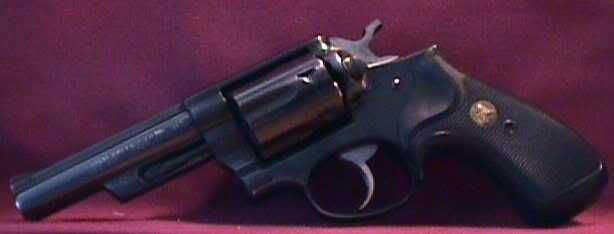
The "Six Series" guns were Ruger's competition for the Colt and S&W .38 Special/.357 Magnum police revolvers. Yep, once upon a time the police most often carried revolvers. Ruger was able to bring these onto the market for substantially less than even an S&W. This sort of excited me and in early 1973 Dad bought one and we shot it when I got home from basic training. Duke Denny had us over to his mother's place and those of us there shot the .38s and my Lyman .44 cap'n'ball. Had a great time.

Now Dad didn't shoot this gun much and I'm not sure what he used it for but he had a Hunter holster for it and he saved the box. He also shot a couple of hundred of reloads somebody (Duke?) made up for him. He let me carry it a couple of times but I had a Stainless Security Six and didn't really need to.

I've used this gun mostly for home defense duties. Nana understands how to operate it and it is of the correct size to suit her. This makes it a winner for that purpose. Speed loaders are the standard size for the S&W model 10s and such. Bianchi speed strips work a treat. I've got an Uncle Mike's paddle holster for those times it accompanies me to the field in memory of Dad. A good gun that makes me wish I hadn't sold my stainless Security Six 4" .357 Mag with the big stocks (I have a new one now).

I have also replaced the Pachmayr rubber with the factory grips and a Tyler-T grip adapter. This gives one enough to hold on to so that you can handle the .357 Magnum loads but minimizes the grip for concealed carry. The truth is that I use either Remington's 125 gr. Golden Saber .357 Mag load (a reduced velocity round) or the 158 gr. .38 Special "FBI" load. The full-effort 125 gr. .357 Magnum loads are simply too loud for me, particularly indoors. Nana absolutely hates them.