Showing posts with label Books. Show all posts
Showing posts with label Books. Show all posts
Friday, July 10, 2015
"The Generals" by Thomas E. Ricks
I just finished reading "The Generals" by Thomas E. Ricks. It was an easy read, i.e. it was easy to read, the narrative moved along well and I didn't feel as if I was being bored. This book isn't for everyone, maybe not many people at all. It concerns American military leadership, generals, from World War II to today. Mr. Ricks describes the WWII generals very well (and, yes, we still "knew" these generals during my lifetime) and goes on to explain how influential George C Marshall was on the management/selection/assignment of generals during the world war and how those management techniques were degraded (I have to agree with his opinion) and how this degradation of management and military professionalism among generals is adversely affecting our military performance today. He has some damning things to say about various generals who were pretty much media darlings during their period of ascendance. I'm glad I read it.

Wednesday, December 18, 2013
THE M1 GARAND RIFLE by Bruce Canfield

Friday, April 26, 2013
Letters from an Army Officer's Wife, 1877-1888 - Frances Mack Roe
 |
| Frances M. A. Roe wearing her husband’s West Point coatee, pictured with their dog. |
I think she must have been a fascinating person. Although she appears to have unflinchingly supported her husband's military career and followed him to some rather isolated posts she impresses me as a more "modern" woman. Frances M. A. Roe, born Frances Marie Antoinette Mack (died 6 May 1920) was the wife of U. S. Army officer Fayette Washington Roe, ultimately a Lieutenant Colonel, who was sent to Fort Lyon in Colorado Territory in 1871. She accompanied him and recorded her life during these years in a memoir. While her husband's career has been described as "unremarkable", Roe continues to be known on the basis of her book for the accurate picture of Army life it painted. Black soldiers from this period became known as the "Buffalo Soldiers"; Roe's was the first documented use of the name. Roe said of the Buffalo Soldiers:
These ‘Buffalo Soldiers’ are active, intelligent, and resolute men; are perfectly willing to fight the Indians, whenever they may be called upon to do so, and appear to me to be rather superior to the average of white men recruited in time of peace.Roe is buried with her husband in Arlington National Cemetery.
Fayette Roe’s family came from upstate New York, though he was born in Virginia. When he graduated from West Point, he married another upstate New Yorker, Frances Mack. Roe’s first post took the couple west to Colorado, and over the next fifteen years, to Montana, Utah, and the Dakotas.
Roe’s military career was an unremarkable series of clerical and administrative posts. He would have passed into obscurity had he not appeared as Frances’s beloved comrade “Faye” in her lively and perceptive account of frontier life, Army Letters from an Officer’s Wife (1909).
Captivated by the beauty of western landscapes, Frances described in telling detail the scenes and events in their army communities. She carefully balanced tales of lively social life with attention to the harsh conditions and isolation that military families endured.
Links:
- A Frontier Army Wife
One of the posts to which her husband was assigned was Fort Ellis as shown here...
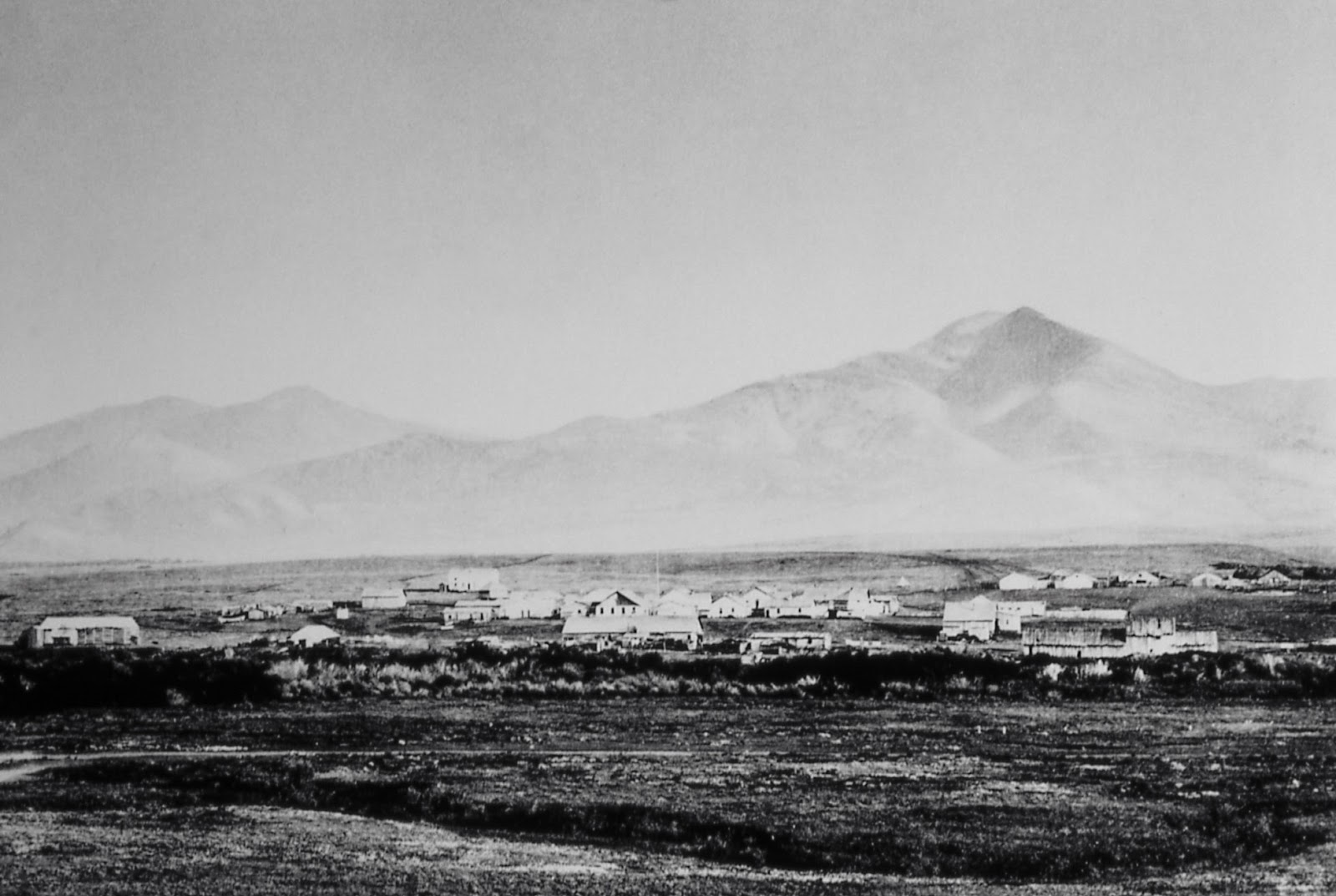
She also mentions a stint at Camp Supply...

Friday, May 18, 2012
The Winchester Model 1876 "Centennial" Rifle by Herbert G. Houze

Interestingly included as part of the development of the 1876 rifle (as part of the product improvement of the Henry rifle) is a long description of the Swiss rifle trials and the cartridges produced for those trials. Indeed, since the Swiss wanted more than the .44-40 (.44 WCF) which was a 200 gr. bullet over 40 gr. of powder, a cartridge was produced which utilized a 350-372 gr. bullet over 60 gr. of powder. Also noted is O. F. Winchester's letter criticizing the .450 Martini-Henry cartridge adopted by the British as overly powerful for infantry use. Neat stuff!
Wednesday, December 28, 2011
2012 Hodgdon Annual Manual is in stores...

Saturday, November 12, 2011
Nessmuk
Many years ago my favorite aunt, Aunt Virginia Dawn Parslow Partridge gave me a copy of "Woodcaft" by Nessmuk and I was smitten by a severe case of wanderlust. I can't tell you how often I read that book.

 At the time I read "Woodcraft" I couldn't fully comprehend the extent of the disability Nessmuk endured. When I could understand the debilitating effects of tuberculosis I was fairly amazed by what he accomplished. I'm not the only one.
Today there are any number of cutlers offering their version of Nessmuk's knife and hatchet design. Boat/canoe builders are building modern, kevlar versions of his various canoes including Sairy Gamp. His books are still in print and in demand. Most telling of all, there are any number of adherents who annually attempt to emulate a man who, while struggling with physical limitations, managed to live a full and adventuresome life.

George Washington Sears (b. December 2, 1821 – d. May 1, 1890) was a "correspondent" for Forest and Stream magazine in the 1880s and an early conservationist.Writing under the name "Nessmuk" he popularized self-guided canoe camping tours of the Adirondack lakes in open, lightweight solo canoes and what we call ultralight camping.
Typical canoe trips of the time used expert guides and heavy canoes. Sears, who was 5' 3" tall and weighed 103 pounds had a 9-foot-long, 10-1⁄2-pound solo canoe built by J. Henry Rushton of Canton, New York. He named it the Sairy Gamp used it to take a 266-mile trip through the central Adirondacks. He was 62 years old and in frail health (tuberculosis and asthma) when he did this. The Sairy Gamp is now owned by the Smithsonian Institution andon loan to the Adirondack Museum.
The eldest of ten children in South Oxford (now Webster), Massachusetts, he took his pen name from an American Indian who had befriended him in early childhood. His family had a few books about Indians and Nessmuk was fascinated and left with an abiding interest in forest life and adventure. His experience as a child working in a factory left him with a fondness for the writing of Charles Dickens. At age twelve he started working in a commercial fishing fleet based on Cape Cod and at nineteen he shipped out on a three-year whaling voyage in the South Pacific; this was 1841, the same year that Herman Melville shipped out of the same port bound for the same whaling grounds. On his return, his family moved to Wellsboro, Pennsylvania where he was to live for the rest of his life. However, he continued traveling for adventure, from the upper Midwest and Ontario to an Amazon tributary in Brazil (in 1867 and again in 1870).
Sears wrote "Woodcraft", a book on camping, in 1884, that has remained in print ever since. A book of poems, Forest Runes, appeared in 1887. He died at his home in Pennsylvania seven years later. Mount Nessmuk, in northern Pennsylvania, is named after him.

Today there are any number of cutlers offering their version of Nessmuk's knife and hatchet design. Boat/canoe builders are building modern, kevlar versions of his various canoes including Sairy Gamp. His books are still in print and in demand. Most telling of all, there are any number of adherents who annually attempt to emulate a man who, while struggling with physical limitations, managed to live a full and adventuresome life.
Thursday, August 18, 2011
A local story...
 I have a friend, John H_____, who was interested in doing a bit of genealogical research on his family. I offered to help. I really enjoy solving the mystery of who, what, when and where. In doing so I was looking for narratives on the Estaline Valley which is just north of Craigsville, VA. In my search I came across a book, "Jesse is Her Name" by Don L. Brown.
 Now this is a "novel" but it is called a novel because while the facts of who, what, when and where are absolutely true, the "how", i.e. the words exchanged by the participants (their conversations) are a matter of supposition and yet Mr. Brown has added that dialog to his family story. That is what makes it interesting, the family story part. Not much to do with the Estaline Valley really, but it touches on class, race, culture and the influences of the times (THE Depression).
It is a short book, I read it in a little over 1½ hours, but well written and it doesn't stray from the goal of telling the story that Mr. Brown wants to tell. I think he does it well. I enjoyed reading it, I enjoyed the story as history, and I really identified with the places. If you live here in Staunton or in Craigsville or even in other areas of Augusta County, you can get a real feel for the area in the 1930s and 40s by reading this book. If you have family that lived here during that time, the book might be a great way to open the door onto family history.
Again, yes, Jesse and Luther were real people. Thank you Don for sharing your story with us.

Wednesday, July 13, 2011
William F. "Buffalo Bill" Cody Autobiography
 |
| "Buffalo Bill" with Lucretia Borgia |
Much of the book is given over to Cody's life and exploits on the plains and very little to mention of his family although one does get the impression that he cared for them (at least in his "own way"). Among those stories are accounts of his buffalo killing with his 1869 Springfield Trapdoor .50-70 Government rifle, his "needle gun", Lucretia Borgia.
I've been given to understand that this is the only known photo of Cody with that rifle. It is this rifle with which Cody, on his horse Brigham, made his reputation.
We recently had one of these rifles in the shop and while it seems a bit lighter than the rifled-musket from which it was converted, it is still just as long and, I would think, ungainly on horse or in confined spaces. Clearly, Cody was extremely competent with that rifle as nearly all the accounts of his witnessed exploits agree in nearly every detail. In truth, I know of no dispute of his accounts.
Wednesday, June 22, 2011
Farmer Boy
 |
| Alonzo Wilder |
Of course, in our advanced years we now know that our perceptions aren't always accurate. Alonzo is known in his family as Almanzo. I haven't been able to discover exactly why but suspect it is because this is how his name was recorded by a census enumerator and that was likely because that is very close to way he pronounced it.
I had no idea from the book that he was born in 1857 and a contemporary of the Civil War. I don't remember a single mention being made of brothers or cousins going to war, dying, being maimed, and so forth. I suppose that Laura cleaned up the account to avoid any unnecessary conflicts, after all, she was living in Missouri at the time.
In any case it is a good book. If today's boys were to read that book I'm betting that more of them would have at least a passing idea of honor, integrity and the concept of hard work.
Saturday, June 04, 2011
A Rifleman Went to War by Captain Herbert Wesley McBride
 I recently re-read "The Emma Gees" on my Kindle and was reminded thereby of this book, "A Rifleman Went to War" by Captain Herbert Wesley McBride in 1935, just prior to his death.
 The first part of the book is almost a verbatim repetition of "The Emma Gees" but it soon takes a different path and the tone changes from the earlier book. CPT McBride manages to weave his experiences, the stories of his fellow soldiers and the war into one neatly written account of this bitterly fought war. He says that he doesn't want the book to be nor is it a history of the war but indeed it is, a very personal history.
McBride touches on his background and how his previous training as an artillery and Gatling battery officer helped him in his service with the Canadians in France during the 1915-1917 period.
His is the only first person account of use of the Warner-Swasey sight that I've read. I only wish he had written in greater detail about it. What he does say can be summed up by saying that the sight took a bit to get zeroed, had to be checked and wasn't the best but was the best for the time. To put it another way, he took the available technology and made it work.
He also talks about the practical use of the various pistols in the trenches. I had previously read that the French were using .32 ACP Browning and Ruby pistols in their trench raids and wondered how that really worked for them. By McBride's account, one wouldn't think they did so well. He strongly felt that the .45 ACP Model 1911 (which was the issue pistol for the Canadians) was the best of the lot. However, he wasn't averse to anything of .40-something caliber. He wasn't fond of the smaller caliber guns but part of that was due to the actions in which they were chambered. He also recounts how the pistols were best carried in the trench raids and security patrols between the lines.
He discusses the various artillery pieces at length. My feeling is that he felt very qualified to comment on the various pieces, their application and effectiveness. He also discussed at some length how the soldier should react to shelling and how the use of the various pieces gave indication of what the enemy intended to do. Very interesting stuff.
McBride doesn't limit himself to comments on firearms and explosives. He also talks about the edged weapons used and mentions that the Lebel ("the French bayonet") bayonet used as a sword (rather than on the rifle) was one of the best of the lot.
 |
| 21" French Lebel bayonet was McBride's trench raid favorite edged weapon |
CPT McBride even manages to discuss the espirit of the various armies involved. This is about the worst part of the book and seemed a bit disjointed to me. I think he was trying to be profound but got a bit verbose. Although he doesn't really reach beyond his personal experience some of his opinions were very similar to those I heard in the 1970s!
I really enjoyed the book and thought it was full of useful information. I was fortunate to find a Kindle version of the edition that included a prologue by that eminent expert on combat pistolcraft, COL Jeff Cooper. In that prologue he obliquely comments on the importance of CPT McBride's book on his own life and career while denying that it was the sole source of his opinions on the subject.
I think it is safe to say that every soldier (and Marine) should read this book. The practical content applies even in these days of the GPS guided munitions and the personal expressions about the war will be forever timeless.
Saturday, May 28, 2011
The Emma Gees - Captain Herman W. McBride

I thought there was much to learn beyond the recounting of his activities and actions. There is a certain attitude of expressed indifference that seemed to prevail at that time. Expressed not actual indifference. I think that he was anything BUT indifferent is shown in his efforts to avenge the deaths of his fellow soldiers or, later, to mark the death place of his friend, LCPL William Emmanuel Bouchard. One thing for certain, while McBride recounts his experiences, it is not done in a way to promote himself as in the way that a certain public figure has done with regards to the death of a terrorist leader. In truth, most comments about his own actions seem intended only to show how he was there and how he knows what happened. Neither does McBride attempt to account for activities outside his immediate location except for what he heard about those actions at that time. I found that refreshing.
The book has a number of quality photos of action at the front and maps of the trenches. Unfortunately, I am read this on my Kindle and if Kindle has a weakness it is that one can't see page size maps easily. However, the book is so good that I think one should have a hardbound copy.
Captain McBride was one of those men whose life excited the young men in the past. It was fully adventurous and exciting (before we fully understood what "adventurous" and "exciting" really meant!). An obituary for Herbert McBride from the May 1933 American Rifleman as follows:
Capt. Herbert W. McBride, Indiana National Guard, has passed away at the age of 59 years, and in his passing the shooting game has lost one of its staunchest veteran supporters. His death, which came suddenly at his home in Indianapolis, was attributed to heart trouble. Not long before, he had suffered a fractured shoulder in an automobile accident while on duty in the troublous mining area of his state. From boyhood Captain McBride, a son of the late Judge Robert W. McBride of the Indiana Supreme Court, was devoted to the outdoors and to small arms. He had a varied and colorful career. Gold mining in Alaska, logging, railroad construction work in the Yukon and northern British Columbia, exploring, hunting and fishing widely, wars - all these formed interesting chapters of activity in his life. Biology, geology, ethnology, anthropology, botany and entomology, in addition to his long devotion to shooting, all claimed his attention. As a writer, too, Captain McBride was not unknown, in which connection it might be mentioned that a story written by him "Dog Eat Dog," a narrative of one of his sniping experiences in the World War, will appear in an early issue of The American Rifleman. Captain McBride had handled about every type of small arms extant during his lifetime. His fondness for guns was acquired in his tender years, and he had shot his first deer and wild turkey before he was 10 years old. As a member of the Indiana National Guard Team he shot at the National Matches from 1905 to 1911 inclusive, and he won the Indiana State Championship in 1905, 1906 and 1907. Also, he attended six National Matches after 1919. He was the organizer of the Indiana State Rifle Association and many rifle clubs, and served as N.R.A. State Secretary for Indiana for a number of years. Captain McBride always maintained a close association with some military organization from March, 1888, up until the time of his death. He was associated with the Military Smokeless Powder Division of the Du Pont Company from 1907 to 1912, going back to British Columbia in 1912, where he ranged all along the Upper Frazer in connection with the building of the Grand Trunk Pacific Railroad. In 1914 he was in command of a company of the Indiana National Guard, but resigned and went to Canada where he served as captain and military instructor in the 38th and 21st Battalions until the latter was sent overseas in May, 1915. He then resigned his commission and accompanied the battalion as a private machine gunner. He served overseas until early in 1917, when he was invalided home. Reaching this country late in April, he was assigned to duty as an instructor. He served throughout the remainder of the war in that capacity. when the Small Arms Firing School was organized at Camp Perry in May, 1918, he was one of the first instructors. Captain McBride, before wounds cut short his was service, was decorated with the British Military Medal for capturing 12 machine guns at the Battle of St. Eloi in Flanders in 1916, the Medaille Militaire for invading the German lines and capturing a German flag, and the Croix de Guerre. He was wounded seven times. In addition to his service in the World War, Captain McBride also saw service in the South African Boer War. Following the war, Captain McBride spent most of his time in Washington and Oregon, returning to Indianapolis about 18 months ago.

Wednesday, May 04, 2011
Lincoln Apostate The Matson Slave Case By Charles R. McKirdy

How the "Great emancipator" found himself in court defending a slave owner's claim to human chattelsI've received mine and am only about half way through the 1st chapter so a review will have to wait.
In 1847, in a small rural courthouse in Coles County, Illinois, Abraham Lincoln represented a Kentucky slave owner named Robert Matson in his attempt to recover a runaway slave woman and her four children. Most Americans, even those with a penchant for the nation's history, have never heard of this court case. This is no coincidence. Lincoln's involvement in the case has troubled and bewildered most students and biographers of the "Great Emancipator." In many assessments, the case inspires rationalizations and distortions; in others, avoidance and denial. These approaches are a disservice to the man and to those who seek to understand him.
In Lincoln Apostate: The Matson Slave Case, lawyer and historian Charles R. McKirdy digs behind the myths and evasions to determine why Lincoln chose to advocate property rights grounded in a system that he claimed to abhor and pursue the continued enslavement of five of its most vulnerable and sympathetic victims. In a careful and readable blend of narrative and analysis, the book finds the answer in the time and place that was Lincoln's Illinois in 1847, in the laws and judicial decisions that provided the legal backdrop against which the drama of the Matson case was played out, and in the man that Lincoln was thirteen years before he became president.
The discussion of Lincoln's decision to represent Matson and the description of the trial itself take nothing at face value. The author examines primary and secondary sources for the ribbon of truth shorn of preconceptions and hollow justifications. Lincoln Apostate scrutinizes Lincoln's motives for choosing as he did and explores the ideals and fears of this very complex man.
Charles R. McKirdy, Poway, California, litigated cases for twenty-five years in the state of Illinois and holds a Ph.D. in history and a law degree from Northwestern University. His work has been published in the American Journal of Legal History, the Journal of Criminal Law and Criminology, and the Journal of Legal Education.
176 pages (approx.), 6 x 9 inches, bibliography, index
Monday, April 25, 2011
Remington Rolling Block Military Rifles of the World by George Layman
 As I noted previously there are multitudinous variations of the Remington System rifles. In this book, "Remington Rolling Block Military Rifles of the World", George Layman attempts to make sense of it all, or at least most of it in his examination of the military rifles.
 This is a great book. Mr. Layman can write in a way that is easy to follow and understand and has an obviously genuine interest in the topic. The photography is excellent and there are a number of items to interest even the general or military historian.
Friday, April 22, 2011
1911 The First 100 Years by Patrick Sweeney
 |
| I really like the 29 ID insignia! |
1911 The First 100 Years by Patrick Sweeney is the latest book to rest in my lap and make the journey to the "reading" room. I had seen the paperback version in Books-a-Million and Barnes and Noble but couldn't bring myself to pay full retail for it (sorry Mr. Sweeney). I couldn't even get myself to allow Amazon to ship a copy. However, I got an emailed offer from Gun Digest Books for this and several other books on then 1911 at considerable savings for all and couldn't resist. Yesterday a large box containing the books was dropped off by the mailman. It wasn't until last night that I had the time to open the box and to peruse its contents.
The other books were paperback and so I was a bit surprised, as I worked my way to the bottom of the stack, to find this one in hardbound form. Wow!, this really seems to have upped the quality of the publication over the paperback version. That is immediately apparent in the quality of the photographs, and there are a bunch, of wonderful pistols throughout the book.
Equally wonderful are the photograph captions. Usually there is very little information in a caption, but Sweeney has and his editor has permitted, extensive comments in the captions. If there was no other content, this book might well be worth the price for the photos and captions alone. But, there is prose aplenty in this book. I've read Sweeney's other stuff and I thought it was "good enough", a backhanded compliment if there ever is one. In this book it is apparent that Sweeney loves and I mean LOVES this subject and this book was a labor of love. His writing is concise and organized when making technical descriptions. But there is more. Clearly, Sweeney loves the stories behind the choices and acts made by the designers, manufacturers, customers (the governments), and the end users civilian or military. To say that this adds to the quality of the book is an understatement but this book is the whole package. Wonderful illustrations, a certain exuberance in writing style that is easy to follow and a wealth of information certain to entertain and delight any enthusiast or neophyte.
Thursday, April 07, 2011
Savage Pistols by Bailey Brower Jr.

I've been interested in Savage Pistols for a long time. As some people have pointed out, I have an interest in the smaller "pocket" pistols and revolvers and most of the Savages fall into this category. Unfortunately there has been a dearth of information on the subject.
In Savage Pistols, author Bailey Brower Jr. tells the remarkable story of Savage Arms, from its humble beginnings with Arthur Savage in the late 1880s to the creation of the last pistol in the late 1920s. Bailey explains the evolution of the Savage pistol, the role of Savage pistols in World War I, and the pistol’s connection to such historical figures as Buffalo Bill Cody, Bat Masterson, and William Pinkerton. This information-packed book includes hundreds of photographs of Savage pistols and rifles, cartridges, holsters, and other Savage products, as well as fascinating advertisements and illustrations.This book also provides a lot of info on the 1910 service pistol trails and the Savage .45 ACP pistol(s). Great history there. The numerous photos are excellent. I also liked the fact that large format photos were used making discernment of various markings and features easy to see and understand.
The explanations of various finishes and such is so good the internet listings of these pistols was much easier to understand and the various relative values easier to understand.
I was very fortunate to get my copy at the Green Valley Book Fair just outside of Mount Crawford, VA for $7.00 and tax. Published price is $49.95.
Thursday, March 17, 2011
From Ingot to Target: A Cast Bullet Guide for Handgunners©
If you cast your own bullets you've probably got a couple of references. There's the Lyman loading manual for cast bullets and then maybe you've got the NRA compilation by C. E. Harris on casting. Well, here's a reference you probably need! From Ingot to Target: A Cast Bullet Guide for Handgunners© by Glen E. Fryxell and Robert L. Applegate.
If there is any fault with From Ingot to Target: A Cast Bullet Guide for Handgunners© it is that there isn't a paper/print version you can have down at the loading bench for reference or to carry to the reading room for entertainment/diversion. Yes, I have a Kindle, but I still have a place in my home for the old fashioned printed work.
Mr. Fryxell and Mr. Applegate have joined forces to produce an genuinely useful reference lacking in the old wive's tales one used to read in magazine articles on casting. There is plenty of clearly and concisely presented information which, if acted on, will allow anyone to produce accurate, useful, quality bullets.
If there is any fault with From Ingot to Target: A Cast Bullet Guide for Handgunners© it is that there isn't a paper/print version you can have down at the loading bench for reference or to carry to the reading room for entertainment/diversion. Yes, I have a Kindle, but I still have a place in my home for the old fashioned printed work.
Mr. Fryxell and Mr. Applegate have joined forces to produce an genuinely useful reference lacking in the old wive's tales one used to read in magazine articles on casting. There is plenty of clearly and concisely presented information which, if acted on, will allow anyone to produce accurate, useful, quality bullets.
Wednesday, March 09, 2011
The Kindle
Originally 12/28/10, updated 3/8/2011
I've got to say that I have been ambivalent about the Kindle with 3G service. I'm a fan of the tactile experience of reading a book or magazine and I like to see the color illustrations. Like all children, I like illustrations. After registering, my first book was Jeff Cooper's, "Art of the Rifle". One thing I like is that I am able to but the "book" down (turn it off) and come back right to where I left it. I can search for other such books from this one. I can search by author or title. Still, there is something to turning the page, smelling the ink, etc. Intangible pleasures not available in the digital version. Also, since Nana got one, I've had a bit of a problem working two Amazon accounts off one e-mail address. However, now that her account is functioning, we can let it be as she orders off the Kindle device with one-click payment. One of the biggest selling points of the Kindle for me is the accessibility of free, pre-1923, books. I am particularly interested in Theodore Roosevelt's writings. Heretofore one had to buy a print version or lug it back from the library IF you could find a copy there. This will be infinitely easier.
The 3G Kindle would seem to be a bargain as one doesn't pay for the service but can surf the net using Google and Wikipedia (which is neither awful nor exemplary but is useful) as a starting point.
We have had a problem with Nana's Kindle cover. A patent leather looking folder with what appears to be a felt lining and a hook system to secure the Kindle to the cover, it certainly doesn't have a high-tech appearance but it must be. You see as soon as I put the Kindle in the cover the device kept rebooting. Finally, it locked up and had to be manually reset. I called customer service and as soon as I explained what was happening the tech on the other end told me to take the cover off. It has worked perfectly since. We tried re-installation of the cover with the exact same problem. Another call to Amazon and I was told that the cost of the cover would be reimbursed to Nana's account and to order another cover. I did so. Knock on wood.
The new Kindle cover worked just fine, for me. Nana had it in hand for about 10 minutes and it started to reboot. I took off the cover and it worked fine. I think I've discovered the problem. It is in how she holds the Kindle when in the cover. She holds it in such a way that the power switch on the bottom of the Kindle is pushed to the right and held for over 15 seconds which causes it to reboot. She doesn't hold it the same way out of the cover and so doesn't get this effect. She's now using it without the cover but my use with the cover shows that it doesn't reboot.
My kindle reading list...
Links:
- Note on Kindle Cover Problem
I've got to say that I have been ambivalent about the Kindle with 3G service. I'm a fan of the tactile experience of reading a book or magazine and I like to see the color illustrations. Like all children, I like illustrations. After registering, my first book was Jeff Cooper's, "Art of the Rifle". One thing I like is that I am able to but the "book" down (turn it off) and come back right to where I left it. I can search for other such books from this one. I can search by author or title. Still, there is something to turning the page, smelling the ink, etc. Intangible pleasures not available in the digital version. Also, since Nana got one, I've had a bit of a problem working two Amazon accounts off one e-mail address. However, now that her account is functioning, we can let it be as she orders off the Kindle device with one-click payment. One of the biggest selling points of the Kindle for me is the accessibility of free, pre-1923, books. I am particularly interested in Theodore Roosevelt's writings. Heretofore one had to buy a print version or lug it back from the library IF you could find a copy there. This will be infinitely easier.
The 3G Kindle would seem to be a bargain as one doesn't pay for the service but can surf the net using Google and Wikipedia (which is neither awful nor exemplary but is useful) as a starting point.
We have had a problem with Nana's Kindle cover. A patent leather looking folder with what appears to be a felt lining and a hook system to secure the Kindle to the cover, it certainly doesn't have a high-tech appearance but it must be. You see as soon as I put the Kindle in the cover the device kept rebooting. Finally, it locked up and had to be manually reset. I called customer service and as soon as I explained what was happening the tech on the other end told me to take the cover off. It has worked perfectly since. We tried re-installation of the cover with the exact same problem. Another call to Amazon and I was told that the cost of the cover would be reimbursed to Nana's account and to order another cover. I did so. Knock on wood.
The new Kindle cover worked just fine, for me. Nana had it in hand for about 10 minutes and it started to reboot. I took off the cover and it worked fine. I think I've discovered the problem. It is in how she holds the Kindle when in the cover. She holds it in such a way that the power switch on the bottom of the Kindle is pushed to the right and held for over 15 seconds which causes it to reboot. She doesn't hold it the same way out of the cover and so doesn't get this effect. She's now using it without the cover but my use with the cover shows that it doesn't reboot.
My kindle reading list...
Links:
- Note on Kindle Cover Problem
Friday, December 10, 2010
The Nitro Express Forum has a Neat Feature
Nickudu has got a number of books in digital form. Makes a great reading list as well!
Tuesday, September 21, 2010
The Accurate Rifle by Warren Page

One of the first things that strikes me about the book is all the now historical information contained therein. However, aside from that, the data here is usable by all shooters to understand accuracy in all of the rifle shooting sports.
- What We Can Learn From Lefty by David E. Petzal
Thursday, September 16, 2010
Ruger and His Guns

Content, yes, there is content galore. Bits and pieces of personal remembrances from family, friends and co-workers/employees. Interesting stuff I don't think you'll find elsewhere. I had always wanted to meet Mr. Ruger but now I feel as I've gotten about as close to him as I ever would have. But there are also asides that give information on the various people who have influenced the products and sales (through their illustrations) and there is information on the financial workings of the company. Not a whole lot of detail but enough to explain why the company has cash in the bank today. That bodes well for American shooters because, unlike other firearms companies, Ruger is in a position to weather the storm of the current recession.
I should point out that the book isn't up to date in that it cuts off sometime before 2010. That shouldn't matter to the aficionado of Ruger firearms.
Subscribe to:
Comments (Atom)