Showing posts with label Winchesters. Show all posts

Sunday, May 25, 2014

Winchester Model 52C

Introduced in 1920, the Model 52 was considered by many to be the first reliable .22 RF bolt-action repeater built for accuracy. Beginning in 1918, the Winchester company put Thomas Crossley Johnson and Frank Burton to the task of designing the new match rifle. Intended to replace the 1885 single-shot and appeal to the army and returning doughboys for use in target matches (and hopefully, military training), the gun went into production in April of 1920. The gun was produced on machinery originally used to build 1917 rifles for the army.

The 52 action is a rear locking, non-rotating bolt in a cylindrical receiver which is machined from a forged billet. It has dual opposing spring claw extractors which also provide controlled cartridge feeding. There is a fixed, blade type, ejector.

In 1935 the single-shot adapter was introduced. This is a dummy magazine with a shaped top, to facilitate manual loading. My rifle came with one of these as well as 2 standard magazines and a body for another single-shot adapter. In 1951 Harry Sefried's two-lever Micro-Motion trigger was introduced. Adjustable for pull-weight between 2.5 and 6 lbs, and travel between .030 and an almost imperceptible .003 inches, the Micro-Motion was an instant success, and considered the new state of the art in match rifle trigger locks. The Marksman stock, a heavy Laudensack-designed match stock with high comb and full beavertail forearm was introduced in 1936. It outsold the Standard Target Stock, which it eventually replaced. Instead of the standard stock's external barrel band, the Marksman used a light band fixed inside the squared-off fore-end; this would be replaced by a pillar mount after the war (Marksman 1A). There were two slightly different versions: the Marksman 1 for telescopic or high scope-level sights, and the Marksman 2 (1938) for standard-height sights.

I was very fortunate to purchase my rifle from a consignment at the shop. Manufactured in 1955 it came with the scope blocks and Olympic sights. I ordered a Weaver T-36 scope with 1/8-minute dot reticule and a Ken Viani mount.

View of the mount from the left...
The Viani mount utilizes the same threaded holes as the Redfield aperture sight for mounting. I was fortunate in that I got a single-shot adapter and two magazines with the rifle. The Ken Viani mount is a neat piece of work. Very well made it fits as it should and finished as it should be. I am very pleased.

Thursday, April 17, 2014

A New Game

Well, I've been suckered into shooting in our club's .22 LR benchrest matches. Of course I don't (didn't) have a suitable rifle. Most shoot an Anschutz but a couple of fellows use BSA tilting blocks. I put it off but the combined pressure of the wife wanting me to make the club membership "worth the money" by shooting more and various and sundry urging me to shoot came to a head yesterday when I stopped by the shop to work out some scheduling details (which have yet to be worked out). The boss wasn't there but my co-worker and good friend Wayne pointed out that a Winchester 52C HB target had come in on consignment. I didn't think that I could afford to pay what it was worth but put some money down to make sure it didn't get out the door with somebody else.

Made in 1955, with globe and aperture sights as well as scope blocks it is set up as a small bore rifle. However, these have a big flat forearm which should work well on the rest. Then I got a little research done and was thinking I'd have to D&T for mounts suitable for a more modern scope and also discovered that it was more than I'd initially thought.

So, today, I went in to get my money and put it back on the market. The boss man was there and I fell over when he said he'd let me have it for what the consignor wanted, $825. Now I will have to find an adapter bracket for the Lyman/Unertl block(s) or a mount that uses the rear sight mounting holes. It does need some loving cleaning on the exterior. I will also have to find some better ammo.

Links:
- Dewey Greiner's Classic Unertl Scopes
- Evolution Gun Works
- Gary Fellers Sights & Scopes
- Parson Scope Service

Tuesday, July 16, 2013

Winchester Model 47

Winchester Model 47 Target
The Winchester Model 47 is a single-shot bolt action .22 rimfire for the .22 Short, .22 Long and .22 Long Rifle cartridges.  Shown at left is the target version but most of the 40,000 some rifles produced between 1949 and 1954 had the standard open rear sight like mine (shown at the bottom of this article).  The gun is pretty neat in that the safety is automatically set every time you work the bolt.  I like it a lot despite the noticeably stiff trigger.

PS - I've been shooting this gun a lot with Aguila Colibri ammo. Nothing but a little click as the firing pin falls and another "ting" when the little 20 gr. bullet hits the steel backstop. It gave me a pretty good group!


Wednesday, September 01, 2010

Winchester 1894 Production Dates and other Information

Many people have questions as to the date of manufacture or age of their Winchester Model 1894 and Model 94 rifles and carbines. There are a number of references, some with conflicting information. I am making this information available partially to save a copy for myself! It is up to the collector to use and properly interpret the information provided.

You can contact the Records Office of Cody Firearms Museum at the Buffalo Bill Historical Center. The Cody Firearms Museum holds the records of 3.5 million individual Winchester firearms and many LC Smith and Marlin firearms.

Information that may be in a record includes the date the gun was received into the warehouse, the configuration of the gun, and the date the gun shipped out. The company to whom the gun was sent may be available for very late Model 1873s and 1886s and most of the run of the Model 21. There are no records for the Models 42, 12, 54, or 70.

There is a charge for Factory Letter information but this and any other questions should be answered by contacting the Records Office.

Cody Firearms Museum Records Office
720 Sheridan Avenue
Cody, Wyoming 82414
307-578-4117
cfmrecords@bbhc.org
www.bbhc.org/firearms/records.cfm

Winchester 1894/94 Serial Number List
Determining date by serialization has become confusing as it has been determined by the staff of the Cody Firearms Museum that previous work by George Madis is incorrect. This is not due to the quality of work performed by Mr. Madis, but by the questionable data provided to him. The following list includes the data held at the Buffalo Bill Historical Center in Cody Wyoming (CFM) and the previously understood figures (Madis). It is up to the collector to make the best use of this data that they can.
1894 end of year serial number was 1674 (CFM), 14579 (Madis)
1895 end of year serial number was 14222 (CFM), 44359 (Madis)
1896 end of year serial number was 18571 (CFM), 76464 (Madis)
1897 end of year serial number was 33108 (CFM), 111453 (Madis)
1898 end of year serial number was 53941 (CFM), 147684 (Madis)
Any gun manufactured prior to January 1, 1899 is legally an Antique and is not affected by any federal regulations regarding the ownership or transfer of firearms.
1899 end of year serial number was 80148 (CFM), 183371 (Madis)
1900 end of year serial number was 103932 (CFM), 204427 (Madis)
1901 end of year serial number was 137058 (CFM), 233975 (Madis)
1902 end of year serial number was 168420 (CFM), 273854 (Madis)
1903 end of year serial number was 204565 (CFM), 291506 (Madis)
1904 end of year serial number was 249782 (CFM), 311363 (Madis)
1905 end of year serial number was 291706 (CFM), 337557 (Madis)
1906 end of year serial number was 331895 (CFM), 378878 (Madis)
1907 end of year serial number was 381524 (CFM), 430985 (Madis)
1908 end of year serial number was 429757 (CFM), 474241 (Madis)
1909 end of year serial number was 449102 (CFM), 505831 (Madis)
1910 end of year serial number was 479073 (CFM), 553062 (Madis)
1911 end of year serial number was 534429 (CFM), 599263 (Madis)
1912 end of year serial number was 591281 (CFM), 646114 (Madis)
1913 end of year serial number was 645304 (CFM), 703701 (Madis)
1914 end of year serial number was 722280 (CFM), 756066 (Madis)
1915 end of year serial number was 825186 (CFM), 784052 (Madis)
1916 end of year serial number was 840846 (CFM), 807741 (Madis)
1917 end of year serial number was 873425 (CFM), 821972 (Madis)
1918 end of year serial number was 882032 (CFM), 838175 (Madis)
1919 end of year serial number was 895365 (CFM), 870762 (Madis)
1920 end of year serial number was 926851 (CFM), 880627 (Madis)
1921 end of year serial number was 935778 (CFM), 908318 (Madis)
1922 end of year serial number was 951501 (CFM), 919583 (Madis)
1923 end of year serial number was 964709 (CFM), 938539 (Madis)
1924 end of year serial number was 974121 (CFM), 953198 (Madis)
1925 end of year serial number was 987148 (CFM), 978523 (Madis)
1926 end of year serial number was 997938 (CFM), 997603 (Madis)
1927 end of year serial number was 1012753 (CFM), 1027571 (Madis)
1928 end of year serial number was 1038665 (CFM), 1054465 (Madis)
1929 end of year serial number was 1060899 (CFM), 1077097 (Madis)
1930 end of year serial number was 1071420 (CFM), 1081755 (Madis)
1931 end of year serial number was 1079689 (CFM), 1084156 (Madis)
1932 end of year serial number was 1088141 (CFM), 1087836 (Madis)
1933 end of year serial number was 1092328 (CFM), 1089270 (Madis)
1934 end of year serial number was 1095364 (CFM), 1091190 (Madis)
1935 end of year serial number was 1099625 (CFM), 1099605 (Madis)
1936 end of year serial number was 1119104 (CFM), 1100065 (Madis)
1937 end of year serial number was 1158835 (CFM), 1100679 (Madis)
1938 end of year serial number was 1198405 (CFM), 1100915 (Madis)
1939 end of year serial number was 1216165 (CFM), 1101051 (Madis)
1940 end of year serial number was 1259563 (CFM), 1142423 (Madis)
1941 end of year serial number was 1313301 (CFM), 1191307 (Madis)
1942 end of year serial number was 1343183 (CFM), 1221289 (Madis)
1943 end of year serial number was 1343190* (CFM), 1267741* (Madis)
1944 end of year serial number was 1343196 (CFM), 1314193* (Madis)
1945 end of year serial number was 1352066 (CFM), 1360645* (Madis)
1946 end of year serial number was 1407097* (Madis)
1947 end of year serial number was 1453549* (Madis)
1948 end of year serial number was 1500000 (Madis)
1949 end of year serial number was 1626100 (Madis)
1950 end of year serial number was 1724295 (Madis)
1960 end of year serial number was 2469821 (Madis)
1963** end of year serial number was 2586000 (Madis)
1964*** end of year serial number was 2700000 (Madis)
1965 end of year serial number was 2894428 (Madis)
1966 end of year serial number was 2991927 (Madis)
1967 end of year serial number was 3088458 (Madis)
1968 end of year serial number was 3185691 (Madis)
1969 end of year serial number was 3284570 (Madis)
1970 end of year serial number was 3381299 (Madis)
1980 end of year serial number was 4892951 (Madis)
1981 end of year serial number was 5024957 (Madis)
1982 end of year serial number was 5103248 (Madis)
Estimate after 1982 by adding 100000 per year.
* Some serial numbers produced during and after World War II were not recorded. These serial number figures assume an equal number produced each year of these gaps in the record.
** 1963 saw the end of the classic Winchesters made with hand-finished cast parts.
*** 1964 began with 2700000 and ended with 2797428. Numbers 2586001 through 2699999 were not used.
Website
http://www.bbhc.org/firearms/
http://armscollectors.com/sn/winlookup.php

Correction to Kennedy's Information
The following Corrections to David Kennedy's data given about are submitted by:
TexasBear10@netscape.net
7/10/2010

The information by David Kennedy and posted here are of great value to Winchester collectors and the following corrections should in no way take away from his valuable work. He is now aware of this error and has not had time to make a correction. He just assumed that the tables published by others were taken from Madis information.

The dates attributed to Madis by Kennedy do not agree with those in Madis' books: The Winchester Book & Winchester Handbook. They do agree with the dates in Schwing, Pirkle (and most "Others") books & tables. The differences are:

1894: 1674 (CFM); 14579 (attributed to Madis, really "Others" 14759 (actual Madis)
Notice the transposing of the "57" and "75" in these dates? Which is correct?

Then in 1933 the dates attributed by Kennedy to Madis start varying from what is published in his books, and by 1936 take a major deviation:

1933: 1092328 (CFM), 1089270 (attributed to Madis, really "Others") 1,089,271 (actual Madis)
1934: 1095364 (CFM), 1091190 (attributed to Madis, really "Others") 1,091,192 (actual Madis)
1935: 1099625 (CFM), 1099605 (attributed to Madis, really "Others") 1,099,608 (actual Madis)
1936: 1119104 (CFM), 1100065 (attributed to Madis, really "Others") 1,112,194 (actual Madis)
1937: 1158835 (CFM), 1100679 (attributed to Madis, really "Others") 1,138,781 (actual Madis)
1938: 1198405 (CFM), 1100915 (attributed to Madis, really "Others") 1,169,370 (actual Madis)
1939: 1216165 (CFM), 1101051 (attributed to Madis, really "Others") 1,197,211 (actual Madis)
1940: 1259563 (CFM), 1142423 (attributed to Madis, really "Others") 1,238,584 (actual Madis)
1941: 1313301 (CFM), 1191307 (attributed to Madis, really "Others") 1,287,648 (actual Madis)
1942: 1343183 (CFM), 1221289 (attributed to Madis, really "Others") 1,317,830 (actual Madis)
1943: 1343190* (CFM), 1267741* (attributed to Madis, really "Others") 1,348,192 (actual Madis)
1944: 1343196 (CFM), 1314193* (attributed to Madis, really "Others") 1,378,554 (actual Madis)
1945: 1352066 (CFM), 1360645* (attributed to Madis, really "Others") 1,408,916 (actual Madis)

*Some serial numbers produced during and after World War II were not recorded. These serial number figures assume an equal number produced each year of these gaps in the record.
Also, the numbers given by Kennedy, attributed to Madis, for 1951 - 1962 are those given by "Others," not Madis.


Bert Hartman, a moderator on Gunbroker's "Ask the experts" for many years, has spent for the past 5 years at least two weeks a year with a volunteer at the Cody Museum of Firearms research room.  This is is what he says.

"A bored mind is a terrible thing to waste, so having some free time to kill, I finally put together a fact sheet on the true production ratios and the verified DOMs for the Winchester Model 1894/94.

As many of you will undoubtedly note, the figures I have compiled below vary significantly from the numbers published by George Madis in his tomes "The Winchester Book" and "The Winchester Handbook". All of my statistical numbers were derived from a detailed survey (conducted by the Cody Firearms Museum) of the first 353,999 serial number records, and from the Polishing Room Serialization Record Books (held by the Cody Firearms Museum).

Unfortunately for all of the many collectors and interested people, all of the remaining pre-64 factory warehouse records (serial numbers 354,000 - 2,600,000+ were destroyed in a fire in the late 1950s or early 1960s. Undoubtedly, all of the caliber, and the Rifle versus Carbine production number ratios would change drastically if the records were available for serial numbers 354,000 - 2,600,298. The Polishing Room Serialization Record Books (PRSRBs) which contain nothing more than just the serial number, fortunately survive up to serial number 1,352,066, which was manufactured on December 29th, 1945.

For all of the many people who collect the Model 1894/94, this information should be both very enlightening and useful, and I highly encourage everyone to save a copy of it.

Production ratios for the first 353,999 Model 1894s made:

4:5 (78.19%) were Rifles (276,780)
1:5 (21.20%) were Saddle Ring Carbines (75,075)

1:2 (45.92%) was a 30 W.C.F. (162,568)
1:5 (22.80%) was a 38-55 (80,734)
1:9 (11.31%) was a 32-40 (40,023)
1:9 (10.45%) was a 25-35 W.C.F. (36,999)
1:11 (8.77%) was a 32 W.S. (31,050)

1:13 (7.60%) were Take Down Rifles (26,934)

9:10 (91.6%) had a full length magazine (324,270)
1:13 (7.51%) had a 1/2 magazine (26,579)
1:688 (0.15%) had a 2/3 magazine (515)
1:770 (0.13%) had a 3/4 magazine (459)
Just (1) gun had a 7/8 magazine

1:20 (5.02%) had a shotgun butt (17,768)
1:584 (0.17%) carbines had rifle butt plates (606)
1:1655 (0.06%) had a Swiss butt plate (209 rifles, 5 carbines)
1:3308 (0.03%) rifles had carbine butt plates (107)

1:26 (3.88%) rifles had pistol grip stocks (13,703)
1:34 (2.97% had checkered stocks (10,512)
1:718 (0.14%) carbines had pistol grip stocks (493)
1:4023 (0.025%) had carved stocks (81 rifles, 7 carbines)
1:9567 (0.01%) had a cheek piece (37)

1:69 (1.46%) had a double-set trigger (5,153)
1:70800 (0.0014%) had a single set trigger (5)

1:3026 (0.033%) were nickel plated (117)
1:3978 (0.025%) were silver or gold plated (89)

1:668 (0.15%) were inscribed (530)
1:998 (0.10%) were engraved (355)
Just (1) gun had a matted receiver (on the frame ring)

1:1744 (0.057%) had a matted barrel (200 rifles, 3 carbines)
1:3000 (0.033%) rifles had interchangeable barrels (TD) (118)

1:2255 (0.044%) had a case hardened receiver (155 rifles, 2 carbines)

1:88500 (0.0011% had a factory installed scope (4)
Just (1) rifle had a factory installed Maxim silencer (Teddy Roosevelt’s)

(2067) records are blank
(184) were sold as receivers only

Serial number 53,941 is the last “Antique” number based on the information in the Polishing Room records.

For the years 1894 through 1945, the DOMs published by George Madis (and copied/republished by nearly every other reference book or internet website) do not agree with the original surviving factory records (the factory warehouse ledgers and the PRSRB records), and they are inaccurate by nearly four years in the 1896 - 1914 timeframe.

Winchester began producing Model 94s at an accelerated pace starting in 1935. By the end of the year 1935, Madis' published DOM list and the PRSRB records only differ by just (17) serial numbers (1099625 versus 1099608), but they rapidly begin to diverge in the ensuing years.

Winchester's production of the Model 94 averaged about 35,000 units per year for the next (7) years (1936-1942 inclusive), and once again, Madis’ published numbers diverge from the PRSRB records. The PRSRB records end at serial number 1,352,066, which is listed as the last Model 94 serial number recorded on December 29th of 1945.

Following WW II, Winchester averaged approximately 100,000 Model 94s per year from 1946 - 1953, then about 55,000 per year through 1963. The numbers I have listed below are estimates that are based on my research survey, and they should not be relied upon to determine an "exact" DOM.

1946 ended at circa serial number 1,411,000
1947 ended at circa serial number 1,470,000
1948 ended at circa serial number 1,560,000
1949 ended at circa serial number 1,660,000
1950 ended at circa serial number 1,760,000
1951 ended at circa serial number 1,875,000
1952 ended at circa serial number 1,960,000
1953 ended at circa serial number 2,045,000
1954 ended at circa serial number 2,100,500
1955 ended at circa serial number 2,156,000
1956 ended at circa serial number 2,211,500
1957 ended at circa serial number 2,267,000
1958 ended at circa serial number 2,322,500
1959 ended at circa serial number 2,388,000
1960 ended at circa serial number 2,453,500
1961 ended at circa serial number 2,510,000
1962 ended at circa serial number 2,564,500
1963 ended at circa serial number 2,600,300

Winchester changed the designation from "Model 1894" to "Model 94" very shortly after a "Change in Manufacture Order" was issued by Frank F. Burton on February 2nd, 1919.

The following list contains verified Model 1894 dates based on the factory warehouse ledgers (held by the Cody Firearms Museum). The actual DOMs listed in the PRSRB will typically precede the "received in warehouse" date by an average of 4-weeks.:

EDIT: I recently added a very significant number of new serial numbers to this list. It should now very clearly show the progression of verified dates of manufacture. I do not plan to add any additional new serial numbers to the list on this post. That said, I am still updating my personal database survey with additional verified numbers. If anyone would like to contribute to the survey, please send me a PM.

Serial*** Received Date
22 - 10-20-1894
61 - 11-27-1894
90 - 12-7-1894
136 - 11-1-1894 (1st Takedown received)
137 - 11-14-1894
139 - 11-14-1894
165 - 12-8-1894
170 - 11-2-1894
204 - 12-1-1894
257 - 11-13-1894
266 - 11-12-1894
309 - 11-6-1894
338 - 1-5-1895
563 - 11-21-1894
603 - 11-22-1894
604 - 11-23-1894
624 - 12-10-1894
679 - 11-24-1894
734 - 2-2-1895
814 - 12-8-1894
832 - 2-16-1895
988 - 12-10-1894
1296 - 12-26-1894
1368 - 12-29-1894
1673 - 2-4-1895
1835 - 3-5-1895 (1st engraved)
2465 - 8-12-1895
3314 - 5-29-1895 (1st 30 W.C.F.)
3559 - 4-26-1895
4176 - 4-18-1895
4598 - 6-10-1895
4762 - 6-29-1895
5014 - 7-18-1895 (1st 25-35 W.C.F.)
5044 - 8-1-1895
5047 - 9-6-1895
5579 - 9-13-1895
5860 - 8-29-1895
6506 - 10-3-1895
7566 - 10-17-1895
11020 - 12-10-1895
12356 - 3-26-1896
12695 - 11-4-1896
12962 - 7-30-1896
12970 - 5-21-1897
13135 - 4-14-1896
14311 - 7-28-1896
15315 - 6-29-1896
15332 - 8-7-1896
15488 - 10-9-1896
16259 - 10-31-1896
16400 - 10-26-1896
16582 - 10-3-1896
17819 - 3-11-1897
17862 - 12-16-1896
20041 - 3-11-1897
20492 - 8-30-1901
22905 - 6-5-1897
25762 - 10-13-1897
26639 - 10-1-1897
26831 - 9-10-1897
27056 - 10-26-1897
27122 - 10-27-1897
27158 - 3-4-1902 (1st 32 W.S.)
28202 - 10-25-1897
32192 - 3-24-1898 (Factory engraved)
32246 - 1-27-1898
35925 - 12-9-1899
38802 - 4-20-1898
39555 - 7-20-1898
46056 - 8-13-1898
46821 - 8-30-1898
46831 - 9-19-1898
46882 - 12-22-1900
47142 - 9-15-1898
47176 - 9-23-1898
47431 - 9-29-1898
47856 - 10-20-1898
48116 - 10-22-1898
48468 - 10-15-1898
48466 - 10-15-1898
49796 - 12-28-1898
49809 - 11-10-1898
49980 - 12-19-1898
50840 - 9-13-1899
50909 - 11-17-1898
***********
54160 - 9-8-1899
59367 - 5-23-1899
59668 - 5-22-1899
60584 - 4-4-1899
60879 - 4-17-1899
61710 - 5-8-1899
62652 - 5-12-1899
63274 - 8-3-1899
64043 - 8-10-1899
64406 - 8-19-1899
64872 - 9-1-1899
65056 - 10-18-1899
66200 - 8-25-1899
67776 - 9-26-1899
67952 - 9-19-1899
69622 - 10-10-1899
70126 - 10-19-1899
70788 - 10-20-1899
71479 - 11-4-1899
71560 - 11-1-1899
73342 - 7-3-1900
74059 - 11-24-1899
77924 - 3-29-1900
78333 - 9-12-1900
79036 - 1-8-1900
84801 - 3-24-1900
85249 - 8-9-1900
85741 - 4-24-1900
85816 - 6-20-1900
85930 - 7-7-1900
86623 - 7-24-1900
87767 - 9-1-1900
88624 - 7-2-1900
89924 - 12-28-1900
96641 - 1-8-1901
96800 - 1-9-1901
97581 - 4-25-1901
97869 - 11-2-1900
98829 - 3-1-1901
99126 - 12-7-1900
100621 - 8-3-1901
100955 - 2-4-1901
100994 - 3-11-1901
106970 - 2-25-1901
107731 - 10-5-1901
109921 - 5-25-1901
108346 - 6-1-1901
111524 - 4-2-1901
112916 - 4-24-1901
113997 - 5-18-1901
115623 - 10-22-1901
116570 - 7-29-1901
118828 - 10-5-1901
118446 - 8-6-1901
119046 - 8-2-1901 (18-inch Trapper Carbine)
119244 - 9-3-1901
119959 - 2-5-1902
120238 - 8-20-1901
122029 - 9-27-1901
122466 - 10-24-1901
124883 - 10-17-1901
125858 - 10-7-1901
128249 - 3-10-1904
128693 - 3-11-1902
131170 - 11-15-1901
131497 - 11-19-1901
136647 - 1-31-1902
139319 - 12-13-1902
139676 - 3-14-1902
142899 - 5-10-1902
145358 - 7-29-1902
145643 - 7-21-1902
146235 - 9-2-1902
150670 - 8-29-1902
152631 - 10-6-1902
154488 - 10-16-1902
154905 - 9-17-1902
155354 - 10-25-1902
156875 - 10-17-1902
164526 - 12-16-1902
165264 - 12-11-1902
167894 - 2-24-1903
168355 - 5-29-1903
168865 - 2-10-1903
176427 - 5-23-1903
176792 - 4-17-1903
177990 - 5-1-1903
180787 - 6-12-1903
182665 - 7-20-1903
186261 - 7-24-1903
187561 - 8-17-1903
189302 - 11-3-1903
190079 - 8-28-1903
199578 - 12-5-1903
203012 - 1-11-1904
203606 - 1-9-1904
203617 - 12-30-1903
206055 - 3-4-1904
206175 - 2-1-1904
216183 - 6-21-1904
222901 - 3-30-1905
225852 - 7-2-1904
226254 - 12-19-1908
227057 - 7-15-1904
235840 - 9-20-1904
239193 - 10-27-1904
240596 - 5-9-1905
244142 - 8-23-1905
249157 - 12-24-1904
249665 - 5-8-1905
250113 - 2-5-1906
256862 - 4-28-1905
257652 - 4-11-1905
259195 - 4-22-1905
260056 - 7-15-1905
261228 - 9-5-1905
261408 - 8-29-1905
265717 - 8-12-1905
274317 - 8-24-1905
274648 - 3-21-1906
275004 - 10-7-1905
276723 - 9-25-1905
277476 - 10-25-1905
280853 - 10-22-1906
282746 - 4-25-1906
288514 - 1-30-1906
299679 - 4-2-1906
301737 - 4-1-1907
302051 - 9-26-1906
303891 - 5-18-1906
304600 - 7-21-1906
309409 - 3-13-1908
311943 - 8-11-1906
311946 - 8-31-1906
313571 - 9-14-1905
314210 - 8-30-1906
314870 - 9-11-1906
318034 - 10-6-1906
324134 - 1-9-1907
324386 - 11-24-1906
324596 - 1-8-1907
325531 - 5-20-1907
326869 - 8-20-1907
327349 - 12-12-1906
330989 - 1-5-1907
335602 - 2-2-1907
336447 - 3-16-1907
337827 - 2-26-1907
340492 - 3-7-1907
353136 - 6-20-1907
353512 - 11-4-1907

Significant serial numbers;

1,000,000 was engraved and presented to President Calvin Coolidge in 1927
1,500,000 was presented to President Harry S. Truman on May 8th, 1948
2,000,000 was presented to President Dwight Eisenhower in 1953
2,500,000 was assembled in 1961
3,000,000 was assembled in 1970

All told, by January of the year 1980, 5,200,000 Model 1894/94 Rifles, Carbines, and Commemoratives had been manufactured at Winchester’s New Haven factory.

As I was going through some of the recently posted questions on the forum, I realized that I had neglected to address the dates and serial numbers for the introduction of the various calibers... the following list should help rectify that.

edit: I received a request concerning when and what the first Saddle Ring Carbine (SRC) was, so I have added this new information;

38-55 Rifle - serial number 24, 10-22-1894
38-55 Carbine - serial number 46, 3-36-1895 (by serial number order)
38-55 Carbine - serial number 471, 11-1-1894 (by date order)

32-40 Rifle - serial number 692, 12-14-1894
32-40 Carbine - serial number 1409, 1-18-1895

30 W.C.F. Rifle - serial number 3314, 5-29-1895
30 W.C.F. Carbine - serial number 4787, 6-24-1895

25-35 W.C.F. Rifle - serial number 5014, 7-18-1895
25-35 W.C.F. Carbine - serial number 6506, 10-1-1895

32 W.S. Rifle - serial number 107731, 10-5-1901
32 W.S. Carbine - serial number 22967, 8-27-1902 (by serial number order)
32 W.S. Carbine - serial number 142889, 5-10-1902 (by date order)


The above information should allow anyone with a letterable Model 1894 (serial 1 - 353999) to very closely estimate the DOM. For those who are interested in adding your Model 1894 to my database, please get in touch with me at Win1885@msn.com

Additionally, Winchester did not assemble any of the many different models in serial number order.
When the receivers were serialized and polished, they went into large bins and were sent to the finishing room (were they were blued).
After being blued, the receivers were sent into the Assembly Room (in bins) and were then assembled into complete firearms in complete random order.
In some cases, the bins were refilled before the bin was completely empty, and that left on older serial numbered receiver on the bottom of the bin for months, and sometimes a few years."

Tuesday, August 31, 2010

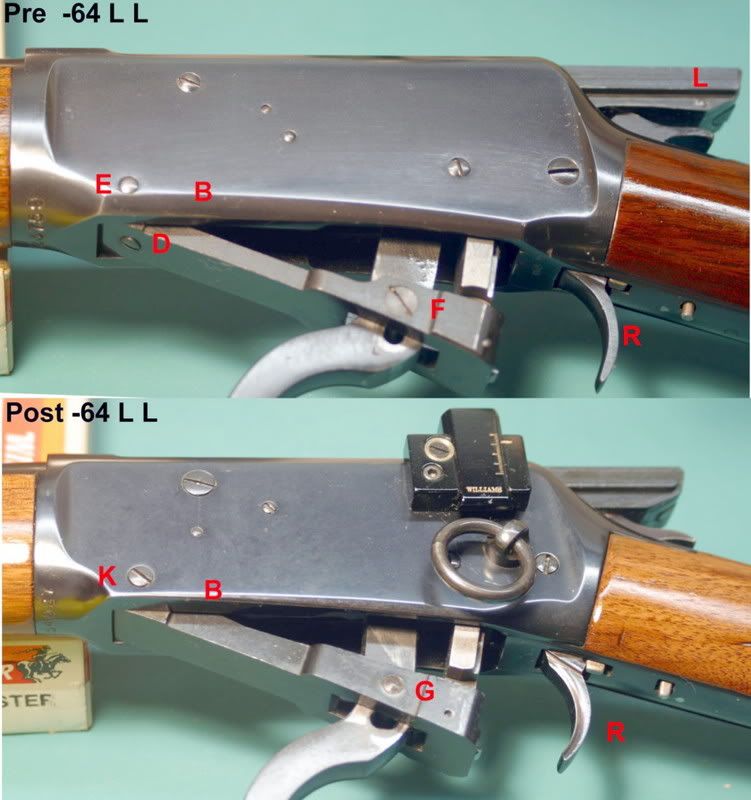
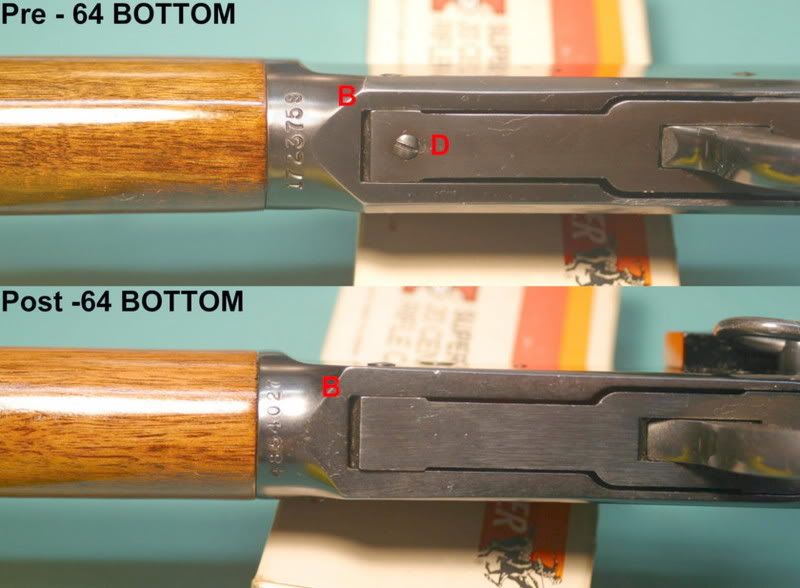
Differentiating between the Pre-64 and Post-64 Winchester Model 94s by Joe Miller

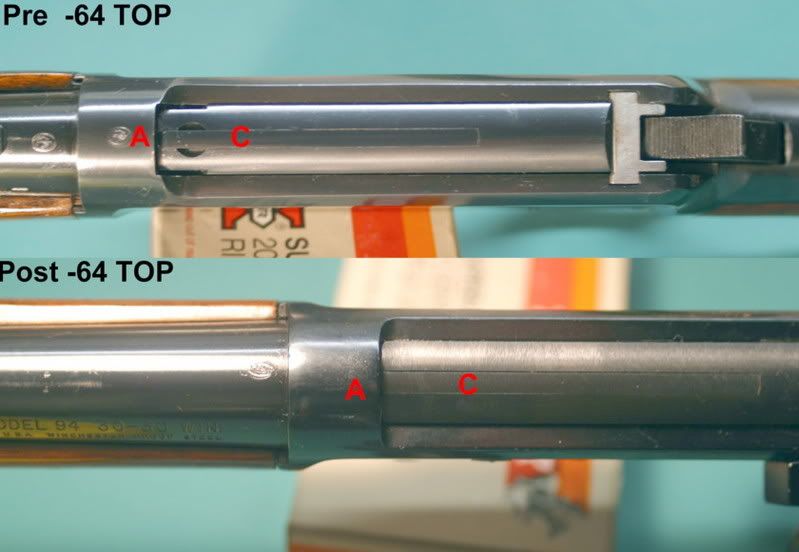
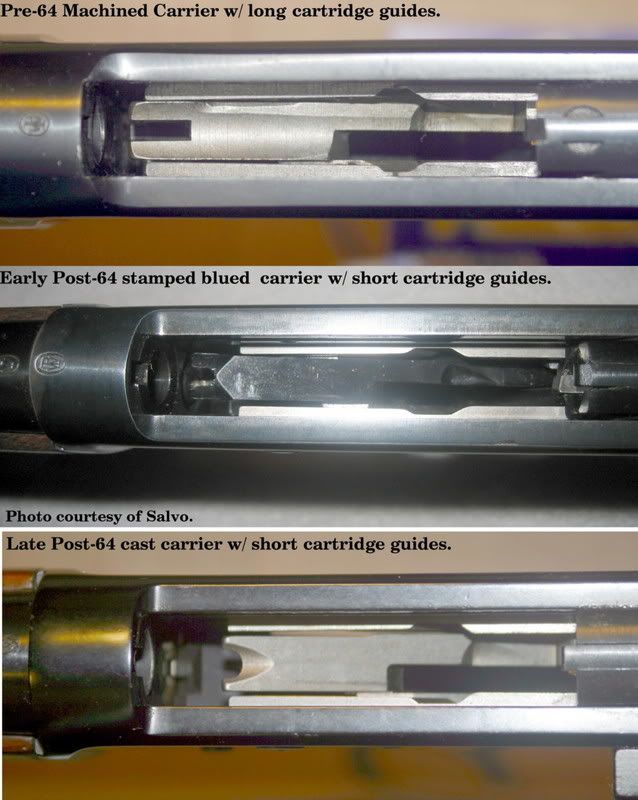
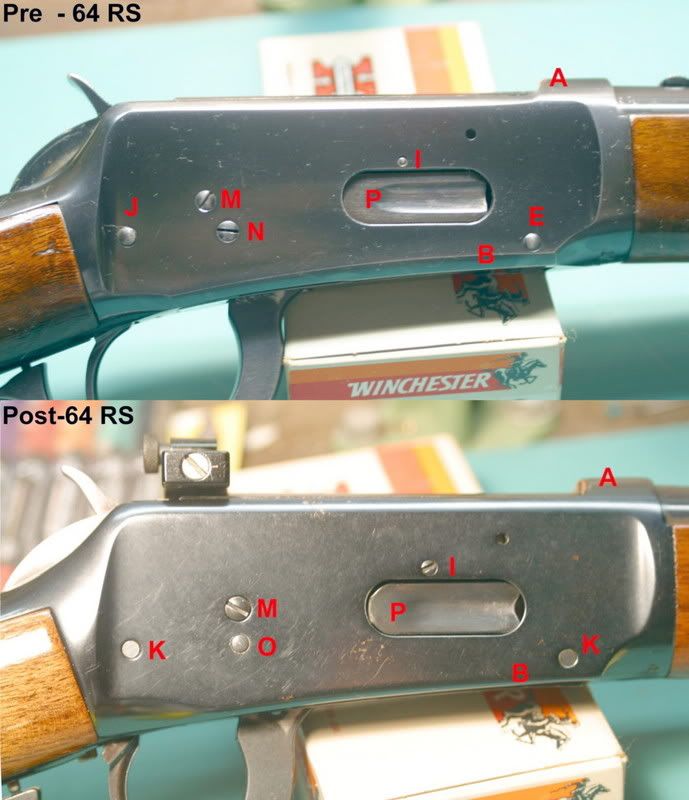
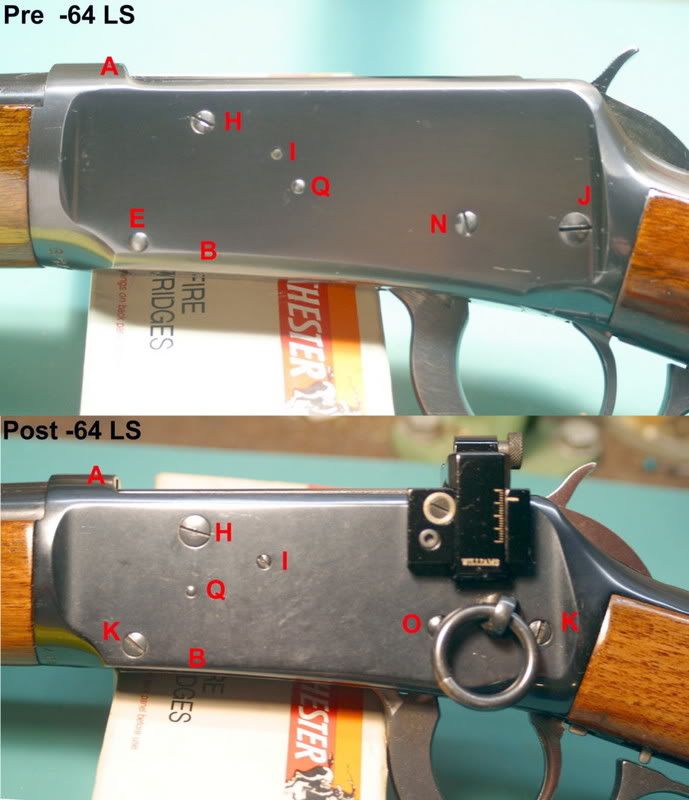
This photo essay was intended to help those who are not familiar with the external differences between the Pre-64 and Post-64 Winchester Model 94s. These pictures will show the differences in the screws, the triggers, some of the machining changes, the carriers, and the shapes of the receivers.

I've created a legend to match the letters that identify the various features that are different between the two vintages. It should be self explanatory.

A - Angles & Contours or Upper Edges of Receiver, Step at Front of Bolt
B - Angles & Contours of Lower Edges of Receiver
C - Round or oval cut to rear of blot face surrounding extractor, machine cuts on sides of front end of bolt.
D - Link pin retaining screw - pre-64
E - Link pin - pre-64
F - Finger lever link screw - pre-64
G - Finger lever pin - post-64
H - Finger lever pin stop screw; small pre-64 - larger post-64
I - Cartridge guide screws; threads from inside pre-64, thread from outside post-64
J - Hammer screw: larger head pre-64
K - Hammer/link screw post-64
L - Firing pin retaining pin omitted on post-64
M - Spring cover screw
N - Carrier screw; 2 used pre-64
O - Carrier screw; 1 used post-64
P - Spring cover; machined pre-64, stamped post-64
Q - Carrier spring screw
R - Trigger; machined pre-64, cast post-64


-Joe Miller-

Wednesday, May 26, 2010

Winchester 1892 Survey

Our friend Michael _____ is doing some research on Winchester 1892s. If you are willing to have your 1892(s) included, email Michael.

In his own words...
I have begun a survey of the production variations of the Model 1892 and intend on covering the entire production range of just over a million rifles. Yeah I am sure I'm nuts to take this on but being a science kind of guy, collecting data and analyzing it is just part of me. So far I have looked at 535 rifles for the survey and hope to have several thousand down the road. The furthest rifle so far is from New Zealand. If you have one or one dozen and would like to make some data available for the project that would be great. I will be glad to let you know how your rifle fits into the serial number range around it. All data will be kept confidential and eventually I intend to publish a long article documenting the variations as they pertain to serial number and date of production. I have reference material and a spread sheet with easy instructions to help you. Any photos will gladly be accepted.

Tuesday, May 25, 2010

Winchester Polishing Room Records

Bert Hartman has been a moderator on Gunbrokers "Ask the experts" for many years.  For the past 5 years he has spent at least two weeks a year with a volunteer at the Cody Museum of Firearms research room.

This is a post that he has made and I hope you find it as informative as I have.

A bored mind is a terrible thing to waste, so having some free time to kill, I finally put together a fact sheet on the true production ratios and the verified DOMs for the Winchester Model 1894/94.

As many of you will undoubtedly note, the figures I have compiled below vary significantly from the numbers published by George Madis in his tomes "The Winchester Book" and "The Winchester Handbook". All of my statistical numbers were derived from a detailed survey (conducted by the Cody Firearms Museum) of the first 353,999 serial number records, and from the Polishing Room Serialization Record Books (held by the Cody Firearms Museum).

Unfortunately for all of the many collectors and interested people, all of the remaining pre-64 factory warehouse records (serial numbers 354,000 - 2,600,000+ were destroyed in a fire in the late 1950s or early 1960s. Undoubtedly, all of the caliber, and the Rifle versus Carbine production number ratios would change drastically if the records were available for serial numbers 354,000 - 2,600,298. The Polishing Room Serialization Record Books (PRSRBs) which contain nothing more than just the serial number, fortunately survive up to serial number 1,352,066, which was manufactured on December 29th, 1945.

For all of the many people who collect the Model 1894/94, this information should be both very enlightening and useful, and I highly encourage everyone to save a copy of it.

Production ratios for the first 353,999 Model 1894s made:

4:5 (78.19%) were Rifles (276,780)
1:5 (21.20%) were Saddle Ring Carbines (75,075)

1:2 (45.92%) was a 30 W.C.F. (162,568)
1:5 (22.80%) was a 38-55 (80,734)
1:9 (11.31%) was a 32-40 (40,023)
1:9 (10.45%) was a 25-35 W.C.F. (36,999)
1:11 (8.77%) was a 32 W.S. (31,050)

1:13 (7.60%) were Take Down Rifles (26,934)

9:10 (91.6%) had a full length magazine (324,270)
1:13 (7.51%) had a 1/2 magazine (26,579)
1:688 (0.15%) had a 2/3 magazine (515)
1:770 (0.13%) had a 3/4 magazine (459)
Just (1) gun had a 7/8 magazine

1:20 (5.02%) had a shotgun butt (17,768)
1:584 (0.17%) carbines had rifle butt plates (606)
1:1655 (0.06%) had a Swiss butt plate (209 rifles, 5 carbines)
1:3308 (0.03%) rifles had carbine butt plates (107)

1:26 (3.88%) rifles had pistol grip stocks (13,703)
1:34 (2.97% had checkered stocks (10,512)
1:718 (0.14%) carbines had pistol grip stocks (493)
1:4023 (0.025%) had carved stocks (81 rifles, 7 carbines)
1:9567 (0.01%) had a cheek piece (37)

1:69 (1.46%) had a double-set trigger (5,153)
1:70800 (0.0014%) had a single set trigger (5)

1:3026 (0.033%) were nickel plated (117)
1:3978 (0.025%) were silver or gold plated (89)

1:668 (0.15%) were inscribed (530)
1:998 (0.10%) were engraved (355)
Just (1) gun had a matted receiver (on the frame ring)

1:1744 (0.057%) had a matted barrel (200 rifles, 3 carbines)
1:3000 (0.033%) rifles had interchangeable barrels (TD) (118)

1:2255 (0.044%) had a case hardened receiver (155 rifles, 2 carbines)

1:88500 (0.0011% had a factory installed scope (4)
Just (1) rifle had a factory installed Maxim silencer (Teddy Roosevelt’s)

(2067) records are blank
(184) were sold as receivers only

Serial number 53,941 is the last “Antique” number based on the information in the Polishing Room records.

For the years 1894 through 1945, the DOMs published by George Madis (and copied/republished by nearly every other reference book or internet website) do not agree with the original surviving factory records (the factory warehouse ledgers and the PRSRB records), and they are inaccurate by nearly four years in the 1896 - 1914 timeframe.

Winchester began producing Model 94s at an accelerated pace starting in 1935. By the end of the year 1935, Madis' published DOM list and the PRSRB records only differ by just (17) serial numbers (1099625 versus 1099608), but they rapidly begin to diverge in the ensuing years.

Winchester's production of the Model 94 averaged about 35,000 units per year for the next (7) years (1936-1942 inclusive), and once again, Madis’ published numbers diverge from the PRSRB records. The PRSRB records end at serial number 1,352,066, which is listed as the last Model 94 serial number recorded on December 29th of 1945.

Following WW II, Winchester averaged approximately 100,000 Model 94s per year from 1946 - 1953, then about 55,000 per year through 1963. The numbers I have listed below are estimates that are based on my research survey, and they should not be relied upon to determine an "exact"  DOM.

1946 ended at circa serial number 1,411,000
1947 ended at circa serial number 1,470,000
1948 ended at circa serial number 1,560,000
1949 ended at circa serial number 1,660,000
1950 ended at circa serial number 1,760,000
1951 ended at circa serial number 1,875,000
1952 ended at circa serial number 1,960,000
1953 ended at circa serial number 2,045,000
1954 ended at circa serial number 2,100,500
1955 ended at circa serial number 2,156,000
1956 ended at circa serial number 2,211,500
1957 ended at circa serial number 2,267,000
1958 ended at circa serial number 2,322,500
1959 ended at circa serial number 2,388,000
1960 ended at circa serial number 2,453,500
1961 ended at circa serial number 2,510,000
1962 ended at circa serial number 2,564,500
1963 ended at circa serial number 2,600,300

Winchester changed the designation from "Model 1894"  to "Model 94"  very shortly after a "Change in Manufacture Order"  was issued by Frank F. Burton on February 2nd, 1919.

The following list contains verified Model 1894 dates based on the factory warehouse ledgers (held by the Cody Firearms Museum). The actual DOMs listed in the PRSRB will typically precede the "received in warehouse" date by an average of 4-weeks.:

EDIT: I recently added a very significant number of new serial numbers to this list. It should now very clearly show the progression of verified dates of manufacture. I do not plan to add any additional new serial numbers to the list on this post. That said, I am still updating my personal database survey with additional verified numbers. If anyone would like to contribute to the survey, please send me a PM.

Serial*** Received Date
22 - 10-20-1894
61 - 11-27-1894
90 - 12-7-1894
136 - 11-1-1894 (1st Takedown received)
137 - 11-14-1894
139 - 11-14-1894
165 - 12-8-1894
170 - 11-2-1894
204 - 12-1-1894
257 - 11-13-1894
266 - 11-12-1894
309 - 11-6-1894
338 - 1-5-1895
563 - 11-21-1894
603 - 11-22-1894
604 - 11-23-1894
624 - 12-10-1894
679 - 11-24-1894
734 - 2-2-1895
814 - 12-8-1894
832 - 2-16-1895
988 - 12-10-1894
1296 - 12-26-1894
1368 - 12-29-1894
1673 - 2-4-1895
1835 - 3-5-1895 (1st engraved)
2465 - 8-12-1895
3314 - 5-29-1895 (1st 30 W.C.F.)
3559 - 4-26-1895
4176 - 4-18-1895
4598 - 6-10-1895
4762 - 6-29-1895
5014 - 7-18-1895 (1st 25-35 W.C.F.)
5044 - 8-1-1895
5047 - 9-6-1895
5579 - 9-13-1895
5860 - 8-29-1895
6506 - 10-3-1895
7566 - 10-17-1895
11020 - 12-10-1895
12356 - 3-26-1896
12695 - 11-4-1896
12962 - 7-30-1896
12970 - 5-21-1897
13135 - 4-14-1896
14311 - 7-28-1896
15315 - 6-29-1896
15332 - 8-7-1896
15488 - 10-9-1896
16259 - 10-31-1896
16400 - 10-26-1896
16582 - 10-3-1896
17819 - 3-11-1897
17862 - 12-16-1896
20041 - 3-11-1897
20492 - 8-30-1901
22905 - 6-5-1897
25762 - 10-13-1897
26639 - 10-1-1897
26831 - 9-10-1897
27056 - 10-26-1897
27122 - 10-27-1897
27158 - 3-4-1902 (1st 32 W.S.)
28202 - 10-25-1897
32192 - 3-24-1898 (Factory engraved)
32246 - 1-27-1898
35925 - 12-9-1899
38802 - 4-20-1898
39555 - 7-20-1898
46056 - 8-13-1898
46821 - 8-30-1898
46831 - 9-19-1898
46882 - 12-22-1900
47142 - 9-15-1898
47176 - 9-23-1898
47431 - 9-29-1898
47856 - 10-20-1898
48116 - 10-22-1898
48468 - 10-15-1898
48466 - 10-15-1898
49796 - 12-28-1898
49809 - 11-10-1898
49980 - 12-19-1898
50840 - 9-13-1899
50909 - 11-17-1898
***********
54160 - 9-8-1899
59367 - 5-23-1899
59668 - 5-22-1899
60584 - 4-4-1899
60879 - 4-17-1899
61710 - 5-8-1899
62652 - 5-12-1899
63274 - 8-3-1899
64043 - 8-10-1899
64406 - 8-19-1899
64872 - 9-1-1899
65056 - 10-18-1899
66200 - 8-25-1899
67776 - 9-26-1899
67952 - 9-19-1899
69622 - 10-10-1899
70126 - 10-19-1899
70788 - 10-20-1899
71479 - 11-4-1899
71560 - 11-1-1899
73342 - 7-3-1900
74059 - 11-24-1899
77924 - 3-29-1900
78333 - 9-12-1900
79036 - 1-8-1900
84801 - 3-24-1900
85249 - 8-9-1900
85741 - 4-24-1900
85816 - 6-20-1900
85930 - 7-7-1900
86623 - 7-24-1900
87767 - 9-1-1900
88624 - 7-2-1900
89924 - 12-28-1900
96641 - 1-8-1901
96800 - 1-9-1901
97581 - 4-25-1901
97869 - 11-2-1900
98829 - 3-1-1901
99126 - 12-7-1900
100621 - 8-3-1901
100955 - 2-4-1901
100994 - 3-11-1901
106970 - 2-25-1901
107731 - 10-5-1901
109921 - 5-25-1901
108346 - 6-1-1901
111524 - 4-2-1901
112916 - 4-24-1901
113997 - 5-18-1901
115623 - 10-22-1901
116570 - 7-29-1901
118828 - 10-5-1901
118446 - 8-6-1901
119046 - 8-2-1901 (18-inch Trapper Carbine)
119244 - 9-3-1901
119959 - 2-5-1902
120238 - 8-20-1901
122029 - 9-27-1901
122466 - 10-24-1901
124883 - 10-17-1901
125858 - 10-7-1901
128249 - 3-10-1904
128693 - 3-11-1902
131170 - 11-15-1901
131497 - 11-19-1901
136647 - 1-31-1902
139319 - 12-13-1902
139676 - 3-14-1902
142899 - 5-10-1902
145358 - 7-29-1902
145643 - 7-21-1902
146235 - 9-2-1902
150670 - 8-29-1902
152631 - 10-6-1902
154488 - 10-16-1902
154905 - 9-17-1902
155354 - 10-25-1902
156875 - 10-17-1902
164526 - 12-16-1902
165264 - 12-11-1902
167894 - 2-24-1903
168355 - 5-29-1903
168865 - 2-10-1903
176427 - 5-23-1903
176792 - 4-17-1903
177990 - 5-1-1903
180787 - 6-12-1903
182665 - 7-20-1903
186261 - 7-24-1903
187561 - 8-17-1903
189302 - 11-3-1903
190079 - 8-28-1903
199578 - 12-5-1903
203012 - 1-11-1904
203606 - 1-9-1904
203617 - 12-30-1903
206055 - 3-4-1904
206175 - 2-1-1904
216183 - 6-21-1904
222901 - 3-30-1905
225852 - 7-2-1904
226254 - 12-19-1908
227057 - 7-15-1904
235840 - 9-20-1904
239193 - 10-27-1904
240596 - 5-9-1905
244142 - 8-23-1905
249157 - 12-24-1904
249665 - 5-8-1905
250113 - 2-5-1906
256862 - 4-28-1905
257652 - 4-11-1905
259195 - 4-22-1905
260056 - 7-15-1905
261228 - 9-5-1905
261408 - 8-29-1905
265717 - 8-12-1905
274317 - 8-24-1905
274648 - 3-21-1906
275004 - 10-7-1905
276723 - 9-25-1905
277476 - 10-25-1905
280853 - 10-22-1906
282746 - 4-25-1906
288514 - 1-30-1906
299679 - 4-2-1906
301737 - 4-1-1907
302051 - 9-26-1906
303891 - 5-18-1906
304600 - 7-21-1906
309409 - 3-13-1908
311943 - 8-11-1906
311946 - 8-31-1906
313571 - 9-14-1905
314210 - 8-30-1906
314870 - 9-11-1906
318034 - 10-6-1906
324134 - 1-9-1907
324386 - 11-24-1906
324596 - 1-8-1907
325531 - 5-20-1907
326869 - 8-20-1907
327349 - 12-12-1906
330989 - 1-5-1907
335602 - 2-2-1907
336447 - 3-16-1907
337827 - 2-26-1907
340492 - 3-7-1907
353136 - 6-20-1907
353512 - 11-4-1907

Significant serial numbers;

1,000,000 was engraved and presented to President Calvin Coolidge in 1927
1,500,000 was presented to President Harry S. Truman on May 8th, 1948
2,000,000 was presented to President Dwight Eisenhower in 1953
2,500,000 was assembled in 1961
3,000,000 was assembled in 1970

All told, by January of the year 1980, 5,200,000 Model 1894/94 Rifles, Carbines, and Commemoratives had been manufactured at Winchester’s New Haven factory.

As I was going through some of the recently posted questions on the forum, I realized that I had neglected to address the dates and serial numbers for the introduction of the various calibers... the following list should help rectify that.

edit: I received a request concerning when and what the first Saddle Ring Carbine (SRC) was, so I have added this new information;

38-55 Rifle - serial number 24, 10-22-1894
38-55 Carbine - serial number 46, 3-36-1895 (by serial number order)
38-55 Carbine - serial number 471, 11-1-1894 (by date order)

32-40 Rifle - serial number 692, 12-14-1894
32-40 Carbine - serial number 1409, 1-18-1895

30 W.C.F. Rifle - serial number 3314, 5-29-1895
30 W.C.F. Carbine - serial number 4787, 6-24-1895

25-35 W.C.F. Rifle - serial number 5014, 7-18-1895
25-35 W.C.F. Carbine - serial number 6506, 10-1-1895

32 W.S. Rifle - serial number 107731, 10-5-1901
32 W.S. Carbine - serial number 22967, 8-27-1902 (by serial number order)
32 W.S. Carbine - serial number 142889, 5-10-1902 (by date order)


The above information should allow anyone with a letterable Model 1894 (serial 1 - 353999) to very closely estimate the DOM. For those who are interested in adding your Model 1894 to my database, please get in touch with me at Win1885@msn.com

.

Monday, March 22, 2010

Winchester Ammo Boxes

Interest in one aspect of shooting often results in interest in some other aspect. Some folks actually commit money and time to the effort. Rick Bachman has managed to accumulate these ammo boxes for Winchester 1876 ammunition.

Check out the late (circa 1915) box of .40-60 WCF. Look at the model designation at the bottom of the label. It says for Model “86. This is a very rare “error” label box. This is actually a sealed, unopened box. I’ve had it in my collection for nearly 45 years.


UMC box .40-60 WCF circa 1890


Winchester box .40-60 WCF circa 1892


Winchester box .40-60 WCF circa 1915


Winchester box .45-60 WCF circa 1890


Winchester box .45-60 WCF circa 1900


Winchester box .45-75 WCF circa 1883


UMC box .45-75 WCF circa 1895


Winchester box .45-75 WCF circa 1898


Winchester box .50-95 WCF circa 1881


UMC box .50-95WCF circa 1895


Winchester box .50-95 WCF circa 1895

Friday, March 12, 2010

Winchester 94 Manufacturing Dates

While folks are still hashing out whether the shipping or polishing books have the most accurate production dates for the Winchester M1894/94, there is a dearth of data for the post 1981 period. Reproduced here, so that it will be easy to find (I hope) is that data. Like everything else it will probably be amended. Don't sweat it. Some OCD afflicted collector is working on it as we type this. Just enjoy, tell the grandkids that the gun was made before they were a glimmer in daddy's eye and enjoy life. Thanks for this to Mr. J. Bledsoe.
Winchester Model 94 Manufacturing Dates
1982 - 2006

1981 U.S. Repeating Arms assumes control of license to mfg. Winchesters
Changeover serial numbers for Model 94 is around 5,000,000.
1981 4,870,000 to 5,014,556
1982 to 5,093,968
1983 to 5,115,742
1984 to 5,264,685
1985 to 5,372,442
1986 to 5,439,997 Chapter 11 Many parts guns made
1987 to 5,463,774
1988 to 5,491,805
1989 to 5,527,732
1990 to 5,612656
1991 to 5,999,999 Last non crossbolt safety
1992 6,000,000 to 6,054,408
1993 to 6,087,144
1994 to 6,174,987 1894-1994 marking for first half of year
1995 to 6,198,987
1996 to 6,265,870
1997 to 6,395,546
1998 to 6,360,632
1999 to 6,395,546
2000 6400134 to 6,455.865
2001 to 6,466,766
2002 to 6,494,011 safety change over from crossbolt to tang between here and first of 2003 numbers.
2003 6,494,346 to 6,516,423 6494346 has tang safety
2004 6,517,000 to 6,549,926 New right side marking: “Winchester trademark licensed from Olin Corp.”
2005 to 6,584,120
2006 ? to 7,076,704 Highest numbered Model 94 ever seen. Plant closed some time between April and August, 2006

Chart made by jbledsoe http://www.jbledsoe.com/MfgDates.htm

Sunday, March 02, 2008

Winchester 1894 Flat-band Carbine

Once upon a time I lived in a land far, far, away aka California and was about to move. Sometime during my stay in that land of altered dream states, I had acquired a sofa on which to sit and watch Leon Panetta run for Congress. That sofa would not, could not fit into the cargo compartment formed by the topper on my Datsun pick-up truck. I had, or rather my then wife had, in a fit of generousity paid $55 for the sofa and that was what I was using as the asking price when trying to sell it to newly arrived soldiers in our apartment complex. Alas, like me, few had the ready cash to pay that for this thing. So it came to pass that one fellow spec four came to me with a "deal". His old winchester M94 carbine for my sofa. Well the gun was much easier to pack into the truck than the sofa and so the deal was done. I'm sure he felt like he got the better part of the deal. I know I felt like I got the better part of the deal. After all, I had a gun and all he had was a sofa in pretty good condition.

Of course he might have been taking the condition of the gun into consideration while I didn't. You see this gun came with a rather unique adaptation of the standard 2x4 as a buttstock for the carbine. Yes, it was pine, no it was not even varnished but it did have the original buttplate! Hey, that's a good deal, right?

Of course, the stock wasn't acceptable and neither was the lack of a good receiver sight. It wasn't long before I glass-bedded a replacement wood stock and had the gun drilled and tapped for a Williams Foolproof 94/36 sight. This gun is now a babe.

So, that gun which was, to me, worth a $55 sofa is the 1946 manufactured (according to the stamping on the barrel) flatband Winchester 94 herewith presented. A wonderful gun which has taken deer and groundhogs, the first .30-30 that my son ever shot (but hopefully not the last), this is a gun to keep.

A good load for the .30 WCF (aka .30-30) isn't hard to find. Just go to your local ammunition purveyor and buy the desired quantity of 170 gr. bulleted ammunition from any of the major manufacturers (Remington, Winchester or Federal). All seem to shoot to point of aim in this gun and all function slick as snot through the action. Want to reload? I use 30 gr. IMR 3031 under any standard 170 gr. RN or FP ".30-30" bullet seated to crimp in the cannelure and lit with a standard primer (I always use CCI). However if you're using one of the newer lots of IMR 3031 you might want to work up to a max of 29 gr. Other suitable powders include IMR or H 4895 and W748. Consult your loading manual for data on those.

As to accuracy, well I get what seems to be the standard for me of 1½-2" groups at 100 yards. That's more than accurate enough and probably more accurate than most future shooters will ever need. I'm glad I'll be able to pass this one on.

What's it worth now? Don't ask. I know I don't care but I will tell you this, it is worth considerably more than $55.


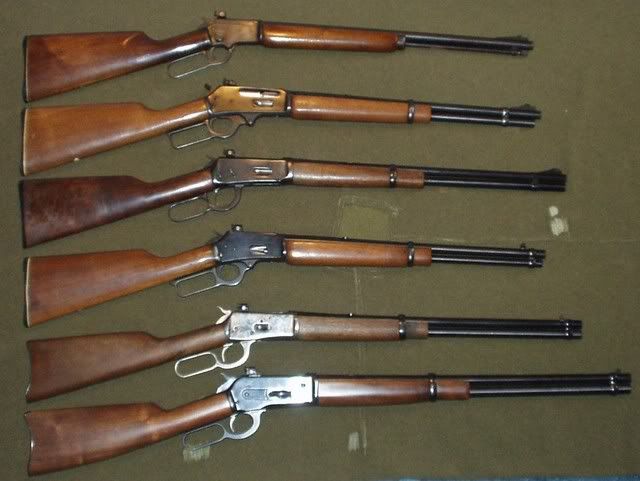
The "flatband" is third from the top. You might notice that I prefer a certain configuration for my lever-action rifles...

Wednesday, December 05, 2007

Saturday, September 08, 2007

Winchester Model 62A and 06 (1906)


These guns have a lot in common. Both are developed from the Model 1890, Winchester's premiere pump action rimfire rifle. Both are chambered for the .22 Short, Long and Long Rifle rimfire ammunition. Both are operated exactly the same way. Both now have the same type of sights, notably the tang peep sight. Both came from grandfathers albeit different grandfathers. Both spent most of their service lives dealing with garden pests. Both are now mine and both will likely be passed to my grandchildren. That would be 5 generations of service for these guns.

The first which I became familiar was Grandpa P's M62A. Every summer we would trek up from West Virginia or Kentucky to visit him near Fly Creek, NY and I would be sure to get a shooting lesson and later to help keep the woodchuck/groundhog population down. We did a lot of shooting with .22 Shorts because there was a real economic advantage to using the little cartridges. However, Grandpa used LR hollowpoints on the groundhogs. What I can't say for certain now but I remember more of the H headstamp for Winchester ammo. Grandpa used that same ammo to keep the rabbits out of the garden but I think it was "Uncle" George who taught Aunt Gigi and Dad to shoot.

Dad taught me to shoot with this gun and that was the highlight of every summer trip, for me. I think for Dad as well as he only hunted woodcock and grouse a couple of times while I was growing up. It wasn't until I was 12 that we got a bird dog and Dad took the time to get a license or go hunting. He started me on coffee cans at about 20 yards and we moved up from the cheap .22 shorts to using the .22 LR on game. By the time I was 10 I was allowed to take Grandpa's gun out woodchuck hunting on my own. I killed many with that gun to Grandpa's delight. He hated woodchucks so much I've seen him swerve, near to running off the road, trying to hit them with his car.

Dad told me once that this was the only new gun that Grandpa ever bought and I believe he had the Lyman #2 tang sight on it from the beginning. It is a great combination and if you miss it is some problem other than the sights. The serial dates this gun to 1949 and I think that Grandpa was making good money on the farm at that time with all the kids gone and out of college so he had extra to spend.

The 1906, made in 1920 was Grandfather F's gun. I think that he most certainly bought it used and he spent no more on it than he needed to. I'm the one who mounted the Marble's tang peep. He didn't take care of the rifle either. Once upon a time he decided that the open sights weren't helping him kill the garden pests easily enough and he borrowed his veterinarian's scoped Mossberg rifle for that job. The 1906 was put away and never again brought out. My Grandmother F was a virulent anti-gun person and she banned the guns from the house proper. Grandfather put them all in the attic where they remained, apparently untouched, for nearly 40 years. Unfortunately, Grandfather wasn't as serious about house maintenance as he was about boat maintenance and the guns had various amounts of rust damage. The 1906 had quite a bit of rusting over all of the outside, apparently from condensation. I stripped it and had it fine bead blasted and re-blued so the finish is not original but it won't deteriorate further.

So I've two of Winchester's pump guns and this has got me wanting an 1890, preferably in .22 WRF. But I'm glad for what I have. The 62A has not been re-zeroed and I use Winchester PowerPoints in it and it does go squirrel hunting now and again. The 1906 is currently zeroed for the Aguila Colibris and it is used for light, no hearing protection plinking with Dad's old swinging metal target. Great fun, the both of them.

Winchester pump-action rimfire series began with the Browning designed 1890. The 1890 became the quintessential gallery rifle and many thousands were made for that purpose as well as for field use. The 1906 was an attempt to make a lower price-point firearm for the younger shooter. Stocks were shorter and the gun lighter. Perhaps most importantly, this is when the design of the lifter was changed so that the guns could operate with .22 shorts, longs and long rifle cartridges interchangeably. The Models 62 and later 62A were the result of slight alterations to facilitate manufacture and reduce production costs. Like the Marlin 39s, all these (except for some early solid frame guns) are "takedowns". This makes them convenient for transportation and storage. However, I don't think ours have ever been taken down except for cleaning. According to Schwing Winchester originally intended to chamber the rifles for .32 caliber cartridges and to make a lever action version. Although there wasn't the market demand to move Winchester to do that, Taurus has seen fit to produce the lever action version. It would be great if they followed up on Winchester's earlier vision and actually produced the .32 H&R version.

Monday, May 21, 2007

My Browning 1895 - UPDATED

It is a crappy photo. I simply haven't had the time to do better.

Some guns are just easier to shoot well than others. This one has the firing pin strike slightly off center but it has yet to be a problem. It hangs well, the trigger is pretty good (I'm a trigger insensitive kinda shooter, if it doesn't take two fingers to pull it doesn't much bother me.), and the sights are at just the right distance that in the right light I can do well with them.

Processing 100 cases now for a 220 gr. bullet load. My goal is 2000 to 2100 fps. It is much cheaper to run such a load in a .30 than a .31. This isn't difficult to do with IMR or Hogdon 4350 and produces a round the penetrates and kills well without excessive recoil.

I haven't gotten the Ukranian Lyman 38 reproduction sight installed yet but hope to go do this soon. This will make the rifle really useful as it will give a wide range of adjustment.

Here's a video about the 1895 rifle...


Originally posted 11/9/2006

Saturday, May 19, 2007

Winchester 1876 Survey

Mr. Rick Bachman aka Buck Stinson (click on the name to send him an e-mail) is compiling a collectors' database of 1876 Winchesters. He is not at all interested in who owns the guns, only in their configuration. Don't worry if you send him a duplicate. You might include info missed by another reporter.

Serial number
Rifle, carbine or musket
Round barrel, octagon barrel, half octagon or heavy barrel over 1" across muzzle.
Caliber/chambering
Barrel length
Any special order features. ie, shotgun butt, half mag, set trigger, etc.
Any rework like outside refinish, new wood, etc.

This includes any stripped receivers or parts guns with serial numbers. These are also added to the list. If known, I might mention if it has been lettered.

Monday, April 02, 2007

Winchester Model 72

In looking for background on the M72 I found this in "The Winchester Book" by George Madis.
For years dealers had been asking Winchester to make a reasonably priced tubular magazine repeater. Clip-fed magazine repeaters have the objection of a loose magazine to lose and rarely feed the Short, Long and Long Rifle cartridges interchangeably. In 1939 the model 72 was introduced to fill this demand.

At first production was on a standard rifle with two standard sight combinations. After production of less than one year, a "Gallery Special" was added to the listing. Standard rifles have 25 inch barrels. Gallery Special rifles are the same as the standard models but were chambered for the 22 Short only and are so marked.

Barrels of this model are made separate from the receiver and are threaded into the receiver. A sliding safety was provided. Earlier rifles will have the bolt handle bent downward, later arms have the handle bent downward and to the rear.

Earlier arms have a stock which is 1-5/8 inch thick. When production began after WWII, the stocks were 1-3/4 inch thick and forends were more rounded and tapered with a slightly more beavertail shape in some issues. Production of this model, as with some previous models, ceased in 1941 due to the war and began again in late 1946. Three quarter length magazines are found on this model. Some longer magazines, extending to within six inches of the muzzle, were assembled. Standard magazines are 7-5/8 inches from the muzzle. Attractive bolt handles (knobs) of ovoid shape are standard on this model. The first rifles made had the handles of round shape, but this was changed after production of a few hundred guns (sic).
Also...
Pistol grips and composition shotgun buttplates were standard. All steel parts except bolt fronts were blued.

Barrel markings are the same as the 69-A with the model marking changed. Latest of the rifles have a barrel marking:


WINCHESTER - MODEL 72A -
TRADEMARK - 22 S.L. OR L.R. -
MADE IN U.S.A.


A few barrels have the "made in U.S.A." following the model marking.

After production reached nearly 100,000 guns, triggers were grooved.

Early in production two sight combinations were offered. First was the number 32 open rear barrel mounted and series 75 front: A tin bead was attached to the front sight. Second to be announced to dealers was the rifle with a series 97 hooded ramp front with an 80A receiver moutned peep sight.
And...
In 1959 the model 72 and 72A were discontinued when production passed 161,000.

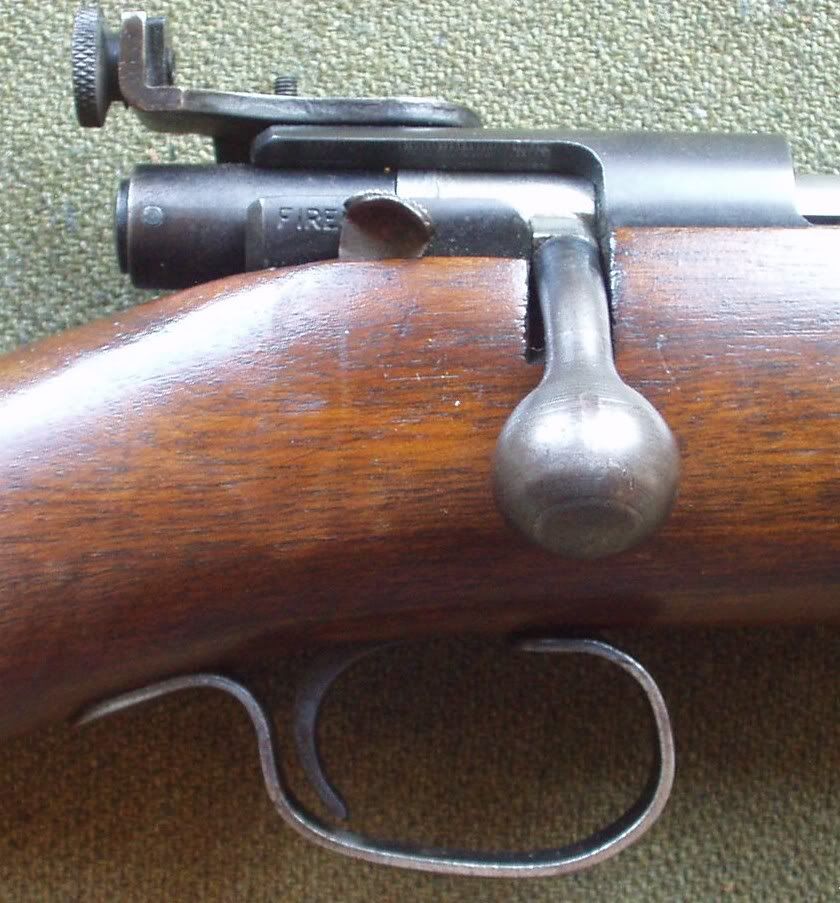
This model 72 Winchester was Dad's. I had thought that he may have bought it new after coming home from the Army (the first time) in 1947 but it seems to be an early gun. As you can see this seems to my eye to be a round bolt knob and it isn't swept back. However, the stock is about 1-3/4" wide. The barrel marking is also of the earlier type. The mag ends 6-7/8" from the muzzle. Does this gun exhibit a mix of features or was Winchester's production so varied that this is completely normal? Unfortunately for me, these rifles are unserialed and so it is yet more difficult to date. Hindsight being 20/20, I wish Dad had told me more of the history of these guns as I'm trying to do for my grandchildren.

To my mind the Model 72 is nearly the epitome of the bolt-action .22 LR. The trigger is more than adequate and the stock is comfortable in both carrying and shooting. Complete with the factory peep sight, this gun has taken numerous squirrels and rabbits, more than a few groundhogs and given many years of pleasure to two generations.

Thursday, March 29, 2007

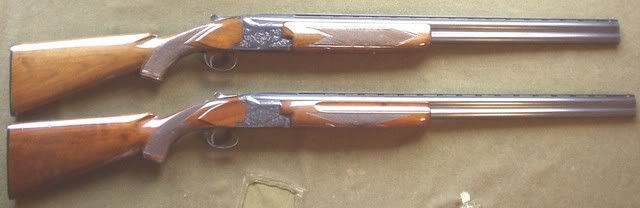
Winchester 101s - Dad's Skeet Guns


My dad was an outdoorsman, forester, minor league baseball player, soldier (combat engineer and infantryman 1945-47 and 1950-1951 respectively, thanks Dad), pilot (one solo flight) and skeet shooter. He apparently started skeet shooting when he returned home from his first two years in service and was awaiting admission to Syracuse University. He apparently shot a lot of skeet, what is now international style, before departing for university and did so with an old Savage or Stevens made Tru-Test 16 ga. side by side (I have that gun, too). Choked modified and full and missing the front bead even then, this second hand shotgun was likely the best he could find and afford at the time. I've no idea how he got the shells or paid for the many rounds of skeet that he shot.

He must have been popular because when we went to that range when I was about 12-13 that must have been 20 years after he'd last been shooting there and several of the old guys (to me!) recognized him and came up to shake his hand. That single visit to that range rekindled his interest and we were shortly looking for places to shoot. Dad tried a couple of used Winchester 1400s but wasn't happy with them. I know it took a lot of cleaning on my part to keep them going (not that I minded). At some point he decided that this pair of 101s were the deal and he dropped his credit card and the two 1400s on Jon Ridenour's counter and walked out with them both. He must have been enamoured of these guns because he never, ever used the credit card for anything but emergencies.

The Winchester Model 101 Over-Under shotguns were introduced in 1963. Dad's 101s are skeet guns in 12 and 20 gauge (bottom) but the skeet guns were made in all four skeet gauges, 12, 20, 28 and .410 (I know, not a gauge but a "bore"). They are over-under double guns, with barrels mesuring 26-1/2" on the 20 and 26" even on the 12 gauge with ventilated ribs, barrel selector switch safeties and single triggers. The old Winchester 101 was something of a landmark gun in the post-war history of the shotgun, one of the models that firmly established the over-and-under as the gun for competition clay shooting. Based on the Browning B25, it handled well, was affordable and was well built by the Japanese. Thousands were sold. Dad must have really liked his as he never considered selling them even after his macular degeneration ended all his shooting.


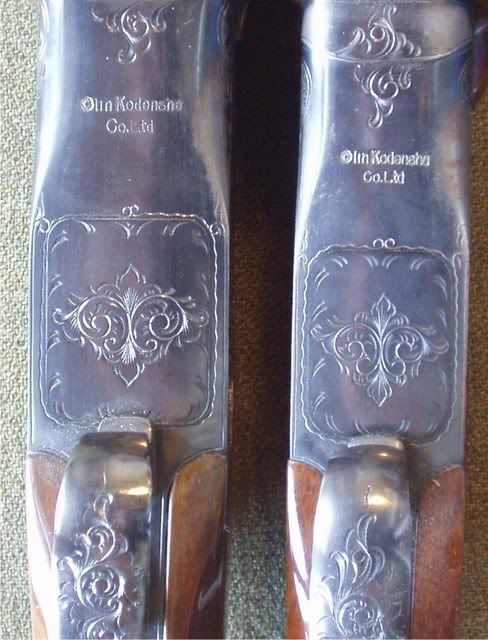
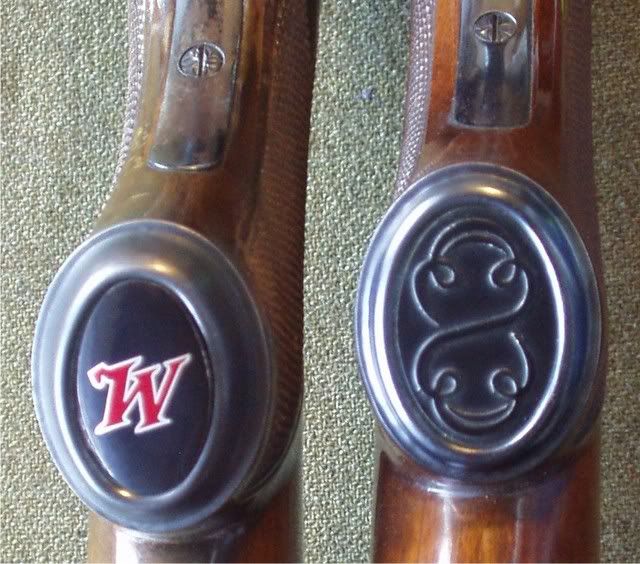
Our guns have few differences despite the 5 years between manufacture of the two guns. The 12 ga. has the big red W on the pistol grip cap, while the 20 ga. has the plainer cap shown. Together with the barrel length, these are the major differences between these guns made at the Olin Kodensha plant in Japan in 1970 (20) and 1965 (12).

Links:
- Midwest Gun Works 101 Serials

Saturday, January 13, 2007

1876 SRC Repros are Out!

It looks like they're here. See Gunblast.com for updates.

Wednesday, January 10, 2007

Ukranian Lyman Type 38 Sight Received

Today I received my sight from HikerLT. I saw over on Gunboards.com that he had one he'd bought from Buffalo Arms. Made by Parts Unknown, Inc. of 206 Oxford St., Winnipeg, Manitoba, Canada R3M 3J6 (Phone & FAX: 204-487-7185), these sights are the affordable option to an original climbin' Lyman even at $225 US.

UPDATED:

I thought I'd add some observations for those with questions.

Markings? My sight's only markings (other than windage and elevation "ticks") are a faint eletric pencil "148" on the long leg near the forward mounting screw. Is it a serial number? I don't know.

Apertures? This has the same type of flip change aperture as on the Lyman #1 sights. I like it. Very practical for a hunting rifle.

The windage adjustment is adjusted by means of the wheel to the right of the aperture. There is no mechanism to lock it in place. However, once adjusted a bit of loctite on the screw on either side of the aperture should hold it against inadvertent adjustment or those who just have to twirl knobs (if you allow such to pick up your gun).

Quality? I think the sight is of good quality. The technology is typical of the time and although the sight body appears to be a thick sheet of steel folded to have two portions at right angles to each other, there are numerous small and well fit parts to make the sight.

The list on these is $225 but an original sight is at least double that even for the Lyman 21 with is drift adjustable for windage rather than the more expensive 38 (screw adjustable windage).

Friday, November 17, 2006

Guns I have Sold

This is a sad, sad thing to say but I have actually sold guns and let them out of my hands. What foolishness sometimes possesses us. What and why you ask? Well...

The first is truely heart rending. This was my first centerfire rifle, my first deer was killed with this rifle, and it was a gift from Dad. The latter I did not know until I told him I'd traded it. I thought I'd paid for it out of my savings. Truly heart breaking that.

I'd been wanting a centerfire for a loooong time like every other boy I knew. I'd been putting money in my savings account (but I didn't hold the bank book) for that gun. Now, it was approaching another deer season and I had my safety certificate and could get a license. Dad and I made the rounds of gun shops and found the 336 in the Western Auto just off Court Square in Harrisonburg, VA. Talk about excited! That season I got my first deer, with one shot and it was a buck (it pretty much had to be!). Still excited. But I've always been a gun nut and a couple of years later I was wondering what OTHER guns might be "better". Oh, I truly regret losing this one and can't find the serial number anywhere. The follow-on was this gun...

Marlin 1893 .38-55 rifle. The 26" octagonal barrel had been cut-down to 19 inches and a bit, the magazine likewise shortened and a later 336 ramp front soldered (not silver soldered and not well at that) onto the barrel. The mag spring had to be replaced as it had been cut somewhere in the middle and welded back together to make the spring the correct length. The stock may have been taken from the same 336 donor rifle... You get the picture. But it did have a Lyman #2 tang peep which worked well. I found out later that that sight was correct for the Marlin 1892. Oh it was a mishmash but with a new buttstock and some cleaning of the solder job it was a treat. That rifle was able to hang around until my divorce when it "had" to go to pay the lawyer (or for food for the kids and me, depending on how you look at it). That was a great gun.

Of course, at about the same time, I was enamoured of the .44 Mag cartridge but too young to own a revolver. I found instead a "great deal" on a post-64 M94 Winchester in .44 Mag. I never managed to save up the money to install a Williams Foolproof, I think they were about $25 at the time, quite a bit of money to me in 1973, but that rifle was accurate and I killed crows (on the ground), groundhogs and other vermin. It was quick to the shoulder and while the Remington SWC (a half-jacketed round) didn't feed all that well it was accurate as was the more expensive 240 gr. SJHP. That last round became my ammo of choice until I started reloading. Unfortunately, this gun had one fault. It would, sometimes, feed a second round under the carrier. What a pain to correct that fault. Of course I was too stupid to know how to fix it by repairing the cartridge stop although I had access to all the equipment needed to effect the repair. I kinda wish I had that gun. Unfortunately I traded it for...

A Marlin 1894 in .44 Mag. These were "new" on the market at the time and had a few good write-ups in the gun magazines (yeah, I know, but I was 18). Now, I had the money for the Foolproof for that gun and although it never managed to be in my hands when there was a deer in front of me, it did get a few hogs in the FT Hunter-Liggett hills. I also loaned the gun out to similarly impoverished junior enlisted and they took hogs and goats with the gun. None of them managed to damage it (was I just lucky?) and I was able to bring it back from California just before shipping overseas to Korea for 3 years 9 months. Load of choice? Remington 240 gr. SJHP. Killed everything with a minimum of muss. However, there came a time when the wife decided that another fellow was more to her liking (he's gone now, too) and the gun was one of this group which went to pay the lawyer and feed my kids. I do indeed miss this gun but it could have been better. How?

Well, if it had been the Sporter version or the two band version I'd have liked it even better. It was fully as accurate as the Winchester it replaced and it never fed two but I've never really warmed to the rifle style forearm cap paired with the muzzle barrel band of which Marlin seems so fond. Looks dumb to me.

Sometime in this period I found an 1891 Argentine rifle that had been bubbaized. Still properly chambered in 7.65x53mm Belgian/Argentine, the rifle was the equivalent of the .308 but nowhere near the price. No matter, I supported the gun industry more than adequately in my attempt to feed the gun. I remember buying one box of Norma ammunition for $22 or over $1 a case and this was in 1973! Fortunately a Lee Loader came with the gun or I'd have been impoverished very quickly. Even a box of brass was over $15.

Still in the cut-down military stock and with a cobbled together combo of Weaver bases and cheap, cheap telescopic sight, this gun needed work. I bought a Fajen sporting stock, a Williams Foolproof, and Jon Ritenour installed a Remington 700 ramp and Williams front bead. The bolt had already been altered for scope use. While I was gone to Korea the first tour (12 months) my dad fit the stock to the gun and I was ready to go. I took the gun deer hunting several times but ammo was expensive and it didn't get loaned out for hog hunts. I did carry it to Washington on a visit to a friend at FT Lewis but a hoped for elk hunt didn't materialize. This gun, too, helped to finance the big "D". I'm still looking for it even though I now have a very nice 1891 Argentine Engineer's carbine.

While I was in Korea the second time I started to save quite a bit of money. Living cheaply on the economy and having little to do but play with the kids and read gun magazines/books I started to spend on my passion. After much consideration I bought, through my Dad who actually did the transaction while I was gone, a Ruger Security-Six in stainless steel with 4" barrel. A .357 Magnum, this gun was everything that one would expect. I shot it quite a bit with reloaded .357 Mag ammo and .38 Special wadcutters. I managed to kill a groundhog or two with it as well as a squirrel and wrote up the gun and my choice thereof in "The Sixgunner", the official news of JD Jones' Internationl Handgunners' Association (I was charter member #500).

The Security-Six wasn't just a hunting gun, it also served as the bedside gun and rode along on the seat of the car when I was out and about. At the time, that was the only way for me to carry and size was unimportant. Unfortunately, this fine gun also was sacrificed on the altar of divorce.

There are more but the emotion of the moment prevents continuing this "saga". I'll do so later...

Thursday, June 02, 2005

Well, I finally got to take out the .45 Colt M92 after securing the front sight. Results were pleasing. Because it was raining and going downrange would have resulted in my own field of lost shoes I just shot at pre-placed (make that left behind) stuff including several metal plates. These have been there a while and are about 6" in diameter and at 50, 100 and 150 yards. Although I only got to shoot about 15 rounds, every round was a hit at every range, from the standing position! Very pleased I am. The load was 23 gr. H110 under the Sierra 300 gr. .451 JSP lit by a CCI large pistol magnum primer in Winchester cases. Seated as these were, they fed very smoothly through the gun. This load is in the 30K CUP range.

Hopefully, I be able to try the 265 gr. Cast Performance bullet loaded over 9 gr. of Unique the next time I get to the range. Unfortunately that will be about the middle of July! Argggggh!!!!