Showing posts with label ThompsonCenter. Show all posts

Friday, September 22, 2023

TC Contender and Encore Barrel Twist Rates

Just thought I'd post this up....

17 Bumble Bee...............1:10
17 BEE A.I....................1:10
17 Hornet.....................1:10
17 Hornet A.I................1:10
17 Kilborn Hornet..........1:10
17 MACH IV..................1:10
17 REM........................1:10
204 RUGER...................1:12
22 LR..........................1:15
22 HORNET...1:12, 1:14, 1:16
22 K-HORNET........1:12, 1:14
218 BEE.......................1:12
22 Jet..................1:14, 1:15
221 REM FIREBALL..1:12, 1:14
222 REM...............1:12, 1:14
222 REM MAG................1:12
223 REM...............1:12, 1:14
223 ACKLEY IMPROVED....1:12
22 PPC.........................1:12
22 BENCHREST...............1:12
22-250 REM...................1:12
22/250 A.I.....................1:12
225 WIN.......................1:12
220 SWIFT....................1:12
6MM REM ......................1:10
6MM BR REM..................1:10
6MM TCU ..............1:10, 1:14
6MM PPC ......................1:10
243 WIN ......................1:10
6MM-06........................1:10
250 SAVAGE..................1:10
250/3000 A.I.................1:10
256 WIN MAG.........1:10, 1:14
25-20 WIN....................1:10
25-35 WIN....................1:10
257 ROBERTS................1:10
257 ROBERTS A.I............1:10
25-06 REM....................1:10
25/06 A.I......................1:10
6.5MM TCU...........1:08, 1:10
6.5 BENCHREST.............1:08
6.5 JDJ................1:08, 1:09
6.5X54 MANNLICHER.......1:08
6.5X55........................1:08
6.5X284......................1:08
260 REM......................1:08
6.5 REM MAG................1:08
264 WIN MAG................1:08
6.8MM REM SPC............1:10
270 Ren...............1:08, 1:10
270 WIN......................1:10
280 REM (7MM EXP REM).1:09
280 REM A.I..................1:09
284 WIN......................1:09
7MM TCU .............1:09, 1:10
7-30 WATERS......1:09, 1:9.5
7MM BR REM.................1:09
7MM-08 REM................1:09
7MM (7X57).................1:09
7MM REM MAG..............1:09
7MM INT .............1:09, 1:10
30 CARB (M1)........1:10, 1:14
30 HERRETT..........1:10, 1:14
30-30 WIN....1:10, 1:12, 1:14
300 WHISPER................1:10
7.62X39.......................1:10
300 SAVAGE.................1:10
30/40 KRAG..................1:10
309 JDJ.......................1:08
307 WIN......................1:10
308 WIN..............1:10, 1:12
308 A.I........................1:10
30-06 SPRG.................1:10
30/06 A.I....................1:10
300 H&H MAG...............1:10
300 WIN MAG...............1:10
32 H&R MAG.................1:10
32-20 WIN...........1:10, 1:16
32 S&W.......................1:10
338 JDJ.......................1:10
338 FEDERAL................1:10
338-06........................1:10
338 WIN MAG...............1:10
38 SPECIAL MATCH.......1:14
357 MAG.....................1:14
357 REM MAX...............1:14
357-44 B&D.................1:14
357 SIG......................1:14
357 HERRETT...............1:14
35 REM...............1:14, 1:16
358 WIN.....................1:14
35 WHELEN.................1:14
350 REM MAG..............1:14
375 WIN.....................1:12
375 JDJ......................1:12
38-55 WIN..................1:12
375 H&H MAG..............1:12
10mm Auto.................1:16
40-44 WIN..................1:20
405 WIN.....................1:14
41 REM MAG................1:20
414 SUPER MAG...........1:20
416 RIGBY..................1:14
44 REM MAG........1:20, 1:22
445 SUPER MAG...........1:20
444 MARLIN................1:20
45 AUTO LH................1:16
45 Win Mag.............LH 1:16
45 Colt LH.1:16, 1:22, 1:24
45 COLT-410..........LH 1:16
454 CASULL................1:16
460 S&W ...................1:16
450 MARLIN.........1:14, 1:20
45-70 GOVT........1:14, 1:20
480 RUGER..................1:18
50 AE........................1:20
500 S&W ...................1:20
209X45......................1:28
209X50......................1:28
209X50 Custom Shop....1:48
12 GAUGE 209X12GA.......SB
12 GAUGE 3" (RIFLED)...1:28
20 GAUGE 3"..................SB
20 GAUGE 3" (RIFLED)...1:24
28 GAUGE 2 3/4".............SB

Saturday, August 29, 2015

Another Contender...

Picked up the $310 Contender. Got the Weaver 92A base, Z-rings, Weaver 1.5-4X scope and mounted same after removing Aimpoint Mark III and base. I don't know why the previous owner felt the need on a .22 LR barrel, but he drilled and tapped it for the forward screws on the base even though he had the rear 4 on the Contender barrel. Anyway, I put in some filler screws. Shot some Aguila Colibri in it. Quiet enough that the wife and dog didn't pay any attention to it 20 feet away from them on the other side of the closed basement door. I now have an understudy barrel for the BR/Varmint pistol AND another frame for Contender carbines.

Thursday, July 23, 2015

Range day...

Range day was interesting. Got reminded of something I knew (that loads worked up on one Contender frame MIGHT need to be shot on that frame or maybe the headspace will be wrong and they won't fire), saw my new Fowler target cratered by a .243 Ackley (70 gr. HP at almost 4000 fps), and remembered that my old 7mm TCU 10" was probably last shot at 50, not 100 yards... I did take a couple of photos of the cratered plate. I have to download the photos and the other computer where I do that is giving me fits. That 7mm TCU was shooting about 4" high. The .30 Herrett really shot well once I moved it to the correct frame which also required moving the butt stock since one frame was set up for the 10". Neat that you can do all that at the bench with no more tools than the one TC tool. The 7mm TCU didn't kick too much but I bet this .223 barrel kicks some less. The new scope should be here by Monday (might already be at the store) and we'll see where we stand.

Thursday, July 09, 2015

Range day...

Got the new steel targets (armor plate, 12, 8 and 4 inch plates) to the range but I only worked on it with the .17 HMR Contender at 100 yards. All bullets simply vaporized against the plate. I'm going to have to try this with other cartridges. Richard P______, Ed C___________ and his son Curtis were there. Pretty warm day with an intermittent breeze but actually less breezy than at home. The Contender .17 shoots very well, I'm pretty impressed.

Thursday, May 14, 2015

Range day...

Had the Single-Seven to the range this afternoon and put 4 cylinders full through it (I was kinda pressed for time). The first cylinder was all over the place. I shot that first cylinder from the bench, then I stood up and shot from the standing leaning against a range shed supporting post to steady myself and the gun would actually group but still, it is more like several groups in different places as if each chamber is shooting its own group. Further, the firing pin strikes every primer off center. I wonder how much that might affect accuracy. Ammunition today was the Federal 100 gr. load instead of the 85. Both bullets are the flat point soft nose. You can't tell them apart looking at a loaded round. Maybe handloads will be better...

I am not very found of these Federal loads. Some rounds seem to have a "bottleneck" in the case about 3/8" above the rim. When you drop them in the chamber, some will just drop in and some will "hang up" right at that point. Also, when shooting, the cylinder will sometimes drag and I am pretty certain this is a primer dragging across the recoil plate.

The club president was there this afternoon and he thinks the trigger pull is pretty darn heavy. I think I will take it in and measure it tomorrow at work. I didn't think it was all that bad.

I also took the CCI A17 ammo to try in the Contender .17 HMR barrel. It shot quite a bit higher than the standard .17 HMR ammo I was trying earlier but grouped inside of 1 inch at 100 yards despite my use of my old Weaver 1.5-4.5 scope on a standard small-bore target.

Tuesday, May 31, 2011

Thompson Center Arms Contender and G2 Answers

I've had to deal with a number of questions about the Thompson Center Contender and G2 regarding interchangeability of parts including barrels, stocks and such.  I'm going to give it a go to have the whole deal in one place to which I can refer without having to write it all out again.


The pistol/rifle barrel interchangeability thing was addressed in a case before the Supreme Court of the United States and one can switch the original Contender back and forth, most frames have been changed so often through dealers that one can't know how they were first sold. However, there may be questions about the G2 and Encore frames because they were sold after the decision and it is possible that somebody would think they weren't covered by the decision... Yes, I know it is confusing but the only way anyone would ever know is if they get you for something else and then do an investigation to make their case stick. In practical terms it is a non-starter so long as you don't assemble a sub 16" barrel on a rifle stocked frame.

As to barrels. ALL Contender barrels will work on all frames with only a couple of caveats. First is that many years ago TC switched to the split locking bolt in conjunction with the "easy opening" frame and newer frames are SOMETIMES problematic with the old solid locking bolt.

Second is that isn't including G2 barrels which have a little stud off the bottom of the lug for some calibers (.375 JDJ and .45 ML come to mind). That stud has clearance in a little cut in the G2 frame that doesn't exist in the Contender frame. Folks are just cutting the stud off the bottom of the lug. TC did this to avoid liability issues with cleaning on the ML barrels and with frame stretching on the .375 JDJ barrels. This is because it is very easy to load the .375 JDJ to the point that pressures exceed limits of the Contender frame.

Third is that the Armor Alloy (a plating system used by TCA) barrels might not interchange. The critical dimension is the link pin hole. Carefully polish it out and voila! Many have already been so altered which is why I say "maybe". All it takes is some crocus cloth wrapped around a dowel (some folks use a pencil) and spun in the link pin hole. Not so sure about the Armor Alloy FRAMES as I can't remember anyone trying a blued barrel on the frame but I think (might, might not work) using a blue link pin on the Armor Alloy frame with the blue barrel will work. Just can't remember anyone doing that. The AA barrels are MUCH more common than the frames but not that common. TC quickly changed to stainless. I imagine that if the pin hole is too small for the blue pin it could be opened up. The problem stemmed from using mostly standard dimensions but adding the plating after final dimensions had been achieved.

The Encore is NOT the Contender/G2. It is a larger frame and will handle higher pressure cartridges. However it won't handle the short magnums because the breach thrust will stretch the frame. This is due to the larger case head on those cartridges. All Encore barrels will work on all Encores.

All CONTENDER and G2 frames have switchable hammer faces to fire rimfire, not so for the Encores. Various schemes have been concocted to put the rimfire barrels on Encores but it seems that not many have pursued that as I've yet to see a rimfire Encore barrel.

The stocks can be confusing in that it seems that forearms (which have had many different variations for the Contender) are useable on the G2 as well.  However, the changes to the frame have required a different buttstock for the G2 and these do not interchange between the two actions.

One more point, the original Contender is not referred to as the "G1".

Friday, March 18, 2011

Need a Contender Barrel?

As of now, these are the best sources...

- Bellm's TCs
- Bullberry
- Dave Van Horn
- David White
- E. Arthur Brown
- Ed's Contenders
- RJ's Guns
- Stratton Custom took over from Virgin Valley
- SSK Industries

I've dealt with everybody but Stratton. Foxridge aka TC Custom shop is no more. Neither is OTT LLC who did EDM chambering of barrels.

Friday, January 15, 2010

7mm Thompson Center Ugalde (TCU)

The 7mm TCU is one of a series of cartridges developed by Wes Ugalde for Thompson Center. It was first offered as a standard chambering in 1979. The single shot Contender has been offered with standard barrel lengths of 10, 14 and 21 inches. Based on the 223 Remington case necked up, the 7mm TCU dates back to 1980. It was very popular for metallic silhouette pistol shooting. Might also be referred to as the 7mm x 223. The cartridge has a reputation for exceptional accuracy. Aside from metallic silhouette it is also known as a good varmint cartridge in the T/C Contender pistol. Many consider it to be marginal for deer or other medium game. It is usually recommended that only commercial 223 Remington brass be used as the base for forming cases. Most/many don't/won't use military brass. Cases can be formed simply by running into the full-length resizing die once it is properly adjusted. Proper case length is given as 1.740-1.760 inches.

My rifle is a Thompson-Center 21" factory barrel on either of my two Contender frames. It was one of the first barrels purchased for the Contender due to its purported versatility. However, I think the strong suit of the cartridge is that brass is based on the VERY available and inexpensive .223 Remington. I am one of those who doesn't mind using military brass and find it gives very similar results to commercial brass both in forming and in performance. The only reason I prefer commercial brass is that the primer pockets must be swaged to remove the crimp on military brass. My barrel is an early one with only one dovetail lock for attachment of the forearm. That has not been a problem as this is a low recoil cartridge.

I liked the cartridge so much that I later acquired a 10" barrel, the metallic silhouette standard, to see how it would perform in the shorter length. True to expectations the short barrel gave approximately 400 fps less velocity compared to the 21" "big brother". Unfortunately, I'm not that enamored of the short barrel. It works and that's about all I care about it. I really concentrated on the 21" barrel as you can see in the tables below.

10" factory bull barrel
BulletWeightPowderChargeFPSFPE
Sierra SSP130 gr.H489529.420401201

21" factory carbine barrel
BulletWeightPowderChargeFPSFPE
Sierra HP115 gr.H489529.023371395
Hornady SSP120 gr.H33530.024461595
Hornady SSP120 gr.H32226.022341390
Sierra SSP130 gr.H489529.424601747
Hornady FP139 gr.H489529.020241260
Hornady FP139 gr.H33529.021171383
Sierra SP145 gr.240010.01385618

While I still have a quantity of these bullets remaining, the Sierra and Hornady SSP bullets have been discontinued as has the Hornady 139 gr. FP originally intended for the 7-30 Waters. Not to worry. John Haviland in Handloader Magazine #264 tested the Sierra 140 gr. SP, Sierra 150 gr. BT and Hornady 162 gr. A-Max and found that they all expanded at only 1000 fps striking velocity. This means that any number of 7mm/.284" bullets are usable in the cartridge.

Although I didn't use it due to lack of availability, AA2460 seems to be the powder to use giving top velocities with bullets of all weights. Regardless of powder I've never been able to attain "book" velocities in my 21" barrel. I'm not sure why, but I hit signs of excessive pressures before I reach the velocities the manual says I should be getting.

Links:
- Shooting A T-C 7mm TCU by Junior Doughty

Wednesday, October 18, 2006

My Thompson-Center Contender Collection

Once upon a time I'd invested in a Colt AR-15 Carbine. The gun was in excellent condition, came with a Colt 3X telescopic sight and was so old it didn't have the forward assist. I had a collection of 20 and 30 round magazines and filled them with 5.56/.223 Rem ammo. I had a duplicate set of web gear loaded with ready to go magazines. I used the gun for practice, familiarization (I was still serving in the Army), for the TEOTWAWKI rifle, and sometimes took it to the armory during alerts (with the approval and at the request of my full-time supervisor).

In 1994, the Democrats showed their hand and passed the assault weapons bill which banned certain combinations of features on firearms as more dangerous than the basic gun. Moronic and a brilliant first step at the same time (and now gone when it sunset) created the class of pre and post ban guns and magazines. Suddenly my AR-15 was worth a lot of money. I had a couple of really good guns for TEOTWAWKI should that ever occur, wasn't a nut who believed in spray and pray, and had other interests which needed funding. I sold the AR-15 and bought a Thompson-Center Contender with scoped .223 and .35 Remington 21" barrels.

This initial purchase began an obsession, albeit not as bad as some folks, which resulted in the purchase of a second frame and a total of 21 barrels, 19 of which are "carbine" barrels and 2 are 10" pistol barrels. Nearly every barrel is scoped and I also have a supply of ammunition and reloading dies for nearly every barrel. The barrels I own are (with notes on each barrel sighting, etc.)...

1. .22 LR 21" Factory Match - Weaver 4X scope in Weaver rings and mount. Favorite load is the Winchester PowerPoint HP.

2. .22 Winchester Rimfire Magnum (WRFM) 16" Factory - Simmons 3-9X in Weaver rings and mount. Shoots very well with either the Federal Supreme or Remington 30 gr. loads.

3. .22 Hornet 21" Factory - Simmons 4X in Weaver rings and mount. Loves 13 gr. of Lil'Gun under the 35 gr. VMAX lit by a CCI small PISTOL primer.

4. .218 Bee 22" Bulberry Bull - 4X Swift in Weaver rings and mount. Great accuracty with 14 gr. Lil'Gun under the 40 gr. VMAX lit by a CCI small PISTOL primer.

5. .223 Remington 21" Factory - 3-9X Simmons in Weaver rings and mount.

6. .25-35 Winchester 21" Custom-Shop - 1.5-4.5X Swift in Weaver rings and mount. Highest velocity with 28 gr. BL(C)2 under the 75 gr. VMAX but this load requires radical resighting compared to the standard load of 117 gr. RN at about 2200-2300 fps.

7. 7mm TCU 21" Factory - 2.5X Weaver in Weaver rings and mount. Has single forearm dovetail. The 7mm TCU has a reputation for accuracy and this doesn't disappoint. Accurate with everything. In the same class as the .25-35 but usable with a wider range of bullets, 115-175 gr.

8. 7mm TCU 10" Factory - factory open sights.

9. 7-30 Waters 21" Factory - 2.5X Weaver in Leupold rings and mount.

10. .30 Herrett 14" Factory with Choate extension - 2.5X Weaver in Weaver rings and mount.

11. .30-30 Winchester (.30 WCF) 21" Factory - 2.5X Weaver in Leupold rings and mount.

12. .357 Remington Maximum 21" Factory - 2.5X Weaver in Leupold rings and mount.

13. .35 Remington 21" Factory - 2.5X Weaver in Leupold rings and mount.

14. .38-55 Winchester 22" Bullberry Bull - Williams Foolproof or 2.5X Weaver in Weaver rings and mount.

15. 10mm Auto 14" Factory with Choate Extension - Thompson-Center aperture sight.

16. .41 Remington Magnum 16" Bullberry Bull - 4X Simmons in Weaver rings and mount.

17. .44 Remington Magnum 10" Factory - 2.5X Weaver in Weaver rings and mount.

18. .44 Remington Magnum 21" Factory - 2.5X Weaver in Weaver rings and mount. Has single forearm dovetail.

19. .45-70 Government 24" Custom-Shop - 2.5X Weaver in Weaver rings and mount.

20. .410 Shotgun 21" Factory - vent rib with beads

21. 28 Gauge Shotgun 26" Dave Van Horn - front bead only.

My guns have all Rynite furniture. Even the Choate folding stock is the Rynite. By the way, Choate was the supplier of the Rynite stocks to Thompson-Center. Note that most don't have exceedingly high power scope sights. These are the first rifles that I've scoped. Heretofore I've almost exclusively used aperture sights. Most cartridges for which my barrels have been chambered were also used in leverguns. Most of these barrels will shoot into 1-1.75" at 100 yards. With most barrels, the carbines weigh no more than 6 lbs (scope included!).

I also have the Choate folding butt stock but I only use it with the 16" barrels and not necessarily so. I had to do a bit of modification on the latch cut so that it would lock in the closed position. However, the stock is a quality product. It now locks in the closed or open position without slop and is comfortable for shooting up to .41 Mag or .30 Herrett ammo. I've never tried it with the .45-70 barrel, the big kicker, because it seems dumb to bother with a folding stock when using a 24" barrel.

Wednesday, February 01, 2006

The .357 Remington Maximum in the Contender Carbine

I've was asked to write this short article on the .357 Remington Maximum as it applies to my Thompson Center Arms (www.tcarms.com) (TCA) Contender carbine. I thought that rather interesting as I often have written such articles in order to record the required data on my collection of firearms. So, this is written with the idea that I will forever be able to refer to it in the loading and shooting of that barrel.

THE GUN

My .357 Max is a factory, 21", blue, Contender purchased from the old TC Arms obsolete barrel list for $113.50 plus shipping. I like it. My thanks to all on the old TC-List for that tip. I don't know what the twist rate is, but I think it is the same as the .35 Rem, at least in the factory barrels.

I've mounted a Weaver 2½X fixed power scope in a Leupold mount. This scope has a duplex reticule. Now some may wonder at the low magnification of this scope but it suites me. Given the cartridge's capabilities, there is no need for more magnification.
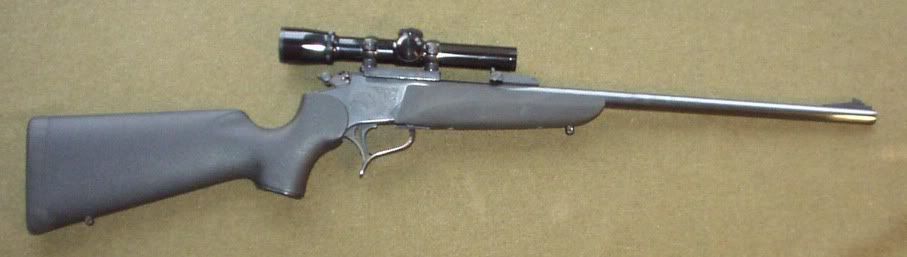

Image hosting by Photobucket


It is stocked in factory Rynite. Rynite is a synthetic stock material and the stocks are made by Choate Machine and Tool Company (www.riflestock.com) for Thompson Center Arms. I like the combination of appearance (I'm used to synthetics from my military service) and light weight compared to wood. I also think that the Rynite stocks fit me better than the wood provided by TCA. Thus the gun all up (sling TOO) and loaded weighs just 6¼ lbs. That's not too much to pack for anyone.

As I write this I have 21 barrels of which only 2 are the 10" length. All others are 16" and longer and the cartridges for which they are chambered range from the .22 LR to 28 gauge shotgun. This barrel, chambered for the .357 Remington Maximum, seems to be among my favorites.

THE CARTRIDGE

Maybe this barrel is such a favorite because the cartridge for which it is chambered is so versatile. One can have loads ranging in power level from .38 Special to .35 Remington without difficulty.
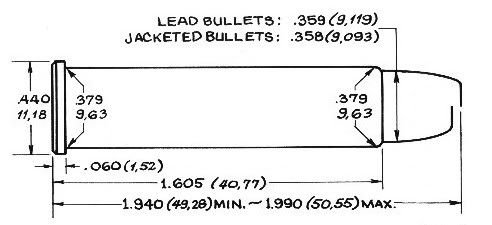

Image hosting by Photobucket


The cartridge is an old one all done up in modern garb. You could trace it back to the .38 Ballard Extra Long. However, I think that all the developers of this round were doing was extending the .357 Magnum so that it was long enough to attain their goals. They had the silhouette game in mind and managed to convince Ruger to bring out a special revolver with a longer cylinder to handle it. That revolver was quickly taken off the market due to complaints of gas cutting of the frame above the cylinder/barrel gap. I've heard that there were 10,000 guns built so it must have had a market. I used to think a lot of the problem was reloader use of hot loads with light bullets, a use which was unanticipated and unintended. However, I read somewhere that Ruger asked Remington to modify the loading to reduce the problem but Remington would not (could not?) do it and Ruger pulled the model from the line. A friend who has one says that the erosion stopped at a certain point and he hasn't looked back. It seems that every collector has one and many have been used to create .445 SuperMag and other revolvers. Dan Wesson makes or made a revolver, but as with all their guns, the cylinder/barrel gap was adjustable and so could be minimized thus likewise minimizing the gas cutting "problem". TC apparently chambered for the cartridge pretty soon after it came out. It has been a moderate success there. NEF also chambered Handi-Rifles for the round but these have been discontinued. However, it is a simple matter to extend the chamber of the still manufactured .357 Magnum that little bit and it affects functioning not at all. Note: I now understand that NEF has discontinued the .357 Magnum rifles as well!

GENERAL LOADING NOTES

I am not particularly interested in silhouette shooting because there isn't a range in my area so all my loads are for hunting, and I generally practice with those same loads. This ensures that I don't have to change zero or that I don't forget to change zero. When I make up plinking or small game loads, I like for those loads to shoot to the sights at some distance without changing the zero from that of the "standard" ammunition.

I have a set procedure for reloading. I begin by taking all once fired cases and polishing them in my Frankfort Arsenal vibratory polisher. Then each case is run through the RCBS full-length sizing die (a carbide die, no lube required). All cases are trimmed to 1.600" after full-length resizing but before case mouth expansion/flaring. Immediately after trimming, cases are chamfered and then run through the case mouth expansion die. They are then primed. This leaves me with a batch that I can load during available time. It is my approach of having a batch of cases prepared for loading that causes me to prefer to use powders that don't require a different primer. I don't really care which it is, magnum or standard, but I'd prefer for it to be one or the other. Sometimes, such as with the .357 Max, I'll count out a certain number for use with one powder (H110 in this case) and prime with the CCI450s and then load that batch. Later I'll come back and prime the remainder with the CCI400 and load those with H4227 and a 200 gr. cast bullet.

There is a die "problem" some people experience when loading the Max. I made the mistake of loading my very first 180 gr. SSP in a .357 Max case using the seating stem that came with the die. The result was a flat point (FP). I had thought that I could get away with using the "issue" stem but it had flattened the point so much it was clear that would be unacceptable. So, I pulled the bullet (I like all mine to at least start out the same) and got the seating stem from my .35 Rem die, screwed it into the .357 Max die and seated a Hornady 180 gr. SSP just as pretty as pie. Too cheap to buy another seating stem, I just swap it back and forth.

That your dies will include a carbide sizer die is a great plus that many people overlook with this cartridge. No lubing is a time saver that I overlooked for many of my early years of reloading, but no longer.

BULLETS

There are 5 bullets that I've come to depend on for this cartridge. There are a couple that I might use given the need to. Shown in the accompanying photo, they are (from left to right): 158 gr. swaged Speer LSWC; 180 gr. Hornady SSP; 180 gr. Remington SJHP; 200 gr. Hornady RN; 205 gr. Leadheads FPGC; 200 gr. Cast Performance WLNGC. Although not illustrated, other suitable or popular bullets include the 180 gr. Hornady XTP, 150 gr. Corelokt SP, and the 180 gr. Speer FP.
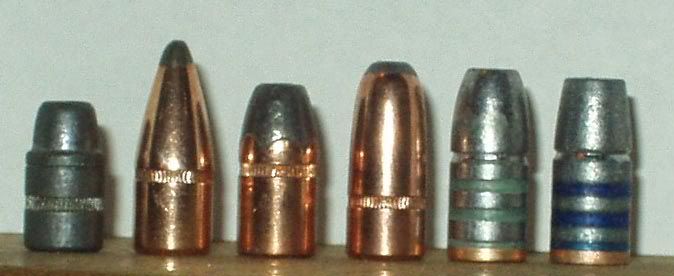

Image hosting by Photobucket


The 158 gr. Speer LSWC is a swaged lead bullet. Originally intended for use in the .38 Special it performs very well in the Max when loaded to about 900-1100 fps. Such performance apparently duplicates the .38 Extra Long and doesn't strain the bullet. I did try the Hornady equivalent but didn't get nearly as good accuracy in my barrel in this application. Whether it was because one has to seat to crimp of the bore diameter portion of the bullet or the lube used by Hornady or some other unknown factor such as weight distribution in the bullet, I don't know. I do know that in my barrel, it is the Speer bullet that is the clear winner with groups more than an inch smaller at 50 yards.

The 180 gr. Hornady SSP has been a standard for me in this cartridge from the time I started to reload for it. I believe it was originally developed to provide optimum performance in .357 Herrett and .35 Remington barrels of 10-14 inches in length. I thought that it would be the perfect round in the smaller .357 Max case. Some do not experience good accuracy in their barrels but it performs better than or as well as any other bullet in my barrel and I don't think one can quibble with terminal performance on any game animal one would tackle with the Max. Note for those interested: That is the only SSP left in the line is the .358". The .308 and the .284 (we knew that the 7mm had been replaced by the VMAX) are gone. There is NO apparent replacement for the .30 cal SSP, however, MidwayUSA is still cataloging the .308 SSP.

The 200 gr. Hornady RN is a bullet that was built for one cartridge, the revered (at least by me) .35 Remington. It is an excellent bullet for the velocities produced by the Max, Herrett or Remington cartridges. Accuracy is right up there being 1.25" or less, seemingly with any load in any gun chambered for any of these three cartridges. I've got a lot of confidence in this bullet which has proven terminal performance. Now that I know that I can start it at velocities fully in excess of FACTORY .35 Remington loads, it may become a new standard with this cartridge.

Well, swaged bullets just don't get it for some people and jacketed bullets are "cheating" somehow so they love cast bullets in the Max. There are a couple that I think are "da bomb" in the Max.

The first is the Leadheads 205 gr. FPGC. I buy this bullet in 500 piece lots and have yet to have one I need to scrap. The excellent quality of this bullet from the folks at Leadheads (www.proshootpro.com) contributes to it's excellent accuracy and the design which follows those by Veral Smith works on game. I don't stress my cast bullets but this has a gas check and can be pushed just as fast as the Hornady jacketed bullet with the same load. It is still accurate and I like to use my load with this bullet for off-hand practice.

Perhaps with even better terminal performance on game is the Cast Performance 200 gr. WLNGC. Also a gas check design, this bullet can also be pushed to 2000 fps and is still accurate. No leading here. Cast Performance (www.castperformance.com) is another cast bullet maker with an excellent product. Never any scrap in their boxes but more than that, consistent weight and casting technique make for a consistently accurate bullet. It is a bit more expensive but the design is more along the lines of Veral Smith's thoughts and might be even more effective on game.

I should also talk about some bullets I don't use in the Max.

The 180 gr. XTP is NOT a bullet that I have used. Friends and acquaintances that have used it and posters to the various Internet forums often choose it as their premier bullet for the Max. I'm sure it is great in the revolvers chambered for the Max and probably solves whatever problem makes the SSP inaccurate in some barrels. It SHOULD be a good bullet for the Max and it certainly works well for quite a few people.

I only recently discovered the Remington 180 gr. SJHP. I've been told that this bullet was originally developed for the .357 Maximum. However, I've never seen it in loaded ammunition. In fact, the ONLY Remington factory ammo for the Max that I've ever seen is loaded with the 158 gr. SJHP. I bought 500 recently to use in a .357 Magnum rifle. They perform well there at about 1600 fps. Interestingly, that is about what you should get from the Max in a 10" barrel. I don't know how they would perform when launched at 2100 fps but they might be a bit frangible for my taste.

Indeed that's why I don't use the Remington 158 gr. SJHP. This bullet is all that I've seen loaded in the Remington factory ammo. As many gun-writers reported, this load is indeed more of a varmint load. Some people are very satisfied with the old Remington factory load with the 158 gr. SJHP on deer and some were not (very much not!). I think those differences of opinion are influenced by the size of deer shot and the ranges at which those deer were shot. Of course there are those who report that it takes deer down NOW. No doubt. However, I would bet that these fellows use it only on quartering shots from the rear and into the lungs just above the heart. The bullet is moving at 2173 fps from my 21" barrel and the bullet is just too "soft" for this starting velocity. Accurate, I don't use it on game larger than groundhogs. I would not recommend it be used on anything like coyote if you want the pelt. I think we can do better in this cartridge. Of course it will work on deer there and there isn't anything wrong with that if that is what you want. I want to be able to take game from any angle and prefer a sturdier bullet.

I think that the Remington 150 gr. Core-lokt SP deserves to be mentioned here. I think that this bullet is primarily designed to use in the .35 Remington. The intent being to provide greater velocities out of the old girl and flatten trajectories in the process. I'm sure that there are a lot of .357 Max Contender shooters out there using this bullet. Lighter by 30 whole grains than the 180s and with a sharp little point to boot one would think that this bullet can be driven fast and maintain that velocity way on out there (relatively speaking). There was even a fellow on the Accurate Reloading forum (www.accuratereloading.com) who prevailed upon Remington to make a run of 50,000 of these bullets and paid the up-front cost himself. Apparently, there were at least a few who agreed and I believe that he's recouped his investment. For me, these bullets were not at all accurate in my barrel. I believe that the bearing surface or perhaps that combined with the weight distribution of the bullet made this no better than a 2-3 inch grouper for me. For what it's worth, they don't work in my .35 Remingtons either!

The Speer 180 gr. FP was developed for use in the .35 Remington to give higher velocities and thus flatter trajectories with more bullet weight than the previous light bullet for the .35 Remington, the 150 gr. Corelokt SP. It is accurate in my barrel and it seems to provide good terminal performance but I thought that it might be a tad too heavily constructed to be used at the slightly slower Max velocities especially at the outer ranges at which I would use the cartridge. I don't experience the problems with accuracy with this, or any other 180 gr. bullet, that I had with the 150 gr. Remington. I do know of one shooter that uses this bullet exclusively, also from the carbine, and has excellent results on game deer sized and smaller.

One thing that some people don't consider when carrying loads of different capabilities. They often load the same bullets and can't tell the difference between loads when they get to the field. In the worst case a hunter might lose game due to misidentification of a small game load as a full-power "deer" load (or the other way round). Paint and fingernail polish sometimes can't be seen or wear off after extended carry. Much more certain in my opinion is to use a different bullet or different case. Cases can be differentiated by headstamp OR length (or both…). Bullets are much more certain. Usually, I load cast for the small game load and jacketed for the "deer" load. When using the heavy weight LBT style bullets, which are very effective, one needs to use a completely different style bullet to ensure that you can quickly tell the difference.

CRIMP

If you're talking bullets you've got to talk crimp. I've tried various degrees of crimp. In all cases consistent velocities are helped with a firm but not excessive roll crimp. I suppose that a good taper crimp would do as well, but my die is not a taper crimp die. I don't use the Lyman M die but do expand as I would with any straight case. I don't see anything "wrong" with any of the methods if they work. My system works and only because I take care to properly trim the cases and adjust the die. If you put too much of a roll in the roll-crimp your neck tension might actually decrease (with some dies) as the brass in the neck or case mouth is deformed. However, it seems that most of the powders indicated for the .357 Max are best served with quite a bit of resistance in the crimp. It is ALWAYS best for 2400 and H110/W296. Differences in the crimp often make a HUGE difference with H110/W296.

I'm not a "believer" in the factory crimp die concept and have none of those dies. I am satisfied with the performance of the crimp provided by my RCBS seating die.

TRIMMING

Trimming ensures that each case releases the bullets the same way. I have to admit, that for my first 600 rounds or so I didn't pay attention to trimming or the crimp. A few unexplainable flyers and sticky cases made me look at what was going on and the only variable is the crimp based on case length. When I eliminated that variable, the anomalies went away.

PRIMERS

This cartridge REQUIRES small RIFLE primers. Rifle primers are tougher and will withstand the 50,000 CUP that the .357 Max can go to. It IS stated to be a requirement for that reason. Clearly if you are loading to the old .38 Extra Long standard (i.e. 6 gr. Unique and a 150 gr. lead bullet) you won't have nearly the pressures. That's not what most do as that's not what the case was developed to do. I will reiterate, you must use small RIFLE primers. A pierced primer at these pressures in the gun you are using can be a very bad thing indeed. There is NO benefit to using small pistol primers. The cost to you of buying a $20 brick of primers is NOTHING compared to your EYESIGHT! (I've seen a couple of instances of the failure of protective eyewear. A fine safety element, NOTHING is guaranteed!)

POWDERS

I think that there is a wide range of powders usable in this case. However, there are relatively few powders that will produce the velocities (at safe pressures) for which the case was designed. WC680, AA1680, Lil'Gun, H110/W296, and H4227 seem to be best in my gun or are reported as providing the best velocities or accuracy in those guns shot by others.

BRASS

I've never seen the Federal or Winchester brass but I've accumulated over 1000 Remington cases. The Remington brass is pretty good, but when used in MY Contender barrel, it all needs to be precisely trimmed to 1.600 inches for best performance and there has been quite a bit of variance in length with this brass. Still, it holds up to repeated use well.

357 MAX LOAD DATA

The following chart gives my favorite loads. The "full effort" loads are the maximum in my barrel and I am not responsible for your use of this data or your reloading practices. It is your responsibility to use this data appropriately.
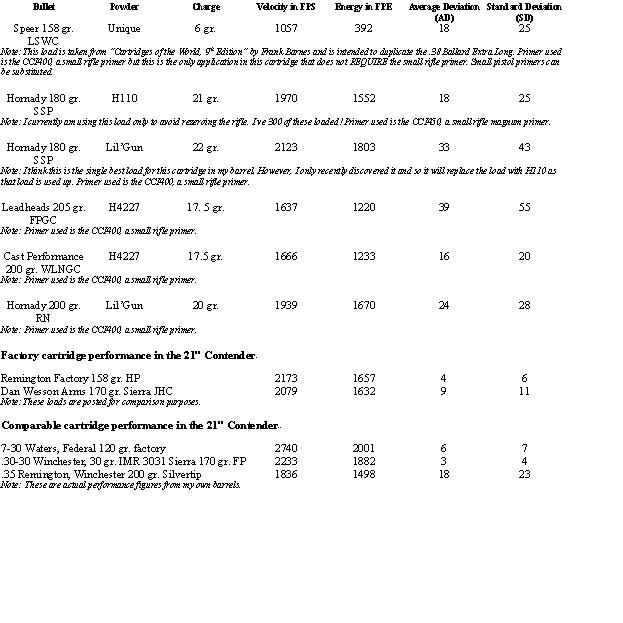

Image hosting by Photobucket


Of course one wants to see just how well this gun will shoot. By shooting the gun "off the bags" you'll have a better idea of how the gun really performs. It has been my experience that tip barrel rifles and the Contender in particular require that the resting point be to the rear of the pivot point with absolutely no upward pressure on the forearm. Shooting from field positions will give a better idea of how the gun groups when used in the field but the groups won't be as tight. This bothers some people but I use mine in the field, the range is only for load development. For those of you who care what MY rifle does, I'll tell you that from field positions I get 1-1½ inch groups at 100 yards with all but the 158 gr. Speer LSWC load. That load will do 1-1½ inches at 50 yards and requires but a small adjustment in point of aim. That's plenty for what I'm going to do and remember, these groups are shot from FIELD positions.

I've really grown to love this cartridge. It does what the .35 Remington does from factory loads and nearly what it will do from handloads. It also has some advantages. Rimmed case for ease in handling with the Contender, a straight case that can be reloaded using a carbide sizing die eases reloading chores, and a small case head that increases the margin of safety in the Contender system. It is that small case head that allows the 50K CUP pressures that allow, in turn, the .357 Maximum to run so closely on the heels of the .35 Remington. Another benefit to many is that the Max can do this on very light charges, one-half to two-thirds of what the .35 Remington will use. With powder prices rising, this is important to quite a few shooters.

Light powder charges do something other than ease the strain on the wallet. They reduce recoil as well. Recoil with the heaviest charges and bullets have a recoil energy of only 13.7 ft lbs. That's actually 3 ft lbs. less than the .35 Remington 200 gr. factory load at only 1836 fps. This gun is easy on you all the way round!

However, there are those who always push too hard. You will see some who claim that they get 200 gr. RNs to 2000 fps in 18" or shorter barrels. They have to really be pushing things even using 680, AA1680 or Lil'Gun. I don't think it is worth losing your eyesight (or worse). There are limits to everything. If you simply must have more velocity, chamber for a bigger case like the .358 JDJ or .358 Bellm.

Wanting a small game load for my barrel, I tried 2.5 gr. of Bullseye in the .38 Spec case with the 205 gr. cast bullet. This makes a quiet (not silent) small game load that shoots point of aim at 50 yards when the gun is sighted for 100 yards using the full-power loads. Very handy and you can easily tell them apart. A nearly silent small game load would be a great benefit in some circumstances.

This is an efficient, well-balanced cartridge that gets .30-30 performance without a lot of powder. It will match factory .35 Remington ammo. I like it.

Addendum--

We are constantly asked about adaptation of this cartridge to lever-action and other rifles. Most of these requests for detailed information are without any research what-so-ever. However, in the interest of saving me some typing in the future I'm going to add it here.

The Marlin 1894 is most often mentioned as the "ideal" basis for a rifle chambering this cartridge. It isn't. One shooter actually had a very good smith make up such a rifle. He reported that he wasn't entirely satisfied with it. Functioning wasn't entirely reliable and the lever throw had to be so lengthened that use of the gun was awkward. He felt that the awkwardly long lever throw might have contributed to the functioning problems but that the geometry inside the action as the overly long for this action cartridge was maneuvered into position must have contributed to his problems.

The Marlin 336 is simply too long an action for the .357 Maximum. The same problems that the .44 Magnum 336s sometimes had can occur with the Max. Further, a new barrel is required. One can't simply re-chamber a .35 Remington barrel (and one wonders why one would). This increases the cost considerably. This gun also negates the smaller action/lighter weight rifle benefit one expects with the .357 Maximum.

Another action mentioned is the Winchester 1894/94 as one might expect. After all, the action is one of the most common available. The MOST suitable of these is those guns factory produced in .357 Magnum. Some shooters have reported that these will already handle the .360 Dan Wesson cartridge which splits the difference between the .357 Mag and the .357 Max. Still, one shooter who actually attempted the conversion wasn't, at last report, fully satisfied with functioning. Apparently the cartridge guides are set up to handle the .357 Mag length cartridge and while they actually will work with the .360 DW don't work with the Max. Altering the cartridge guides takes time (and money) to do correctly.

The Winchester 1892 and clones are simply too small to handle the additional length of the .357 Maximum cartridge.

Also asked is why there are no factory chambered leverguns for the .357 Max. The simple explanation is that there is no market. Many shooters have found that the cartridge is wonderful in single-shots. One can load about any bullet. It is easy to reload (no lubing of cases).

The .38-55 in the Contender Carbine

The .38-55 Cartridge - Then and Now

Introduced in or about 1884 by Marlin for the Ballard single-shot and Model 1881 Marlin repeating rifles, the .38-55 replaced its predecessor, the .38-50 Ballard cartridge. Other than being approximately ?-inch longer in its case and thus holding another five grains of black powder, the .38-55 practically duplicated the older round, and was soon even more widely known than had the .38-50 as a target cartridge for short and mid-ranges.

The .38-50s and .38-55s were supreme during the 1880s. And although faced with tough competition from the .32-35 and .32-40 after 1890, the .38-55 managed to hold its own at ranges of 200 yards and 40 rods (or 220 yards). Possessed of mild recoil, many makers chambered fine match rifles for it. These included Bullard, Farrow, Remington Rolling-Block, Remington-Hepburn, Winchester High Wall, Stevens Model 44 and in 1903, the Stevens Model 44½. Sporting style single-shots and repeating rifles were also sold, first with the Marlin Model 1891 and then the Colt Lighting pump, the Model 1893 Marlin (my first .38-55), the Model 1894 Winchester, Remington-Lee bolt actions, and finally the 1899 Savage Model 99.

The cartridge soon developed a good reputation as a killer of deer and black bear to 150 yards especially following the introduction of the "High Velocity" and "High Power" smokeless powder loadings. Due to its flat-nosed, relatively heavy bullets of good diameter and sectional density, it proved capable of downing game of this size neatly without a lot of meat destruction. There was no better cartridge for both hunting and match shooting at the time. This was because the smaller cartridges lacked power for reliable use on big game and the larger cartridges were seldom as accurate.

Those earliest lead bullet black powder loads had a muzzle velocity of only 1,321 fps but still retained a speed slightly in excess of 1,000 fps at 200 yards. Kinetic energy was a low 988 foot-pounds. The same ballistics applied to the first smokeless loads but with its adoption as a hunting round, demand grew for a faster, more powerful loading suited to the new and stronger rifles that had been developed in the 1890s.

The ammunition makers answered this call with a High Velocity load reaching 1,593 fps for 1437 FPE, and later still a High Power round which drove the 255-grain bullet to 1,700 fps and 1,635 FPE. Where the original rounds had an arched trajectory some 13½ inches halfway to the 200-yard mark, trajectory of the High Velocity loads was 9½ inches, and only a bit over 8 inches with the High Power load. Pressures likewise increased, from a modest 18-20,000 PSI in the black powder and low-pressure smokeless rounds, to some 28-30,000 PSI in the High Velocity ammunition, and 32-34,000 PSI in High Power loads.

Now, the cartridge may be undergoing a revival as a cartridge for the long-range Cowboy shooters. This new demand has encouraged supply of components, particularly bullets.

There is but one source for factory ammunition and that is the Winchester brand of a 255/1300 load. Occasionally one can find the excellent Dominion -CIL brand load of 255/1600. The sources of brass are similarly limited to the Winchester brand. But now Starline has brass in both lengths, new and old and it is good brass. New and old? Well, that's one other thing that should be mentioned here and that is that the brass has been shortened from 2.120" to 2.075" or about 0.145". This is sufficient to make older seating/crimping dies inappropriate, as they are unable to even remove the belling of these shorter cases. If you have an older set of dies it is possible to order only a seating die to work with the newer brass which is the tact I took. Of course the older die can be shortened and will then work, properly adjusted, with both types of brass.

There are many sources for bullets. For jacketed bullets the finest is probably the Barnes Original in either .375 or .377 diameter from most volume mail order houses or special order through your local gun shop. Lead bullets are available from many sources as follows: Lead Head Bullets, Western Bullet Company, Cast Performance Bullet Company, MidwayUSA, Beartooth Bullets.

Sometimes it is possible to acquire second hand partial or complete boxes of Remington or other brands of .375/.377 bullets. As long as the price is less than the Barnes (currently $30 or so plus shipping), these will suit well. Using this method I was able to run across 19 FMJ 255 bullets of Remington manufacture. These were accompanied by 20 of the standard soft points.

I've also found a new source, that being private maker in Florida, Dave Deering (aka Stone Fence). Dave makes some wonderful .375" bullets that actually weigh 255 gr. AND have a more blunt profile than the Barnes bullet. This means that they are shorter for their weight compared to the Barnes and that might be important to users of lever action rifles. These bullets are wonderfully accurate in my rifle and by all tests are strong enough to work at 2000 fps.


The Rifle -My .38-55 Bullberry Barrel Contender Carbine

In order to shoot any cartridge you need a rifle to fire it. While many rifles have been chambered to fire the .38-55 Ballard or Winchester round, few are currently manufactured for it.

Image hosting by Photobucket
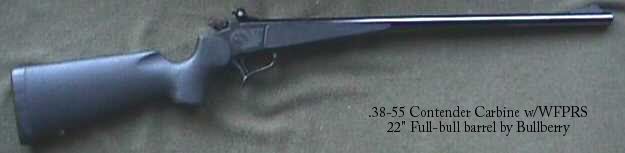
Full View of the Contender Carbine as .38-55

Image hosting by Photobucket
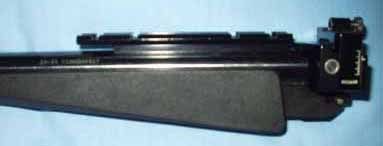
Side View of Scope Mount and Williams Foolproof

Image hosting by Photobucket
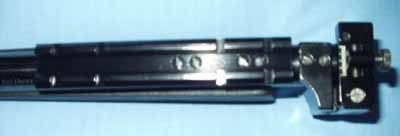
Top View of Scope Mount and Williams Foolproof


I've long admired the mechanical simplicity of the Contender pistol as manufactured by the Thompson Center Firearms Company of New Hampshire. However, I did not want to use it as a pistol but wanted to convert it to a carbine or rifle configuration. I spent a large part of my nearly 4 year tour in the Republic of Korea (1977-1981) reading and dreaming of converting the break open action Contender into a nifty light rifle.


My Contender Carbine set up as a .38-55 Winchester rifle.

Unfortunately, this was not to be for many years as I struggled to care for a growing family and with the restrictions on firearm ownership that are part and parcel of serving in the armed forces overseas. Finally, after enduring a divorce and settling down with a more understanding wife, I was able to begin acquisition of the finer things in life. After a brief fling with an early AR-15 Carbine, rising prices for that particular weapon and dissatisfaction with rapid fire moved me to sell the AR-15 and purchase my first Contender with 2 barrels. A .223 Remington and a .35 Remington, it snowballed from there finally (currently) ending with 18 barrels of various chamberings and lengths. Still, I did not have a .38-55.

However, I've not been completely remiss in exploring this cartridge. Once, immediately after high school and before entering the Army, I bought a used (very) Marlin M1893 with a formerly 26 inch octagon barrel now appearing as a 19¾ inch with a full-length magazine tube. Although I had to replace the magazine spring and stock, this rifle was a fine shooter and hardly recoiled even with the CIL-Dominion High Velocity loads that I had to shoot. I purchased reloading tools and Hornady 220 grain bullets (which were developed for the .375 Winchester, progeny of the .38-55) After a couple of years a friend came to me and asked if I could reload the .38-55 for a Winchester rifle he was about to purchase.

Loading

Well, I've read a lot and done a lot of reloading of this cartridge over the years and yet, I hear something new all the time. I'll try to address all the problems I've experienced but if I forget something, please ask.

Case preparation is critical and follows a strict procedure. I'll start with a new case and run through the drill. First, all factory new cases must be sized in the full-length sizing die. This uniforms the cases and particularly the case mouths before the next step, trimming.

Trimming is absolutely critical with any cartridge that will be crimped on the bullet as will the .38-55. It ensures that you have a consistent length that will make adjusting the crimping die so very much easier. I trim all my cases to either 2.075" or 2.1295". You see with the .38-55, there's the old case length of 2.1295" or the new standard of 2.075". Older die sets sometimes won't crimp the newer cases. More about that later. Chamfering the case follows all trimming. I deburr the case mouth outside and inside.

One must have completed chamfering/deburring before this next step, belling. There are a couple of options here. One can use the die provided or purchase the Lyman M die. I use the RCBS set as sold BUT many report a more consistent seating of the bullet AND a more concentric seating of the bullet when using the Lyman M die. It is worth looking into. Please note that the M die is a separate action and die and can't be combined with the normal belling step. This step is necessary to ease the bullet into the case and particularly necessary in the .38-55. Why? Because, the case mouths are thin and will tear or buckle if the bullet can't be easily seated. It is ALSO important to ensure that the expansion plug, belling stem, or whatever you want to call it is of the correct diameter and works with your choice of bullet diameter. The .38-55 uses bullets of .375" to .380" and that's quite a range. While the case needs to grip the bullet firmly, there is no need to deform the bullet (and maybe harm accuracy) by having too firm a grip.

The next step is to prime. I use the CCI 200 large rifle primer exclusively. I have found no reason to use any other primer.

Now we must charge the case and seat the bullet. Here's where it all comes together. Some will have problems with the bullet being seated non-concentrically and causing a bulge on one side or the other. If it chambers, let it go. Make certain the case is all the way into the shell holder before seating the bullet. Also, as mentioned, having the case mouth expanded to the proper diameter will mitigate this problem. However, I believe a lot is in technique. I use bullets of from .375" to .379" in diameter with no such problems.

Crimping is absolutely necessary for cartridges used with repeaters. I feel that cartridges that will feed absolutely every time best serve such guns. Power, etc. mean nothing if you can't feed shells from the magazine. Rounds loaded for the Contender don't need to be crimped but the die should be adjusted to take the belling from the case. Here's where the two different case lengths and die adjustment are critical. The seating die set up for the old case length (and I have a set) will not crimp the new shorter length cases. Since I have both length of case, I simply got a new seating die and the two seating dies are set up for the two different case lengths.

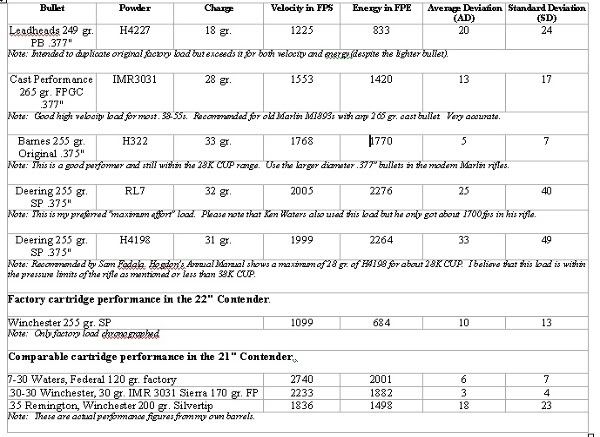
There are a number of powders that can be used with the .38-55. I've listed loads that I've had success with. If it didn't work for me, I didn't list a load with that powder. That doesn't mean I didn't try that powder, only that it did not work for me.

Image hosting by Photobucket


One thing I found in my reloading research is that several people have used the load of 32 gr. of RL-7 (Reloader 7) with 255 gr. jacketed bullets but have gotten widely varying velocities. Ken Waters cites the load in "Pet Loads" but only gets a little more than 1700 fps. Layne Simpson recently mentioned the load in an article on leverguns but he got over 1800 fps. Yet another writer, Christian H. Helbig, in an article "Loading the .38-55" republished in "Big Bore Rifles and Cartridges" uses up to 33 gr. of RL-7 but gets only 1825 fps. I tested it several times and continue to get the average of 2005 fps shown in the chart. All barrel lengths were approximately the same length as mine or even a bit longer. Don't know quite why this is always so as this is not a notably "fast" barrel. However RL-7 has changed a bit and the earlier version(s) might have given such results.

How do I know this? Because with all other loads I get very much what is forecast and what others get with the same load in their barrels.

By the way, Mr. Helbig's article is interesting in that he feels the same about loading the .38-55 to .30-30 pressure levels. He says,

Since this case has the same base diameter as the .30-30, it can be loaded to the same pressures (in the aforementioned rifles) as the .30-30. Back-thrust or stress on the action will be the same and these rifles are perfectly OK for modern .30-30 loads of 38,000 PSI, (factory load pressures).


Mr. Helbig also loads (or loaded) the .38-55 with No. 4198 (which became IMR4198 and is similar to H4198) using 31 gr. under the 265 gr. cast lead gas check bullet from the Lyman 375296 mold. However, he only got 1870 fps. He used a Marlin 336 with a new surplus 1893 barrel.

Sam Fadala apparently feels the same way about loading the .38-55 and it is "his" load of 31 gr. of H4198 that began my experiments beyond the 28,000 PSI range intended to keep the old Ballard rifles safe and intact (as well as their shooters!).


Related articles by other authors:

- "Levergun loads: the .38-55 Winchester; another fine levergun cartridge gets the Taffin treatment" Guns Magazine, June 2003 by John Taffin
- "Loading the .38-55" republished in "Big Bore Rifles and Cartridges" February 1991 by Christian H. Helbig
- "Marlin's .38-55 - Long Range Cowboy Levergun" Guns Magazine, Feb, 2000 by John Taffin
- "Serious ammunition: heavy duty factory loads for the big-bore levergun"
Guns Magazine, March, 2004 by John Taffin

As some of you who have an interest in this old cartridge know, I've been pursuing a wide range of loads. Using Stone Fence's 255 gr. jacketed .375" bullets (excellent for consistency!, thanks Stone Fence) and the subject powders, I did a bit of a run up to the limits I was looking for. Case expansion was measured using the Ken Waters method and in my rifle, no load is apparently excessive. Cases used were once fired Winchester (the newer "short" cases) and primers were all CCI 34. My gun is a Thompson Center Contender with 22" Bullberry barrel bored to .375" and chambered to the .38-55 cartridge.

The H4198 charge is one that Sam Fadala wrote up in Shooting Illustrated for use in HIS Marlin M336CB. He'd made a couple of modifications to the gun's trigger, springs and the cross-bolt safety. The RL-7 charge is one I've seen a couple of places. Both charges exceed manual recommendations and if used are at your own risk. I accept no responsibility for your reloading practices.

Yep, the recoil level is up there in this light gun, approximately 23 fpe free recoil energy. Cases fell right out when the gun was opened and the barrel turned down (and I know that doesn't necessarily mean anything). Accuracy seems good, but this is one cartridge that has to be rezeroed for every load and there is a wide change in sight elevation between the slow 1300 fps loads and these loads.

1900 fps was my goal and I exceeded that. I feel that the .38-55 cartridge is vastly underloaded because all the listed loads are for the Ballard rifles' limits of about 28,000 CUP (or less). This much like the situation with the .45-70 and the relationship of that cartridge to the Trapdoor and the modern Marlin. I think it is also true that the .38-55 could be loaded to .30-30 pressure levels safely. That's about another 10-12,000 CUP. Even the modern short case is longer than the .375 Winchester.

Friday, November 19, 2004

I posted on Mike Bellm's forum:

Yes, I have the 28 ga. Van Horn barrel. I like it.

It is really, really light since, well, heck, there's just about as minimal an amount of steel as you can have in a Contender barrel. It is so light that you really have to work to avoid shooting errors. There's no inherent self correction on something like swing through since there's no weight in the system to keep those barrels moving in spite of yourself. If you stop swing, the barrel stops right now! Heck, the whole gun weighs about 5 lbs (maybe a bit less).

I've tried several loads which work and I think enough better than the .410 to make the barrel worthwhile.

I had Dave put a modified choke in it and when I got it that's what it patterned. That's good. I also asked for a 22" but Dave (bless his heart) sent me a 25½" barrel. I wasn't happy when I opened the tube but I'm now glad he did that. Every bit of steel one hangs on that barrel is a good thing! Yep, this is a bull barrel!

Another consideration is that the "dovetail" locks are actually brazed to the barrel there being insufficient material to cut a dovetail. This and the bull barrel configuration require a dedicated forearm. I've modified a Custom Shop (Choate) bull barrel carbine Rynite forearm for use with this barrel.

Birding isn't what it used to be around here and I've only collected a couple of mourning dove and a single squirrel with the barrel. I just haven't been able to get onto any quail and not managed to bust a grouse with the gun in hand.

If anyone has further questions, feel free to ask even by e-mail. If you want to know about the 28 ga. capabilities any published data will apply. This barrel doesn't exhibit any surprises in that area.


I received an e-mail:

I happened to see on Mike Bellm's website that you have a site of your own and that you have a 28 gauge barrel for your TC Contender. I too have a Contender (a G2 model) which has a truly superior trigger and I had read here and there that 28 gauge shotgun barrels are made for them. Then when I saw your post on Mike's website I had evidence that these barrels are being made by someone out there. I had considered calling Fox Ridge to order one since I thought that the TC Custom Shop barrel should be a cut above what other companies make, but I guess that I must be wrong on that account. If you don't mind telling me: who made your 28 gauge Contender barrel and why did you decide to go with that company as opposed to Fox Ridge (Thompson Center Custom Shop)? Since I started this research on TC barrels, I see that there are a couple of companies that make barrels for their guns, and since I read commentary that TC's quality control is "spotty", I am beginning to understand why.So maybe a 28 gauge barrel from the TC Custom Shop would not be such a good idea after all? I look forward to your input on this subject and I thank you for your time and consideration.


My response (edited for this format and to remove personal references):

...about the 28 gauge. I got my barrel from Dave Van Horn. I believe he still has a website The Gun Shop.

I got the 28 gauge barrel from him because at the time:
1. I was on the prairienet TC list and they arranged a "deal" with Mr. Van Horn
2. I didn't have a 28 gauge barrel.
3. He was the only fellow who would make one for the Contender!

I didn't try the Custom Shop because they didn't do that at that time. I must not have noticed that they do 28 gauge Contender barrels now. I would think that they would do at least as good a job. Frankly, I've never gotten a bad custom shop barrel. I have 2, a .45-70 24" and a .25-35 21". Both are good accurate performers.

I highly recommend one other forum to a budding Contender freak like yourself. Specialty Pistols is a great forum for Contender and Encore shooters. Bullberry produces good quality after market Contender barrels as does On Target Technologies. For a good price on previously loved barrels, see Ed's Contenders.

Wednesday, May 19, 2004

I thought I would post some notes on my 10mm Auto barrel from posts I made on the Specialty Pistols forum.

I have a 14" that I got from the old obsolete barrels list. I put a Choate extension on it and use it as a carbine barrel. I had some interesting results from my chrono run on my 14" barrel.

Load/velocity/energy/AD/SD
10 gr. Unique 155 XTP/1156/460/55/67
155 XTP Factory/1457/731/5/7
180 Hydroshock Factory/1093/477/39/54
180 Rem HP Factory/1180/556/20/27
10 gr. BlueDot 180 BullX TC/1510/911/10/16

Factory ammo sure ain't a barn burner!

Reference, pierced primers. This is interesting. I noted that some loads, and not the hot ones, have a tendency to have that look to the primers although none were actually pierced. You know, that just about pierced look. I haven't seen such primer appearance with any other cartridge regardless of pressure level. Of course all these were fired on the same frame. RELOADS don't exhibit this only FACTORY ammo. Peculiar.

I'm really getting to like the 180s in this cartridge. Guess what, just like the .38 WCF (aka .38-40).

BTW, another interesting observation. At 150 yards, all loads struck to within 3 inches of one another. My 14" with Choate extension, used as a carbine, TC aperture sight. That's with loads of 155 going 1100 fps to 180s going 1450 fps!

I can see why this level of performance had a following. Low recoil usable trajectory to 150 yards (and farther if you are have some experience), sufficient power for close range hunting but not excessive for small game and relatively low report. Would be a great cartridge to teach a youngster and transition to centerfire.

Found a box of PMC 170 gr. factory stuff and shot it up today. 1292/630/17/26 (fps/fpe/ad/sd)

I'm constantly amazed at the velocities I'm not getting. The bore expansion ratio is such with this cartridge that it does just a hair better in the 14" than it would in the 5".
Wanted to let you know the results from my 10mm Auto loads with the 180 gr. XTP and 10.4 gr. Blue Dot. I got 1271/646/23/32 (fps/fpe/ad/sd).

My load with the old BullX 180 gr. TC cast got 1510 fps with 10 gr. of Blue Dot. A little faster I can see but 239 fps! I'd like to know what is up with that. Well that is what makes this interesting. It is accurate.

Of course it is more accurate when the darn sight (TC made aperture) doesn't fall apart while shooting! Apparently the elevation screw unscrewed itself. With my handy magnetic pointer I found it but what a pain. I'll be switching to the Williams WGRS shortly.

I crimp them pretty good and it burns noticeably "cleaner" than new Unique. Of course clean means different things to different people. Also, I can't remember if I said before, but I'm consistently getting complete burn with 10.4 gr. BD and the CCI LP primer (standard NOT magnum). The other day I kept looking down the bore for powder and didn't see any. I was also shooting over my ground sheet to catch whatever blows out of the barrel, but nada.

I am seating those XTPs to make a COL of 1.265" (average). It seems to vary some (I measured 15) and varies between 1.260 and 1.270. I haven't been able to figure out what is causing the variation but suspect that there is a minor variation in the bullet length (guess I'll have to measure the bullets now! ). I does NOT seem to be the result of high primers, headstamp "burrs", or bullet deformation.

I loaded these so that I could use them in a Delta Elite if I wanted (eventually ) without regard to the throat length. I'm off to the range this morning to zero this load and try it for groups out to 150 yards (range use allowing).

Took the new load and loaded it into Pointblank. That program says my PBR (Point Blank Range) should be 107 yards. Range tests prove it out. If you want a 150 yard gun in this caliber you need to go to the .41 Rem Mag or wildcat the 10mm on the .44 Mag. With the 10mm Auto you are down 10-12 inches at 150 yards.

Now when I shoot this out of a Delta Elite, it doesn't seem that bad because I can easily adjust but with peep sights (and probably with a scope) it is very noticeable.

However, it should still do in any farm pest like groundhogs, coyotes and such.

Accuracy? Well, with my sight set up it is no great shakes. On rocks or what have you I will hit them but on a bullseye (50 meter slow fire pistol) at 100 yards, the front post subtends so much that it is difficult to figure out how much side to side you have. Groups ran 5 shots into ½" vertically but 1-2" horizontally. That was the best I could do.


Set up for the PBR, you have to remember that you will be shooting noticeably over at 25-65 yards. This overage is 1-2" and can make the difference if you're attempting squirrel dinner. Again, for those farm pests, just hold center of mass and you'll be fine. This will work on 2 legged pests to 150 yards but much further would be a true desperation/time buying move.

Interestingly, this load of 10.4 gr. BlueDot supposedly runs 35K CUP or around 4400 for breach thrust. That's near the limit for the Contender (isn't it supposed to be about 4500?).

In any case it is a fun cartridge.

Friday, May 14, 2004

I've been reloading the 10mm Auto for my 14" Contender barrel. My preferred bullet is the 180 gr. XTP and I'm currently loading it with Blue Dot (BD).

I've been reading some of the posts on the forum and following links to a certain excellent site and see that I'm not getting the results that I ought to expect.

First, I've tried various bullets. Those I had the best accuracy results with (other than the preferred 180 gr. XTP) were the 155 gr. Hornady XTP and the 180 gr. BullX (sadly departed) TC cast. I also tried various powders including BD, Unique, and 2400. In other words a wide range of powders (although the AA powders are very hard to come by around here). BD seems to be the best powder for accuracy and velocity.

Combining BD and the 180 XTP I worked up to the Hogdon's Annual Manual max of 10.4 gr. of BD. Velocity from my 14" barrel was only 1270 some fps. Factory loads from Remington, PMC, Federal (Hydro Shock), and Hornady did no better. Of course the Hornady factory 155 gr. XTP loading was an exception and produced about 1450 fps. One notably surprising thing is that the BullX 180 gr. cast went 1458 fps (or so, I don't have my records here at work) over 10 gr. of BD. Now, I expect jacketed bullets to be a bit slower, but 200 fps?

Reading posts here and there and some associated files, I see that this performance is generally what can be expected from 5" barrels. That's kinda disappointing but not really.

My goal was to load the XTP to .38-40 rifle velocities, or about 1350 fps and I'm only about 80-100 fps too slow.

Does anyone have any suggestions?

Tuesday, September 30, 2003

210 gr. XTP over the Hogdon charge of 22.5 gr. Lil'Gun when used in the 16¼" Bullberry barrel :

For 5 shots - 1872, 1845, 1871, 1863, 1837, avg 1858, ad 13, sd 16, for 1609 fpe at 7 yards. This is better than what I get from factory Winchester 200 gr. .35 Remington ammo in my 21" factory barrel. It probably doesn't carry as well as the .35 caliber bullet but it is usable without sight adjustment to 150 yards, shooting into just under 2" at that range from sitting position. My Rynite stocked Contender weighs just 5 lbs, scoped. For our area, this is one handy little deer gun!

BTW, these were taken in 50-55 degrees and correspond very closely (as I remember it) with the velocities taken on a 90 degree day.

I also took the .25-35 out with the load of 8 gr. SR4759 under the Remington 86 gr. JFP intended for the .25-20. Avg velocity/energy was 1191/268. Using the lower vertical leg of the duplex reticule as a post it went into a cloverleaf at 25 yards, on POA. This is exactly the use this load was intended for and I'll be making up more of them.

Thursday, September 04, 2003

This year I bought a TC Custom Shop 21" .25-35 Winchester barrel for my Contender. With the factory 117 gr. RN load (2150 fps)or the European version 6.5x52R (S&B, 2000 fps) it is a mild recoiling fun cartridge. Handloading can get "improved" performance if improved performance means higher velocity but I don't see it as necessary. I am loading the Hornady 117 gr. RN to 2250 fps and this load suits me fine.

Remington's 86 gr. ".25-20" bullet comes with 2 cannelures, the one closer to the base being correct for the .25-35 and giving the correct LOA. My goal is upper end .25-20 velocity or a bit more. I've tried 14, 13, 12 and 11 gr. of SR4759 but while accurate at 50 yards it is a bit "smokey". However, as I've said before, maybe that isn't important if I bother to clean the barrel! Today, I took out the loads with Rem. 86 gr. jacketed FP for the .25-20 and 10 gr. of IMR SR4759. Shazzam! Right on at 50 yards with the same sight setting as the 117 gr. for 100. Hooorah. I keep wanting to use this powder because of the high loading density.

Then... I had to try out some more of the 75 gr. VMAX burners. What do you know, I finally found out how to hold the duplex reticule for that load. As best as I can describe, I use the bottom of the top thick leg of the reticule, sort of like an inverted post reticule. Right on at 150, a little high at 100. Heck, these might even be usable!

BIG difference in recoil and muzzle blast between the two loads (not as though there is a lot of recoil in this cartridge).

I've been doing a lot of work with this cartridge. Funny, I never expected to. It is just a fun cartridge to work with and I really like it. Now, I've got a good small game load, a good big game load and a usable coyote load! I'm chuffed.

Thursday, June 12, 2003

After shooting the 75 gr. VMAX load some more yesterday, I have to say that I was a bit disappointed in MY performance. Clearly, the load will group (albeit 6" or more too high to be usefull) sometimes shooting tight cloverleafs at 50 yards. However, I didn't seem to be up to the load having some very bad problems with trigger control and having many called flyers. Putting a single shot in the right place is easy enough but running strings of 5 shots inevitably resulted in the groups opening up from .5" for the first 3 to 1" or MORE with the remaining 2 shots. It got so bad that I got up and went brass scrounging for a while to clear my head.

It really seems that I'll have to be happy with the 117 gr. Hornady RN in this chambering. My only other alternative seems to be the 86 gr. Remington FP intended for the .25-20.

Now that bullet is interesting. It comes with 2 cannelures. The cannelure closest the nose is CLEARLY intended for the .25-20 cartridge but there is another cannelure about one-half a caliber from the base of the bullet. This works well for establishing a seating depth in the .25-35. Loading this bullet to about 2300 fps should be a mild recoiling, mild report, WACKER for groundhogs and coyotes.

I've no problems with the barrel itself. It isn't picking up a lot of fouling so it must be fairly well finished. This is a custom shop barrel, 21" long with the standard carbine taper and the high lustre finish. I've got a Swift 1.5-4.5x scope mounted in Weaver mounts on a Weaver base. This arrangement is satisfactory EXCEPT that it doesn't have enough range of adjustment to permit use of the above mentioned 75 gr. VMAX load which goes about 500-700 fps faster than the factory 117 gr. RN loads.

Other than this the only shooting related activities I've been involved in is reloading the .218 Bee (and I'm having problems finding another pound of L'ilGun) and polishing brass and packing that away for this winter's reloading festival.

Tuesday, June 10, 2003

Yesterday I went to the range to test the .25-35 load using CCI 200, 27 gr. BL-C(2) and the 117 gr. Hornady RN .257 bullet. I also shot some more of the load using CCI 200, 34 gr. BL-C(2) and the 75 gr. Hornady .257 VMAX as well as the factory S&B 6.5x52R for comparison of both trajectory with the sights set for the 117 gr. RN load and group sizes out to 150 yards.

Interestingly, the average velocity of the new load (.25-35/117 RN/27 BLC(2)/200) was 2282 fps for 1353 fpe. This is some 200 fps faster than the S&B 6.5x52R load and the sights had to be adjusted to bring the POI to just 2" high at 50. This put this load right on at 100. What is really interesting is that the S&B load is right on at 50 AND 100 with this sight setting! Must have something to do with the dwell time. The much faster .25-35/75 VMAX/34 BLC(2)/200 load (2832 fps for 1336 fpe) still impacts the target 6" higher at 50 yards and 4" higher at 150 (it didn't even hit the target backing at 100 so I couldn't measure how high it was there). Groups at 100 were 1½" for the 117 RN handload and 2-3" for the S&B factory load. The 117 RN handload fell into even tighter groups at 150 (maybe I was just holding better?) and the 75 gr. VMAX kept right up with it for grouping ability.

There is virtually no "kick" with these loads, generating about 4-4½ ft lbs recoil in this 6 lb rifle.

Tuesday, April 29, 2003

Today I took the .30 Herrett barrrel back to the range to try out the load with the 140 gr. Leadheads LFN. In reformed Winchester cases with CCI 200 primers and 12 gr. of IMR SR4759, these loads must have been cooking because they followed the 130 gr. Hornady SSP bullet load all the way out to almost 150 yards. Intended to be a "sub-load", these are in effect a good match to the 130 but in lead. Not what I had in mind at all. Back to the drawing board on this one.

I also still had a box of 20 of the sub-sonic 200 gr. Sierra MK loads. Now this would not stabilize the bullets before but must be just under the required speed because with the ambient air temp 10 degrees warmer a couple actually hit point on! Pushing this bullet as fast as it will go may provide a shootable load. However, I did play with these at 150 yards. While they were all over the place (and I recovered 2 from where the lay on the face of the dirt bank, after obviously striking side on) I did hit my 25 meter pistol target center twice at that range! Another interesting effect is that you can hear them "buzz" as they fly down range end over end!

Got to the fields too early in the afternoon for groundhogs (and it reach 80 today) so didn't see any for tagging with the Hornet. Perhaps we'll have a better day tomorrow.

Saturday, April 19, 2003

I have (acquired in this order) a TC Seneca .36 (traditional caplock), a Lyman Remington "M1858" New Model Army, a TC New Englander .54 (traditional caplock), a .45 barrel for the Seneca, and a Pedersoli Brown Bess "Carbine" .75 cal. flintlock. In use in the western Virginia hunting conditions, I see no advantage to telescopic sights or in-line ignition at the ranges at which I will use these guns.

Obviously, I expect to have reduced "firepower" and perhaps range. I do not expect less accuracy from the rifled arms. The Bess is a smoothbore and with ball it simply will not be as accurate at ranges past 50 yards as rifled arms. If you hunt with a bow, you've already learned that your range will be limited. This is much the same thing but with a firearm.

In most cases, those buying the in-lines and scoping them are correctly perceived by the industry as wanting to hunt during the muzzleloader seasons without giving up range or power. In short, they are not interested in history, self-limitation, new hunting challenges, etc.

You need to determine the why of your muzzleloading hunting and choose accordingly. Good luck!