Showing posts with label Marlins. Show all posts

Saturday, October 09, 2010

Marlin 1894 and "The Jam" by Adirondack Jack

Ok here goes. Patience, read slowly, then read again. this gets a bit confusing, but ultimately makes sense. I've tuned a peepot of em to the Nth degree, so I got real good at seeing what happens inside there when ya cycle em.

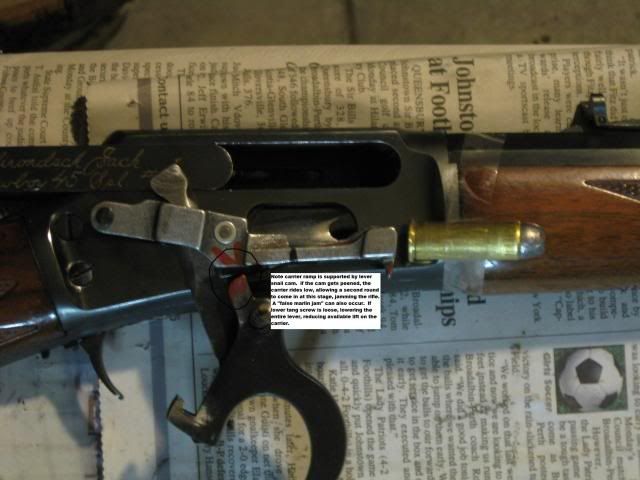
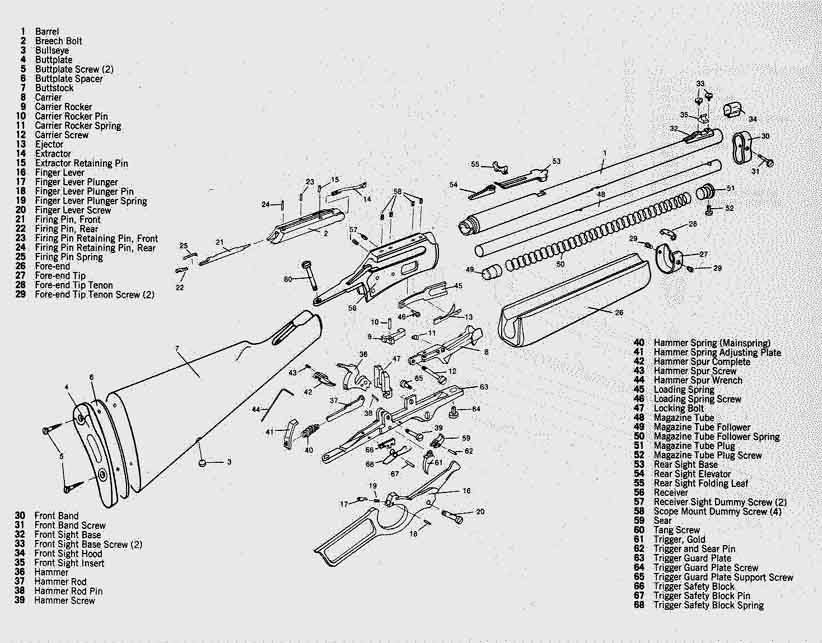
Exhibit #1

Image

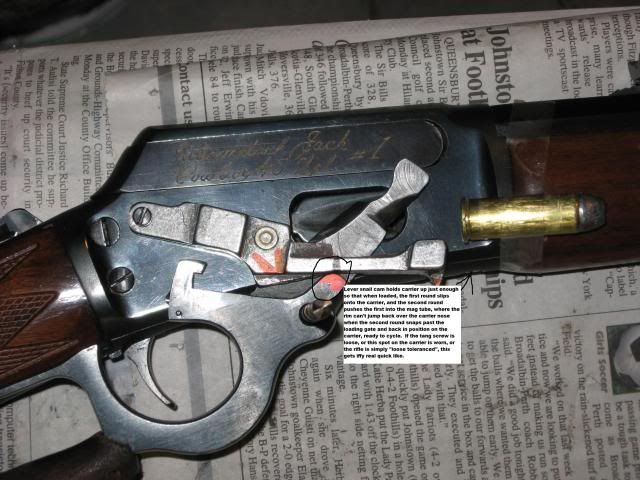
The parts arranged on the outside of the gun. Note the position of the carrier, the snail cam on the lever that lifts the carrier, the round in the mag tube, etc. This is ONE OF the two trouble spots in the cycle.


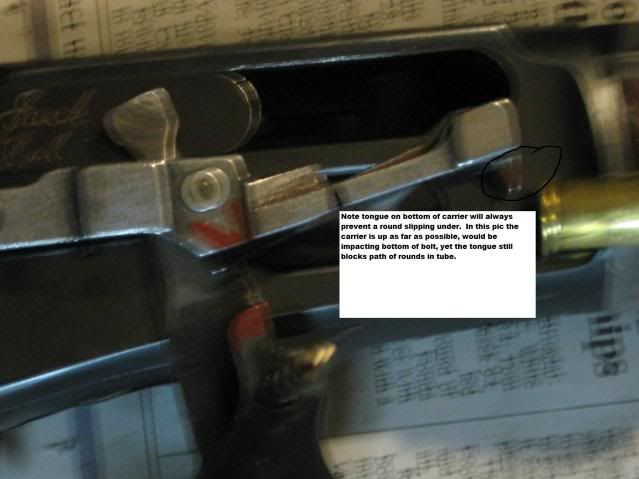
Exhibit two:
Image

Here the lever has been cycled open and is on the way back up, This is yer little "Bob" I was talking about on an earlier post. The carrier has to be exactly timed right to prevent two short rounds entering. Longer rounds are somewhat less critical.

SOMETIMES in the early going you can chase the problem by running longer rounds. But as it gets worse ya get more "close calls" where the carrier bites on the rim of a second round before smashing it back into the tube, causing more peening of the carrier, worse timing, etc until it's a jamomatic.

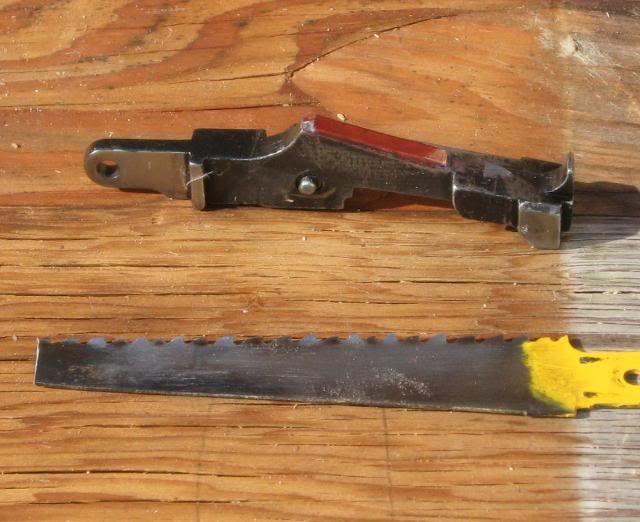
Exhibit Three:
Image
I know, blurry but bear with me.

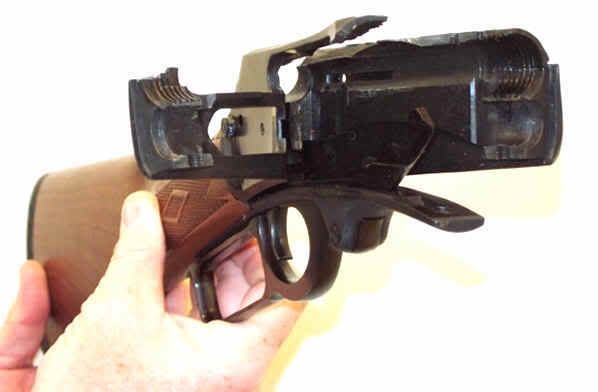
As stated, the tongue hanging down in front of the carrier WILL prevent a round going under the carrier, even in the most extreme carrier lift situation because the bolt is in the way of the carrier lifting any more. Why folks make the error is sometimes when a gun is jammed, they take the lever screw out, pull out the lever, the bolt jumps back, the carrier flips up and THEN ya get that jammed round UNDER the carrier. That can ONLY happen during disassembly, never when in operation. A jammed Marlin means bad timing, and'or loose screws, and/or two rounds on top of the carrier (well, one and a part of the next).

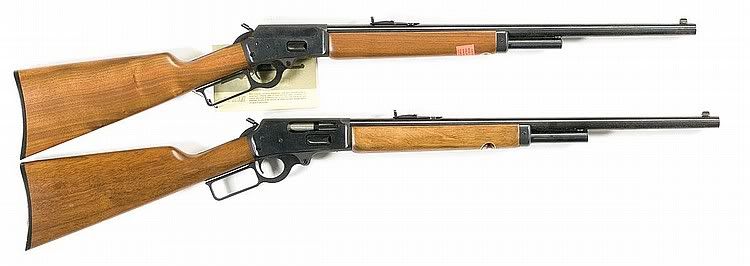
While the fixes end up a book, PART OF the fix (I just finished one BTW) is to build up the ramp on the bottom of the carrier.
Image
I filed the ramp on this one down a little, then JB Welded a piece of sawzall blade to the bottom of the carrier. This is NOT a total fix. It is part of a bunch of mods I do to rework the Marlin, but it gave me back the lift lost when the gun was out of time. DO NOT think all ya gotta do is epoxy a shim under the carrier. Best bet is to read and follow the stuff here:
http://marauder.homestead.com/rifles.html

Thursday, May 13, 2010

Marlin Model 62

Marlin Model 62 Rifle
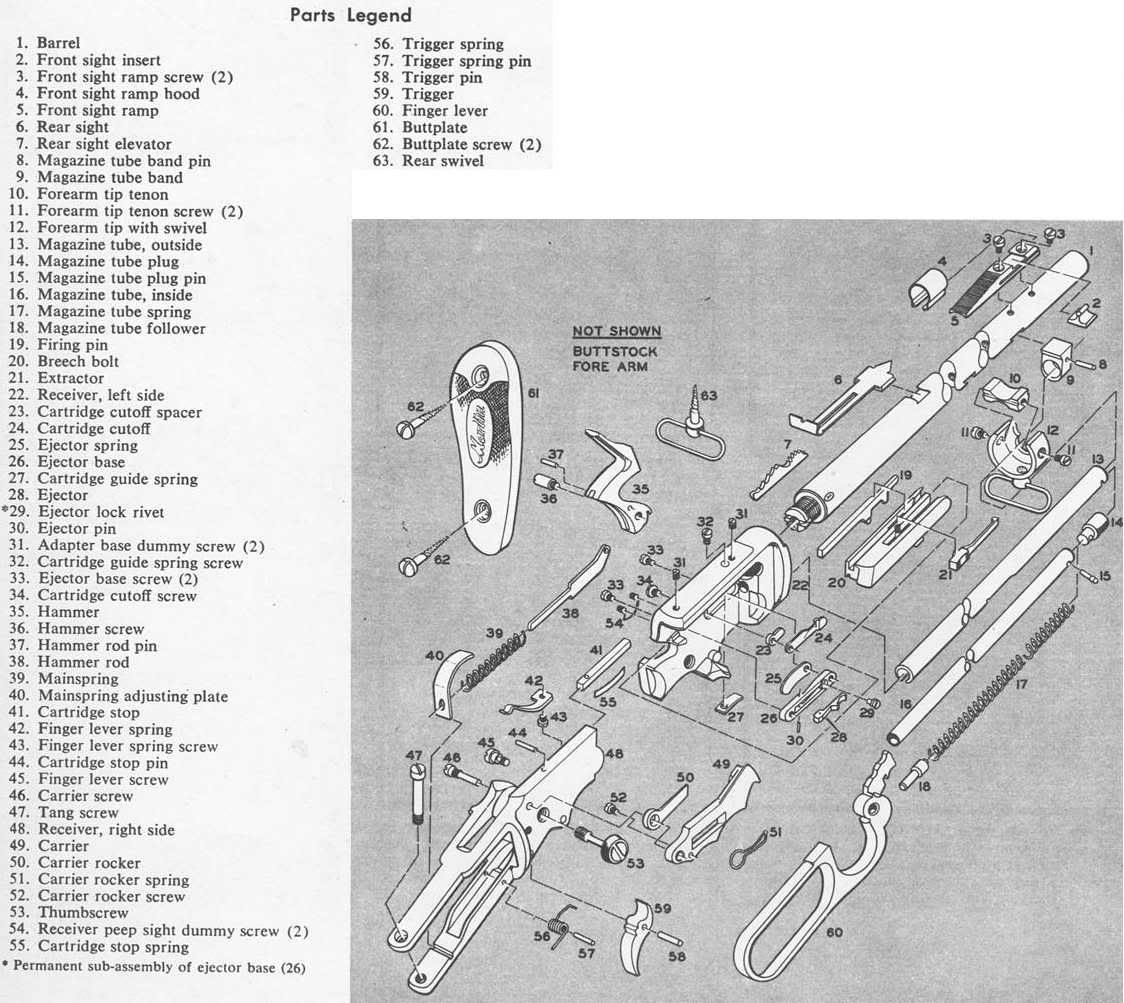
Chambered for the .256 Winchester and .30 U.S. Carbine, the Marlin Model 62 (as well as the Model 56 .22 LR and 57 .22 WMRF) was an attempt by Marlin to produce a 'modern' levergun at a better price-point.  These guns were made from 1955 to 1969.

To disassemble (from the hang tags for the Marlin 62):

1. Remove magazine, open lever, loosen front takedown screw (69), and front screw under lever ((70). Barrel and action may now be lifted out of the stock. NOTE: The trigger plate (78) is permanently attached to the stock. DO NOT try to remove it.
2. Remove the two front assembly screws (5) and the rear assembly screw (3) and post (1). Swing the rear of the action out of the receiver completely. Spread the front ends of the side plates (64 & 65) apart to disengage studs from receiver and remove action. To reassemble, reverse this procedure.
3. By lifting the front of the breech bolt (11), all working parts are exposed for cleaning and oiling without taking side plates apart. It is not recommended to take the side plates apart for cleaning or oiling.

Thursday, March 25, 2010

Marlin Closing the New Haven Plant

Marlin Firearms closing, 265 laid off, North Haven plant closing in next 18 months
North Haven, Conn. (WTNH) - Employees at Marlin Firearms in North Haven just got word late this afternoon that they will be losing their jobs in the next 18 months.

265 people will be losing their jobs. The layoff will begin in May and the plant will be closed by June 2011. The company tells News Channel 8 that they are moving the work out of state.

Employees we spoke with say they feel blindsided.

"We had a meeting at 3:30pm. They gonna phase us out," said one employee who has worked at Marlin for 19 years.

Founded by John Marlin in New Haven in 1870, Marlin Firearms is now headquartered in Madison, North Carolina. In 2007, Marlin was sold to the Remington Arms Company.

The North Haven plant manufactures a variety of rifles.
Looks like they'll be moving their production south just like FN/Winchester...

It is a fact of life that businesses must make money to exist. You can't make money when the government takes it all. Business of one or many, same thing. I believe the 'health care' bill is going to force several businesses to the edge rather than help. This will affect tax revenues negatively, certainly for CT in this case and so on ad naseum...

Now for what concerns most here. Marlin firearms will likely be problematic from now on. Call me names if you like but there will be a number of plant employees who will take out their anger for the layoff on the customer via the product. Some just won't care and this will be evident in the quality of the product as the lack of care tolerances stack to produce unacceptable product and discourage sales.

BTW, Marlin's bottom line must be up against the wall to make the move.

Monday, June 01, 2009

Marlin 1894 Sporter

The year was 1973. The place was a sporting goods store on Alvarado Street in Monterey, California. The gun that was the subject of my lust was a Marlin 1894 Sporter. I now know that 1398 of these "mini" versions of the new Model 1895 introduced in 1972 were made. Back then I only knew I didn't have the scratch to get one. I'm afraid I'd wasted my limited funds on the wild life of watching a movie at the post theater and having a beer or two at the club.

I owned the standard carbine in .44 Mag at that time. It was a good enough gun, much better than the Winchester 1894 .44 Mag it had replaced. It was not the sporter. Perhaps, I've been thinking, my memories of lively handling, sleek lines, and that special something that warms your heart were just the cloudy delusions of a mind in decline.

Then I got the 1894CL in .32-20. The CLs have nearly the same layout but not the same curved buttplate as the 1972 era 1895s. My impressions from long ago were confirmed. My lust was renewed. My search was restarted. Then Neal in Alabama had one and had to sell. His misfortune (again, the CL was from him as well) was my gain. Money has changed hands. FFLs are in place. Shipment will occur. All will be well. Well, I thought so! Unfortunately, Neal had stored the gun at a relative's house and the relative misplaced the gun. This isn't a good thing for a lot of reasons but it isn't the end of the world for me. I'll just keep looking and maybe Neal will find his gun again. No, I'm not without a .44 Mag rifle, I still have the 21" barrel for the Contender.

That pretty much short-stopped all my plans for the gun. As I often do, I had ordered a Williams Foolproof receiver sight for the rifle. At least I'll have one on hand for the next rifle!

Also, I've come to the conclusion that my .44 Mag loads should all come as close to duplicating the highly successful (for me anyway) Remington 240 gr. SJHP load, albeit with the Hornady 240 gr. XTP. These loads will work in all my .44 Mags. The 300 gr. XTP loads I have already loaded, if they chamber, will best suit the Redhawk and perhaps will give that gun purpose.

Wednesday, March 25, 2009

The .357 Mag in a Carbine

Probably the best single gun a person could buy. It is good enough to do many jobs, is light in recoil (very light with .38 Specials), light to carry and easy on the budget. One can choose a Winchester Model 92 clone or the Marlin 1894C. The Winchester 1894 was made in .357 Mag but has been discontinued. Likewise, one could go with the Timberwolf pump gun or any of the 1873 clones. I am somewhat leery of the later for continuous use as .357 Magnums but they've been around for a while and much used. I'll confine most of my comments to the Winchester 92 clones and the Marlin 1894C.

Ammo isn't a problem. Just about any commercially available ammo for the .38 Special or .357 Magnum will work in these rifles. The only exception in the Marlin 1894C is the .38 Special wadcutter but some of the Winchester 92 clones will feed these without problems or alterations. However, the wadcutter ammo can be singly loaded and is a wonderful small game load. Recoil of the most powerful of these loads will be in the very mild range of about 7.3 fpe compared to the 14.3 fpe of the .30-30. The Winchester 1873 guns are very sensitive to cartridge overall length.

As I've said before, I do have some favorite loads to cover the gamut of use for me. #1 is the Federal full wadcutter load. This load shoots to point of aim at 25 yards when the gun is sighted at 100 yards with my .357 Magnum 180 gr bullet load. One can duplicate the factory load with 2.7 gr. Bullseye and a 148 gr. wadcutter.

#2 favorite load uses either the Hornady 180 gr. XTP or Remington 180 gr. SJHP over 15 gr. of L'ilGun. I prefer to use CCI's small pistol magnum primers for this and load #3.

#3 is the Hornady 158 gr. XTP-FP (emphasis on the FP which is designed for these velocities while the HP is not) over 18 gr. of L'ilGun. This load gets an honest 2000 fps from my carbine. It would be an about perfect all-around load for deer and varmints. I don't use it on squirrels or rabbits though!

The weight of these two carbines is a very portable and usable 5½ to 6½ pounds maximum with the Marlin 1894C being the heavier of the two. The 1894C is what I have. The major advantage the Marlin has is being drilled and tapped for and readily accepting a telescopic sight. The 92's major advantage is in weight. Either are more than strong enough to handle any factory .357 Magnum load.

A short aside about the guns. First, if you decide you want a 92 clone you can do no better than to visit Steve's Gunz and get one of his Rossi guns already slicked up with all the negatives mitigated. That would include his slicking up of the action, replacement of the plastic follower with one of metal and removal of the stupid bolt top safety. He'll also install a peep sight on that gun to fully exploit the cartridge.

Second, if you're going to get a Marlin and don't want one of the current cross-bolt safety guns, you're going to have to look around for one. The good news is that you probably won't have to pay a premium for the pre-safety gun. That's a good thing!

Sights are a flexible option mostly because the legitimate operating range for these rifles maxes out at about 150 yards and that is due more to energy levels at that range for deer size targets and the practical limits of accuracy for the smaller game. I prefer the Williams Foolproof receiver sight because it adds precision while remaining as compact as the factory open sights. However, I compact 4X or 1-5X variable is about ideal for this platform. I understand that some folks are using scout mounts to put IER and EER scopes on the 92 clones. For those that can utilize them or NEED them, scope sights are doable and usable.

So, you might say, just what is such a "light" carbine good for? Well, using .38 Special loads of your preference it is an excellent small game gun. Back before the turn of the 19th to the 20th century cartridges (both rimfire and centerfire) with the ballistic output of the .38 Special wadcutter load were considered outstanding small game guns. The .38 Special roundnose (yes roundnose) is an excellent plinking/training round for the gun. It does or can be made to slickly feed through the .357 Magnum guns, the recoil is about nil (actually around 3-4 fpe) and it is plenty accurate (oh, and still relatively CHEAP, too). The .357 Mag 125 gr. load, often recommended for revolvers used for self-defense, is a hot self-defense load and much easier on the ears from the carbine than from the revolver. Lots of folks find a shoulder gun easier to use accurately under stress and it has the added bonus of being legal where a handgun might not be. Move up to the 158 gr. and 180 gr. loads (personal preference & locale might have a lot to do with the choice) and you have a viable big game rifle. At least it will be suitable for deer, eating sized hogs, and certainly larger varmints like coyotes. One might even use it on bear, in a pinch, maybe not, without being tremendously undergunned. With forethought one could single load CCI's shot cartridges for eliminating poisonous snakes around the homestead. Again, this is a tremendously versatile firearm.

Frankly, I don't see how anybody serious about a cost effective firearms collection could avoid getting a .357 Mag carbine.

Sunday, February 08, 2009

Marlin 1894 .44 Magnum Carbine

Years ago, just after I turned 18, I bought a Winchester 94 in .44 Magnum. A standard carbine, post-64 of course, that was a pretty good gun but sometimes the cartridge stop would let a cartridge in under the carrier. I'm telling you, that is a nasty jam to clear in the field. It happened enough that I traded it in on another .44 Magnum, a Marlin 1894!

Now this was a good gun. I immediately installed a Williams Foolproof receiver sight and took some of the ammo that I'd used in the Winchester with the new rifle and went to the range. Sometimes I could manage to put 3 rounds of the old Remington half-jacket SWC load into a cloverleaf. It sure shot well. I didn't actually get to hunt with it until after my first tour in Korea.
I was stationed at Fort Hunter-Liggett in California and lived in Greenfield, CA. Needing a combination of self-defense and a hunting gun, I asked Dad to send the Marlin out to me. That Marlin fed a few of us as I loaned it out for hog and goat hunts on Fort Hunter-Liggett. We used the Remington 240 gr. SJHP load exclusively. That load was both relatively cheap and effective.

When I came back to Virginia that gun went hunting for whitetails a couple of times but one day I had to sell it to raise money and it went to LBW Shooter's Supply in Staunton for cash. What a silly thing to do. I felt really badly about that decision.


I have felt very stupid for having gotten rid of that good gun and so I got another. My friend was looking for money and had this gun and he brought it to me. A deal was arranged and I have this good gun just like the old one!

Sunday, October 19, 2008

My Marlin 1894C, .357 Magnum Carbine

I bought my 1894C, .357 Magnum carbine from Dave, now of Lubbock, and it is a beauty. Made in 1982, it doesn't have the intrinsically repulsive, lawyer-induced, add-on, cross-bolt safety. somebody has shot it quite a bit so the action is slick. It is pretty much as slick as any rifle I've ever owned. However, it has yet to have suffered from the infamous Marlin jam. The barrel on these guns is only 18½ inches in length but that is plenty for this cartridge.

The great thing about these little beauties is that they will function with and shoot .38 Specials. Gun-to-gun you might have to pick and choose your load due to a need for a certain cartridge-overall-length to function well, but most .38 Special ammunition shoots well and recoil is nearly non-existent. I will mention that full-wadcutter ammo will NOT feed through the action and WILL tie it up tighter than a tick on a hound dog. Single loaded, those same wadcutter loads will be about perfect for squirrels and rabbits out to 35 yards or so. Still, you can load it with .357 Magnum ammo and when using an appropriate bullet you have a fine deer rifle. These guns have even been used on African antelope and North American black bear.

I have some favorite loads. #1 is the Federal full wadcutter load. This load shoots to point of aim at 25 yards when the gun is sighted at 100 yards with my .357 Magnum 180 gr bullet load. One can duplicate the factory load with 2.7 gr. Bullseye and a 148 gr. wadcutter.

#2 favorite load uses either the Hornady 180 gr. XTP or Remington 180 gr. SJHP over 15 gr. of L'ilGun. I prefer to use CCI's small pistol magnum primers for this and load #3.

#3 is the Hornady 158 gr. XTP-FP (emphasis on the FP which is designed for these velocities while the HP is not) over 18 gr. of L'ilGun. This load gets an honest 2000 fps from my carbine. It would be an about perfect all-around load for deer and varmints. I don't use it on squirrels or rabbits though!

Monday, October 06, 2008

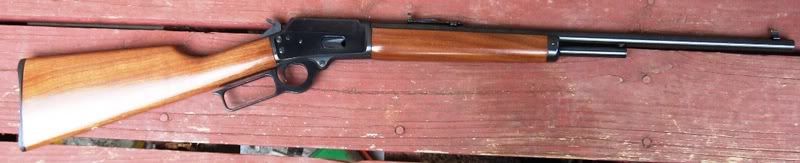
Marlin 1894CL .32-20 (.32 WCF)

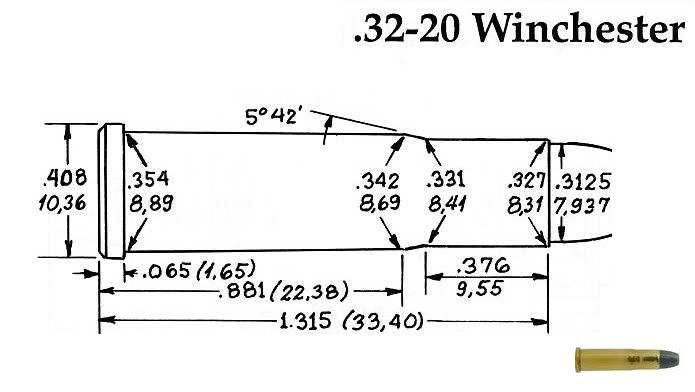
Winchester introduced the .32 Winchester Center Fire (WCF) in 1882 for their Model 1873 lever action rifle. Intended as a multipurpose small game and light deer round, it quickly attained considerable popularity in both rifle and revolver. Practically all American makers have chambered rifles for the 32-20 in lever, slide or bolt action, and most single shot rifles have also chambered it. Colt, Smith and Wesson and Bayard made revolvers in this caliber. Winchester once offered a lighter 100 grain bullet black powder load for the .32 Colt Lightning magazine rifle, headstamped .32 CLMR. A similar 100 grain loading specifically for Marlin rifles was headstamped .32-20. Although semi obsolete, the .32-20 still enjoys some popularity and it can be reloaded easily and at a moderate cost with good killing power on small and medium game at ranges out to 100 yards without destroying all the edible meat. Both Remington and Winchester still offer factory loaded ammunition in this caliber. Marlin reintroduced it for their Model 1894CL lever action, the rifle in question here. The .32-20 is the base case for the 25-20 and the 218 Bee.

The Marlin 1894CL is a return to an original chambering of the Marlin 1894. Known to most shooters as a rifle chambered for the .44 Magnum, .357 Magnum, .41 Magnum, .44-40 or .45 Colt for use by hunters and CAS competitors, Marlin reintroduced the 1894 when they discovered that the 336 just didn't handle the .44 Magnum cartridge as well as it should. They then reintroduced it in several chamberings until they finally got the idea that original chamberings might sell as well (even though the .44-40 had not done well). So, they introduced the gun in .32-20 and .25-20. You'll notice that my gun has the smooth stocks. It is also drilled and tapped for a receiver sight on the left side of the receiver. Later guns are not drilled and tapped on the side of the receiver but the stocks are checkered. I think it makes a big difference.

Of course all of these guns have the repulsive cross-bolt safety. Mr. Ludwig makes a filler for this abomination and I'll have one in here ASAP. What it does is replace the cross-bolt and look like an additional screw (on the receiver right side). But the big thing is that it absolutely can't be pushed a direction other than intended and thus put the gun in a condition unexpectedly such that one could pull the trigger and get a click rather than bang. The Marlins are otherwise just as they used to be and so the half-cock still works and is just like all my other guns.

I'll also be installing a Williams FP-94/36 receiver sight. A good aperture sight is necessary to ring all possible accuracy out of the gun and still maintain maximum handiness inherent in the levergun format. You might have seen that nearly all my leverguns have such a sight (or one waiting installation). This system works for me and has for many years.

.32-20 brass production is a seasonal thing and not much is available at the moment. Fortunately I was able to find and acquire from a previous owner of this same rifle a supply of 6 boxes (50 rounds per box) of Remington ammunition. I have a quantity of Hornady 100 gr. bullets on hand and so I'll have ammo until the season rolls around and brass is again available.

Which particular loads are a question at the moment. I think I'll mess about with the factory load before deciding on the tact I'll take with this gun. It seems to me that it will be a pretty neat groundhog, fox, and coyote gun. I'm looking forward to living with it a while.


Rifle in hand, I discovered that I'm the fourth owner of this gun. Aside from the missing box and paperwork the 1894CL was nearly new in appearance. I immediately changed that. I installed the Ludwig safety replacement (and lost the tiny safety detent spring) and a Williams FP-94/36 receiver sight. One thing I really like is the lack of Marlins former signature white line spacer at the butt plate.  I don't like whitewall tires on my cars/trucks either.  Now the only thing is to take it shooting.


Shooting has proven to be a treat.  It didn't take long to get the rifle zeroed.  The only reason to change the zero will be to take full advantage of the trajectory of the cartridge.  The gun seems to function well.  Some have reported that new rifles "let in two" or allow feeding of two cartridges onto the carrier at once.  Mine doesn't do this.  The gun hangs well and the longer barrel, compared to other 1894 carbines, is just right.  The trigger is fine.  That front bead sight though, it might have to go.  I think I could do more precision with a good post or sourdough front sight.  I've got a couple around here somewhere. 

Links:
- "The Marlin 1894CL .32-20: a fun little gun in a fun little chambering" by John Taffin
- "Marlin 32-20 Its Not a Mouse Gun" by Paco Kelly
- "32-20 Winchester Centerfire 1882" by Paco Kelly
- Ludwig Replacement Safety by Jim Taylor
- While It Was Out by Jim Taylor
- Loading the dash cartridges: these "obsolete" calibers are soft-shooting, efficient, and just plain fun by Charles E. Petty
- The .32-20: Neat Little Caliber That Still Works in Leverguns, Sixguns by Jim Taylor

BulletWeightPowderCharge WeightVelocityEnergy
Lyman 3118120IMR3031
4.8
unknownunknown
Lyman 3118120W296
15.0
20001066
Lyman 3118120Bullseye
3.5
1200383
Lyman 3118120W231
4.0
1200383
Speer JHP1002400
12
2000888
Silent Loads
Lee952400
2.5
491
Lee953031
4.8
420
Lyman 31181203031
4.8
432
Not Quite Silent Loads
Lee95Bullseye
1.5
861
Lyman 3118120Bullseye
1.5
420


Mr. Ludwig, who makes and markets the safety replacement has moved. His new contact info is:

Clyde Ludwig
PO Box 318
Bridgewater, SD 57319

Phone: 605-729-2029

Links:
- The .32-20: Neat Little Caliber That Still Works in Leverguns, Sixguns by Jim Taylor
- While It Was Out - Marlin 1894CL .32-20 Make-Over by Jim Taylor
- MARLIN 32-20 - It's NOT A MOUSE GUN by Paco Kelly

Saturday, May 17, 2008

Marlin 336T in .35 Remington

This jewel of a gun came to me from Jim ______ and I deeply appreciate the opportunity to get this 1964 manufactured gun and for a very fair price. There were a couple of cosmetic issues (for most folks) but the screws will be replaced and I'm sure I'm going to ding up the metal myself a bit. The thing is the furniture is sound and the bullseye is unmolested. I had to put the Williams Foolproof on but that is never a chore.

Aside from the differing sights on my other 336T (a .30-30 made in 1982 which mounts a Lyman 66) the two 336Ts have different lever forms with the earlier gun haveing the ovoid lever loop instead of the more rectangular form.

This one is a bit slicker as well but rather than being more often fired I think it was made in a different era at Marlin. Another plus it has over the .30-30 336T is that it is lighter and quicker to the shoulder. The forearm is slimmer and the whole gun has a more dynamic feel. I don't think that any Winchester 1894 shooter would be disappointed in this gun as they often are in Marlin's admittedly clunkier standard guns.

Yeah, I like it.

Saturday, March 29, 2008

Marlin 39A Mountie

Once upon a time I looked at the Ithaca 49R Saddlegun and lusted after this perennial advertiser in the boys magazines. Then a friend of my father's managed to drop his guard and let me close enough to his Marlin Mountie to initiate the drool response. Although it was many years until money and a rifle were co-located in my life, the drooling never stopped. I had other, fully capable, .22 Long Rifle chambered rifles but still, the trim lines, lever and balanced layout of the Mountie continued to cause a Pavlovian response in this poor boy.

The Marlin 39 began as the 1891 and through improvements (models 1892, 1897 and 39) finally evolved into the 39A. One of the models of the 39A was the straight grip Mountie with a 20" barrel. The gun has further evolved into the 39AS with rebounding hammer and crossbolt safety (which are completely unneccesary complications to this fine design).

As is my habit, I buy Williams Foolproof Receiver sights for guns I'd like to have someday. It was my good fortune to find a poorly and inaccurately described sight for the Marlin 39. Joy of joy, I got the sight (and some others...) for about $30 delivered. Ever closer to my dream, I stored the sight in my parts box in the basement and went on with life.

But I never lost my dream. One day I was perusing Gunbroker.com with the reckless abandon born of empty pockets when I spied this Marlin 39A Mountie with a buy-it-now price of just $200. Obviously, there must be something wrong with it but at $250 delivered and background check it couldn't be that bad. It wasn't. Scrambling through the wallet, emptying the change jar, and the money was scraped together. Off it went together with the necessary FFL copy and in a matter of days the gun was delivered into my hands.

With, finally after 41 years, a Marlin Model 39 Mountie in my hands, I was as happy as I could be with a new-to-me gun. This one was made in 1956 which I knew because the serial began with the letter "N". The gun had one issue in that the latch/muzzle end of the mag tube is a bit buggered but a new mag tube was ordered (although I've yet to install it).

Of course, the first thing I did was install the Williams Foolproof Receiver sight (you can see in the photo that I tend to a certain pattern) and go to the range. I took along some Aguila Super Colibri, CCI CB-Long, Winchester Dynapoint (both modified to the SGB point and unmodified), Winchester PowerPoint and Aguila SSS (with the 60 gr. bullet) but forgot the chronograph. I don't know the velocities of the various loads from this gun but all proved to be usably accurate with the PowerPoints and SGB pointed Dynapoints being the most accurate. I was also very surprised to discover that the Marlin would stabilize the long Aguila 60 gr. bullets in the SSS load. None of my other .22s would do so. I converted a few to the SGB point and they were even more accurate but not so much as to be a critical difference at 25-50 yards. Perhaps at 100 yards the accuracy difference would be notable.

I then had to take it squirrel hunting. It was a treat. There is nothing like toting a classic rifle made of wood and steel into the woods after game. I was in a sort of heaven and shortly so were two of the local gray squirrel population. (They were excellent when cut up, stir fried and served over white rice...) The gun was everything I knew it would be. I only wish I'd been able to share the experience but, as usual, I was hunting alone.

I'm looking forward to many happy years with this fine .22 rimfire rifle.

Thursday, March 20, 2008

Marlin 336T .30-30


When I was a boy of but a few years I had many lusted for guns on my "list" of "to haves". Among these was the straight grip Marlin 336 sometimes known as the "Texan". Just like the normal 336C except for the straight grip in lieu of the standard pistol grip, this gun just seemed handier to me. When the time came for me to actually purchase a deer rifle, what I could find AND afford was a more standard Marlin 336 with the pistol grip and that is what I got. Oh, it was a fine shooter, but it never excited me as much as the straight grip guns and I traded it off for a Winchester post-64 M94 in .44 Mag. Hard to explain that one. In any case the desire for a straight gripped M336 stayed with me for years despite actually having other straight-gripped .30-30 leverguns in hand. So...

I got the urge and some few bucks saved up and went hunting one and found this one on an internet auction site. It must have been fated because my bid of $250 was the only bid on this gun! Lucky I was.

The gun came in and it was pretty much as described. Let's just say that it has been shot and carried a bit and a previous owner was enamoured of slings and had used the Marlin trademark bullseye as the location for the the sling swivel stud.

Let me digress a moment to unequivocally state that the Marlin trademark is NOT the location for such things. Indeed, screwing the sling swivel stud in there will usually shatter or crack the plastic bullseye and might even pull out under stress. One is then left with nothing more than a hole and possible embarassment. Don't do it. Just measure back from the toe of the stock about 1½-2¼ inches and center the sling swivel stud there. Be sure to pre-drill the hole to avoid cracking the stock.

So, back to my gun, I had this HOLE where the bullseye was supposed to be. I didn't have a replacement bullseye to hand (but you can get them from Marlin or Gun Parts Corp.) but I did have some deer antler. That seemed appropriate to me so I cut a plug that would fit the hole and epoxied the antler there and then filed and sanded it to fit the stock. I like it.

I also had to have better than the issue sights. My usual fix is to install a Williams Foolproof 94/36 and go shooting. However, I'd been reading the adventures of John Taffin and he'd recently published an article in which he'd found a Texan in .35 Remington (my knees weaken at the thought of such a find). Now Mr. Taffin had installed a Lyman 66 on his rifle and I thought that it would be a fine and different thing to do to my rifle as well so I ordered one from MidwayUSA.

The Lyman 66 is a pretty neat sight having an interesting feature not found on the Williams. That feature is that you can push a little plunger and remove the top part of the sight leaving the base and then reinstall the sight by reversing the procedure and right to zero. You can also easily adjust the sights via knobs with a coin rather than needing a screwdriver. AND you can zero the little side plate and then move the sight around as in matches from the ready reference point for that particular rifle. Pretty neat stuff except... I don't have a scope so don't switch sights. Being able to remove the top part leaving the base is more liability for me than it is benefit. Also, the screw which attaches/secures the side zero plate stripped its hole. A call and e-mail to Lyman products elicited zero product support so I epoxied the plate and screw in place. It looks right but it isn't.

The Lyman 66 does look retro, but it isn't as they are now made from aluminum, just like the Williams, and thus actually have more weaknesses than the Williams. I haven't bought another Lyman since. However, if I could get a vintage Lyman, made of steel, I'd likely buy it. All the old Lyman's I shot on other folks guns many years ago gave not one lick of trouble.

As to the rifle, a quick check of the serial number revealed that it was made in 1982. Of course this is prior to the introduction of the cross-bolt safety so we are happily lacking that homage to the ambulance chaser. That's a wonderful thing.

Wonderful too, is that this is yet another of my "sub-collection" of guns manufactured in 1982. It isn't as if I've set out to collect such. In fact, I don't check the age, or year of manufacture, until after the gun is purchased. If there is some sort of "message" in the coincidence, I can't find it, yet.

The gun performs about as well as any other Marlin 336 including my long since departed pistol-gripped 336. It easily groups into 1½-2 inches at 100 yards with all the ammo I've tried in it. The action functions smoothly but really no better or worse than other 336s or Winchesters. In short, there is nothing special or noteworthy about this gun except that I always wanted one and now I have one.

Monday, February 05, 2007

The Marlin "Trapper" .30-30 and Law Enforcement

A forum friend provided the information. Nothing has been changed (except, perhaps, spelling).

I have a Marlin .30-30 "Spikehorn" Model 336 with the handy, 16.5-inch barrel. Oddly, off a double-sandbag rest at 100 yards it holds a tighter group than a 1980's-vintage 20-inch barreled Marlin 336, and a 1970's era Winchester 20-inch Model 94 I have. I was interested in your posted comment that the stiffness of the shorter barrel may benefit accuracy. I never thought of that, but then I'm not much of a rifleman, honestly.

I have a Williams 5-D receiver sight on it, as I do all my leverguns, and it's zeroed for the Federal Cartridge 125-grain .30-30 jhp factory load, since that load and the Winchester 150-grain jhp are the only .30-30 loads we're permitted to use for anti-personnel use.

As you'd know, I use the .30-30 mostly for cleanly euthanizing road-injured livestock and, since that normally (for me) involves head and neck shots, the little 125-grain jhp does an excellent job. I nevertheless keep some 170-grain loads with me for the occasional full-grown steer or horse that gets hit by a vehicle. Anybody who thinks they can cleanly euthanize a road-injured horse with a 9mm or .40 cal pistol is asking for some real trouble, especially when the owner of the animal is watching you and expecting you to do it cleanly.

I just wondered about the 170-grain .30-30's out of that little barrel when I'm needing to shoot something deer-sized or a bit larger out to, say, 100 yards. Wasn't sure how the lower velocity that the short trapper barrel would give would effect the 170's impact at a distance. I figured you have experience with using a trapper length levergun on deer at that distance...so I thought I'd ask.

FWIW, the factory 125-grain jhp is the most accurate factory load I've tried in all my .30-30's. It's great on feral dogs at a distance since it's flat-shooting enough to be more forgiving of my mistakes in range-judging. This past deer season I shot a little 120-pound whitetail buck at a measured 90 yards with it, as he quartered toward me. The 125-grain jhp smacked him on the near-side shoulder and staggered the little buck backwards almost onto his ass.

He recovered and ran off about 30 yards on three legs before banging into a tree and falling down for good. The bullet wrecked his shoulder-joint, took out the top of both lungs and blew lung-colored blood froth out a quarter-sized exit hole on his off-side ribs. When we skinned him out, there was a 12-inch circle of bloodshot meat surrounding the entrance hole, so it must have really hit him hard even at 90 yards. I guess I always expect light bullets to lose their velocity and energy quickly over any sort of distance.

I grew up using lead cast .30-30's as a farm gun (along with a .22 rimfire), and the only "hunting" bullets I ever saw in .30-30 as a kid were Remington Core-Lokt's. I have no idea now whether they were 150's or 170-grainers. We used to drive to the hardware store and they'd sell us 4 or 5 bullets...we didn't even have to buy the whole 20-round box. I'm sure you remember those days. :-)

The 125-grain Federal jhp's are the one .30-30 factory jhp that have exposed lead at the tip of the bullet, and I noticed that the spring pressure of the tubular magazine would slightly deform the noses on the little jhp's when I left the magazine loaded for long periods. I wondered naturally if the deformation of the noses would effect accuracy and expansion.

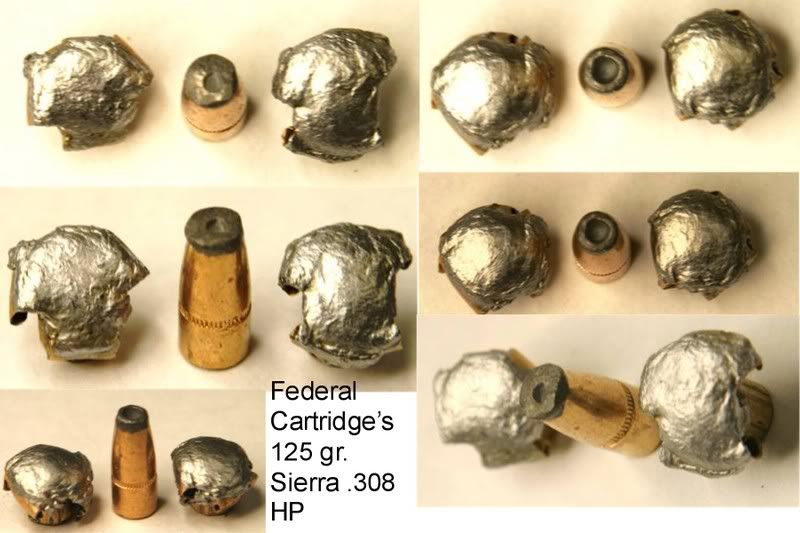
A long time friend is an R&D engineer at Federal Cartridge, and he agreed to test their 125-grain jhp's for me in gelatin. He deliberately deformed the noses on some of the test bullets, and compared them to non-deformed ones during the test. Attached are the photos he sent me, Hobie.

It appears that the slight deformation the magazine spring does to those 125-grain jhp's has no practical effect on their mushrooming (or "upset', as he calls it) in the target. The deliberately deformed test bullets expanded into an irregular shape, instead of the perfect toadstool like the non-deformed ones did at 100 yards.

If you scroll from right-to-left at the bottom of the page, you'll see the results of the test-groups for accuracy from a test-barrel at 200 yards. The deformed test bullets, he told me, delivered a 200 yard group that was only .9-inch larger than the non-deformed group. He said also that the 125-grain .30-30 (catalog 3030C) is their most accurate .30-30 bullet.

I know I'll never be enough of a rifleman that a .9-inch decay in accuracy at 200 yards will ever be a problem for me. Anyway, that's all the experience I have with the factory 125 jhp's.

In our testing, the Winchester 150-grain jhp (Catalog X30301) and the Federal Cartridge 125-grain jhp (Catalog 3030C) both penetrated through 4 layers of cotton denim into calibrated ordnance gel about the same penetration distance as the .40 S&W pistol ammo we issue here. (155 grain Federal jhp's.)

The only catch is, these two .30-30 loads are unloading some 1,800 foot-pounds of striking energy into the target over that penetration distance, compared to the 400 or so foot-pounds delivered by the .40 S&W pistol ammo.

The Winchester load penetrated about 14.5-inches on the average and fragmented in the classic "lead snowstorm" described by Dr. Vincent DiMaio in his book "Gunshot Wounds", which is a standard reference text in forensic pathology. The Federal Cartridge 125-grain jhp load penetrated and average of 13.5-inches in the denim-covered gel.

The Federal 125-grain .30-30 jhp zipped right through auto glass during some testing we did at a local auto salvage yard. No sweat on using it at roadblocks. That little 125-grainer is a toughly constructed bullet, which probably accounts for its giving such good penetration on whitetails, in spite of its light weight.

Both of these loads should make an "urban safe" home defense load for an American householder who has the ever-popular .30-30 carbine handy. Abdul and Rasheed will be bringing their terror show to our neighborhoods a lot sooner than any of us would like, and its best that we be ready. Not all of us can afford an AR-15 rifle, and the .30-30 can be made to do.
And this is the response our correspondent got from Federal Cartridge...

Keith - here are some photos of bullet expansion with and without nose deformation. The unfired bullet is an example of how much the noses were deformed for this test.

Scott Schamber / Federal Cartridge


Friday, November 17, 2006

Guns I have Sold

This is a sad, sad thing to say but I have actually sold guns and let them out of my hands. What foolishness sometimes possesses us. What and why you ask? Well...

The first is truely heart rending. This was my first centerfire rifle, my first deer was killed with this rifle, and it was a gift from Dad. The latter I did not know until I told him I'd traded it. I thought I'd paid for it out of my savings. Truly heart breaking that.

I'd been wanting a centerfire for a loooong time like every other boy I knew. I'd been putting money in my savings account (but I didn't hold the bank book) for that gun. Now, it was approaching another deer season and I had my safety certificate and could get a license. Dad and I made the rounds of gun shops and found the 336 in the Western Auto just off Court Square in Harrisonburg, VA. Talk about excited! That season I got my first deer, with one shot and it was a buck (it pretty much had to be!). Still excited. But I've always been a gun nut and a couple of years later I was wondering what OTHER guns might be "better". Oh, I truly regret losing this one and can't find the serial number anywhere. The follow-on was this gun...

Marlin 1893 .38-55 rifle. The 26" octagonal barrel had been cut-down to 19 inches and a bit, the magazine likewise shortened and a later 336 ramp front soldered (not silver soldered and not well at that) onto the barrel. The mag spring had to be replaced as it had been cut somewhere in the middle and welded back together to make the spring the correct length. The stock may have been taken from the same 336 donor rifle... You get the picture. But it did have a Lyman #2 tang peep which worked well. I found out later that that sight was correct for the Marlin 1892. Oh it was a mishmash but with a new buttstock and some cleaning of the solder job it was a treat. That rifle was able to hang around until my divorce when it "had" to go to pay the lawyer (or for food for the kids and me, depending on how you look at it). That was a great gun.

Of course, at about the same time, I was enamoured of the .44 Mag cartridge but too young to own a revolver. I found instead a "great deal" on a post-64 M94 Winchester in .44 Mag. I never managed to save up the money to install a Williams Foolproof, I think they were about $25 at the time, quite a bit of money to me in 1973, but that rifle was accurate and I killed crows (on the ground), groundhogs and other vermin. It was quick to the shoulder and while the Remington SWC (a half-jacketed round) didn't feed all that well it was accurate as was the more expensive 240 gr. SJHP. That last round became my ammo of choice until I started reloading. Unfortunately, this gun had one fault. It would, sometimes, feed a second round under the carrier. What a pain to correct that fault. Of course I was too stupid to know how to fix it by repairing the cartridge stop although I had access to all the equipment needed to effect the repair. I kinda wish I had that gun. Unfortunately I traded it for...

A Marlin 1894 in .44 Mag. These were "new" on the market at the time and had a few good write-ups in the gun magazines (yeah, I know, but I was 18). Now, I had the money for the Foolproof for that gun and although it never managed to be in my hands when there was a deer in front of me, it did get a few hogs in the FT Hunter-Liggett hills. I also loaned the gun out to similarly impoverished junior enlisted and they took hogs and goats with the gun. None of them managed to damage it (was I just lucky?) and I was able to bring it back from California just before shipping overseas to Korea for 3 years 9 months. Load of choice? Remington 240 gr. SJHP. Killed everything with a minimum of muss. However, there came a time when the wife decided that another fellow was more to her liking (he's gone now, too) and the gun was one of this group which went to pay the lawyer and feed my kids. I do indeed miss this gun but it could have been better. How?

Well, if it had been the Sporter version or the two band version I'd have liked it even better. It was fully as accurate as the Winchester it replaced and it never fed two but I've never really warmed to the rifle style forearm cap paired with the muzzle barrel band of which Marlin seems so fond. Looks dumb to me.

Sometime in this period I found an 1891 Argentine rifle that had been bubbaized. Still properly chambered in 7.65x53mm Belgian/Argentine, the rifle was the equivalent of the .308 but nowhere near the price. No matter, I supported the gun industry more than adequately in my attempt to feed the gun. I remember buying one box of Norma ammunition for $22 or over $1 a case and this was in 1973! Fortunately a Lee Loader came with the gun or I'd have been impoverished very quickly. Even a box of brass was over $15.

Still in the cut-down military stock and with a cobbled together combo of Weaver bases and cheap, cheap telescopic sight, this gun needed work. I bought a Fajen sporting stock, a Williams Foolproof, and Jon Ritenour installed a Remington 700 ramp and Williams front bead. The bolt had already been altered for scope use. While I was gone to Korea the first tour (12 months) my dad fit the stock to the gun and I was ready to go. I took the gun deer hunting several times but ammo was expensive and it didn't get loaned out for hog hunts. I did carry it to Washington on a visit to a friend at FT Lewis but a hoped for elk hunt didn't materialize. This gun, too, helped to finance the big "D". I'm still looking for it even though I now have a very nice 1891 Argentine Engineer's carbine.

While I was in Korea the second time I started to save quite a bit of money. Living cheaply on the economy and having little to do but play with the kids and read gun magazines/books I started to spend on my passion. After much consideration I bought, through my Dad who actually did the transaction while I was gone, a Ruger Security-Six in stainless steel with 4" barrel. A .357 Magnum, this gun was everything that one would expect. I shot it quite a bit with reloaded .357 Mag ammo and .38 Special wadcutters. I managed to kill a groundhog or two with it as well as a squirrel and wrote up the gun and my choice thereof in "The Sixgunner", the official news of JD Jones' Internationl Handgunners' Association (I was charter member #500).

The Security-Six wasn't just a hunting gun, it also served as the bedside gun and rode along on the seat of the car when I was out and about. At the time, that was the only way for me to carry and size was unimportant. Unfortunately, this fine gun also was sacrificed on the altar of divorce.

There are more but the emotion of the moment prevents continuing this "saga". I'll do so later...

Friday, October 27, 2006

The .308 & .358 Winchester in the Marlin 336 Action

There is one topic that arises frequently on internet firearms forums/chat rooms particularly those devoted to Marlins, leveractions or handloading. That subject is the rechambering of the Marlin 336 in .30-30 (.30 WCF) to .307 or .308 Winchester and/or the rechambering of the 336 in .35 Remington to .356 or .358 Winchester. It has been encouraged by articles such as this one, Damaged Marlin 336 Restored, Rechambered for .358 Winchester by R. K. Campbell. It isn't my intention to discuss Mr. Campbell's article but rather to dispute the assertions made by many who apparently misread his article.

The goal, almost universally, is to get "better" ballistics easily and cheaply. Easily because the conversion will require "only" running a chambering reamer into the action and cheaply because the owner can do it himself without removing the barrel or using power tools. Ignored in the conversions .35 Rem to .356/.358 Win are the need, in some instances at least, to change the .35 Rem bolt for a .30-30 bolt to handle the rim of the new round. Ignored too, is the ability of the action to handle the increased case/cartridge length. Some will point out that the action can be modified to handle a cartridge up to 2.665" COL but that negates the "easy" and "cheap" part of the conversion, at least for most shooters.

Posters define better ballistics as flatter trajectory or more usually "more knockdown", i.e. more energy. Sometimes, those expectations are unrealistic. Posters often point to the ballistics of the wished for round ignoring the fact that until Hornady releases the LEVERevolution© bullets, the pointed high ballistic coefficient (BC) bullets used in the ballistic tables can't be used in the tubular magazine of the 336 due to safety concerns. Indeed the loaded cartridges will be too long to feed in the rifle. Larger cartridges are necessary to the concept of increased ballistic performance. If you can't fit the loaded cartridge into the gun and have it function in the gun, the whole idea is a waste of time. Mr. Campbell, although he shows factory ammo ballistics in the table in his article, acknowledges this problem of fit by only loading the .358 in the rechambered gun with pistol bullets. Only pistol bullets have the flat point, overall length, and cannelure position to permit use in the 336 as it is. Thus, the ballistics in the table are misleading and boy, are people mislead. Also ignored is that the barrel length used for the ballistics tables quoted are longer for the conversion cartridges than they are for the standard 336 carbine length of 20".

For many years the ballistics of the .30 WCF and .35 Remington were considered more than adequate. Indeed they were an improvement over older black powder cartridges providing adequate power fired from compact platforms. They were even commonly used on elk and other large game. After WWI and WWII, the bolt action and .30-06 cartridge and larger began to dominate the game fields. Marketing made many hunters doubt this well established cartridges. The .30 WCF and .35 Rem produced their ballistics, 170 and 200 gr. bullets respectively at 2200 fps, generating about 38-40,000 PSI or a breach thrust of about 4800 psi for the .30 WCF, 4900 psi and for the .35 Rem. This was well within the capabilities of the actions in which these cartridges were chambered including the 336 Marlin.

On the other hand, the .308 and .358 Winchester generate their ballistics, using 180 and 200 gr. bullets respectively, with pressures of about 52,000 PSI and breach thrust of approximately 8400 psi for the .358 Winchester. This is due to the larger case base and much higher pressure. So, as you can see, it is inevitable that a lot of the discussion concerns the strength of the 336 action. I'll talk about that a bit later.

Is there an overwhelming ballistic advantage? I don't think so. The .35 Rem can easily be loaded to move the 200 gr. RN to about 2200 fps and the 220 gr. Speer can be loaded to go about 2000 fps. The .358 is said to push those bullets to about 2500 fps but those figures come from 24" barrels. I think that 2400 fps is closer to realistic or only about 200 fps faster. The .356 will go about 2350 fps for the same bullet from the 20" barrel.
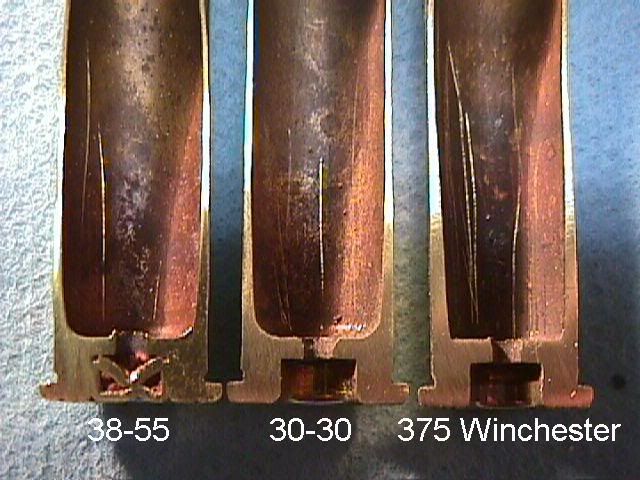
Proponents of the conversions point to the factory chambering by Marlin of the rifle to .375 Winchester which has a SAAMI average maximum or working pressure of 52,000 PSI. They ignore the fact that the .375 case is nearly straight and that it has the smaller .30 WCF case head and that the case has extra thick case walls as do the .307 and .356 Winchester. I think that perhaps the case walls have the complimentary effects of reducing the case expansion and decreasing the effective case head size both of which reduce breach thrust.

Some folks have pointed to the "fact" that Marlins don't fail at the locking bolt but the receiver distorts and then lets go as shown in the last photo. Indeed that was the context in which I found that photo. I wonder, how important is how the action fails?

In attempting to dissuade us from the breach thrust argument, some remind us of P. O. Ackley's experiments where he moved the locking bolts from guns chambered for his improved .30-30 and there was no problem, presumably because there is no bolt thrust. However, in the context of Contenders, his protege Mike Bellm has made it clear that all cartridges produce breach thrust. He also feels that the .375 Winchester's case design as well as the .307 and .356 help to mitigate that breach thrust. I would like to point out that the Winchester company modified their M94 in order to use these cartridges. Marlin did not but produced NO .307s and only some 2000 .356s. They have NEVER produced or attempted to produce guns chambered for the .308 or .358 Winchester cartridges. Methinks that there is a reason and it wasn't some perceived inability to handle rimless cases as the 336 does very well with the rimless .35 Remington.

Pressure is important. It affects shooting in three important ways. The first of course is that it pushes the bullet down the bore. So far, so good. It also bears on gun design.

  • The first way is that the gun must have sufficient hoop strength to contain the pressure generated in firing. This is why a minimum thickness of any particular metal is required over the chamber and bore. Obviously, a margin of safety, extra strength if you will, is necessary. I submit that there is no margin of safety or that it has been seriously reduced by use of cartridges generating 52,000 PSI with a case diameter the same as the .444 Marlin (limited to about 42,000 PSI).
  • The second consideration is breach thrust. That is the pressure that bears against the bolt and through the bolt to the locking lugs or bolts on a rifle action. You can figure that by dividing the pressure in PSI by the internal area of the case base. In my mind this is the important issue. How this will wear the gun, stretch the parts to the point of unserviceability, accelerate other wear, and so forth is a genuine concern for me.
Some shooters are unconcerned because they rationalize wear/stretching in this way. "I don't shoot that many rounds on game." What about practice? What about the next person to own the gun? Will you not practice? Can you guarantee the safety of the next person to own the gun and that they will be as knowledgeable as you are about any limits of the gun? Or will they, as most do when they look at a chambering mark, assume that the gun marked .308 or .358 Winchester is suitable for all .308 or .358 Winchester ammo?

Debate also rages about whether or not the 336 actions were heat treated differently for the various cartridges, TomRay (a Marlin employee) has stated that he isn't aware of different heat treating for the different actions. This makes sense as it is a costly thing to have to produce actions which are cartridge specific. TomRay has also mentioned that the .356 rifles (the 336 ER) that Marlin produced required tighter than normal breaching to work correctly and that the locking bolt must fit the action to produce a very tight lock up. How many shade tree gunsmiths are going to be able to do this? Why would you want to produce a rifle with no ballistic advantage and lower resale (if you can sell it) value? NOTE: TomRay also says not to take his "speculation" as true.

Tim Looney at Marlin is quoted as saying that the differences between the .35 Rem and .356 Winchester barrels are:
  • .35 Remington barrel: Bore: .3500" Groove: .3570" Grooves: 6 Twist rate: 1 x 16 RH
  • .356 Winchester barrel: Bore: .3515"Groove: .3577" Grooves: 6 Twist rate: 1 x 12 RH
How much the difference in groove diameter may have mitigated pressures in the Marlin is unknown. One thing for certain this is a complicated issue made more complicated than it should be by the lack of information of definitive limits on action strength from the Marlin Firearms Company. Of course they have liability concerns but it should be noted that they have never chambered the 336 action for the .308 or .358 Winchester cartridges. As these would be big sellers, I would bet a dollar to a donut that there is a reason.

Mr. M. L. McPherson has contemplated what can be done with the Marlin action. His article, "What is Possible with the Marlin" is an excellent read which will likely interest anyone struggling with my poor writing here.

1895 Action
With all that information do I think the Marlin 336 will suffer a catastrophic failure with a few rounds of .308 or .358 Winchester ammo? What I think is that you can ruin the rifle without it coming apart like this one.  I also think that such a re-chamber job does a disservice to all after the original owner who might want to use the gun.  I don't think that is responsible or right. 
Monday, June 07, 2004

Marlin 1894C .357 Magnum

Well, I've received my new (to me) Marlin M1894 .357 Mag from LubbockDave. Hoorah. Actually better than described, well cared for and smoooooooooooth from use. Does shoot a little high now that I've got a Williams Foolproof Receiver Sight installed (about 10 minutes after I picked it up ). I think it will probably shoot POA or close to it with my intended load of Lil'Gun and the Remington 180 gr. SJHP. Yeah, I got it at 9:30 and was at the range by 10:30!

I looked high and low for a pre-crossbolt safety (which I might have mentioned that I detest ). I think it is actually a better gun than my old (and departed ) M1894 in .44 Mag. It is as accurate (even with the .38 Special FBI load) at 50 yards.

For those wondering if LubbockDave is fit to do business with you'll only get a big thumbs up from me. Modest description with complete photos, what I think was a fair price, fast shipment (and apparently good packing! ), and darn nice correspondence about it all to boot. I think he'll do to ride the range with.

This was my first net purchase and I was a bit nervous about it. Not because of the seller but because of the system.

It certainly IS a lot of fun. I've got the factory rear sight off and a dovetail filler in. I was really surprised by how well it shot (Microgroove barrel and all) the Federal .38 Special FBI load. I was adjusting sights but got a couple three cloverleafs at 50 yards. Swaged bullets never worked well in my 1894 .44 Mag but they did pretty good from this gun.

125 gr. Federal factory load (in fact I used up what I had) and they averaged 2068 fps. I also loaded a few (had some 6 primed cases ready, the bulk of my brass is in the trim stage) with Lil'Gun and the Remington 180 SJHPs. For MY rifle the bullets have to be seated so that the cannelure is just a shade below the case mouth (as trimmed). Easier to fix by trimming the cases a bit shorter than rolling a new cannelure.

With Federal .38 Special "FBI" load of 158 gr. swaged bullet, I got about 1100 fps and 2 inch groups at 50 yards. My bead almost covers the 50 yard pistol slow fire pistol target center I was using.

The 15 gr. Lil'Gun under the 180 gr. Remington SJHP does 1669 fps for 1114 fpe from my gun. My old 125 gr. SJHP loads over H110 did 1978 fps for 1108 fpe. These are just about as fast as the Federal factory 125s and shoot high just like the Federal ammo (no surprises there!).

I also ran the 158 gr. XTP over 18 gr. of Lil'Gun (CCI500 primer) over the chronograph. Temps were about 63-65 degrees. Average velocity was 1989 fps for 1389 fpe with an AD of 8 and SD of 10. These even beat the 125 gr. bullet reloads using 2400 I had!

Now this was with the HP version but I've no doubt it will do as well with the FP version which will probably hold up to these velocities and contact with actual game.

I also tried the 15 gr. of Lil'Gun under the 180 gr. Remington SJHP with the CCI550 (magnum small pistol) instead of the CCI500. Avg velocity was up slightly to 1675 fps with an AD of 15 and SD of 21. However the extreme spread (ES) was cut in half! I bought 500 of these and will no doubt load up the rest over the CCI550.

The 158s will shoot a bit flatter and have an extended point blank range over the 180s but the 180s have a lot going for them. They will probably penetrate a bit better, they were cheaper by half, they use less powder, they are just as accurate and they shoot flat enough given how much that front bead covers at range. I won't have to get a higher front sight either.

I also had 4 old (1975 vintage?) Glaser safety slugs for the .38 Special. These went 1986 fps (heck I was going to shoot them up anyway and have almost forgotten just how expensive they were at the time ).

The more I shoot it the more I like this gun. My old M1894 .44 Mag didn't have a barrel band at the forearm tip and always looked a bit odd to me. So that feature is an improvement in my book. Also, the 18½" barrel of this model seems to make it handy and balance like it ought to. I want to use this for my "truck gun" which is used on the very odd coyote (suicidal is more like it), feral dogs and cats, foxes, groundhogs, and maybe a deer now and again. Have yet to take a turkey with a "truck gun" but I see more turkeys from the truck than on stand! May have sold yet another of those Marlins! A couple of "spectators" were really excited to see those numbers. Of course, they had to try it out as well and went through most of the rest of my ammo.