Showing posts with label Gunsmithing. Show all posts

Friday, September 22, 2023

TC Contender and Encore Barrel Twist Rates

Just thought I'd post this up....

17 Bumble Bee...............1:10
17 BEE A.I....................1:10
17 Hornet.....................1:10
17 Hornet A.I................1:10
17 Kilborn Hornet..........1:10
17 MACH IV..................1:10
17 REM........................1:10
204 RUGER...................1:12
22 LR..........................1:15
22 HORNET...1:12, 1:14, 1:16
22 K-HORNET........1:12, 1:14
218 BEE.......................1:12
22 Jet..................1:14, 1:15
221 REM FIREBALL..1:12, 1:14
222 REM...............1:12, 1:14
222 REM MAG................1:12
223 REM...............1:12, 1:14
223 ACKLEY IMPROVED....1:12
22 PPC.........................1:12
22 BENCHREST...............1:12
22-250 REM...................1:12
22/250 A.I.....................1:12
225 WIN.......................1:12
220 SWIFT....................1:12
6MM REM ......................1:10
6MM BR REM..................1:10
6MM TCU ..............1:10, 1:14
6MM PPC ......................1:10
243 WIN ......................1:10
6MM-06........................1:10
250 SAVAGE..................1:10
250/3000 A.I.................1:10
256 WIN MAG.........1:10, 1:14
25-20 WIN....................1:10
25-35 WIN....................1:10
257 ROBERTS................1:10
257 ROBERTS A.I............1:10
25-06 REM....................1:10
25/06 A.I......................1:10
6.5MM TCU...........1:08, 1:10
6.5 BENCHREST.............1:08
6.5 JDJ................1:08, 1:09
6.5X54 MANNLICHER.......1:08
6.5X55........................1:08
6.5X284......................1:08
260 REM......................1:08
6.5 REM MAG................1:08
264 WIN MAG................1:08
6.8MM REM SPC............1:10
270 Ren...............1:08, 1:10
270 WIN......................1:10
280 REM (7MM EXP REM).1:09
280 REM A.I..................1:09
284 WIN......................1:09
7MM TCU .............1:09, 1:10
7-30 WATERS......1:09, 1:9.5
7MM BR REM.................1:09
7MM-08 REM................1:09
7MM (7X57).................1:09
7MM REM MAG..............1:09
7MM INT .............1:09, 1:10
30 CARB (M1)........1:10, 1:14
30 HERRETT..........1:10, 1:14
30-30 WIN....1:10, 1:12, 1:14
300 WHISPER................1:10
7.62X39.......................1:10
300 SAVAGE.................1:10
30/40 KRAG..................1:10
309 JDJ.......................1:08
307 WIN......................1:10
308 WIN..............1:10, 1:12
308 A.I........................1:10
30-06 SPRG.................1:10
30/06 A.I....................1:10
300 H&H MAG...............1:10
300 WIN MAG...............1:10
32 H&R MAG.................1:10
32-20 WIN...........1:10, 1:16
32 S&W.......................1:10
338 JDJ.......................1:10
338 FEDERAL................1:10
338-06........................1:10
338 WIN MAG...............1:10
38 SPECIAL MATCH.......1:14
357 MAG.....................1:14
357 REM MAX...............1:14
357-44 B&D.................1:14
357 SIG......................1:14
357 HERRETT...............1:14
35 REM...............1:14, 1:16
358 WIN.....................1:14
35 WHELEN.................1:14
350 REM MAG..............1:14
375 WIN.....................1:12
375 JDJ......................1:12
38-55 WIN..................1:12
375 H&H MAG..............1:12
10mm Auto.................1:16
40-44 WIN..................1:20
405 WIN.....................1:14
41 REM MAG................1:20
414 SUPER MAG...........1:20
416 RIGBY..................1:14
44 REM MAG........1:20, 1:22
445 SUPER MAG...........1:20
444 MARLIN................1:20
45 AUTO LH................1:16
45 Win Mag.............LH 1:16
45 Colt LH.1:16, 1:22, 1:24
45 COLT-410..........LH 1:16
454 CASULL................1:16
460 S&W ...................1:16
450 MARLIN.........1:14, 1:20
45-70 GOVT........1:14, 1:20
480 RUGER..................1:18
50 AE........................1:20
500 S&W ...................1:20
209X45......................1:28
209X50......................1:28
209X50 Custom Shop....1:48
12 GAUGE 209X12GA.......SB
12 GAUGE 3" (RIFLED)...1:28
20 GAUGE 3"..................SB
20 GAUGE 3" (RIFLED)...1:24
28 GAUGE 2 3/4".............SB

Thursday, September 24, 2015

Single-Seven and Ruger's customer service

Wrote Ruger about the problems with the Single-Seven and got a quick response. Called as instructed and got an RMA number and shipping label e-mailed to me. Sent the revolver back on Tuesday afternoon. Ruger says 2-3 week turn-around. So far they have lived up to their reputation for wonderful customer service. Not every mass produced item is going to be perfect. I'm optimistic about this and will note progress as it occurs.

Thursday, May 21, 2015

Smith & Wesson customer service, repair service and a Model 34...

Hard to believe but about 8-years ago I bought a nickeled, Smith and Wesson Model 34 2-inch. While I shot it a bit I held back on my posts as I tried to work out some problems I had with the gun. It may have extracted a bit harder than it should with a couple of different loads but more importantly, to the point that any other problems were completely overshadowed, was that after a couple of cylinders full the cylinder was almost impossible to turn at one point. A not so close examination of the outside of the cylinder showed that there was one point on the outside circumference of the cylinder face was just rubbing the barrel root and this was exacerbated by the buildup of powder residue. After some pondering and the natural distractions of life I decided it would be best to have Smith and Wesson do the repair. I contacted them and got some information on how to send the gun and packed it. Then something else came up and I was further delayed. Another attempt was in order and so off went another e-mail to verify the previous instructions which were now a couple of years old.

I had been trying to get S&W to communicate with me for a couple of weeks on how to get this revolver repaired before finally receiving a message that indicated that they would send a call tag for it. I followed up with S&W on March 3 but didn't hear back from them for a couple of weeks. On my birthday I got the gun shipped to Smith and Wesson via FEDEX. April 25th I received a bill, in the mail, for the charges for evaluation of my revolver ($58.00). Saturday I got notice it had been shipped and they tried to deliver it today but I'll have to wait until Thursday to get it. Communication has been pretty much non-existent on their part unless asking for money. The folks at S&W never bother to let me know what was wrong, work that needed to be done, etc. It was 2-days shy of 2-months since I sent the gun to them.

The gun was FINALLY delivered today after a week of missed meetings, etc. The crane definitely has a changed relationship to the frame and the cylinder has the same relationship to the barrel through a complete rotation. I'm betting I was right about the bent crane. Of course I had to test fire the gun. Then, aw heck, cases stick! Out comes the chamber iron and all is now well. Well, except it shoots a bit high at 21 feet. We'll work that out later. Some of that is probably the nickeled front sight against the particular target. I'm breathing a little easier now. 2 months from first contact with S&W to having the gun back in my hands. No charge aside from the evaluation.

Monday, April 27, 2015

Gunsmithing services - bluing

This fellow was recently recommended to me as a good provider of bluing services. It is a shame that we no have to drive such distances for what should be a common service but so it goes...

Allan Broughman
Broughman's Gunshop
314 Horse Mountain View
Covington, VA 24426

540-962-7957

Thursday, April 03, 2014

Webley MK IV .38/200 (aka .380 Revolver or .38 S&W)

Webley MK IV .38 opened for loading
The Webley & Scott MK VI revolver, caliber .455, was the standard British service revolver during and immediately following the First World War. It was produced by Webley & Scott of Birmingham (who had been producing Britain's service sidearms since 1887) until 1921, when production of the MK VI was undertaken by the Royal Small Arms Factory (RSAF) at Enfield Lock. This government production continued until 1926. Despite good service during the war, it was considered by many to be bulky, heavy, and to have excessive recoil. In 1922 the War Office made the decision to introduce a lighter service revolver of reduced caliber. Webley & Scott was contracted to undertake the research and development of the new revolver.

The main reason for the desired change from .455-inch to .380-inch was that handgun marksmanship and handling are training intensive skills. This fact was painfully emphasized early in the First World War after the long serving professional British Army had been decimated in the 1914 and 1915 offensives and replaced by conscripts without shooting experience. The conscript force did not have sufficient time to be competently familiarized and trained with the big .455 MK VI. It was decided that a lighter pistol of smaller caliber would have been more suitable. Webley & Scott submitted a sample .380 revolver to the War Office on July 19th, 1921, along with 200 rounds of modified .38 Smith & Wesson (S&W) ammunition. The revolver was a modified Webley MK III hinged frame, self-ejecting pocket model. New features included a detachable striker for the hammer and a removable sideplate cover. The ammunition was modified to use lead bullets of over 200 grains in weight.

Based on the War Office's evaluation, a new MK IV model was submitted in January, 1922, and received favorable reports from the Army's Small Arms School. The revolver was generally liked for its lighter weight and shorter barrel and was considered to be a better service weapon than the .455 MK VI Webley, provided that a projectile of sufficient stopping power could be provided.

Schematic for MK IV
Since the length of the cylinder precluded the use of a longer cartridge, such as the .38 Special, the Kynoch ammunition concern produced a test batch of ammunition that had 200 grain lead bullets propelled by 2.8 grains of "Neonite" nitro-cellulose powder in a case dimensionally identical to the .38 S&W. This load produced a bullet which lost stability after target penetration, yet maintained a velocity in excess of 570 feet per second at 50 yards. This was deemed acceptable, and became the .380/200 service cartridge.

Meanwhile, all was not well at Webley & Scott. The government Small Arms Committee, on August 30th, 1922, directed RSAF Enfield to arrange the manufacture of the new revolver. This they did, making no changes to the Webley MK IV worthy of note, except eliminating certain manufacturing features to speed production, and a subtle reshaping of the grip. Webley & Scott was understandably upset by this turn of events - when they were shown the engineering drawings of the RSAF Enfield revolver, no design acknowledgment was given to Webley & Scott!

Despite this, two .380 Webley & Scott MK IV revolvers were sent to the Small Arms School in March 1924, and underwent trials from September 4th to 11th, 1924. These guns, one with a 6 inch barrel and one with a 5 inch barrel, achieved 1 inch groups at 10 yards and 2 inch groups at 20 yards.

By 1927, Webley & Scott became aware that their design for the MK IV had been pirated by the government as the "Pistol, Revolver, No. 2 Mk. 1," and that there was no intention by RSAF Enfield to have the new revolver manufactured by Webley & Scott. Webley & Scott sued the government for their development costs, but were denied. They were eventually awarded about 50% of their claim by the Royal Commission on Awards to Inventors, but the War Office took umbrage to the claim, and concluded the relationship which had provided Britain with her service pistols for so long.

Manual available from Cornell Publications
Webley was to have the last laugh, though. RSAF Enfield was to prove unable to keep up with the demand for pistols caused by the Second World War. As a result, Webley & Scott was to provide over 120,000 MK IV, .38 caliber pistols to the British and Commonwealth forces, with the MK IV becoming officially approved for British service on September 20th, 1945.

Use of the commercial Webley MK IV by many police forces around the globe, notably those in Britain, Israel, Canada, and Australia, continued as late as the 1970's, and in some places continues today, a fine testament to this outstanding revolver.

While British military .380 ammunition is available, the Webley MK IV shoots well with US commercial .38 S&W ammunition. Although the point of impact vs. point of aim may vary due to the lighter bullets used in the US commercial ammunition (146 grains as opposed to 178 or 200), group sizes can be quite satisfying.

This particular revolver is marked "S P F 5131" on the top of the "knuckle" or grip frame hump, i.e. it was issued to the Singapore Police Force. 5131 is the agency's "rack" number. As received it had apparently been converted to double action only. Not all SPF guns have been so altered. It is an earlier import though and lacks the cross-bolt safety or importer markings made mandatory on later imported lots.

I was certain I could convert it back to SA/DA from DA only. I was pretty certain that this would only require a new hammer with the sear notch. I think it is safe to say that I assumed too much.

I ordered a replacement hammer from Apex Gun Parts and it came right away. Got gun and hammer the same day but a couple of days passed before I was able to mess with it. This is not a particularly difficult gun to work on. However...

The No. 2 Mk. I Revolver
The Apex part does not have a firing pin so I had to move the pin from the original hammer to the "new" hammer. No difficulties there Hammer 1 is never fail to function albeit DA only. Guess what, hammer 2 is never fail to function... SA only. It will not function DA EXCEPT for the first time you try it after installation. And that part of it is really peculiar to me. It will correctly function the first trigger pull but thereafter it only advances the cylinder correctly and will not trigger cock the hammer. Is that odd or what? I haven't beat this but that wasn't the only surprise.

This gun has a hammer safety lever and two related parts (including the hammer safety lever) almost like the Enfield No. 2 MK I revolver. The hammer was modified to function with the hammer safety lever but if you take it out, i.e. omit only the safety lever, then either hammer function just fine. I decided to give it a rest and ponder the problem a bit.

So, one day some friends came by the militaria shop and I pulled out the revolver to show them how simple it was to take apart and reassemble. Using a dime to remove the cam lock screw I showed them how the gun was field stripped. I then reassembled the gun and, intending only to tighten the screw "finger" tight managed to turn the head right off. It was back to Apex Gun Parts for 2 of what they call the "cam fixing screw". It appears that I am now accumulating parts for this model gun. The cam fixing screw/cam lock screw arrived and it is a simple matter of removing the left side cylinder hinge screw and, while holding everything in place with the left hand, removing the cam lever and then using a pair of needle-nosed pliers to turn out the headless screw (the cam lever slipped right off over the headless screw), replacing the cam lever and cylinder hinge screw and then the cam fixing/cam lock screw. All back to normal now, I continued to ponder the work needed to return the single-action capability.

It seems to me that what was wrong with this gun was that there was insufficient room on the hammer for the trigger to engage the sear. Rather than stoning the sear itself, I used the stone to judiciously (I hoped) remove enough metal to give the trigger room to engage the sear without actually touching the sear. This seems to have worked. The gun has now been through 100 single-action dry fire cycles without failure.

This gun is a bit peculiar to the type. While the Enfield has a hammer block (which one can see in the above illustration/schematic) which is a flat metal bar operating in a slot machined to the right interior of the revolver frame from the area of the trigger to the level of the barrel catch, the Webley revolvers made to fill wartime exigencies did not have this nor did many of the revolvers made after the war for issue to various police agencies. This one does. Interestingly, the hammer was clearly modified after production without refinishing although the frame was clearly produced for this modification. To provide a "stud" on which the linkage connecting the trigger to the block could rotate, a screw was added to the right side of the pistol which is unthreaded inside the pistol to provide that "stud" or pin. No effort was made to inset the screw head in the revolver frame and it stands strong and proud. While it is a bit of an eyesore it doesn't interfere with the hand or fingers in firing. The hammer block itself has the appearance of an allen wrench flattened on the short leg with a hole through that flattened portion by which it is attached to the linkage at the trigger. The hammer body holds that part of it against its connecting stud on the link. For what it is worth, the gun will function without this part just as well as with it. It does complicate reassembly of the hammer and trigger but all this can be done without a third hand or vise.

At the gun shop, while on the floor stocking ammo, a fellow walked up to me with the short barrel small grip version of the gun. This has the cross-bolt safety, near the knuckle of the frame. Because of my experience with this gun I was able to educate him on his gun and on the one fault it possessed. The cylinder stop was worn. Webley uses a stop separate from the bolt that locks the cylinder in place during firing to keep the cylinder from rotating when not actually firing the revolver. Thus, his cylinder could easily be rotated when the hammer was forward although it did advance the cylinder and lock up properly when cocked. I think this could be fixed by replacing the part.

I seem to remember that his gun was a .38 (the .38 S&W) but all that I have seen in my research are .32s (for the .32 S&W Long). The Brits don't seem to have worried much about terminal ballistics in their choice of revolver chamberings. However, to give credit where credit is due, these cartridges are at least as good as the .32 ACP, .380 ACP/9mm Kurz or 9x18 Makarov cartridges with which these guns are contemporary in military usage.

Now I can begin acquiring and loading ammunition for this revolver. One of the most intriguing loads is the old Super Police 200 gr. bulleted load.

This is not a barn burner so far as velocity is concerned but it approximates the British .38/200 load that was the rationale behind adoption of the No. 2 MK I revolver (and the Webley war expedient purchases).

I really wanted to duplicate the load but given the current state of affairs I wanted to use a powder which could be stretched to load several hundred cases and would be relatively easy to replace later. Bullseye does the trick and 2.0 grains under a 200 gr. lead bullet from Matthews seems to duplicate the British load quite well. It does seem to hit with more authority than the standard U.S. load using the 145 grain bullet.

Friday, November 22, 2013

Rifle, U.S. M1, .30 Caliber blast deflector...

Received my copy of the Rock Island Auction catalog and seemed to be immediately drawn to lot 1535.  This is an M1 Rifle (Garand) with a unique blast deflector reportedly locally fabricated and used only in Alaska.  This is a gas-trap rifle.  A photo of the blast deflector is shown below.  Bruce Canfield's new book doesn't seem to mention it but it is possible I've overlooked that somehow.  Very interesting to me.  It would seem that it would have to be removed for operator cleaning.  The catalog copy says that only 3 are known to exist.  I've never seen or heard of one before.  Accordingly, this rifle's estimate is between $30,000 and $50,000! 


Wednesday, October 23, 2013

Colt Concealed Carry Officer's Model .45 ACP

John M. Browning designed the Model 1911 pistol, our nation's service pistol for many years. Some thought it could be improved by making it lighter, hence the Commander with aluminum alloy frame and 3/4" shorter barrel and then shorter yet as the Officer's Model with 3-1/2" barrel. However, many noticed that the angles necessary to function the smaller Officer's Model resulted in decreased reliability. Also, while the shorter butt contributed to greater concealability, the shorter barrel was more a hindrance to accuracy than it was benefit in any other way. The idea of installing a Commander length slide assembly to an Officers' model frame was executed and the lords of the gun rags called it good. So Colt made some in 1998. Apparently, it was not a model that inspired enough buyers to lay out the cash. There is still a demand though and it is being met by the Gunsite model at $1395 (last I checked) plus tax plus shipping plus transfer fees or about $1460-1500 out the door and by the custom gunsmiths.

One of those smiths is Jim Garthwaite. I have read articles about him and/or his guns, indeed I've read all the articles shown on his website. He was the Pistolsmith of the Year in 2004. Mr. Garthwaite does work on 1911 and Browning High Power pistols. He also has been doing classes in which the participants build their own guns.

My friend, Rob Leahy of Simply Rugged Holsters, told me about a Garthwaite CCO at Bucky O'Neill's Guns in Prescott, AZ. Although rob said he'd get photos the work load at his shop was too great but he assured me that I'd like the gun. Knowing Rob, I took the leap of faith and called Dave at Bucky's to order the gun sight unseen. I am all into the gun for less than the price of the Gunsite CCO, which is simply a production gun. Further, the few of his guns I have seen for sale have been asking $2500 or more.

Well, it took a bit longer than expected. While they received my money, and FFL, in a timely manner, shipment was somehow delayed a bit and I didn't receive the gun until this week. Today was the first day I had time to shoot and photograph it.

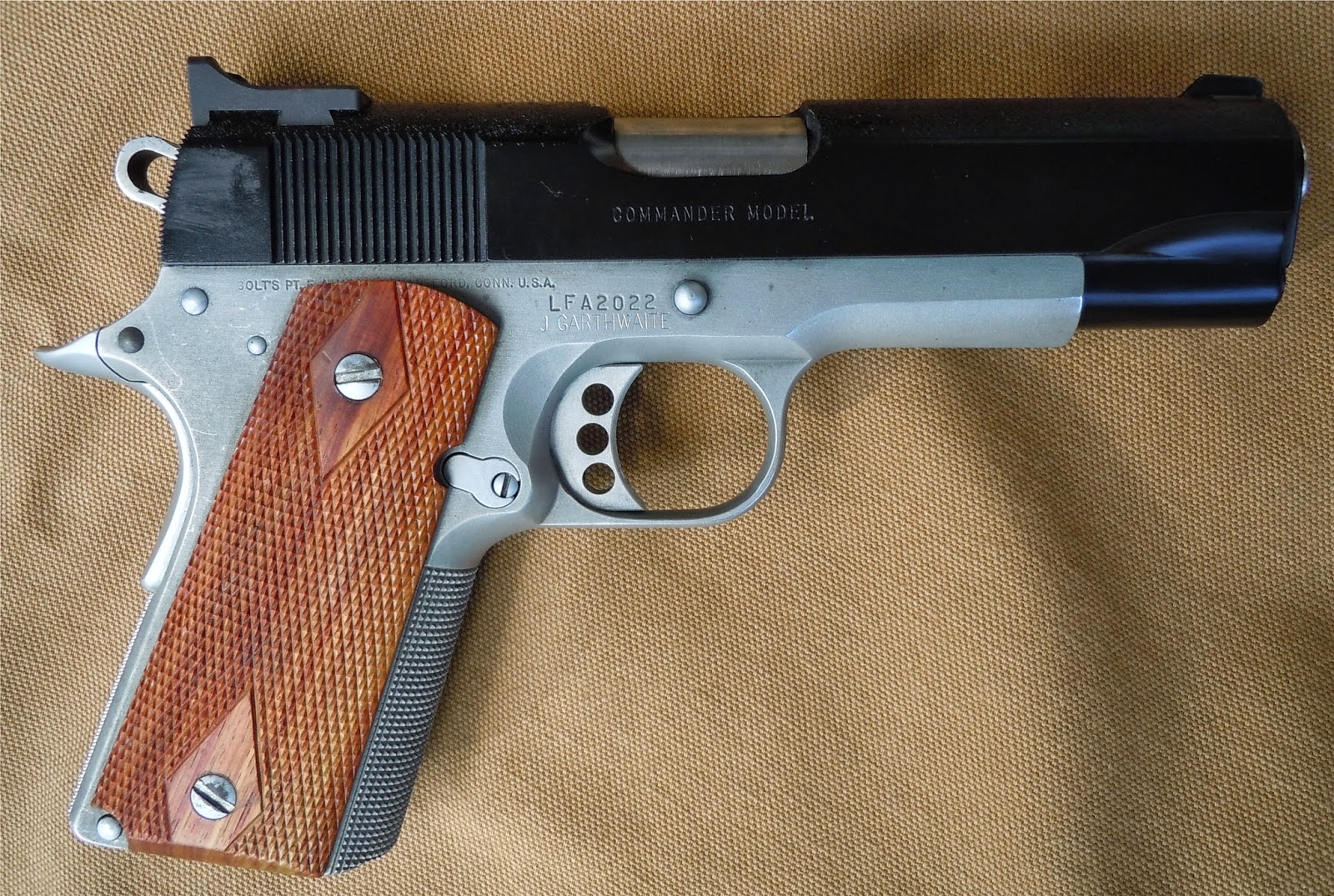
As you can tell from the photo this gun is literally a Colt Commander slide (1991A1) on a Colt Officers' Lightweight frame. The front sight is dovetailed and a Heinie rear sight has been installed. The top of the slide was stippled and the rear of the slide was checkered. Also checkered was the steel (stainless I presume) main spring housing and the front strap. I'm personally pleased that the front of the trigger guard was not checkered. The trigger is like that on my Officers' Lightweight ACP but the feel is different. The gun has a National Match bushing. I haven't had it apart yet so I haven't looked at who made what component.

When you look at the first target you can see that I lost a couple of rounds due to the trigger. That should go away with practice. I really like the sights. Even with my currently compromised vision (cataracts) and bifocals I could see the sights well enough to be effective.

You'll note the vertical stringing and "lost" rounds outside the "group". That trigger is pretty light and crisp which I'm obviously not accustomed to! Then the stringing I think is due to the slight difficulty I had in shooting the gun quickly. Recoil seems to be snappier in this than in the Officers' Lightweight, I think because the gun is just about as light but the bullets are getting more velocity out of the longer barrel. That's just my perception. Recoil is not at all physically bothersome in that it is not at all painful. In comparison I think that a S&W M13 shooting full on 125 gr. .357 Magnum loads with the factory stocks can be painful.

The ammunition used was a mix of ball (Winchester white box) and Federal Hydrashocks. Nary a slip twixt mag and chamber or chamber and ground with any of it or any magazine (Wilson, Chip McCormick and Colt factory). I'll check 230 gr. Golden Sabers next.

Links:
- Massad Ayoob: The Colt Concealed Carry Officers and its niche-mates
- How About the CCOs by Wiley Clapp

Saturday, June 01, 2013

Printing guns...

Much is being made of the concept of using computers and plastic-3D printers to "print" firearms.  Some see it as a bane on society while others see it as a great liberating concept, both for the same reason(s), i.e. that anyone can produce a firearm at any time so long as they have a printers.  Something like the Star Trek replicators in concept, the printing of firearms is advancing quite rapidly.  In as much as many modern firearms are mostly made of some sort of polymer anyway, there is little or no stigma attached to such a firearm.  To put it another way, plastic guns made one way work, why not plastic guns made another way?  Printing of guns might me that way, at least for the some gun smith.

Sor far as it goes now, it isn't illegal for an American to fabricate a firearm so long as it meets the other criteria as mentioned in the linked article.  Handguns must have a rifled barrel to avoid being an National Firearms Act (NFA) regulated firearm and they must have some metal in them to avoid being an undetectable firearm.  However, the real attraction of printing firearms comes from the ability to "stick to the man", i.e. the government, a concept that many currently active progressive/liberal politicians have supported from the time of Richard Nixon.  Unfortunately for them, they are "the man" now and they are all too well aware of that.  They don't like it one bit and they intend to make it illegal.

It might be interesting to watch this show.  Unfortunately for the banners, history doesn't support the idea of successful bans.  If you don't believe me, just look at all the marijuana these same folks smoked since the 1960s.  If people want something, they'll get that something and use it as they please and eventually it will become the norm and permitted.  This is happening with pot in Colorado, California and Washington, it is happening with homosexual "unions" and I'm sure it will happen with any number of things before I die.

Wednesday, April 17, 2013

Need your Parker Bros shotgun refurbished?

I think that my Parker might be about ready for a visit to these folks...

A fourth-generation gunsmith, still going strong By Aaron Smith @CNNMoney April 15, 2013: 3:52 AM ET

A single brand of antique shotgun, the Parker, has provided enough work for a family of gunsmiths for four generations, even though it was discontinued more than 70 years ago.

"It's an honor to work on these guns," said Larry DelGrego III, whose great-grandfather, Herman Shura, emigrated from Germany in the early 1900s to begin the family tradition of working on Parker shotguns. "I'm very fortunate that this is something I was born into."

The Parker is a specific brand of break-action shotgun that has a fervent following among hunters and collectors. The cheapest model, the "Trojan," goes for $2,000, while the rarest make is the "Invincible." Only three of them were ever made, and together are valued at $5 million. One Invincible was refurbished by DelGrego III's father, "Babe" DelGrego Jr., who worked on the guns until 1993.

A Parker that's worth $110,000 will cost about $6,000 to refurbish at DelGrego's shop. But he'll charge $2,500 to spruce up a more run-of-the-mill model.

Charles Parker of Meriden, Conn., developed the gun in 1865, as the muzzle-loaders of the Civil War gave way to more advanced breech-loading technology. Shura was hired by him first, and Shura's son, Lawrence DelGrego Sr., started working for the Parker company in 1933. He moved when Remington bought the company five years later to Ilion, N.Y., where Remington still has a gun factory.

Remington stopped making Parkers in 1942, when supplying arms to the military to fight World War II took precedence over shotguns used for hunting. But the DelGregos kept fixing, maintaining and refinishing the guns.

The work they do includes rebuilding a gun's stocks, hardening the frame, blueing the trigger and rebrowning, reboring and repolishing the barrels. DelGrego III said it takes about 50 hours to refinish a gun, and he typically works on eight at a time.

"When the gun leaves here, it's exactly the way it was when it left the Parker factory," said DelGrego, as he worked to removed "100 years of hunting and shooting dirt" from an antique firearm.

DelGrego said his business brings in about $120,000 per year. After expenses he takes home from $30,000 to $50,000 per year, a decent living in this part of upstate New York.

More than 242,000 Parkers were produced during the shotgun's 77-year history. DelGrego says his family has refurbished more than 60,000 of them so far.

DelGrego III's shop is still about a mile from the Remington Arms plant, which was established in Ilion in 1816. He estimates there are at least 40,000 Parkers still in existence that his family has yet to refurbish. Some of that work might fall to the next generation.

His college-aged sons and teenaged daughter have accompanied him in the shop, just as he used to accompany his father.

"They're going to college first," he said, but he doesn't know if there will be a fifth generation gunsmith after he's gone.

"I won't retire," DelGrego said. "I'll work until I'm dead, and they'll worry about it then, I guess."

Links:
- Larry DelGrego & Son

Sunday, February 10, 2013

Tyler T-Grip Numbers

SMITH & WESSON
REVOLVERS

MODEL

SIZE

For ALL Smith & Wesson "J" frames; models: 30, 31, 34, 36, 37, 38, 47, 60, 63, 649, ect..., made after 1955. Chief, Kit Gun, Bodyguard, Centennial, hand Ejector, ect, also most Charter Arms, Rossi 38 Special, Taurus 85, R.G. Model 31. All guns must have standard factory panel grips, will not fit oversize or rubber grips.

1

For Smith & Wesson "J" frame revolvers made before 1955. Chief, Terrier, etc. Also for EIG E9, INA, Tiger, Llama X111, some late model Charter Arms, with standard grips.

2

For ALL Smith & Wesson "K" and "L" SQUARE BUTT frame revolvers; models: 10, 12, 13, 14, 15, 17, 18, 19, 48, 64, 65, 66, 67, 547, 581, 586, ect...,. Also fits Astra Cadix, Falcon Revolvers with standard size regular grips, will not fit oversize grips. SQUARE BUTT "K" & "L" FRAMES.

3

For ALL Smith & Wesson "K" & "L" frame ROUND BUTT: models: 10, 12, 13, 19, 64, 65, 66, 547, 586, ect... and all "K" frame ROUND BUTT models with regular standard size grips, will not fit oversize grips.

3R

For ALL Smith & Wesson "N" frame; models: 22, 25, 27, 28, 29, 57, 58, 629, ect... Patrolman, Outdoorsman, Target Military, 1918 Military, also Miroku, Aster 357, Llama Heavy Frame Revolvers all with standard size grips, will not fit oversize grips. Round or Square butt does not matter for N-Frame Revolvers.

4

COLT
REVOLVERS

For Colt "D" frame Round or Square Butt models. Agent, Cobra, Detective Special, Diamondback, Police Positive made after 1941, with standard size grips.

5

For Colt "I" & "J" frame models. Python, Trooper, Official Police, Officers Model, Target, 357, MK III, New Service, 1918 Army, with standard size grips.

6

For Colt, old model made before 1941, Police Positive, Police Positive Special, Detective Special, this model has a very narrow butt, narrow between trigger guard and butt stock, Grips are 1 1/2" at bottom width.

7

RUGER
REVOLVERS

For Ruger, Security Six, Speed Six, Police Service Six, Red Hawk Revolvers with standard factory grips.

8

Wednesday, January 30, 2013

Loctite

This is a product line of thread lockers and glues that is often mis-reported as to use. Most often, the recommended product is referred to by color only. I've done that because when you go to the actual product numbers people's eyes start to glaze over and it is obvious you are losing their interest. Via my friend Tycer L____ is some good info on the subject.

- 271, Red: High strength threadlocker for larger diameter hardware.
- 262, Red: High strength threadlocker for for hardware smaller than that which uses 271 (more like heli parts). Either does a good job for our stuff, however. I see 271 most commonly in auto parts stores.
- 609, Green: Retaining compound, high strength, for mounting slip fit bearings to shafts. An appropriate product for tail boxes.
- 603, Green: Retaining compound, high strength, similar to 609 but good where the parts may be a little oily. Good for mounting oilite bushings in housings, BTW.
- 640: Green: Retaining compound, high strength. Similar to 609 and 603. Lacks the oil tolerance of 603. I use it where I might have trouble with adjacent bearing contamination with the product, such as start shaft bearing blocks, since it has a little greater viscosity than 603.
- 638, Green, rather thick: Ultra strong retaining compound for assemblies with a marked amount of slop in the fit, min 0.004". Don't try to use this stuff for our normal bearings on healthy shafts. It sets almost immediately in the tight gap, and you'll never have the chance to get the bearing into place.
- 290, Green: Wicking product for thread locking AFTER assembly. Medium strength, much stronger than 242 blue in my experience. Not the correct choice per loctite for bearing mounting.
- 242, 243 Blue: Classic medium strength threadlocker for most of our threadlocking applications. 243 is the oil tolerant version.
- 222MS, Purple: Low strength threadlocker for small diameter or otherwise delicate fasteners.

Saturday, January 14, 2012

New hammer for the new Ruger Flat-tops

I have a couple/three of the Ruger Flat-tops on the 50th Anniversary Flat-Top frame which is the size of the original Ruger Blackhawk but with the new lockwork.  Two are .44 Specials and one is a .45 Colt/.45 ACP.  All came to being courtesy of Lipsey's.  I get along well with all these guns.  However, I have been thinking that a lower hammer would be the ticket.  To that end I've been reading what I can and looking at comparisons of the various hammers Ruger installs on their single action revolvers.  Two of these interest most people wanting to make a similar modification.  These are the Bisley and Super Blackhawk hammers. Below, courtesy of Matt Olivier, we have, left to right: Old Army, Super Blackhawk, large frame Blackhawk, 357 Blackhawk, Single Six, Super Single Six, and Bearcat.


This gives a good idea of the relative heights of the spurs and sizes of the parts.  However, this photo lacks a direct comparison of the Super Blackhawk and Bisley hammers.  This next photo, from Whopist on Cast Boolits, does show the relative heights of the three hammers shown.


So it might be necessary to get a Bisley hammer and remove the excess metal that it has to blend with the ears on the Bisley grip frame.  This next photo from Whopist shows that.  If you look at the Bisley hammer you can see that the original hammer form has been drawn with a black marker.


I read in the same topic that:
On the thick transfer bar gun, ease the hammer down while holding the trigger and look at firing pin protrusion, see if your thin transfer bar revolver looks to have the same protrusion. If not, you may need to remove some metal from the top of the hammer to get a full strike from your pin.

Also, on the thick transfer bar revolver, with the hammer lowered on the transfer bar and the firing pin extended, see if the hammer drops a fraction to fully come to rest when you release the trigger. If it does, you have transfer bar pinch which will/could lead to a broken transfer bar. In this case you need to file some off the second step until you alleviate the pinch.

Then to further confuse things, on a midframe like the 44 special, Anv 357, New Vaquero, you have to look at how deep the hammer "sits" at rest. If you do a straight swap on a midframe, the hammer might not rest deep enough to fully retract the pawl. Then you get clicks from the pawl on the ratchet plus the reverse indexing pawl, 12 clicks per rotation. To fix this, you have to establish resting depth, then file the second step to alleviate the pinch.
Whether the differences between the thick and thin transfer bars will really be a problem or not has yet to be seen.  A Montado hammer would be close to ideal, if there was a blued version.

Another comparison of the various Ruger SA hammers...

I got two Super Blackhawk hammers but have yet to install either of them. I am one of those people who finds it hard to fix something that works.

How to do this?  It was supposed to be this simple and you might have seen these instructions elsewhere...
1) Remove the grips
2) Remove the five grip frame screws. Remember where the long one goes.
3) Separate the grip frame from the cylinder frame carefully. Don't lose the two small plungers. One is in the grip frame just forward of the trigger slot. The other is on the rear face just below and to the side of the hammer.
4) Depress the gate detent spring so the trigger pin can be removed (a gate detent spring tool ($20) is a BIG asset).
5) The hammer and trigger can now slide out.
Change the hammers and reverse directions for reassembly. 15 minutes and your done.

It was NOT that simple.  The instructions are in the manual and you should follow them.  The first time it took MUCH longer than 15 minutes, more on the order of 2 hours to both disassemble and reassemble.  The gate detent spring tool IS a big asset.

You must remove the main spring and you will eventually have to remove the trigger spring so you might as well do that also before removing the frame.  It is a bit of a juggle to put it back together and correctly install the mainspring strut and trigger spring.  On the New Vaquero and other guns with the lock, one captures the mainspring on the strut and then removes the grip frame to remove the mainspring (and trigger spring).  It just doesn't work any other way.

In reassembly, one needs to depress the detent spring just so as to slide the trigger pivot pin back into place.  It helps if the cylinder catch/bolt is flat against the detent spring as that means the pivot pin hole will not bind on the trigger pin.  Also, you need to be certain that the gate is closed and the detent spring leg is correctly positioned against the gate.  It might have a tendency to slide forward of the gate.

Was it worth the effort?  First, a Montado hammer will more correctly match the radius on the grip frame.  That might be more important to you than the fact that it is a stainless part (if you can get one).  The Bisley hammer is a bit lower yet and you can cut/file the radius to match the grip frame.  However, the lower hammer is a benefit as one can cock/uncock the gun without shifting ones's grip much at all.  For those with physical issues limiting dexterity, this might be very important.  Aside from learning HOW to do this, the parts are pretty much drop in.  That speaks volumes on the quality/concistency of Ruger's fabrication.

All this would be pretty pointless without photos, right?  Here's two.  The first is a side view of the Bisley hammer in my New Vaquero.  I have about $350 in the gun.  Yes, a bit ugly but the thing works.  Think of it as the Glock of Single Actions.

Ruger NV-44 .45 Colt New Vaquero, 2005 vintage with Super Blackhawk hammer installed
Ears and hammer radius don't match up...
The second photo is of the rear of the gun.  I'm trying to show the difference in the radius of the hammer and the grip frame at the "ears".  It kinda irritates me a bit so I don't know if I'll leave the Super Blackhawk hammer in the gun.  Because the Super Blackhawk is such a big gun, compared to this one, I am a bit surprised that the hammer for it is missing metal in this area.  However, dimensions elsewhere are correct and the hammer works just fine in the gun.  As I said before, a Montado hammer would do the same thing and match the grip frame but all the Montados I know about are stainless steel.  Also, at this time I don't know where to get a Montado hammer.

After a bit of shooting and dry fire I've really grown to like this modification.  The original hammer seems to have a spur more akin to the headgear on a longhorn bull than a Colt SA hammer and while there isn't much difference, the 1/8"-3/16" lower plane of the top of the Bisley hammer is a big help in smoothly and quickly cocking the gun.  I like it so much that I've ordered a Bisley hammer to modify for my .45 Colt Flattop.  It will rest a bit lower and have a bit more "style" than the Super Blackhawk hammer AND I'll be able to grind/file/shape the radius to match the frame "ears".

I've also discovered that the Montado hammers have become unobtainable.  Ruger apparently has made a corporate decision to not make them available as parts while still providing Bisley and Super Blackhawk hammers to the trade.  How and why they have made this decision is unfathomable to this simple-minded former infantryman.  To my mind, if it sells, make it and sell it.  If they made a blued version, I think it would sell very well for installation on the .44 Special and .45 Colt Flattops they've recently put on the market.  The lower hammer is a big plus to the older shooters, some with the beginnings of arthritis, who make up a big share of the market for these guns.

Originally published 20:00 2011-09-07.

Tuesday, January 03, 2012

Smith and Alexander Main Spring Housing for Lightweight Officers' ACP

Lightweight Officer's ACP with Lanyard Loop
The new main spring housing with lanyard loop arrived today and it was in the gun in about 2½ minutes.  I think I've got the process down now.  Gun functions, the steel MSH rather than nylon factory part doesn't add any noticeable weight and the lanyard loop will be handy when canoing.

Saturday, August 06, 2011

Tyler-T Grip Adapter

Colt Official Police with Tyler T-Grip Adapter
As mentioned in an earlier article, I like the Tyler-T Grip Adapters.  I have them on a lot of my revolvers.  Properly installed they are very stable and reliable and they work well with my hands and factory grips/stocks.  Unfortunately there's some bad news out there in the world of Tyler Manufacturing.

As has been noted, Melvin Tyler (who developed the product) died about 10 years ago.  His son-in-law Brian took over management of the business and now he has passed.  The remaining family is attempting to keep things going.  They have not taken down the web site and continue to take orders and may be continuing to produce grip adapters.  However they seem to have no understanding of customer service and are devoting little to no effort in that regard.

What appears to be happening is that after the loss of Brian no announcement was made and orders continued to come in.  Family in attempting to keep the business going accepted those orders and cashed checks.  Apparently they lost their facility, likely due to the vagaries of probate and lease conditions, and had to move the production equipment.  Inexperience likely delayed that process.  Orders continued to come in and be accepted (and more checks cashed to fund the move).  Communications ground to a halt.  As production started or continued the new "staff" had to learn "how to" which resulted in yet lower production rates.  I know that the anodizing is done by another firm and they appear to work on their own schedule.  The upshot is that no customers are happy.  While they might be shipping product, nobody is reporting receipt of product and so nobody knows that product might be coming out of the company but EVERYBODY tells and repeats the horror stories of orders unfilled, calls un-returned, checks cashed months ago, etc.  The Oklahoma Attorney General's office has received a great many complaints but can't give any further information and denies any jurisdiction.  This is all very sad as this company's reputation is now trashed and for no reason.

However, as often happens, the Tyler-T Grip Adapter is seemingly more in demand as cultists adherents try to get their grip adapters before they are "all gone".  Prices have gone through the roof rising from the MSRP of about $30 to as much as $250 (perhaps more by now) on the internet auction sites.  Most people who are willing to sell are asking $60-100 for each adapter.  When the madness ends, and it will, I wonder, how will those folks who bought at those prices feel?  I know how I'd feel.  I suggest that you wait it out.  There are other options for compact grips/stocks that don't stick to clothing when carried concealed.  The likelihood is that the company is in fact going to produce and ship or another manufacturer will step in and take advantage of the market vacuum.


Now that there's an unfilled demand somebody has stepped up to fill it! BK Grips or you can e-mail him directly. He also has an ad up on The High Road.


Now we find that the 800-number is disconnected and the web-page(s) taken down. Very sad. For those looking at those currently in the market here's a chart...

#1 For ALL Smith & Wesson "J" frames; models: 30, 31, 34, 36, 37, 38, 47, 60, 63, 649, ect..., made after 1955. Chief, Kit Gun, Bodyguard, Centennial, hand Ejector, ect, also most Charter Arms, Rossi 38 Special, Taurus 85, R.G. Model 31. All guns must have standard factory panel grips, will not fit oversize or rubber grips.

#2 For Smith & Wesson "J" frame revolvers made before 1955. Chief, Terrier, etc. Also for EIG E9, INA, Tiger, Llama X111, some late model Charter Arms, with standard grips.

#3 For ALL Smith & Wesson "K" and "L" SQUARE BUTT frame revolvers; models: 10, 12, 13, 14, 15, 17, 18, 19, 48, 64, 65, 66, 67, 547, 581, 586, ect...,. Also fits Astra Cadix, Falcon Revolvers with standard size regular grips, will not fit oversize grips. SQUARE BUTT "K" & "L" FRAMES.

#3R For ALL Smith & Wesson "K" & "L" frame ROUND BUTT: models: 10, 12, 13, 19, 64, 65, 66, 547, 586, ect... and all "K" frame ROUND BUTT models with regular standard size grips, will not fit oversize grips.

#4 For ALL Smith & Wesson "N" frame; models: 22, 25, 27, 28, 29, 57, 58, 629, ect... Patrolman, Outdoorsman, Target Military, 1918 Military, also Miroku, Aster 357, Llama Heavy Frame Revolvers all with standard size grips, will not fit oversize grips. Round or Square butt does not matter for N-Frame Revolvers.

COLT REVOLVERS

#5 For Colt "D" frame Round or Square Butt models. Agent, Cobra, Detective Special, Diamondback, Police Positive made after 1941, with standard size grips.

#6 For Colt "I" & "J" frame models. Python, Trooper, Official Police, Officers Model, Target, 357, MK III, New Service, 1918 Army, with standard size grips.

#7 For Colt, old model made before 1941, Police Positive, Police Positive Special, Detective Special, this model has a very narrow butt, narrow between trigger guard and butt stock, Grips are 1 1/2" at bottom width.

RUGER REVOLVERS

#8 For Ruger, Security Six, Speed Six, Police Service Six, Red Hawk Revolvers with standard factory grips.


As of 25 Jul 2011....

ATTENTION CUSTOMERS:

------------------------------------------------

Tyler Manufacturing has resumed production of the TYLER T-GRIPS and TRIGGER SHOES. After a lengthy family conflict I have been successful in taking over the ownership and management of Tyler Manufacturing. As of July 25, 2011 over 1000 shiny and flat black T-GRIPS have been manufactured and will be received by Tyler's customers within the next 7 to 10 days.

I would like to extend my sincerest sympathies for the practices of the previous owners/managers of Tyler. I have made it my priority as the new owner/operator to fill EVERY back order immediately. I will post weekly, my production list of all completed finishes and sizes of T-GRIPS AND TRIGGER SHOES. These updates will continue until appropriate office help can be hired to answer your questions. Address changes have been logged and applied and your letters have been read. Although I am not able to respond to every request, I hope this update and receipt of your orders will be a satisfactory response for now.

As of this date, I have produced over 200 back ordered TRIGGER SHOES. However, not all back orders of TRIGGER SHOES have been completed, most have been done in flat black. Bronze and Aluminum finish TRIGGER SHOES and T-GRIPS are the next items to be produced and mailed.

My business practices are far different than what many of you have previously experienced in dealings with Tyler Manufacturing this last year. I have taken a leave of absence from my law enforcement career to focus on the day to day operations of Tyler and will continue to do so to ensure the company's success.

My intent is to have inventory and orders shipped out as they are received instead of back orders or custom made items. This means that all trigger shoes will be manufactured in black once the back orders have been completed, and bronze items will be available for a limited run in both T-GRIPS AND TRIGGER SHOES.

Also, as soon as possible, Tyler will have a new web site.

I look forward to doing business with you.

Sincerely,

Bryan Matthews, Jr.

Saturday, July 30, 2011

Bearcat Cylinders

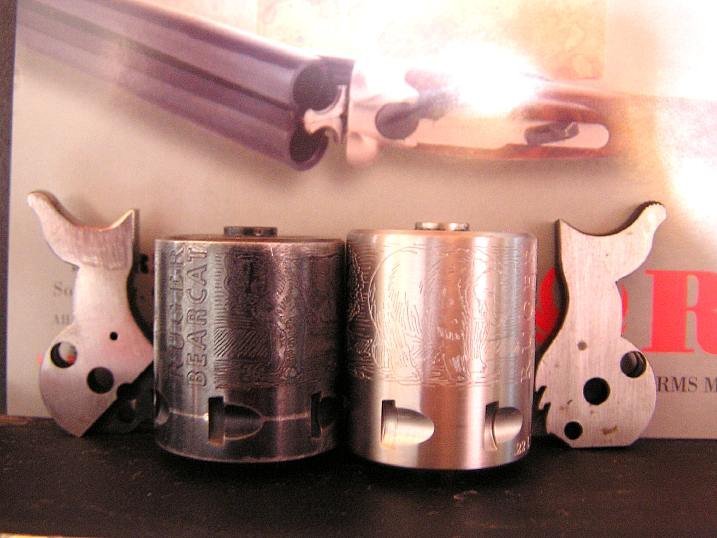
Carl Laco provided this photo comparing an old model Bearcat cylinder on the right with a new model Bearcat cylinder on the left.  Note the difference in length.

Based on this, I would think that a new model Bearcat would be one to re-chamber to .22 WRFM if one was so inclined.

Friday, June 10, 2011

Letting yourself down...

I let myself down last night. How? Let me try to explain.

Many months ago I came into this Marlin 1894 .44 Magnum to replace my old beloved 1894 .44 Magnum and to help out a buddy who needed some money. One of the first things I noticed was that the loading gate screw was a bit buggered. I thought I'd fix that and so I acquired a new screw but of course the person who'd buggered the screw had cross-threaded the gate and so I needed a new one of those as well. I got the parts but I put off doing the repair for several years now because, well, I didn't have the time. Last night I got the wild hair and took the gun apart.

Unfortunately, I wasn't smart enough to find my parts first so that I had everything together. So I then had to reassemble the rifle so that I wouldn't lose any more parts. Still can't find the new parts. No they aren't in the parts boxes. I've no idea where they are and I could swear I had to move them only a couple of months ago because they were in the way of a loading project.

So, you see, in failing to keep myself organized I let myself down and wasted time. Entirely preventable.

Monday, May 09, 2011

Chamber Casting on the Cheap by Tim

A friend has an old 1885 Winchester High Wall that was original a 38-55, but someone in the past has relined to a center-fire .22 caliber and the new caliber is not marked anywhere on the rifle. I decided to make a chamber cast to find out what it was.

Ordinarily you would use Cerrosafe, a metallic substance that melts at the temperature of boiling water and is designed for the job of chamber casting. But if you don't have any Cerrosafe, wax can make a cheap substitute if done carefully. In this case I used refined beeswax.

Here you see a picture of the muzzle showing the .22 liner that was epoxied into the barrel:

Image


I started by giving the breech area and bore a good cleaning. Then everything was given a light coat of oil, :

Image


I needed a tight oiled patch placed in the bore just ahead of the chamber. I first closed the breech block, ran a rod down the muzzle to determine overall bore length, then backed the rod out enough to clear the chamber and marked the rod with a piece of tape. The patch was then run in from the muzzle, stopping the rod at the tape mark. I did it this way because it presents a smoother surface for the wax to stop against as opposed to a patch run in from the breech, but I suppose it really doesn't matter much how it gets in there as long as it is there!

Image


Next I used some automotive body caulking to build a dam around the bore breech so as not to get wax into the action:

Image


I used an old metal cigar tube cut at an angle and pinched to form a pouring spout for the melted beeswax. A Vicegrip was used to handle the hot tube:

Image


Here you see the rifle clamped barrel down in a vice with the action tilted slightly uphill to let any wax that overflows go away from the action:

Image


Now the wax has been poured. It will shrink and pull down into the chamber slightly as it is poured, so I keep dribbling in hot wax until it overflows slightly:

Image


While I waited a half hour or so for the beeswax to completely harden, I cleaned up the overflow and removed the caulking from the action area:

Image


Lastly, the cleaning rod was run down the muzzle and the casting pushed out:

Image


Using a caliper to check dimensions, and referring to the book "Cartridges of the World", I determined that the rifle appears to be a R-2 Lovell, a famous old wildcat caliber designed in 1937 and based on the 25-20 Single Shot case. I know a fellow who has a rifle in that caliber, so the next step is to borrow a round from him and see if it fits.

This wax chamber casting method will get you by in a pinch, but having used Cerrosafe in the past, I think it does a much better job, and the cerrosafe casting does not require the delicate handling that a wax casting does. Still, I found out what I needed to know, and it was kind of fun going through the process!

Tim (Shasta)

Saturday, April 16, 2011

Why oh why...?

I deal with a number of people on the retail side of firearms and militaria. Being interested I willingly engage just about anyone in a discussion on either topic. As it happens, I learn or at least hear a lot in these conversations. Sometimes I get a bit irritated in spite of myself. Yes, I have several pet peeves.  A recent conversation made me aware of another one...

Why is it that so many people will buy something and then immediately change it? That bothers me. I am not talking about the many people who have experience in use of or repair of a given thing such as a gun. I'm not talking about people who understand the mechanical workings of a given machine and seek to improve it or modify/mitigate its faults. I'm talking about the newcomer who is completely ignorant about the subject who immediately seeks to insert the latest most faddish modifications because of something that they read or heard. Women don't tend to do this. This sort of behavior seems to be a "man" thing.

To give you a "fer instance". There was a fellow who just bought a Marlin Model 1894C rifle. So what did he do? Did he go out and shoot and learn his rifle? Did he clean, disassemble and reassemble it a number of times noting the simple but effective parts and how they interact to create a reliable shooting tool? Nope. The first thing this fellow apparently did was to replace the Marlin firing pin with a one-piece pin. He then proceeded to tell us about it without actually having yet fired the gun. When it was pointed out that there were reasons that Marlin had a "two" piece firing pin, he proceeded to lecture us on how the mechanism (all guns are just a mechanism) worked. However, we finally came to understand that, as he said, "...this rifle is new to me and I just like to understand the mechanics of it all." In other words, he didn't know much at all before he felt he had to modify the gun.


The original Marlin two-piece firing pins have a forward long pin and a short rearward "striker" which is pushed down out of contact with the forward pin by a short flat spring until the locking bolt is fully in the locked/closed position. (Note:  Marlin calls these the front and rear firing pins.)It is the locking bolt that pushes the rear "striker" up into alignment with the forward firing pin so that the blow of the hammer can be transmitted to the primer. The intent is to ensure that the firing pin can't set off the primer until the bolt is fully locked. Some people believe that this system has too much friction and that this friction makes the gun cycle too slow to be used in certain shooting sports such as cowboy action shooting.

An old original cut-away action, see the locking bolt through the hole in the upper rear

To counter that the one-piece firing pin was "invented" by gamers (going back to a version of a design that the Marlin folks deliberately left in the interest of safety). In that highly controlled environment on the shooting range where the loaded guns aren't much jostled about the firing pin can't take a run at a primer and cause a problem. It is from the gamers that the hunters and shooting neophytes have learned of the on-piece firing pin. There are some that apparently believe that the Marlin was incorrectly engineered low those many years ago and they are going to "fix" their gun. It isn't as if that extra hundredth of a second in cycling the action is going to matter to a hunter or plinker but let's not get too bogged down in reality.

Brownells' image showing relationship of parts in Marlin action

Yes, I do know that there are some, even many, knowledgeable shooters and competitors who so modify their Marlin rifles. That's fine. They've thought it out, maintain their guns well and keep them clean. They can actually feel and appreciate the improvements large or small that they have worked on their firearms. They are more than welcome to do so. I also know that there wouldn't be a lot of gun stores in business if not for the more fickle and ignorant of the shooting public. Their changes of firearms, accessories, and so forth are literally the bread and butter for shops all over the country as well as for several large and not so large mail order firms.

Links:
- Long Hunter Shooting Supply
- Evil Roy Shooting School
- While It Was Out by Jim Taylor

Friday, April 08, 2011

Slotter & Company, Phila - Rimfire Tip-up Rifle

Scarce Pair of Slotter & Co. "Peanut" Size Pistols
The Schlotterbeck (or, alternatively in some records, Slotterback) brothers, Charles (b. ca 1832), Frederick (b. ca. 1834) and Henry (b. ca. 1837), were apparently natives of Wurttemberg, Germany and had immigrated about 1855.

It is unclear if Charles ever worked for Henry Deringer but he is known to be working for A. J. Plate in San Francisco in 1860.  After working for Henry Deringer, Henry  and Frederick Schlotterbeck opened their own shop/factory in 1860 which operated at 400 Lynd Street, Philadelphia until about 1869.  These former Deringer employees were involved in a patent infringement suit in 1863, due to Henry Deringer's statement that the brothers falsely interpreted authorization to use Deringer's name on their arms. They were, in fact, marking their guns "H. Deringer" and shipping them to A. J. Plate who was apparently desperate for the pistols to sell. Shortly after the court ruled in Deringer's favor, the brothers began putting out arms under their own company name, Slotter & Company, or marking guns "J. Deringer" for a partner who was reputedly a butcher or tailor who never set foot in the shop. There was a John Deringer, tailor, in Philadelphia (who was drafted to serve in the Civil War).   Did he accept the deal in order to get the money to buy a substitute?  That last is pure speculation. To continue, Slotter & Co. not only made Deringer type pistols but also muzzleloading percussion rifles and at least one breechloading rifle (shown here). The company ceased all activities about 1869 and the brothers moved to the west coast.

Slotter/ & Co. Phila marked rifle
Charles lived in San Francisco (on 1870 census) where he made rifles and later moved to Lakeport, CA with his wife Poline (Pauline, who also immigrated in 1855) and children including Henry (or Charles Henry) who was also a gunsmith. Charles was known for his quality firearms and held several patents on firearms (84224, 208765, and 233034). He was apparently in business in 1867 as this ad from 16 August 1867 attests.
VILLEGIA & SLOTTERBEK, GUN, RIFLE AND PISTOL makers, 730 Washington street, opposite the Plata, Messrs. JOSEPH VILLEGIA and CHARLES SLOTTERBEK beg to call the attention of their friends and the sportsmen of California to the fact that they have taken the above store, and purpose conducting it as a first- class establishment, where the entire wants of the Sportsmen can be accommodated. Messrs. V & S would call special attention to tho superiority of the Guns, Rifles and Pistols made under their supervision, and challenge competition in this particular; and are now making guns to order with the elaborate cold drawn steel barrels, which are so favorably known for their great strength and superior shooting powers. Repair of Firearms done at the shortest notice, and satisfaction guaranteed in all cases. Ammunition of all kinds constantly on hand.
Charles was also apparently well known as a Schutzen shooter (and we see yet another spelling of the family name).
During 1872 the National Rifle Club was organized by the members of the old “Deutsche Schuetzen Club” which had ceased to exist, Joseph Hug, Alois Schneider, Wm. Ehrenpfort, John Bach, George Schmidt, Chas. Slotterbek, Philo Jacoby and others were original members. Their shooting range was at Harbor View where they practiced every Sunday and held several public prize shootings.
But that isn't all that's out there on Charles.
Slotterbek Gun Shop - 185 N. Main Street
Charles Slotterbek located his gun shop in this building in 1872. The Chopsticks restaurant is the latest business to be housed in this same location that Charles Slotterbek made famous because of his superior ability as a gunsmith. Slotterbeck was probably the most famous of the California target rifle gun makers of the mid 1800's (see California Gunsmiths by Lawrence Shelton for more details). He was well known in the west for the exceptional quality of his rifles and pistols which are still highly prized and sought after by gun collectors today. He was born in Wurtemburg, Germany in 1832, immigrated to the United States and worked for Derringer in Philadelphia, where he learned all phases of pistol making. Not only a superb craftsman, he was an inventor and was granted patents for an off-set scope mount, a three barrel gun and a breach loading rifle. This is another example of a building that began as a wooden structure, but was later converted into brick due to the many fires that destroyed buildings in the late 1800's.
Charles Slotterbek died in Lakeport in 1886 and is buried in Hartley Cemetery.
Henry is shown on the 1880 census as living in Los Angeles, California to which he had moved in 1869-1870. It is difficult to track them in the census documents because of the many spellings of the family name.  One can well understand why they used the name "Slotter" for their company.  It was easy to spell! He apparently had a good business in Los Angeles (on Main Street and living on Eternity now Buena Vista Street?) until his death June 24, 1888.   Well known for customized Sharps rifles, one occasionally comes on the market. Another note is that Ludwig (Louis) Wundhammer apparently took over his shop after working for him. By this discovery we also discover how Henry died. According to Michael Petrov,
Wundhammer and Slotterbeck were at the rifle range where Slotterbeck was adjusting the front sight on a rifle when it discharged, striking him in the chest and killing him.
Mr. Petrov also reports that
Slotterbeck bought out the business from the founding gunsmith of LA, Henry Schaffer who retired in 1872 to grow flowers. The business went from Schaffer to Slotterbeck to Wundhammer to Ross King who later moved the shop to Roseburg, OR. Then in 1936 King retired and sold out to a young man by the name of P. O. Ackley.
We know that P. O. Ackley mentored Mike Bellm... And so it goes.

Frederick apparently moved to Seattle, Washington.  He was working to establish his gunsmith business there when he died November 14, 1873.

This .38 RF Long caliber, 24" octagonal barrel marked Slotter & Co, Philadelphia. Unusual hammer-activated breech system. Marked on top of breechblock W. Morgenstern Patent W.P. Wilstach. Breechblock and frame are nicely engraved, German silver furniture, patchbox, inlays. Finely checkered buttstock and forearm with silver tip. 

Slotter rifle action
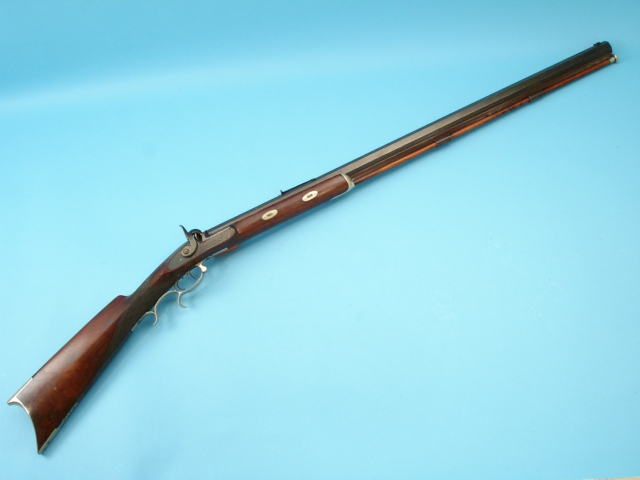
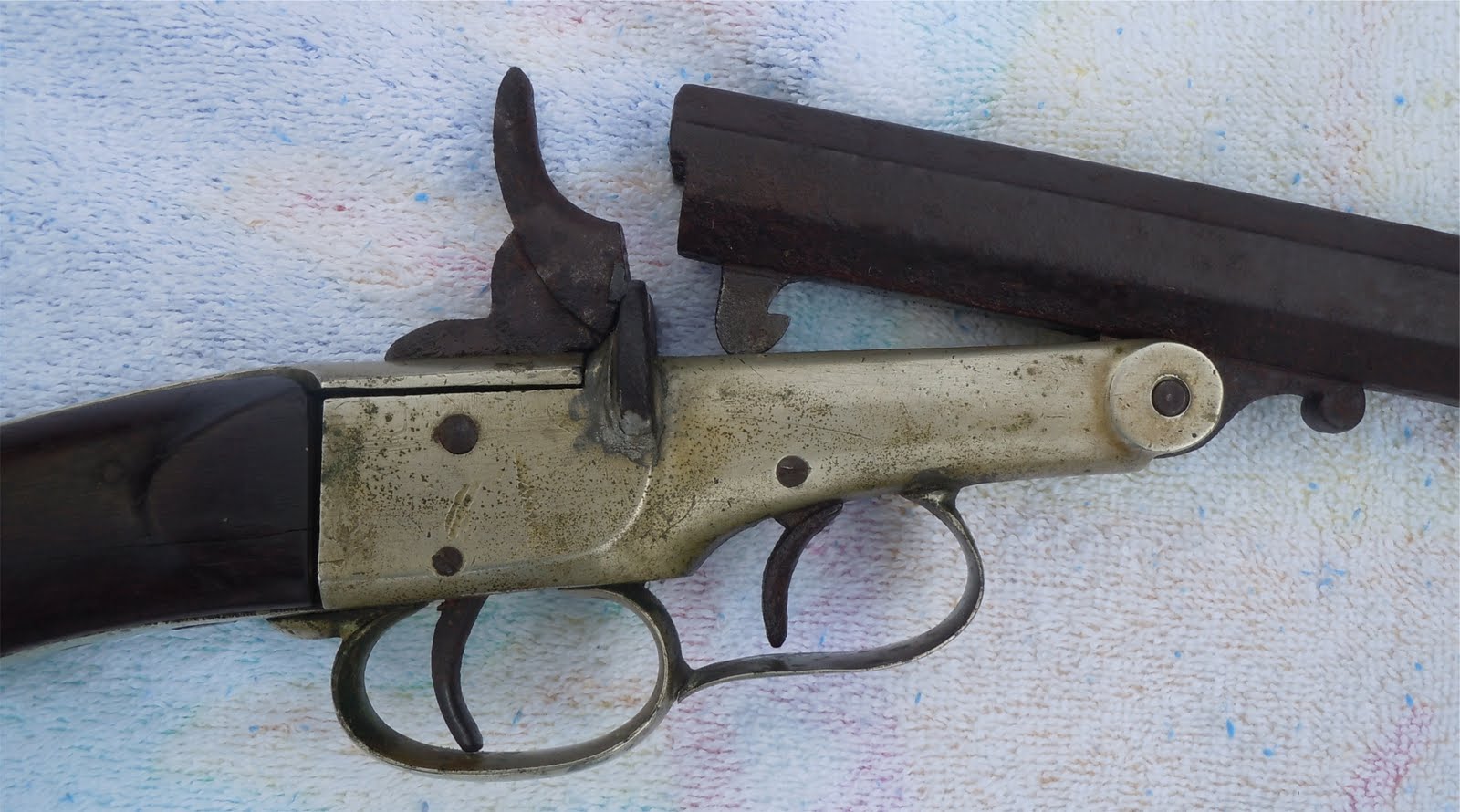
That is about the sum total of what I could quickly discover about this gunmaker.  Why the interest?  Today Nuckols Gun Works took in this "Slotter & Co. of Phila" marked rifle.  The barrel appears to be of iron, is 28" long and 7/8" across the flats and is .22 caliber. The action appears to be of gun metal. The forward trigger releases a locking bolt allowing the action to tip open similar to the Wesson tip-up rifle. The breech is extremely simple. The hammer has a ridge laterally across its face which functions as the firing pin. When fully forward, the top face of the hammer (above this firing "pin" ridge) serves to hold the cartridge in place but there is some space between the lower face and the case head. It is likely that the case will split there, and has judging by the appearance of the face and surrounding material. I didn't get to look inside but the trigger mechanism seems very simple. The buttstock follows earlier muzzleloading conventions and the toe is broken.

It seems to me that this was a standard production item although it might have been a prototype or one-off. The standing breech portion seems to have been crudely rebrazed sometime later during the gun's life because the rest of the construction is as refined as the rest of Slotter & Company's production. I think it was made relatively early in the cartridge era, about the end of the Civil War or circa 1865. I'm sure that this system won't be at all acceptable with a cartridge larger than a .22 Short. Still, it is clear that this gun was used and valued enough as a tool that an effort was made to repair it.

We have yet to find another example in our research but we will continue to look.


Wesson 2-trigger Tip-up Rifle
It has the appearance of but should not be confused with the Wesson Tip-up Rifle.  They are not the same action.

Now I have some more and better photos (shown below)...

Overall view, note the broken toe of the stock and stock shape
Action close up, right side, hammer fully forward
Action close up, hammer fully cocked
Close up view of breech, hammer at half-cock, note brazed on " standing breech"
Only manufacturer's mark, top tang
Action bottom and bottom tang.  You can see the tang and spring screws here.  Note moderate engraving.
Pulling forward trigger releases locking hook and allows action to open.


Links:
- Guns of the Old West: An Illustrated Guide By Charles Edward Chapel
- IMPROVEMENT IN TELESCOPE ATTACHMENTS FOR FIRE-ARMS

Mounting Rifle Sights — Chas. Slotterbeck, Lakeport, Lake Co., Cal. This invention
relates to a novel method of mounting telescopic sights upon breech-loading rifles, so that the telescope will not interfere with the action of the breech mechanism or the loading of the gun, nor displace or interfere with the ordinary sight. In the ordinary method of attaching a telescope to a rifle, it is mounted over the center of the barrel, and thus displaces the ordinary open or globe sight. It also extends so far back over the small of the stock, that it is totally inapplicable to breechloading rifles of many description, and inconvenient upon any. This invention consists in the employment of a device by which the telescope can be accurately mounted without interfering with the ordinary sights, and at the same time be entirely out of the way of the breech mechanism.