.308 vs. 7.62x51
Showing posts with label GunsIHaveOwned. Show all posts
Showing posts with label GunsIHaveOwned. Show all posts
Saturday, November 01, 2014

Thursday, July 31, 2014
The Sig-Sauer P938-22
I had high hopes for the Sig-Sauer P938-22. A parallel development of the P938 9mm subcompact pistol, it was reportedly intended to first be a conversion kit for the 9mm pistol but was actually introduced prior to the conversion. I suppose that Sig-Sauer rightly saw that the market for dedicated .22 Longrifle pistols was larger than the market for conversions. With all the lip-service given to the idea of training with the .22 rimfire that duplicates the full-caliber gun most owners of these guns devote minimal time (and ammunition) to practice and many simply load and carry the guns right out of the box. Certainly not wise but it is the likely reality.
I had been pondering the little P938 but couldn't bring myself to "drop the hammer" on one. However, when given the opportunity to purchase a P938-22 pistol at a good price I impulsively leaped at the opportunity. I should have given it more thought.
The P938-22 arrived at my dealer and I completed the transfer. I took the pistol home. It sat in the box, in the safe, for two weeks. I then had an opportunity to shoot the gun. I pulled some ammo that was available and loaded the single magazine that came with the gun with the first ammo to be tried. That was the old CIL .22 LRN which must have come from the early 1960's that is it is now 40-50 years old and has been stored in unknown conditions. Every round went downrange and produced a group at 33 feet (10 yards) of about 4-5 inches centered about 3 inches to the left of target center. Ok, so the ammo works fine in 3 rifles and 2 other pistols/revolvers producing squirrel killing usable groups but maybe this ammo just doesn't go with this ammo. Well neither did R-50, 30-year old (and carefully stored, tried and true) Winchester 40 gr LRN High-velocity, or Winchester Power Points. Nor did the point of impact change much, if at all. I thought that this would be the time to adjust the "adjustable" sights.
I suppose that age hasn't lessened my naivete. I fully expected the adjustable sights to adjust. No go. Neither right nor left more than one "click". That is, the sight would adjust one click right from the original setting and then one click left from that. Not much adjustment when you need to move it about 3-inches at 10 yards. Nor could I decrease or increase elevation, not at all and I mean, not at all. The elevation screw refused to turn. There are no locking screws, just the elevation screw dead center top of the sight and a windage screw on the right of the leaf. I must be missing something... UPDATE: I finally got the sights to adjust. I am still not certain why the sight's adjustment screws resisted adjustment but after soaking several weeks in Kroil something broke loose and they now seem to work properly.
Ok, when all else fails, read the instructions. Another fail. The instruction manual is not for the P938-22 but for the 9mm version, the P938. Oh, but there's a P938-22 card insert! All is well, right? No. The card insert is concerned with the peculiarities, compared to the parent P938, of dis-assembly and assembly. No help with the sights.
I mentioned that I loaded the one magazine. That's all they ship with this .22 pistol. That's all they ship with all their pistols. Pistols are around because the advantage they have over revolvers is that one can rapidly reload via the box magazine so it would seem apropos that the pistol would come with at least 2. No. Sig-Sauer apparently can't clear enough profit unless they charge you a minimum of $38 and change (plus shipping because no firearms distributor has these in stock) per plastic magazine. Irritating but it seems to be an industry standard as Browning ships the 1911-22 with just one lonely magazine as well as do other manufacturers. As things stand now, I'm not all that sure I want to invest in my usual minimum of 6 magazines per pistol.
This is a good time to note that you might need more magazines than usual. The pistol slide does remain open on an empty magazine, but only because the bottom of the slide is stopped by the follower. The follower does not push the slide lock/slide release up as the slide lock/slide release's "tab" is made for the 9mm magazines and too short to reach the .22 follower which is in the middle of the magazine and magazine well. Indeed, the wall of the magazine would prevent even a lengthened tab from touching the magazine follower as they are made now. This has to accelerate wear on the follower. However, further wear is caused if one simply removes an empty magazine as the rear of the follower then drags across the bottom of the slide face until there is insufficient contact to retain the slide and it slides forward to close.
I had been pondering the little P938 but couldn't bring myself to "drop the hammer" on one. However, when given the opportunity to purchase a P938-22 pistol at a good price I impulsively leaped at the opportunity. I should have given it more thought.
The P938-22 arrived at my dealer and I completed the transfer. I took the pistol home. It sat in the box, in the safe, for two weeks. I then had an opportunity to shoot the gun. I pulled some ammo that was available and loaded the single magazine that came with the gun with the first ammo to be tried. That was the old CIL .22 LRN which must have come from the early 1960's that is it is now 40-50 years old and has been stored in unknown conditions. Every round went downrange and produced a group at 33 feet (10 yards) of about 4-5 inches centered about 3 inches to the left of target center. Ok, so the ammo works fine in 3 rifles and 2 other pistols/revolvers producing squirrel killing usable groups but maybe this ammo just doesn't go with this ammo. Well neither did R-50, 30-year old (and carefully stored, tried and true) Winchester 40 gr LRN High-velocity, or Winchester Power Points. Nor did the point of impact change much, if at all. I thought that this would be the time to adjust the "adjustable" sights.
I suppose that age hasn't lessened my naivete. I fully expected the adjustable sights to adjust. No go. Neither right nor left more than one "click". That is, the sight would adjust one click right from the original setting and then one click left from that. Not much adjustment when you need to move it about 3-inches at 10 yards. Nor could I decrease or increase elevation, not at all and I mean, not at all. The elevation screw refused to turn. There are no locking screws, just the elevation screw dead center top of the sight and a windage screw on the right of the leaf. I must be missing something... UPDATE: I finally got the sights to adjust. I am still not certain why the sight's adjustment screws resisted adjustment but after soaking several weeks in Kroil something broke loose and they now seem to work properly.
Ok, when all else fails, read the instructions. Another fail. The instruction manual is not for the P938-22 but for the 9mm version, the P938. Oh, but there's a P938-22 card insert! All is well, right? No. The card insert is concerned with the peculiarities, compared to the parent P938, of dis-assembly and assembly. No help with the sights.
I mentioned that I loaded the one magazine. That's all they ship with this .22 pistol. That's all they ship with all their pistols. Pistols are around because the advantage they have over revolvers is that one can rapidly reload via the box magazine so it would seem apropos that the pistol would come with at least 2. No. Sig-Sauer apparently can't clear enough profit unless they charge you a minimum of $38 and change (plus shipping because no firearms distributor has these in stock) per plastic magazine. Irritating but it seems to be an industry standard as Browning ships the 1911-22 with just one lonely magazine as well as do other manufacturers. As things stand now, I'm not all that sure I want to invest in my usual minimum of 6 magazines per pistol.
This is a good time to note that you might need more magazines than usual. The pistol slide does remain open on an empty magazine, but only because the bottom of the slide is stopped by the follower. The follower does not push the slide lock/slide release up as the slide lock/slide release's "tab" is made for the 9mm magazines and too short to reach the .22 follower which is in the middle of the magazine and magazine well. Indeed, the wall of the magazine would prevent even a lengthened tab from touching the magazine follower as they are made now. This has to accelerate wear on the follower. However, further wear is caused if one simply removes an empty magazine as the rear of the follower then drags across the bottom of the slide face until there is insufficient contact to retain the slide and it slides forward to close.
Sunday, May 25, 2014
Winchester Model 52C

The 52 action is a rear locking, non-rotating bolt in a cylindrical receiver which is machined from a forged billet. It has dual opposing spring claw extractors which also provide controlled cartridge feeding. There is a fixed, blade type, ejector.
In 1935 the single-shot adapter was introduced. This is a dummy magazine with a shaped top, to facilitate manual loading. My rifle came with one of these as well as 2 standard magazines and a body for another single-shot adapter. In 1951 Harry Sefried's two-lever Micro-Motion trigger was introduced. Adjustable for pull-weight between 2.5 and 6 lbs, and travel between .030 and an almost imperceptible .003 inches, the Micro-Motion was an instant success, and considered the new state of the art in match rifle trigger locks. The Marksman stock, a heavy Laudensack-designed match stock with high comb and full beavertail forearm was introduced in 1936. It outsold the Standard Target Stock, which it eventually replaced. Instead of the standard stock's external barrel band, the Marksman used a light band fixed inside the squared-off fore-end; this would be replaced by a pillar mount after the war (Marksman 1A). There were two slightly different versions: the Marksman 1 for telescopic or high scope-level sights, and the Marksman 2 (1938) for standard-height sights.
I was very fortunate to purchase my rifle from a consignment at the shop. Manufactured in 1955 it came with the scope blocks and Olympic sights. I ordered a Weaver T-36 scope with 1/8-minute dot reticule and a Ken Viani mount.
 |
| View of the mount from the left... |
Thursday, April 03, 2014
Webley MK IV .38/200 (aka .380 Revolver or .38 S&W)
 |
| Webley MK IV .38 opened for loading |
The main reason for the desired change from .455-inch to .380-inch was that handgun marksmanship and handling are training intensive skills. This fact was painfully emphasized early in the First World War after the long serving professional British Army had been decimated in the 1914 and 1915 offensives and replaced by conscripts without shooting experience. The conscript force did not have sufficient time to be competently familiarized and trained with the big .455 MK VI. It was decided that a lighter pistol of smaller caliber would have been more suitable. Webley & Scott submitted a sample .380 revolver to the War Office on July 19th, 1921, along with 200 rounds of modified .38 Smith & Wesson (S&W) ammunition. The revolver was a modified Webley MK III hinged frame, self-ejecting pocket model. New features included a detachable striker for the hammer and a removable sideplate cover. The ammunition was modified to use lead bullets of over 200 grains in weight.
Based on the War Office's evaluation, a new MK IV model was submitted in January, 1922, and received favorable reports from the Army's Small Arms School. The revolver was generally liked for its lighter weight and shorter barrel and was considered to be a better service weapon than the .455 MK VI Webley, provided that a projectile of sufficient stopping power could be provided.
 |
| Schematic for MK IV |
Meanwhile, all was not well at Webley & Scott. The government Small Arms Committee, on August 30th, 1922, directed RSAF Enfield to arrange the manufacture of the new revolver. This they did, making no changes to the Webley MK IV worthy of note, except eliminating certain manufacturing features to speed production, and a subtle reshaping of the grip. Webley & Scott was understandably upset by this turn of events - when they were shown the engineering drawings of the RSAF Enfield revolver, no design acknowledgment was given to Webley & Scott!
Despite this, two .380 Webley & Scott MK IV revolvers were sent to the Small Arms School in March 1924, and underwent trials from September 4th to 11th, 1924. These guns, one with a 6 inch barrel and one with a 5 inch barrel, achieved 1 inch groups at 10 yards and 2 inch groups at 20 yards.
By 1927, Webley & Scott became aware that their design for the MK IV had been pirated by the government as the "Pistol, Revolver, No. 2 Mk. 1," and that there was no intention by RSAF Enfield to have the new revolver manufactured by Webley & Scott. Webley & Scott sued the government for their development costs, but were denied. They were eventually awarded about 50% of their claim by the Royal Commission on Awards to Inventors, but the War Office took umbrage to the claim, and concluded the relationship which had provided Britain with her service pistols for so long.
 |
| Manual available from Cornell Publications |
Use of the commercial Webley MK IV by many police forces around the globe, notably those in Britain, Israel, Canada, and Australia, continued as late as the 1970's, and in some places continues today, a fine testament to this outstanding revolver.
While British military .380 ammunition is available, the Webley MK IV shoots well with US commercial .38 S&W ammunition. Although the point of impact vs. point of aim may vary due to the lighter bullets used in the US commercial ammunition (146 grains as opposed to 178 or 200), group sizes can be quite satisfying.
This particular revolver is marked "S P F 5131" on the top of the "knuckle" or grip frame hump, i.e. it was issued to the Singapore Police Force. 5131 is the agency's "rack" number. As received it had apparently been converted to double action only. Not all SPF guns have been so altered. It is an earlier import though and lacks the cross-bolt safety or importer markings made mandatory on later imported lots.
I was certain I could convert it back to SA/DA from DA only. I was pretty certain that this would only require a new hammer with the sear notch. I think it is safe to say that I assumed too much.
I ordered a replacement hammer from Apex Gun Parts and it came right away. Got gun and hammer the same day but a couple of days passed before I was able to mess with it. This is not a particularly difficult gun to work on. However...
 |
| The No. 2 Mk. I Revolver |
This gun has a hammer safety lever and two related parts (including the hammer safety lever) almost like the Enfield No. 2 MK I revolver. The hammer was modified to function with the hammer safety lever but if you take it out, i.e. omit only the safety lever, then either hammer function just fine. I decided to give it a rest and ponder the problem a bit.
So, one day some friends came by the militaria shop and I pulled out the revolver to show them how simple it was to take apart and reassemble. Using a dime to remove the cam lock screw I showed them how the gun was field stripped. I then reassembled the gun and, intending only to tighten the screw "finger" tight managed to turn the head right off. It was back to Apex Gun Parts for 2 of what they call the "cam fixing screw". It appears that I am now accumulating parts for this model gun. The cam fixing screw/cam lock screw arrived and it is a simple matter of removing the left side cylinder hinge screw and, while holding everything in place with the left hand, removing the cam lever and then using a pair of needle-nosed pliers to turn out the headless screw (the cam lever slipped right off over the headless screw), replacing the cam lever and cylinder hinge screw and then the cam fixing/cam lock screw. All back to normal now, I continued to ponder the work needed to return the single-action capability.
It seems to me that what was wrong with this gun was that there was insufficient room on the hammer for the trigger to engage the sear. Rather than stoning the sear itself, I used the stone to judiciously (I hoped) remove enough metal to give the trigger room to engage the sear without actually touching the sear. This seems to have worked. The gun has now been through 100 single-action dry fire cycles without failure.
This gun is a bit peculiar to the type. While the Enfield has a hammer block (which one can see in the above illustration/schematic) which is a flat metal bar operating in a slot machined to the right interior of the revolver frame from the area of the trigger to the level of the barrel catch, the Webley revolvers made to fill wartime exigencies did not have this nor did many of the revolvers made after the war for issue to various police agencies. This one does. Interestingly, the hammer was clearly modified after production without refinishing although the frame was clearly produced for this modification. To provide a "stud" on which the linkage connecting the trigger to the block could rotate, a screw was added to the right side of the pistol which is unthreaded inside the pistol to provide that "stud" or pin. No effort was made to inset the screw head in the revolver frame and it stands strong and proud. While it is a bit of an eyesore it doesn't interfere with the hand or fingers in firing. The hammer block itself has the appearance of an allen wrench flattened on the short leg with a hole through that flattened portion by which it is attached to the linkage at the trigger. The hammer body holds that part of it against its connecting stud on the link. For what it is worth, the gun will function without this part just as well as with it. It does complicate reassembly of the hammer and trigger but all this can be done without a third hand or vise.

I seem to remember that his gun was a .38 (the .38 S&W) but all that I have seen in my research are .32s (for the .32 S&W Long). The Brits don't seem to have worried much about terminal ballistics in their choice of revolver chamberings. However, to give credit where credit is due, these cartridges are at least as good as the .32 ACP, .380 ACP/9mm Kurz or 9x18 Makarov cartridges with which these guns are contemporary in military usage.
Now I can begin acquiring and loading ammunition for this revolver. One of the most intriguing loads is the old Super Police 200 gr. bulleted load.

I really wanted to duplicate the load but given the current state of affairs I wanted to use a powder which could be stretched to load several hundred cases and would be relatively easy to replace later. Bullseye does the trick and 2.0 grains under a 200 gr. lead bullet from Matthews seems to duplicate the British load quite well. It does seem to hit with more authority than the standard U.S. load using the 145 grain bullet.
Wednesday, October 23, 2013
Colt Concealed Carry Officer's Model .45 ACP
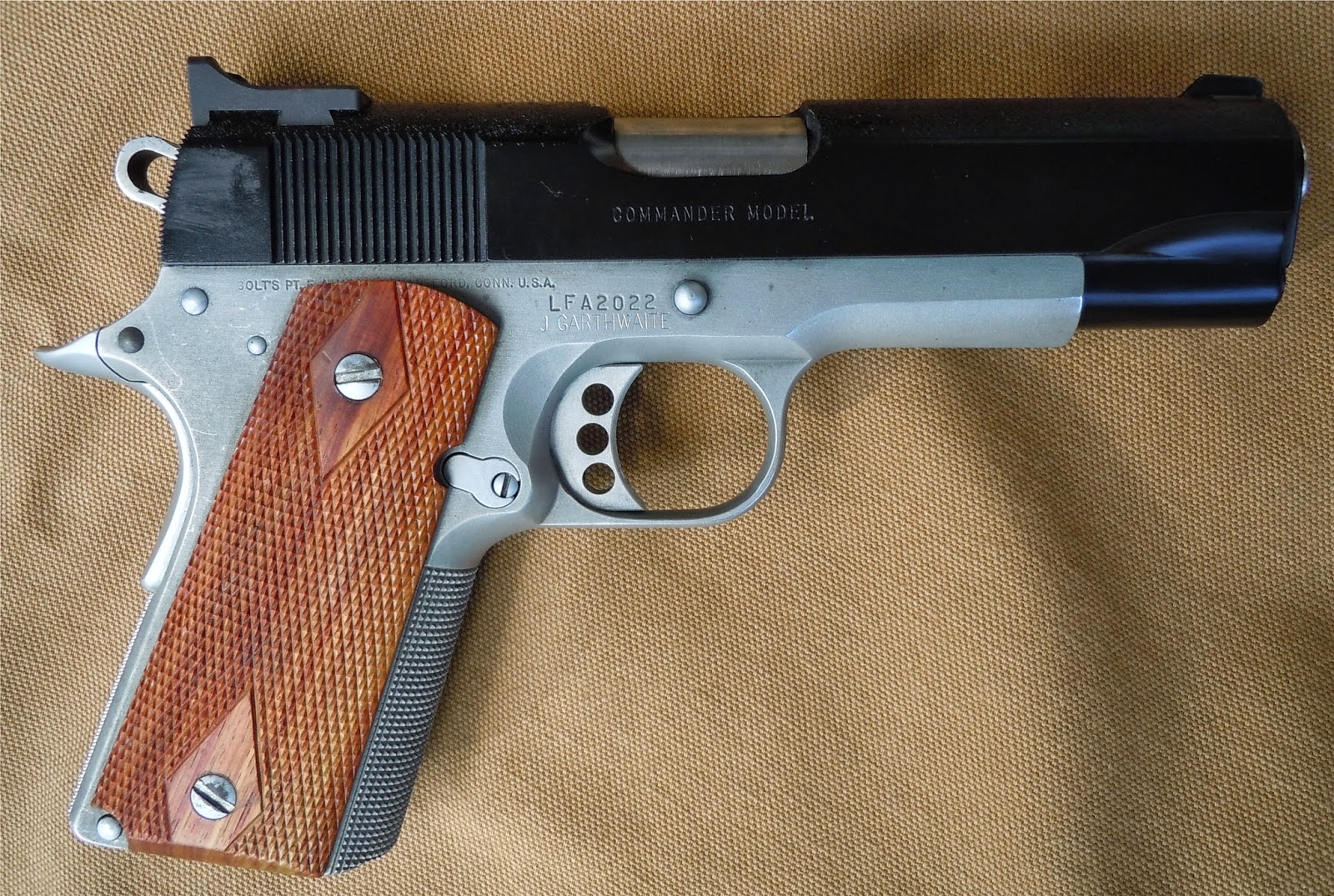
One of those smiths is Jim Garthwaite. I have read articles about him and/or his guns, indeed I've read all the articles shown on his website. He was the Pistolsmith of the Year in 2004. Mr. Garthwaite does work on 1911 and Browning High Power pistols. He also has been doing classes in which the participants build their own guns.
My friend, Rob Leahy of Simply Rugged Holsters, told me about a Garthwaite CCO at Bucky O'Neill's Guns in Prescott, AZ. Although rob said he'd get photos the work load at his shop was too great but he assured me that I'd like the gun. Knowing Rob, I took the leap of faith and called Dave at Bucky's to order the gun sight unseen. I am all into the gun for less than the price of the Gunsite CCO, which is simply a production gun. Further, the few of his guns I have seen for sale have been asking $2500 or more.
Well, it took a bit longer than expected. While they received my money, and FFL, in a timely manner, shipment was somehow delayed a bit and I didn't receive the gun until this week. Today was the first day I had time to shoot and photograph it.
As you can tell from the photo this gun is literally a Colt Commander slide (1991A1) on a Colt Officers' Lightweight frame. The front sight is dovetailed and a Heinie rear sight has been installed. The top of the slide was stippled and the rear of the slide was checkered. Also checkered was the steel (stainless I presume) main spring housing and the front strap. I'm personally pleased that the front of the trigger guard was not checkered. The trigger is like that on my Officers' Lightweight ACP but the feel is different. The gun has a National Match bushing. I haven't had it apart yet so I haven't looked at who made what component.

You'll note the vertical stringing and "lost" rounds outside the "group". That trigger is pretty light and crisp which I'm obviously not accustomed to! Then the stringing I think is due to the slight difficulty I had in shooting the gun quickly. Recoil seems to be snappier in this than in the Officers' Lightweight, I think because the gun is just about as light but the bullets are getting more velocity out of the longer barrel. That's just my perception. Recoil is not at all physically bothersome in that it is not at all painful. In comparison I think that a S&W M13 shooting full on 125 gr. .357 Magnum loads with the factory stocks can be painful.
The ammunition used was a mix of ball (Winchester white box) and Federal Hydrashocks. Nary a slip twixt mag and chamber or chamber and ground with any of it or any magazine (Wilson, Chip McCormick and Colt factory). I'll check 230 gr. Golden Sabers next.
Links:
- Massad Ayoob: The Colt Concealed Carry Officers and its niche-mates
- How About the CCOs by Wiley Clapp
Thursday, December 22, 2011
Colt Officers' Lightweight...
 |
| The new to me gun... |
For a long time I was dead set against these guns because previous experience led me to believe that the short barrel just didn't work with the old Browning mechanism. Lately, however, a couple of friends have demonstrated that their guns are dependable. So, I wanted one but I wanted to go all the way on the concealment theme and get a lightweight. This has proved to be a problem.
I'd been following them on Gunbroker.com and when I finally ran across one with the box for a reasonable to me starting bid I jumped in. Anticipating its momentary arrival, I've ordered some coco-bolo stocks and spare magazines. The wood is pretty indeed and I think it does much more for the gun than the rubber. As you can see, I got more than the basic Lightweight Officers' ACP and this one is the enhanced model with the cut-out behind the trigger guard so that you can grip it just a bit higher.
 |
| With new stocks and lanyard loop |
I've got a Milt Sparks Summer Special (which I've now been told won't be here before 1 July) and a Simply Rugged Cuda holster ordered for this gun.
Monday, May 16, 2011
Ruger Speed-Six Stainless 2-3/4"
 |
| Ruger Stainless 2-3/4" Speed-Six |
 |
| Speed-Six, Tyler-T and Speed Loader, all ready! |
Now what holster should I carry the old girl in? Why a Bianchi Pistol Pocket made for the S&W 13, 65, 19 and 66 of course. Works a treat.
Friday, May 06, 2011
Smith and Wesson Model 624
 |
| S&W M624 |
This makes my 5th .44 Special revolver but it is the only double action gun in which I would feel comfortable using the Skeeter load. I think the smaller L-frame 696 should be preserved with a slightly lighter load and it is certainly more pleasant to shoot that way.
I didn't get the box or papers with this gun but it should still hold its value well. I don't yet know whether or not I like the finger groove grips but they are original.
All of the Lew Horton guns had the serial prefix of "AHW" and this gun is an "ALV" which, interestingly enough, isn't listed for date in the 3d edition of the standard catalog. However one can easily see that this gun has no lock or MIM parts and uses the hammer mounted firing pin.
 |
| S&W 624 in Galco Holster |
I did get to shoot it some a couple of days ago and it did pretty well with the Winchester Silvertip load (which was very mild in recoil) and the "Skeeter Skelton" load of 7.5 gr. Unique under the 250 gr. Keith bullet. That last was clearly not a pussy cat but the recoil is very manageable and will be even more so with practice.
 |
| M624 with new shoes, Skeeter load and Silvertips |
A bit of an addendum... The following information was provided by a very thoughtful reader:
According to Skelton's ST article (10/85), here are the recall SN ranges for the Model 624 recall:
ADXXXX
AEXXXX
AFXXXX
AGXXXX
AHXXXX
ALVXXX (the “V” is not a typo)
N910000 thru N953000
Wednesday, November 24, 2010
DeeBee's 34-1 - A Parkerized Wonder
 What a neat gun. It apparently has none of the problems my nickeled 34-1 has. The parkerization appeals to me even though I think I'll still want to get a blued and a stainless (Model 63) gun. It seems business like.
The first shooting with the gun was at about 20 feet with Aguila Colibris. You could have covered that group with a dime. Unfortunately it was a good 3 inches to the right. Further shooting in better light showed that the gun was shooting to the sights. Better light was the key here.
 I like the way this gun shoots and handles. The square grip does make a difference. You wouldn't think so but the square grip makes it feel like an entirely different firearm compared to the round butt.
 One other good thing about getting this gun was that it pointed up a problem with my other 34-1. It has a problem with the cylinder binding on the barrel face. This older and re-finished gun has no such problem.
Tuesday, October 19, 2010
The Smith and Wesson Model 15-2
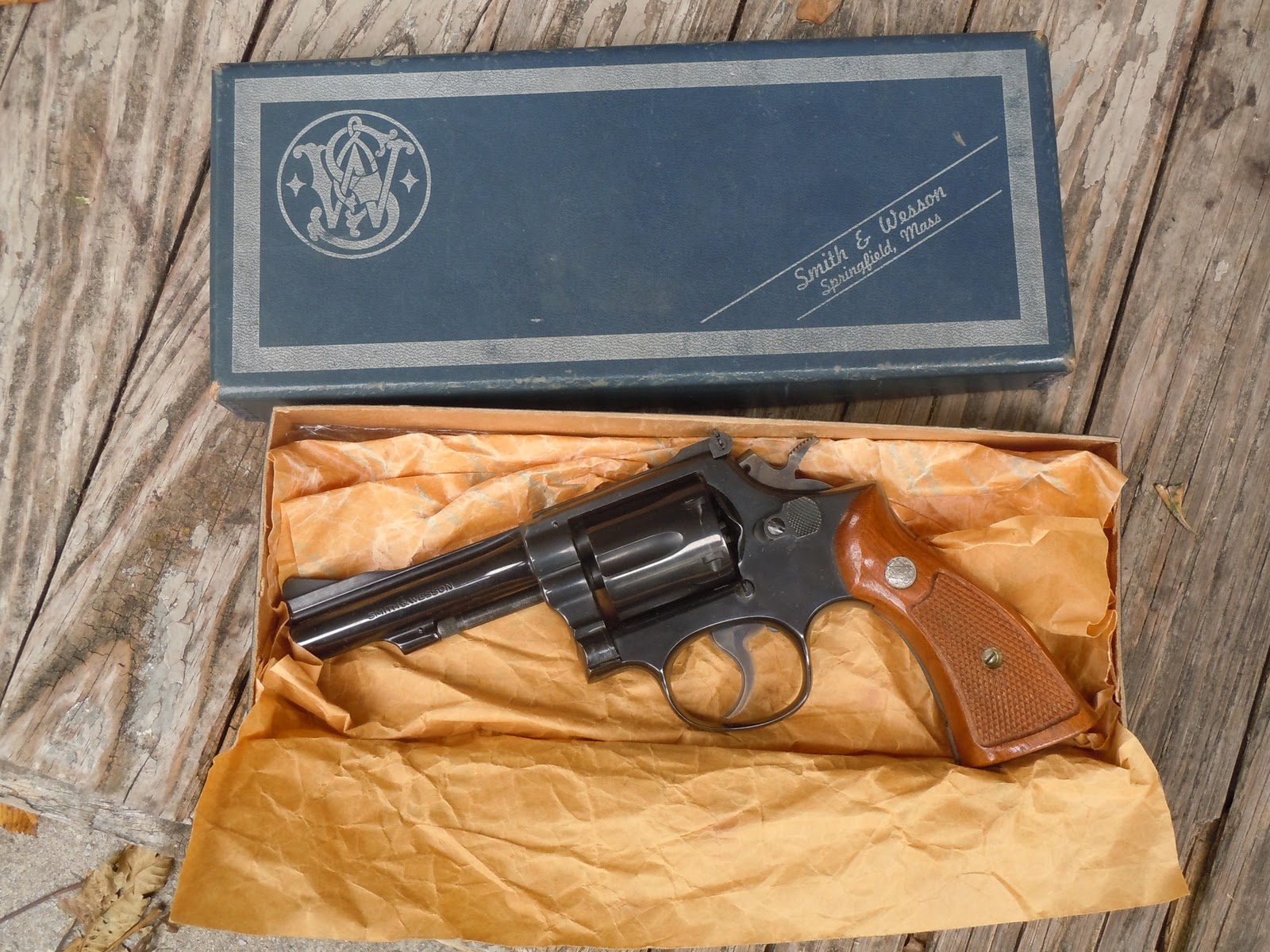
These aren't exactly the most sought after of firearms. They don't have the aura of the Colt Python. They aren't chambered for some whiz-bang cartridge. They are good solid working guns most people can handle and which fill most needs. Chambered for the now mundane .38 Special cartridge, these guns can't generate the excitement that comes with superior ballistic output. This one is special because it is NEW IN BOX. Apparently never fired, in the box with the tools. Yes, I'm thinking about shooting it.
What's the value? That's a question one must answer for many reasons including insurance. I think that such a gun could fetch $500 or more in the right market. I imagine that shooting it will lower the resale value. However, what is the value to me if it just sits in the safe?
Friday, September 10, 2010
Colt Police Positive Target - .22 LR
 This past weekend (the 29th) I managed to slip away to the gun show before heading out to Ella Ann's 2nd birthday party. Of course, the show, for me, wasn't so much my interests except for a couple of tables. I met a couple of friends and acquaintances there and stopped at Randy Clark's tables because he always has something that catches my eye. I think he has a particularly good eye for the neat old handguns. This time didn't disappoint.
The revolver isn't perfect. There's a bit of freckling on it but the finish, considering it has survived since 1938, is darn nice. The metal work has no scratches or dings. The stocks have no faults. It locks up tight without any discernible endshake. It is in such good condition that one has to wonder why the box didn't survive with it. I asked Randy and he said that he'd gotten from a regular customer who constantly trades guns in and out and finds stuff that he shoots for a while and trades. One of those always trying something new. He didn't know where the gun had been before that. The Colt Police Positive Targets were first cataloged in 1911. This gun was produced in 1938 and is the later, heavier frame weighing 26 ounces and has the standard 6" barrel.

When I took the gun out for a quick shooting session with Winchester Dynapoints that had been modified in my Hanned Line SGB tool it didn't fail at 20 yards proving to be "duelist" capable of half a minute of soda can and at 85+ yards it managed to consistently wack my 12" cinder-block face. Firing Aguila Super-Colibri ammo produced surprising energy on a metal swinging disk target. That ammo would be great fun in the back yard, where legal.
My initial impression of the gun is that it is superior to the Smith & Wesson Model 34 although it is about the same size, being just slightly larger. One of the reasons is that fouling doesn't need to be cleaned out so often in order to permit functioning yet it seems to fully as accurate. Because the grips are the size of the Police Positive service guns, there is more to hold on to (although the compactness of the S&W 34s is one of their main selling points). I really need to take this gun squirrel hunting.
Wednesday, July 28, 2010
Pistolet Makarova by Bulgaria - UPDATED
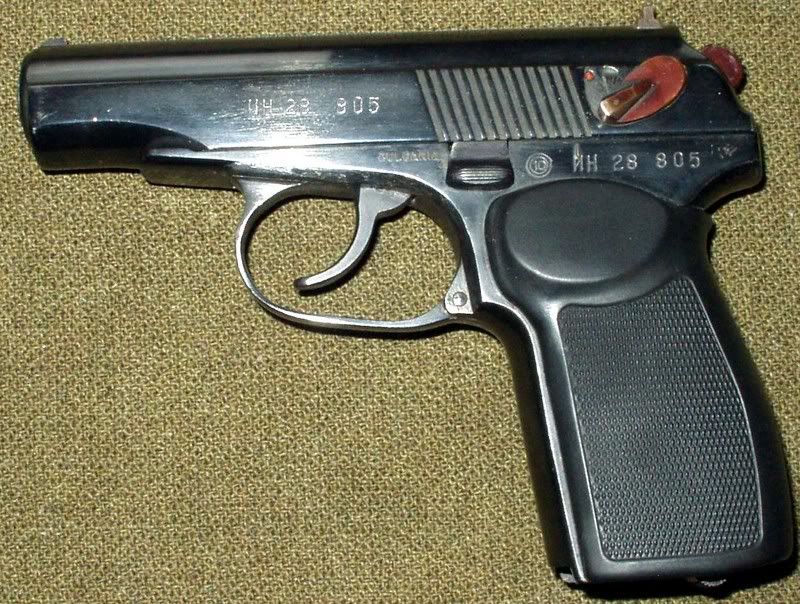 I was once asked about the Bulgarian Makarov. I like the pistol and said so. I thought I'd post a few of my observations about my pistol here.
First, it is accurate, reliable and relatively inexpensive. Mine cost $159 but I think you'll pay at least $250 today. The best ammo, cheaper than reloading, came from Dan's Sporting Goods at $60 per 500, shipped. You couldn't beat that and I tried. I've got dies, 250 Starline cases (excellent brass) and Hornady XTP. Still, reloading was more expensive than the Barnaul 95 gr. hollow-points from Dan's and you have to hunt down those valuable brass cases. The Barnaul is steel cased and Berdan primed, hardly a practical reloading proposition. Now, with the change in the Euro/Dollar exchange rate and diversion of the ammo to various hot spots, you might re-look reloading.
With carbide dies, reloading is really a snap. I'm sure you could set up a progressive press to load vast quantities of this cartridge. I used the Hornady XTP bullets over 4.1 gr. of Unique using a CCI small pistol primer for 927 fps 181 fpe. In contrast the Barnaul 95 gr. load produces 1025 fps and 222 fpe. Federal ball produced 965 fps and 195 fpe. Silver Bear ammo using the 120 gr. bullet produced 932 fps 232 fpe. Obviously one can do better ballistically than with my handloads, but they are accurate.
For accessories like my Fobus paddle holster we used to have Makarov.com, another well run business. The fellow who ran this knows his products and provided fast service together with good product. Unfortunately, they are no longer in business.
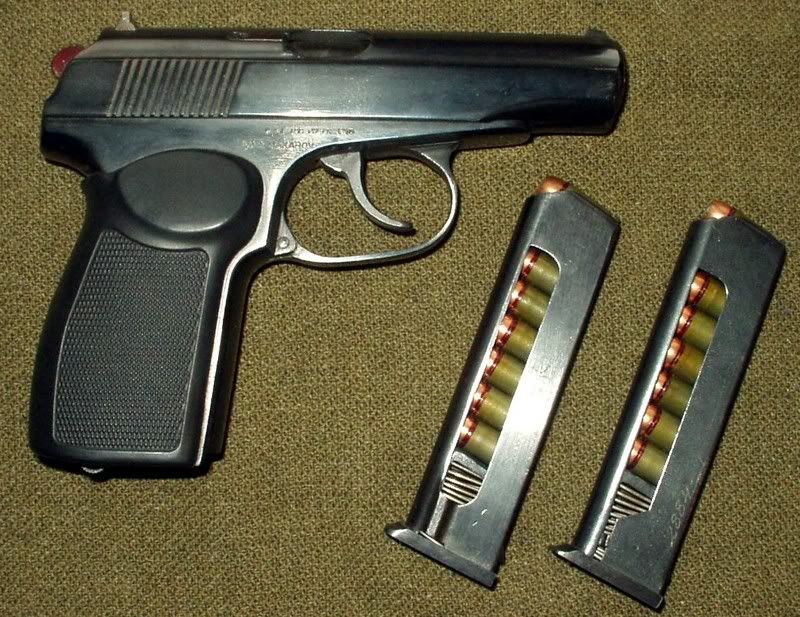 The pistol has possibilities I didn't consider when I first saw it while in the military. It is relatively light for a field pistol. It fits my hand well with the Pearce grips. The Fobus paddle holster is light and comfortable AND it secures and protects the pistol properly. It is accurate. I got groups, two-handed standing, of 2 inches at 25 yards and I have killed a groundhog at a measured 80 yards with a single shot in the chest (a little to the right of center). There was some luck involved (no doubt!) but it wasn't all luck. I believe the cartridge is at least as effective as the .38 Special and that is enough gun for most people, particularly in the east. It isn't particularly loud. It doesn't kick too much which is good for new shooters and those who are recoil sensitive. It is safe, having a double action and de-cocking safety that seems very sturdy. I think that this makes it a good bedside gun, at least during the summer when an intruder is less likely to be wearing a bulky winter coat. Fixed sights mean they probably won't go out of adjustment.
The down side is that, while the grip fits me and my average size hand, it could easily be too big for those with smaller hands. The Pearce grips are actually a bit bulkier than issue but they are also much more comfortable.
The sights that it comes with are very basic. Non-adjustable except by drifting in the dovetail, the rear sight has sharp edges that might not be compatible with some clothing. I ever so slightly "broke" the corners and edges on my pistol's sights. The rear blade has a nice square notch but these are black on black sights. Some people prefer the dots, etc. The good news is that after market adjustable and night sights are available but they can cost nearly as much as the pistol. My eyesight isn't such that I really benefit from such sights.

Bulgarian Makarovs were made at the state military factory in Kazanlak, aka factory number 10. That is why the Bulgarian pistols are marked with a 10 inside a double circle on the left of the frame. Production began in 1970, continued under direct Russian oversight in 1975 and in 2000 the date codes were eliminated and replaced with numerical dates immediately following the serial number.
Man At Arms Magazine reported the following information about the serial numbers that owners will find interesting:
Bulgarian Makarovs have unusual serial numbers composed of three groups of characters: two capital letters, two numbers, and then an additional sequence of numbers. The two numbers in the center indicate the year of manufacture, but in a slightly confusing way. You add those two numbers to the year 1960 to ascertain the year of manufacture. For instance, a center number "31" would indicate a manufacture year of 1991 because 31+60=91. By the way, the final group of numbers is the actual serial number, while the two letters are a code indicating the production batch that the serial number belongs to.

Parts List
1) Slide
2) Ejector
3) Main spring
4) Trigger
5) Trigger transfer bar
6) Magazine
7) Hammer spring
8) Sear
9) Disconnector
10) Hammer
Field Stripping - After removing the magazine and emptying the chamber, pull the trigger guard down in the front and move it to the right (as seen with the bore pointed away from you). Pull the slide all the way back and lift the rear of the slide. The slide will now come forward and off. Now remove the return spring off of the barrel. Reassemble in reverse order.
original post 3/7/07
This is a video showing the gun as used by a Chinese policewoman. It is "graphic" although less so than a Sam Peckinpah movie. However, to view you might need to sign in to YouTube and verify your age...
Wednesday, July 21, 2010
Smith and Wesson Model 1905, 4th Change

This one is particularly "finish challenged". The original blue is missing from most surfaces and it has been replaced with a hopeful mix of bare steel and oil/steelwool removed patches of former rust. What little original blue remains is only a tease to tempt you to think what might have been nearly 100 years ago. The grips, mostly intact but for one split toe, are worn mostly smooth from use. The barrel is loose/can be turned by hand but held mostly in the correct position by the pin. To look at it it is a real dog of a revolver.

Last night's rather speedy foray at Mom's shooting facility (her pasture) gave me 3 hits in a row on a 6" square cinderblock face at about 75 yards, manually cocked off-hand. It had me fooled at first, I shot over the target! This thing shoots flat.
The ammunition used was a bonus. Several months ago, I bought several hundred rounds of .32 WCF from Jim ______ when he was moving from Missouri to Mozambique. Among those were a quantity of handloads using pistol primers. I intended to use the ammo in my 1894CL but discovered that the Marlin's firing pin was a hair short to ignite the pistol primers used in these loads. I have no such problem with this gun, and likely all that ammo will be shot up in this revolver.
Recoil is extremely mild as is the report. I bet this is one reason why the .32 WCF was so popular in both pistols and rifles "back in the day". Certainly it was worth what I have in it. I'm well pleased with this "ugly duckling".
Of course, Tam's is much nicer!
07/25/2010
Jim's load was 3.0 gr. Bullseye under the Lyman 3118 bullet. It is a mild load that still has oomph enough to deform the cast bullets when fired into a soft dirt bank at 60 yards or so. It is also accurate enough to take on Mr. Groundhog should he come out to play. I was plinking with it some at Mom's today. Not too hard to hit stuff the rather fine sights notwithstanding. The light does have to be right though. Recoil is inconsequential with this load. I've got lots more to shoot!
I then found out that Xavier had a 1905 4th change .32 WCF with some interesting marks. As you can see my gun does NOT have the "Made in U.S.A." mark and I suppose it should not be expected to. It certainly isn't worth $400 either!
Friday, July 16, 2010
Savage 99A .250 Savage (.250-3000)

Many people prefer the pre-tang safety guns and compare those to the pre-64 Winchesters. They think the later 99s just aren't up to snuff. Are the post 1972 guns as good? Well, no. Are they better than guns you can buy today? I think so. I like them. I like the tang safety. I like the straight grip. I like the location of the receiver sight (after-market from Williams in my case). About the only difference from my other gun is the chambering. .250 Savage aka .250-3000. The cartridge has a storied history and has become a favorite of many since its inception.

Designed by Charles Newton, the 250 Savage was introduced in 1915 by the Savage Arms Company for the Model 99 lever action rifle. The original load used an 87 grain bullet loaded to 3000 fps muzzle velocity, and Savage named it the 250-3000. The 87 grain bullet was chosen because it could be safely driven at 3000 fps with the available powders. About 1932, the 100 grain bullet load was marketed by Peters Cartridge Company and later the velocity of the 87 grain bullet was slightly increased. Now simply called the 250 Savage.
When I was about 17-years old, I thought that this cartridge would be the one to get. Only lack of availability and money prevented purchase then. I think it is a better cartridge than the .243 Winchester although rifling twist rates (1:12 in early guns, 1:10 later) in most Savage rifles prevent use of heavier bullets than with the .243 Winchester. I wanted to mount a Williams FP-99S receiver sight and have one on order for this gun. That will make it look like the .308 gun and so care must be taken to have the correct ammunition when shooting or hunting.

Interestingly, even though these are the same model and manufacturing period, the barrels are different lengths being 20" for the .250 and 22" for the .308, the forearms are different in length by 1/8" and the .308 has a 1/4" longer length of pull. Overall the .308 Winchester gun, a later gun, is bigger. I tried to align the two guns so that you could see this.
| 87 GR. Speer SP | Hodgdon | Varget | .257" | 2.450" | 35.0 | 2947 | 40,200 CUP | 37.0 | 3074 | 43,200 CUP | |
| 90 GR. Sierra HPBT | Hodgdon | H4895 | .257" | 2.425" | 33.0 | 2901 | 39,000 CUP | 35.5 | 3060 | 43,900 CUP | |
| 100 GR. Hornady SP | Winchester | 748 | .257" | 2.500" | 35.5 | 2820 | 43,500 CUP |
This morning I picked up the rifle and immediately mounted a Williams FP-99S. I "zeroed" it by aligning the new rear sight with the issue folding open sight. I then folded the sight down. This evening I went to Mom's and fired two shots off-hand both of which struck a 6" square at 90 yards distance. I will refine the zero but I think this rifle will serve me well!
To get an personally autographed copy of Murray’s book, send a check or money order for $30 (U.S.) together with a note asking him to send you a copy of his book, “The Ninety-Nine”, to:
Doug Murray
20 Polo Lane
Westbury, N.Y. 11590
Delivery, via U.S. Postal Service, will take about 3 weeks.
Thursday, May 27, 2010
Smith and Wesson K-Frame Model 66-7
 |
| The Model 66-7 2½-inch |
Smith and Wesson apparently worked these over well as they are tight as a tick, timed right and every one of them has the 2 piece barrels. I thought the counter-bore might have been done to repair muzzle crown damage from cleaning but this is the manufacture method used on the 66-7. They have the lock (which you could see in my original photo) but did not come with the key nor did any literature accompany them.
When I got it it had the original Hogue grips. They are entirely too long but apparently that police agency used the same grips on all their revolvers. Every one of them I've seen has the grips, 2½ or 4-inch it doesn't matter. Anyway, I replaced those with a pair of wood stocks that were previously received in trade. They fit well enough, are more compact, and don't stick to my clothing or make me nauseous.
I had the gun up to Mom's and shot 3 cylinders full of my .38 Special load of the 158 gr. Speer swaged HP over 5 gr. Unique. Worked a treat. These tensioned 2-piece barrels apparently have quite a good reputation for accuracy.
The two piece barrel was developed by Herb Belin, S&W Handgun Product Manager for the X-Frame 500 to add strength for the big new cartridge it fires. A conventional S&W barrel is supported only at the barrel/frame interface with a crush fit while the two piece is supported at both ends. Since the interface at the forcing cone is not stressed it is also stronger there. The better accuracy is an additional benefit.
 |
| Muzzle View - 2-piece Barrel |

Saturday, January 09, 2010
Freedom Arms Model 97 .44 Special
 Well, I've been putting together a sort of collection of different single-action guns but it has gone askew and I need to re-think it. However, one "goal" of the collection was to have an example of the Ruger, USFA, Colt and Freedom Arms in .45 Colt. I might be switching that chambering to .44 Special. You see, a Freedom Arms Model 97 in .44 Special came my way. Sort of. It got my attention and then hung around for months until I managed to cobble together the readies (one way or another) all the while thinking it wouldn't be there. It was. It has found its way to my greasy mitts. (the photo shown was taken by the former owner)
First thing about it that struck me was when I lifted the package. Very light. I expected more heft. Must have been thinking of the 83. It seems quite a bit smaller and lighter than the Lipsey's Flattop and more like the Smith and Wesson Model 696.
A bonus was that it came with two other front sights (they are interchangeable on this gun). The fit and finish on this gun surpasses anything else I own except for fit on my old Parker shotgun.
The company could produce/use a better box than the cardboard used. If stored in the safe, the gun will have to go into an MTM Case-Gard long-term plastic storage box. I don't know that it will spend much time in the safe once I get a holster for it.
The grip form on this gun is a bit unique. It has a different form than the Colt or USFA and is wider than the USFA or Ruger plastic stocks. It is as broad as the USFA Henry Nettleton but feels good in the hand. I think it will handle recoil well.
As to loads, my intent is to use the same load of 7.5 gr. Unique under the 250 gr. Keith bullet. This gun will allow a bit more oomph but, in deference to the other .44 Specials, I'm going to stick with the one load. This load as well as the Buffalo Bore product is pretty snappy in the little gun. Those that really want to ramp up the performance would likely need to practice. For myself, I see no need for more than the Buffalo Bore or similar handloads provide. If I need more I'll get out one of my .44 Magnums.
Links:
- Gun Digest Book of the .44 by John Taffin
- Freedom arms Model 97 .44 special by John Taffin
- Freedom Arms Collector Association
- Bitterroot Trading Post in Hamilton Montana, 406-363-2525, Bill Neustrom
Friday, November 06, 2009
USFA Color Case and Dome Blue Single Action

I was really excited to get this gun. However, coincidentally I'd worked a deal to get two others, the Henry Nettleton and an earlier 7½" barreled version. Suddenly I had a whole collection. I haven't carried any of them very much, there's been too many other things going on but I can look forward to a time when it will be possible to fully enjoy this accurate, quality revolver.
Monday, November 02, 2009
Smith and Wesson Bodyguard Airweight (pre-38)
 The Bodyguard Airweight (aka pre-Model 38) was introduced in 1955. That's when I was "introduced". It has the built-up frame to shroud the hammer. This was intended to minimize hammer spur snags on clothing when drawn while allowing manual cocking if desired. I don't suppose that, given the intended use, it is surprising that the airweight/alloy frame version was introduced before the all steel version. The 5-shot cylinder is steel. Most barrels are 2-inches.
  My gun came to me from a local collector who was moving it on and was accompanied by its original box. It doesn't have the tools.
Saturday, October 31, 2009
Smith and Wesson 49

Mine is the blued steel version (they were also factory nickeled) and has the usual 2-inch barrel (3-inch barreled guns are rare).
Friday, October 30, 2009
Colt Combat Commander
The Combat Commander is an all steel version of the Commander, a 4-1/4 inch barreled version of the Government model on an aluminum frame. Whatever I've said about Colt's .45 ACP semi-auto pistols applies here including that this particular gun has the Colt Series 80 modifications. As has become my usual course of action, the main spring housing was replaced with a flat version. I simply prefer the feel of the flat MSH.
I bought this .45 ACP chambered gun about 1985 or 1986, I'm not exactly certain now. I got it from LBW Shooter's Supply in Staunton. I had an opportunity to buy a Lightweight Officer's Model but got a good deal on this one so bought it instead. I wish I'd gotten the other as well!
I used this gun for concealed carry for several years. While a lighter pistol might have been more comfortable I was in good condition and much thinner than now and it didn't bother me at all. It did take a while to find the best way to carry concealed but once I did nobody knew and I carried all the time.
For a long time the gun wore Pachmayr rubber stocks but there was really no reason for this. The factory wood was entirely satisfactory and I shoot equally well with either. The wood does have the advantage of not "grabbing" at clothing the way the rubber does.
It is sufficiently accurate with any number of combat capable loads and feeds most with the necessary reliability. However, I always felt most comfortable with the standard ball or Remington's 230 gr. +P Golden Saber. That is what has become standard for my carry use in .45 ACP guns.
I bought this .45 ACP chambered gun about 1985 or 1986, I'm not exactly certain now. I got it from LBW Shooter's Supply in Staunton. I had an opportunity to buy a Lightweight Officer's Model but got a good deal on this one so bought it instead. I wish I'd gotten the other as well!
I used this gun for concealed carry for several years. While a lighter pistol might have been more comfortable I was in good condition and much thinner than now and it didn't bother me at all. It did take a while to find the best way to carry concealed but once I did nobody knew and I carried all the time.
For a long time the gun wore Pachmayr rubber stocks but there was really no reason for this. The factory wood was entirely satisfactory and I shoot equally well with either. The wood does have the advantage of not "grabbing" at clothing the way the rubber does.
It is sufficiently accurate with any number of combat capable loads and feeds most with the necessary reliability. However, I always felt most comfortable with the standard ball or Remington's 230 gr. +P Golden Saber. That is what has become standard for my carry use in .45 ACP guns.
Subscribe to:
Posts (Atom)