| 12 Gauge | 20 Gauge | 28 Gauge | .410" Bore | American | English | Browning | Italian | Perazzi | Percentage | |||||||||
| Constriction | Constriction | Constriction | Constriction | Designation | Designation | Codes | Codes | Codes | Pattern | |||||||||
| .000" -.001" | .000" - .001" | .000" | .000" | cyl | true cylinder | *** | C**** | 0 | 40% | |||||||||
| .002" - .006" | .002" - .004" | .001" - .004" | .001" - .002" | skeet | impr cylinder | **$ | S | 1 | 45% | |||||||||
| .007" -.013" | .005" - .011" | .005" - .007" | .003" - .006" | imp cyl | quarter | **- | **** | 3 | 55% | |||||||||
| .014" -.023" | .012" - .019" | .008" - .014" | .007 - .012" | mod | half | ** | *** | 4 | 60% | |||||||||
| .024" -.031" | .020" - .026" | .015" - .020" | .013" - .017 " | imp mod | three quarter | *- | ** | 6 | 65% | |||||||||
| .032" -.040" | .027" - .033" | .021" - .027" | .018" - .021" | full | full | * | * | 9 | 70% | |||||||||
| .040"+ | .034"+ | .028"+ | .022"+ | ex. full | 10 | 75% |
Showing posts with label Shotguns. Show all posts
Showing posts with label Shotguns. Show all posts
Friday, April 18, 2014
Chokes
It is spring gobbler season. Consequently, we've had a lot of people looking for turkey chokes and have been sorting through the odd assortment of used and mis-packaged chokes every shop seems to have. I've found this chart useful.

Wednesday, April 17, 2013
Need your Parker Bros shotgun refurbished?
I think that my Parker might be about ready for a visit to these folks...
Links:
- Larry DelGrego & Son
A fourth-generation gunsmith, still going strong By Aaron Smith @CNNMoney April 15, 2013: 3:52 AM ET
A single brand of antique shotgun, the Parker, has provided enough work for a family of gunsmiths for four generations, even though it was discontinued more than 70 years ago.
"It's an honor to work on these guns," said Larry DelGrego III, whose great-grandfather, Herman Shura, emigrated from Germany in the early 1900s to begin the family tradition of working on Parker shotguns. "I'm very fortunate that this is something I was born into."
The Parker is a specific brand of break-action shotgun that has a fervent following among hunters and collectors. The cheapest model, the "Trojan," goes for $2,000, while the rarest make is the "Invincible." Only three of them were ever made, and together are valued at $5 million. One Invincible was refurbished by DelGrego III's father, "Babe" DelGrego Jr., who worked on the guns until 1993.
A Parker that's worth $110,000 will cost about $6,000 to refurbish at DelGrego's shop. But he'll charge $2,500 to spruce up a more run-of-the-mill model.
Charles Parker of Meriden, Conn., developed the gun in 1865, as the muzzle-loaders of the Civil War gave way to more advanced breech-loading technology. Shura was hired by him first, and Shura's son, Lawrence DelGrego Sr., started working for the Parker company in 1933. He moved when Remington bought the company five years later to Ilion, N.Y., where Remington still has a gun factory.
Remington stopped making Parkers in 1942, when supplying arms to the military to fight World War II took precedence over shotguns used for hunting. But the DelGregos kept fixing, maintaining and refinishing the guns.
The work they do includes rebuilding a gun's stocks, hardening the frame, blueing the trigger and rebrowning, reboring and repolishing the barrels. DelGrego III said it takes about 50 hours to refinish a gun, and he typically works on eight at a time.
"When the gun leaves here, it's exactly the way it was when it left the Parker factory," said DelGrego, as he worked to removed "100 years of hunting and shooting dirt" from an antique firearm.
DelGrego said his business brings in about $120,000 per year. After expenses he takes home from $30,000 to $50,000 per year, a decent living in this part of upstate New York.
More than 242,000 Parkers were produced during the shotgun's 77-year history. DelGrego says his family has refurbished more than 60,000 of them so far.
DelGrego III's shop is still about a mile from the Remington Arms plant, which was established in Ilion in 1816. He estimates there are at least 40,000 Parkers still in existence that his family has yet to refurbish. Some of that work might fall to the next generation.
His college-aged sons and teenaged daughter have accompanied him in the shop, just as he used to accompany his father.
"They're going to college first," he said, but he doesn't know if there will be a fifth generation gunsmith after he's gone.
"I won't retire," DelGrego said. "I'll work until I'm dead, and they'll worry about it then, I guess."
Links:
- Larry DelGrego & Son
Friday, December 14, 2012
Darne M1892 Rotating Breech Shotgun...
Had a Mr. Charles D____ bring this in for identification. I will attempt to post here all I know about it. It is a Darne manufactured side by side shotgun, apparently chambered for the 12 ga. 2½" shell but I was unable to verify this as I had no tools, not even a proper screwdriver with which to remove the forearm. It was definitely made before WWII as it was found in the forest by a US GI (Mr. D's father) during the Battle of the Bulge. I think we can safely say that this is a pretty unique acquisitional circumstance!
I got to shoulder the gun and it fits me to a "T". I'd love to quail hunt with such a gun. It is light, well made, comes to the shoulder easily and my eye is correctly aligned right down the rib. With light 12 or 16 ga loads it would be a delight on upland game.
Regis Darne is the designer and obviously he had a unique approach to solving engineering problems. This was his first approach to the problem and in 1881 he produced a hammer gun in which everthing rotated to the right to open the breach. Of his rotary breach guns, the 1881 has hammers, the 1892 does not and the 1908 has the lever on top in a more (now) conventional position. This last gun was produced in very limited numbers, some say as few as 1000 guns were made. Darne probably saw that his own sliding breach shotgun, for which he is much better known here, was a better system and less expensive to produce.
I don't think that there are very many in the U.S. as this is the first I've seen. Further, I can't remember reading much about them. Regis Darne's later sliding breach shotgun is much more well known.
The owner wanted a value on this gun. I believe it has the shorter chambers and may not be nitro proofed. But, again, I was unable to check because I didn't have a proper screwdriver or measuring tool. I estimated that it was worth between $2500 and $3000. I have now seen values nearing $4500 for this gun. I suspect that other gauges might be more desirable and perhaps more or less common. That has to affect value.
 In sequence this is the method of operating the action...


Links:
- Darne by Jean Michel
I got to shoulder the gun and it fits me to a "T". I'd love to quail hunt with such a gun. It is light, well made, comes to the shoulder easily and my eye is correctly aligned right down the rib. With light 12 or 16 ga loads it would be a delight on upland game.
 |
| The action closed as seen from the right |
 |
| The Butt Plate |
 |
| The muzzles showing the "feather" rib and sight bead |
 |
| The action open as seen from the right side |
The owner wanted a value on this gun. I believe it has the shorter chambers and may not be nitro proofed. But, again, I was unable to check because I didn't have a proper screwdriver or measuring tool. I estimated that it was worth between $2500 and $3000. I have now seen values nearing $4500 for this gun. I suspect that other gauges might be more desirable and perhaps more or less common. That has to affect value.
 |
| The action open as seen from the rear |
 |
| The rib at the breach showing the matting and barrel marking |


Links:
- Darne by Jean Michel
Saturday, January 07, 2012
"Wells Fargo" shotguns...
I was recently asked by a friend if I could authenticate a "Wells Fargo" side-by-side hammer shotgun. His father bought the gun at the Reno Show in 1998 (price unknown) from Ed Kolivowski (if I read that last name correctly). It has a brass tag indicating that it was item #35854 from the Lyons Pony Express Museum.
Mr. W. Parker Lyons was from Fayetteville, New York, and migrated to California in the late 1800s settling in Fresno. He became Sheriff and was eventually elected mayor. He started the Lyon Van & Storage, became a millionaire and started collecting. Collector Parker Lyons began his collection of Western artifacts in 1910: Wells Fargo, saddles, leather, guns, country-store items and you name it. It grew into the well-attended Pony Express Museum until 1949, when Lyons died. It was sold to W.F. Harrah, who moved it to Reno in 1955, where it remained until it was auctioned in 1986. I have a book about the Harrah collection that might show the gun but there is another book out there, The Parker Lyon-Harrah's Pony Express Museum A Photographic Essay by Greg Martin. If this gun is indeed from that collection, at least the providence should be relatively easy to track.
The gun itself? It appears to be an English made gun sold in this country by and marked for the New England Arms Company. This is NOT the New England Firearms with which we are familiar as makers of the Handi-rifles, et-al. The trade name is believed to have been used by Charles J. Godfrey of New York City on shotguns made for the Rohde, Spencer Company of Chicago. Godfrey is listed as a Manufacturer, Agent, and Importer active around the turn of the 20 century (early 1900s). Godfrey was also responsible for importing a large number of English shotguns. That part fits in well with the official response on these shotguns from Wells Fargo but as you'll see, some other information would seem to mark the gun as "enhanced".
I am pretty well convinced the gun is fake as the type would have been a local purchase, not a contract purchase, and it would not have had the stock carving and likely not a property "badge".
So now to describe the actual characteristics of the gun. 35" overall, the length of pull is 13-1/8" and the barrels are 19-1/2" long. The barrels are 12 gauge, damascus, with a matte rib marked "New England Arms". On the left side of the pistol gripped stock is a steel shield marked "W. F. Co's Guard 5 Express". On the left of the stock it is carved "Wells, Fargo & Co., S.F.CAL., EXPRESS". This "carving" almost appears to be laser engraved but is very shallow. The letters also appear to have been stained darker than the other wood. The stock does appear to have been refinished/cleaned on this side at some time. The action is a side-lock hammer gun with Greener cross-bolt. It is slightly off-face, i.e. loose. I don't think it was cleaned the last time it was shot but one can't determine when that might have been. If it was part of the Lyons collection it was auctioned by Harrah's in 1976 and has been wandering about the country since then. This gun also has the BELGIAN definitive blackpowder proof and is also marked "not for ball".
Of course I took some photos and here they are.
Mr. W. Parker Lyons was from Fayetteville, New York, and migrated to California in the late 1800s settling in Fresno. He became Sheriff and was eventually elected mayor. He started the Lyon Van & Storage, became a millionaire and started collecting. Collector Parker Lyons began his collection of Western artifacts in 1910: Wells Fargo, saddles, leather, guns, country-store items and you name it. It grew into the well-attended Pony Express Museum until 1949, when Lyons died. It was sold to W.F. Harrah, who moved it to Reno in 1955, where it remained until it was auctioned in 1986. I have a book about the Harrah collection that might show the gun but there is another book out there, The Parker Lyon-Harrah's Pony Express Museum A Photographic Essay by Greg Martin. If this gun is indeed from that collection, at least the providence should be relatively easy to track.
The gun itself? It appears to be an English made gun sold in this country by and marked for the New England Arms Company. This is NOT the New England Firearms with which we are familiar as makers of the Handi-rifles, et-al. The trade name is believed to have been used by Charles J. Godfrey of New York City on shotguns made for the Rohde, Spencer Company of Chicago. Godfrey is listed as a Manufacturer, Agent, and Importer active around the turn of the 20 century (early 1900s). Godfrey was also responsible for importing a large number of English shotguns. That part fits in well with the official response on these shotguns from Wells Fargo but as you'll see, some other information would seem to mark the gun as "enhanced".
"Wells Fargo" marked shotguns have become a problem among collectors of antique firearms. In general, each town's Well Fargo Agent bought weapons from local stores carrying whatever was available — it was not a central headquarters function. Just as with companies today, Wells Fargo's offices did not keep outdated records. Therefore, there are no comprehensive lists of Wells Fargo firearms.
Additionally, in recent years, many people have added "Wells Fargo" to actual antique weapons. All of this makes it very difficult to know whether any shotgun currently for sale was or was not used by Wells Fargo, regardless of the markings.
I am pretty well convinced the gun is fake as the type would have been a local purchase, not a contract purchase, and it would not have had the stock carving and likely not a property "badge".
So now to describe the actual characteristics of the gun. 35" overall, the length of pull is 13-1/8" and the barrels are 19-1/2" long. The barrels are 12 gauge, damascus, with a matte rib marked "New England Arms". On the left side of the pistol gripped stock is a steel shield marked "W. F. Co's Guard 5 Express". On the left of the stock it is carved "Wells, Fargo & Co., S.F.CAL., EXPRESS". This "carving" almost appears to be laser engraved but is very shallow. The letters also appear to have been stained darker than the other wood. The stock does appear to have been refinished/cleaned on this side at some time. The action is a side-lock hammer gun with Greener cross-bolt. It is slightly off-face, i.e. loose. I don't think it was cleaned the last time it was shot but one can't determine when that might have been. If it was part of the Lyons collection it was auctioned by Harrah's in 1976 and has been wandering about the country since then. This gun also has the BELGIAN definitive blackpowder proof and is also marked "not for ball".
Of course I took some photos and here they are.
 |
| Right side... |
 |
| Left side... |
 |
| Close up of the stock "badge"... |
 |
| Close up of stock stamp/carving/whatever... Note the ill-fitting buttplate... |
 |
| Left side close-up of receiver... |
 |
| Close-up of receiver right side... |
 |
| You can see it is clearly marked "BELGIUM" and has the proof mark as well as stamp for "WF&CO'S EX" on the barrel... |
 |
| Not so good photo of receiver with patent and serial number... |
Thursday, September 09, 2010
Browning Auto-5

I remember we had a man, last name of Shifflett, with whom we used to shoot skeet. He had a Belgian Browning Auto-5 and would shoot the targets from the hip with his gun. Amazing to me at the time, as after some 10,000 rounds I hadn't achieved that level of skill. However, those many Saturdays or Sundays of observing his shooting and getting a little trigger time on his gun (with my ammo) did instill some fondness for the gun. I don't think a properly set up gun is a particularly hard kicker but most of my shooting with one has been with skeet loads. Those aren't particularly punishing from any gun! Note: Brownells sells spring and friction ring kits for those old guns which is necessary to restore proper operation.
Recently, a customer at Nuckol's bought a plain barrel Auto-5 and didn't even take it home before having the barrel cut down. It was then that I discovered that not everyone sees this as a good thing. Oh, how loud were the cries about ruining a Belgian Browning! A real collectible done away with! Of course, so far as I know all the Japanese Brownings have vent ribs and aren't quite so suitable for this operation. I have to admit I'd looked at the same gun and contemplated the same action!
These guns are a long-recoil operated, 5-shot (3-shot with plug for migratory birds), and semi-automatic. The safety can be, with the skills of a gunsmith (the official word), reversed for left-handed shooters. The same gun was produced here in the US, after initiation of punitive tariffs on the Belgian guns, by Remington Arms as the Model 11 and later 11-48 (which differs from the Model 11 in the shape of its machined steel receiver and the use of cheaper stamped steel internal parts).
From Browning's site we have this information on the guns.
The production of the Auto-5 began in 1902. Produced by F.N., John M. Browning ordered 10,000 of these shotguns in his first order. In 1999 Browning issued the "Final Tribute" version featuring engraved scenes of John M. Browning, the F.N. Factory and the Browning Brothers first store. Only 1,000 of these were produced in a high-grade wood. Production of the famous "A-5" ceased after this final tribute.The gun isn't too complicated as can be seen in the accompanying schematic. It is yet another example of Jonathan Browning's inventive ability.
To find your serial number, you will need to refer to your owner's manual. We have most owner's manuals online. You can go to those by clicking here.
Date Historic Information Serial Number Info 1903-1939 First 10,000 shipped to U.S. Marked with "BROWNING AUTOMATIC ARMS CO. OGDEN UTAH-U.S.A." Very few serial number records remain. Beginning with Serial Number 1 to approximately 228,000. Exact production figures are not available. Year of manufacture on Pre-World War II production is strictly a guess. 1940-1946 From 1940 to 1946 production of the Auto-5 was turned over to Remington. Serial number is on the side of receiver. "ABC" for American made Version. (A=16 gauge, B-12 gauge, C=20 gauge) 1946+229,000-237,000 1947 237001-249000 1948 249001-270000 1949 270001-285000 1950 285001-315000 1951 315001-346000 1952 F.N. took over production of the Auto-5. 346001-387000 1953 387000-438000 1954-55 Serial Numbering System changed. H=Standard Weight. L=Light Weight. H1-H83000
L1-L830001956 Serial Number designation for the Light Weight changed to G. H83001-H99000
G1-G230001957 Serial Numbering System changed again. M=Standard Weight. G=Light Weight. M22000-M85000
G23001-850001958-67 From 1958 serial numbers were preceded by the date of manufacture. 8M=standard weight for 1958. 8G=light weight for 1958.
Example: 8M1000 = A 1958 Auto-5 standard weight shotgun with serial number 1000G85001-G99000
8G1-8G2000
M=standard weight
G=light weight1968-76 In 1969 Browning started using two digits for the date of manufacture which was followed by a four digit code that identified the type of Auto-5:
M=standard weight
G=light weight
This was then followed by the serial number beginning with 1000.
Example: 69G1000 = A 1969 Auto-5 Lightweight 12 ga.. shotgun with a serial number of 1000.M-standard weight
G=light weight1976-1997 In 1976 Browning standardized its serial number identification which it followed until 1998.
1. Auto-5 Type 151=Magnum 12 gauge
161=Magnum 20 gauge
211=Light 12 gauge
221=Sweet 16
231=Light 20 gauge2. Date of Manufacture
is a two digit codeZ=1
Y=2
X=3
W=4
V=5
T=6
R=7
P=8
N=9
M=03. Serial Number
beginning with 01001
at the start of each year.
Serial
Number Example: 01001RT151
This would be an Auto-5 Magnum 12 ga.,manufactured in 1976 with the serial number 01001.1999 The Auto-5 will be discontinued for 2000. To commemorate this historic event for the Auto-5, Browning released the "Final Tribute" version in 1999.
1. Serial Number
beginning with 1001
at the start of each year.
2. Date of Manufacture
is a two digit code2000 (distribution began in 1999) 3. Auto-5 Type FT="Final Tribute" 12 ga.
Serial
Number Example: 2000FT1001
This would be a Auto-5 "Final Tribute" 12 ga., manufactured in 1999 with the serial number 1001.

Saturday, January 09, 2010
Tactical Shotguns
A friend wrote and asked me to help with a particular video. While looking for that video I found this one. I'd never seen the show, don't know who has. I don't think I can get it on my service. So, I posted here.
Tuesday, September 15, 2009
Quantico and Caesar Guerini shotguns, it isn't good news...
From Rob Leahy comes notice of this USMC report about a catastrophic failure of a Caesar Guerini shotgun. If you have one you should read the report.
I don't know that I've seen one of these shotguns. While some folks around here have good quality shotguns, most order them and they aren't stocked in the local shops. Well, that said and darn if Dominion Outdoors in Stuarts Draft isn't listed as a dealer. Don't know if they stock them though...
If you follow the link to the maker's site you'll eventually find that the shotgun in question has an MSRP of about $3200. That's a lot for a shotgun that has the number of catastrophic failures documented in the well researched and written USMC report.
I have to say, I've never seen a shotgun disintergrate at the chamber end. All the failures I've of which I've seen the aftermath were at the muzzle end and all but one were certainly due to a barrel obstruction while the one other was due to severe pitting weakening the barrel.
I don't know that I've seen one of these shotguns. While some folks around here have good quality shotguns, most order them and they aren't stocked in the local shops. Well, that said and darn if Dominion Outdoors in Stuarts Draft isn't listed as a dealer. Don't know if they stock them though...
If you follow the link to the maker's site you'll eventually find that the shotgun in question has an MSRP of about $3200. That's a lot for a shotgun that has the number of catastrophic failures documented in the well researched and written USMC report.
I have to say, I've never seen a shotgun disintergrate at the chamber end. All the failures I've of which I've seen the aftermath were at the muzzle end and all but one were certainly due to a barrel obstruction while the one other was due to severe pitting weakening the barrel.
Friday, June 05, 2009
Shotgun Effectiveness
I don't know how long this will remain available but the Shotgun World Forum has a post with photos of the penetration of various loads, birdshot to slugs, in gelatin. Draw your own conclusions.
Wednesday, April 22, 2009
20 ga. vs. 12 ga. for self-defense
What the gentleman (Mr. Massad Ayoob) is talking about is the use of the 20 ga. rather than the 12 ga. for self-defense due to the reduced recoil of the 20 ga. compared to the 12 ga. People of smaller stature will likely (although not necessarily so with a properly fitted gun) find the 20 ga. easier to control than the 12 ga. This is important in firing follow-up shots in the event of a miss or multiple assailants (and, no, we're not talking zombies but home invasion).
Many times the 20 ga. guns, when built on 20 ga. frames, are much lighter and so easier to handle for that reason as well. Perhaps then the recoil reduction won't be the main thing, but rather the ease of handling the slightly smaller and lighter gun will be.
It is VERY important to note that every person is different. Even of the same height and weight they may well have different proportions as well as pain tolerance levels and these both affect how any given firearm handles for them. How a gun handles is often important in the level of confidence it gives the user. Confidence can be critical in how we handle crisis. I know of no more immediate crisis than the need to defend your life or the lives of loved ones with a firearm. Every advantage that you can have increases the odds that you will win and the criminal will lose. That is down to the nitty gritty and about as basic as it gets.
Hat tip to Xavier.
Many times the 20 ga. guns, when built on 20 ga. frames, are much lighter and so easier to handle for that reason as well. Perhaps then the recoil reduction won't be the main thing, but rather the ease of handling the slightly smaller and lighter gun will be.
It is VERY important to note that every person is different. Even of the same height and weight they may well have different proportions as well as pain tolerance levels and these both affect how any given firearm handles for them. How a gun handles is often important in the level of confidence it gives the user. Confidence can be critical in how we handle crisis. I know of no more immediate crisis than the need to defend your life or the lives of loved ones with a firearm. Every advantage that you can have increases the odds that you will win and the criminal will lose. That is down to the nitty gritty and about as basic as it gets.
Hat tip to Xavier.
Friday, January 16, 2009
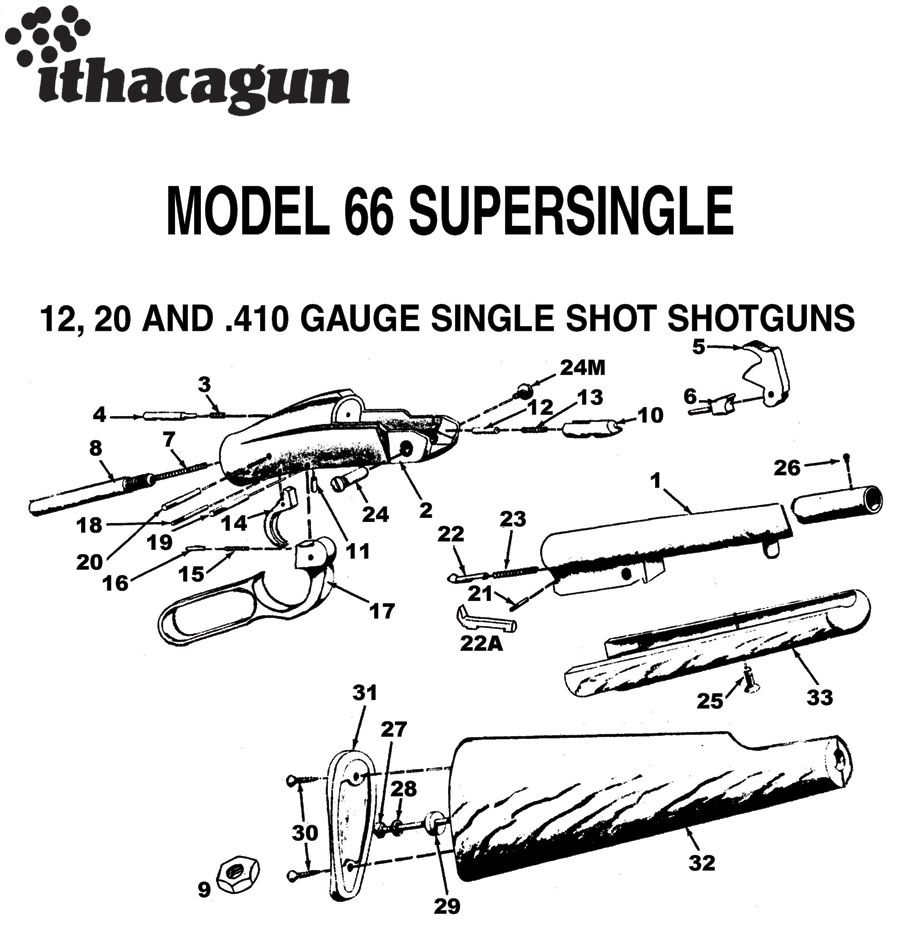
Ithaca M66 Single-Shot Shotgun
 Once upon a time I was a long way from home in a town far, far away known as San Angelo, Texas. I remember very little about San Angelo except for the "no dogs and no airmen" sign on a club, two gun shops and one steak place. I spent most of my time on base, Goodfellow Air Force Base, learning the trade of voice intercept operations.
  But that isn't to say that I never got out to enjoy life (the steak house is one example), I even got out to go hunting! Unfortunately I didn't have a shotgun. Fortunately I did have a friend with a shotgun. Perry Fuller and his lovely bride Angela were stationed there at the time. Perry not only showed me every gun store in close proximity to base but stored my purchase at his home until he was transferred. A true friend he even had scoped out the public hunting in the area.
 Lake Nasworthy is something less than it was then, according to my sources, but it was surrounded by public land and we went out there to shoot my Lyman New Model Army reproduction and hunt quail. Got one, too, and that was with the Ithaca 66 single-shot in 20 gauge. Sadly, I got it on the first rise with the one shot and we didn't find another covey! Angela cooked that succulent morsel for me and it certainly was good food for my soul.
Just as good for the soul was a chance to walk in the "wild" with a gun and to hunt. Although it was inexpensive and simple, the M66 was a fine companion. It worked and was easily handled, it came to the shoulder well, and good stock design made recoil inconsequential. The under lever appears to be awkward especially to those accustomed to the now traditional top lever. Only the H&R button next to the hammer is handier. I liked the lever and felt it was natural and simple in operation. The mechanism is simple and seems to be pretty sturdy. Don't turn one down on appearance, these are good guns.
Saturday, November 29, 2008
Tenite Stocked Savage-Stevens M94
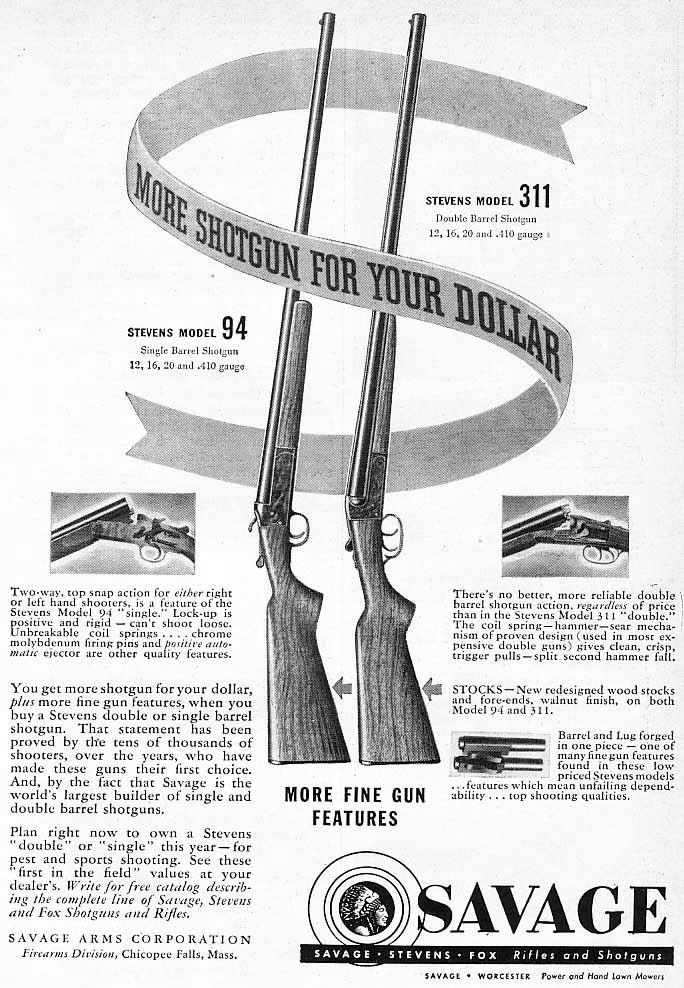 The Savage 94 single-shot shotgun recently came to my attention by way of helping a recently widowed friend. This shotgun is interesting for a number of reasons. It is one of the better single-shots, a light and handy gun and the stock isn't walnut or other hardwood but Tenite.
Tenite, an Eastman Corporation synthetic (cellulose acetate butyrate) from 1929 was much used in the 1930s for automotive parts. It weighs considerably less than wood and is quite stable. In keeping with Eastman's tradition of environmental consciousness, Tenite is made from 100% renewable softwood materials. It is GREEN! According to the fine Larry Sterrett article (“Tenite and the early synthetics in the Long Gun Industry”, 1997 “GUN DIGEST”), Tenite was announced as a stock choice in 1939, put in use in 1940, shelved for WWII, reintroduced in late ’45 or ‘46 and officially used until 1950. Apparently some old inventory of stocks got used up, and this continued until 1954.
Tenite can be molded to precise shapes, and therefore offered some advantages for gunstocks. It is not a particularly cheap product but had a track record in use as a material for US bayonet scabbards produced by Beckwith Manufacturing spinoff Victory Plastics as well as football helmets.
The rest of the gun is pretty unremarkable. It has seen quite a bit of use as evidenced by the well worn finish. However, it has been well cared for, there isn't much rust at all on it.
The 20 gauge is an appropriate choice for a gun this light. Most people will find the recoil of even very many 20 gauge rounds to be punishing and even one round of 12 gauge to be downright objectionable from a 5-1/2 lb gun.
We sold this gun for our widow friend. I'll get a chance to catch a couple of photos of it before it goes down the road because that friend wants me to clean it up for him. This will require at least partial disassembly.
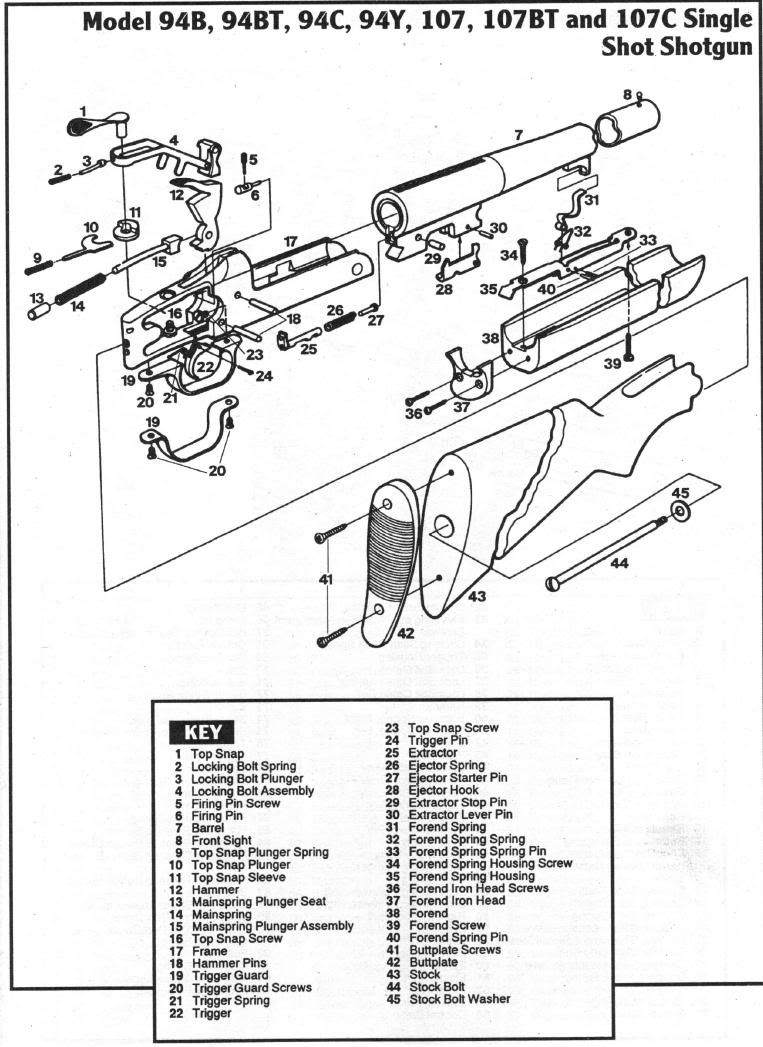 The 94B (which this is) isn't a particularly complicated mechanism. It has been around a long time because it works and it is durable. It was also inexpensive to manufacture and to buy and was a mainstay in farms all across the country. I'm sure Montgomery Wards and Sears & Roebuck sold many thousands.
Thursday, October 30, 2008
Ithaca M37 Riot Shotgun
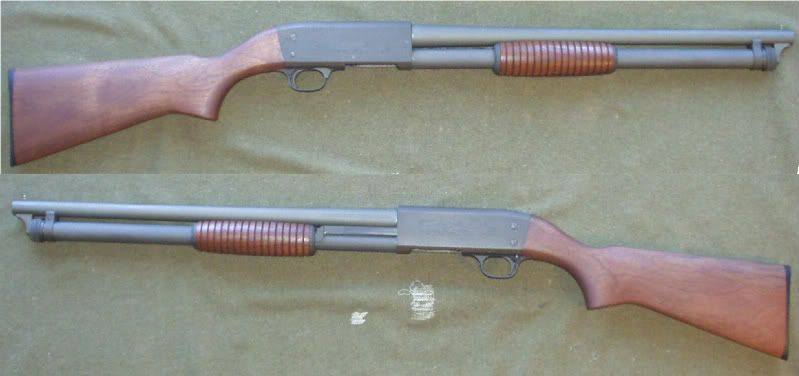 |
| Ithaca Model 37 Riot - right and left side views |
"It" is a 1964 manufactured Ithaca M37 Featherlight, parkerized 12 gauge riot gun with 2-3/4" chamber, 20" barrel and full-length/7-round magazine. UNFIRED, formerly mint and NIB (I've ruined that by simply removing the barrel), this gun has a left-hand safety. That will be changed. It is unfortunate, but I've already discovered that putting my finger on the trigger it automatically pushes the current safety to the ON position, blocking the trigger and making this combat shotgun unshootable. Fortunately, the Ithaca M37 safety is easy to reverse requiring only a bit of screwdriver work (properly fitting screwdrivers, please), time and a right hand safety button. I think this is likely the reason this gun remained in unfired condition.
The Ithaca 37 Featherlight is a legend in the world of pump-action shotguns. The gun was designed by the famous firearms designers John Browning and John Pedersen and first sold as the Remington Model 17. The Model 17 was a 20-gauge of trim proportions which was later redesigned and refined into the popular Remington Model 31 which was replaced by the Remington 870 which is still made.
 After World War One, the Ithaca Gun Company was searching for a pump-action shotgun to produce and compete with the Winchester Model 12. Ithaca waited for Remington Model 17 patents to expire in order to produce that gun. After preparing for production of the Ithaca model 33, they found more Pedersen patents that would not expire until 1937 so, along with the introduction date, they changed the model designation from 33 to 37.
The Great Depression and approaching world war wasn't the best time to introduce a sporting shotgun. That the M37 soldiered through the war proves it is a sound design. Production of many sporting guns ceased during this same period.

This configuration is pretty much limited to use as a self-defense or police firearm. The 7-shot magazine makes it illegal for hunting in most states and most game. Being mostly out of production now, or at least at low production levels compared to some other shotguns, there aren't a lot of accessories out there. I kinda like that. While I have a fully accessorized, modular Winchester 120 (their successor to the M37's competitor the Winchester M12) I like the almost retro simplicity of this shotgun.
Disassembly
Before attempting disassembly, unload the magazine and chamber. To empty the magazine, push in the spring shell stop (13) on the inside of the receiver. Ease the shells out one by one. Pull back on the slide release on the forward side of the trigger guard, and pull back the slide handle to empty the chamber.
To re- move the barrel (1), pull back on the slide release and pull the slide handle assembly (12) to the rear to open the breech. Pull up the magazine nut pin (2) and use it as a lever to rotate the magazine nut (3) until the projection on it is free of the barrel lug. The magazine nut pin was furnished only on guns built prior to 1955. On later-built guns having no pin, simply rotate the magazine nut (Fig. 1).
The barrel is joined to the receiver by an interrupted thread. When the magazine nut is free of the barrel lug, give the barrel a one-quarter turn in the direction shown (Fig. 2) and pull it free of the receiver. The magazine tube and slide handle assembly will remain attached to the receiver.
The stock (53) must be removed before disassembling the action. First remove the buttplate screws and buttplate. The stock is attached to the receiver by a stock bolt (26) that has a square head with a slot so that it can be removed with a long screwdriver or socket wrench (Fig. 3).
With the stock removed, turn out the trigger plate screw (17) (Fig. 4) and slide the trigger plate group to the rear (Fig. 5) and out of the receiver. Remove the carrier screw lock screws (56) and carrier screws (55) from the receiver. Hold the receiver bottom up with the magazine to the left, and with a punch pull the slide pin (33) toward the body (Fig. 6) until the slide bar can be pulled forward from engagement with the slide (35). Pull the slide, breechblock (52) and carrier (42) together rearward out of the receiver.
The top extractor (47) is retained by a powerful spring. To remove it, use a thin punch to push the spring plunger back; at the same time push the extractor out of its seat (Fig. 7). The bottom extractor (43) can be removed easily by driving out its hinge pin (48). To remove the firing pin from the breechblock, first drive out the check pin (49). Then the firing pin and spring (51 and 50) can be removed easily rearward.
Reassembly is in the reverse order.
After about 20 min. including time figuring out WHICH pin punch to use for what AND moving the vise from one bench to the other, I've got a right-hand safety on the Ithaca M-37. Just in time, maybe, well, you know what I mean...
Gunpartscorp.com got the part to me in 4 days start to stop including a Sunday. A record. Correct part and fast...
I had a left-hand Ithaca M-37 safety with large button which I offered for sale here and on a couple of forums. As I believe I noted above, I HAD to switch because putting my finger on the trigger often pushed the safety button to the safe position. Not good in the middle of "use". I had a lot of interest (I was a bit surprised) but folks didn't want to pay as much as Numrich Gun Parts was charging for a used right-hand safety. I sold it for $20 shipped. $25 was too much for anyone but they wouldn't even give a counter-offer. In as much as it seems critical for certainty of use to have the correct safety and the left hand safety seems to be much rarer than the right, AND there are a lot of people out there looking for the left-hand safeties, this might not have been a good move on their part.
Links:
- Ithacagun Featherlight
- Manual - a PDF from Steve's Pages
Wednesday, July 16, 2008
Winchester Ranger Pump 12 Gauge Shotgun
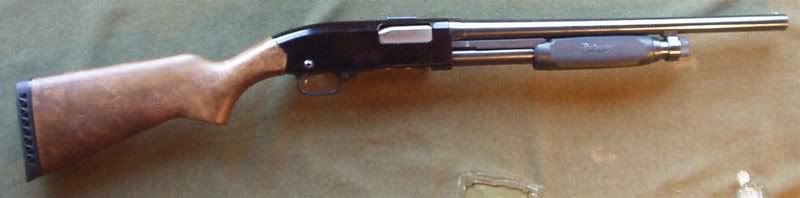
First came the Winchester 1200 to replace the Model 12 with a more price friendly (i.e. cheap) alternative. Then came the Ranger and 120 models in an attempt to further cut costs and keep the product competitively priced and then the 1300 in an attempt to market the same guns but convince buyers that they were getting quality. Somewhere in all that a friend of mine bought this Ranger with 28-3/4-inch barrel utilizing choke tubes (Winchoke). Then came bankruptcy and he had to sell it. I put $60 into it and had a good toy.
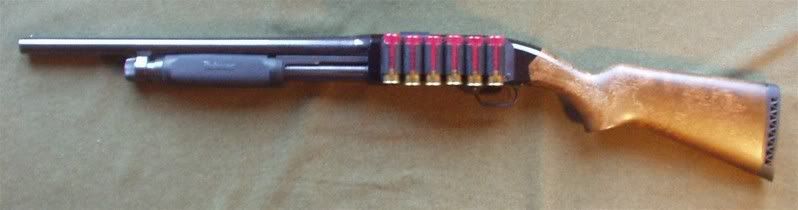
Yep, I've been playing with it over the years. I've bought additional choke tubes, tube tools, stock sets (Pachmayr Vindicator), barrels and even one of those TAC-STAR Sidesaddles. This now resides somewhere close to bedside to reply boarders in the dark of night. With the increasing threat of home invasions, I'm fully prepared to do what must be done to ensure my wife's safety. This shotgun is now part of the plan. To that end the first additional barrel I bought was an 18-1/2-inch "riot" or cylinder bore barrel with bead front sight. I was passing by a table at a gun show and saw it there with a $25 price tag. Of course it had to come home (and the gun is shown here with the barrel and Vindicator forend installed). But, if required, the gun is still a game getting tool.
A while back, somebody asked me why I'd chosen the side-saddle instead of the extended mag. The answer was an easy one. As is, I can simply reinsert the plug to be hunting legal whereas with the extended mag I'd have to do more modification. Conversely, the side-saddle can remain on the gun while hunting.
Hunting is a critical use for such a gun. The original barrel and the interchangeable choke tubes that go with it provide a lot of versatility in the game fields. This is the gun I'd use if I went after waterfowl. Using steel shot in this gun holds no terrors for me. Also, at $60 I hardly have hurt feelings if I put another scratch on wood or metal. Then, today I got another barrel.
I stopped by Nuckols Gun Works and looking into the barrel barrel (just in case) I found a 22-1/4" Winchester 1300 rifled slug barrel. Anyway, I asked Chris the price, was told $55 and it so it has come home, had an experimental ride on the receiver and is now awaiting some good 12-bore "rifle" ammo.
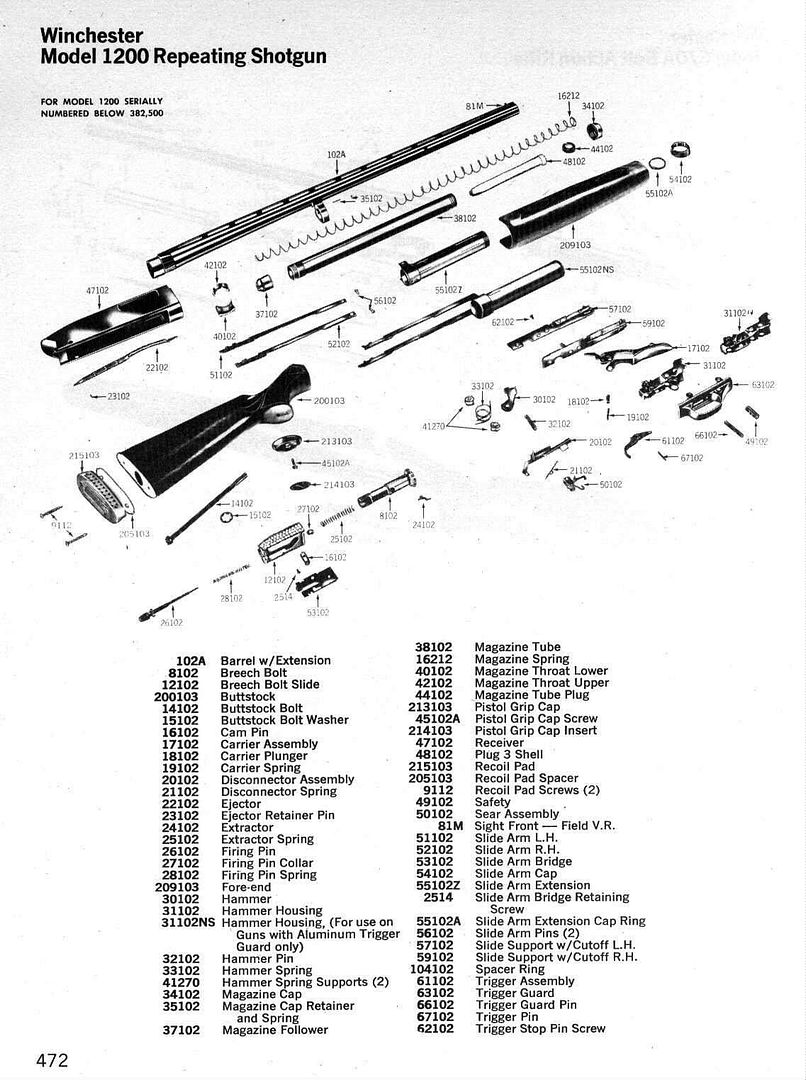 So, "hey," you might say, "are all those parts just plug and play?" Well, yes and no. One of the most noticeable dimensional differences of which one should be aware is the ejector. A flat spring that sits in the left side of the receiver it has a tab that extends into the barrel. Sometime between the 1200 or 120 series, this tab was lengthened. This means that the cut for this tab in the older barrels needs to be deepened slightly (relieved) to avoid excessive wear on or kinking of the ejector. Other than that, all parts have readily interchanged on my gun.
There is one problem with this gun, for me, and that is the over-long length of pull (LOP). It is just a hair too long too shoulder quickly and to operate the forearm. I figured at least an inch would have to come off the stock length to make it work well for me. Today, I found a 1300 beech YOUTH buttstock for sale at AR-7. How much shorter is the youth stock? 1 inch. You can't get any better than that and it comes complete with a recoil pad. I'm sure my wife will appreciate that. The price? $47.95 shipped. Not bad and one has already arrived at the house and been installed. It works and was worth every penny.
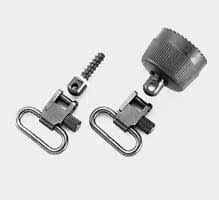 One thing this gun lacks is sling swivels. Uncle Mikes makes a mag tube cap set for the 1300 which will fit fine. Installing that mag tube cap (with swivel stud) and a swivel stud in the buttstock can solve that problem and make the gun very usable in the 12-bore rifle mode. This item has arrived, too. However, I haven't had the time to install the stock swivel stud.
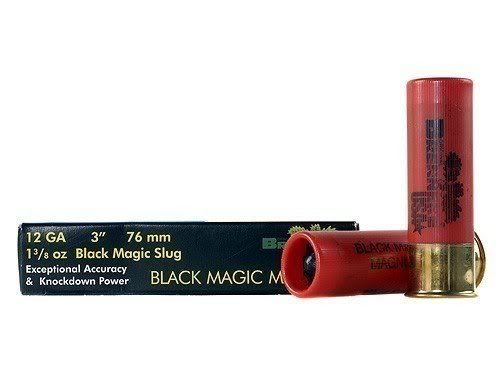
 Good slug ammo is the next thing to do for this project. There's a lot out there and the July 2008 issue of Guns Magazine has an article on the subject. Apparently, with the new high tech ammo, you can hardly go wrong but there's a lot to choose from.
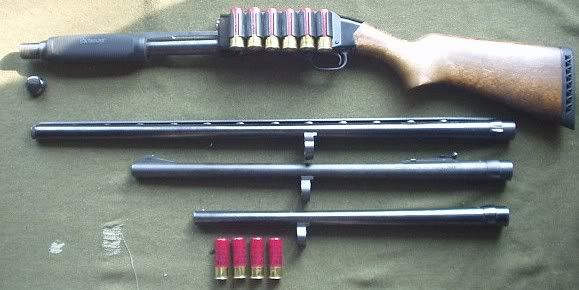
Base gun, issue vent rib barrel, open sighted rifled slug barrel, "riot" barrel (top to bottom).
Links:
- Oct 2006 article
Thursday, March 29, 2007
Winchester 101s - Dad's Skeet Guns
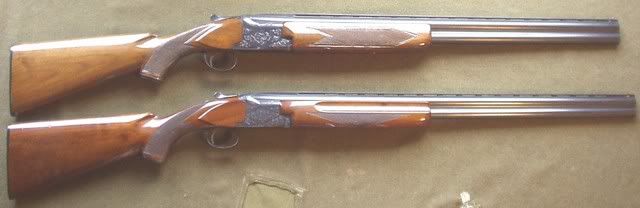
My dad was an outdoorsman, forester, minor league baseball player, soldier (combat engineer and infantryman 1945-47 and 1950-1951 respectively, thanks Dad), pilot (one solo flight) and skeet shooter. He apparently started skeet shooting when he returned home from his first two years in service and was awaiting admission to Syracuse University. He apparently shot a lot of skeet, what is now international style, before departing for university and did so with an old Savage or Stevens made Tru-Test 16 ga. side by side (I have that gun, too). Choked modified and full and missing the front bead even then, this second hand shotgun was likely the best he could find and afford at the time. I've no idea how he got the shells or paid for the many rounds of skeet that he shot.
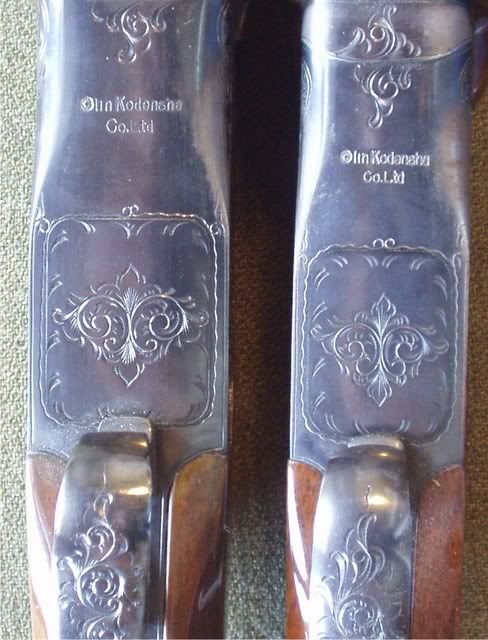 He must have been popular because when we went to that range when I was about 12-13 that must have been 20 years after he'd last been shooting there and several of the old guys (to me!) recognized him and came up to shake his hand. That single visit to that range rekindled his interest and we were shortly looking for places to shoot. Dad tried a couple of used Winchester 1400s but wasn't happy with them. I know it took a lot of cleaning on my part to keep them going (not that I minded). At some point he decided that this pair of 101s were the deal and he dropped his credit card and the two 1400s on Jon Ridenour's counter and walked out with them both. He must have been enamoured of these guns because he never, ever used the credit card for anything but emergencies.
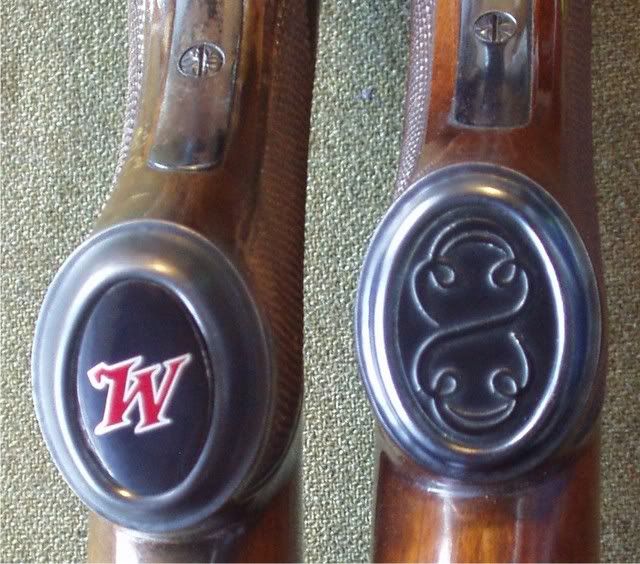 The Winchester Model 101 Over-Under shotguns were introduced in 1963. Dad's 101s are skeet guns in 12 and 20 gauge (bottom) but the skeet guns were made in all four skeet gauges, 12, 20, 28 and .410 (I know, not a gauge but a "bore"). They are over-under double guns, with barrels mesuring 26-1/2" on the 20 and 26" even on the 12 gauge with ventilated ribs, barrel selector switch safeties and single triggers. The old Winchester 101 was something of a landmark gun in the post-war history of the shotgun, one of the models that firmly established the over-and-under as the gun for competition clay shooting. Based on the Browning B25, it handled well, was affordable and was well built by the Japanese. Thousands were sold. Dad must have really liked his as he never considered selling them even after his macular degeneration ended all his shooting.
 Our guns have few differences despite the 5 years between manufacture of the two guns. The 12 ga. has the big red W on the pistol grip cap, while the 20 ga. has the plainer cap shown. Together with the barrel length, these are the major differences between these guns made at the Olin Kodensha plant in Japan in 1970 (20) and 1965 (12).
Links:
- Midwest Gun Works 101 Serials
Thursday, March 22, 2007
"Uncle" Dave's Fox Sterlingworth
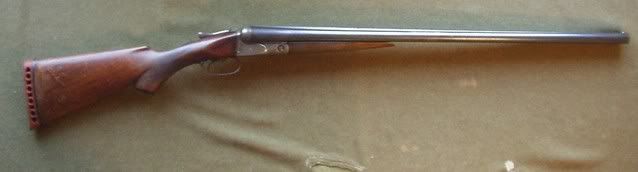
"Uncle" Dave (as he was called by my dad) was Grandpa's brother-in-law. But it seems that he was the gunniest of the "family" before me. He must have been because he didn't have much but he spent his money on things like swords (a "wristbreaker" from Bannermans), a Remington Model 8 (new!) and this Fox Sterlingworth (also bought new). Now my dad knew Uncle Dave but he never told me who Uncle Dave was and I had to discover that for myself!
Uncle Dave must have really liked the gun because at some point he installed the rubber recoil pad. It seems from this gun and the Remington that he was wont to do such things but wasn't all that good at it. In any case, we know he took it hunting because before he died he got some snow in the right barrel and split the barrel with his next shot at a bunny or partridge (grouse). He didn't try that repair himself but sent the gun back to the manufacturer with instructions to have the barrel replaced with one with an improved cylinder choke. So it is today, a 12 ga. gun with 28 inch barrels choked IC and Full. Pretty cool and useful in the field.
When he died the gun went to my Grandfather. I think Dave and his wife had no children and so didn't have any other immediate family to whom to pass his stuff. When Grandpa died the guns went to Dad and then to me. This is a great gun. I know that Grandpa used it to hunt deer near Cooperstown, NY and was successful at least once. Dad and I used it to hunt quail and it was the bees knees as it could take them up close or a bit out and going away and was a good fit for me and tolerable for Dad. I can't say how much game Uncle Davee took with it and was never regaled with stories of his exploits. I don't know why, but nobody in the family talked about him much. I did get the idea that he was considered a bit of a ne'er do well and the guns and such were just more evidence of that. I hope my family won't forget me as I imagine I'm a lot like he was! In any case, Dad sure would get a grin when he did mention him.
The Fox Sterlingworth was the entry level grade double and is the most common of all the Fox guns. A.H. Fox started producing shotguns in 1896 working for Fox Gun Company and later Baltimore Gun company before starting A. H. Fox & Company in 1903. In 1930 Savage Arms purchased Fox and began producing guns up till 1942. The Fox shotguns are of very fine quality and compared to the LC Smith, and lower grade Parkers.
Now for the photos.
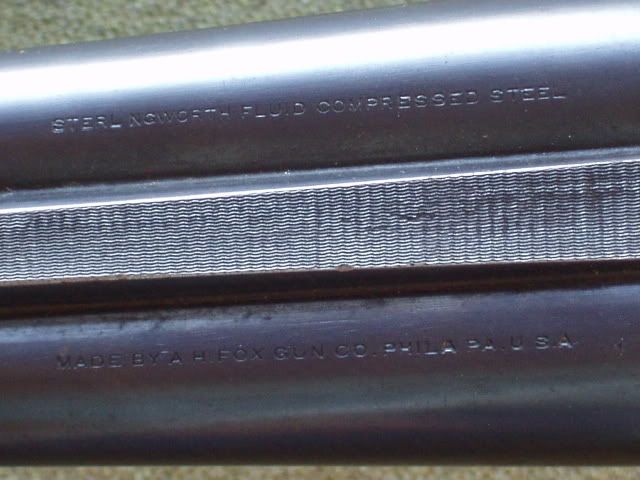 Interestingly, the right barrel is stamped, "STERLNGWORTH FLUID COMPRESSED STEEL" omitting the "I". However, this is the barrel that was replaced so I don't know if that has anything at all to do with it. The left barrel is stamped "MADE BY A.H. FOX GUN CO. PHILA. PA. U.S.A." So this gun uses the patented Sterlingworth steel barrels. I really like the fine knurling on the solid rib which is raised for part of it's length. There is only a front bead sight. There is some slight pitting and finish wear where one would grasp the barrels when shooting. There is also a small dent about 2" back from the muzzle. Nothing to worry about though you can see it. Both the under and top ribs are firmly affixed and the barrels "ring" well.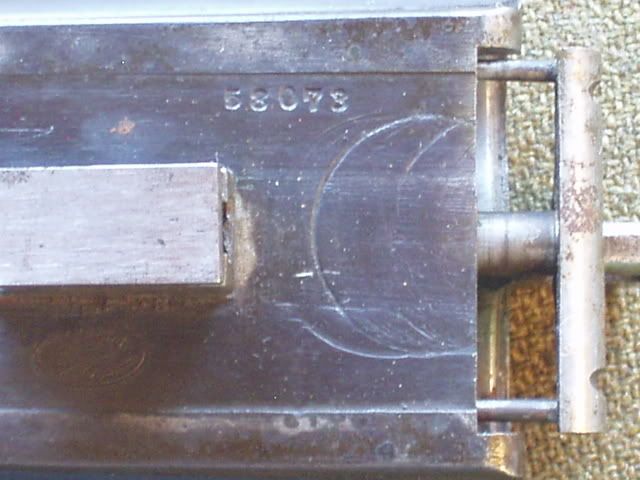
As you can see the underside of the barrels at the breach are marked with the firearm serial number. This gun has extractors only and they are shown extended, not what I usually do but that is where they were when I snapped the photo! What you can't see so well in the photo is the oval mark under the right barrel or just below the lump in the photo. That is the Fox proof mark showing the barrels have passed the manufacturer's proof test. I have no idea what caused the large circular marks on the flat. There is nothing on the gun that I can see (or as you can see in the photo of the watertable) that could cause this mark. This is yet another mystery of Uncle Dave's gun.
The watertable is also marked with the firearm serial number. Of more interest to some are the patent markings on the left side of the watertable.
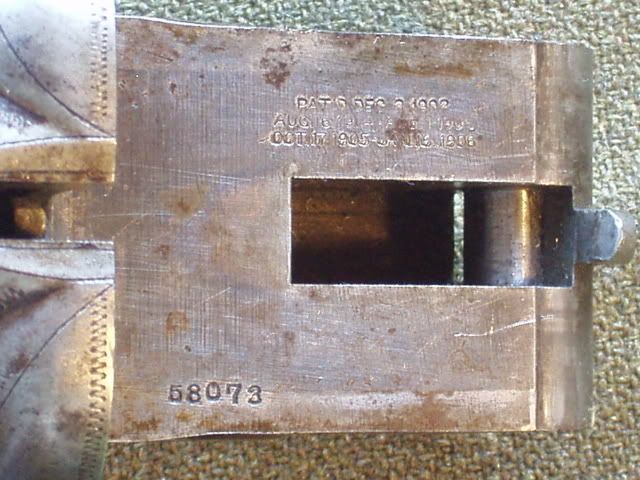
"PAT'D DEC 2, 1902
AUG.6.1904 - AUG.1.1905OCT.17.1905 - JAN.16.1906"
The only other markings on the gun are "MODEL 1911" and the firearm serial on the forearm iron. I had thought this gun was made in 1910 according to certain references but why then would it be marked Model 1911 UNLESS the forearm was replaced when the barrels were repaired. It makes sense to me that the forearm was damaged when the barrel split due to the bore obstruction and had to be replaced with a new forearm iron as well. Very interesting, and perhaps, another mystery!
Wednesday, February 28, 2007
Sears 12 Gauge Pump aka Mossberg

This gun came to me, first to sell for a friend and then, when I couldn't move this 24" slug gun quickly enough and offered to return it, as a gift to me. It came to this friend from his brother who, due to some legal problems, had to relinquish control of his firearms. Over the years those problems only worsened and my friend, more of a Zumboite, didn't want this gun in his home and certainly didn't want to return it to his brother.
It is a typical Mossberg pump produced for Sears to sell as a house brand. With the 24" barrel, rifle sights and cylinder choked smoothbore barrel it was once the epitome of the shotgun only area slug gun. It does indeed shoot Foster type slugs fairly well for a smoothbore. It also shot the old Winchester BRI type sabot slugs well. Both group into about 4" (or a little worse) at 50-75 yards. Brennekes do quite a bit better, extending this group size out to beyond 75 yards. But, to be honest, I never really thought of this gun to be any better or more long-ranged than my Pedersoli Brown Bess carbine. Unless I was truly hungry I'd be wanting to get right up within 50 yards of any deer and with shot, 25 yards is a long shot on small game with that wide open pattern.
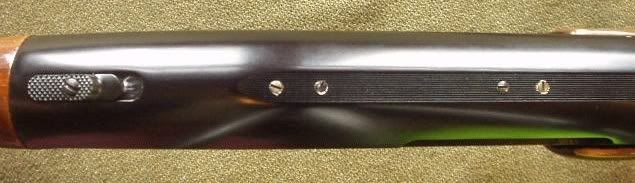 As you can see it is drilled and tapped for a top mount scope. this would be right handy if you could get better accuracy out of the gun. Now, I'm not particularly trigger sensitive but this one likely doesn't help much. I also don't think a scope helps a lot at 50 yards but then I've done a lot of shooting with open sights. I'd lean more towards a big ghost peep on the gun and have a Williams 5D for the purpose but never got around to installation. Rifles being permissable for big game, this shotgun just hasn't seen a lot of use.
You can also see the tang safety. Now that is handy. Right under the thumb this is one fast gun to bring into action.
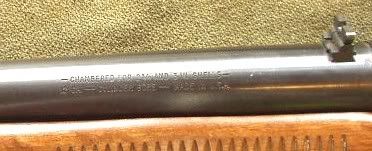 The Barrel marks are pretty standard. It is good to know that I can run the 3" maggie Brennekes through this gun. Those things are about as good as it gets in a 12 gauge smooth barrel. It also might help some with the low shot density due to the non-existant choke. Not much though. The recoil? It can influence your decision to pull the trigger. I've shot this one off the bench. After that, shooting from position was nothing!
 All in all this is a pretty good gun, of Mossberg's usual workman quality but likely not as expensive when purchased new and capable of meeting most hunting requirements in VA. this is one I can't sell as if my friend wants it back, back it goes.
Tuesday, February 27, 2007
True-Test 16 Gauge Side by Side

This was Dad's shotgun, his almost only gun, for many years. As nearly as I can tell, he bought the gun shortly after his first discharge from the army in 1947. He used it to hunt grouse, shoot skeet (what we call international style now), as a prop when on the Forest Service float and maybe hunt deer. It is virtually unchanged from when he bought it, used, from somebody in the Cooperstown, NY area. The only thing that I've done is to replace the broken bead with a Pachmayr red-dot bead. I'll likely get a proper brass bead and replace that as well. The Pachmayr unit just doesn't look right.
The gun was made for True-Test, a hardware supplier, by Savage or Stevens and as it was used (even abused as we shall see), it was probably made pre-war. Consequently, quality is pretty good even for a bottom of the line double.
The 16 gauge was once very much more popular than now. It is still popular in Europe. Great as an all-arounder where lead shot is still permissable, this cartridge can be chambered in guns lighter than the 12s and not much heavier than a 20 but with more oomph than the 20. I guess this gun served Dad well for many years and was worth every dollar he paid.
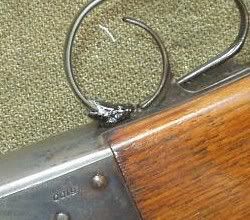 Interestingly, when he bought the gun it probably already had the trigger guard repair seen in the photo to the left. This is pretty interesting. I don't know exactly how it is broken. The Stevens guns I've seen (like my 20 gauge) have the front of the trigger guard bow screwed to the receiver. I can't see how this was attached but it is now imbedded in a wad of solder which has been painted black. If this was done before Dad bought the gun the repair certainly has held up well. Dad took it hunting for grouse, woodcock, and dove and it was moved in household goods at least 18 times!
  This photo shows the "5100" mark on the right side of the receiver.This is the model number.
 You can also see that the color case has survived pretty well. I think this is remarkable because Dad told me that he shot 100s of rounds of skeet with the shotgun. Apparently this was his passion right after he got out of the service. I wonder if he got interested while stationed in Italy (1945-47). I think that all that frivolity ended when he was accepted to Syracuse University in 1949 or 1950. With all the use I would have expected more wear. in any event there was no more skeet shooting until he took me to the skeet field when I was 14, in 1969. I often say that we loaded 50,000+ shotshells for skeet but who knows how many more than those 50K. He really enjoyed himself on the range. Good times.
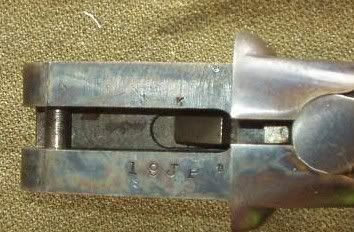 The water table is pretty much bereft of information. Only the stamp "19JP" (a serial) which I think is no more than an assembly mark. It also appears on the forearm and barrels breach. I don't know what the "K" means. The color case is very good here on this protected portion of the gun and this level of preservation is expected.
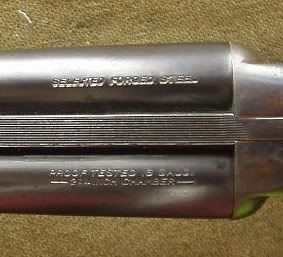 These marks on the barrels are important mainly in that it shows that the gun is chambered for the modern version of the 16 ga. shell, the 2-3/4" version. That's a real relief. Many guns have had their chambers lengthened, most with satisfactory results, but some are a bit dodgy. I'm just glad I can pick up ammo anywhere for this gun. Well, almost anywhere the 16 isn't all that popular in the US. Still, if all else fails you can get ammo on-line.
 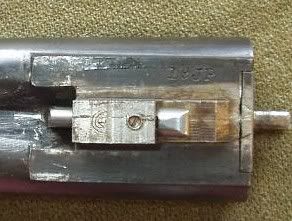 The breech marks aren't all that telling. Surprising to me is the "19JP" is here as well. Again, I don't think this is a serial but rather an assembly mark to keep all the parts for this particular shotgun together in this lot of shotguns for Tru-Test. The lump is also marked but the I think it is an incomplete stamp. It appears to be an oval with a "P" at the top but the mark fades towards the bottom (rear of the lump). There are no other marks.
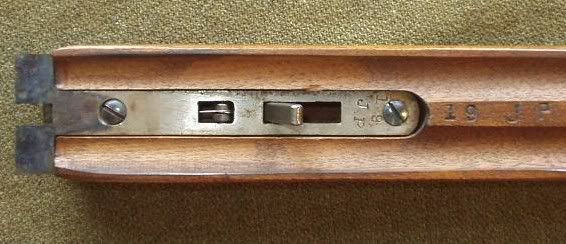 The forearm is also marked "19JP" but the mark is more spread apart which is one reason I think that this is an assembly mark rather than a serial number. The mark appears on both the wood and the iron. That is the only mark on the forearm.
 The wood on this gun, like my 20 ga., was refinished about 1971. As I remember it the original (?) finish was a varnish and had worn away in some places. The Tru-Oil finish we gave it back then has held up very well indeed. The pistol grip is very full with a tight radius. It has a much different feel than the Stevens 20 ga.
I did an internet search for history on the Tru-Test but found nothing but other guns and my own blog. That's a bit disappointing. If anyone knows anything about the Tru-Test gun purchases or can point me to a reference book, please do so by writing me.
Subscribe to:
Posts (Atom)