Sunday, November 09, 2008

Squirrel Hunting

Squirrel hunting is fun. You can go just about anyplace you can shoot and see squirrels. You can hunt squirrels with all sorts of guns although you might have to be a bit adaptable. You can eat squirrels. You can even shoot several squirrels every day (here it is 6 per day). Lots of fun.

For those who don't know, there are two common types of squirrels in this part of Virginia, the fox (first photo) and the gray. There is also the tiny red but we don't have those here, at least not in noticeable quantities. When I was a kid we did all our squirrel hunting with shotguns. I'm not exactly certain as to why but that's what we did. I for one didn't like finding a #6 shot in my dinner. Maybe I'm just picky. Anyway, I switched to a .22 LR gun. At first, I had only my dad's M72 Winchester. Fitted with the factory peep sight, this gun was good enough for squirrels out to 50 yards or so. Honestly, headshots had to be at 10-25 yards. I didn't trust myself not to overshoot at 10 yards so I'd shoot them in the chest. It isn't all that hard to get close to a squirrel. I think the biggest reason I switched was to avoid the lead additives in my food! You do have to watch your backstop, or lack of backstop, with the rifle(s).

In the old days, the .32 and .36 muzzleloaders were the ticket for small game. These work really well on squirrels when loading a round ball over 15-25 gr. of blackpowder or suitable substitute such as Pyrodex. In fact, my favorite squirrel rifle is my .36 caliber Thompson-Center Seneca. Gifted to me on my 18th Christmas, this is gun didn't even get shot until 8 years of service in the US Army passed. I then fell in love with the gun when used on squirrels and rabbits. Why are they so effective? Well the mild charge of powder and light weight of the ball combine to minimize recoil which contributes to pleasant shooting. Also, the ball is of the correct size to be effective (it as big as any expanded .22 LR bullet will ever be on such light game) and still accurate at these relatively short ranges of not more than 50 yards or so.

To squirrel hunt I take my tool of choice for the day and go to a place where I both have permission and there is food for squirrels. They are everywhere there's food for them and after a relaxing sit-down at least one will make his presence known. Many times, especially if you pay attention to where you sit, you won't even have to get up to take your limit. I have done so even while wandering around with chatting kids in tow.

After you take a squirrel, you need to move him from the forest to the dinner plate. The first step in that process is skinning the little buggers. That can be a chore and it was for me at times. Fortunately, Mr. Squack produced a video of a neat method to quickly and cleanly remove the overburden from some squirrel gravy (although I'm not a gravy guy, I stir fry mine!).


After washing and deboning the meat, your next step is to discover a favorite recipe. All the better if your partner/spouse already knows one. Bon appetite!

Wednesday, November 05, 2008

Long Term Storage of Firearms

Please read this stuff, for quite obvious reasons!

Long term storage of guns - relatively short, MUST READ. Mentions Brownell's Triple Tough Bags and Rust Blox combination for great long term protection of firearms in storage.

Where to get long term gun storage bags and tablets
If the above link doesn't work simply log on to Brownells and look in their cleaning supplies tab, then enter "Triple Tough" in the search box.

Storage bags and tabs for 12 long guns, 12 handguns currently comes to just a tad over $100.00 from Brownell's, at least if you are a registered customer.

Prices will suddenly go up and/or supplies will dwindle very soon

John de Fresno

Links:

Burying Guns? by Massad Ayoob
Bury a gun and ammo
for 15 years
(and be assured everything still works when you dig it up)
by Charles Wood

Sunday, November 02, 2008

Build Your Own AR

Brownell offers a FREE video series on building an AR. They also have it in PDF form. Hat tip to Xavier for this tip. I'd seen it but didn't remember to post it.

Now, why you would do this? Simply look at the news.

Saturday, November 01, 2008

Military Musketry

I happened on this Youtube video of drill for "Last of the Mohicans".  I thought it was interesting.


Uberti Remington New Model Army 5½-inch

The Remington New Model Army revolver was manufactured by E. Remington & Sons of Ilion, New York, from 1863 to 1875. An average of 10,000 per year were manufactured (most during the Civil War, 1863-1865) for an approximate total of 132,000 revolvers. This six-shot, .44 caliber revolver was the second most issued to Union soldiers pistol during the Civil War.  The New Model was proceeded by the Old Model Army, of which 12,000 were produced circa 1862. The Old Model had a dovetailed front sight, and the loading lever was cut so the cylinder could be removed without lowering the lever. The Army found both features unacceptable and the New Model Army features a loading lever that must be dropped for cylinder removal and a screw-in post front sight. One of the oddities of these revolvers is that the Old Model Army has a patent date of Dec 17, 1861 and the New Model Army, it's replacement, has a patent date of Sept 14, 1858! It is interesting to note that the reproductions most often use the dovetailed front sight of the Old Model Army but the New Model Army loading lever. 
Once upon a time in a place that now seems so far away called San Angelo, Texas, I bought a revolver.  Along for that ride, maybe an instigator now that I think about it, was my dear friend Perry Fuller.  Perry had taken me to a gun shop in downtown San Angelo as a break from the tiring classes at Goodfellow Air Force Base.  I suppose he didn't intend for me to buy a cap'n'ball revolver but I did.  This Lyman marketed, Italian copy of the Remington New Model Army was my first handgun of over .177" caliber.  With a can of DuPont 3F, some Remington caps, a can of Crisco lard and a popsicle stick I was all ready to go shooting. 
The two of us went out in the vicinity of Lake Nasworthy and proceeded to shoot up some cactii and an armadillo.  Not exactly responsible, but we were certain to watch our backstop!  I believe we also got a quail or two out there (which Perry's wife Amy graciously prepared for dinner!) using Perry's 20 ga. Ithaca M66 lever-action shotgun.  In any case, that was great fun and when I got home on leave I was eager to show Dad just how it worked.  He liked it but had one concern.  The grip size. 

Now my hands are about average in size but Dad's were pretty large.  He was 6' 1" and his hands were a little larger than one might think would be proportional.  That early NMA grip disappeared in those paws!  Even in my average sized mitts, the grips felt a bit on the small side.   The guns were supposed to be accurate reproductions of Civil War era revolvers used by men so why were the grips small?

Well, it seems that when the Italian gun makers first started to reproduce the guns, they were casting the frames and somehow while the copied the dimensions for the frames from originals there was a bit of shrinkage in the castings and the guns came out a bit on the small side in some dimensions.  Fast forward to about 2000 and correctly dimensioned guns were beginning to come on the market.  Now, Uberti produces a forged, steel frame version, some with color-cased frames.  Barrel lengths are not just in the 8" original length but also in 5-1/2", a more desirable length to modern CAS shooters. 

Taylor's & Co., Inc. of Winchester, Virginia distributes these guns but I'm sure you can get them from other firms like Dixie Gun Works.  The Uberti guns come in typical Uberti boxes.  There's the usual manual but also NRA and other literature included.  No nipple wrench is included and you will need one. 

Loading these guns is actually pretty straight forward.  It is a good primer (pun intended) for the budding reloader.  First, the gun must be cleaned to ensure there is no grease or oil in the chambers or nipples.  Excess oil should be removed and I strongly suggest that no petroleum based oils or greases be used on the gun as exposure to blackpowder (or substitutes) and heat can create a "tar" that can be terribly difficult to remove.  This fouling on the cylinder can tie up the gun in short order and is well avoided.  Also lay out your components/ensure you have everything you need before you start.  There is nothing so irritating as having to go find a component in the middle of the process.  Don't ask me how I know.  You will need:
 - .454" pure lead round balls or the correct conical bullets
 - #11 percussion caps
 - greased over-powder wads and/or grease/lard for application over the bullet.  This is important to both lubricate the bullet and to prevent accidentally igniting the powder charge from the front.
 - 2F or 3F BP or substitute
 - powder measure or flask with measure

I prefer to fire two caps on each chamber to ensure that all nipple flash holes are clean through and through and dry.  The fired caps are removed from the nipples and we move on to actual loading.

I charge and seat the ball/ball&wad one chamber at a time and then move on to the next chamber.  It is preferred to load only five chambers and leave one empty.  The gun is carried with the hammer resting on the nipple of this empty chamber.  To do this the gun is placed on half-cock so that the cylinder can rotate freely.  It is held muzzle up in my left hand so that can do the other tasks with my right.  A charge is measured and poured and the wad, then ball is seated using the loading lever.  Only after I've completed loading each chamber do I go back and apply the grease over the ball with the popsicle stick, tongue depressor or other suitably shaped applicator.  Excess grease is wiped off.  The gun, still held in my left hand is then capped and the cylinder rotated and the hammer let down on the nipple of the empty chamber.  The gun is now ready for carry and/or firing. 

Typical powder charges are 25-35 gr. (limited by the size of the chamber) and round-balls weigh about 144 gr.  Velocities are typically in the 700-850 fps range and produce energy levels about on par with .38 Special round nose lead ammunition.  However, the larger diameter pure lead ball gives better terminal performance.  Find the load your revolver likes best and you can likely shoot cloverleafs to some very interesting distances and you'll have a fine small to medium game revolver.  Conical bullets often give better penetration on target but less accuracy.  Molds are available from Lee, Lyman and others. 

After shooting, timely cleaning is strongly recommended.  It isn't necessary to completely disassemble the revolver after every shooting session.  My Lyman hasn't had that done in 25 years but a peek inside shows no BP buildup.  It is necessary to clean the cylinder (removing the nipples for a thorough cleaning), bore and exterior of the revolver.  Hot, soapy water is my preferred solvent.  Hot water helps heat the metal so that it dries more quickly.  After cleaning give it a protective wipe down with Bore Butter or other non-petroleum based oil. 

Thursday, October 30, 2008

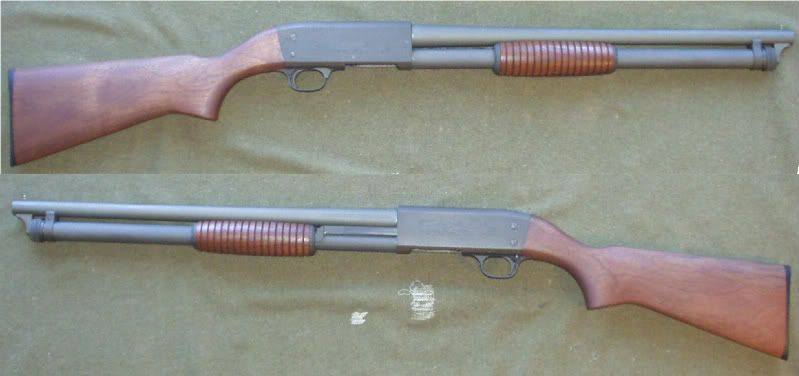
Ithaca M37 Riot Shotgun

Ithaca Model 37 Riot - right and left side views
This is a gun I never thought I'd get to shoot/handle.  I'd see one from time to time but not at a price I could afford or a trade I could do.  To acquire the gun, and now, is a special treat.  I know that some will be angry with me, but I'm going to shoot it.  It does have one fault that may explain its condition.  What is it?

"It" is a 1964 manufactured Ithaca M37 Featherlight, parkerized 12 gauge riot gun with 2-3/4" chamber, 20" barrel and full-length/7-round magazine.  UNFIRED, formerly mint and NIB (I've ruined that by simply removing the barrel), this gun has a left-hand safety.  That will be changed.  It is unfortunate, but I've already discovered that putting my finger on the trigger it automatically pushes the current safety to the ON position, blocking the trigger and making this combat shotgun unshootable.  Fortunately, the Ithaca M37 safety is easy to reverse requiring only a bit of screwdriver work (properly fitting screwdrivers, please), time and a right hand safety button.  I think this is likely the reason this gun remained in unfired condition.

The Ithaca 37 Featherlight is a legend in the world of pump-action shotguns.  The gun was designed by the famous firearms designers John Browning and John Pedersen and first sold as the Remington Model 17. The Model 17 was a 20-gauge of trim proportions which was later redesigned and refined into the popular Remington Model 31 which was replaced by the Remington 870 which is still made.

After World War One, the Ithaca Gun Company was searching for a pump-action shotgun to produce and compete with the Winchester Model 12. Ithaca waited for Remington Model 17 patents to expire in order to produce that gun. After preparing for production of the Ithaca model 33, they found more Pedersen patents that would not expire until 1937 so, along with the introduction date, they changed the model designation from 33 to 37.

The Great Depression and approaching world war wasn't the best time to introduce a sporting shotgun.  That the M37 soldiered through the war proves it is a sound design.  Production of many sporting guns ceased during this same period.

Ithaca resumed production of the Model 37 after WW-II. The Ithaca 37 has the longest production run for a pump-action shotgun in history and made in many models.  The Ithaca 37 has been called the Model 87, but the M37 name was soon restored. In 2005 production halted when Ithaca once again changed hands but has resumed in Ohio.

This configuration is pretty much limited to use as a self-defense or police firearm.   The 7-shot magazine makes it illegal for hunting in most states and most game.  Being mostly out of production now, or at least at low production levels compared to some other shotguns, there aren't a lot of accessories out there.  I kinda like that.  While I have a fully accessorized, modular Winchester 120 (their successor to the M37's competitor the Winchester M12) I like the almost retro simplicity of this shotgun.

Disassembly

Before attempting disassembly, unload the magazine and chamber. To empty the magazine, push in the spring shell stop (13) on the inside of the receiver. Ease the shells out one by one. Pull back on the slide release on the forward side of the trigger guard, and pull back the slide handle to empty the chamber. 


To re- move the barrel (1), pull back on the slide release and pull the slide handle assembly (12) to the rear to open the breech. Pull up the magazine nut pin (2) and use it as a lever to rotate the magazine nut (3) until the projection on it is free of the barrel lug. The magazine nut pin was furnished only on guns built prior to 1955. On later-built guns having no pin, simply rotate the magazine nut (Fig. 1).

The barrel is joined to the receiver by an interrupted thread. When the magazine nut is free of the barrel lug, give the barrel a one-quarter turn in the direction shown (Fig. 2) and pull it free of the receiver. The magazine tube and slide handle assembly will remain attached to the receiver. 


The stock (53) must be removed before disassembling the action. First remove the buttplate screws and buttplate. The stock is attached to the receiver by a stock bolt (26) that has a square head with a slot so that it can be removed with a long screwdriver or socket wrench (Fig. 3). 


With the stock removed, turn out the trigger plate screw (17) (Fig. 4) and slide the trigger plate group to the rear (Fig. 5) and out of the receiver. Remove the carrier screw lock screws (56) and carrier screws (55) from the receiver. Hold the receiver bottom up with the magazine to the left, and with a punch pull the slide pin (33) toward the body (Fig. 6) until the slide bar can be pulled forward from engagement with the slide (35). Pull the slide, breechblock (52) and carrier (42) together rearward out of the receiver.

The top extractor (47) is retained by a powerful spring. To remove it, use a thin punch to push the spring plunger back; at the same time push the extractor out of its seat (Fig. 7). The bottom extractor (43) can be removed easily by driving out its hinge pin (48). To remove the firing pin from the breechblock, first drive out the check pin (49). Then the firing pin and spring (51 and 50) can be removed easily rearward. 


Reassembly is in the reverse order. 

After about 20 min. including time figuring out WHICH pin punch to use for what AND moving the vise from one bench to the other, I've got a right-hand safety on the Ithaca M-37. Just in time, maybe, well, you know what I mean...

Gunpartscorp.com got the part to me in 4 days start to stop including a Sunday. A record. Correct part and fast...

I had a left-hand Ithaca M-37 safety with large button which I offered for sale here and on a couple of forums. As I believe I noted above, I HAD to switch because putting my finger on the trigger often pushed the safety button to the safe position. Not good in the middle of "use". I had a lot of interest (I was a bit surprised) but folks didn't want to pay as much as Numrich Gun Parts was charging for a used right-hand safety. I sold it for $20 shipped. $25 was too much for anyone but they wouldn't even give a counter-offer. In as much as it seems critical for certainty of use to have the correct safety and the left hand safety seems to be much rarer than the right, AND there are a lot of people out there looking for the left-hand safeties, this might not have been a good move on their part.

Links:
- Ithacagun Featherlight
- Manual - a PDF from Steve's Pages

Saturday, October 25, 2008

St Crispian's Day


If we are mark'd to die, we are enow
To do our country loss; and if to live,
The fewer men, the greater share of honour.
God's will! I pray thee, wish not one man more.
By Jove, I am not covetous for gold,
Nor care I who doth feed upon my cost;
It yearns me not if men my garments wear;
Such outward things dwell not in my desires.
But if it be a sin to covet honour,
I am the most offending soul alive.
No, faith, my coz, wish not a man from England.
God's peace! I would not lose so great an honour
As one man more methinks would share from me
For the best hope I have. O, do not wish one more!
Rather proclaim it, Westmoreland, through my host,
That he which hath no stomach to this fight,
Let him depart; his passport shall be made,
And crowns for convoy put into his purse;
We would not die in that man's company
That fears his fellowship to die with us.
This day is call'd the feast of Crispian.
He that outlives this day, and comes safe home,
Will stand a tip-toe when this day is nam'd,
And rouse him at the name of Crispian.
He that shall live this day, and see old age,
Will yearly on the vigil feast his neighbours,
And say 'To-morrow is Saint Crispian.'
Then will he strip his sleeve and show his scars,
And say 'These wounds I had on Crispian's day.'
Old men forget; yet all shall be forgot,
But he'll remember, with advantages,
What feats he did that day. Then shall our names,
Familiar in his mouth as household words-
Harry the King, Bedford and Exeter,
Warwick and Talbot, Salisbury and Gloucester-
Be in their flowing cups freshly rememb'red.
This story shall the good man teach his son;
And Crispin Crispian shall ne'er go by,
From this day to the ending of the world,
But we in it shall be remembered-
We few, we happy few, we band of brothers;
For he to-day that sheds his blood with me
Shall be my brother; be he ne'er so vile,
This day shall gentle his condition;
And gentlemen in England now-a-bed
Shall think themselves accurs'd they were not here,
And hold their manhoods cheap whiles any speaks
That fought with us upon Saint Crispin's day.


**********************************************


There are lessons aplenty here.

John A. Kopec Now On-Line

Mr. Kopec is an authority on Colt Single Action revolvers and he now has a site.  On this site is contact information for both his authentication services and his publications.  I have a copy of the latest edition of A Study of the Colt Single Action Army Revolver and I can't imagine any person interested in the subject being without one.  It is a marvelous book, not only in content but in presentation and production quality as well. 

Tyler T Grip Adapters

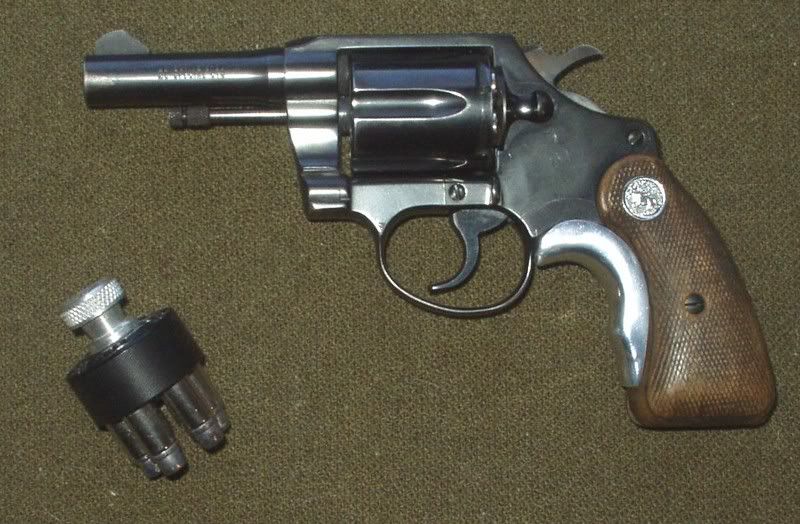
The Tyler T grip adapter was designed by Melvin Tyler back in 1952 to provide a means by which a revolver owner could make more hand-filling revolver grips without great expense or difficulty.  I think he got it right. I like that it isn't like Pachmayr's copy and produced in plastic but rather in real aluminum. Nowadays you can get them in matte aluminum, high polish aluminum, matte black, shiny black and bronze and for most DA revolvers. In addition to the advantages that accrue in gun handling, the Tyler-Ts do those things without adding bulk or making a concealed firearm "print" more than the issue piece. This is an additional benefit because the factory wood stocks/grips don't grab clothing in the way most rubber does. In other words, it makes the gun more comfortable to carry.

Once upon a time my thing was to replace all the factory wood with Pachmayr rubber. It was in, it pretty much fit my hand and it wasn't too expensive. I've left that period of perversion behind and put the factory wood back on but also installed Tyler-Ts on my Colts and S&Ws. To the right is my 3" Colt Detective Special with a Tyler-T (bright) to illustrate the system.  You could say that they suit me to a "T".

Links:
- D&J Gun Repair
- Bob Makowski

Sunday, October 19, 2008

My Marlin 1894C, .357 Magnum Carbine

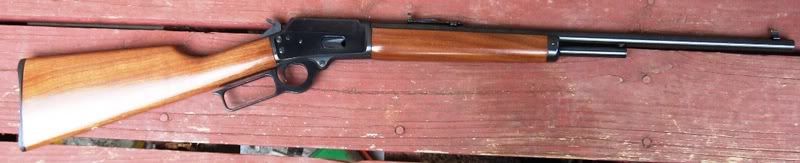
I bought my 1894C, .357 Magnum carbine from Dave, now of Lubbock, and it is a beauty. Made in 1982, it doesn't have the intrinsically repulsive, lawyer-induced, add-on, cross-bolt safety. somebody has shot it quite a bit so the action is slick. It is pretty much as slick as any rifle I've ever owned. However, it has yet to have suffered from the infamous Marlin jam. The barrel on these guns is only 18½ inches in length but that is plenty for this cartridge.

The great thing about these little beauties is that they will function with and shoot .38 Specials. Gun-to-gun you might have to pick and choose your load due to a need for a certain cartridge-overall-length to function well, but most .38 Special ammunition shoots well and recoil is nearly non-existent. I will mention that full-wadcutter ammo will NOT feed through the action and WILL tie it up tighter than a tick on a hound dog. Single loaded, those same wadcutter loads will be about perfect for squirrels and rabbits out to 35 yards or so. Still, you can load it with .357 Magnum ammo and when using an appropriate bullet you have a fine deer rifle. These guns have even been used on African antelope and North American black bear.

I have some favorite loads. #1 is the Federal full wadcutter load. This load shoots to point of aim at 25 yards when the gun is sighted at 100 yards with my .357 Magnum 180 gr bullet load. One can duplicate the factory load with 2.7 gr. Bullseye and a 148 gr. wadcutter.

#2 favorite load uses either the Hornady 180 gr. XTP or Remington 180 gr. SJHP over 15 gr. of L'ilGun. I prefer to use CCI's small pistol magnum primers for this and load #3.

#3 is the Hornady 158 gr. XTP-FP (emphasis on the FP which is designed for these velocities while the HP is not) over 18 gr. of L'ilGun. This load gets an honest 2000 fps from my carbine. It would be an about perfect all-around load for deer and varmints. I don't use it on squirrels or rabbits though!

Saturday, October 18, 2008

Date Codes?

Are you looking for date codes to date your firearm.  Perhaps it will be in this Blue Book source.

Rockefeller Creed

Rockefeller Creed (John D. Rockefeller)

I believe in the supreme worth of the individual and in his right to life, liberty, and the pursuit of happiness.

I believe that every right implies a responsibility; every opportunity, an obligation; every possession, a duty.

I believe that the law was made for man and not man for the law; that government is the servant of the people and not their master.

I believe in the dignity of labor, whether with head or hand; that the world owes no man a living but that it owes every man an opportunity to make a living.

I believe that thrift is essential to well ordered living and that economy is a prime requisite of a sound financial structure, whether in government, business or personal affairs.

I believe that truth and justice are fundamental to an enduring social order.

I believe in the sacredness of a promise, that a man's word should be as good as his bond; that character -- not wealth or power or position -- is of supreme worth.

I believe that the rendering of useful service is the common duty of mankind and that only in the purifying fire of sacrifice is the dross of selfishness consumed and the greatness of the human soul set free.

I believe in an all-wise and all-loving God, named by whatever name, and that the individual's highest fulfillment, greatest happiness, and widest usefulness are to be found in living in harmony with His will.

I believe that love is the greatest thing in the world; that it alone can overcome hate; that right can and will triumph over might.

Friday, October 17, 2008

IF by Rudyard Kipling

If you can keep your head when all about you
Are losing theirs and blaming it on you;
If you can trust yourself when all men doubt you,
But make allowance for their doubting too;
If you can wait and not be tired by waiting,
Or, being lied about, don't deal in lies,
Or, being hated, don't give way to hating,
And yet don't look too good, nor talk too wise;

If you can dream - and not make dreams your master;
If you can think - and not make thoughts your aim;
If you can meet with triumph and disaster
And treat those two imposters just the same;
If you can bear to hear the truth you've spoken
Twisted by knaves to make a trap for fools,
Or watch the things you gave your life to broken,
And stoop and build 'em up with wornout tools;

If you can make one heap of all your winnings
And risk it on one turn of pitch-and-toss,
And lose, and start again at your beginnings
And never breath a word about your loss;
If you can force your heart and nerve and sinew
To serve your turn long after they are gone,
And so hold on when there is nothing in you
Except the Will which says to them: "Hold on";

If you can talk with crowds and keep your virtue,
Or walk with kings - nor lose the common touch;
If neither foes nor loving friends can hurt you;
If all men count with you, but none too much;
If you can fill the unforgiving minute
With sixty seconds' worth of distance run -
Yours is the Earth and everything that's in it,
And - which is more - you'll be a Man my son!

Monday, October 06, 2008

Marlin 1894CL .32-20 (.32 WCF)

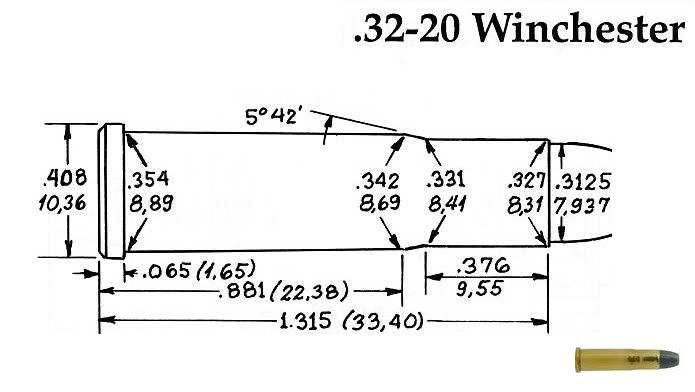
Winchester introduced the .32 Winchester Center Fire (WCF) in 1882 for their Model 1873 lever action rifle. Intended as a multipurpose small game and light deer round, it quickly attained considerable popularity in both rifle and revolver. Practically all American makers have chambered rifles for the 32-20 in lever, slide or bolt action, and most single shot rifles have also chambered it. Colt, Smith and Wesson and Bayard made revolvers in this caliber. Winchester once offered a lighter 100 grain bullet black powder load for the .32 Colt Lightning magazine rifle, headstamped .32 CLMR. A similar 100 grain loading specifically for Marlin rifles was headstamped .32-20. Although semi obsolete, the .32-20 still enjoys some popularity and it can be reloaded easily and at a moderate cost with good killing power on small and medium game at ranges out to 100 yards without destroying all the edible meat. Both Remington and Winchester still offer factory loaded ammunition in this caliber. Marlin reintroduced it for their Model 1894CL lever action, the rifle in question here. The .32-20 is the base case for the 25-20 and the 218 Bee.

The Marlin 1894CL is a return to an original chambering of the Marlin 1894. Known to most shooters as a rifle chambered for the .44 Magnum, .357 Magnum, .41 Magnum, .44-40 or .45 Colt for use by hunters and CAS competitors, Marlin reintroduced the 1894 when they discovered that the 336 just didn't handle the .44 Magnum cartridge as well as it should. They then reintroduced it in several chamberings until they finally got the idea that original chamberings might sell as well (even though the .44-40 had not done well). So, they introduced the gun in .32-20 and .25-20. You'll notice that my gun has the smooth stocks. It is also drilled and tapped for a receiver sight on the left side of the receiver. Later guns are not drilled and tapped on the side of the receiver but the stocks are checkered. I think it makes a big difference.

Of course all of these guns have the repulsive cross-bolt safety. Mr. Ludwig makes a filler for this abomination and I'll have one in here ASAP. What it does is replace the cross-bolt and look like an additional screw (on the receiver right side). But the big thing is that it absolutely can't be pushed a direction other than intended and thus put the gun in a condition unexpectedly such that one could pull the trigger and get a click rather than bang. The Marlins are otherwise just as they used to be and so the half-cock still works and is just like all my other guns.

I'll also be installing a Williams FP-94/36 receiver sight. A good aperture sight is necessary to ring all possible accuracy out of the gun and still maintain maximum handiness inherent in the levergun format. You might have seen that nearly all my leverguns have such a sight (or one waiting installation). This system works for me and has for many years.

.32-20 brass production is a seasonal thing and not much is available at the moment. Fortunately I was able to find and acquire from a previous owner of this same rifle a supply of 6 boxes (50 rounds per box) of Remington ammunition. I have a quantity of Hornady 100 gr. bullets on hand and so I'll have ammo until the season rolls around and brass is again available.

Which particular loads are a question at the moment. I think I'll mess about with the factory load before deciding on the tact I'll take with this gun. It seems to me that it will be a pretty neat groundhog, fox, and coyote gun. I'm looking forward to living with it a while.


Rifle in hand, I discovered that I'm the fourth owner of this gun. Aside from the missing box and paperwork the 1894CL was nearly new in appearance. I immediately changed that. I installed the Ludwig safety replacement (and lost the tiny safety detent spring) and a Williams FP-94/36 receiver sight. One thing I really like is the lack of Marlins former signature white line spacer at the butt plate.  I don't like whitewall tires on my cars/trucks either.  Now the only thing is to take it shooting.


Shooting has proven to be a treat.  It didn't take long to get the rifle zeroed.  The only reason to change the zero will be to take full advantage of the trajectory of the cartridge.  The gun seems to function well.  Some have reported that new rifles "let in two" or allow feeding of two cartridges onto the carrier at once.  Mine doesn't do this.  The gun hangs well and the longer barrel, compared to other 1894 carbines, is just right.  The trigger is fine.  That front bead sight though, it might have to go.  I think I could do more precision with a good post or sourdough front sight.  I've got a couple around here somewhere. 

Links:
- "The Marlin 1894CL .32-20: a fun little gun in a fun little chambering" by John Taffin
- "Marlin 32-20 Its Not a Mouse Gun" by Paco Kelly
- "32-20 Winchester Centerfire 1882" by Paco Kelly
- Ludwig Replacement Safety by Jim Taylor
- While It Was Out by Jim Taylor
- Loading the dash cartridges: these "obsolete" calibers are soft-shooting, efficient, and just plain fun by Charles E. Petty
- The .32-20: Neat Little Caliber That Still Works in Leverguns, Sixguns by Jim Taylor

BulletWeightPowderCharge WeightVelocityEnergy
Lyman 3118120IMR3031
4.8
unknownunknown
Lyman 3118120W296
15.0
20001066
Lyman 3118120Bullseye
3.5
1200383
Lyman 3118120W231
4.0
1200383
Speer JHP1002400
12
2000888
Silent Loads
Lee952400
2.5
491
Lee953031
4.8
420
Lyman 31181203031
4.8
432
Not Quite Silent Loads
Lee95Bullseye
1.5
861
Lyman 3118120Bullseye
1.5
420


Mr. Ludwig, who makes and markets the safety replacement has moved. His new contact info is:

Clyde Ludwig
PO Box 318
Bridgewater, SD 57319

Phone: 605-729-2029

Links:
- The .32-20: Neat Little Caliber That Still Works in Leverguns, Sixguns by Jim Taylor
- While It Was Out - Marlin 1894CL .32-20 Make-Over by Jim Taylor
- MARLIN 32-20 - It's NOT A MOUSE GUN by Paco Kelly

Ruger Redhawk

The Ruger Redhawk (introduced in 1979) is an interesting gun in that it is still in production but made somewhat obsolete by Ruger's own Super Redhawk and Ruger's new standard grip format using the stud instead of a grip frame. The Redhawk (as opposed to the Super Redhawk) is now very much old school.
I once owned a Security Six (.357 Magnum) and you might view the Redhawk as a development from that series, up sized and with some modifications, for larger cartridges. The Redhawk has been factory chambered for the .357 Mag, .41 Mag, .44 Mag and .45 Colt. It is hell for stout. As Ruger says on their website:

The Ruger Redhawk® revolver was Ruger's first double action revolver specifically designed for the powerful .44 Magnum cartridge. It embodies many advanced features such as a "triple-locking" cylinder, a unique "single spring" mechanism for relatively lighter trigger pull, easily replaceable front sights and adjustable rear sights, and all-stainless steel construction. Ruger Redhawks are perfect for the big game handgun hunter who needs the power of a .44 Magnum in a rugged, dependable revolver.

I really liked my Security-Six. It was a good gun, gave good service and it is unfortunate that I sold it to meet family responsibilities. For a couple of years I let the need for a home defense/hunting revolver pass me by until I had the opportunity at a S&W M629 4". I've written enough about that at the linked page. Needless to say I've been looking for another suitable revolver to fill this niche almost since I got the 629. The Redhawk seemed to be about right but... the "but"? Well the "but" was that it was pretty close to the right size but the barrels were too long. You see, they only had them in 5½ and 7½ inch lengths. Yes you can cut them down but add that expense to the MSRP and, well, that's darn expensive when you already have a "perfectly" serviceable 4" .44 Magnum in hand. So I've put it off for the longest time.


Then, about a year and a half ago, Ruger came out with the Redhawk in a 4" version. Of course I liked the idea, but it hasn't been until recently that circumstances have conspired to put one into my hands. I've now got one coming. We'll have to see if it will actually replace the M629...

************

My first impression of the Redhawk was that it was/is a LARGE revolver.  Not as big as the X-frame S&W but big, brutal looking.  Definitely and noticeably larger than the S&W 629. Fitting is not as good as I'd have liked but nothing was broken or missing.  It has been factory test-fired.  I do like the balance of this gun as compared to the longer 5.5 or 7.5 inch barreled guns.  The verdict is still out on the grips.

While the grips are big, and I'm sure they would accommodate rather large hands, I can use them too.  One thing I like is that with the issue grips I can use the gun both SA with a single hand cocking and DA one or two handed.  Can't do both with any given grips on my S&W 629.  Dry firing (done without the plastic disk in place) has shown that either mode is easy.

That dry firing showed something else as well.  The action came to me very gritty.  Now, I'm not a particularly particular person.  If the trigger can be pulled, the gun shoots, if the gun stays in one piece, that is pretty good.  I guess that comes from my years of military service.  But I could feel and hear the grittiness in this revolver.  However, as has been suggested, it has smoothed out quite a bit.  One thing that hasn't changed is that the bolt rises early.  As you cock the gun, SA or DA, the bolt rises to contact the cylinder about half way between the locking notches and rides the cylinder into the next notch.  This has already resulted in a cylinder ring.  However, it has been noted that rising early is better than rising late and the cylinder rotating past the bolt and the gun firing unlocked.  But I still haven't fired the gun.

Stay tuned.

LINKS:
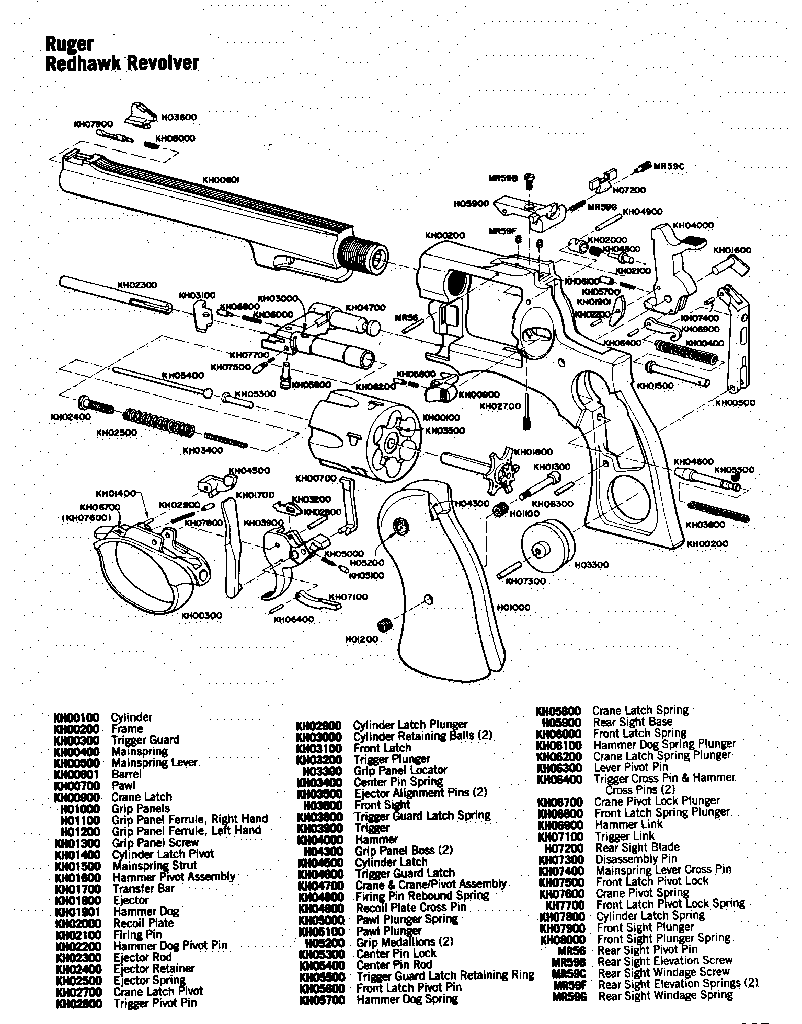
- Assembly/Disassembly of the Ruger Redhawk by Trueblue Sam