The controversy as to the purpose and direction of muzzloading hunting (as opposed to primitive firearms hunting) has apparently reached another milestone...
http://www.americanlongrifles.com/forum/topic.asp?TOPIC_ID=10971
http://www.americanlongrifles.com/forum/topic.asp?TOPIC_ID=10980
The infighting on the subject amongst hunters is, has been and will be tremendous. Some of the participants are vicious.
The truth is that in the past it was supposed to be a "primitive" hunt and now it isn't. Some of us take exception to that but many if not most just take deer. To them it is, as here in VA, a chance to take the "best" deer a week earlier than any gun hunter without any handicap compared to a gun hunter.
Thursday, November 09, 2006

Muzzleloading Season
Our season WEST of the Blue Ridge starts Saturday (it started Nov 4 east of the Blue Ridge). Unfortunately (perhaps not so much) I'll be working. Next week promises to be cooler and I'll be able to hunt most of it. Monday I have to wait for delivery and installation of a new dishwasher. Since I'm it otherwise it wasn't a stretch to pop for a good unit! Anyway, I'll be able to hunt Tues-Thurs for certain.
Wednesday, November 08, 2006
A Shooting Impression
An impression because it didn't get to the range, ammo wasn't shot over the chrony, etc.
Using Remington factory 180 gr. bulleted ammo the sights were right on. Feeding and function was slick, smooth, and easy without any hitches. Felt recoil was less that my No. 4 MK 1 rifles firing .303 Brit ammo also doing 180 at 2400 fps (note that some say the Remington ammo won't hit 2300 fps). It was easy to hit 4" plates to 150 meters shooting off-hand. I like it.
I was really happy to have this gun to shoot after not seeing any deer this morning.
Saturday, November 04, 2006
Good News Comes in Long Packages
Yes indeed, packages about as long as a Browning 1895 Grade I rifle chambered for the .30 US (aka .30-40 cartridge). The monkey is taking quite a ride this year. I just bought this very nice rifle from Terry M. in Michigan and despite some drama that often seems to accompany long distance deals the rifle arrived safely. I've been coonfingering it ever since I got it into the house.
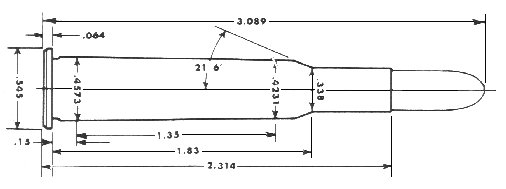 The .30-40 cartridge was adopted by the US Army in 1892 along with the U.S Magazine Rifle, Model 1892 (aka "Krag") rifle and was one of the first three cartridges for which the Winchester 1895 was chambered. Like many military smokeless cartridges of the period it moved a 220 gr. jacketed bullet out the muzzle at about 2000-2100 fps. One could say that it is the US version of the British .303 round. Aside from the ballistics with the 215-220 gr. bullets, both cartridges will push a 174-180 gr. bullet at about 2400 fps or 150 gr. at about 2500 fps and have similar dimensions. One thing about fans of the 220 gr. bullet at 2000 fps is that it is much easier to get such bullets in .308" than in .311" or .312" diameter (and cheaper).
The Browning rifle was also produced in .30-06. I guess I could have looked for one of those. I have lots of brass, dies, etc, but the .30-06 just doesn't float my boat the way the .303 Brit and .30-40 do. I'm looking forward to working with the cartridge. I've already got some brass and more brass, 220 gr. Hornady RNs and dies on order. They should arrive next week and if possible I'll take the gun hunting this year.
I'll be looking for a Lyman 56 or perhaps I'll save up the money and get a Lyman 38 reproduction to install. I like the Williams Foolproof but, let's just face facts, it wouldn't look right on this gun. I'm really leaning towards the 38 as having a much wider range of elevation adjustment.
The gun itself is very handy. Much handier than expected with the 24" barrel and magazine protruding below the receiver. The balance point is just at the front of the magazine and the gun rests well between the hands coming to the shoulder smoothly and aligning the sights to the eye like a good shotgun. I'm sure my very average dimensions have something to do with that. Still, I can see how the gun was pretty popular among a number of people on the cutting edge of technology in 1895 or so. It is a much nicer gun than a bolt action of the period.
I still haven't gotten to take a good photo of the gun or shoot it. I hope to do so this week and will post the results of both endeavors ASAP.
See also:
THE WINCHESTER MODEL 1895 by Redcoat
.30-40 Krag Cartridge Board - by Gil Sengel
The .30-40 cartridge was adopted by the US Army in 1892 along with the U.S Magazine Rifle, Model 1892 (aka "Krag") rifle and was one of the first three cartridges for which the Winchester 1895 was chambered. Like many military smokeless cartridges of the period it moved a 220 gr. jacketed bullet out the muzzle at about 2000-2100 fps. One could say that it is the US version of the British .303 round. Aside from the ballistics with the 215-220 gr. bullets, both cartridges will push a 174-180 gr. bullet at about 2400 fps or 150 gr. at about 2500 fps and have similar dimensions. One thing about fans of the 220 gr. bullet at 2000 fps is that it is much easier to get such bullets in .308" than in .311" or .312" diameter (and cheaper). The Browning rifle was also produced in .30-06. I guess I could have looked for one of those. I have lots of brass, dies, etc, but the .30-06 just doesn't float my boat the way the .303 Brit and .30-40 do. I'm looking forward to working with the cartridge. I've already got some brass and more brass, 220 gr. Hornady RNs and dies on order. They should arrive next week and if possible I'll take the gun hunting this year.
I'll be looking for a Lyman 56 or perhaps I'll save up the money and get a Lyman 38 reproduction to install. I like the Williams Foolproof but, let's just face facts, it wouldn't look right on this gun. I'm really leaning towards the 38 as having a much wider range of elevation adjustment.
The gun itself is very handy. Much handier than expected with the 24" barrel and magazine protruding below the receiver. The balance point is just at the front of the magazine and the gun rests well between the hands coming to the shoulder smoothly and aligning the sights to the eye like a good shotgun. I'm sure my very average dimensions have something to do with that. Still, I can see how the gun was pretty popular among a number of people on the cutting edge of technology in 1895 or so. It is a much nicer gun than a bolt action of the period.
I still haven't gotten to take a good photo of the gun or shoot it. I hope to do so this week and will post the results of both endeavors ASAP.
See also:
THE WINCHESTER MODEL 1895 by Redcoat
.30-40 Krag Cartridge Board - by Gil Sengel
More on Customer Service - AJAX Grips
Customer service comes close to being a misnomer for Ajax Grips. They have yet to respond to ANY of my e-mails. I bet that is a big plus for their business...
Anyway, after about 2 weeks I got my credit for the ill-fitting grips (an understatement for these "custom" grips). I've lost $14 in shipping so far and will have to pay another $7.99 in shipping for this "order" to claim my credit. For those of you who can't do math that's about $22 in nothing but shipping and overpriced at that as their packaging sucks and is $2 too much for the items of the weight shipped. Think I'll ever buy anything else from these folks?
So, my order to them goes out this afternoon after work. I'll report back as to what happens.
For those of you reading this and running a business, don't ever try to do this to me. You might, depending on circumstance, get away with it one time but you will never, ever get another dime from me AND your name will be, forever, mud when I mention you to my friends, family, acquaintances, strangers, etc.
Saturday, October 28, 2006
Where Will Your Guns Go When You Are Gone?
Where will your guns go when you're gone? You know what I mean, when you have shuffled off this mortal coil, kicked the bucket, bought the farm, crossed the river, what will happen to your guns? Do you know? Have you thought about it? Do you have a general plan? A specific plan? Do you care?
In the work I do I've seen a lot of family heirlooms move onto the market because of one of two reasons. The most likely, seemingly most common, is that there was no planning. The owner didn't talk about his treasures with his wife, his children, his friends and that includes talking about why these things were treasured by him. If they don't know that something is important they likely don't value those things enough to either keep them around or ensure they go someplace or to somebody that will value them.
The second most likely reason is that nobody in the family cares. Not about the stuff, oh they care about the stuff, it is the person they don't care about. They don't care about what that person liked, what they did in their life, what they liked in life. They do care about the value of the items, at least to some degree, and they want the value of those things. At least what they perceive as the value of those things. We've all seen the treasures of a family including family bibles and photos go for pennies at yard sales and estate auctions.
I've met many folks who know they are nearing the end of their lives. They are aware of what will happen if they don't plan. Many know that their families don't care about some of the very valuable things they have. Sometimes, often times, that might include a firearms collection/accumulation.
I've got a few heirloom guns. I'd like to see them go to the grandchildren. But for one, my children don't care for my interests at all. The one, only because her husband is interested as I am. It is likely that her children will follow their father's lead. That is where I intend to pass on the bulk of my guns. But, I'm thinking that if I pass, my wife will want to sell some.
Now you and I both know that there are some unscrupulous folks out there that will take advantage of the bereaved. They are not above lying about market value or straight out stealing an item they desire to turn into dollars for themselves. Wives who want to get "that old thing" out of the house will sell guns for 50% (or less) of value. Husbands who "fibbed" about the cost of their guns might be looking down on a widow moving out his collection for what he said he paid when the true value is many times that. I wouldn't want that to happen to my wife.
So, what I did was to create a database (for my use) that details the guns I've got (and had) and the values of those guns I own. It lists the serial numbers so that there is no doubt which is which. Every time I get a new gun, I add it to the DB and print out a valuation report. Included in the valuation report is a comment section for each gun that specifies to whom I want it to go. I put that report in with my important "death" documents.
Now, you may only have one or two guns. You might not have any children or even a wife. Likely you do have parents, siblings, and a friend or two. If you don't you have my condolences, it must be a lonely life for you! One of those folks is likely the person to whom you would most like your collection, however small, to go. Make plans, be prepared. I am.
- Massad Ayoob, "Passengers, Prepare for Departure"
Friday, October 27, 2006
The .308 & .358 Winchester in the Marlin 336 Action
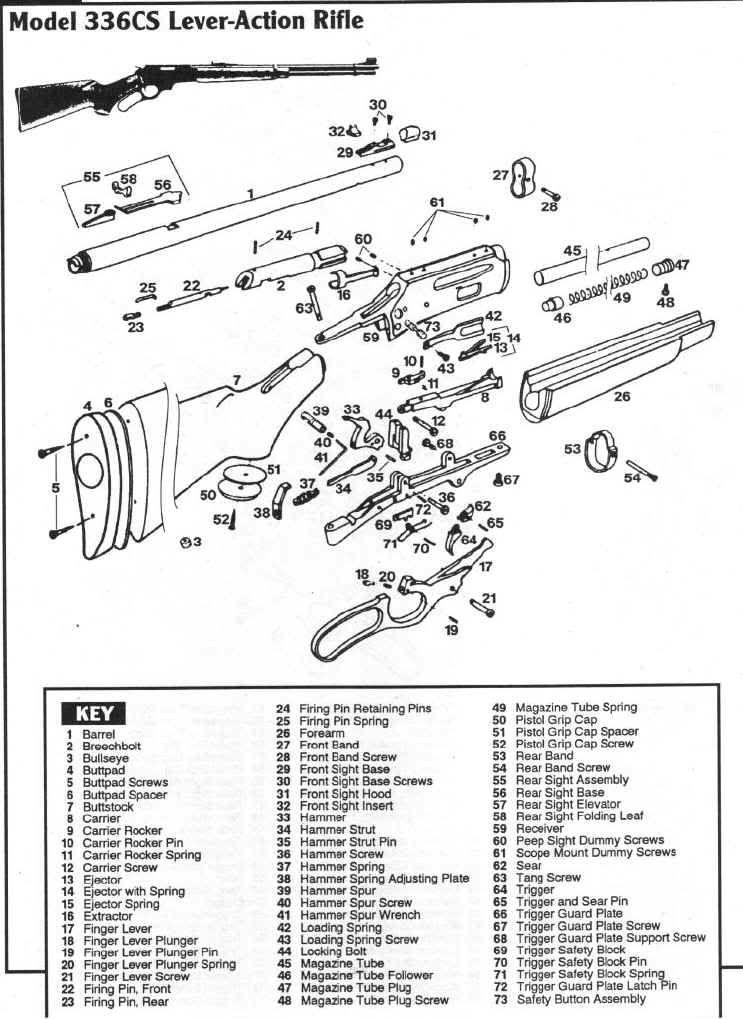 There is one topic that arises frequently on internet firearms forums/chat rooms particularly those devoted to Marlins, leveractions or handloading. That subject is the rechambering of the Marlin 336 in .30-30 (.30 WCF) to .307 or .308 Winchester and/or the rechambering of the 336 in .35 Remington to .356 or .358 Winchester. It has been encouraged by articles such as this one, Damaged Marlin 336 Restored, Rechambered for .358 Winchester by R. K. Campbell. It isn't my intention to discuss Mr. Campbell's article but rather to dispute the assertions made by many who apparently misread his article.
The goal, almost universally, is to get "better" ballistics easily and cheaply. Easily because the conversion will require "only" running a chambering reamer into the action and cheaply because the owner can do it himself without removing the barrel or using power tools. Ignored in the conversions .35 Rem to .356/.358 Win are the need, in some instances at least, to change the .35 Rem bolt for a .30-30 bolt to handle the rim of the new round. Ignored too, is the ability of the action to handle the increased case/cartridge length. Some will point out that the action can be modified to handle a cartridge up to 2.665" COL but that negates the "easy" and "cheap" part of the conversion, at least for most shooters.
Posters define better ballistics as flatter trajectory or more usually "more knockdown", i.e. more energy. Sometimes, those expectations are unrealistic. Posters often point to the ballistics of the wished for round ignoring the fact that until Hornady releases the LEVERevolution© bullets, the pointed high ballistic coefficient (BC) bullets used in the ballistic tables can't be used in the tubular magazine of the 336 due to safety concerns. Indeed the loaded cartridges will be too long to feed in the rifle. Larger cartridges are necessary to the concept of increased ballistic performance. If you can't fit the loaded cartridge into the gun and have it function in the gun, the whole idea is a waste of time. Mr. Campbell, although he shows factory ammo ballistics in the table in his article, acknowledges this problem of fit by only loading the .358 in the rechambered gun with pistol bullets. Only pistol bullets have the flat point, overall length, and cannelure position to permit use in the 336 as it is. Thus, the ballistics in the table are misleading and boy, are people mislead. Also ignored is that the barrel length used for the ballistics tables quoted are longer for the conversion cartridges than they are for the standard 336 carbine length of 20".
 For many years the ballistics of the .30 WCF and .35 Remington were considered more than adequate. Indeed they were an improvement over older black powder cartridges providing adequate power fired from compact platforms. They were even commonly used on elk and other large game. After WWI and WWII, the bolt action and .30-06 cartridge and larger began to dominate the game fields. Marketing made many hunters doubt this well established cartridges. The .30 WCF and .35 Rem produced their ballistics, 170 and 200 gr. bullets respectively at 2200 fps, generating about 38-40,000 PSI or a breach thrust of about 4800 psi for the .30 WCF, 4900 psi and for the .35 Rem. This was well within the capabilities of the actions in which these cartridges were chambered including the 336 Marlin.
On the other hand, the .308 and .358 Winchester generate their ballistics, using 180 and 200 gr. bullets respectively, with pressures of about 52,000 PSI and breach thrust of approximately 8400 psi for the .358 Winchester. This is due to the larger case base and much higher pressure. So, as you can see, it is inevitable that a lot of the discussion concerns the strength of the 336 action. I'll talk about that a bit later.
Is there an overwhelming ballistic advantage? I don't think so. The .35 Rem can easily be loaded to move the 200 gr. RN to about 2200 fps and the 220 gr. Speer can be loaded to go about 2000 fps. The .358 is said to push those bullets to about 2500 fps but those figures come from 24" barrels. I think that 2400 fps is closer to realistic or only about 200 fps faster. The .356 will go about 2350 fps for the same bullet from the 20" barrel.
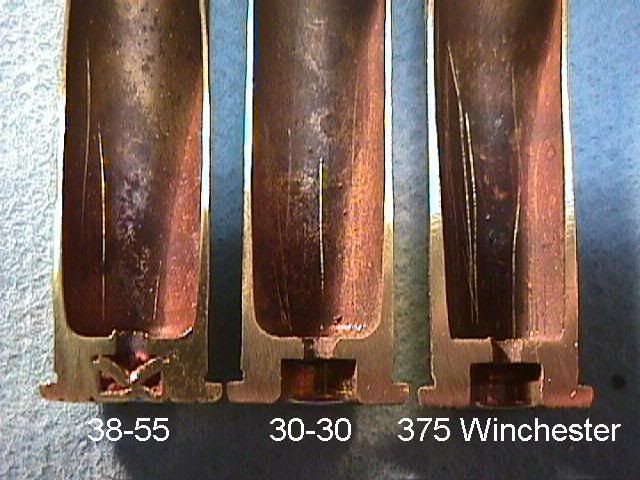 Proponents of the conversions point to the factory chambering by Marlin of the rifle to .375 Winchester which has a SAAMI average maximum or working pressure of 52,000 PSI. They ignore the fact that the .375 case is nearly straight and that it has the smaller .30 WCF case head and that the case has extra thick case walls as do the .307 and .356 Winchester. I think that perhaps the case walls have the complimentary effects of reducing the case expansion and decreasing the effective case head size both of which reduce breach thrust.
Some folks have pointed to the "fact" that Marlins don't fail at the locking bolt but the receiver distorts and then lets go as shown in the last photo. Indeed that was the context in which I found that photo. I wonder, how important is how the action fails?
 In attempting to dissuade us from the breach thrust argument, some remind us of P. O. Ackley's experiments where he moved the locking bolts from guns chambered for his improved .30-30 and there was no problem, presumably because there is no bolt thrust. However, in the context of Contenders, his protege Mike Bellm has made it clear that all cartridges produce breach thrust. He also feels that the .375 Winchester's case design as well as the .307 and .356 help to mitigate that breach thrust. I would like to point out that the Winchester company modified their M94 in order to use these cartridges. Marlin did not but produced NO .307s and only some 2000 .356s. They have NEVER produced or attempted to produce guns chambered for the .308 or .358 Winchester cartridges. Methinks that there is a reason and it wasn't some perceived inability to handle rimless cases as the 336 does very well with the rimless .35 Remington.
Pressure is important. It affects shooting in three important ways. The first of course is that it pushes the bullet down the bore. So far, so good. It also bears on gun design.
- The first way is that the gun must have sufficient hoop strength to contain the pressure generated in firing. This is why a minimum thickness of any particular metal is required over the chamber and bore. Obviously, a margin of safety, extra strength if you will, is necessary. I submit that there is no margin of safety or that it has been seriously reduced by use of cartridges generating 52,000 PSI with a case diameter the same as the .444 Marlin (limited to about 42,000 PSI).
- The second consideration is breach thrust. That is the pressure that bears against the bolt and through the bolt to the locking lugs or bolts on a rifle action. You can figure that by dividing the pressure in PSI by the internal area of the case base. In my mind this is the important issue. How this will wear the gun, stretch the parts to the point of unserviceability, accelerate other wear, and so forth is a genuine concern for me.
Debate also rages about whether or not the 336 actions were heat treated differently for the various cartridges, TomRay (a Marlin employee) has stated that he isn't aware of different heat treating for the different actions. This makes sense as it is a costly thing to have to produce actions which are cartridge specific. TomRay has also mentioned that the .356 rifles (the 336 ER) that Marlin produced required tighter than normal breaching to work correctly and that the locking bolt must fit the action to produce a very tight lock up. How many shade tree gunsmiths are going to be able to do this? Why would you want to produce a rifle with no ballistic advantage and lower resale (if you can sell it) value? NOTE: TomRay also says not to take his "speculation" as true.
Tim Looney at Marlin is quoted as saying that the differences between the .35 Rem and .356 Winchester barrels are:
- .35 Remington barrel: Bore: .3500" Groove: .3570" Grooves: 6 Twist rate: 1 x 16 RH
- .356 Winchester barrel: Bore: .3515"Groove: .3577" Grooves: 6 Twist rate: 1 x 12 RH
Mr. M. L. McPherson has contemplated what can be done with the Marlin action. His article, "What is Possible with the Marlin" is an excellent read which will likely interest anyone struggling with my poor writing here.
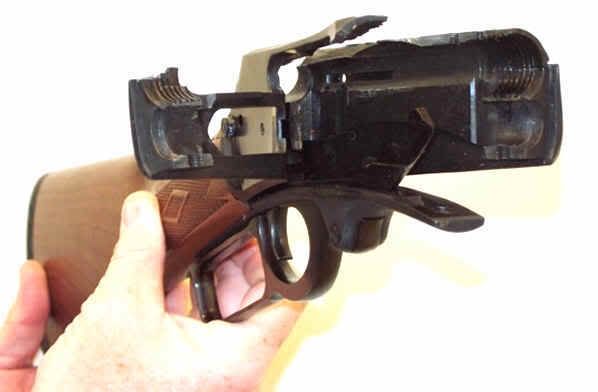 |
| 1895 Action |
Monday, October 23, 2006
Aguila 60 gr. SSS .22 Long Rifle
 Once upon a time I bought a couple of boxes of the much hyped Aguila 60 gr. Sniper SubSonic .22 Long Rifle ammo. The ammo is basically a 60 gr. swaged lead bullet loaded in a .22 short case. I tried the round in many rifles and pistols. Accuracy in my Winchester 62A, 1906, 72, and 320 was poor even at 25 yards because the bullets wouldn't stabilize. Likewise in the Ruger and S&W .22 semi-autos. Feeding wasn't an issue.
However, in the Marlin 39A Mountie made in 1956, the bullets not only stabilized but were actually accurate. Accuracy was improved after running the ammo through the Hanned Line SGB die (now discontinued). With the rifle zeroed at 25 yards using Winchester PowerPoints, the Aguila SSS is right on the money. This could be a valuable circumstance. Unfortunately, I've yet to actually use these on any game. Perhaps afterwards I'll be motivated to buy more of this unique product.
Thursday, October 19, 2006
Tyler-T Grip Adapter Arrives
About six (6) weeks after ordering I received my black anodized #1 Tyler-T Grip Adapter. This is for the J Frame S&W M-36. All is forgiven...
Wednesday, October 18, 2006
Ruger New Vaquero and Rust
Just a note that about the New Vaquero and rust. Today, after a summer's rest, I pulled the New Vaquero from its box in the safe. There was a patch of fine rust on the frame along the sight channel, again on the left recoil shield, and on the left flat below the cylinder. A quick visit with a wad of 0000 steel wool and Breakfree removed the rust without apparent damage to the finish.
We shall see. I bought the gun despite warnings about the applied "color case" finish. My intent is that if the finish fails I will have it refinished. I'm not going to worry about it even though I will record the success or failure of the finish here.
We shall see. I bought the gun despite warnings about the applied "color case" finish. My intent is that if the finish fails I will have it refinished. I'm not going to worry about it even though I will record the success or failure of the finish here.
Customer Service (continued, still, again)
 Despite requesting that my backorder be canceled and my money refunded Ajax sent me the grips. The arrived yesterday. First thing I noticed was that they are much thinner than issue grips. They I put them on the gun. I was so very disappointed. If this is what passes for custom, well, you might as well make something of Bondo and Acraglas and be done with it. It was bad enough that the grips stand proud of the grip frame by a good 1/8" front and back (I suppose they might be INTENDED for custom fitting) but they also do not mate well at the bottom. In other words there is a gap between the two halves/grips at the bottom. They fit worse than the grips I got used shown elsewhere. Much, much worse. Today I called for a return authorization number and sent them back. The policy is for CREDIT to be given, not a refund. If I must I'll get other products sold but not made by Ajax.


Found at the Range
One finds many things at the range. Shooters, certainly, and their trash. Brass, too.
Brass I like. I pick up all the rifle brass that is Boxer primed. I also get the .45 ACP, .38 Special, .357 Magnum and 10mm Auto (rare). I keep my eye out for .32 S&W (short and long) and any oddities like the .50 AE, .460 S&W, etc. Brass is nearly an obsession with me and I wonder why it is that so many leave so much of it behind. How can they? Brass is rife with potential. Brass is the most expensive part of the cartridge (unless you're using premium bullets). Brass can be modified to other uses as well as other cartridges. Brass is difficult if not impossible for a reloader to make. Some brass can be very expensive. Still, it litters the ground. Worse yet, some actually police up their brass and throw it away! At least they clean up after themselves. I can't even toss brass for cartridges I don't shoot!
Everyone has seen the vegetables, paper in the form of boxes and targets, plastic from all sources, metal plates, even TVs and appliances brought in as targets by some. Simply amazing and requiring constant vigilance by Range Officers (where they exist). The worst, it seems to me, is the large quantity of loaded ammo left behind. I've collected more than 400 rounds over the past 2 years at ONE range. Everything from .22 LR (about 2/3rds of the ammo) to 12 buckshot. Of particular concern is that sometimes the Forest Service brings in state prisoners to perform maintenance work. That ammo is just lying on the ground waiting to be picked up by the inmates and smuggled back inside the prison. It seems to me that a little care can be taken. But some are apparently too lazy to even bend over to pick up a dropped box of ammo. Several times I've found 6 or more rounds close together on the ground. Amazing.
But I've found other things as well. Magazines (of both the cartridge holding and reading variety), coats, hats, flashlights, screwdrivers, and MONEY. Not to complain, but I have to wonder at the mental process that drops a fiver at the public and FREE range.
Ah well, I doubt it will stop me from going but I do carry a 30 gallon garbage bag.
My Thompson-Center Contender Collection
Once upon a time I'd invested in a Colt AR-15 Carbine. The gun was in excellent condition, came with a Colt 3X telescopic sight and was so old it didn't have the forward assist. I had a collection of 20 and 30 round magazines and filled them with 5.56/.223 Rem ammo. I had a duplicate set of web gear loaded with ready to go magazines. I used the gun for practice, familiarization (I was still serving in the Army), for the TEOTWAWKI rifle, and sometimes took it to the armory during alerts (with the approval and at the request of my full-time supervisor).
In 1994, the Democrats showed their hand and passed the assault weapons bill which banned certain combinations of features on firearms as more dangerous than the basic gun. Moronic and a brilliant first step at the same time (and now gone when it sunset) created the class of pre and post ban guns and magazines. Suddenly my AR-15 was worth a lot of money. I had a couple of really good guns for TEOTWAWKI should that ever occur, wasn't a nut who believed in spray and pray, and had other interests which needed funding. I sold the AR-15 and bought a Thompson-Center Contender with scoped .223 and .35 Remington 21" barrels.
This initial purchase began an obsession, albeit not as bad as some folks, which resulted in the purchase of a second frame and a total of 21 barrels, 19 of which are "carbine" barrels and 2 are 10" pistol barrels. Nearly every barrel is scoped and I also have a supply of ammunition and reloading dies for nearly every barrel. The barrels I own are (with notes on each barrel sighting, etc.)...
1. .22 LR 21" Factory Match - Weaver 4X scope in Weaver rings and mount. Favorite load is the Winchester PowerPoint HP.
2. .22 Winchester Rimfire Magnum (WRFM) 16" Factory - Simmons 3-9X in Weaver rings and mount. Shoots very well with either the Federal Supreme or Remington 30 gr. loads.
3. .22 Hornet 21" Factory - Simmons 4X in Weaver rings and mount. Loves 13 gr. of Lil'Gun under the 35 gr. VMAX lit by a CCI small PISTOL primer.
4. .218 Bee 22" Bulberry Bull - 4X Swift in Weaver rings and mount. Great accuracty with 14 gr. Lil'Gun under the 40 gr. VMAX lit by a CCI small PISTOL primer.
5. .223 Remington 21" Factory - 3-9X Simmons in Weaver rings and mount.
6. .25-35 Winchester 21" Custom-Shop - 1.5-4.5X Swift in Weaver rings and mount. Highest velocity with 28 gr. BL(C)2 under the 75 gr. VMAX but this load requires radical resighting compared to the standard load of 117 gr. RN at about 2200-2300 fps.
7. 7mm TCU 21" Factory - 2.5X Weaver in Weaver rings and mount. Has single forearm dovetail. The 7mm TCU has a reputation for accuracy and this doesn't disappoint. Accurate with everything. In the same class as the .25-35 but usable with a wider range of bullets, 115-175 gr.
8. 7mm TCU 10" Factory - factory open sights.
9. 7-30 Waters 21" Factory - 2.5X Weaver in Leupold rings and mount.
10. .30 Herrett 14" Factory with Choate extension - 2.5X Weaver in Weaver rings and mount.
11. .30-30 Winchester (.30 WCF) 21" Factory - 2.5X Weaver in Leupold rings and mount.
12. .357 Remington Maximum 21" Factory - 2.5X Weaver in Leupold rings and mount.
13. .35 Remington 21" Factory - 2.5X Weaver in Leupold rings and mount.
14. .38-55 Winchester 22" Bullberry Bull - Williams Foolproof or 2.5X Weaver in Weaver rings and mount.
15. 10mm Auto 14" Factory with Choate Extension - Thompson-Center aperture sight.
16. .41 Remington Magnum 16" Bullberry Bull - 4X Simmons in Weaver rings and mount.
17. .44 Remington Magnum 10" Factory - 2.5X Weaver in Weaver rings and mount.
18. .44 Remington Magnum 21" Factory - 2.5X Weaver in Weaver rings and mount. Has single forearm dovetail.
19. .45-70 Government 24" Custom-Shop - 2.5X Weaver in Weaver rings and mount.
20. .410 Shotgun 21" Factory - vent rib with beads
21. 28 Gauge Shotgun 26" Dave Van Horn - front bead only.
My guns have all Rynite furniture. Even the Choate folding stock is the Rynite. By the way, Choate was the supplier of the Rynite stocks to Thompson-Center. Note that most don't have exceedingly high power scope sights. These are the first rifles that I've scoped. Heretofore I've almost exclusively used aperture sights. Most cartridges for which my barrels have been chambered were also used in leverguns. Most of these barrels will shoot into 1-1.75" at 100 yards. With most barrels, the carbines weigh no more than 6 lbs (scope included!).
I also have the Choate folding butt stock but I only use it with the 16" barrels and not necessarily so. I had to do a bit of modification on the latch cut so that it would lock in the closed position. However, the stock is a quality product. It now locks in the closed or open position without slop and is comfortable for shooting up to .41 Mag or .30 Herrett ammo. I've never tried it with the .45-70 barrel, the big kicker, because it seems dumb to bother with a folding stock when using a 24" barrel.
Monday, October 16, 2006
At the Range with the Browning 1886 SRC
 As some might know I had to install the Williams Foolproof this past spring. Well, I finally got the gun to the range at Hite Hollow to verify zero. After a bit of mucking around she and I figured it out and instead of doubles put 5 (2 Federal factory 300 gr. and 3 of my duplication reloads using the Sierra 300 g.r JHC) into the target at 100 yards. Those are the 5 inside the 10-ring. All the other shots were playing about with the sights and some other loads. This WAS shot from the bench resting my elbows on the bench and not off a bag or mechanical rest. The group actually measures 1.5" center-to-center extreme spread. I am fairly pleased to have shot this group with the Williams Foolproof issue aperture and original front sight. This load of 54 gr. H322 under the 300 gr. Sierra JHC and lit by a CCI 200 it should do ok for Virginia whitetails. This load, like the Federal factory, gives just a bit more than 1800 fps to the 300 gr. projectile.

I'm going to work up a load (probably start with the classic Keith recommended load) for the 405 gr. and see how that prints in relation to the 300s. That will be a bit later, I've some other guns to shoot!
Compare the above target to the best I could do with the open sights...
Saturday, October 14, 2006
The Remington Model 8 - .35 Remington
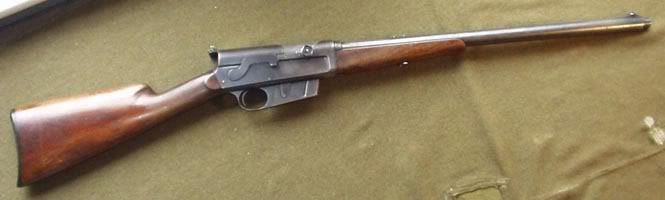 My Remington Model 8 is chambered for the .35 Remington. I inherited it from my father. Dad inherited it from his father who inherited it from, so far as I know, the first owner/user. That was "Uncle" Dave and Uncle Dave was the gunny guy of that generation but he wasn't really an uncle. He liked the old stuff and guns like I do and like me he was willing to spend money on good guns and hunting. Uncle Dave's gun has a Lyman receiver sight, the factory rear sight has been removed, and is sighted for the Winchester factory 200 gr. Silvertip load (a box of which I still remember from my youth). My dad had to have a slip on recoil pad as the length of pull was entirely too short for his frame. Grandpa had the same slip on pad but his stated reason was that the gun kicked too hard without it. I don't know who put the pad on, but somehow I think it was Uncle Dave as he also put a pad on his Fox Sterlingworth 12 ga. I don't use it and the recoil doesn't bother me.
The Remington Model 8 is a Browning design. The first semi-auto sporting rifle produced by Remington, it was introduced in 1906. Discontinued in 1936 after 80,500 had been produced, the gun was produced in 4 chamberings, .25, .30, .32 and .35 Remington. It was also produced in 6 grades, No.1 Standard, No.3 Special, No.4 Peerless, No.5 Expert, and No.6 Premier. My gun is the Standard. The Model 8 was replaced by the Model 81 (chambered in .300 Savage, .30, .32 and .35 Remington) from 1936-1950. About 55,000 of the Model 81 were manufactured by Remington. The design was also used by FN but I'm unsure of production numbers. One seldom sees one of the FN guns here in the US.
 Introduced in 1906 in the Remington Model 8 autoloading rifle, the .35 Remington is one of the few pure woods cartridges that can be considered successful. In addition to the Model 8, this excellent cartridge was once available in Remington Models 81, 14, 141, 720, 600, and 760, as well as the Winchester Model 70, Standard Arms Models G and M, the Mossberg Model 472 and a slide action rifle once made by Savage. Presently available in the Marlin Model 336 lever action, Remington Model Seven KS bolt action and the Remington XP-100 and T/C Contender handguns, the .35 Remington is still a favorite of those who believe it kills deer and black bear quicker than the .30-30 Winchester. Whether or not this is true is the stuff classic campfire debates are made of.
The Model 8 is recoil-operated has a rotating bolt and double, opposed locking lugs. The gun fires from a fixed 5-shot magazine (it is NOT detachable!) and is equipped with a bolt hold-open that engages after the last shot is fired. The autoloading action was made more revolutionary by the incorporation of a barrel that was shrouded in a full-length jacket. When the gun is fired, the barrel moves backward inside the shroud. It is a long recoil operated gun, not gas, like the Browning Auto-5.
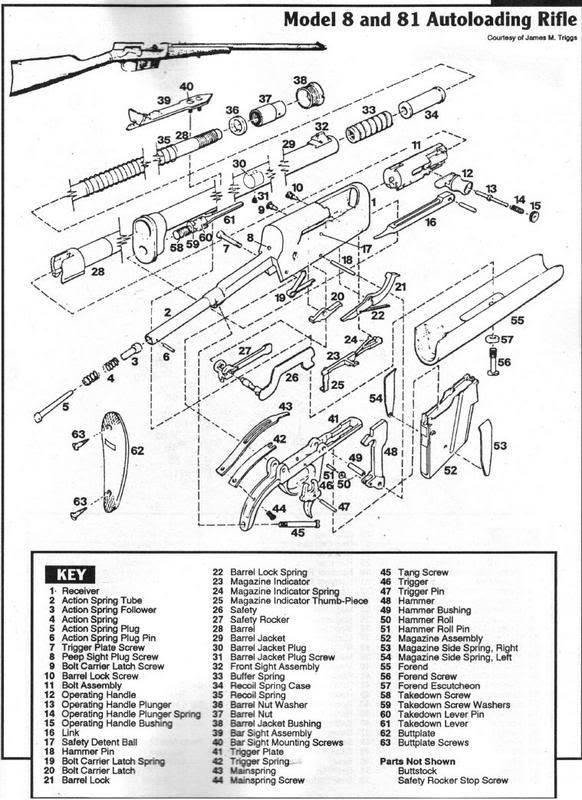 Designed in a day when travel by train or bicycle was common, the 8-pound, 41-inch carbine was built on a take-down design for ease of transport and cleaning. Take down is accomplished by removing the forearm to access an integral barrel wrench. Once loosed, the wrench releases the barrel. As the barrel, including chamber and the open sights, remain in one piece, this feature does not negatively affect accuracy.
Even today the .35 Remington is second only to the .30-30 in popularity among those who prefer to head for the woods with a short lever action carbine hanging from their shoulders. Many years ago the .35 Remington was used on bigger game, but it is seen at its best when used on deer, black bear, and wild boar at ranges not exceeding 150 yards or so. At greater distances, the little .35 is handicapped by its moderate velocity and moderate accuracy from most of the rifles in which it has been available. However, when fired in a bolt action rifles such as the Winchester Model 70, Remington Model 600, and Remington Model Seven FS, the .35 Remington is as accurate a cartridge of similar caliber.
Links:
- The Great Model 8 & 81
Subscribe to:
Posts (Atom)