Wednesday, January 14, 2009

Winchester 1876 SRC NWMP Reproduction - Revised

I'm making every effort to keep this post as the up-to-date and complete accounting of this rifle/carbine. If you see something missing, please, drop me an e-mail.

For many years I have been entranced by the stories surrounding the Royal Canadian Mounted Police and a predecessor unit, the North West Mounted Police. The idea of the lone Mountie (trooper) patrolling vast reaches of the rugged Canadian heartland with his odd mix of English and American firearms simply caught my imagination. Canada has some beautiful country and I could easily imagine myself and my dog team out in the middle of that wild country.


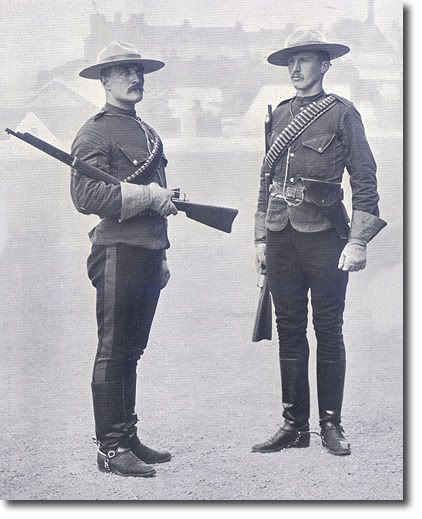
Look at these fellows on the left. Fit, proud, why wouldn't I want to emulate that rugged individualism in service. Note that these fellows, as are the men in the next photo, are holding the 1876 SRC!
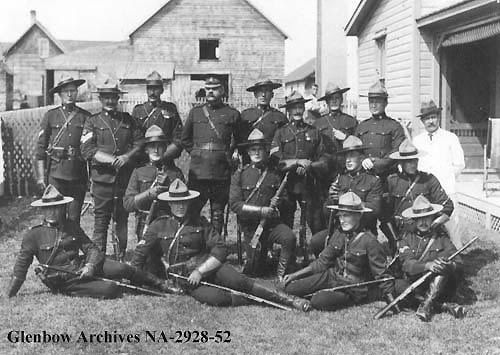


Of course the reality of the times was different. Mounties often worked together, sometimes in rather large (for Canada) units. They not only patrolled the back country but kept order in towns and along routes to the gold fields and they suppressed insurrections. I'm sure that the 1876 Saddle Ring Carbines (SRCs) that they carried were well worn for a reason! Still, I wanted one of those carbines.


Back in the day, Winchester was producing the very popular 1873 rifle and carbines which were chambered for the .44 WCF (aka .44-40) cartridge which moved a 200-220 gr. bullet at about 1200 fps. Experienced hunters know that this isn't exactly the first choice for game such as elk, bison or grizzly bear. Ned Roberts reports in his "The Man and the Boy" stories how his .44-40 was not nearly as good as his .45 muzzleloading double rifle in killing black bear due to the heavier bullets and larger powder charge of the "old fashioned" gun. So, hunters out in the western US were demanding and buying rivals of the Winchester just for hunting. Winchester wanted to compete in the marketplace and hence the 1876.


Produced from 1876 until 1886 approximately 63,871 1876s of all types were built. The last 1876 rifle left the factory in 1897 and was likely made up of various unused parts. Most popular among collectors (and bringing the highest prices) are the SRCs and the Express rifles. Some of this is due to the relative rarity of the two types. E.g. only 1600 SRCs were produced for the NWMP and at one point they reported only 970 some were functional! The English Express rifles (those in .50-95 often referred to as "cat guns") are even more rare.


Like all Winchesters of the era, a multitude of options were available. Some were produced in one configuration and returned to be modified (adding the dust cover to early guns was one popular modification) to another configuration. In some cases, they were pulled from stock and modified to meet an order. Add to that all the "parts guns" that were made up after regular production ceased in 1886 and one should expect a startling array of variations.
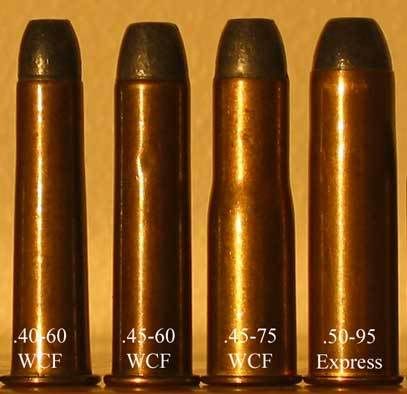


Longer (and heavier) than the 1873 but still using the same basic action design, the 1876 (called the Centennial because it was introduced in the 100th year of the USofA) couldn't handle the .45-70 Government cartridge. Winchester's fix was to use a fatter, bottle-neck cartridge of .45 caliber using a lighter bullet to nearly match the .45-70-405 cartridge's terminal ballistics. This it did. Winchester later produced the 1876 also chambered for 3 other cartridges as shown. Of course my gun had to be a .45-75 as were the NWMP guns. Unfortunately, this will make brass and ammunition difficult to find and more expensive than the .45-60 which can be formed from the cheap .45-70 Government cartridge.
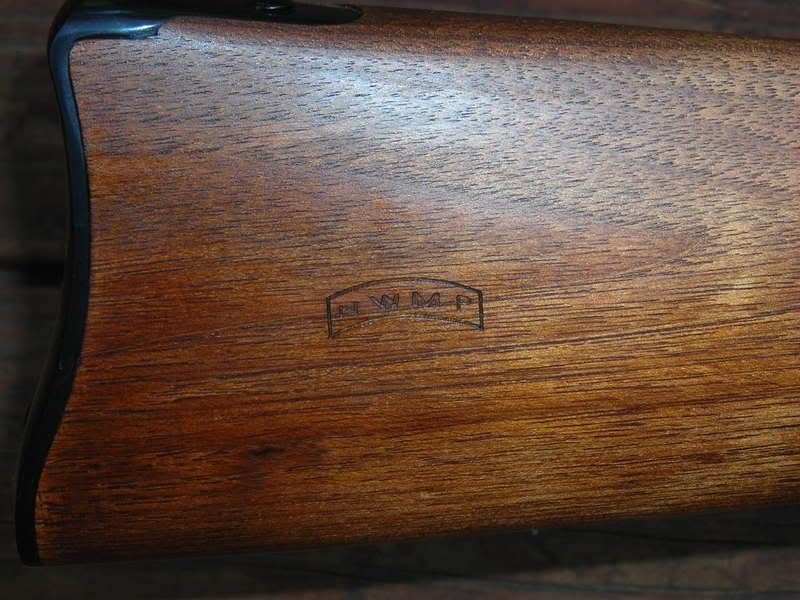


When the Parliament of the Dominion of Canada authorized the North West Mounted Police on May 23, 1873, to stop the liquor traffic among the Indians, they had to have rifles. The single-shot Snider-Enfield breech loader was sufficent cause for them to want a replacement and 50 of the 1876 Saddle Ring Carbines (SRCs) were tried in service. These were acquired through the I. G. Baker Company and 50 were in use by 1878. In 1880 another 100 guns were received. 300 of the SRCs came in the 1882 order and another 100 in 1883. In 1885, the largest group of SRCs was received by the NWMP, that being 446 guns. More were likely purchased but the records are incomplete. The marking shown in the photo to the right (as on the reproduction) wasn't uniformly applied so it might not be legible and some carbines don't have it at all. Later carbines had the "Spanish meter" sight which is very similar to the "military wind gauge" sight but not identical. Range markings on this sight are in meters. My reproduction has this sight as well as the NWMP stock stamp.


Now that I've received my gun I can tell you a little bit about it. The rifle weighs 8-1/2 lbs, has a 22 inch barrel and is otherwise as described. Of course it has the Italian proof markings but they are on the bottom of the receiver. Also on the receiver bottom are the serial number and rifle catalog number. The cartridge/chambering is marked on the barrel between the rear of the back sight and forward edge of the receiver. The barrel is also marked with the patent dates and the importer and maker name. Some folks might not appreciate their location or form but they are pretty unimportant to me.


The finish of the gun is pretty good. The oiled finish on the wood (walnut?) stock is average and seems to be in keeping with the original guns. Only the made-for-the-English guns had varnished furniture. The bluing is even and looks pretty good. There is a finish flaw on the loading gate where the rifle was loaded and test fired. This is mostly due to the different material/metal used for the spring steel loading gate. It should eventually wear to look like an original. The finger lever latch is very stiff. I haven't been able to turn it into position yet. Then again, I'm not forcing it and it isn't used when shooting.

Spanish Meter Sight
Sights are critical on any rifle and experience has shown that the issue sights on this gun need improvement. They might be correct as to dimensions compared to originals but they don't suit the rifle. The gun shoots way high and needs a higher front sight. This was initially remedied by building up the front sight with JB Weld and blackening it with a Sharpie. Classy, huh. I'd like to install a penny from the period of the same total sight height but haven't gotten to it. That will be some work and I want to know exactly how I will do it before starting any cutting. The rear sight is the Spanish Meter sight as specified by the NWMP. However, all the edges are a bit "soft" or rounded. I expect that it is a casting/injection molded part which was not so carefully buffed before bluing. I might take a file to it to "sharpen" the edges on the sight notches. It should look like this one on a Turnbull restoration.

Reloading/handloading is almost a requirement with the .45-75. Brass is the most critical and difficult to find component. There is properly headstamped brass out there. However, the influx of reproductions has created a surge in demand and stripped the market of most of this brass. If you find cases it might be a good thing to buy them then and there.


Of the properly headstamped brass, Venturino reported that the Bertram brass (which came un-necked) had to be reamed and fire-formed before use. I understand the the Bertram brass now comes formed. His fireforming load was 12 gr. of W231 under a .457" roundball. Mr. Venturino also notes that COL is critical. You can't be very far off before experiencing feeding problems.


Jamison International made a run of .45-75 brass and supplied both Buffalo Arms and Ten-X with the brass they use in making their ammunition (note: Ten-X is now using Bertram brass with a corresponding rise in cost). It has a good reputation for working in original and the Chapparal reproductions. Unfortunately for the .45-75 shooter, Jamison has some big government defense contracts and is concentrating on supplying those now and for the forseeable future. Usable brass can be made from several other currently manufactured cases.


The cheapest of these, although it is a seasonal production item, is .348 Winchester brass. Nonte says to do this: "Expand neck to hold .456" bullets: Trim to 1.88" length; Size full length; Fire form; use .456" bullets" but it is a bit more complicated than that. The details are what will get you on this and you can lose quite a bit of brass in the forming if you don't pay attention to the details. Venturino addresses this in some detail in Loading Leverguns of the Old West.


Brass can be had in two ways. One is that .348 Winchester cases can be formed by full length sizing them in a .45-75 die.


Venturino also says that these will get the shooter by, but are not perfectly correct for either the Model 1876's chamber or its extractor. The cases may form a slight bulge about 1/4 inch ahead of the rim, and sometimes an extracted case will fall back on top of the cartridge lifter instead of being ejected from the action. So, I don't know if results will be entirely satisfactory for all shooters in all guns. I think that you can do it relatively easily it being necessary only to trim to length, form, fire-form and load and the cases work in my carbine.


Paco Kelly gives his instructions thusly:


It is not a hard conversion because the .348 case is smaller by a hair in all dimensions except length. The only catch I found was after trimming when running the cut down .348 case thru the 45/75 die; first do it without the primer/neck sizer rod, then the second time do it with the rod in. that way you remove the small part of the tighter neck left after trimming without ruining the case. Also use a super slick case lube inside the neck area.

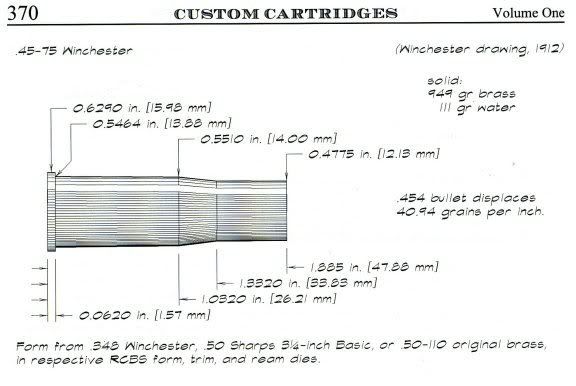
The 45/75 case length is 1.895" so the .348 case must be cut back to 2.0 inches. you need the extra 1/10th of an inch length because the case will shrink slightly in fireforming. so remove approx. .250" off the .348 case neck, chamfer well. Then run it thru the 45/75 die as described above.

The other dimenstions of the .348 case are very close to those of the 45/75. .348 rim diameter is .603", the 45/75 rim diameter is .616", the head diameter (just above the rim) of the .348 is .547" and the 45/75 is .560". the difference in size in both these measurements for the two above is about the same .013", the thickness of a thick human hair. So no problem.

Just like the rim thickness of the .348 is 065" and the 45/75 is .070" which is less than half a human hair difference. So then use a fireforming load. The .348 cases's beauty is its strength once made then it will last forever at 45/75 pressures. Remember, once fireformed the cases set the resizing die so it doesn't touch the new shoulder, ever.

45/75 CASE DIMENSIONS...
CASE LENGTH 1.895"
HEAD DIA. .560"
RIM DIA. .616"
RIM THICK .070"
NECK LENGTH.550"
CASE OVERALL LOADED LENGTH 2.25" CASE HOLDS 5 CCs OF WATER
Another brass source or alternative cases for forming the .45-75 are the .50-70, .50 Alaskan and .50-90 Sharps cases from Starline. I think the .50-70 forms up as too short (see far right case in the photo below) but the .50 AK case is 2.1" long and requires trimming only .22" and is cheaper than the much longer .50-90 Sharps.

Here's some dimensional info.

.348 Win.50 Alaskan.50-90 Sharps
Rim Diameter.603".6015".651"
Rim Thickness.0665".067".064"
Case Head Dia.546".545".5585"

Ok, to summarize the steps...
1 - trim .50-90 or .50 AK case to 1.90" using tubing cutter. Be careful because technique is required here as well.
2 - lube the case.
3 - run the case into the .45-75 full-length sizing die.
4 - anneal
5 - run the case through the expansion die
6 - remove lube (I use alcohol pads, I like ALL the lube off my cases).
7 - final trim
8 - LOAD!


Properly lubricated, a .50-90 case trimmed to 1.88" and run through the Lee full-length sizing die lengthens enough for a final trimming back to 1.88" but requires no fire-forming. Once a quantity of cases is made up one can do as Paco suggests and reset the die to just resize the neck (partial full-length resize) thus lengthening brass life. One important note about the .50-90 cases is that the rim diameter must be turned down to function through the magazine tube.


As to sizing it bears repeating that the shoulders in my chamber seem to be forward of those in the sizing die. This could result in working the brass excessively. I'm thinking that the rifle manufacturers used the original chamber dimensions from original rifles and the die makers used the cartridge dimensions as published by Winchester and, as with many BP cartridges of the time, there's some slop to allow for reliable functioning despite fouling. I will probably partial full-length size these cases. If you look at the 2nd and 3rd case from the left in the below photo you can see just what we are talking about here... (click on the photo to go to a larger version) The fired cases have a different shoulder configuration.
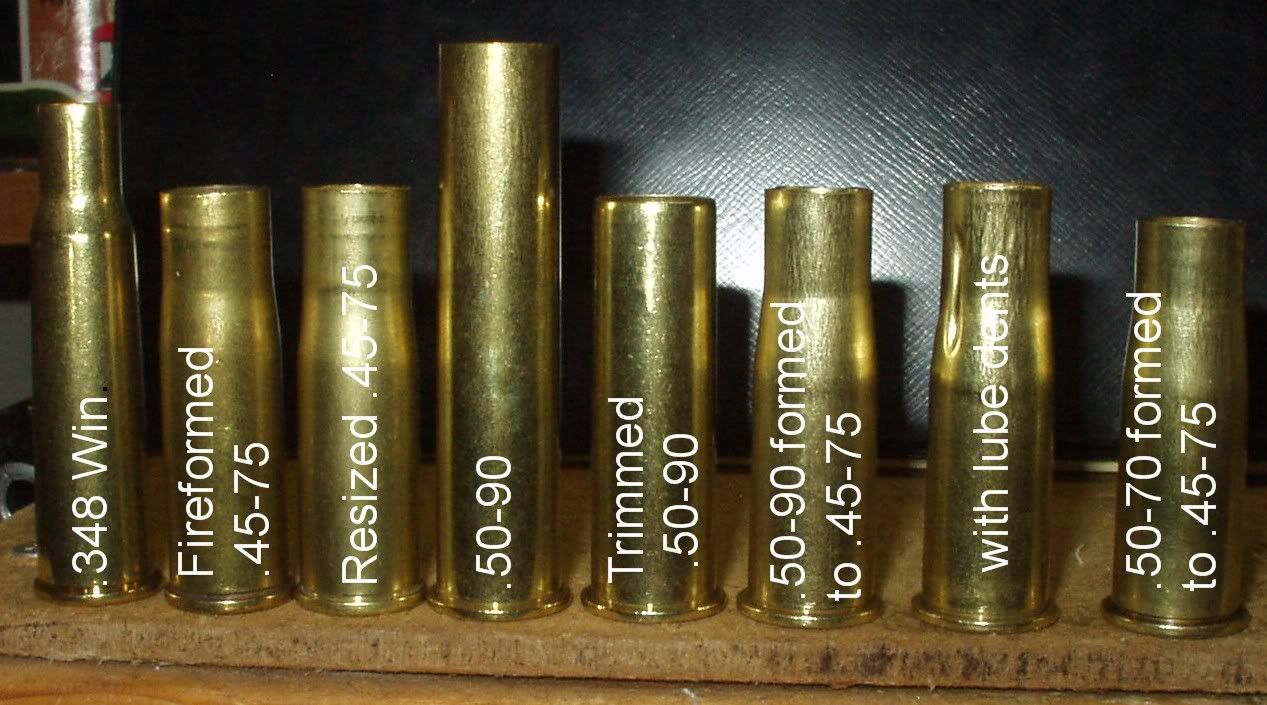


Anyway, dies are needed to work that brass. As I write this the Lee Pacesetter 3 die set is $25.99. Lyman's Classic set goes for $41.99, RCBS wants $229.99 for theirs. RCBS has the forming die set for .348 to 45-75 for $412.99. CH Tool & Die offers the 45-75 3-die set (includes FL sizer, expander and seater) for $101.45. For forming 45-75 brass from .348W, CH sells three step sized expander plugs for $13.30 each and $8 shipping. The expander die body only is $13.30. That is a total of $61.20, incl. shipping for the complete form die set.


Bullets are, of course, also a requirement. I was planning to use the Lyman 457122 (I understand that the FP mold number was 457192 and the HP is the 457122) from Mt. Baldy Bullets but will likely cast them myself. This is a hollow point, plain base bullet and 330 gr. but is of the correct length with the crimp groove in the correct place. I went ahead and purchased this mold and have high hopes for both the HP version and perhaps a solid/flat point version. The Lyman 457122 HP weighs 336 gr. cast of 1/20 alloy and as somebody else noted would, if not a hollowpoint (that is the Lyman 457192), duplicate the original bullet very closely. the good news is that we were able to get together a limited run of the Lyman 457192 and Lyman will be using the original cherry. Now that I've received my Lyman 457192 I'll be casting some bullets soon.


Venturino tried the RCBS 45-300FN and RCBS 45-325FN the latter of which is about the best weight 345 gr. cast from 1/20 alloy. BUT he says he got groups measured in FEET! One has to wonder why. I think .458" bullets are more likely correct. Venturino says that even the old originals all had .457" groove diameter. and so I've got some on the way from various sources. Other possible molds for this rifle are Lee's 457-340-F and 457-325-F. I've got one of the latter which I received via Chris C. They seem to do well but I've not yet done any group shooting. Will be switching to SPG to lube all bullets when my current stick of lube in the sizer runs out. Until then the cast bullets I lube will be used with smokeless only.


A short note about lube. Some correspondents are telling me that 1.5-1.7 gr. of lube will work with blackpowder. I suggest switching to SPG as that lube will work with all possible powders and simplify bullet preparation.


Powder is another requirement. I plan on using IMR SR4759, AA5744, IMR 3031, IMR or H-4198 and good old black powder. The action will not permit nor will I try to push velocities above original velocities. That would probably be 1200-1300 fps in the short 22 inch carbine barrel. I know that there is a lot of discussion out there about the choices of powders for this cartridge with some decrying the use of any smokeless powders and even some foolhardy individuals pushing the envelope. It seems to me that the loads used should not exceed 18K CUP although Brian Pearce expresses a different opinion in Lyman's 49th edition. Therein he states that the modern reproductions (he uses Chaparrals) 28K CUP is the upper limit. One should be able to duplicate original velocities with like weight bullets and thus equal original performance. That should be good enough for deer and black bear even if the ballistics aren't impressive by today's standards.


Crimping is another concern particularly for shooters using original bullets over smokeless powder. Why? Because the original bullets are designed to be crimped over the front band and the bullet supported by a case full (and compressed) charge of black powder. Smokeless won't fill the case and some fear that the bullet will be set back in the magazine resulting is an unintended and disastrous pressure increase. Orville C. Loomis in his article, "Shooting the .45-75 Model 1876" in the Summer 2001 issue of Blackpowder Cartridge News says that the crimp made by his original tool is very similar to that made by the Lee Factory Crimp Die (FCD). That being the case, one can order a FCD from Lee for less than $30. Chris C., Grizzly Adams and I have ours.


Suggested Loads (these come from various sources including Cartridges of the World, The Home Guide to Cartridge Conversions, The Legacy of Leverguns, Shooting Leverguns of the Old West, Blackpowder Cartridge News)and Lyman Reloading Handbook, 49th ed. however, I am not responsible for either the data presented or for your use thereof. You are on your own as to what is suitable and safe. Many experts recommend only blackpowder be used in original rifles and the reproductions are so new that I've not seen any comments on the subject from commonly accepted authorities.


BulletWeight PowderCharge Weight Velocity Energy
Lyman 4571223302400


20.0
unknownunknown
Lyman 457122330XMP5744


21.5
12801274
Lyman 457122330IMR4198


26.0
1310unknown
Lyman 457122330AA2015


41.0
1508unknown
Lyman 457122330Trail Boss


15.5
1212unknown
Lyman 457122330H4895


43.0
1480unknown
Lyman 457122330Triple7 FFG


36.7
1307unknown
Lyman 457122330GOEX FFg


70.0
14421524
Liberty 458-300FP 350IMR 3031


43.0
unknownunknown
Lead300IMR SR4759


24.0
13001126
Hornady HP300IMR SR4759


26.0
14001306
Lyman 456192350IMR 4198


24.0
13801480
Lasercast FP300IMR 3031


44.0
unknownunknown


I now have quite a bit of ammunition together and need to do more shooting! I've had the gun out shooting the fireforming loads as well as a few using bullets from an original Winchester mold sent to me by Grizzly Adams. Those bullets weighed 364 gr. lubed and sized and both they and my fireforming loads using 300 gr. jacketed bullets I normally use for the .45-70 seemed pretty accurate. While I didn't shoot them at targets I did use the crotch of a 3" diameter Sycamore about 80 yards distance on the upper bank of Mom's farm pond. This is a tree I'm going to have to take down anyway so topping it with the NWMP carbine was no problem for the environment and it was no problem with the rifle either. The sights held for horizontal dispersion as I could see the tree shake with every round but it was a bit difficult with that sighting point and the sights to hold the vertical. Now that I have a stock of 20-1 alloy, I'm looking to get some more bullets cast and take my current stock of 500+ cases and really give the gun a workout.


Because of the popularity of NCOWS and SASS cowboy action shooting and reenacting, Chaparral and Uberti have decided there is a market for reproduction rifles and carbines, and some producers have stepped in the breech as it were and offered the things necessary to cartridge reloading. Many resources can be found on the net. Here are a few.


On-line articles on the 1876 Winchester:
- The Winchester Model 1876 by Kirk Durston
- John Boy's info on forming and loading with BP
- Winchester Toggle Link 101 by Larsen E. Pettifogger


Books on the 1876 Winchester:
- The Winchester Book by George Madis
- Shooting Lever Guns of the Old West by Mike Venturino
- Winchester by R. L. Wilson
- Winchester Lever Action Repeating Firearms Volume 1 The Models fo 1866, 1873 and 1876 by Arthur Pirkle


Sources for all things 1876 Winchester:
- Buffalo Arms - brass, loaded ammunition (smokeless and blackpowder), bullets, dies, rifles
- CH Tool and Die - dies
- GAD Custom Cartridges - loaded ammunition
- Graf & Sons - brass, dies
- Midway USA - brass, dies, molds
- Mount Baldy Bullets - Lyman 457122 cast bullets lubed with SPG
- Nevada Western Firearms - exclusive sellers of the NWMP carbines in the USofA.
- Old West Reproductions - custom, authentic copy of NWMP saddle scabbard
- Ten-X Ammunition - loaded ammo (smokeless and Triple-7)


Please send your corrections, comments or additions to me, Hobie via e-mail.


UPDATE -- Rowdy Fulcher has made a neat video concerning his 1876 rifle. It is worth a look and posted here for your enjoyment.


Friday, January 09, 2009

Modifying .22 Rimfire Ammo

The cost of all ammo is up, even .22 LR. Folks are finding they feel to make do with the lower priced offerings. Some of these bullets are solids or not so effective hollowpoints. While this is fine for plinking and marksmanship training, the ammunition is less than effective on game. Consequently, some modification is needed. This is an old problem. One of the approaches was to create the "small game bullet" or SGB.

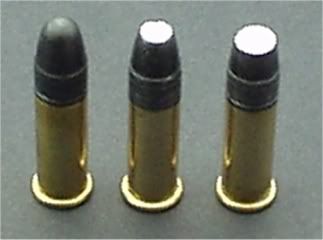
The SGB is simply a standard lead round nose (LRN) with a tip flattened. This dramatically increases effectiveness and some say, it improves accuracy as well. The concept has been so successful that CCI produces the SGB load for the .22 LR that uses a swaged bullet. There are other methods which shooters can use.

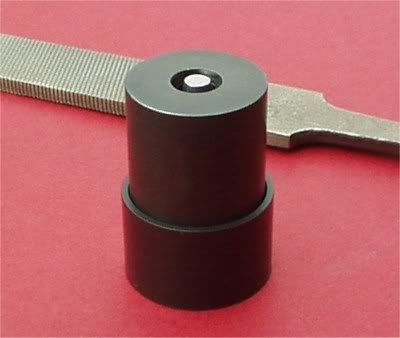
The first method used was filing or cutting the nose off. As you can see in the photo, different sizes of flat on the meplat (tip or nose of the bullet) can be achieved. The first tool available was the Hanned SGB Tool. Sadly, the Hanned Line has gone out of business and the tools are no longer available new. However, the concept is simple and a tool like the Hanned SGB Tool or Beljan Tool (shown here) is easy to make.

Using steel, round bar stock, cut to the length of a .22 Short, Long or Long Rifle round (as preferred). Drill/bore a hole the diameter of the cartridge through the length of the round. Counter sink one end for the cartridge rim. Adjust length as necessary to give the desire meplat size. Harden to resist file damage.

Actually, depending on how much use you actually want to get from the tool, most any material can be used, even wood. Also, you don't have to counter-sink for the cartridge rim. Beljan, who manufactured the tool shown, did not but instead created a nylon base which was cupped on both sides/ends and counter-sunk (that is the BASE had the counter-sink) to different depths to provide different meplat sizes (as you can see in the first photo).

These tools sold for $12-$39 but neither is available now. So, what is a fella to do? Well, there is an alternative!

Paco Kelly's ACU'RIZER is the thing. Using a die and plunger/piston, this die swages the bullet, still in the case, to both uniform OD dimensions and reform the bullet nose. There are more possible permutations than I can imagine. For me, the big hollow point, or Nasti-nose, and very slightly cupped flat point are the two biggies. Just as important is the ability to size the bullet to a size appropriate to your firearm. This can be particularly important to shooters of the convertible Ruger Single-Sixes which have bores better suited to the .22 WMRF.

Paco has redesigned his tool and had to redesign the fixtures at the same time. This is a great tool with great flexibility.

Links:
- Gunblast.com article Paco Kelly's ACU'RIZER

Dave Deering's Custom Bullets up and running...

Many folks on the various shooting forums know David Deering as StoneFence and have been using his custom swaged bullets for the .38-55 with complete success. That's a .38-55 Marlin 1893 that took down this deer with a Deering bullet in 2008.


Photo by Grace Koch

David started swaging his own jacketed .378" (also .375") bullets about 4 years ago as a hobby, because what he wanted wasn't available (at least at a decent price) in the marketplace. He's since added heavy .357 (190 grain) bullets for .357 Max, a .401" TCFP for .38-40 and 10mm, and new .431" 270 grainers for Marlin .444's. I've not seen the latest bullets but the .375" .38-55 bullets are beautiful in that they are well made, consistent, accurate bullets. They're so good that I just ordered another 300 and 300 of the 190 gr. bullets for the .357 Maximum. David is also thinking about doing a boat-tail spitzer (with small flat) in .338 cal for the new Marlin .338 Express-- there seem to be NO .338 levergun bullets out there anymore. I know that if you're a .33 Winchester shooter, you should drop David a line..

Custom Bullets
2528 3rd Ave. N.
St. Petersburg FL 337

david@custombullets.com

Also, look for David's ad in the January issue of Handloader Magazine.

Photo courtesy of Kirk Durston

There are no better bullets out there for the .38-55 than Dave's ESPECIALLY at that price! For years we couldn't find them at all (even the Barnes were practically unobtainium). I'll get 'em while I can!

Wednesday, January 07, 2009

Sources for Bullet Lead

My interest piqued for some reason and I went on a search, a quest perhaps, for a less expensive source of properly (not done by me) lead bullet alloy. I found the following:

- Mayco Industries
- MidwayUSA
- Rotometals, Inc.
- Sharp Manufacturing
- Widener's Reloading and Shooting

Tuesday, January 06, 2009

.45 ACP (also 9mm and .40 S&W) Charter Arms Revolver - UPDATED

Gun Pundit, Guns, Holsters and Gear and elsewhere but not at Charter Arms


A small, Bulldog sized .45 ACP revolver would be a good thing. If the Lipsey's .44 Flattop becomes a reality in my safe, I'd like to get a Bulldog .44 Special as well.

From PJ at MKS Supply Inc., Marketer for Charter Arms comes this
The rimless revolvers will not go into production until the first quarter 2009; expected delivery should begin in late February or early March (this is one of the reasons why there’s nothing on the web yet). Just like any other new innovations, it takes more time to make sure everything is as it should be. You’re more than welcome to check back with us at a later date to see if there are any updates to the scheduled production.
and this
Charter Arms’ New Revolutionary Rimless Revolver

Charter Arms, Dayton, OH, December, 2008 – Charter Arms announces the Charter Arms Rimless Revolver (CARR) a revolutionary new rimless revolver for popular semi-auto cartridges.


Problem: The major drawback to rimless semi-auto cartridges in revolvers is they require specially made revolvers. These low production, somewhat scarce and highly specialized revolvers are limited to sometimes fragile and expensive moon/half moon ammunition clips. Generally, only revolver aficionados and collectors bother with (.45 ACP and 9mm Parabellum) rimless revolvers. While they may sometimes be fired without the specialized moon clips, generally the ejector rod will not eject the free floating fired cases (got a pencil?).

Solution: Charter Arms has come up with an affordable revolver that chambers rimless semi-auto rounds in the same manner as a standard rimmed-cartridge revolver.

Available Calibers: Charter Arms will first offer the .40 S&W chambering (see availability below) followed by the .45 ACP and 9x19 mm Parabellum (the 9mm Parabellum revolver will also chamber factory .380 ACP). All three of Charter Arms’ Rimless Revolvers (9mm, .40 S&W and .45 ACP) are rated for higher velocity +P loadings.

The advantage is now the average gun owner can own an affordable, trouble free revolver chambered in these popular semi-auto rounds without the need for specialized ammunition clips and a specialized gun.

Back up and self defense: For law enforcement work the always ready-to-fire, fiddle-factor-free revolver is the back up to have; especially if is the same caliber as the officer’s carry gun. As a primary self defense carry gun, these three calibers mean reliable protection in popular semi-auto self defense-calibers.

If more power is needed, step up to +P ammo. The advantage with Charter Arms Rimless Revolvers is they will fire any mix of cartridges while maintaining 100% reliability. For plinking with .45 ACP or 9mm surplus and discounted military type ammo, the affordable Charter Arms Rimless Revolver will prove to be very economical and it’s also a .380 ACP revolver. Now that is fun!

The secret is the patent pending Charter Arms Rimless Revolver Round System. Basically, when a round is loaded into the chamber a specialized spring engages the cartridge’s ejector groove. When the cylinder is opened and the ejector rod operated, it extracts and ejects the fired cases.

Models: Initially snub barrels (2” 9mm and 2.2” .40 S&W and .45 ACP) as these revolvers are designed for self defense and back up. The 9mm is built on Charter Arms’ compact and lightweight undercover platform featuring an aluminum frame and weighing only 12 ounces. The .40 S&W and .45 ACP built on the popular and robust Bulldog frame due to the larger diameter of these cartridges while maintaining a compact profile.

Availability: First quarter of 2009 the .40 S&W will be available, about 90-120 days later the .45 ACP and 90-120 days after the .45 ACP will come the 9mm. Please see above models for more information.

Warranty: Charter Arms has an industry exclusive lifetime warranty on its revolvers.

MSRP Prices: 9mm $399.00, .40 S&W $449.00, .45 ACP $449.00


The debut of this model has been delayed (quel suprise!) reportedly due to delays in patent filing. I don't know about that, but it is a concept that many like and we hope that Charter can pull it off.


Still no sign of this gun and don't hold your breath.  Apparently Charter Arms discovered that they would be violating a patent held by a competitor.  I suppose that will kill it.   We'll see...


I heard it is on again... Might turn blue waiting though...

Monday, January 05, 2009

Merrill Carbine

A poster on leverguns mentioned that he'd shot a Merrill carbine this past weekend. It sometimes pays to have one's chronograph out and working!

The one illustrated here comes from a listing at Sharpsburg Arsenal.
Merrill Carbine 2nd Model
Serial #156xx. 54 Caliber. All metal surfaces with the exception of the rear sight are void of any bluing. Markings are all sharp and clear. The rear sight has approx. 80% of original blue. The lock is dated "1863". The brass butt plate, trigger guard and barrel band do not appear to have ever been cleaned. Walnut stock is in good condition with the normal handling marks that come with issued carbines. There are 2 good visible cartouches on the stock flat. The bore is very good. All components are 100% original. Overall an above average example.
$3295.00 - DG101
I wanted to include a good close up so that you might have a better idea about appearance and function.

According to Rifles of the World, a metallic cartridge version was tested in 1865. By all accounts that I can find, the Federals didn't like the carbine (although it was considered "accurate") but the Confederate States soldiers did and used them throughout the war (after 1862) as they did many other captured arms.

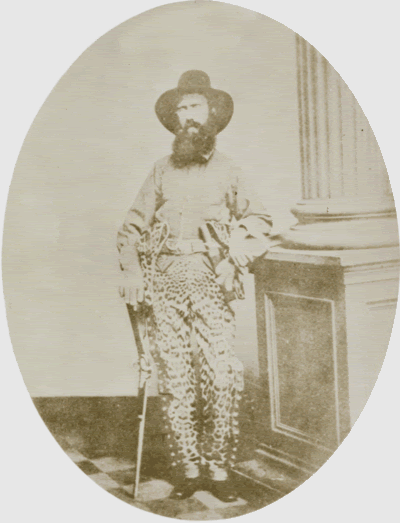
This nattily dressed (probably in Jaguar skin pants and holsters) gentleman is Captain Samuel J. Richardson, commander of Company F, 2nd Texas Cavalry (2nd Mounted Rifles).  Captain Richardson's photograph is housed in the collections of the Museum of the Confederacy and was reproduced in The South Besieged; The Image of War 1861-1865 by the National Historical Society (1983). He appears to have a Merrill carbine!  While it is likely that the photo was taken early in the war, before he wore out the pants, it is possible that he has one of the carbines captured in the vicinity of Harpers Ferry.  Even if it isn't a Merrill, the photo is just too darn interesting due to his attire to not post.  You've got to admit, that man has a certain "style"! 


Links:
- Shooting Merrill's Carbines by Tony Beck

Sunday, January 04, 2009

What is old is new again... flashlights on pistols

Developed and patented by George Seeley in 1912, hence the big S. There were similar designs marketed by other folks, including one that clamped on top of the barrel and had a mercury switch in it so that when the gun was unholstered the light came on. I have old advertisements from Europe that shows candle mounts for revolvers. (courtesy kwill on the Colt Forum)

Saturday, January 03, 2009

Unarmed Self-Defense

While I've talked about guns and knives I've never mentioned unarmed self-defense. While I fully support avoiding any problems as a first step and have no problem with somebody using gun or knife to defend themselves, sometimes one isn't able to have a gun or knife with you. It might be in a government building such as a school or courthouse (or enroute in or out to your transportation) that you are attacked. Knowing how to resist might be the difference between life and death for yourself and others.

Today, I had a short conversation with somebody on another subject and Imminent Threat Defense Systems, LLC was mentioned. Located in Ransomville, NY, they will go anyplace where 12 or more are gathered together.

Saturday, December 27, 2008

My Soon-to-Be AR-15

I recently purchased a Del-Ton stripped lower receiver and ordered a parts kit and upper. Apparently, an EBR was in my future and I'm fulfilling my duties as a member of the unorganized militia. I should have gotten it in January 2008 but didn't. So, now, I'll play the waiting game just like everyone else. One thing though. I've got primers and powder. Another thing is that my ideal didn't change over the intervening months. That kinda surprised me. Perhaps there was more reason in my thought process than I thought.

Sunday, December 21, 2008

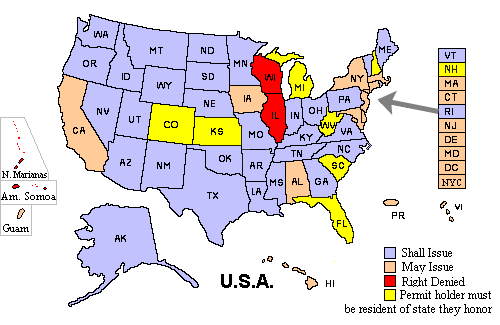
Concealed Carry Map

From Handgun Law is this map showing the "shall issue," "may issue" and "don't issue" states with a few comments besides.

Saturday, December 20, 2008

Stock Making from Scratch by Marlinman93(Vall)

On Paco Kelly's Leverguns Forum, Marlinman93 (Vall) has posted his method of creating a pattern for creation of a stock on a stock duplicator. Re-published here with his permission, the series will be combined in this one article.

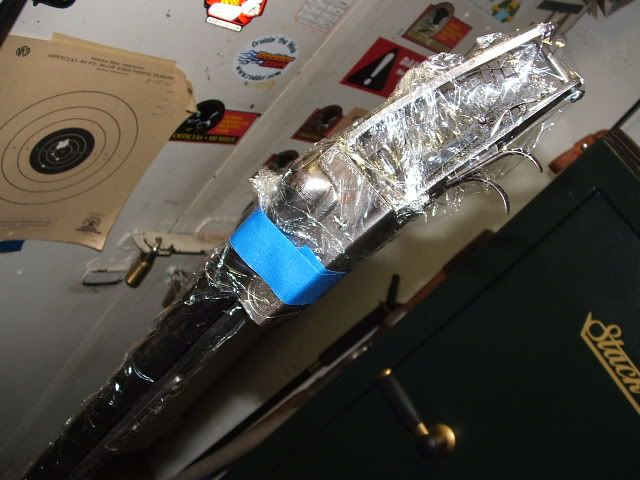
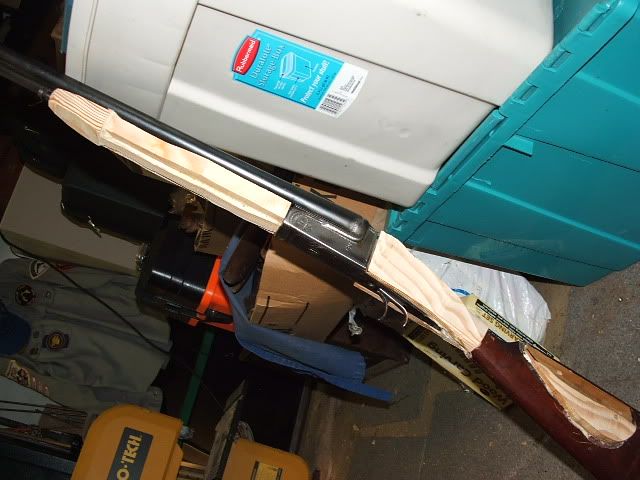
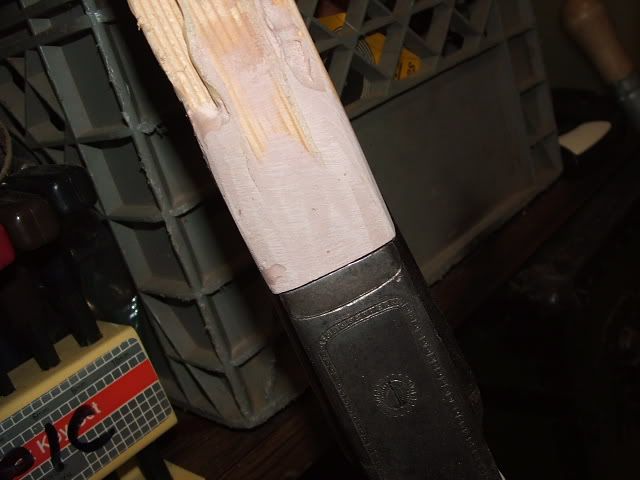
This will be long and drawn out, as it takes time between steps waiting for things to dry. I'm in the process of building a set of stocks for my double gun project, and thought I'd take some pictures to describe how I do it. Not sure how others do it, but this has been my method. I start by building the stocks from the inside out. This way I can fit pieces next to the action and barrel, rather than carving out a stock and then cutting in the inletting.

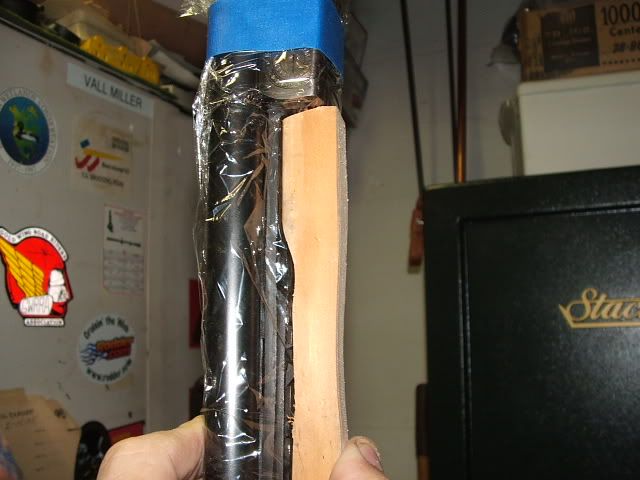
I start by covering the entire area with good quality plastic wrap. Tape it in a couple places to keep it in place:


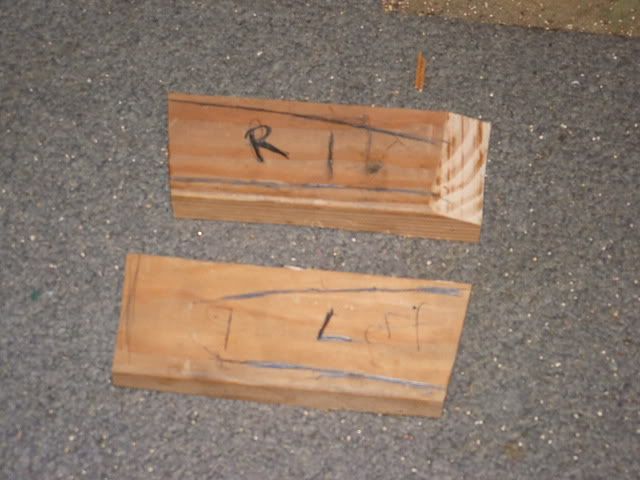
Next I get some soft fir or other wood that is easily cut and shaped. I fit the wood in pieces around the metal, and glue the pieces together with Gorilla glue. Don't worry about a perfect fit, as that will be the last step before sanding:


The forearm will be done in 4 pieces. Three for the bottom, and one for the tip:


The buttstock will end up being a lot of small pieces and one large piece:


Tape and rubber bands work well to hold it all together while the glue sets up:


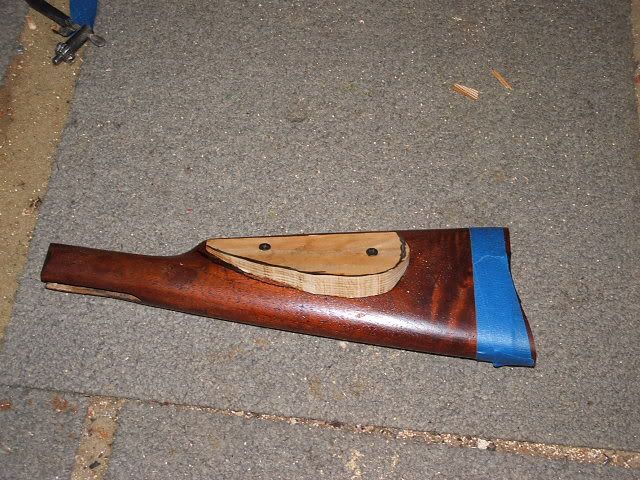
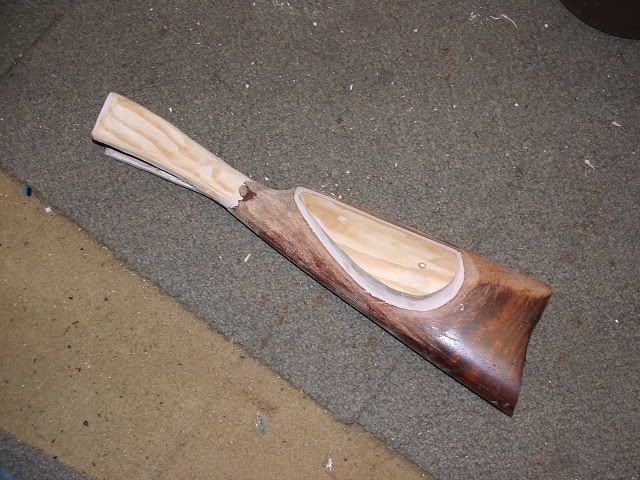
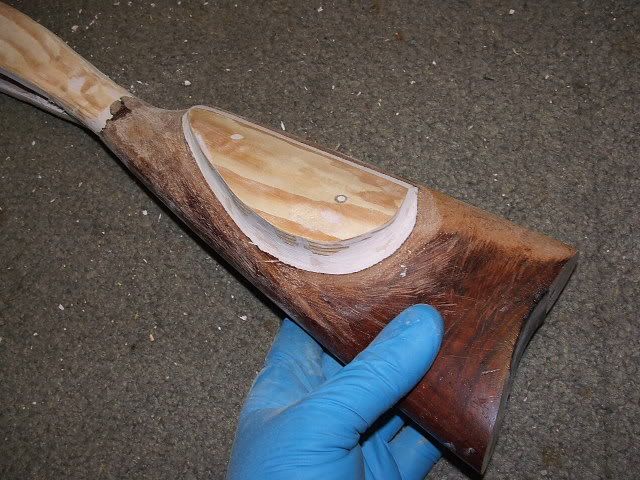
On this project Im using a donor stock (old Marlin 27) so I wont have to carve all the shape. I want a cheekpiece, so I cut one out on the band saw and glued it on. The screws will be removed when the glue sets up:


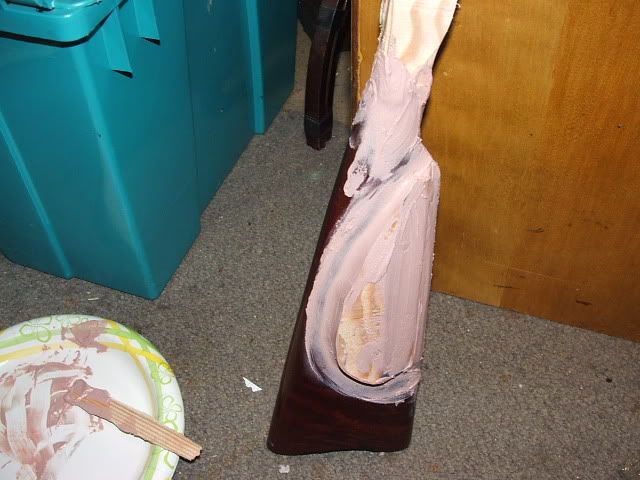
When all this dries I'll attach the stock to the pieces already fitted, fill in some more pieces, and then final fit the wood to the action using plain old body filler. I'll also mold in the cheekpiece and buttstock using the same. When it's done I'll have a perfect pattern to send to the duplicator.

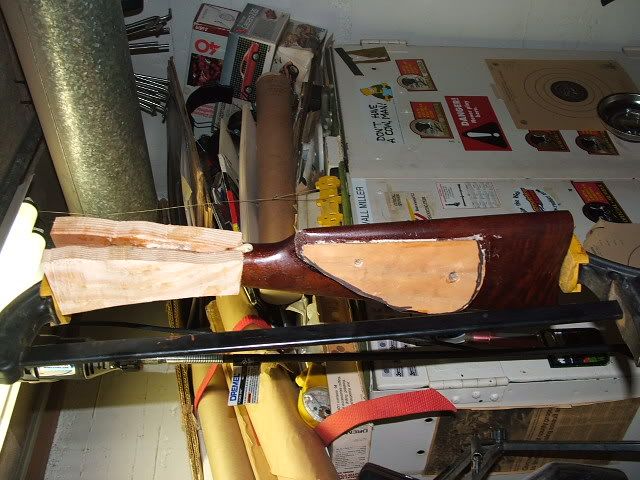
I fitted pieces of wood to the action and forearm and have them close. I installed the cheekpiece and donor stock to the inletted fir pieces.


Next I bondo the wood to the action and bondo the cheekpiece into the stock.


After drying I rough shape the bondo with a coarse rasp, and later I'll do final filling and sand to a close finish.


It doesn't need to be perfect for a pattern, but the closer the better, as that saves woodwork later!


The forearm is next to get a few more pieces of wood, and then final shaping with bondo and a rough rasping. Here it's fitted to the receiver, and will be shaped the rest of the way when the fit is perfect.

Friday, December 19, 2008

Slingshots

Slingshots can certainly be useful tools. David used one to slay Golaith. The Egyptians had whole units of slingers. Over the years the design has gotten more high-tech due to the introduction of elastic rubber as the propulsive force rather than the centrifugal force of slinging the projectile in a large arc before releasing it at the target. In consequence, some have given them other names such as bean shooter. A while back I think I posted on this weapon used by youth gangs in Timor.

Quite something, these utilize the modern elastic force and require, perhaps, a little less skill/practice for effective use.  I bet these could be used for hunting.  However, you'd want to find your dart.  After all, you'd have considerable fabrication time or money tied up in each one. 

One could use lead balls (shot) or nuts (such as go on bolts to become fasteners).  We used nuts from our supply sources together with Wrist Rockets to kill ground squirrels on Fort Hunter-Liggett, CA.  Effective (when contact was made) cheap, silent, concealable and untraceable. 

Rocks as projectiles are a whole different story.  They can be found in appropriate sizes most anywhere.  Rocks cost nothing.  They carry no ballistic information whatsoever (except for the trace they pick up on contact with the target).  Think they aren't viable?   Look at this video of Rufus Hussey and his bean shooter. That is impressive.

Tuesday, December 16, 2008

Baxter Black - Just a Dog

If you have a dog, odds are you'll outlive them. Baxter says it well...

Saturday, December 13, 2008

Life Experience

A silly thing but I thought it might turn out to have useful info for the grandchildren...

1. Started your own blog. Yes, this here journal intended for your edification.
2. Slept under the stars. Many nights, maybe too many, maybe not enough. Stars are nice even in the cold. Clouds can be ok. Wet is just nasty.
3. Played in a band. Music is not my thing...
4. Visited Hawaii. On a jet plane and only long enough to go on across the pond. Dittos for Alaska although we did get off the plane while it refueled.
5. Watched a meteor shower. Who would not run outside to watch a meteor shower?
6. Given more than you can afford to charity. Accidentally. I gave what I thought was reasonable only to discover it was more than I should have done.
7. Been to Disneyland. If Disney WORLD counts. If so I've been there 4 too many times.
8. Climbed a mountain. I take it this is a named mountain and not restricted to Mount Everest, Mont Blanc or some such...
9. Held a praying mantis. They are all over the place here in late summer.
10. Sang a solo. I was often ordered by the music teacher to lip-synch so that nobody would hear me. That's just how badly I sing. Beat out Milli-Vanilli by many years but was never chastised for it!
11. Bungee jumped. There is no reason on earth to trust your life to a minimum wage worker and a rubber-band.
12. Visited Paris. Well, I rode a bus through the outskirts.
13. Watched a lightning storm at sea. Does looking out over the ocean from land during a hurricane count?
14. Taught yourself an art from scratch. Art=singing=no, dittos for artistic drawing.
15. Adopted a child. She didn't want to be adopted but my step-daughter is my daughter...
16. Had food poisoning. Not really but I've had gastro-intestinal discomfort on an epic scale!
17. Walked to the top of the Statue of Liberty.
18. Grown your own vegetables. Yep, but that was in spite of my efforts.
19. Seen the Mona Lisa in France.
20. Slept on an overnight train.
21. Had a pillow fight. A looooooong time ago...
22. Hitch hiked. I was walking the 13 miles home (was between King City and Greenfield) from my broken down car and several migrant workers picked me up and dropped me at my exit. I still remember and am still grateful. Gracias.
23. Taken a sick day when you’re not ill. Yes, but I was sick of work.
24. Built a snow fort. Where I lived, EVERYBODY my age who was physically able to has built a snow fort.
25. Held a lamb.  Yes.
26. Gone skinny dipping.  At Pfeiffer Beach for one...
27. Run a Marathon.
28. Ridden in a gondola in Venice.
29. Seen a total eclipse.
30. Watched a sunrise or sunset. Many, most due to sleeping under the stars!
31. Hit a home run.
32. Been on a cruise. And I might get forced into doing it again but it won't be willingly going!
33. Seen Niagara Falls in person. 5 times now.
34. Visited the birthplace of your ancestors. Of course.
35. Seen an Amish community. Visited several times and always ate well.
36. Taught yourself a new language. I think that is impossible for me to teach myself but I have learned some Mandarin (WAS literate), Korean, French, and American Sign Language. It is difficult to teach oneself language, you need to learn to think it, a hard thing for me to do on my own.
37. Had enough money to be truly satisfied. I'm there right now. To be well fed, warm, dry and able to study the things that interest you, that is a good life.
38. Seen the Leaning Tower of Pisa in person.
39. Gone rock (wall) climbing. And rappelling (abseiling).
40. Seen Michelangelo's David.
41. Sung karaoke. Did you miss my comment on singing?
42. Seen Old Faithful geyser erupt. In a thunderstorm. A boy scout was struck by lightning. A magnificent juxtaposition of all of nature's power at one place and time. The scout lived.
43. Bought a stranger a meal at a restaurant.

44. Visited Africa.
45. Walked on a beach by moonlight. Asilomar in 1974, Ormond several times between 1989 and 2005.
46. Been transported in an ambulance.
47. Had your portrait painted/drawn. A characterture.
48. Gone deep sea fishing.
49. Seen the Sistine Chapel in person.
50. Been to the top of the Eiffel Tower in Paris.
51. Gone scuba diving or snorkeling.
52. Kissed in the rain. But not often enough. Women do not consider me a good kisser. Don't kiss men.
53. Played in the mud.
54. Gone to a drive-in theater. Among others I saw "The Exorcist" in a drive-in.
55. Been in a movie. "Lights of Inchon" as an extra but I'm probably on the cutting room floor.
56. Visited the Great Wall of China.
57. Started a business.
58. Taken a martial arts class.
59. Visited Russia.
60. Served at a soup kitchen.
61. Sold Girl Scout Cookies. However, I've done my bit by buying and eating a ton of the Thin Mints.
62. Gone whale watching.
63. Got flowers for no reason. Yes, I remember that...
64. Donated blood, platelets or plasma. Some crummy fever I had in Korea was reason not to accept my blood.
65. Gone sky diving. And I won't as long as every plane I fly in is still flying.
66. Visited a Nazi Concentration Camp.
67. Bounced a check. Only because the BANK didn't credit my deposit within 5 days.
68. Flown in a helicopter. Many, many times. Jumped from the skid and rappelled from one, too.
69. Saved a favorite childhood toy. Crafield, the stuffed bear. Well, really, my mom saved him.
70. Visited the Lincoln Memorial.
71. Eaten Caviar.
72. Pieced a quilt.
73. Stood in Times Square. I have now (2011). Not that great a thing.
74. Toured the Everglades.
75. Been fired from a job.
76. Seen the Changing of the Guards in London.
77. Broken a bone. Broke my wrist on an obstacle course.
78. Been on a speeding motorcycle. Drove a speeding motorcycle.
79. Seen the Grand Canyon in person. AND floated on the Colorado River, twice.
80. Published a book. I've been quoted in a book.
81. Visited the Vatican.
82. Bought a brand new car. Several times.
83. Walked in Jerusalem.
84. Had your picture in the newspaper. Servicing a HMMVW just prior to a big snow storm and teaching school kids about the Army.
85. Read the entire Bible. Hasn't every Christian? Seriously, it was a project.
86. Visited the White House. Took the tour.
87. Killed and prepared an animal for eating. Several.
88. Had chickenpox.
89. Saved someone’s life. And been saved.
90. Sat on a jury. Not yet although I return the questionnaire in a timely manner.
91. Met someone famous. Penn and Teller, John O. Marsh (Secretary of the Army), Edgar and Mrs. Bergen, several of the Statler Brothers, several authors and artists...
92. Joined a book club. I suppose everybody can be that stupid.
93. Lost a loved one. Way too many. I doubt that as I age the rate of loss will decline, unless of course I go first.
94. Had a baby. Well, not me personally, but I do have children.
95. Seen the Alamo in person. A lifetime highlight.
96. Swam in the Great Salt Lake. I've SEEN The Great Salt Lake. My understanding is that few want to swim in it anymore.
97. Been involved in a law suit. Testified.
98. Owned a cell phone. Only this past year and only because I HAD to.
99. Been stung by a bee. I'm sure I'll be stung a few more times, too, although I am getting better at avoiding it.
100. Read an entire book in one day. I've read more than one in one day.

Friday, December 12, 2008

Is an EBR in my future?

Acquaintance has an "extra" Del-Ton stripped lower receiver (yes, AR-15 type) for sale. Asked if I'd be interested. Maybe. Looked at the options for the rest of it at Del-Ton.
16" M4 Rifle Kit
- DTI 16" M4 1x7 Chrome Lined
- CAR Handguard with Heat Shields-Black
- Standard Bolt & Carrier
- M4 Buttstock - Black
- A2 Grip - Black
- No Carrying Handle
- A2 Flash Hider
- Single Rail Gas Block
- Standard Lower Parts
- Standard Charging Handle
- Flat Top Upper with T-Marks
AR-15 Multi Tool
AR-15 Lower Receiver Vice Block
Flip Up Front Sight for Gas Block
Flip Up Rear Sight

What I want is a carbine that will shoot the heavy bullets and take a scope without having to look at the front sight in the sight picture. Still want "irons" just in case. I might just put a Weaver 2½X on it and get another scope for whatever I steal the Weaver from. I get the impression from looking at all the various "makes" that this stuff is very much commodity as opposed to any real differences depending on brand. Frankly, after years of dealing with the M16A1 and A2 in the position of armorer (or pseudo-armorer/supply sergeant/only person left at the point of contact) I'm not exactly wound up about the high-tech modern plug and play gadgetry that is out there. I do believe I have a sling, cleaning kit, BFA and muzzle cover on hand.