Many people have questions as to the date of manufacture or age of their Winchester Model 1894 and Model 94 rifles and carbines. There are a number of references, some with conflicting information. I am making this information available partially to save a copy for myself! It is up to the collector to use and properly interpret the information provided.
You can contact the Records Office of Cody Firearms Museum at the Buffalo Bill Historical Center. The Cody Firearms Museum holds the records of 3.5 million individual Winchester firearms and many LC Smith and Marlin firearms.
Information that may be in a record includes the date the gun was received into the warehouse, the configuration of the gun, and the date the gun shipped out. The company to whom the gun was sent may be available for very late Model 1873s and 1886s and most of the run of the Model 21. There are no records for the Models 42, 12, 54, or 70.
There is a charge for Factory Letter information but this and any other questions should be answered by contacting the Records Office.
Cody Firearms Museum Records Office
720 Sheridan Avenue
Cody, Wyoming 82414
307-578-4117
cfmrecords@bbhc.org
www.bbhc.org/firearms/records.cfm
Winchester 1894/94 Serial Number List
Determining date by serialization has become confusing as it has been determined by the staff of the Cody Firearms Museum that previous work by George Madis is incorrect. This is not due to the quality of work performed by Mr. Madis, but by the questionable data provided to him. The following list includes the data held at the Buffalo Bill Historical Center in Cody Wyoming (CFM) and the previously understood figures (Madis). It is up to the collector to make the best use of this data that they can.
1894 end of year serial number was 1674 (CFM), 14579 (Madis)
1895 end of year serial number was 14222 (CFM), 44359 (Madis)
1896 end of year serial number was 18571 (CFM), 76464 (Madis)
1897 end of year serial number was 33108 (CFM), 111453 (Madis)
1898 end of year serial number was 53941 (CFM), 147684 (Madis)
Any gun manufactured prior to January 1, 1899 is legally an Antique and is not affected by any federal regulations regarding the ownership or transfer of firearms.
1899 end of year serial number was 80148 (CFM), 183371 (Madis)
1900 end of year serial number was 103932 (CFM), 204427 (Madis)
1901 end of year serial number was 137058 (CFM), 233975 (Madis)
1902 end of year serial number was 168420 (CFM), 273854 (Madis)
1903 end of year serial number was 204565 (CFM), 291506 (Madis)
1904 end of year serial number was 249782 (CFM), 311363 (Madis)
1905 end of year serial number was 291706 (CFM), 337557 (Madis)
1906 end of year serial number was 331895 (CFM), 378878 (Madis)
1907 end of year serial number was 381524 (CFM), 430985 (Madis)
1908 end of year serial number was 429757 (CFM), 474241 (Madis)
1909 end of year serial number was 449102 (CFM), 505831 (Madis)
1910 end of year serial number was 479073 (CFM), 553062 (Madis)
1911 end of year serial number was 534429 (CFM), 599263 (Madis)
1912 end of year serial number was 591281 (CFM), 646114 (Madis)
1913 end of year serial number was 645304 (CFM), 703701 (Madis)
1914 end of year serial number was 722280 (CFM), 756066 (Madis)
1915 end of year serial number was 825186 (CFM), 784052 (Madis)
1916 end of year serial number was 840846 (CFM), 807741 (Madis)
1917 end of year serial number was 873425 (CFM), 821972 (Madis)
1918 end of year serial number was 882032 (CFM), 838175 (Madis)
1919 end of year serial number was 895365 (CFM), 870762 (Madis)
1920 end of year serial number was 926851 (CFM), 880627 (Madis)
1921 end of year serial number was 935778 (CFM), 908318 (Madis)
1922 end of year serial number was 951501 (CFM), 919583 (Madis)
1923 end of year serial number was 964709 (CFM), 938539 (Madis)
1924 end of year serial number was 974121 (CFM), 953198 (Madis)
1925 end of year serial number was 987148 (CFM), 978523 (Madis)
1926 end of year serial number was 997938 (CFM), 997603 (Madis)
1927 end of year serial number was 1012753 (CFM), 1027571 (Madis)
1928 end of year serial number was 1038665 (CFM), 1054465 (Madis)
1929 end of year serial number was 1060899 (CFM), 1077097 (Madis)
1930 end of year serial number was 1071420 (CFM), 1081755 (Madis)
1931 end of year serial number was 1079689 (CFM), 1084156 (Madis)
1932 end of year serial number was 1088141 (CFM), 1087836 (Madis)
1933 end of year serial number was 1092328 (CFM), 1089270 (Madis)
1934 end of year serial number was 1095364 (CFM), 1091190 (Madis)
1935 end of year serial number was 1099625 (CFM), 1099605 (Madis)
1936 end of year serial number was 1119104 (CFM), 1100065 (Madis)
1937 end of year serial number was 1158835 (CFM), 1100679 (Madis)
1938 end of year serial number was 1198405 (CFM), 1100915 (Madis)
1939 end of year serial number was 1216165 (CFM), 1101051 (Madis)
1940 end of year serial number was 1259563 (CFM), 1142423 (Madis)
1941 end of year serial number was 1313301 (CFM), 1191307 (Madis)
1942 end of year serial number was 1343183 (CFM), 1221289 (Madis)
1943 end of year serial number was 1343190* (CFM), 1267741* (Madis)
1944 end of year serial number was 1343196 (CFM), 1314193* (Madis)
1945 end of year serial number was 1352066 (CFM), 1360645* (Madis)
1946 end of year serial number was 1407097* (Madis)
1947 end of year serial number was 1453549* (Madis)
1948 end of year serial number was 1500000 (Madis)
1949 end of year serial number was 1626100 (Madis)
1950 end of year serial number was 1724295 (Madis)
1960 end of year serial number was 2469821 (Madis)
1963** end of year serial number was 2586000 (Madis)
1964*** end of year serial number was 2700000 (Madis)
1965 end of year serial number was 2894428 (Madis)
1966 end of year serial number was 2991927 (Madis)
1967 end of year serial number was 3088458 (Madis)
1968 end of year serial number was 3185691 (Madis)
1969 end of year serial number was 3284570 (Madis)
1970 end of year serial number was 3381299 (Madis)
1980 end of year serial number was 4892951 (Madis)
1981 end of year serial number was 5024957 (Madis)
1982 end of year serial number was 5103248 (Madis)
Estimate after 1982 by adding 100000 per year.
* Some serial numbers produced during and after World War II were not recorded. These serial number figures assume an equal number produced each year of these gaps in the record.
** 1963 saw the end of the classic Winchesters made with hand-finished cast parts.
*** 1964 began with 2700000 and ended with 2797428. Numbers 2586001 through 2699999 were not used.
Website
http://www.bbhc.org/firearms/
http://armscollectors.com/sn/winlookup.php
Correction to Kennedy's Information
The following Corrections to David Kennedy's data given about are submitted by:
TexasBear10@netscape.net
7/10/2010
The information by David Kennedy and posted here are of great value to Winchester collectors and the following corrections should in no way take away from his valuable work. He is now aware of this error and has not had time to make a correction. He just assumed that the tables published by others were taken from Madis information.
The dates attributed to Madis by Kennedy do not agree with those in Madis' books: The Winchester Book & Winchester Handbook. They do agree with the dates in Schwing, Pirkle (and most "Others") books & tables. The differences are:
1894: 1674 (CFM); 14579 (attributed to Madis, really "Others" 14759 (actual Madis)
Notice the transposing of the "57" and "75" in these dates? Which is correct?
Then in 1933 the dates attributed by Kennedy to Madis start varying from what is published in his books, and by 1936 take a major deviation:
1933: 1092328 (CFM), 1089270 (attributed to Madis, really "Others") 1,089,271 (actual Madis)
1934: 1095364 (CFM), 1091190 (attributed to Madis, really "Others") 1,091,192 (actual Madis)
1935: 1099625 (CFM), 1099605 (attributed to Madis, really "Others") 1,099,608 (actual Madis)
1936: 1119104 (CFM), 1100065 (attributed to Madis, really "Others") 1,112,194 (actual Madis)
1937: 1158835 (CFM), 1100679 (attributed to Madis, really "Others") 1,138,781 (actual Madis)
1938: 1198405 (CFM), 1100915 (attributed to Madis, really "Others") 1,169,370 (actual Madis)
1939: 1216165 (CFM), 1101051 (attributed to Madis, really "Others") 1,197,211 (actual Madis)
1940: 1259563 (CFM), 1142423 (attributed to Madis, really "Others") 1,238,584 (actual Madis)
1941: 1313301 (CFM), 1191307 (attributed to Madis, really "Others") 1,287,648 (actual Madis)
1942: 1343183 (CFM), 1221289 (attributed to Madis, really "Others") 1,317,830 (actual Madis)
1943: 1343190* (CFM), 1267741* (attributed to Madis, really "Others") 1,348,192 (actual Madis)
1944: 1343196 (CFM), 1314193* (attributed to Madis, really "Others") 1,378,554 (actual Madis)
1945: 1352066 (CFM), 1360645* (attributed to Madis, really "Others") 1,408,916 (actual Madis)
*Some serial numbers produced during and after World War II were not recorded. These serial number figures assume an equal number produced each year of these gaps in the record.
Also, the numbers given by Kennedy, attributed to Madis, for 1951 - 1962 are those given by "Others," not Madis.
Bert Hartman, a moderator on Gunbroker's "Ask the experts" for many years, has spent for the past 5 years at least two weeks a year with a volunteer at the Cody Museum of Firearms research room. This is is what he says.
"A bored mind is a terrible thing to waste, so having some free time to kill, I finally put together a fact sheet on the true production ratios and the verified DOMs for the Winchester Model 1894/94.
As many of you will undoubtedly note, the figures I have compiled below vary significantly from the numbers published by George Madis in his tomes "The Winchester Book" and "The Winchester Handbook". All of my statistical numbers were derived from a detailed survey (conducted by the Cody Firearms Museum) of the first 353,999 serial number records, and from the Polishing Room Serialization Record Books (held by the Cody Firearms Museum).
Unfortunately for all of the many collectors and interested people, all of the remaining pre-64 factory warehouse records (serial numbers 354,000 - 2,600,000+ were destroyed in a fire in the late 1950s or early 1960s. Undoubtedly, all of the caliber, and the Rifle versus Carbine production number ratios would change drastically if the records were available for serial numbers 354,000 - 2,600,298. The Polishing Room Serialization Record Books (PRSRBs) which contain nothing more than just the serial number, fortunately survive up to serial number 1,352,066, which was manufactured on December 29th, 1945.
For all of the many people who collect the Model 1894/94, this information should be both very enlightening and useful, and I highly encourage everyone to save a copy of it.
Production ratios for the first 353,999 Model 1894s made:
4:5 (78.19%) were Rifles (276,780)
1:5 (21.20%) were Saddle Ring Carbines (75,075)
1:2 (45.92%) was a 30 W.C.F. (162,568)
1:5 (22.80%) was a 38-55 (80,734)
1:9 (11.31%) was a 32-40 (40,023)
1:9 (10.45%) was a 25-35 W.C.F. (36,999)
1:11 (8.77%) was a 32 W.S. (31,050)
1:13 (7.60%) were Take Down Rifles (26,934)
9:10 (91.6%) had a full length magazine (324,270)
1:13 (7.51%) had a 1/2 magazine (26,579)
1:688 (0.15%) had a 2/3 magazine (515)
1:770 (0.13%) had a 3/4 magazine (459)
Just (1) gun had a 7/8 magazine
1:20 (5.02%) had a shotgun butt (17,768)
1:584 (0.17%) carbines had rifle butt plates (606)
1:1655 (0.06%) had a Swiss butt plate (209 rifles, 5 carbines)
1:3308 (0.03%) rifles had carbine butt plates (107)
1:26 (3.88%) rifles had pistol grip stocks (13,703)
1:34 (2.97% had checkered stocks (10,512)
1:718 (0.14%) carbines had pistol grip stocks (493)
1:4023 (0.025%) had carved stocks (81 rifles, 7 carbines)
1:9567 (0.01%) had a cheek piece (37)
1:69 (1.46%) had a double-set trigger (5,153)
1:70800 (0.0014%) had a single set trigger (5)
1:3026 (0.033%) were nickel plated (117)
1:3978 (0.025%) were silver or gold plated (89)
1:668 (0.15%) were inscribed (530)
1:998 (0.10%) were engraved (355)
Just (1) gun had a matted receiver (on the frame ring)
1:1744 (0.057%) had a matted barrel (200 rifles, 3 carbines)
1:3000 (0.033%) rifles had interchangeable barrels (TD) (118)
1:2255 (0.044%) had a case hardened receiver (155 rifles, 2 carbines)
1:88500 (0.0011% had a factory installed scope (4)
Just (1) rifle had a factory installed Maxim silencer (Teddy Roosevelt’s)
(2067) records are blank
(184) were sold as receivers only
Serial number 53,941 is the last “Antique” number based on the information in the Polishing Room records.
For the years 1894 through 1945, the DOMs published by George Madis (and copied/republished by nearly every other reference book or internet website) do not agree with the original surviving factory records (the factory warehouse ledgers and the PRSRB records), and they are inaccurate by nearly four years in the 1896 - 1914 timeframe.
Winchester began producing Model 94s at an accelerated pace starting in 1935. By the end of the year 1935, Madis' published DOM list and the PRSRB records only differ by just (17) serial numbers (1099625 versus 1099608), but they rapidly begin to diverge in the ensuing years.
Winchester's production of the Model 94 averaged about 35,000 units per year for the next (7) years (1936-1942 inclusive), and once again, Madis’ published numbers diverge from the PRSRB records. The PRSRB records end at serial number 1,352,066, which is listed as the last Model 94 serial number recorded on December 29th of 1945.
Following WW II, Winchester averaged approximately 100,000 Model 94s per year from 1946 - 1953, then about 55,000 per year through 1963. The numbers I have listed below are estimates that are based on my research survey, and they should not be relied upon to determine an "exact" DOM.
1946 ended at circa serial number 1,411,000
1947 ended at circa serial number 1,470,000
1948 ended at circa serial number 1,560,000
1949 ended at circa serial number 1,660,000
1950 ended at circa serial number 1,760,000
1951 ended at circa serial number 1,875,000
1952 ended at circa serial number 1,960,000
1953 ended at circa serial number 2,045,000
1954 ended at circa serial number 2,100,500
1955 ended at circa serial number 2,156,000
1956 ended at circa serial number 2,211,500
1957 ended at circa serial number 2,267,000
1958 ended at circa serial number 2,322,500
1959 ended at circa serial number 2,388,000
1960 ended at circa serial number 2,453,500
1961 ended at circa serial number 2,510,000
1962 ended at circa serial number 2,564,500
1963 ended at circa serial number 2,600,300
Winchester changed the designation from "Model 1894" to "Model 94" very shortly after a "Change in Manufacture Order" was issued by Frank F. Burton on February 2nd, 1919.
The following list contains verified Model 1894 dates based on the factory warehouse ledgers (held by the Cody Firearms Museum). The actual DOMs listed in the PRSRB will typically precede the "received in warehouse" date by an average of 4-weeks.:
EDIT: I recently added a very significant number of new serial numbers to this list. It should now very clearly show the progression of verified dates of manufacture. I do not plan to add any additional new serial numbers to the list on this post. That said, I am still updating my personal database survey with additional verified numbers. If anyone would like to contribute to the survey, please send me a PM.
Serial*** Received Date
22 - 10-20-1894
61 - 11-27-1894
90 - 12-7-1894
136 - 11-1-1894 (1st Takedown received)
137 - 11-14-1894
139 - 11-14-1894
165 - 12-8-1894
170 - 11-2-1894
204 - 12-1-1894
257 - 11-13-1894
266 - 11-12-1894
309 - 11-6-1894
338 - 1-5-1895
563 - 11-21-1894
603 - 11-22-1894
604 - 11-23-1894
624 - 12-10-1894
679 - 11-24-1894
734 - 2-2-1895
814 - 12-8-1894
832 - 2-16-1895
988 - 12-10-1894
1296 - 12-26-1894
1368 - 12-29-1894
1673 - 2-4-1895
1835 - 3-5-1895 (1st engraved)
2465 - 8-12-1895
3314 - 5-29-1895 (1st 30 W.C.F.)
3559 - 4-26-1895
4176 - 4-18-1895
4598 - 6-10-1895
4762 - 6-29-1895
5014 - 7-18-1895 (1st 25-35 W.C.F.)
5044 - 8-1-1895
5047 - 9-6-1895
5579 - 9-13-1895
5860 - 8-29-1895
6506 - 10-3-1895
7566 - 10-17-1895
11020 - 12-10-1895
12356 - 3-26-1896
12695 - 11-4-1896
12962 - 7-30-1896
12970 - 5-21-1897
13135 - 4-14-1896
14311 - 7-28-1896
15315 - 6-29-1896
15332 - 8-7-1896
15488 - 10-9-1896
16259 - 10-31-1896
16400 - 10-26-1896
16582 - 10-3-1896
17819 - 3-11-1897
17862 - 12-16-1896
20041 - 3-11-1897
20492 - 8-30-1901
22905 - 6-5-1897
25762 - 10-13-1897
26639 - 10-1-1897
26831 - 9-10-1897
27056 - 10-26-1897
27122 - 10-27-1897
27158 - 3-4-1902 (1st 32 W.S.)
28202 - 10-25-1897
32192 - 3-24-1898 (Factory engraved)
32246 - 1-27-1898
35925 - 12-9-1899
38802 - 4-20-1898
39555 - 7-20-1898
46056 - 8-13-1898
46821 - 8-30-1898
46831 - 9-19-1898
46882 - 12-22-1900
47142 - 9-15-1898
47176 - 9-23-1898
47431 - 9-29-1898
47856 - 10-20-1898
48116 - 10-22-1898
48468 - 10-15-1898
48466 - 10-15-1898
49796 - 12-28-1898
49809 - 11-10-1898
49980 - 12-19-1898
50840 - 9-13-1899
50909 - 11-17-1898
***********
54160 - 9-8-1899
59367 - 5-23-1899
59668 - 5-22-1899
60584 - 4-4-1899
60879 - 4-17-1899
61710 - 5-8-1899
62652 - 5-12-1899
63274 - 8-3-1899
64043 - 8-10-1899
64406 - 8-19-1899
64872 - 9-1-1899
65056 - 10-18-1899
66200 - 8-25-1899
67776 - 9-26-1899
67952 - 9-19-1899
69622 - 10-10-1899
70126 - 10-19-1899
70788 - 10-20-1899
71479 - 11-4-1899
71560 - 11-1-1899
73342 - 7-3-1900
74059 - 11-24-1899
77924 - 3-29-1900
78333 - 9-12-1900
79036 - 1-8-1900
84801 - 3-24-1900
85249 - 8-9-1900
85741 - 4-24-1900
85816 - 6-20-1900
85930 - 7-7-1900
86623 - 7-24-1900
87767 - 9-1-1900
88624 - 7-2-1900
89924 - 12-28-1900
96641 - 1-8-1901
96800 - 1-9-1901
97581 - 4-25-1901
97869 - 11-2-1900
98829 - 3-1-1901
99126 - 12-7-1900
100621 - 8-3-1901
100955 - 2-4-1901
100994 - 3-11-1901
106970 - 2-25-1901
107731 - 10-5-1901
109921 - 5-25-1901
108346 - 6-1-1901
111524 - 4-2-1901
112916 - 4-24-1901
113997 - 5-18-1901
115623 - 10-22-1901
116570 - 7-29-1901
118828 - 10-5-1901
118446 - 8-6-1901
119046 - 8-2-1901 (18-inch Trapper Carbine)
119244 - 9-3-1901
119959 - 2-5-1902
120238 - 8-20-1901
122029 - 9-27-1901
122466 - 10-24-1901
124883 - 10-17-1901
125858 - 10-7-1901
128249 - 3-10-1904
128693 - 3-11-1902
131170 - 11-15-1901
131497 - 11-19-1901
136647 - 1-31-1902
139319 - 12-13-1902
139676 - 3-14-1902
142899 - 5-10-1902
145358 - 7-29-1902
145643 - 7-21-1902
146235 - 9-2-1902
150670 - 8-29-1902
152631 - 10-6-1902
154488 - 10-16-1902
154905 - 9-17-1902
155354 - 10-25-1902
156875 - 10-17-1902
164526 - 12-16-1902
165264 - 12-11-1902
167894 - 2-24-1903
168355 - 5-29-1903
168865 - 2-10-1903
176427 - 5-23-1903
176792 - 4-17-1903
177990 - 5-1-1903
180787 - 6-12-1903
182665 - 7-20-1903
186261 - 7-24-1903
187561 - 8-17-1903
189302 - 11-3-1903
190079 - 8-28-1903
199578 - 12-5-1903
203012 - 1-11-1904
203606 - 1-9-1904
203617 - 12-30-1903
206055 - 3-4-1904
206175 - 2-1-1904
216183 - 6-21-1904
222901 - 3-30-1905
225852 - 7-2-1904
226254 - 12-19-1908
227057 - 7-15-1904
235840 - 9-20-1904
239193 - 10-27-1904
240596 - 5-9-1905
244142 - 8-23-1905
249157 - 12-24-1904
249665 - 5-8-1905
250113 - 2-5-1906
256862 - 4-28-1905
257652 - 4-11-1905
259195 - 4-22-1905
260056 - 7-15-1905
261228 - 9-5-1905
261408 - 8-29-1905
265717 - 8-12-1905
274317 - 8-24-1905
274648 - 3-21-1906
275004 - 10-7-1905
276723 - 9-25-1905
277476 - 10-25-1905
280853 - 10-22-1906
282746 - 4-25-1906
288514 - 1-30-1906
299679 - 4-2-1906
301737 - 4-1-1907
302051 - 9-26-1906
303891 - 5-18-1906
304600 - 7-21-1906
309409 - 3-13-1908
311943 - 8-11-1906
311946 - 8-31-1906
313571 - 9-14-1905
314210 - 8-30-1906
314870 - 9-11-1906
318034 - 10-6-1906
324134 - 1-9-1907
324386 - 11-24-1906
324596 - 1-8-1907
325531 - 5-20-1907
326869 - 8-20-1907
327349 - 12-12-1906
330989 - 1-5-1907
335602 - 2-2-1907
336447 - 3-16-1907
337827 - 2-26-1907
340492 - 3-7-1907
353136 - 6-20-1907
353512 - 11-4-1907
Significant serial numbers;
1,000,000 was engraved and presented to President Calvin Coolidge in 1927
1,500,000 was presented to President Harry S. Truman on May 8th, 1948
2,000,000 was presented to President Dwight Eisenhower in 1953
2,500,000 was assembled in 1961
3,000,000 was assembled in 1970
All told, by January of the year 1980, 5,200,000 Model 1894/94 Rifles, Carbines, and Commemoratives had been manufactured at Winchester’s New Haven factory.
As I was going through some of the recently posted questions on the forum, I realized that I had neglected to address the dates and serial numbers for the introduction of the various calibers... the following list should help rectify that.
edit: I received a request concerning when and what the first Saddle Ring Carbine (SRC) was, so I have added this new information;
38-55 Rifle - serial number 24, 10-22-1894
38-55 Carbine - serial number 46, 3-36-1895 (by serial number order)
38-55 Carbine - serial number 471, 11-1-1894 (by date order)
32-40 Rifle - serial number 692, 12-14-1894
32-40 Carbine - serial number 1409, 1-18-1895
30 W.C.F. Rifle - serial number 3314, 5-29-1895
30 W.C.F. Carbine - serial number 4787, 6-24-1895
25-35 W.C.F. Rifle - serial number 5014, 7-18-1895
25-35 W.C.F. Carbine - serial number 6506, 10-1-1895
32 W.S. Rifle - serial number 107731, 10-5-1901
32 W.S. Carbine - serial number 22967, 8-27-1902 (by serial number order)
32 W.S. Carbine - serial number 142889, 5-10-1902 (by date order)
The above information should allow anyone with a letterable Model 1894 (serial 1 - 353999) to very closely estimate the DOM. For those who are interested in adding your Model 1894 to my database, please get in touch with me at Win1885@msn.com
Additionally, Winchester did not assemble any of the many different models in serial number order.
When the receivers were serialized and polished, they went into large bins and were sent to the finishing room (were they were blued).
After being blued, the receivers were sent into the Assembly Room (in bins) and were then assembled into complete firearms in complete random order.
In some cases, the bins were refilled before the bin was completely empty, and that left on older serial numbered receiver on the bottom of the bin for months, and sometimes a few years."
Wednesday, September 01, 2010

Tuesday, August 31, 2010
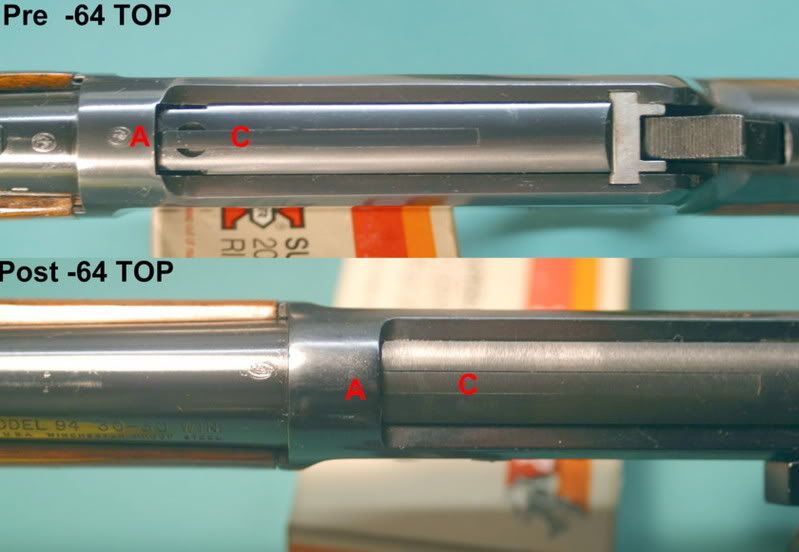
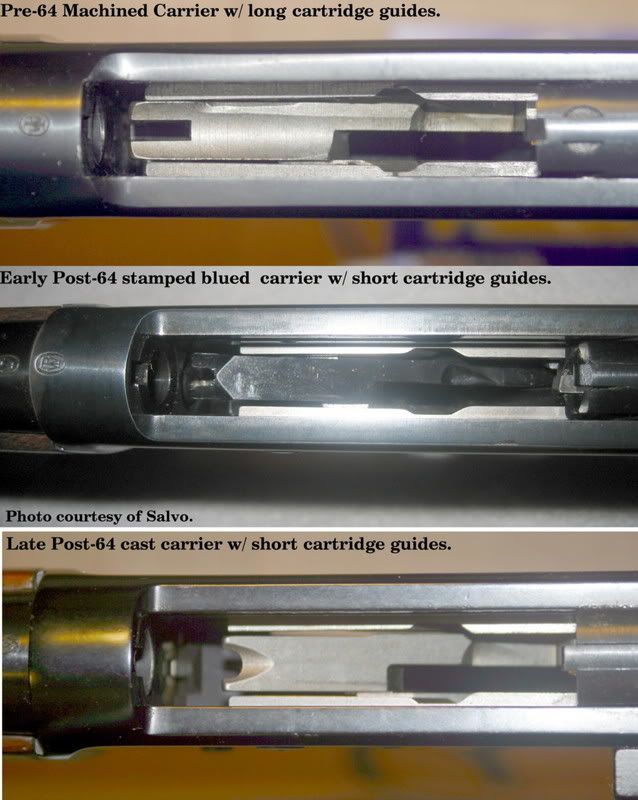
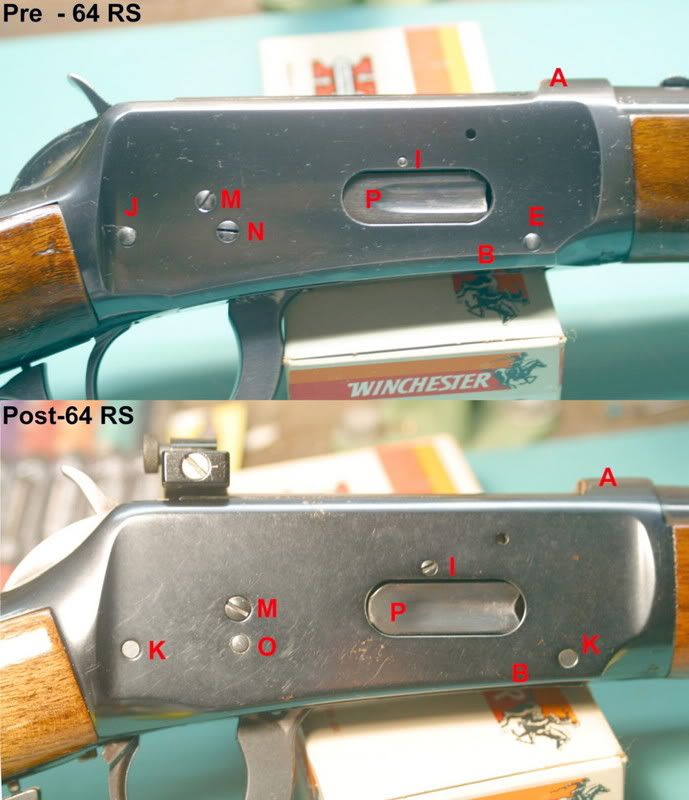
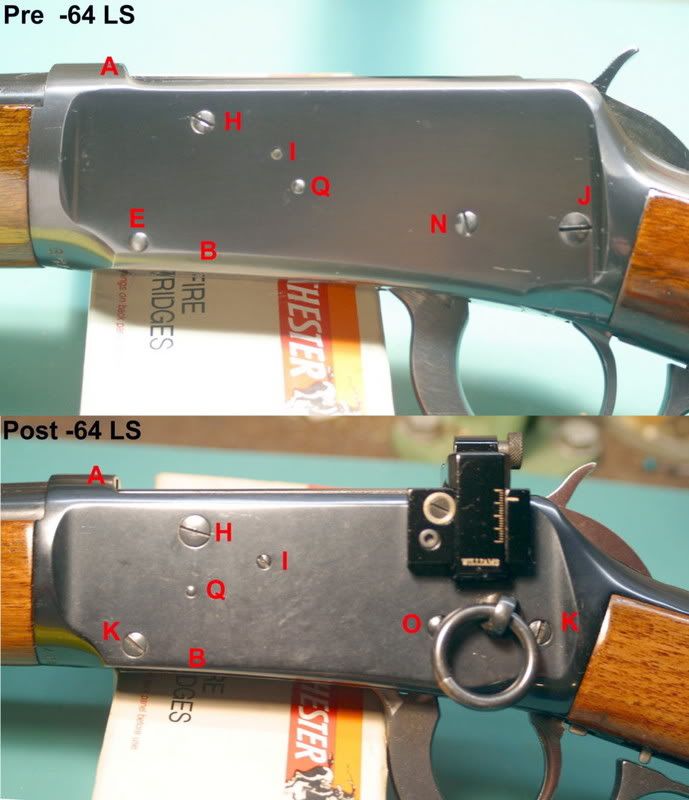
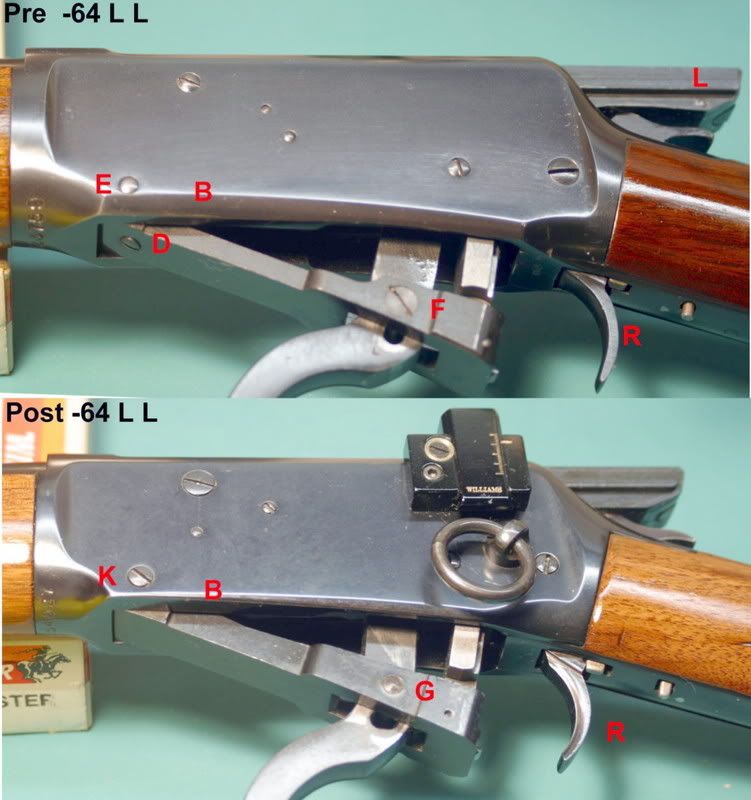
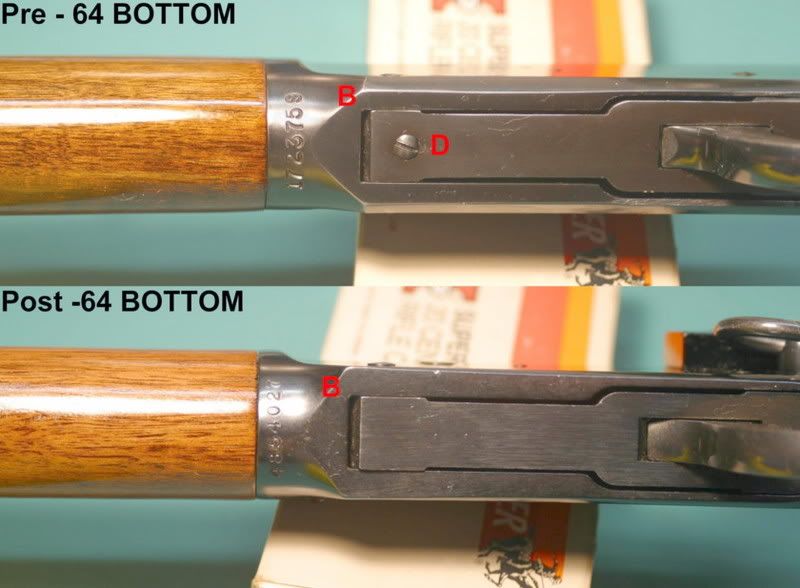
Differentiating between the Pre-64 and Post-64 Winchester Model 94s by Joe Miller
This photo essay was intended to help those who are not familiar with the external differences between the Pre-64 and Post-64 Winchester Model 94s. These pictures will show the differences in the screws, the triggers, some of the machining changes, the carriers, and the shapes of the receivers.
I've created a legend to match the letters that identify the various features that are different between the two vintages. It should be self explanatory.
A - Angles & Contours or Upper Edges of Receiver, Step at Front of Bolt
B - Angles & Contours of Lower Edges of Receiver
C - Round or oval cut to rear of blot face surrounding extractor, machine cuts on sides of front end of bolt.
D - Link pin retaining screw - pre-64
E - Link pin - pre-64
F - Finger lever link screw - pre-64
G - Finger lever pin - post-64
H - Finger lever pin stop screw; small pre-64 - larger post-64
I - Cartridge guide screws; threads from inside pre-64, thread from outside post-64
J - Hammer screw: larger head pre-64
K - Hammer/link screw post-64
L - Firing pin retaining pin omitted on post-64
M - Spring cover screw
N - Carrier screw; 2 used pre-64
O - Carrier screw; 1 used post-64
P - Spring cover; machined pre-64, stamped post-64
Q - Carrier spring screw
R - Trigger; machined pre-64, cast post-64
-Joe Miller-
I've created a legend to match the letters that identify the various features that are different between the two vintages. It should be self explanatory.
A - Angles & Contours or Upper Edges of Receiver, Step at Front of Bolt
B - Angles & Contours of Lower Edges of Receiver
C - Round or oval cut to rear of blot face surrounding extractor, machine cuts on sides of front end of bolt.
D - Link pin retaining screw - pre-64
E - Link pin - pre-64
F - Finger lever link screw - pre-64
G - Finger lever pin - post-64
H - Finger lever pin stop screw; small pre-64 - larger post-64
I - Cartridge guide screws; threads from inside pre-64, thread from outside post-64
J - Hammer screw: larger head pre-64
K - Hammer/link screw post-64
L - Firing pin retaining pin omitted on post-64
M - Spring cover screw
N - Carrier screw; 2 used pre-64
O - Carrier screw; 1 used post-64
P - Spring cover; machined pre-64, stamped post-64
Q - Carrier spring screw
R - Trigger; machined pre-64, cast post-64
-Joe Miller-
Monday, August 30, 2010
From Buck Elliott
Just remember that pressure is always and only relative to the resistance of the system in place to contain it... If the pressure does not exceed strength of the containment apparatus, all is well. The Freedom Arms .454 revolver has a built-in 100%+ safety factor - that is, it will contain pressures in excess of 100% overload. That said - DON'T try to find out how much or how high that is... We did succeed in breaking a .454 at F.A., but only after much tedious loading and firing of ammunition no one could conceivably load by accident or mistake. The gun never did "blow up," it just finally "broke..."
In my own .454 levergun tests, back in the late '80s, we did manage to ruin a few Winchester '94s, and one Marlin 336. The Marlin failed after the fewest rounds of factory-equivalent ammo, digesting only a handful of rounds (somewhere short of 20, if memory serves...) before the action would no longer lock up safely or securely.
Next to fall was a brand-new Winchester '94 Big-Bore AE, which stretched and flowed like taffy, as the bolt tried to climb up the locking lug and out of the top of the receiver, peening the lug recesses in the receiver terribly, and noticeably stretching the right side wall of the receiver. In their infinite wisdom, Winchester (USRAC) beefed up the receiver in the wrong place, while cutting ALL the strength out of the right receiver wall, to allow for their ill-conceived "angle ejection" modification. The '94 that performed best in my testing was a well-used carbine, made in the 1920s. It was still tight and crisp when we screwed the .454 barrel into it, but even it became dangerous and unserviceable in fewer than 50 rounds.
The whole point of the testing was to prove to various and sundry doubters that the 1894 Winchester was NOT a suitable platform for the powerful .454 Casull round - and WHY. The guns used (and used up...) in the tests were donated to the cause by those very Doubting Thomases...! It doesn't get much better than that.
BTW, the same Sharon barrel was used in all the tests, and it emerged unscathed. It was finally rethreaded and rechambered to .45 Colt and installed in a Browning '92, where it still resides -- a 24", octagon beauty.
The 1894 and 1895 Winchesters are NOT particularly strong actions, having llooooooonnnnngg receiver walls and angled, rear locking bolts. In short, physics and geometry are against them from the outset. As mentioned above, the '94 AE suffers the further indignity of having the only strengthening metal available to it REMOVED to make way for the abominable ejection system.
The '86/M-71 and '92 Winchesters are by far the strongest of the "traditional" lever actions, with the nod going to the '86/71, with its square-to-bore vertical lockup, which situates the lugs about 2/3 the distance back from the breech-face as compared to a '94 or '95. The '86's receiver walls are robust and not chopped up or hollowed out as are those on the '94, in particular.
The new Browning/Winchester 1886 and Model 71 are virtually identical offerings, made of good, through-hardened steel, and will serve as the basis for some VERY powerful loading.
Be careful, and don't try this at home...
In my own .454 levergun tests, back in the late '80s, we did manage to ruin a few Winchester '94s, and one Marlin 336. The Marlin failed after the fewest rounds of factory-equivalent ammo, digesting only a handful of rounds (somewhere short of 20, if memory serves...) before the action would no longer lock up safely or securely.
Next to fall was a brand-new Winchester '94 Big-Bore AE, which stretched and flowed like taffy, as the bolt tried to climb up the locking lug and out of the top of the receiver, peening the lug recesses in the receiver terribly, and noticeably stretching the right side wall of the receiver. In their infinite wisdom, Winchester (USRAC) beefed up the receiver in the wrong place, while cutting ALL the strength out of the right receiver wall, to allow for their ill-conceived "angle ejection" modification. The '94 that performed best in my testing was a well-used carbine, made in the 1920s. It was still tight and crisp when we screwed the .454 barrel into it, but even it became dangerous and unserviceable in fewer than 50 rounds.
The whole point of the testing was to prove to various and sundry doubters that the 1894 Winchester was NOT a suitable platform for the powerful .454 Casull round - and WHY. The guns used (and used up...) in the tests were donated to the cause by those very Doubting Thomases...! It doesn't get much better than that.
BTW, the same Sharon barrel was used in all the tests, and it emerged unscathed. It was finally rethreaded and rechambered to .45 Colt and installed in a Browning '92, where it still resides -- a 24", octagon beauty.
The 1894 and 1895 Winchesters are NOT particularly strong actions, having llooooooonnnnngg receiver walls and angled, rear locking bolts. In short, physics and geometry are against them from the outset. As mentioned above, the '94 AE suffers the further indignity of having the only strengthening metal available to it REMOVED to make way for the abominable ejection system.
The '86/M-71 and '92 Winchesters are by far the strongest of the "traditional" lever actions, with the nod going to the '86/71, with its square-to-bore vertical lockup, which situates the lugs about 2/3 the distance back from the breech-face as compared to a '94 or '95. The '86's receiver walls are robust and not chopped up or hollowed out as are those on the '94, in particular.
The new Browning/Winchester 1886 and Model 71 are virtually identical offerings, made of good, through-hardened steel, and will serve as the basis for some VERY powerful loading.
Be careful, and don't try this at home...
Sunday, August 29, 2010
The Shooter's Library - A Start
_ "The Gun and Its Development" by W. W. Greener
_ "Successful Handgun Hunting" by Phil Johnston
_ "Action Shooting, Cowboy Style" by John Taffin
_ "Pet Loads" by Ken Waters
_ "Sixguns" by Elmer Keith
_ "Hell, I Was There!" by Elmer Keith
_ "Gun Notes Vol 1" by Elmer Keith
_ "Gun Notes Vol 2" by Elmer Keith
_ "No Second Place Winner" by Bill Jordan
_ "Fast and Fancy Revolver Shooting" by Ed McGivern
_ "The Standard Catalog of Smith and Wesson" by Jim Supica
_ "Book of the 44" by John Taffin
_ "Big Bore Handguns" by John Taffin
_ "Big Bore Sixguns" by John Taffin
_ "Single Action Sixguns" by John Taffin
_ "Handgun Hunting and Hunting Handguns" by Gary Reeder
_ "Hunting for Handgunners" by Kelly and J. D. Jones
_ "The Custom Revolver" by Hamilton Bowen
_ "The Rifle in America" by Captain Philip Burdette Sharpe
_ "Hatcher's Notebook" by MG Julian S. Hatcher
_ "Handgun Hunting" by George Nonte and Lee Jurras
_ "Colt Firearms" by James E. Serven
_ "A Study of the Colt Single Action Army Revolver" by John A., & Ron Graham and C. Kenneth Moore Kopec
_ "History of the Colt Revolver" by Charles T. Haven and Frank A. Belden
_ "Colt's Single Action Army Revolver" by "Doc" O'Meara
_ "The Story of Colt's Revolver" by William B. Edwards
_ "Winchester's 30-30: Model 94, the Rifle America Loves" by Sam Fadala
_ "Ruger and His Guns" by R. L. Wilson
_ "Trapdoor Springfield: The United States Springfield Single-Shot Rifle" by M. D. "Bud" Waite and B. D. Ernst
_ "Successful Handgun Hunting" by Phil Johnston
_ "Action Shooting, Cowboy Style" by John Taffin
_ "Pet Loads" by Ken Waters
_ "Sixguns" by Elmer Keith
_ "Hell, I Was There!" by Elmer Keith
_ "Gun Notes Vol 1" by Elmer Keith
_ "Gun Notes Vol 2" by Elmer Keith
_ "No Second Place Winner" by Bill Jordan
_ "Fast and Fancy Revolver Shooting" by Ed McGivern
_ "The Standard Catalog of Smith and Wesson" by Jim Supica
_ "Book of the 44" by John Taffin
_ "Big Bore Handguns" by John Taffin
_ "Big Bore Sixguns" by John Taffin
_ "Single Action Sixguns" by John Taffin
_ "Handgun Hunting and Hunting Handguns" by Gary Reeder
_ "Hunting for Handgunners" by Kelly and J. D. Jones
_ "The Custom Revolver" by Hamilton Bowen
_ "The Rifle in America" by Captain Philip Burdette Sharpe
_ "Hatcher's Notebook" by MG Julian S. Hatcher
_ "Handgun Hunting" by George Nonte and Lee Jurras
_ "Colt Firearms" by James E. Serven
_ "A Study of the Colt Single Action Army Revolver" by John A., & Ron Graham and C. Kenneth Moore Kopec
_ "History of the Colt Revolver" by Charles T. Haven and Frank A. Belden
_ "Colt's Single Action Army Revolver" by "Doc" O'Meara
_ "The Story of Colt's Revolver" by William B. Edwards
_ "Winchester's 30-30: Model 94, the Rifle America Loves" by Sam Fadala
_ "Ruger and His Guns" by R. L. Wilson
_ "Trapdoor Springfield: The United States Springfield Single-Shot Rifle" by M. D. "Bud" Waite and B. D. Ernst
Saturday, August 28, 2010
.32 H&R Magnum
 The .32 Harrington & Richardson Magnum cartridge was announced in 1983. I guess I'm one of the nuts that had to have one but alas, the availability of money to scratch that itch wasn't available. I'm kinda glad I waited. Eventually, a Ruger Single-Six did come my way.
 The .32 H&R was the latest in the evolutionary chain from percussion pistol to rimfire to centerfire using what was a .310" bore (.319" groove diameter hence the close enough .32 appellation for cartridges) that developed into today's guns with .311" groove diameters (and .308" in the Thompson Center made Contender barrels). From .32 Rimfires to .32 S&W to .32 S&W Long to .32 H&R (and now to the .327 Federal) the evolution continued as more and more was expected of the little .31 or .32 caliber revolvers.
In 1984, H&R's partner in the project, Federal, cataloged only a 95 gr. LSWC at 1030 fps load. In 1985 a second load using a 85 gr. JHP at 1100 fps was introduced. The second load gets the accuracy award in my revolver. While these loads (which better the .38 Special standard 158 gr. load) were apparently intended for self-defense applications in the H&R double-action revolvers (since discontinued), they do make pretty good small game loads. Yes, they are more than what is needed for head shooting squirrels and rabbits, but they are better for ground hogs and feral/former pets as well as foxes and coyotes (within about 50 yards).
I thought I'd carry mine when I'm just out wandering around as it would deal with any small game or any two-legged varmints with which I might have a problem. I also figured that it would be a great cartridge to play with at the loading bench.
The .311-.312" bullets work fine. In fact, the bullets for the .32 S&W Long and the .32-20 (.32 WCF) will work fine in this cartridge.
| Bullet | Weight | Powder | Weight | Velocity | Energy |
| Factory LSWC | 95 gr. | unknown | - | 1010 fps | 225 fpe |
| Factory JHP | 85 gr. | unknown | - | 1120 fps | 230 fpe |
Friday, August 27, 2010
The Lost Master - Robert W. Service
The Lost Master
“And when I come to die, “ he said,
“Ye shall not lay me out in state,
Nor leave your laurels at my head,
Nor cause your men of speech orate;
Nor monument your gift shall be,
Nor column in the Hall of Fame;
But just the line ye grave for me:
‘He played the game.’”
So when his glorious task was done,
It was not of the fame we thought;
It was not of his battles won,
But of the pride with which he fought;
But of his zest, his ringing laugh,
His trenchant scorn of praise or blame:
And so we graved his epitaph,
“He played the game.”
And so we, too, in humbler ways
Went forth to fight the fight anew,
And heeding neither blame nor praise,
We held the course he set us true.
And we, too, find the fighting sweet;
And we, too fight for fighting’s sake;
And though we go down in defeat,
And though our stormy hearts may break,
We will not do our master shame:
We’ll play the game, please God,
We’ll play the game.
Robert W. Service
Thursday, August 26, 2010
In Honor of the Mad Piper - Bill Millin
 Via Lawdog we are informed of the passing on 17 August 2010 of Piper Bill Millin, piper for Lord Lovat at Pegasus Bridge.
It is men such as these that we should emulate in our own lives.
Obituary: Bill Millin, piper
Published Date: 20 August 2010
By CHRIS MAIR
Bill Millin, piper.
Born: 14 July, 1922, in Regina, Saskatchewan, Canada.
Died: 17 August, 2010, in Torbay, Devon, aged 88.
On Sword Beach during the D-Day Normandy landings in 1944, as German troops opened fire on his comrades, Bill Millin marched up and down along the shore playing Highland Laddie on his bagpipes.
William Millin was the eldest son of Mr and Mrs John Millin. The family crossed the Atlantic in 1925, settling in Shettleston, Glasgow. They lived on Gilmerton Street and Millin was educated at Budhill School, Shettleston. He played the bagpipes in the Boys' Brigade band before joining the Queen's Own Cameron Highlanders as a piper and a commando. His first public piping session was in 1940, an event run to raise funds for the construction of a Spitfire.
Millin, as his mother put it, "was always a good fighter", hence his position as Piper of the 1st Special Service Brigade (redesignated, 1st Commando Brigade in December 1944), a commando unit. The unit consisted of some of the toughest men from the Army and the Royal Marines, all of whom were trained in wilderness survival, close combat, navigation, weapons, demolition and crucially, amphibious assaults.
On 6 June, 1944 Millin, along with his fellow commandoes approached Sword Beach, Normandy as part of the D-Day landings which would see the largest amphibious invasion of all time as 160,000 troops entered France to fight the Nazis.
1st Special Service Brigade was commanded by Brigadier Simon Fraser, the 15th Lord Lovat. Lovat was a passionate and patriotic Scot, and Millin was his personal piper. Lovat was also a fan of the Scottish tradition whereby a piper played his comrades into battle, a tradition banned by the military hierarchy. However, as Lovat not quite factually pointed out: "That was the English Army."
Millin climbed aboard his landing craft with 21 men, including Lovat, and sat as the vessel followed the course of the Hamble River out toward the Solent. He was in the leading boat and Lovat had asked him to play the troops out in to open sea. As they sailed up the Hamble Millin piped The Road to the Isles. He stood proud on the bowsprit as the music was pumped through the loudhailer. As the thousands of transport craft gathered for the mass assault on the French beaches, Millin's pipes could be heard above all else. As the sea became rougher and the craft less stable Millin stopped piping and the Channel crossing began.
Following a fitful night's sleep, the men made their way to the deck and prepared for what, for some, would be the last charge of their short lives. Millin recalled an air of calm aboard their small craft: "Everyone was behaving normally, I mean checking their kit, putting their kit on… We all got up on deck and we stood in the freezing wind watching the shoreline.
Then the order came to get ashore, and no one was shouting that they were afraid or shouting that they were going to kill all these Germans. All people wanted really was to get off."
Millin followed Lovat, watching the tall man crash into the waves, and then watched a man behind take a bullet to the face and sink. Millin saw that as a sign to hurry along and he launched himself into the waves. As his kilt (a 100-year-old one his father had worn in the Great War) rose up he started piping Highland Laddie.
Once Millin had finished that first tune Lovat requested another. "Well, when I looked round - the noise and people lying about shouting and the smoke, the crump of mortars, I said to myself, 'Well, you must be joking surely.' He said, "What was that?" and he said 'Would you mind giving us a tune?' 'Well, what tune would you like, Sir?' 'How about The Road to the Isles?' 'Now, would you want me to walk up and down, sir?' 'Yes. That would be nice. Yes, walk up and down.'"
What transpired has since gone down in military history as an iconic moment. Millin strode up and down the beach piping rallying tunes for his friends. The Germans were perplexed by the sight and did not shoot at him.
As the troops moved inland Millin found himself almost alone on the beach, but as he had not been told to stop playing he ran up and followed the men, playing them all the way to Pegasus Bridge, piping Blue Bonnets Over the Border.
On 10 June, Millins's luck ran out; although he wasn't shot himself, his bagpipes were hit by shrapnel and their war came to an end. In 2001 those same pipes, along with his family kilt, commando beret and knife, the military kit of the "mad piper", were donated to the National War Museum of Scotland.
Following the war Millin was offered employment on the Lovat estate, but grew restless and joined a theatre, where he played his pipes, before retraining as a mental health worker in the late 1950s. He spent the rest of his working life as a care worker, moving to Devon in 1963 and frequently returned to pay his respects the friends who lost their lives in Normandy.
In 1962 a film, The Longest Day, told Millin's incredible story. He was played by Pipe Major Laspee, the Queen Mother's official piper. Millin suffered a stroke in 2003 and had been living in a nursing home in Dawlish since. There is currently a fundraising campaign to construct a bronze statue on Sword Beach to commemorate Millin's heroics on 6 June, 1944.
William "Bill" Millin's wife Margaret predeceased him and he is survived by their son John.
Wednesday, August 25, 2010
Music Videos
With the conversion of the other blog to purely political/cultural correction/advocation, this is the place now to post music videos. All music videos will go in this one post and I'll edit it as necessary...
And then Paul M_______ turned me on to this one and I had to include it.
Lead to this via a link to the Zac Brown Band's "Free"..
Thanks to the Jimmy P.
Time for another update and at the top of the list are the Oak Ridge Boys...
Well, what do you know. It is about time for an update of the music post and who is brought to my attention than Joey and Rory, "Heart of the Wood".
First up is Joey and Rory doing Freebird...
And then Paul M_______ turned me on to this one and I had to include it.
Lead to this via a link to the Zac Brown Band's "Free"..
Thanks to the Jimmy P.
Time for another update and at the top of the list are the Oak Ridge Boys...
Well, what do you know. It is about time for an update of the music post and who is brought to my attention than Joey and Rory, "Heart of the Wood".
First up is Joey and Rory doing Freebird...
Tuesday, August 24, 2010
28 Gauge Shotgun
Introduced by the American firm of Parker Bros. in 1903, the nominal bore diameter of the 28 gauge is .550 inch. It has proven to be quite effective on both upland game and clay targets. Small bore skeet, for which the 28 gauge is legal, has kept the 28 alive. Upland hunters appreciate the 28 gauge gun's light weight and quick handling. 28 gauge shells are 2 3/4 inches in length, selection is limited, and all are loaded with lead shot (so the 28 gauge is not legal for migratory waterfowl).
I have one 28 gauge shotgun in the form of a barrel for my Thompson Center Contender. It is a lot of fun and the whole gun weighs about 4 lbs loaded. It works well for putting up dove and quail or woods walking for squirrel, rabbit and maybe even grouse. It might make a better garden gun than the .410 bore.
Ammo for the 28 ga. is more expensive than it should be because it isn't produced in quantities sufficient to bring down component prices. However, it is much more widely available than just 6-7 years ago. In my area it seems that most gun shops have at least a box or two always available. If I was shooting skeet I would reload it but there's hardly a reason to do so for the few shells I expend from my single-shot gun.
I have one 28 gauge shotgun in the form of a barrel for my Thompson Center Contender. It is a lot of fun and the whole gun weighs about 4 lbs loaded. It works well for putting up dove and quail or woods walking for squirrel, rabbit and maybe even grouse. It might make a better garden gun than the .410 bore.
Ammo for the 28 ga. is more expensive than it should be because it isn't produced in quantities sufficient to bring down component prices. However, it is much more widely available than just 6-7 years ago. In my area it seems that most gun shops have at least a box or two always available. If I was shooting skeet I would reload it but there's hardly a reason to do so for the few shells I expend from my single-shot gun.
|
|
|
Monday, August 23, 2010
Sunday, August 22, 2010
A small place to live...
I have been thinking about downsizing. What do we really need?
- a public area, aka living room and dining area
- a kitchen
- a bathroom (likely TWO (2))!
- a laundry area
- sleeping area(s) (again, likely TWO (2))
- an office/gun room
- heat/cooling
- outside space for dog, garden, vehicles, maybe small shop
- lap pool like the Endless Pool
So what would it take to make this? What sort of building would be most comfortable (stone, frame, log)? Basement? Multiple stories? Super insulated?
I've liked the http://www.deltechomes.com/ for quite a while. The idea of the self-supporting roof design and "round" house both appeal. It is something like a yurt but more permanent.
Links
- "Katrina" homes plans
- Deltec Homes
- Monolithic Dome
- a public area, aka living room and dining area
- a kitchen
- a bathroom (likely TWO (2))!
- a laundry area
- sleeping area(s) (again, likely TWO (2))
- an office/gun room
- heat/cooling
- outside space for dog, garden, vehicles, maybe small shop
- lap pool like the Endless Pool
So what would it take to make this? What sort of building would be most comfortable (stone, frame, log)? Basement? Multiple stories? Super insulated?
I've liked the http://www.deltechomes.com/ for quite a while. The idea of the self-supporting roof design and "round" house both appeal. It is something like a yurt but more permanent.
Links
- "Katrina" homes plans
- Deltec Homes
- Monolithic Dome
Saturday, August 21, 2010
The .357 Maximum Conversions of Leverguns
Typically the conversation begins thusly...
I have a Max albeit in an other rifle (a Contender Carbine). With my background I am often asked for the "final word" on the subject.
I wouldn't mess with a perfectly good Winchester, unless you're positive the .357 Maximum has some kind of inherent qualities that improves it's performance over the .357 Magnum which I think is perfectly adequate in a rifle. Further, there are advantages to a rifle so chambered as compared to one chambered for the .357 Maximum. Increased power isn't always a better choice. Yes, the .357 Max can be loaded to approximate the .35 Remington but it is just cheaper to get the Marlin .35 Remington chambered rifle. Why not just get a .35 Remington? Because you can't shoot the .357 Magnum or .38 Special in it. The Magnum in a rifle approximates the Maximum in a pistol/revolver. The pressures are about the same for the .357 Mag and Max (SAAMI spec for the 357 Max is 40k psi, 5k more than the 357 Mag.) so overpressure is not an issue and the case head is the same, so bolt thrust is not an issue either.
I know of one person who converted a Marlin 1894C several years ago. The .357 Max cartridge is so long that by the time the action is opened up you get a very long (100 degrees?) rough lever throw. His would fire .38 Special, .357 Magnum, and .357 Maximum interchangeably but only if the lever is operated quickly and briskly. The Marlin M1894 had the lever throw increased because the bolt has to retract farther in order to clear the extra length of the loaded .357 Maximum round. That shooter did not feel that the expense was justified by the firearm's performance.
One shooter ordered a new Winchester 94 for this very project. The Winchester action is plenty long with room to spare. His view was that the .357 Maximum was operating at the same pressures as a .357 Magnum, the larger case of the Max allows for more powder, and will give more power than the magnum. It was supposed that the longer 94 action will make all the difference. Probably all that will be necessary is to run a 357 Max finish reamer in the chamber and take a file to the shoulder on the cartridge follower. Tycer L____ reports that his Winchester 94 .357 Magnum would actually accept .360 Dan Wesson ammunition. The .360 DW runs pretty close to .357 Maximum performance, but not quite.
It is true that most hunters do not handload, and it is reasonable to start a youngster on a gun with light .38 Special ammo and work up to some heavy Buffalo Bore, Cor-Bon, or Grizzly .357 Magnum or Maximum for hunting. There are no really light recoiling .30-30 loads for the non-handloader, but there are plenty of .38 Specials out there, at low cost. It could even double as a small game gun with wadcutters, and is excellent for self defense. As the child grows older and taller, a thick recoil pad can be added to increase the length of pull to the normal 13 1/2 inches.
Paco Kelly once responded with this...
In my Max I can just get (with Lil'Gun) 2000 fps with 200 gr. bullets and 2150 fps with 180 gr. bullets. That is "max"ed out! Every rifle is different but I think that those fellows getting 2000 fps with 200 gr. bullets and H110/W296 are smokin' commo wire. Some are even using 2-4" shorter barrels than I am. I can't get those results (or even close) with H110/W296 without signs of excessive pressure.
It doesn't make sense that the MAG should come close to MAX performance and it doesn't in my rifle. I get 1650+ fps from the 180 gr. Rem SJHP and for 2000 fps must go to the 158 gr. (I used the XTP but the Gold Dot will do it as well).
One thing one can do, albeit at similar expense, is to rebarrel a .44 Mag 1894 to .357 Bain and Davis. This cartridge will give similar ballistic performance when compared to the .357 Max but not without effort. It is rightly saved as discussion for another time.
I'm fairly new to the Winchesters and levers in general. On the NEF forum many have re-chambered their 357 Mag single shot rifles to .357 Maximum.The conversation then goes into the various .357/.38 cartridges and on and on...
I realize the differences in the two type of guns and cartridges, but was wondering if anyone knew if a 357 Mag Winchester could chamber and eject the 357 Maximum? The Max is .315" longer overall.
I have a Max albeit in an other rifle (a Contender Carbine). With my background I am often asked for the "final word" on the subject.
I wouldn't mess with a perfectly good Winchester, unless you're positive the .357 Maximum has some kind of inherent qualities that improves it's performance over the .357 Magnum which I think is perfectly adequate in a rifle. Further, there are advantages to a rifle so chambered as compared to one chambered for the .357 Maximum. Increased power isn't always a better choice. Yes, the .357 Max can be loaded to approximate the .35 Remington but it is just cheaper to get the Marlin .35 Remington chambered rifle. Why not just get a .35 Remington? Because you can't shoot the .357 Magnum or .38 Special in it. The Magnum in a rifle approximates the Maximum in a pistol/revolver. The pressures are about the same for the .357 Mag and Max (SAAMI spec for the 357 Max is 40k psi, 5k more than the 357 Mag.) so overpressure is not an issue and the case head is the same, so bolt thrust is not an issue either.
I know of one person who converted a Marlin 1894C several years ago. The .357 Max cartridge is so long that by the time the action is opened up you get a very long (100 degrees?) rough lever throw. His would fire .38 Special, .357 Magnum, and .357 Maximum interchangeably but only if the lever is operated quickly and briskly. The Marlin M1894 had the lever throw increased because the bolt has to retract farther in order to clear the extra length of the loaded .357 Maximum round. That shooter did not feel that the expense was justified by the firearm's performance.
One shooter ordered a new Winchester 94 for this very project. The Winchester action is plenty long with room to spare. His view was that the .357 Maximum was operating at the same pressures as a .357 Magnum, the larger case of the Max allows for more powder, and will give more power than the magnum. It was supposed that the longer 94 action will make all the difference. Probably all that will be necessary is to run a 357 Max finish reamer in the chamber and take a file to the shoulder on the cartridge follower. Tycer L____ reports that his Winchester 94 .357 Magnum would actually accept .360 Dan Wesson ammunition. The .360 DW runs pretty close to .357 Maximum performance, but not quite.
It is true that most hunters do not handload, and it is reasonable to start a youngster on a gun with light .38 Special ammo and work up to some heavy Buffalo Bore, Cor-Bon, or Grizzly .357 Magnum or Maximum for hunting. There are no really light recoiling .30-30 loads for the non-handloader, but there are plenty of .38 Specials out there, at low cost. It could even double as a small game gun with wadcutters, and is excellent for self defense. As the child grows older and taller, a thick recoil pad can be added to increase the length of pull to the normal 13 1/2 inches.
Paco Kelly once responded with this...
I WAITED FOR EVERYONE TO GET THEIR FEELINGS OUT... HERE'S WHAT HAPPENS... FIRST YOU NEED AN EXCELLENT GUNSMITH, NOT A PARTS CHANGER... THE BOLT HAS A BOLT STOP PIN, THAT CAN BE CHANGED FOR THE LONGER THROW...THAT TAKES KNOW HOW SO YOU DON'T HAVE OVER TRAVEL, YES IT TAKES A LITTLE LONGER DRAW DOWN ON THE LEVER...AND IT WILL TAKE THE SAME DRAW FROM THAT TIME ON FOR 357S AND 38 SPECIALS, DON'T KNOW ABOUT THE MARLIN... BUT IT'S NO PROBLEM WITH MY WINCHESTERS... THE REAL PROBLEMS... SOMETIMES WORK HAS TO BE DONE ON THE LIFTER TO ALLOW THE FULL LENGTH OF THE 357 MAXI WITH A GOOD SIZED CAST OR JACKETED BULLET TO CLEAR THE TUBE... AGAIN A GOOD GUNSMITH.. I HAVE HAD IT DONE TO TWO 94S ONE WAS A 20 INCH BARREL... THE OTHER WAS A 24 INCH BARREL, IN VELOCITY BOTH WERE WELL WORTH IT...THE 20" GAVE AROUND 250 FPS+ MORE AND THE 24 INCH GAVE ANOTHER 150+ OVER THAT.... IT IS WORTH IT IF YOU DON'T MIND THE COST OF GUNSMITHING...and later...
I STILL HAVE THE 24 INCH BARREL XTR 94 AND IT IS A BEAUT... ACCURACY HASN'T CHANGED STILL GOOD TO EXCELLENT... THE POWDERS USED IN THE MAXI ROUND HAVE CHANGED FROM THE 357 POWDERS... MINE TENDS TO LIKE SLOWER THAN h110 AND ww296 THOUGH THEY DO WORK... OF COURSE AS MOST OF MY READERS KNOW I USE 2400 IN EVERYTHING.. BUT THAT DOESN'T GIVE TOP VELOCITY... 4227 IS IN A GOOD BURNING RATE.... HOPE THIS HELPS THE REAL KEY IS THE GUNSMITH.... PACO
it was worth it... the efficiency of the cartridge and the velocity gain are significant... different gunsmiths will charge different prices... but it should be upper limit $150....pacoAs I noted in my article on my Contender carbine, the straight wall case and ability to use carbide dies gave substantial advantage in case life and no need for sizing lube.
In my Max I can just get (with Lil'Gun) 2000 fps with 200 gr. bullets and 2150 fps with 180 gr. bullets. That is "max"ed out! Every rifle is different but I think that those fellows getting 2000 fps with 200 gr. bullets and H110/W296 are smokin' commo wire. Some are even using 2-4" shorter barrels than I am. I can't get those results (or even close) with H110/W296 without signs of excessive pressure.
It doesn't make sense that the MAG should come close to MAX performance and it doesn't in my rifle. I get 1650+ fps from the 180 gr. Rem SJHP and for 2000 fps must go to the 158 gr. (I used the XTP but the Gold Dot will do it as well).
One thing one can do, albeit at similar expense, is to rebarrel a .44 Mag 1894 to .357 Bain and Davis. This cartridge will give similar ballistic performance when compared to the .357 Max but not without effort. It is rightly saved as discussion for another time.
Friday, August 20, 2010
Ruger MKIII 22/45 RP

Catalog Number: P512MKIIIRP | Model Number: 10140 | Caliber: .22 LR
| Material: | Alloy Steel | Finish: | Blued | ||||
| Rear Sight: | Adjustable | Front Sight: | Fixed | ||||
| Barrel Length: | 5.50" | Barrel Style: | Bull | ||||
| Length: | 9.50" | Height: | 5.40" | ||||
| Width: | 1.00" | Weight: | 33.00 oz. | ||||
| Twist: | 1:16" RH | Grooves: | 6 | ||||
| Capacity: | 10 | Grip Frame: | Zytel Polymer | ||||
| MA Approved & Certified: | No | CA Approved: | No | ||||
| Suggested Retail: | $380.00 |
Thursday, August 19, 2010
Bailey's Trials
 |
| Bailey |
The vet immediately noted that she had a fever and took steps to rehydrate her but could not find a reason for the fever. I supposed an infection but the doctor wouldn't commit to any reason. The fever passed and Bailey seemed better. She needed to have updated vaccinations and some dental work and this was done. She seemed ok for about 4 days after that. Then she began to rapidly change habits, needing to pee more and more frequently and then to have "accidents". Nana took her to the vet and they refused to handle her not even to help in getting a urine sample. I took her back to the vet, demanded and got a sample cup, produced a sample in about 3 minutes and I told them that I wanted her well and to do what was necessary. They evaluated the urine sample without looking at the dog and prescribed Zeniquin for 10 days. After 4 days she seemed to be slightly improved and still having faith in the vet Nana and I departed on the Alaska trip.
While gone, Bailey boarded with our daughter in McLean. She administered the complete course of Zeniquin and Bailey seemed better but was more and more incontinent. When Bailey returned home late on the 15th it was obvious she was in distress as she had to urinate within minutes of taking water and every 30-45 minutes. I decided to take her to another vet.
 |
| Bailey's Bladder Stone (1 of 3) |
I have to admit to complete ignorance on this subject. I had no idea and had never had any experience with this condition. I feel badly for not having taken Bailey to another vet earlier. I am extremely disappointed in her old vet. It seems to me that any EXPERIENCED and COMPETENT veterinary practice should be able to handle any dog and have identified the condition without any more difficulty than did Bailey's new vet. Her old vet did neither.
Bailey seems to be doing well now. In the course of this experience she has lost 12% of her starting body weight and her lipoma is almost undetectable. She seems to be healing and is able to go through the night without urinating. She doesn't seem to have blood in her urine (although some might be expected). However, I take her out every 2 hours, watch her water intake so that she's not putting too much pressure on her bladder, carry her up and down stairs and watch her closely to ensure that she doesn't damage her stitches at the incision site (center line of her belly). She really, really doesn't like the e-collar. Consequently I have to watch her constantly for the time being. Stitches come out in 10-14 days but she might have months of recovery time. We'll have to wait and see.
8/20/2010 10:30 PM
Bailey has been doing really well (knock on wood). She is obviously more comfortable. Her incision seems to be healing properly. Her urination and defecation activity seems to be returning to normal in as much as we are allowing it. We are taking her out for a walk every two hours except for night-time sleep (11PM to 6AM). Her energy level is up. We have to watch her because of that. She isn't working at the incision (yet). She isn't balking at medication and getting it on time. I am really pleased so far.
Our new vet is Commonwealth Veterinary Clinic in Fishersville/Waynesboro, VA.
Monday, August 16, 2010
This summer's "adventure"...
... in celebration of 25 years of wedded bliss with Mrs. Hobie was to Alaska and back.
The trip really began with our dog, Bailey, being picked up for the 2 weeks by our oldest daughter. We had been planning this for months (one might even say for years) and had asked her to board Bailey before the dog got sick. Bailey was still sick when we left but on Zeniquin for a urinary tract infection (we've now discovered that her problem was LARGE bladder stones). We also bought a new camera which was used to capture the images shown here.
 1 August, 0630 we got on the bus to Dulles to fly to Anchorage via Dallas. Delayed in Dallas for 5 hours, we were up about 24 hours straight before meeting our tour director and hitting the sack for 3-4 hours sleep. I hate air travel, more on my thoughts about that later...
2 August we boarded the train for Denali National Park. We almost immediately entered Elmendorf -Richardson where we were silent as the tracks were the site of a July 28th C-17 crash. Plane wreckage was still on either side of the tracks and investigators were going through the wreckage as we passed. No photos for obvious reasons.
The train car was an observation type with dining room below. We ate breakfast of eggs and reindeer sausage on-board which was absolutely delicious. The train "guide" was Ingrid a school teacher with a wicked sense of humor and attitude. She was both informative and funny. Went right by Wasilla Lake where Sarah and Todd Palin have their house. We checked into our lodge at Denali and it was pretty nice. We explored the area and had a good time before thankfully hitting the sack for a real rest.
3 August we took the Tundra Wilderness Tour. Entrance into the park proper is controlled and limited and 75% of the visitors don't get to see Mt. McKinley (Denali) due to weather conditions/cloud cover. We had a beautiful day and saw some beautiful things including McKinley, moose, caribou, Dall sheep, ptarmigan, snowshoe hare, and bears.
The ride is an upgraded school bus and our driver had an obvious and infectious enthusiasm. He takes this job every summer just for the opportunity to go into the park! He was also very sharp-eyed and spotted game a lot further away than I could. Of course he knows what to look for and how the animals contrast with the background. It is amazing to me, being raised in the Appalachians, how the scale is so different and how far away one can see game. Much different even from California and Texas. The bus was also fitted with a camera which could zoom in quite a bit and display the images on video screens in the bus. This was a big help to many on the tour.
Despite being in a national park, I was a bit surprised at how much game was in the immediate vicinity of this one road. However, everyone really liked that we could see these animals. The bus rocked a bit as people went from side to side of the bus trying to get their photographs!
When we got to our bus's mandatory turn-around point we stopped for photos of Mt. McKinley. According to several sources 25% or less of visitors to the park actually get to see Mt. McKinley. This photo was taken from a point 32 miles away from the mountain. The photo simply can't do it justice. It is simply astounding. We were very lucky to get this view without even a few clouds. Later tours that day were greeted with a mountain-top in clouds. We were very lucky indeed. As I've said, we had to turn-around here, all too soon, and head back.
We still hadn't seen any bears and the guide was almost apologetic. While coming off Polychrome he spotted this momma bear way down in the valley across the river. There were also 3 hikers down in the valley and she was headed their way (They didn't meet). We watched as she and her cubs crossed the river and gamboled down the river-bed. My camera has a 7X zoom and this was as good a photo as I could get. They were quite far away. Of course EVERYONE was very excited. We were then too soon out of the park even though we saw other animals on the way out.

Linda and I went back to the lodge and walked around a bit, and rested, before heading out to Cabin Nite. This was an interesting dinner theater combining all-you-can-eat spare ribs (and more) served family style and Robert Service's "The Shooting of Dan McGrew" with audience participation. I thought it was pretty enjoyable.
By the way, price seemed to be on everyone's mind even though so many paid the prices asked. I have to wonder why one would pay to travel all the way to Alaska and then quibble over the cost of something you'd like to see, do or have that isn't even half of one percent of what you spent to get there. Some call it the tourist tax but there is extra cost due to extra transportation expense which one can understand after traveling to and in Alaska for a bit.
4 Aug we awoke and went to our Horse-Drawn Covered Wagon - Breakfast. Another "excursion" we didn't know quite what to expect but my sister-in-law and her husband had enjoyed their dinner by the same folks and so we took the chance. It was quite interesting but not for quite the reason one might expect.
As so often happens, the most interesting part of visiting new places is the people you meet. Our "guide" and "server" was one James Bright. A local lad with a band, Slave II Nothing, and big dreams but a practical approach to life (he's applied for a job at THE coal mine because it is the source of a year-round job). James is only 24 but he explained Alaskan economics very well indeed. He also pointedly commented on how radical environmentalism is costing Alaskans in high electric bills and lack of jobs.
Breakfast was good as well. Eggs, sausage (reindeer sausage) gravy on biscuits, flapjacks, blueberry muffins, hot chocolate, OJ and all the food cooked on a grill by a fellow who looked like a refugee from 1967 but cooked well!
This afternoon we boarded the train again for Fairbanks. As we left we got a view of the rafters. On the way we had dinner. Of the four options one was prime rib. I expected a rather moderate slice but when served it seemed to be about 1½ pounds. Oh my but was it good. All at our table had it and it was universally praised.
I should take a moment to mention that service in all places was given with a smile. These are great folks that Holland-America hires. They aren't like some we know. They work hard with little apparent supervision.
We arrived in Fairbanks and a bit of rest before the 5th. First thing after breakfast we were gone to the Eldorado Gold Mine and doing some panning. This was a lot fun and included a short "ride" through a mine. After that they take you to the sluice, explain that and then take you to the panning area and hand you a bag of pay dirt to pan out. It was quite a lot of fun and we panned out 13 grains from pay dirt provided. We did have some intermittent rain but no problems. One of the good things about this stop was the free chocolate chip cookies.
We then went to historic Gold Dredge No. 8 and had a lunch of beef stew before heading down the Alaska Highway by bus to Tok, AK with a stopover in North Pole. The dredge's are huge and were brought in to get the "last" bit of gold from the land. Apparently they were pretty good at it. However, sometimes they missed the really large nuggets. We were told that a softball sized nugget was found in tailings outside Dawson City by visitors but I can't find any report on-line to which I can link. So, I don't know if that is true but... It would be exciting, wouldn't it? Dredges changed the courses of rivers such as the Yukon several times as they moved up and down the river valleys.
On the way to Tok we stopped at Rika's Roadhouse in Delta Junction, AK. Tok wasn't too big but it was a good rest stop. The hotel (all the hotels were Westmark owned by Holland-America) reminded me of the 1960s. It was comfortable but more rustic than currently the norm in the lower-48. Dinner and breakfast were excellent.
6 August we were supposed to journey to remote Eagle, then cruise the mighty Yukon River aboard the stern-wheeler Yukon Queen (lunch incl.) to Dawson City. This began the adventure part of the trip.
Alaska, at least this area, had been "enjoying" a very rainy July and roads had been washed out and repaired. On our way we discovered that the road between Chicken and Eagle had been washed out. We were planning to take the more southern route direct to Dawson City and then have a short excursion on the Yukon Queen. Unfortunately, while in Chicken, we discovered that that road had been washed out as well. So, we had to back track and were driven to Beaver Creek, Yukon Territory, Canada for the night. We weren't going to get 2 nights in Dawson City but Holland-America did right by us paying for all meals including the Beaver Creek Rendezvous (more beef stew and roasted chicken). The locals hadn't been expecting us but turned to the task and made our stay very pleasant.
Still, we didn't know quite what was going to happen. Happily, Holland-America did right by us (unlike some others might have done) and FLEW us into Dawson City. Not just us, but at least 4 bus-loads which we knew of that were affected by the wash-outs. We think that is pretty good as they could have just said they were sorry and bussed us to Whitehorse.
On 7 August we flew into Dawson City, YT. It is a neat little place. If you want you can visit Robert Service's cabin. They have a museum, pretty interesting, and then there are all the touristy things such as the casino, Diamond Tooth Gertie's. We went there and saw the show and my better half proved she was by winning $22 at the slots. I never win and have, as a result, learned to not waste my time playing games of chance.
On 8 August we were on our way to Whitehorse. We stopped at Moose Creek Lodge for a break and, later, to see the Five Fingers rapids. Not the safest place on the Yukon River, a couple of the "fingers" (i.e. big rocks) were removed to lessen the danger to river travelers.
We then got to have lunch and later see the "Frantic Follies" which are actually performed in Whitehorse at the downtown Westmark hotel. It was entertaining and mostly kid safe. I don't know that dance hall girls are really kid safe but some people think so and these are all that terrible. There are a couple of double-entendres in the show.
The next day, 9 Aug, we continued along the Klondike Trail by coach, past Emerald Lake, to Carcross and the White Pass train to historic Lake Bennett (lunch incl.) then to Skagway, AK. Lunch was the best beef stew of the tour followed by the best apple pie I've ever had. I love apple pie, I eat all I can and, yes, this was the best. Oh, and the sourdough bread was good, too.
After lunch we had a bit of a walk-about and I got the accompanying photo plus one of me standing on the Chilkoot Trail. Too cool! We then re-boarded the train for Skagway and were bussed over to our hotel.
It is a bit windy in Skagway and, except for Glacier Bay, colder than anywhere else in the 14-day trip.
We also boarded the ship, the Zuiderdam, on the 10th. Quite a ship. Quite an experience to board as well. They run you through a process as exhaustive and as complicated as any I saw in service but they have got it down and were done within an hour. It was after we boarded that we went to the "musher's camp" to see Huskies and ride on a dog "sled". The dogs were plentiful, the guide attractive, the people friendly and the puppies cute. The camp is located in Dyea, the beginning of the Chilkoot Trail, and only a 30-minute drive from Skagway. Aside from the ride and puppies (when are dogs NOT fun?) we saw the salmon running in the stream/creek and a brown bear feeding on them.
This part was particularly interesting because, of course, the people running the operation have some liability concerns. They didn't want us to get hurt. So, to look as intimidating as possible to a bear, they tried to get us to walk in a bunched up group back to the bus. This didn't work. At least one of us (guess who) got a photo but I got the shot because there were faster and slower (much) walkers in the group. Frankly, we weren't too worried, the bear wanted to EAT. I guess he wasn't all that different from the rest of us on the tour!
That evening the ship departed for Glacier Bay which promised to be an interesting experience. This time was the coldest of the trip and a lined wind-breaker was a necessity for most (but not all) passengers. I layered with a hoodie and my light rain-jacket and was comfy. The day started foggy and got clearer as we approached the upper end of the bay and the glaciers.
The glaciers themselves were quite interesting. The Margarie Glacier's appearance is deceiving. The face is 250 feet high with another 100 feet below the water level. It advances at rate of 5-6 feet per day. Yes, it "calved" or dropped ice off the face while we watched.
We also learned that the Johns Hopkins and Grand Pacific Glaciers were advancing. This contradicts, yet again, what we're told about disappearing glaciers. We also learned that in 1760 the Grand Pacific Glacier extended to the mouth of Glacier Bay and had a face 1000 feet high. Retreating glaciers, if they are a problem, are not a new phenomenon.
Then we left for Ketchikan, AK and put in at almost exactly 10 am on the 12th. Ketchikan is a neat place being on an island and only accessible by sea or air. We weren't there long but we had a good time. First thing we had a go at the Tongass Trading Company (the dock store, right on the pier) and then we took an "excursion" to the Saxman Native Village and saw some totem poles and learned about their construction and the symbology. Then we went to the Great Alaskan Lumberjack Show. It might be considered a bit hokey but was great fun. Wood, axes and power tools are nearly as much fun as puppies! We also went to the Discovery Center which is operated by the U.S. Forest Service (dad would be proud) and looked at their displays regarding the coastal rain forest. By 5:00 it was time to board again and head for Vancouver.
After all that, Vancouver was a bit of a let down. After all, this is where we got off and left for home. I'll leave out the gory details but from the time we reported for disembarkation until we were sitting in the Vancouver airport awaiting our plane took 3 hours of non-stop fun with Canadian and U.S. Customs as well as checking of bags. Then our plane was delayed 4 hours and we missed our connector at O'Hare so that we arrived back in Dulles a full 8-hours late. Little did we know that the excitement wasn't over!
The trip really began with our dog, Bailey, being picked up for the 2 weeks by our oldest daughter. We had been planning this for months (one might even say for years) and had asked her to board Bailey before the dog got sick. Bailey was still sick when we left but on Zeniquin for a urinary tract infection (we've now discovered that her problem was LARGE bladder stones). We also bought a new camera which was used to capture the images shown here.
 1 August, 0630 we got on the bus to Dulles to fly to Anchorage via Dallas. Delayed in Dallas for 5 hours, we were up about 24 hours straight before meeting our tour director and hitting the sack for 3-4 hours sleep. I hate air travel, more on my thoughts about that later...
 2 August we boarded the train for Denali National Park. We almost immediately entered Elmendorf -Richardson where we were silent as the tracks were the site of a July 28th C-17 crash. Plane wreckage was still on either side of the tracks and investigators were going through the wreckage as we passed. No photos for obvious reasons.
The train car was an observation type with dining room below. We ate breakfast of eggs and reindeer sausage on-board which was absolutely delicious. The train "guide" was Ingrid a school teacher with a wicked sense of humor and attitude. She was both informative and funny. Went right by Wasilla Lake where Sarah and Todd Palin have their house. We checked into our lodge at Denali and it was pretty nice. We explored the area and had a good time before thankfully hitting the sack for a real rest.
 |
| Cow Moose - she had no calf |
 |
| Caribou |
 |
| Mt. McKinley/Denali |
When we got to our bus's mandatory turn-around point we stopped for photos of Mt. McKinley. According to several sources 25% or less of visitors to the park actually get to see Mt. McKinley. This photo was taken from a point 32 miles away from the mountain. The photo simply can't do it justice. It is simply astounding. We were very lucky to get this view without even a few clouds. Later tours that day were greeted with a mountain-top in clouds. We were very lucky indeed. As I've said, we had to turn-around here, all too soon, and head back.
 |
| Momma Bear with 2 Cubs |

Linda and I went back to the lodge and walked around a bit, and rested, before heading out to Cabin Nite. This was an interesting dinner theater combining all-you-can-eat spare ribs (and more) served family style and Robert Service's "The Shooting of Dan McGrew" with audience participation. I thought it was pretty enjoyable.
By the way, price seemed to be on everyone's mind even though so many paid the prices asked. I have to wonder why one would pay to travel all the way to Alaska and then quibble over the cost of something you'd like to see, do or have that isn't even half of one percent of what you spent to get there. Some call it the tourist tax but there is extra cost due to extra transportation expense which one can understand after traveling to and in Alaska for a bit.
4 Aug we awoke and went to our Horse-Drawn Covered Wagon - Breakfast. Another "excursion" we didn't know quite what to expect but my sister-in-law and her husband had enjoyed their dinner by the same folks and so we took the chance. It was quite interesting but not for quite the reason one might expect.
 |
| James Bright |
Breakfast was good as well. Eggs, sausage (reindeer sausage) gravy on biscuits, flapjacks, blueberry muffins, hot chocolate, OJ and all the food cooked on a grill by a fellow who looked like a refugee from 1967 but cooked well!
 |
| Rafting |
I should take a moment to mention that service in all places was given with a smile. These are great folks that Holland-America hires. They aren't like some we know. They work hard with little apparent supervision.
 |
| Concentrating on making it pay... |
 |
| Result from 4 pans... |
On the way to Tok we stopped at Rika's Roadhouse in Delta Junction, AK. Tok wasn't too big but it was a good rest stop. The hotel (all the hotels were Westmark owned by Holland-America) reminded me of the 1960s. It was comfortable but more rustic than currently the norm in the lower-48. Dinner and breakfast were excellent.
6 August we were supposed to journey to remote Eagle, then cruise the mighty Yukon River aboard the stern-wheeler Yukon Queen (lunch incl.) to Dawson City. This began the adventure part of the trip.
 |
| Beaver Creek Rendezvous |
 |
| Beaver Creek Entertainment... |
Still, we didn't know quite what was going to happen. Happily, Holland-America did right by us (unlike some others might have done) and FLEW us into Dawson City. Not just us, but at least 4 bus-loads which we knew of that were affected by the wash-outs. We think that is pretty good as they could have just said they were sorry and bussed us to Whitehorse.
On 7 August we flew into Dawson City, YT. It is a neat little place. If you want you can visit Robert Service's cabin. They have a museum, pretty interesting, and then there are all the touristy things such as the casino, Diamond Tooth Gertie's. We went there and saw the show and my better half proved she was by winning $22 at the slots. I never win and have, as a result, learned to not waste my time playing games of chance.
 |
| The five-fingers on the Yukon River |
We then got to have lunch and later see the "Frantic Follies" which are actually performed in Whitehorse at the downtown Westmark hotel. It was entertaining and mostly kid safe. I don't know that dance hall girls are really kid safe but some people think so and these are all that terrible. There are a couple of double-entendres in the show.
The next day, 9 Aug, we continued along the Klondike Trail by coach, past Emerald Lake, to Carcross and the White Pass train to historic Lake Bennett (lunch incl.) then to Skagway, AK. Lunch was the best beef stew of the tour followed by the best apple pie I've ever had. I love apple pie, I eat all I can and, yes, this was the best. Oh, and the sourdough bread was good, too.
 |
| View from the Chilkoot Trail down Lake Bennett |
After lunch we had a bit of a walk-about and I got the accompanying photo plus one of me standing on the Chilkoot Trail. Too cool! We then re-boarded the train for Skagway and were bussed over to our hotel.
It is a bit windy in Skagway and, except for Glacier Bay, colder than anywhere else in the 14-day trip.
We also boarded the ship, the Zuiderdam, on the 10th. Quite a ship. Quite an experience to board as well. They run you through a process as exhaustive and as complicated as any I saw in service but they have got it down and were done within an hour. It was after we boarded that we went to the "musher's camp" to see Huskies and ride on a dog "sled". The dogs were plentiful, the guide attractive, the people friendly and the puppies cute. The camp is located in Dyea, the beginning of the Chilkoot Trail, and only a 30-minute drive from Skagway. Aside from the ride and puppies (when are dogs NOT fun?) we saw the salmon running in the stream/creek and a brown bear feeding on them.
 |
| Brown bear salmon fishing in Dyea, AK |
That evening the ship departed for Glacier Bay which promised to be an interesting experience. This time was the coldest of the trip and a lined wind-breaker was a necessity for most (but not all) passengers. I layered with a hoodie and my light rain-jacket and was comfy. The day started foggy and got clearer as we approached the upper end of the bay and the glaciers.
 |
| Margarie Glacier |
We also learned that the Johns Hopkins and Grand Pacific Glaciers were advancing. This contradicts, yet again, what we're told about disappearing glaciers. We also learned that in 1760 the Grand Pacific Glacier extended to the mouth of Glacier Bay and had a face 1000 feet high. Retreating glaciers, if they are a problem, are not a new phenomenon.
Then we left for Ketchikan, AK and put in at almost exactly 10 am on the 12th. Ketchikan is a neat place being on an island and only accessible by sea or air. We weren't there long but we had a good time. First thing we had a go at the Tongass Trading Company (the dock store, right on the pier) and then we took an "excursion" to the Saxman Native Village and saw some totem poles and learned about their construction and the symbology. Then we went to the Great Alaskan Lumberjack Show. It might be considered a bit hokey but was great fun. Wood, axes and power tools are nearly as much fun as puppies! We also went to the Discovery Center which is operated by the U.S. Forest Service (dad would be proud) and looked at their displays regarding the coastal rain forest. By 5:00 it was time to board again and head for Vancouver.
After all that, Vancouver was a bit of a let down. After all, this is where we got off and left for home. I'll leave out the gory details but from the time we reported for disembarkation until we were sitting in the Vancouver airport awaiting our plane took 3 hours of non-stop fun with Canadian and U.S. Customs as well as checking of bags. Then our plane was delayed 4 hours and we missed our connector at O'Hare so that we arrived back in Dulles a full 8-hours late. Little did we know that the excitement wasn't over!
Subscribe to:
Posts (Atom)