Showing posts sorted by relevance for query 357 maximum. Sort by date Show all posts

Saturday, August 21, 2010

The .357 Maximum Conversions of Leverguns

Typically the conversation begins thusly...
I'm fairly new to the Winchesters and levers in general. On the NEF forum many have re-chambered their 357 Mag single shot rifles to .357 Maximum.

I realize the differences in the two type of guns and cartridges, but was wondering if anyone knew if a 357 Mag Winchester could chamber and eject the 357 Maximum? The Max is .315" longer overall.
The conversation then goes into the various .357/.38 cartridges and on and on...

I have a Max albeit in an other rifle (a Contender Carbine). With my background I am often asked for the "final word" on the subject.

I wouldn't mess with a perfectly good Winchester, unless you're positive the .357 Maximum has some kind of inherent qualities that improves it's performance over the .357 Magnum which I think is perfectly adequate in a rifle. Further, there are advantages to a rifle so chambered as compared to one chambered for the .357 Maximum. Increased power isn't always a better choice. Yes, the .357 Max can be loaded to approximate the .35 Remington but it is just cheaper to get the Marlin .35 Remington chambered rifle. Why not just get a .35 Remington? Because you can't shoot the .357 Magnum or .38 Special in it. The Magnum in a rifle approximates the Maximum in a pistol/revolver. The pressures are about the same for the .357 Mag and Max (SAAMI spec for the 357 Max is 40k psi, 5k more than the 357 Mag.) so overpressure is not an issue and the case head is the same, so bolt thrust is not an issue either.

I know of one person who converted a Marlin 1894C several years ago. The .357 Max cartridge is so long that by the time the action is opened up you get a very long (100 degrees?) rough lever throw. His would fire .38 Special, .357 Magnum, and .357 Maximum interchangeably but only if the lever is operated quickly and briskly. The Marlin M1894 had the lever throw increased because the bolt has to retract farther in order to clear the extra length of the loaded .357 Maximum round. That shooter did not feel that the expense was justified by the firearm's performance.

One shooter ordered a new Winchester 94 for this very project. The Winchester action is plenty long with room to spare. His view was that the .357 Maximum was operating at the same pressures as a .357 Magnum, the larger case of the Max allows for more powder, and will give more power than the magnum. It was supposed that the longer 94 action will make all the difference. Probably all that will be necessary is to run a 357 Max finish reamer in the chamber and take a file to the shoulder on the cartridge follower. Tycer L____ reports that his Winchester 94 .357 Magnum would actually accept .360 Dan Wesson ammunition. The .360 DW runs pretty close to .357 Maximum performance, but not quite.

It is true that most hunters do not handload, and it is reasonable to start a youngster on a gun with light .38 Special ammo and work up to some heavy Buffalo Bore, Cor-Bon, or Grizzly .357 Magnum or Maximum for hunting. There are no really light recoiling .30-30 loads for the non-handloader, but there are plenty of .38 Specials out there, at low cost. It could even double as a small game gun with wadcutters, and is excellent for self defense. As the child grows older and taller, a thick recoil pad can be added to increase the length of pull to the normal 13 1/2 inches.

Paco Kelly once responded with this...
I WAITED FOR EVERYONE TO GET THEIR FEELINGS OUT... HERE'S WHAT HAPPENS... FIRST YOU NEED AN EXCELLENT GUNSMITH, NOT A PARTS CHANGER... THE BOLT HAS A BOLT STOP PIN, THAT CAN BE CHANGED FOR THE LONGER THROW...THAT TAKES KNOW HOW SO YOU DON'T HAVE OVER TRAVEL, YES IT TAKES A LITTLE LONGER DRAW DOWN ON THE LEVER...AND IT WILL TAKE THE SAME DRAW FROM THAT TIME ON FOR 357S AND 38 SPECIALS, DON'T KNOW ABOUT THE MARLIN... BUT IT'S NO PROBLEM WITH MY WINCHESTERS... THE REAL PROBLEMS... SOMETIMES WORK HAS TO BE DONE ON THE LIFTER TO ALLOW THE FULL LENGTH OF THE 357 MAXI WITH A GOOD SIZED CAST OR JACKETED BULLET TO CLEAR THE TUBE... AGAIN A GOOD GUNSMITH.. I HAVE HAD IT DONE TO TWO 94S ONE WAS A 20 INCH BARREL... THE OTHER WAS A 24 INCH BARREL, IN VELOCITY BOTH WERE WELL WORTH IT...THE 20" GAVE AROUND 250 FPS+ MORE AND THE 24 INCH GAVE ANOTHER 150+ OVER THAT.... IT IS WORTH IT IF YOU DON'T MIND THE COST OF GUNSMITHING...
I STILL HAVE THE 24 INCH BARREL XTR 94 AND IT IS A BEAUT... ACCURACY HASN'T CHANGED STILL GOOD TO EXCELLENT... THE POWDERS USED IN THE MAXI ROUND HAVE CHANGED FROM THE 357 POWDERS... MINE TENDS TO LIKE SLOWER THAN h110 AND ww296 THOUGH THEY DO WORK... OF COURSE AS MOST OF MY READERS KNOW I USE 2400 IN EVERYTHING.. BUT THAT DOESN'T GIVE TOP VELOCITY... 4227 IS IN A GOOD BURNING RATE.... HOPE THIS HELPS THE REAL KEY IS THE GUNSMITH.... PACO
and later...

it was worth it... the efficiency of the cartridge and the velocity gain are significant... different gunsmiths will charge different prices... but it should be upper limit $150....paco
As I noted in my article on my Contender carbine, the straight wall case and ability to use carbide dies gave substantial advantage in case life and no need for sizing lube.

In my Max I can just get (with Lil'Gun) 2000 fps with 200 gr. bullets and 2150 fps with 180 gr. bullets. That is "max"ed out! Every rifle is different but I think that those fellows getting 2000 fps with 200 gr. bullets and H110/W296 are smokin' commo wire. Some are even using 2-4" shorter barrels than I am. I can't get those results (or even close) with H110/W296 without signs of excessive pressure.

It doesn't make sense that the MAG should come close to MAX performance and it doesn't in my rifle. I get 1650+ fps from the 180 gr. Rem SJHP and for 2000 fps must go to the 158 gr. (I used the XTP but the Gold Dot will do it as well).

One thing one can do, albeit at similar expense, is to rebarrel a .44 Mag 1894 to .357 Bain and Davis. This cartridge will give similar ballistic performance when compared to the .357 Max but not without effort. It is rightly saved as discussion for another time.

Thursday, November 07, 2002

.357 Remington Maximum "Silent" Loads

Range work today consisted of checking impact and accuracy of a proposed squib/"silent" load for the .357 Maximum Contender 21" barrel. Load is the 205 gr. Leadhead GC in Winchester .38 Special cases with 2.5 gr. Bullseye and CCI small pistol primer. The load was not chronographed today due to range "congestion". Accuracy at 25 yards (top photo)was 7/8" for 5 shots (looks like 4, doesn't it?). I think that if you re-sighted this would be perfectly acceptable for small game at this range. Accuracy at 50 yards (bottom photo) was also excellent, the group measured 1 3/8" but might have been tighter if the wind had let up some. Time to impact was noticeable and some workers cleaning the range behind the line did not think I was actually shooting. They had to come over and see what was going on and stood right behind me for 3 shots with no hearing protection. Several shooters stopped what they were doing and looked over at me to see what was "wrong"! Recoil was nil as expected.

Assuming this bullet is moving 450-600 fps, energy would be in the range of 90-160 fpe and recoil was just .66-1 fpe in a 5.5 lb rifle! Surely somebody would have use for this as a training round.

It was suggested that I load these squib loads in .357 Maximum cases. I have thought of that but... I want to do a couple of things here:
1. Avoid the use of fillers to hold the powder against the primer. This would be mandatory in the long Maximum case.
2. Be able to differentiate between the different load types. I already have a full effort load using this same bullet in the Maximum case. It would be very difficult to tell the 2 apart.
3. I also want to use this load, maybe, in my revolvers. I don't have a .357 Maximum revolver but I do have 3 .38 Special or .357 Magnum revolvers.

In fact, that full effort load in the .357 Max is NOT as accurate as these squib loads at these ranges (25-50 yards). I'm going to be using some more case refinement techniques and a different powder in an attempt to improve this.

Wednesday, February 01, 2006

The .357 Remington Maximum in the Contender Carbine

I've was asked to write this short article on the .357 Remington Maximum as it applies to my Thompson Center Arms (www.tcarms.com) (TCA) Contender carbine. I thought that rather interesting as I often have written such articles in order to record the required data on my collection of firearms. So, this is written with the idea that I will forever be able to refer to it in the loading and shooting of that barrel.

THE GUN

My .357 Max is a factory, 21", blue, Contender purchased from the old TC Arms obsolete barrel list for $113.50 plus shipping. I like it. My thanks to all on the old TC-List for that tip. I don't know what the twist rate is, but I think it is the same as the .35 Rem, at least in the factory barrels.

I've mounted a Weaver 2½X fixed power scope in a Leupold mount. This scope has a duplex reticule. Now some may wonder at the low magnification of this scope but it suites me. Given the cartridge's capabilities, there is no need for more magnification.
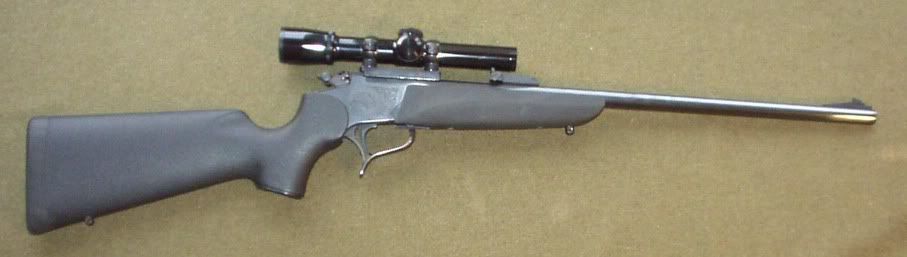

Image hosting by Photobucket


It is stocked in factory Rynite. Rynite is a synthetic stock material and the stocks are made by Choate Machine and Tool Company (www.riflestock.com) for Thompson Center Arms. I like the combination of appearance (I'm used to synthetics from my military service) and light weight compared to wood. I also think that the Rynite stocks fit me better than the wood provided by TCA. Thus the gun all up (sling TOO) and loaded weighs just 6¼ lbs. That's not too much to pack for anyone.

As I write this I have 21 barrels of which only 2 are the 10" length. All others are 16" and longer and the cartridges for which they are chambered range from the .22 LR to 28 gauge shotgun. This barrel, chambered for the .357 Remington Maximum, seems to be among my favorites.

THE CARTRIDGE

Maybe this barrel is such a favorite because the cartridge for which it is chambered is so versatile. One can have loads ranging in power level from .38 Special to .35 Remington without difficulty.
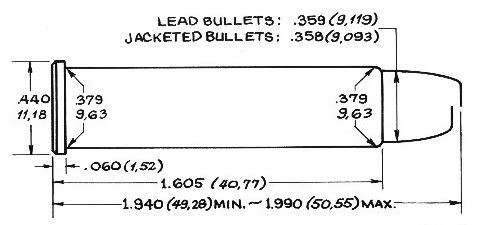

Image hosting by Photobucket


The cartridge is an old one all done up in modern garb. You could trace it back to the .38 Ballard Extra Long. However, I think that all the developers of this round were doing was extending the .357 Magnum so that it was long enough to attain their goals. They had the silhouette game in mind and managed to convince Ruger to bring out a special revolver with a longer cylinder to handle it. That revolver was quickly taken off the market due to complaints of gas cutting of the frame above the cylinder/barrel gap. I've heard that there were 10,000 guns built so it must have had a market. I used to think a lot of the problem was reloader use of hot loads with light bullets, a use which was unanticipated and unintended. However, I read somewhere that Ruger asked Remington to modify the loading to reduce the problem but Remington would not (could not?) do it and Ruger pulled the model from the line. A friend who has one says that the erosion stopped at a certain point and he hasn't looked back. It seems that every collector has one and many have been used to create .445 SuperMag and other revolvers. Dan Wesson makes or made a revolver, but as with all their guns, the cylinder/barrel gap was adjustable and so could be minimized thus likewise minimizing the gas cutting "problem". TC apparently chambered for the cartridge pretty soon after it came out. It has been a moderate success there. NEF also chambered Handi-Rifles for the round but these have been discontinued. However, it is a simple matter to extend the chamber of the still manufactured .357 Magnum that little bit and it affects functioning not at all. Note: I now understand that NEF has discontinued the .357 Magnum rifles as well!

GENERAL LOADING NOTES

I am not particularly interested in silhouette shooting because there isn't a range in my area so all my loads are for hunting, and I generally practice with those same loads. This ensures that I don't have to change zero or that I don't forget to change zero. When I make up plinking or small game loads, I like for those loads to shoot to the sights at some distance without changing the zero from that of the "standard" ammunition.

I have a set procedure for reloading. I begin by taking all once fired cases and polishing them in my Frankfort Arsenal vibratory polisher. Then each case is run through the RCBS full-length sizing die (a carbide die, no lube required). All cases are trimmed to 1.600" after full-length resizing but before case mouth expansion/flaring. Immediately after trimming, cases are chamfered and then run through the case mouth expansion die. They are then primed. This leaves me with a batch that I can load during available time. It is my approach of having a batch of cases prepared for loading that causes me to prefer to use powders that don't require a different primer. I don't really care which it is, magnum or standard, but I'd prefer for it to be one or the other. Sometimes, such as with the .357 Max, I'll count out a certain number for use with one powder (H110 in this case) and prime with the CCI450s and then load that batch. Later I'll come back and prime the remainder with the CCI400 and load those with H4227 and a 200 gr. cast bullet.

There is a die "problem" some people experience when loading the Max. I made the mistake of loading my very first 180 gr. SSP in a .357 Max case using the seating stem that came with the die. The result was a flat point (FP). I had thought that I could get away with using the "issue" stem but it had flattened the point so much it was clear that would be unacceptable. So, I pulled the bullet (I like all mine to at least start out the same) and got the seating stem from my .35 Rem die, screwed it into the .357 Max die and seated a Hornady 180 gr. SSP just as pretty as pie. Too cheap to buy another seating stem, I just swap it back and forth.

That your dies will include a carbide sizer die is a great plus that many people overlook with this cartridge. No lubing is a time saver that I overlooked for many of my early years of reloading, but no longer.

BULLETS

There are 5 bullets that I've come to depend on for this cartridge. There are a couple that I might use given the need to. Shown in the accompanying photo, they are (from left to right): 158 gr. swaged Speer LSWC; 180 gr. Hornady SSP; 180 gr. Remington SJHP; 200 gr. Hornady RN; 205 gr. Leadheads FPGC; 200 gr. Cast Performance WLNGC. Although not illustrated, other suitable or popular bullets include the 180 gr. Hornady XTP, 150 gr. Corelokt SP, and the 180 gr. Speer FP.
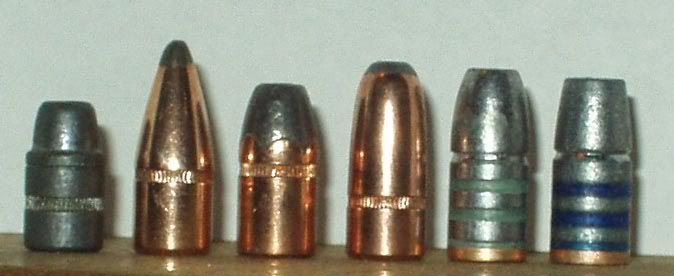

Image hosting by Photobucket


The 158 gr. Speer LSWC is a swaged lead bullet. Originally intended for use in the .38 Special it performs very well in the Max when loaded to about 900-1100 fps. Such performance apparently duplicates the .38 Extra Long and doesn't strain the bullet. I did try the Hornady equivalent but didn't get nearly as good accuracy in my barrel in this application. Whether it was because one has to seat to crimp of the bore diameter portion of the bullet or the lube used by Hornady or some other unknown factor such as weight distribution in the bullet, I don't know. I do know that in my barrel, it is the Speer bullet that is the clear winner with groups more than an inch smaller at 50 yards.

The 180 gr. Hornady SSP has been a standard for me in this cartridge from the time I started to reload for it. I believe it was originally developed to provide optimum performance in .357 Herrett and .35 Remington barrels of 10-14 inches in length. I thought that it would be the perfect round in the smaller .357 Max case. Some do not experience good accuracy in their barrels but it performs better than or as well as any other bullet in my barrel and I don't think one can quibble with terminal performance on any game animal one would tackle with the Max. Note for those interested: That is the only SSP left in the line is the .358". The .308 and the .284 (we knew that the 7mm had been replaced by the VMAX) are gone. There is NO apparent replacement for the .30 cal SSP, however, MidwayUSA is still cataloging the .308 SSP.

The 200 gr. Hornady RN is a bullet that was built for one cartridge, the revered (at least by me) .35 Remington. It is an excellent bullet for the velocities produced by the Max, Herrett or Remington cartridges. Accuracy is right up there being 1.25" or less, seemingly with any load in any gun chambered for any of these three cartridges. I've got a lot of confidence in this bullet which has proven terminal performance. Now that I know that I can start it at velocities fully in excess of FACTORY .35 Remington loads, it may become a new standard with this cartridge.

Well, swaged bullets just don't get it for some people and jacketed bullets are "cheating" somehow so they love cast bullets in the Max. There are a couple that I think are "da bomb" in the Max.

The first is the Leadheads 205 gr. FPGC. I buy this bullet in 500 piece lots and have yet to have one I need to scrap. The excellent quality of this bullet from the folks at Leadheads (www.proshootpro.com) contributes to it's excellent accuracy and the design which follows those by Veral Smith works on game. I don't stress my cast bullets but this has a gas check and can be pushed just as fast as the Hornady jacketed bullet with the same load. It is still accurate and I like to use my load with this bullet for off-hand practice.

Perhaps with even better terminal performance on game is the Cast Performance 200 gr. WLNGC. Also a gas check design, this bullet can also be pushed to 2000 fps and is still accurate. No leading here. Cast Performance (www.castperformance.com) is another cast bullet maker with an excellent product. Never any scrap in their boxes but more than that, consistent weight and casting technique make for a consistently accurate bullet. It is a bit more expensive but the design is more along the lines of Veral Smith's thoughts and might be even more effective on game.

I should also talk about some bullets I don't use in the Max.

The 180 gr. XTP is NOT a bullet that I have used. Friends and acquaintances that have used it and posters to the various Internet forums often choose it as their premier bullet for the Max. I'm sure it is great in the revolvers chambered for the Max and probably solves whatever problem makes the SSP inaccurate in some barrels. It SHOULD be a good bullet for the Max and it certainly works well for quite a few people.

I only recently discovered the Remington 180 gr. SJHP. I've been told that this bullet was originally developed for the .357 Maximum. However, I've never seen it in loaded ammunition. In fact, the ONLY Remington factory ammo for the Max that I've ever seen is loaded with the 158 gr. SJHP. I bought 500 recently to use in a .357 Magnum rifle. They perform well there at about 1600 fps. Interestingly, that is about what you should get from the Max in a 10" barrel. I don't know how they would perform when launched at 2100 fps but they might be a bit frangible for my taste.

Indeed that's why I don't use the Remington 158 gr. SJHP. This bullet is all that I've seen loaded in the Remington factory ammo. As many gun-writers reported, this load is indeed more of a varmint load. Some people are very satisfied with the old Remington factory load with the 158 gr. SJHP on deer and some were not (very much not!). I think those differences of opinion are influenced by the size of deer shot and the ranges at which those deer were shot. Of course there are those who report that it takes deer down NOW. No doubt. However, I would bet that these fellows use it only on quartering shots from the rear and into the lungs just above the heart. The bullet is moving at 2173 fps from my 21" barrel and the bullet is just too "soft" for this starting velocity. Accurate, I don't use it on game larger than groundhogs. I would not recommend it be used on anything like coyote if you want the pelt. I think we can do better in this cartridge. Of course it will work on deer there and there isn't anything wrong with that if that is what you want. I want to be able to take game from any angle and prefer a sturdier bullet.

I think that the Remington 150 gr. Core-lokt SP deserves to be mentioned here. I think that this bullet is primarily designed to use in the .35 Remington. The intent being to provide greater velocities out of the old girl and flatten trajectories in the process. I'm sure that there are a lot of .357 Max Contender shooters out there using this bullet. Lighter by 30 whole grains than the 180s and with a sharp little point to boot one would think that this bullet can be driven fast and maintain that velocity way on out there (relatively speaking). There was even a fellow on the Accurate Reloading forum (www.accuratereloading.com) who prevailed upon Remington to make a run of 50,000 of these bullets and paid the up-front cost himself. Apparently, there were at least a few who agreed and I believe that he's recouped his investment. For me, these bullets were not at all accurate in my barrel. I believe that the bearing surface or perhaps that combined with the weight distribution of the bullet made this no better than a 2-3 inch grouper for me. For what it's worth, they don't work in my .35 Remingtons either!

The Speer 180 gr. FP was developed for use in the .35 Remington to give higher velocities and thus flatter trajectories with more bullet weight than the previous light bullet for the .35 Remington, the 150 gr. Corelokt SP. It is accurate in my barrel and it seems to provide good terminal performance but I thought that it might be a tad too heavily constructed to be used at the slightly slower Max velocities especially at the outer ranges at which I would use the cartridge. I don't experience the problems with accuracy with this, or any other 180 gr. bullet, that I had with the 150 gr. Remington. I do know of one shooter that uses this bullet exclusively, also from the carbine, and has excellent results on game deer sized and smaller.

One thing that some people don't consider when carrying loads of different capabilities. They often load the same bullets and can't tell the difference between loads when they get to the field. In the worst case a hunter might lose game due to misidentification of a small game load as a full-power "deer" load (or the other way round). Paint and fingernail polish sometimes can't be seen or wear off after extended carry. Much more certain in my opinion is to use a different bullet or different case. Cases can be differentiated by headstamp OR length (or both…). Bullets are much more certain. Usually, I load cast for the small game load and jacketed for the "deer" load. When using the heavy weight LBT style bullets, which are very effective, one needs to use a completely different style bullet to ensure that you can quickly tell the difference.

CRIMP

If you're talking bullets you've got to talk crimp. I've tried various degrees of crimp. In all cases consistent velocities are helped with a firm but not excessive roll crimp. I suppose that a good taper crimp would do as well, but my die is not a taper crimp die. I don't use the Lyman M die but do expand as I would with any straight case. I don't see anything "wrong" with any of the methods if they work. My system works and only because I take care to properly trim the cases and adjust the die. If you put too much of a roll in the roll-crimp your neck tension might actually decrease (with some dies) as the brass in the neck or case mouth is deformed. However, it seems that most of the powders indicated for the .357 Max are best served with quite a bit of resistance in the crimp. It is ALWAYS best for 2400 and H110/W296. Differences in the crimp often make a HUGE difference with H110/W296.

I'm not a "believer" in the factory crimp die concept and have none of those dies. I am satisfied with the performance of the crimp provided by my RCBS seating die.

TRIMMING

Trimming ensures that each case releases the bullets the same way. I have to admit, that for my first 600 rounds or so I didn't pay attention to trimming or the crimp. A few unexplainable flyers and sticky cases made me look at what was going on and the only variable is the crimp based on case length. When I eliminated that variable, the anomalies went away.

PRIMERS

This cartridge REQUIRES small RIFLE primers. Rifle primers are tougher and will withstand the 50,000 CUP that the .357 Max can go to. It IS stated to be a requirement for that reason. Clearly if you are loading to the old .38 Extra Long standard (i.e. 6 gr. Unique and a 150 gr. lead bullet) you won't have nearly the pressures. That's not what most do as that's not what the case was developed to do. I will reiterate, you must use small RIFLE primers. A pierced primer at these pressures in the gun you are using can be a very bad thing indeed. There is NO benefit to using small pistol primers. The cost to you of buying a $20 brick of primers is NOTHING compared to your EYESIGHT! (I've seen a couple of instances of the failure of protective eyewear. A fine safety element, NOTHING is guaranteed!)

POWDERS

I think that there is a wide range of powders usable in this case. However, there are relatively few powders that will produce the velocities (at safe pressures) for which the case was designed. WC680, AA1680, Lil'Gun, H110/W296, and H4227 seem to be best in my gun or are reported as providing the best velocities or accuracy in those guns shot by others.

BRASS

I've never seen the Federal or Winchester brass but I've accumulated over 1000 Remington cases. The Remington brass is pretty good, but when used in MY Contender barrel, it all needs to be precisely trimmed to 1.600 inches for best performance and there has been quite a bit of variance in length with this brass. Still, it holds up to repeated use well.

357 MAX LOAD DATA

The following chart gives my favorite loads. The "full effort" loads are the maximum in my barrel and I am not responsible for your use of this data or your reloading practices. It is your responsibility to use this data appropriately.
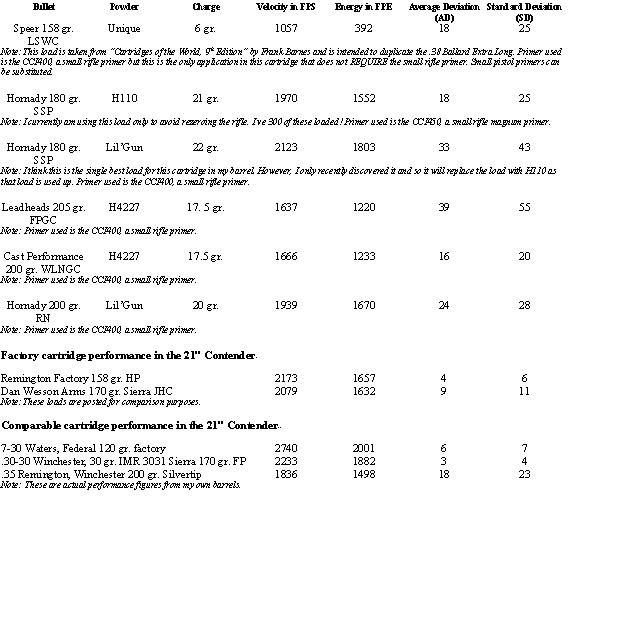

Image hosting by Photobucket


Of course one wants to see just how well this gun will shoot. By shooting the gun "off the bags" you'll have a better idea of how the gun really performs. It has been my experience that tip barrel rifles and the Contender in particular require that the resting point be to the rear of the pivot point with absolutely no upward pressure on the forearm. Shooting from field positions will give a better idea of how the gun groups when used in the field but the groups won't be as tight. This bothers some people but I use mine in the field, the range is only for load development. For those of you who care what MY rifle does, I'll tell you that from field positions I get 1-1½ inch groups at 100 yards with all but the 158 gr. Speer LSWC load. That load will do 1-1½ inches at 50 yards and requires but a small adjustment in point of aim. That's plenty for what I'm going to do and remember, these groups are shot from FIELD positions.

I've really grown to love this cartridge. It does what the .35 Remington does from factory loads and nearly what it will do from handloads. It also has some advantages. Rimmed case for ease in handling with the Contender, a straight case that can be reloaded using a carbide sizing die eases reloading chores, and a small case head that increases the margin of safety in the Contender system. It is that small case head that allows the 50K CUP pressures that allow, in turn, the .357 Maximum to run so closely on the heels of the .35 Remington. Another benefit to many is that the Max can do this on very light charges, one-half to two-thirds of what the .35 Remington will use. With powder prices rising, this is important to quite a few shooters.

Light powder charges do something other than ease the strain on the wallet. They reduce recoil as well. Recoil with the heaviest charges and bullets have a recoil energy of only 13.7 ft lbs. That's actually 3 ft lbs. less than the .35 Remington 200 gr. factory load at only 1836 fps. This gun is easy on you all the way round!

However, there are those who always push too hard. You will see some who claim that they get 200 gr. RNs to 2000 fps in 18" or shorter barrels. They have to really be pushing things even using 680, AA1680 or Lil'Gun. I don't think it is worth losing your eyesight (or worse). There are limits to everything. If you simply must have more velocity, chamber for a bigger case like the .358 JDJ or .358 Bellm.

Wanting a small game load for my barrel, I tried 2.5 gr. of Bullseye in the .38 Spec case with the 205 gr. cast bullet. This makes a quiet (not silent) small game load that shoots point of aim at 50 yards when the gun is sighted for 100 yards using the full-power loads. Very handy and you can easily tell them apart. A nearly silent small game load would be a great benefit in some circumstances.

This is an efficient, well-balanced cartridge that gets .30-30 performance without a lot of powder. It will match factory .35 Remington ammo. I like it.

Addendum--

We are constantly asked about adaptation of this cartridge to lever-action and other rifles. Most of these requests for detailed information are without any research what-so-ever. However, in the interest of saving me some typing in the future I'm going to add it here.

The Marlin 1894 is most often mentioned as the "ideal" basis for a rifle chambering this cartridge. It isn't. One shooter actually had a very good smith make up such a rifle. He reported that he wasn't entirely satisfied with it. Functioning wasn't entirely reliable and the lever throw had to be so lengthened that use of the gun was awkward. He felt that the awkwardly long lever throw might have contributed to the functioning problems but that the geometry inside the action as the overly long for this action cartridge was maneuvered into position must have contributed to his problems.

The Marlin 336 is simply too long an action for the .357 Maximum. The same problems that the .44 Magnum 336s sometimes had can occur with the Max. Further, a new barrel is required. One can't simply re-chamber a .35 Remington barrel (and one wonders why one would). This increases the cost considerably. This gun also negates the smaller action/lighter weight rifle benefit one expects with the .357 Maximum.

Another action mentioned is the Winchester 1894/94 as one might expect. After all, the action is one of the most common available. The MOST suitable of these is those guns factory produced in .357 Magnum. Some shooters have reported that these will already handle the .360 Dan Wesson cartridge which splits the difference between the .357 Mag and the .357 Max. Still, one shooter who actually attempted the conversion wasn't, at last report, fully satisfied with functioning. Apparently the cartridge guides are set up to handle the .357 Mag length cartridge and while they actually will work with the .360 DW don't work with the Max. Altering the cartridge guides takes time (and money) to do correctly.

The Winchester 1892 and clones are simply too small to handle the additional length of the .357 Maximum cartridge.

Also asked is why there are no factory chambered leverguns for the .357 Max. The simple explanation is that there is no market. Many shooters have found that the cartridge is wonderful in single-shots. One can load about any bullet. It is easy to reload (no lubing of cases).

Monday, March 30, 2009

Shot loads for the .357 Mag using .357 Max cases...

From elsewhere came this how to. Personally, I'd rather use the .357 Maximum cases in a .357 Maximum...
357 shotshells from maximum cases:

1, 357 max cases annealed at the mouths to prevent spring back when sized ,i only use rcbs size lube.

2, size in 222rem. die as far as possible without hitting the shoulder area of die.

3, cut your cards with a formed case, regular 357 cards are too big. (i sacificed 1 unannealed case & drilled the primer hole out the size of a 16 penny nail with the point ground off then took a triangled file & cut some teeth on the rim & sharpened with a chamfer tool.
i spin these with a lee trim holder on a block of wood & a cordless drill .
note more than 10 cuts are harder to push out )

4, seat your cci400 small rifle primer & i dropped 3gr. of clays , pushed a card on top ( i take the nail head & pack it tight)

5, i weighed 145gr of #9 shot (thats almost 2x what factory holds!!)
cover with a card (pack & straighten the card with nail head) then seal with water proof carpenters glue. let glue dry24 hrs. or it will get smeared in the barrel. (don`t ask how i know!!)

5A, i use the 222die a little lower in the press to put a little roll on the mouth to help hold it all in.
this is done before sealing with WATER PROOF carpenters glue

6, these work in a GP length cyl. & shoot to POA at 20 ft. i shot both layers of a pizza box & the whole load hit it & penetrated soda cans (both sides) that were behind the box!! have not tried em in the 4" or 3 " yet!!!

Thursday, November 08, 2007

.327 Federal, the .32 Maximum Comes to Fruition

They've been working on this sometime, or so it was rumored. Now, here it is the .32 Maximum or actually, the .327 Federal and will make its debut in the Ruger SP101. 1/8-inch longer than the .32 H&R, the cartridge is reported to nearly match the .357 Remington Magnum 125 gr. load for energy! Now that's remarkable. I would love to have a Contender carbine barrel for it. However, it would need to have a genuine .312" groove diameter just like the .32 H&R and not TC's usual adaptation using the .308 groove diameter. That would be unacceptable.

There's not a lot out there yet but here's some links.

- Shooting Times Article Lethal Combination - Federal Ammunition and Ruger Firearms introduce the .327 Federal Magnum & Ruger SP101 by Dick Metcalf
- Guns and Ammo Video
- Federal Cartridge Company press release
- The New .327 Federal Magnum in Ruger’s SP101 Compact Six-Shot Revolver by Jeff Quinn
- Freedom Arms Model 97 & Single Action Service Custom Ruger Revolvers Chambered for the New .327 Federal Magnum by Jeff Quinn

The more I think about this the more I like it, as a carbine cartridge. In a TC Contender, the .327 Federal would be sort of a .357 Maximum light. IOW, in some areas it could be what the .357 Max is in my area. That is, a small game (loaded with .32 S&W ammo, nearly silent) to small deer round. It would be a light recoiler, too! Of course it is pretty much a rimmed .30 Carbine or modern case .32-20 but heck, it could be fun. Just as with the .357 Maximum, the .327 Federal could be loaded with a carbide die set and no lube. That's quite an advantage.

Friday, January 22, 2010

Has this story been told before?

First we had the .36 caliber percussion revolver which really had a .375-.377" groove diameter. Then we had cartridge conversions which used heel type bullets of correct diameter for the bore which led to the cartridges being called .38 caliber. Then we had the inside lubed bullet due to Russian influence and practicality and the bullet fit in the same case came out to about .358". Then we had bores to match the new bullets but the cartridge name didn't change. Then the .38 Colt was lengthened and eventually we have the .38 S&W Special, .357 Magnum, .360 Dan Wesson and .357 Maximum. Of course the .357 Max is very similar to the .38 Extra Long but not to confuse things...

In between, in years of transition we experimented with hollowbase bullets which got even more "bumped up" due to BP's characteristics and even using the same bore for both the .38s and the .41s...

Isn't life interesting?

What IS really interesting is that the .38 Colt eventually won the .38 (actually .36) revolver cartridge war and the .32 S&W (actually .312) eventually won the .32 revolver cartridge war lengthening to become the .32 S&W, .32 S&W Long, .32 H&R and now the .327 Federal whereas the .32 Colt and .32 Long Colt have only now been given a new lease on life due to the vagaries of the cowboy action shooters.

 So, what is the real "genealogy" of the various .38 cartridges?  Well...

There once was the ".36" caliber Colt revolvers (which established a standard of sorts), with .36" (nominally) bores but .375" (nominally) groove diameters.  When brass cartridges became the in thing and the guns were converted, the cartridges used bullets that approximated the groove diameter.  Due to the technology of the time, these were outside lubricated, heeled bullets like our modern .22 Long Rifle (and shorts and longs and CBs...)  These bullets had drawbacks such as leaving lube in pockets where ammo was carried, picking up dirt and other trash, or worse, being wiped clean off!  Also, when carried a lot, the bullets would come loose from the case.  Something was bound to change.

The Russians might have been the ones to get the ball rolling when they ordered a bunch of Smith and Wesson pistols but insisted that the cartridge for which they were chambered carry an inside lubricated bullet (the .44 Russian instead of the .44 American).  The advantages of inside lubricated cartridges were obvious and immediately in demand.  Makers at first tried to use these inside lubricated bullets in the old cartridges resulting in bullets severely undersized for the bores in which they were being shot.  After a bit, the bores of the revolvers were adapted to the new cartridges by being reduced to .357" (nominal groove diameter measurement) but were still referred to as "thirty-eights".  The .32s went through a parallel development but the cases were made a bit bigger to accommodate the necessary .312" bullets.  Of course, the peculiarities of the market, relative popularity of certain firearms, and so forth worked to bring certain cartridges to the forefront.  The .38 Colt became the .38 Long Colt became the .38 S&W Special (S&W's co-opting of the Colt military cartridge to their own benefit) which became the .357 Magnum which became the .360 Dan Wesson and the .357 Maximum.  S&W tried their own .38 centerfire with the 36/38 caliber in the "Baby Russian" in 1876 (using .36 caliber bullets and .380" diameter brass and later referred to as the .38 S&W beginning about 1877) but it didn't achieve the same level of popularity (again, it uses a .361" bullet) nor did it become a military cartridge in this country which is why S&W didn't use it to create the "Special".  However, the S&W cartridge did get military, para-military and police use elsewhere mainly in Great Britain and its colonies (and former colonies) as the .38/200 or .380/200 later known as the .380 MK I or MK II and I suppose somebody might find ammo marked with the metric designation as 9.1x20R.


On the other hand, S&W had started early with .32s in their rimfire .32 for the Model 2 and had so much market share that Colt switched from chambering their revolvers for the .32 Long Colt to the .32 New Police (a .32 S&W Long with a flat meplat on the bullet), so called to avoid putting the S&W name on their revolvers.

The cartridges from these two design paths have different case diameter so one has to know what is what when buying or reloading ammo.  To further complicate the issue, there are rimfire equivalents and the cartridges were also used in various rifles.  For example, the Marlin 1892 .32s chamber the .32 Colt Long and came with firing pins that could be used with either the centerfire or rimfire versions.  However, some of those rifles have been rechambered to use the more easily found .32 S&W Long. 

So, to run the .32s down (for the centerfires) we have the .32 S&W which begat the .32 S&W Long which begat the .32 H&R which begat the .327 Federal.  So far as I know, the .32 Colt begat the .32 Long Colt and then the line died.

We should note that many of these older cartridges were on the razor edge of absolute death until cowboy action shooting came along.  That game certainly excited a lot of interest in the old cartridges both for reasons of nostalgia and because they are very mild recoiling and period correct.


Saturday, March 06, 2004

I am going to try to bring together some related posts I've made to various forums...

*********


Is there something wrong with TC's .35 Rem barrels for the Contender?

With all the TC made barrels I've seen the problems aren't in how the guns are bored (I think they are very consistent in that regard) but in how they are chambered, crowned or finished. Finishing is a minor problem that brings the price down for the astute buyer. Incorrect crowning can be corrected as well. However, guns that are improperly chambered are a big problem. Often, only rechambering to a larger cartridge can solve the problems with the chamber and/or throat. That can be expensive as sometimes that also requires a foray into the world of wildcats (i.e. .358 Bellm or .358 JDJ) and additional dies, etc. Sometimes, that won't work either as there have been reports of chambers so far out of kilter that they simply can't be repaired. Bobby has probably seen a lot more .35 Rem barrels than I have and TC doesn't have a great rep for quality control so there may be something to the idea that the .35 Rem barrels are more likely to have problems.

IME, the .35 Rem and it's relatively small shoulder is a big problem for some reloaders who don't pay attention to detail or, perhaps, are somewhat lacadaisical in their approach to reloading. This even in perfectly set up barrels. When the dies are improperly set, there can be problems with proper functioning or case life. Many shooters will blame it on the barrel and move on.

I personally think the reason there are so many .35 Rem. barrels out there is that the .35 Rem is too mundane for a lot of shooters. Sure, it was a good first barrel but later... There are a LOT of options, and most want to try them. Rather than simply accumulate barrels (HEY!, don't look at me ), they sell them off and use the cash to buy new barrels, dies, etc. Contender shooters as a group seem to be more likely to do this than most shooters. We seem to love to buy, trade, accessorize, etc. However, it seems to me that there is a lot more of this activity among shooters than 30 years ago when many shooters only hauled out the guns to kill pests in the garden, go quail or dove hunting or for a couple of weekends of deer hunting.

*********


The .357 Maximum...

I have a TC factory 21" barrel for my Contender. Excellent.

There seems to be a lot of stuff out there on the .357 Max and some of it seems to be true! The best powders seem to be W680, AA1680, H110/W296 and H4227. Lil'Gun might be in the running here, too. I'm going to be trying it this summer. Remember to use small rifle primers.

In the longer rifle barrels I think it is possible to get 2000 fps with the 200 gr. jacketed RN and AA1680. 2000 fps for the various 180 gr. jacketed bullets seems to be no great thing. 21 gr. of H110 and the 180 gr. Hornady SSP gets 1960 fps in my gun. This is plenty good. With the Leadheads 205 gr. LBT GC I get 1600+ fps from a charge of 17.5 gr. of H4227. Now this is a fun load to shoot and it is still effective.

Some people say that it reminds them of the .38-55. I think they're right. I'm hoping I can get a 200 gr. to leave my barrel at 1900-2000 fps using AA1680 or Lil'Gun and if so it will be very close to that .38-55 255 gr. jacketed moving out at 1850 fps. The .357 Maximum is really a hidden jewell.

Of course, it is basically the .38 Extra Long. One of the recommended loads for that cartridge is 6 gr. of Unique under a 150 gr. cast bullet. Using 158 gr. swaged lead bullets with this charge gives .38 Special peformance from the rifle and is loads of fun for small game and plinking. Great training round, too. In fact, the .357 Max is capable of swallowing all the .38 Special and .357 Magnum ammo you care to feed it. Just be sure to clean out that chamber later so that the Max cases have no problems sliding into the chamber.

Wednesday, November 20, 2002

I did not have a particularly good day hunting. While exploring, I came upon some fresh but unimpressive rubs (by spike bucks?) but only in one location rather than the several "used to be good spots" I went to.

Then, while exploring further, I apparently pushed a buck out of the laurel thicket and into the gun of another waiting hunter. Which points out the fact that hardly anyone moves around anymore, they wait for somebody else to get out there and push the deer to them.

Today, my truck is in the shop for the repairs noted earlier. Sadly, they expected me to drop it off, indicating that they expect to have it all day. Another days hunting lost, score another one for the gremlins of life who conspire to make things difficult or unpleasant for yours truly. Please note that this is a 1995 Dodge Dakota extended cab. I don't think I'll be buying another Dodge. The package is nice but it has had more than it's share of problems.

Yesterday evening, I was doing some reloading in pursuit of the "squib"/small game loads for the .357 Maximum carbine and discovered something. When I attempted to put a mild crimp on a buckshot load (1 gr. Unique, CCI Small Pistol Primer, #2 buck) in a .38 Special case the buckshot the shot stayed in the die. It was a simple matter to turn the seating stem out but with it came about ¼ inch of accumulated lubricant from Hornady's swaged bullets. I thought that was all then looked at the stem (for wadcutter and semi-wadcutter bullets) and could see that the seating stem was completely plugged with lubricant. that's over 3/8 inch of lubricant! Now, I've loaded about 2000 of those Hornady bullets in the .38 Special (I have separate seating dies for .357 Magnum and .357 Maximum) and that was all it took to strip that much lube off the bullets and leave it in the die. Seems I need to learn to clean my die more often. Yes, I did notice the dies going out of adjustment, but it was so subtle that I thought it was just my imagination. I can look back (hindsight being 20/20) and see just what I did wrong. The lesson learned: inspect and clean your dies every reloading session.

However, I am now ready for the next phase of the small game load experiment. I have 20 .38 Special cases loaded with 2.5 grains of Unique (recommended as being less position sensitive than Bullseye and slightly quieter) and the Leadheads 205 grain LBT GC bullet. I also loaded 5 cases with 1 grain Unique and a single #2 buckshot. The intent is to come up with an effective sub-sonic load for squirrel and rabbit.

I also found some 140 grain 7mm/.286 LBT GC bullets at Beartooth Bullets for my small game load in the 7-30 Waters. I suppose that I have it in the back of my mind that I should be able to simplifiy/reduce my gun collection and Contender barrel collection. Yeah, right. I have already had thoughts of a .300/221 (.300 Whisper) and .25-20 Winchester or .25-25 Stevens barrel.

Anyway, it appears that today will be taken up with reloading, working on the office and playing with my dog, Bailey.

Wednesday, March 25, 2009

The .357 Mag in a Carbine

Probably the best single gun a person could buy. It is good enough to do many jobs, is light in recoil (very light with .38 Specials), light to carry and easy on the budget. One can choose a Winchester Model 92 clone or the Marlin 1894C. The Winchester 1894 was made in .357 Mag but has been discontinued. Likewise, one could go with the Timberwolf pump gun or any of the 1873 clones. I am somewhat leery of the later for continuous use as .357 Magnums but they've been around for a while and much used. I'll confine most of my comments to the Winchester 92 clones and the Marlin 1894C.

Ammo isn't a problem. Just about any commercially available ammo for the .38 Special or .357 Magnum will work in these rifles. The only exception in the Marlin 1894C is the .38 Special wadcutter but some of the Winchester 92 clones will feed these without problems or alterations. However, the wadcutter ammo can be singly loaded and is a wonderful small game load. Recoil of the most powerful of these loads will be in the very mild range of about 7.3 fpe compared to the 14.3 fpe of the .30-30. The Winchester 1873 guns are very sensitive to cartridge overall length.

As I've said before, I do have some favorite loads to cover the gamut of use for me. #1 is the Federal full wadcutter load. This load shoots to point of aim at 25 yards when the gun is sighted at 100 yards with my .357 Magnum 180 gr bullet load. One can duplicate the factory load with 2.7 gr. Bullseye and a 148 gr. wadcutter.

#2 favorite load uses either the Hornady 180 gr. XTP or Remington 180 gr. SJHP over 15 gr. of L'ilGun. I prefer to use CCI's small pistol magnum primers for this and load #3.

#3 is the Hornady 158 gr. XTP-FP (emphasis on the FP which is designed for these velocities while the HP is not) over 18 gr. of L'ilGun. This load gets an honest 2000 fps from my carbine. It would be an about perfect all-around load for deer and varmints. I don't use it on squirrels or rabbits though!

The weight of these two carbines is a very portable and usable 5½ to 6½ pounds maximum with the Marlin 1894C being the heavier of the two. The 1894C is what I have. The major advantage the Marlin has is being drilled and tapped for and readily accepting a telescopic sight. The 92's major advantage is in weight. Either are more than strong enough to handle any factory .357 Magnum load.

A short aside about the guns. First, if you decide you want a 92 clone you can do no better than to visit Steve's Gunz and get one of his Rossi guns already slicked up with all the negatives mitigated. That would include his slicking up of the action, replacement of the plastic follower with one of metal and removal of the stupid bolt top safety. He'll also install a peep sight on that gun to fully exploit the cartridge.

Second, if you're going to get a Marlin and don't want one of the current cross-bolt safety guns, you're going to have to look around for one. The good news is that you probably won't have to pay a premium for the pre-safety gun. That's a good thing!

Sights are a flexible option mostly because the legitimate operating range for these rifles maxes out at about 150 yards and that is due more to energy levels at that range for deer size targets and the practical limits of accuracy for the smaller game. I prefer the Williams Foolproof receiver sight because it adds precision while remaining as compact as the factory open sights. However, I compact 4X or 1-5X variable is about ideal for this platform. I understand that some folks are using scout mounts to put IER and EER scopes on the 92 clones. For those that can utilize them or NEED them, scope sights are doable and usable.

So, you might say, just what is such a "light" carbine good for? Well, using .38 Special loads of your preference it is an excellent small game gun. Back before the turn of the 19th to the 20th century cartridges (both rimfire and centerfire) with the ballistic output of the .38 Special wadcutter load were considered outstanding small game guns. The .38 Special roundnose (yes roundnose) is an excellent plinking/training round for the gun. It does or can be made to slickly feed through the .357 Magnum guns, the recoil is about nil (actually around 3-4 fpe) and it is plenty accurate (oh, and still relatively CHEAP, too). The .357 Mag 125 gr. load, often recommended for revolvers used for self-defense, is a hot self-defense load and much easier on the ears from the carbine than from the revolver. Lots of folks find a shoulder gun easier to use accurately under stress and it has the added bonus of being legal where a handgun might not be. Move up to the 158 gr. and 180 gr. loads (personal preference & locale might have a lot to do with the choice) and you have a viable big game rifle. At least it will be suitable for deer, eating sized hogs, and certainly larger varmints like coyotes. One might even use it on bear, in a pinch, maybe not, without being tremendously undergunned. With forethought one could single load CCI's shot cartridges for eliminating poisonous snakes around the homestead. Again, this is a tremendously versatile firearm.

Frankly, I don't see how anybody serious about a cost effective firearms collection could avoid getting a .357 Mag carbine.

Friday, January 09, 2009

Dave Deering's Custom Bullets up and running...

Many folks on the various shooting forums know David Deering as StoneFence and have been using his custom swaged bullets for the .38-55 with complete success. That's a .38-55 Marlin 1893 that took down this deer with a Deering bullet in 2008.


Photo by Grace Koch

David started swaging his own jacketed .378" (also .375") bullets about 4 years ago as a hobby, because what he wanted wasn't available (at least at a decent price) in the marketplace. He's since added heavy .357 (190 grain) bullets for .357 Max, a .401" TCFP for .38-40 and 10mm, and new .431" 270 grainers for Marlin .444's. I've not seen the latest bullets but the .375" .38-55 bullets are beautiful in that they are well made, consistent, accurate bullets. They're so good that I just ordered another 300 and 300 of the 190 gr. bullets for the .357 Maximum. David is also thinking about doing a boat-tail spitzer (with small flat) in .338 cal for the new Marlin .338 Express-- there seem to be NO .338 levergun bullets out there anymore. I know that if you're a .33 Winchester shooter, you should drop David a line..

Custom Bullets
2528 3rd Ave. N.
St. Petersburg FL 337

david@custombullets.com

Also, look for David's ad in the January issue of Handloader Magazine.

Photo courtesy of Kirk Durston

There are no better bullets out there for the .38-55 than Dave's ESPECIALLY at that price! For years we couldn't find them at all (even the Barnes were practically unobtainium). I'll get 'em while I can!

Thursday, February 04, 2010

Notes from the gun shop...

It is amazing to me that I am still so naive that I'm surprised that anyone would not consider their criminal past when filling out the paperwork (including the 4473) for the background check when buying/attempting to buy a firearm. Whatever you might think of the logic of denying firearms to any given segment of society, be it felons, drug addicted, former mental care recipients, etc, you must be struck by a system that allows prohibited persons an opportunity to violate a law.

Today's exhibit was a person who had been convicted of two counts of simple possession of a controlled substance, marijuana. Under Virginia law that person isn't permitted to purchase a handgun for five years. I thought it was forever, but was corrected. The person who had been denied the transfer claimed to have been unaware of the restriction and then told that they could purchase a rifle but not the handgun they had attempted to purchase. To my mind, a rifle is WORSE than a handgun but then I'm only thinking about destructive power. As we all know, concealability is the almost uniquely American bugaboo as regards firearms. In other countries, military chambering is considered the real threat, but I'm digressing.

So, this fellow comes back and applies to get a .22 LR rifle instead of the inexpensive small pistol he was planning on buying. He was once again delayed. I'm wondering what is going to happen next.

As an aside, a full 2/3s of our background check submissions were delayed. That isn't the norm. Some days less than 10% are delayed. It all depends on who happens to come in. Contrary to rumor, concealed handgun permit holders and law enforcement officers are just as likely to be delayed as other buyers.

The other thing that happened was a customer came in with the now old question of what loads are safe in a .357 Magnum rifle. Apparently there is a wide spread notion that normal .357 Magnum loads aren't safe/suitable for a .357 Magnum rifle. In my experience, by my reasoning, this is wrong.

In my revolvers and rifle, the loads which do not exceed the standard for the cartridge pressure will be safe in all arms which are chambered for any given cartridge. Exceptions might be antique arms chambered for cartridges originally loaded with blackpowder for which ammunition is currently made with smokeless powders. Maybe. I personally believe that if the maximum BP cartridge pressure isn't exceeded, guns in good, serviceable condition don't care about the powder used in the cartridges. However, this is a circumstance that doesn't apply to the .357 Magnum cartridge. The only real consideration of factory or handloaded ammunition which doesn't produce excessive pressures is whether or not the cartridge will function in the user's firearm mechanism. In other words if the exterior dimensions permit function and there are no excessive pressures produced by the combination of components all is well.

Apparently the people at Sierra have contributed to this idea by having, at some point in time, a suggested load(s) expressly for the .357 Magnum rifle. I'm still looking for a copy of the reference. Unfortunately, I don't have a copy of the Sierra manual.

Today was a lesson in misconceptions.

Thursday, February 11, 2010

Handirifle twist rates...

I just though I'd archive this where I could find it, I hope, as we needed the info at the shop. This is also interesting because it lists the cartridges for which the Handi Rifles have been chambered.

Twist rates of Handi Rifles:
ChamberingTwist Rate
.17 HMR 1 in 9"
.22 LR 1 in 16"
.22 WMRF 1 in 16"
.204 Ruger 1 in 12"
.22 Hornet 1 in 12"
.223 Remington 1 in 12", late models are a mix of 1 in 9"/1 in 12", 2007 Marlin produced barrels are 1 in 9"
.22-250 1 in 14"
.25/06 1 in 10"
.243 Winchester 1 in 10"
.270 Winchester 1 in 10"
.280 Remington 1 in 10"
.308 Winchester 1 in 10"
.357 Magnum 1 in 18¾"
.357 Maximum 1 in 18¾"
.35 Whelen 1 in 16"
7mm-08 1 in 10"
7.62x39 COMBLOC 1 in 9¾"
7x57 Mauser 1 in 10"
7x64 1 in 10"
7mm Rem Mag 1 in 9½"
.30/30 1 in 10"
.30/06 1 in 10"
.300 Win Mag 1 in 10"
.38/55 Winchester 1 in 18"
.44 Magnum 1 in 38"
.444 Marlin 1 in 38" (original)
.444 Marlin 1 in 20" (2007 models)
.45/70 Government 1 in 20"
.450 Marlin 1 in 20"
.45 Colt Carbine 1 in 16"
.45 Colt/410 1 in 16"
.500 S&W 1 in 18¾"
20 ga. 1 in 28"
12 ga. 1 in 35"

Sunday, June 01, 2008

Colt Official Police .38 Special

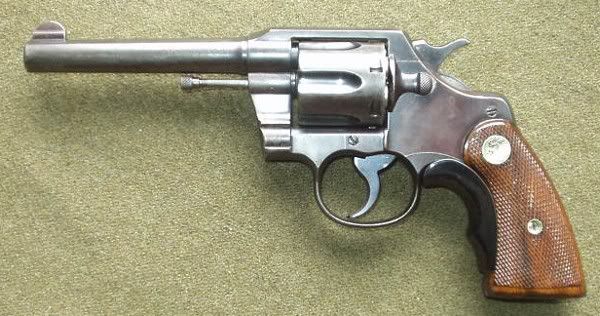
I wanted an Official Police in .41 Colt but finally went with the flow and picked up a 1929 5" OP .38 Special gun. External finish isn't great. The gun is clean, but blue worn, the bore is good, it locks up tightly and is timed correctly. Should shoot well with good ammo. This gun was made in 1929.

I have a load in .38 Special cases of a 200 gr. bullet over 2.5 gr. of Bullseye. Used in my .357 Maximum rifle this is a cat-sneeze load but in a revolver it is the duplicate of the old Super Police, with a slightly better shaped bullet. I'm going to try it out in this gun as well. This would give very close to .41 Colt performance.

I know the grips look wrong for the gun. The grips had the checkering re-cut and they look pretty good condition wise even though they are way better than the rest of the gun.

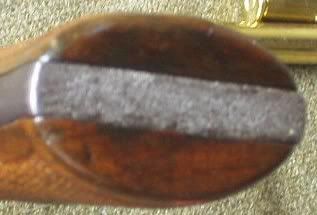
A former police department issued gun, the butt seems to be marked WPD No. 38 (I think, it is really hard to read and this is my 4th or 5th version of what is stamped there!). Look at this photo to the left to see what I mean. The PD wasn't the last interesting duty this gun had. Somebody electric penciled a name or initials on the butt OVER the PD mark and then somebody (the same or later?) tried to obscure the whole thing. It has the appearance of being deliberated rusted to obscure the marks but the "pitting" doesn't extend to the front or back straps of the grip frame.

For those that don't know, in 1928 the Army Special (introduced in 1908) became the Official Police because armies didn't buy the guns but police departments did. Barrels were made in 2, 4, 4½, 5 and 6 inch lengths. The guns were chambered for .22 LR, .32-20, .38 Special and .41 Colt. Calibers .32-20 and .41 Colt were discontinued in 1935.

The gun has a smooth but heavy double action trigger pull and a clean, sharp break when used in single-action mode. Fairly heavy for a .38 Special, recoil shouldn't bother anyone. I like the gun but haven't fired it enough to come to any conclusions. Now wearing a Tyler-T grip adapter, this one might spend most of its time bedside!

Wednesday, March 18, 2009

Observations on working in a gun store...

As you might know I work part-time (actually just 8½ hours a week) at a local gun shop. It doesn't pay much at all, you might put it down to charity if the place was tax exempt! One thing for certain, it is interesting. One gets to see and speak first hand with many different folks on the subject of guns and hunting.

The current shortages, aka the "Obamanation Buying Spree" (OBS) is one such topic. MOST people buying AR-15s and similar EBRs (Evil Black Rifles) are first time buyers of such and are doing so ONLY because of the election. Most of those are men. Women who are on the OBS are buying pistols or rifles for their granddaughters. Men AND women have come in buying ammo but that has really trickled off. The primary motivation was supposed taxes. Now, however, ammo buyers are shooters who want to get ammo before others buy out the store OR people who think the ammo simply won't be available. Interestingly, .380 ACP (aka 9mm Corto/Short) ammo is harder to find than even .223/5.56mm and .308 Winchester. Our shop is now able to keep EBRs in stock for a bit, usually a week. Ruger LCPs and Keltec P3ATs go to the waiting list! I heard a judge say he's signed twice as many CHPs (concealed handgun permits) as before the election. But there is also a continuing shortage of reloading supplies...

Yep, all sorts of things. I feel vindicated in my prognostication of January 2008. While the initial shortage was in primers, it now is in powders as well. Least available primers are the small rifle magnums (to reload .223/5.56), large pistol, large rifle, and small pistol magnum. Other than the Federal Gold Medal primers, the match primers and small pistol have been fairly available. Everything else is iffy. Primers have taken a real hit with customers citing rumors of taxes, "arsenal" laws, primer muddling (such as "time sensitive" priming mixtures), and government interference in production as the reasons they are hoarding.

One needs powders, too! First to be sold out and have orders go unfilled was W748 and Varget (again, very popular for the .223/5.56) but now most popular powders are sold as soon as they come in, Unique, H110/W296, H or IMR 4350, IMR 3031, etc. Valid "substitutes" are then taken.

Of course, everyone who doesn't already have them needs dies. As one might expect, dies for the .223/5.56, .308, .40 S&W, 9mm Parabellum have been intermittently difficult to get.

I left brass (cartridge cases) for last for a reason. Recently there was a real kerfuffle with DOD's (the Department of Defense) property disposal of fired brass. Many remanufacturers as well as reloaders buy fired 9mm, 5.56mm and 7.62mm NATO brass from the DOD or through resellers. Georgia Arms apparently started this by publishing a letter they received from DOD stating that in future all brass would be demilled, i.e. rendered unusable for reloading before being sold for scrap. That policy, whether or not it was misinterpreted by some middle manager, has been reversed for the small arms cases (.50 BMG and smaller). The DOD (and other Federal agencies) use large amounts of ammunition for training purposes and this policy could have cut ammunition availability to civilians (private and police departments) by as much as one-third! However, I need to make this clear, THAT POLICY HAS BEEN REVERSED!

That hasn't stopped brass being sometimes difficult to get. This is particularly true for the "seasonal" production items, i.e. those that are only made in annual or bi-annual production runs. As one might expect, .223/5.56 and .308 Win brass have been in shortage and very noticeably so. Also noticed as hard to find/get are 10mm Auto, .41 Magnum, .44 Special, .45 Colt, .357 Maximum (see a trend here, seasonal production) and real rarities such as the .45-75 Winchester. Brass production has wisely been concentrated on the big sellers, .223/5.56 and .308 Win.

Of course, people are hoarding .22 LR and other rimfire cartridges, too. Regional, sometimes shortages have been reported. I've found it hard to get Winchester's .22 LR PowerPoint. Most of these shortages have occurred in the bargain brands as many are trying to put back the plinking ammo. Another thing that has driven this hoarding has been the threat of lead bans in various states. Based on some ridiculous interpretations of a CDC study and/or pseudo-science, the California ban has made such a thing seem very possible and helped to drive sales.

In general the shortages are NOT the fault of the dealers or distributors. These folks MUST have product and SELL it in order to make a living (and pay their employees). The shortages are due to the extreme demand and manufacturers (who are often working around the clock to attempt to meet demand) reluctant to expand production facilities because they know there will be a "bust" later. They know that either: fears will abate and the glut will cut sales drastically; the economic situation will get so bad there will be no money to support continued sales; the government will indeed drastically alter/affect legal sales of their products. While some dealers seem to be raising prices, most aren't doing so drastically and apparently even the AR-15 manufacturers have only raised wholesale prices $100 or so. That is hardly price gouging.

In handling a portion of these gun sales since the first of December, I've personally entered data for Virginia's version of the National Instant Criminal Background Check System (NICS). About one-half to one-third of these are delayed. I've never had one that I've done that has been denied. Of the 50 or so I've input, most who were delayed expected it. Two of them KNEW they would be delayed because of relatives who committed violent criminal acts. Others were apparently delayed because of their immigration status, DUIs, or very common names (i.e. similar to John Smith). Delays can vary from 30 minutes to several hours. There doesn't seem to be any attempt to delay purchases to harass buyers.

We've seen some neat guns for certain. To me, these aren't necessarily the expensive ones. I was able to finally acquire a Colt Commander because I worked there and walked in to work immediately after the gun was purchased. That's a benefit! It is also fun to watch and sometimes help the resident gunsmith. Lots of my friends who I wouldn't see often otherwise come through the shop (I KNEW there was a reason I liked those guys!). I've heard a lot of stories as well from those who struggle to kill one deer a year to farmers who cull hundreds a year (and yes, I do wish I could get these guys together) or have great hunts all around the country. We have customers who collect and those who are constantly trading. One other thing one notices from behind the counter is that gun buyers/owners are truly representative of the community. Rich & "poor", educated & barely literate, young & old, male & female, community leaders & "not". I have seen a lot of police officers, firemen, judges, and businessmen as well as farmers.

Tuesday, May 04, 2004

Now, let me share an experience I've had.

Last fall I worked up a load of 2.5 gr. Unique in .38 Special cases under a 205 gr. bullet. This was to be used in a .357 Maximum rifle for small game. It would group into 1-1.5 inches and about 2 inches low of point of aim at 50 yards (sights set for the full-throttle deer load). At 25 yards they were spot on. I could see using these for a wide variety of small game including ground hogs, fox and "others" of that size. I loaded 50 to have to use and tested part of that batch to make certain I had it right. All was well. However, I had never chronographed that load. I did use one round to take one squirrel (on the ground).

Well, today I took it with me when I went shooting the Max (testing Lil'Gun loads). VERY disappointing! What happened! Well today (temp 59 degrees, similar to when I worked up the load) velocities went from 83 fps (yes, not a typo) to 340 fps. Most were striking 2 feet low at 50 yards (but 3 were spot on! ). These loads were useless today.

About midway through the test it occurred to me that they had been stored bullet down in the box and maybe the powder was not next to the primer. All following rounds (18) were given a sharp (but safe) rap on the bench before firing and the rifle barrel was elevated immediately before firing. Little if any improvement. Indeed, I did get a good group, just 2 feet too low! The 3 that were right on were from the first 22 rounds...

I don't know what happened here but I'm going to try a few more and see what happens...

Monday, May 03, 2004

I've recently been working with the .357 Maximum and Lil'Gun. Loads shown at the Dan Wesson page show a max of 23 gr. with 180 gr. bullets and 21.5 gr. with 200 gr. cast bullets. My experimentation took me to these limits with the 180 gr. Hornady SSP and 200 gr. Hornady RN. However, there was a problem with "sticky" cases. IOW, pressures are too high. So I dropped a grain for each and the 200 gr. Hornady still does 1939 fps (excellent) for 1670 fpe, 24 fps AD and a 28 SD. The hotter charge was better in that regard but one does not want to be forced to aid in the extraction of cases. You should just pluck them from the chamber without the use of descriptive phrases!

With the 180 gr. SSP, I only dropped the charge by .5 gr. and in a repeat of the previous experiment, velocities did not change (increased slightly!) but also the AD and SD increased substantially. I'm going to drop this charge the other .5 gr. (as I should have done) and try again. If all goes as before, velocities will average just below 2100 fps and the AD and SD numbers will be similar to the load with the 200 gr. Hornady.

I think it is very interesting that I can beat FACTORY .35 Remington loads with this case. Still, there are limits to what you can do and reloads in the .35 Rem. will only do about 2000-2100 fps with loads safe in both my M8 Remington autoloader and the Contender carbine. However, I have pushed the 200 gr. Hornady RN to 2200+ fps in the Contender.

*********


I received the first 50 of 100 bullets from Stone Fence today. I think I'll be getting 100 new cases and loading them all with this bullet and 32 gr. of RL-7. That will probably do me with this cartridge for the rest of my days.

Friday, September 05, 2003

Cat Sneeze Loads

I’ve been told that I should post here more often and in greater detail. I’d like to, but I do have interests other than shooting. Yes, it is a bit sacrilegious, but true. In any case I do have several shooting projects in the works and am constantly playing about and trying new things.

One of those shooting projects is the so-called cat sneeze or silent loads.

Well, what is a “silent load” or “cat sneeze” load

What are these loads good for? Well, for me, the utility of such loads is as a companion to my deer caliber guns that I can use for small game hunting, or pest removal, when a full-power load would be inappropriate.

What are the parameters of such loads? First, of course, seems to be the necessity of silence or as near to that as is possible. This is often the over-riding concern of those interested in such loads. Often, silence or quietness has preference over terminal performance.

Second, bullet weight could be lighter than normal for the cartridge to heavier than normal for the cartridge. Using the .30-30 Winchester (aka .30 Winchester Center Fire or WCF) as an example, 100 grain bullets on the light side and 180 grain bullets on the heavy side. Both extremes are acceptable but serve different purposes. That is the lighter bullets being used for small game and the heaviest possible bullets being used to maximize terminal performance at the low velocities attained in these loads.

That brings us to the third primary characteristic of these “silent loads” (also called cat sneeze loads) and that is small charges of relatively fast powders for velocities in the 500-1000 fps range. I’d like to point out that the smaller the charge, the lower the gas volume resulting in lower sound levels (and velocity) at the shot.

So now, the question no doubt is, “What guns have you developed loads for?” and, “Hobie, what are your loads?”

Let me try to answer that. I am currently primarily interested in such loads for my Contender carbine barrels. It is here that they will have the greatest possible use. Those cartridges include: .25-35 Winchester, 7mm TCU, 7-30 Waters, .30 Herrett, .30-30 Winchester, .357 Maximum, .35 Remington, .41 Remington Magnum, .44 Remington Magnum, and .45-70. These are the cartridges for which I have chambered barrels at this time. Yes, I do carry these deer hunting and yes, I do want to be able to take squirrel, turkey, rabbit, and certain feral animals if the opportunity presents itself.

Saturday, October 19, 2002

I put some pics of groups up on my site.

The first is my .357 Maximum using the 180 gr. Hornady SSP. I shot this group at 100 yards and knew I was doing well then pulled the 5th shot. Thought that I'd shoot a sixth to make a nice braggin' size 5 shot group and pulled that, too. To heck with it. It is still a darn nice group from a 21" factory TC Contender barrel and proves that the Hornady 180 grain SSPs will shoot despite some detractors.

The second is my .44 Magnum. I had fired 4 shots and the shooter next to me noticed the rain come across the mountain. We sprinted to save our targets. Sorry it isn't 5 shots.Shows that this load with the 300 grain Hornady XTP will shoot as well. I'm sure that big bullet will penetrate as well.

Thursday, January 15, 2009

The +P Phenomenon by SaxonPig

I was a little surprised when I began visiting these Internet forums and saw so many questions regarding +P .38 Special ammo. It seems each new day brings yet another post asking about the safety of using factory +P ammo in one gun or another. I always assumed the short answer was that if you had a Star, or Ruby, or some other gun that might be questionable as far as strength is concerned, then stay away from +Ps. But many shooters seem concerned about using this ammo in quality guns of recent manufacture* and I didn’t expect that. I saw many inquiries about K frame S&Ws using +P and I found it odd that anyone would worry about using factory +P ammo in such a gun. Then I started seeing postings from owners of .357 Magnum revolvers asking if +P .38 Special ammo would harm their guns. One forum member was concerned that +Ps would damage his Model 28 S&W.

Come again? I don’t know what caused such a mystique to surround +P ammo to make people with N frame Magnums think it’s too much for their guns, but it strikes me as overblown all out of proportion. The fact is that +P isn’t “all that” anyway. Winchester, Federal and Remington list the velocity of the 125 grain +P at around 925 FPS. These velocities are actually fairly mild. I have shot many rounds of Remington 125 grain +Ps in a 1942 S&W Military & Police revolver and I can literally shake the fired cases from the gun without using the extractor. In my opinion these loads are actually pretty mild and show no sign of even moderate pressure in any of my guns.

As underpowered as I thought the Remington ammo was the PMC proved worse. I clocked a box of the El Dorado 125 JHP +Ps and from a 4" barrel I got a pathetic 890 FPS. Fired from a 2" M&P (made in 1949, BTW) this ammo ran 795 FPS. How can such puny loads cause so much hysteria among shooters? I also tried some Winchester 110 grain +P+ "Law Enforcement Only" ammo. I was expecting around 1300 FPS but all I got was 1100. Big deal! This load was very mild and easy to shoot through the 2" gun and I fail to see the reason for the fear of +P (or +P+ for that matter) that so many shooters express.

Why is everyone so terrified of +P? I believe that the reason +P exists is twofold. First, it is a marketing ploy used to sell ammo by misrepresenting it as powerful. But any perception that this ammo is powerful is a myth. Second, it gives the ammo companies legal cover should anyone blow up their inexpensive gun because they can say "We warned you not to use +P ammo!" Of course, +P is nothing more than what standard pressure ammo used to be and they created the +P moniker to protect themselves.

The factory ammo made back in the 1970s and earlier was hotter than that made today (see chart #1). I have seen the specifications for standard .38 Special ammunition from a 1940 catalog listing the velocity as 960 FPS with a 158 grain bullet. This load would clearly develop higher chamber pressure than the current +P load and yet it was used for decades in all models from Colt and S&W without incident. The current +P is really about what the .38 Special should be in standard form. But note that today's standard load is no longer what it once was, either. In 1940 it was the 158/960 that was considered standard. During most of my youth I recall the load as advertised at 158/870. I have a copy of the specifications for S&W/Fiocchi ammo that was packaged with new guns that appears to have been printed in 1970. It lists the 158 lead .38 Special load at 910 FPS. It also includes a 158 JHP at 1140 FPS (equaling the mighty 38/44 load), a 125 JHP at 1380 FPS and a 110 at 1390 FPS**. I have seen a ‘70s box of SuperVel .38s with the package labeled as containing a 158@955 load. This was the standard load in the early 1970s (although I didn’t recall SuperVel offering standard velocity ammo). Note that none of these loads were marked as +P, but were considered standard pressure and the ad bears no mention of not using this ammo in older guns or revolvers with alloy frames.

These loads are probably similar to those +P loads offered by the specialty ammo makers like Bear Claw, Cor-Bon and others that exceed the levels achieved by the mainstream ammo company loads. Bear in mind that this was ammo bearing the S&W name and sold through their dealer network for use in their guns. They are now advising against using the rather meek current +P for their revolvers when they used to advertise and sell ammo that was much hotter. Compare these velocities to those offered today and tell me they haven't reduced the loads! Current specifications on the lead 158 are pretty wimpy at 158/750 (some are now showing 730). Again, we see the ammo companies reducing the loads over the years. The current +P (which means +Pressure if you didn’t know) is really only +P when compared to current standard loads. Stacked up against past standard loads the +P looks pretty anemic and the current standard load is truly pathetic.

The fact is that +P is only called +P in comparison to the current standard .38 Special loading, not because it exceeds the pressure limits set for the caliber. I believe the SAAMI pressure limit for the .38 Special is 21,500 PSI (the .357 Magnum is 35,000 for comparison). The standard load for the .38 Special as offered by Winchester, et al, generates 16,500 PSI. This is so far below the maximum allowable as to be ridiculous but the ammo makers fear lawsuits from people using the ammo in cheap guns. The +Ps from these manufacturers run about 18,000 PSI. This is more than the standard loadings (hence the +P designation) but is still far below the maximum allowable pressure. Those "really hot +P loads" from the specialty manufacturers like Cor-Bon, etc., are simply loaded to the caliber's full potential of 21,500 PSI and should be perfectly safe in any quality arm in good condition. Sellier & Bellot sells a 158@975 load that is obviously more powerful (and therefore generates more chamber pressure) than the 125@925 +P yet this ammo isn’t labeled as +P. It’s likely simply loaded near the 21,500 PSI maximum allowed for the caliber and this company eschews the ridiculous +P label on ammo that is within industry standards.

So why are we seeing these less powerful loadings? Because there are some guns out there that are not well made. Because of liability concerns the ammo makers must load their products to pressures that are safe in these lower quality guns. They mark the "high pressure" loads as +P (even though as I noted they really aren't high pressure) to give them legal cover should someone hurt himself shooting this ammo in a cheap Spanish S&W knock-off of dubious quality.

S&W ran advertisements in the 1930s and 1940s specifically stating that the .38/44 load, which pushed a 158 grain bullet at an advertised 1125 FPS making it far more powerful than the current +P load, could be used in the K frame revolver. Colt ran similar ads for using this ammo in the Detective Special. If these 1930s-era medium frame revolvers could handle the 158/1125 Heavy Duty loads, why should anyone worry about the same guns shooting the current 125/925 loads labeled as +P? One former police officer told me that between 1958 and 1960 he fired 2,000 rounds of factory 38/44 ammo through his duty Model 10 without any effect to the gun. If all that shooting with the 158/1125 load didn't harm his K frame I don't see how the 125/925 +P can hope to do damage.

Lee Jurras started SuperVel in the 1960s. This was maybe the first of the specialty ammo companies and he offered truly high performance .38 Special loads. I have some of the 110 grain loads and they clock around 1300 FPS. Based on this I would guess his 125 loads would go around 1200 or so. This would be a true +P load but it’s still lighter than the old .38/44 load. I don’t recall seeing or hearing of guns being damaged by this ammo.

Check out a reloading manual from the early '70s. The Speer #8 from 1970 has a load listed for the .38 Special pushing a 158 JHP to 1,250 FPS, one for the 125 grain bullet at 1426 FPS and one for the 110 grain bullet at 1536 FPS! A 1971 Sierra manual shows a load for the 125 grain .38 Special at 1250 FPS. Sort of makes that factory +P at 925 seem less intimidating, doesn't it? Now, of course, new manuals don't include listings that are this hot. Now they stop at about the same levels as the factory +P. Why? Lawyers and lawsuits are the reasons why. The reloading manual publishers are just as scared as the gun and ammo makers about being sued. Fear of lawsuits is the same reason the gun makers caution against the use of +P ammo. They also say don’t use reloads. They have to say this on advice of counsel to protect themselves.

I load 125s at 1,100 FPS in my .38 Special carry guns. This load came from the 1970 Speer manual and is not the top load listed. I have shot many rounds of it through both K and J frame guns and they seem to work just fine. Recoil is slightly more pronounced than with standard ammo, but the cases fall from the cylinder with no sticking and I see no signs of excessive pressure. Just for fun I once put 6 rounds of this ammo through an old small-frame Rossi revolver. Nothing bad happened although I wouldn’t advise using this ammo in such a pistol. I once loaded some 110 JHPs to a clocked 1400 FPS from a 4" Model 10. These were hot, let me tell you, and I backed off. But the gun showed no immediate effect from having fired a small amount of this ammo.

Ask yourself this question: Would any ammo maker in today's litigious environment sell any ammunition that would be unsafe or harmful to use in the typical gun that a consumer may own? If factory +P were really hazardous would Winchester, or Federal, or Cor-Bon sell it to the general public?

With all the many, many questions regarding the safety of +P ammo, there must be many reports of blown-up guns, right? How many guns blown-up by factory +P ammo have you seen? How many guns blown-up by factory +P ammo have you heard about? I have been participating in the shooting sports and studying firearms since 1967 and I know of absolutely NONE. I have heard second and third hand accounts of one or two guns that were said to have been damaged by factory ammo but I think it more likely these guns suffered failure due to some manufacturing defect. It happens. I have a S&W .357 Magnum that was returned to the factory for a new frame. Something went wrong with it.

Certainly, using a gun causes wear. A gun is a machine and using any machine will cause it to wear. Using hotter ammo will likely accelerate the process to some degree. But a quality gun from S&W or Colt or Ruger will not blow up with +Ps. Nor will it excessively stretch the frame or split the barrel in my opinion. It will possibly wear a little faster, and I doubt if anyone could predict how much, but I think the added wear on a good gun will not be all that much. The gun would probably still last longer than the man who owns it.

I admit to some paranoia about warm loads in an alloy-framed gun but factory +P is not a warm load. I do not have any alloy revolvers but if I did I would stick to standard ammo (such as +P) and avoid my warm hand loads. In an alloy gun of good quality I have no concerns at all about +P on a regular basis since I consider factory +P to be nothing more than standard pressure (or less), anyway. Also, in 1955 Elmer Keith wrote of shooting the 38/44 load through the alloy J frame guns and he said that it did them no harm but recoil was pretty fierce. Keith favored big guns with heavy recoil so such a comment coming from him is quite meaningful.

This is just my opinion based on personal experience and research. There are differing points of view. Some replies to the +P question are quite adamant about avoiding regular use of this ammo. Others advise occasional use. Some say only carry +P for defense but don’t use it for practice at all. Some say S&W guns with model markings are OK with +P*** (what about the Colts?) while others say only use it in guns specifically approved by the factory. The fact that there are so many answers to this question tells me that there is great confusion on this matter. I’m a simple man and I take a simple course to the truth. I do basic research and try to find the facts. I have presented the facts as I see them. All one must do to find the truth about current factory +P ammo is look at the specifications. I submit that a 125/975 load is hardly high performance, and certainly nothing to cause concern for owners of quality revolvers. All are free to disagree.

Some forum members have accused me of being irresponsible in recommending the loads I mentioned. Of course, I am not recommending anything, only stating what I do. Also, all of the loads I use came from reputable reloading manuals. If the loads were safe in 1970 I don’t see why they aren’t safe now, but I don’t recommend anything to anyone. Each of us has to make our own choice. If you think any of the loads I mentioned are too hot then avoid them. If you are in any way uncomfortable with +Ps then stick with standard loads.

Notes:

* The manufacture and tempering of steel was imprecise before around 1930 or so. Any of my guns made before this date get reduced loads just to be on the safe side. Note that early S&Ws, those made before around 1918, had cylinders that were not tempered at all. A similar situation likely is true with Colt revolvers but I have no specific knowledge of when Colt began tempering their cylinders.

** This same document advertises a 125 JHP .357 Magnum load at 1775 FPS. Current factory ammo in this caliber with this bullet usually clock around 1250-1300 FPS. Apparently the Magnums have also been "downsized."

*** I never understood using the "model marking" on S&W revolvers as the cut-off for +P. As far as I can tell the last S&W made without the model number stamped on it was exactly the same as the first revolver to have the model number stamped on it. They didn't improve the steel or strengthen the guns in any way. All they did was start stamping the model numbers. Also, how could S&W have intended for the model marking to be a benchmark for +P when the ammo wasn’t invented until 25 years later?

PS:

This same situation that has affected the .38 Special occurs with the .38 Super. The original loading for the Super was a 130 FMJ at nearly 1,300 FPS. But the Super cartridge is the same physical size as the old .38 ACP, just loaded to higher pressures so the ammo makers started fretting over some yahoo stuffing Supers into his 1905 Colt in .38 ACP and spreading parts all over the range. That’s why Super cases were nickel and the .38 ACP were brass until a few years ago, so shooters could instantly recognize which ammo they had. I was curious a few years ago when I noticed that they stopped doing this and I saw Super ammo in regular brass cases. I guess there’s no need any longer since factory Super ammo now clocks about the same as .38 ACP. The last box I checked ran 1,120 FPS, only 40 more than the ACP. They have down-loaded the Super to nearly the same level as the ACP. No lawsuits. Of course, the Super isn’t so… super… any longer, is it?

Some people claim that the standard .38 Special load today is the same as 30-50 years ago and the only difference is the claimed velocities in the past were greatly exaggerated by the test barrels they used. Everyone back then knew real-world velocity would be a little lower but not as much as some would have us think. Below are some actual measured velocities of various vintage ammunition.

Chart #1:

Some .38 Special velocities actually measured (not claimed by the manufacturer) from a 4" Colt Official Police:

Remington 158 grain lead made in the late 1960s-early 70s...840 fps
Peters 158 grain lead made in the 1950s...800 fps
Western Super-X 158 grain lead made in the mid-late1960s...810 fps
Western 150 grain metal-piercing made in the mid-late 1960s...1000 fps
Remington 158 grain lead "Hi-Speed" made in the 1950s...920 fps

The 158 loads from the 1950s-1970s are clearly more potent than the current offerings that achieve a claimed 730-755 FPS velocity. The observed 800-840 FPS is consistent with the manufacturer claims at the time of 870-910 FPS since they used a 6" "pressure barrel" to achieve the claimed velocities and actual velocities from 4" revolvers ran somewhat lower. But clearly not the huge difference some people claim in their assertions that factory .38 Special ammo has not been reduced in power. Also, bear in mind that the ammo being tested was all 30-50 years old and may have exhibited some deterioration in the powder which may have caused lower velocities than the ammo developed when new.

The bottom line:

Each man must do what he thinks is best. After a great deal of research and testing I do not consider factory +P ammo to be very warm at all and it concerns me not one bit in a quality revolver.