Tuesday, September 05, 2006

In Memoriam - Steve Irwin

44 year old TV star and naturalist Steve Irwin was killed by a stingray. He is survived by his parents, siblings, wife Teri, daughter Bindi Sue and son Bob. The Australian was well known as the Crocodile Hunter and his apparently over the top antics with dangerous creatures while maintaining an intensely infectious enthusiasm garnered many loyal viewers.

You might hear many jokes, fond memories, criticisms, the whole gamut of reactions. However, whatever you might think of his approach you have to admit that he got lots of people interested in the natural world. Sort of the Marlin Perkins of this generation I think his loss will be felt for a long time to come.

Sunday, September 03, 2006

The Saga of the S&W 34 Quest

That slick old Xavier posted about a S&W 34-1 2" and it ignited a craving that is without reason or rational cause. Then Lady Tam posts about her great fun with hers and so do some folks of whom I inquire about their experiences with these petite firearms. The hunger grows. Apparently I was not the only person so affected. Suddenly, you can look up old completed auctions, the prices on these guns shot up. They sold and for goodly prices. Blue, nickel, or stainless (M63) matters not. NIB or imperfect matters not. Prices rise quickly. Where I thought I could afford one, I find that I can not. Talk about discouraging. Then I find one on GunsAmerica and committ to the purchase but as it is the weekend I've no word yet and perhaps it is already sold. Frustrating indeed.

UPDATE: The nickel 34-1 should be enroute to my dealer shortly. I was outbid on another.

Friday, August 25, 2006

Woe is me...

I guess I need to roll the change in the gun savings. I'll need the extra. I'm very close to committed to two guns at once! Oh the shame of it all. I don't know what I'll do with this monkey on my back... Oh, please pity me. Find a government program to help me with my problem (preferably one that puts me on a maintenance program, say by loaning me new guns every month...).

All the above was said mostly in jest. No persons were harmed in this joking around.

Thursday, August 24, 2006

S&W 34-1 "Kit Gun" and Instant Obsession

I've been reading Xavier Thoughts every day and then he posts about this S&W 34-1 that he's found and I'm suddenly drooling and otherwise exhibiting signs of firearms acquisition addiction. I've looked everywhere for one just like this. Round butt, blue, 2 inch barrel, in good shooting condition but what do I find, nothing under $400! Surprised me. Really surprised me. Disappointed, too. Now I'm exhibiting the classic signs of the addicts non-fullfillment of desire, namely, wide-eyed desperate running back and forth searching for the object of my desire accompanied by panting, shaking hands, and obsessive-compulsive checking of the gun-money in the wallet!

Pray for me. Better yet, write and tell me where one of these beauties might be available.

UPDATE: Exhaustive research shows that while folks are asking higher prices for these guns they are actually selling for prices $50 or so less than what is being asked. Thus a 90-95% gun sans box and tools is asking $400 but actually making a sale for about $325-350. Put that gun in a box and it seems that it will actually get another $10-25. Make it complete and new in the box (NIB) and suddenly you're looking at $400-450 depending on the condition of box and tools. Nickel? Bump that price up another $25 or so and condition is everything. A nickel gun with flaking is actually worth less than a 80% blued gun (it looks worse). Model 63s of both barrel lengths seem to be in the $375 range across the board, finish wear being less apparent on these guns.

As with all things, some folks seem to think that their particular gun is worth more and won't be talked down. Somehow you're cheating them, or trying, if you tell them that other guns of the same configuration are actually selling for a certain range. These are guns from which you must step back leaving your name and number if the owner reconsiders.

Wednesday, August 23, 2006

Game Sighting and Upcoming Seasons, et al

My licenses are in hand (except for the Federal migratory bird stamp), I've seen several deer at Mom's along with dove, rabbits, squirrels (of course). It has been forever since I've seen quail or even heard a call and turkeys won't come through until later (usually). I haven't jumped any grouse yet either but we do see them in this farm country (close to the National Forest). I think it could be a good season!

Thursday, August 17, 2006

Bill of Sale

I was reading Xavier Thoughts and noticed this article on having a bill of sale. Yessirreee bob, that's what you need. Always. And please do add the seller's driver license number. You know, just in case. I once had an acquaintance who nearly went to jail for buying a stolen gun (unknowingly) and got out of it only because he saw the guy in a bar and dropped a dime on him.

Good stuff Xavier. (BTW, you've got me looking for a S&W 34...)

GPS

Could it be anymore confusing? This things are priced from less than $100 at the bottom end to more than $800! I've yet to suffer because I use a compass and a map and terrain association. Am I really missing something? Do I really need one? I've toyed with the idea for many years now but, when it comes down to it, I can't bring myself to spend the money. Am I cheap or wise?

It is so bad that I've put off posting this. Mapping I understand, navigation I understand (even using a sextant), I fail to see how they choose the combination of features, button location, etc. Maybe I'll just ask for a cheap $100 something model and see what it can do for me.

Of course, as I write this my copy of Primitive Archer magazine shows up with an article on GPS. I think I need to read some more.


And Hank put me on to GPSDiscount.com

Saturday, August 12, 2006

Concealed Carry Guns - Update

After reading a discussion of concealed carry guns on a forum I was forced to recognize that I had 3 .38 Spec/.357 Mag guns with essentially the same grip size. Those Pachmayrs essentially convert even the J-frame guns to K-frame concealability. So, I pulled the Pachmayrs off the M36 and will now try a Tyler T grip adapter (the ones for the K-frames won't fit in case you're wondering). This did wonders for concealability. I'll post a good pic when I get the Tyler T installed.

Friday, July 28, 2006

Bolt-Action Guns I Like

They are few and far between, these bolt-action guns that I actually like. Oh, I'll shoot all of them, I pick them up and look them over and check them out this way and that but I won't spend money on most of them.

The only centerfire bolt guns I really like to the point that I'll spend money on them are the Lee-Enfields and derivatives and the M1891 Mauser. I'll bet some of you are shaking your heads, wondering why I like that old stuff or perhaps if I've never heard of the Winchester M70 or Remington 700 and why I could ignore those wonders of the western world for an overweight, rear-locking or single-column magazine bolt gun.

My first bolt-action gun chambered to anything impressive was a Mauser M91 rifle that had been bubba-ized. The barrel had been cut back to about 21", the issue rear sight removed, the stock "bleached" and refinished probably with Tru-Oil, Weaver mounts had been "installed", the Mauser wing safety had a steel rod soldered to it as an extension to make it operable with the scope (cheap is all I remember) installed. Pretty much an abomination. I'm sure Dad was rolling his eyes behind my back and praying for God to give me some commonsense! I stripped the gun apart, removed the safety "extension", had Jon Ritenour of Homstead Gun Shop in Harrisonburg, VA drill and tap the action for a Williams Foolproof Receiver Sight and install a ramp front with post (I think this was a take off from a Remington rifle of some type). I then ordered a stock from Reinhart Fajen and put it all together. This was a pretty good gun.

If I remember correctly I loaded 43 gr. of IMR 4064 under the Hornady 174 gr. .311" RN. Brass was EXPENSIVE and I had no idea that I could form my own from cheap .30-06. I think I paid $20+ a box of twenty Norma cases in 1973! I've no idea what velocity I was getting but I was certain I had elk medicine. In fact, when in California, I took it north to visit a friend stationed at FT Lewis for just such an eventuality. It never did shoot an elk though. That rifle sadly left my hands during the big D in 1984 but I kept the dies, ammo, and other components "just in case". As is usual, the "just in case" came to pass albeit nearly 15 years later.

I'd been helping a fellow soldier and shooter load for his odd stuff like .30-40 Krag and he'd bought an 1891 Engineer's carbine. Based on that I gave him dies, brass and ammo I had. After 15 years I'd given up on getting one myself. A couple of years after that he ups and gives me the rifle AND returns my ammo, dies, etc.! What a friend! These carbines and the cavalry carbines from which they are derived aren't that intimidating to shoot, my sporterized '91 weighed less, and they have a certain air about them.

The other bolt-action I like is the Lee-Enfield. Now, I have to admit I like the whole series and which one I might own isn't that important to me. However, when they were being mass-marketed here in the States about 1990, I bought two (2). The first was a Long Branch No. 4 MK I* and the second was a Fazerkly No. 4 MK I. Both had been FTRed and both had the milled adjustable rear sight. I later got bayonets and web slings for both. Of course, using these I was able to talk a buddy of mine into getting one of the last from Roses (a local department store, now departed) for $60. We took these guns and that good Greek HXP mil-surp ammo out for a shoot and could easily keep all the rounds on the E type silhouette at 600 yards. My buddy deliberately head-shot a doe at a measured and witnessed 140 yards with his gun. Mine have not been hunting or at least on a successful hunt. Certainly the cartridges are up to the challenge.

Actually, one can think of the 7.65x53mm Argentine (or Belgian) round as a sort of modern, rimless version of the .303 British. Ballistics are VERY similar and the same bullets and powders will work in both. Loads aren't quite the same due to the slight differences in case capacity. Both cartridges started life with 215 gr. bullets and I have loaded some of the 215 gr. Woodleighs up for my little Argentine carbine. At the original velocities they do indeed shoot to the sights. However, the hotter 150s do as well. Perhaps this is why Argentina never changed the sights. Of course the No. 4s were made for the 174 gr. ball and they shoot to the sights with that and the Sierra 180s loaded to 2400 fps.

Great guns despite their age and great cartridges that can still do the job.

Monday, July 24, 2006

Xavier puts us on to Jim March's Revolver Checkout

If you're going to buy a used revolver you need to use the Jim March Checkout (as well put as I've ever seen the various steps with rationale included!). Thanks Xavier!

Revolver checkout: how to tell if a particular specimen is any good
So you're buying a revolver. New, used, doesn't matter, you want a good one, right?

How do check one over without firing it, right at the dealer's counter or gun show table?

This is how. All of this works with DA or SA wheelguns..."close the action" on most DAs means swing the cylinder in, on SA types, close the loading gate, on breakopens, close 'em. UNLOADED.

WARNING: most of these tests require violation of the "finger off trigger" rule. Therefore, be extremely careful about safe muzzle direction and making sure the gun is unloaded ahead of time, PERSONALLY, as you begin handling it.

Note: bring a small flashlight, something small and concentrated. A Photon or similar high-powered LED light is perfect. You also want feeler gauges if you're not used to eyeballing cylinder gaps; at a minimum, bring a .002", .004" and .006".

Note2: no dry firing is required or desired at any point. It just pisses off the gun's current owner.

Cylinder play.

1) With the gun UNLOADED (check for yourself!), close the action.

2) Thumb the hammer back, and while pulling the trigger, gently lower the hammer all the way down while keeping the trigger back - and KEEP holding the trigger once the hammer is down. (You've now put the gun in "full lockup" - keep it there for this and most other tests.)

3) With the trigger still back all the way, check for cylinder wiggle. Front/back is particularly undesirable; a bit of side to side is OK but it's a bad thing if you can wiggle it one way, let go, and then spin it the other way a fraction of an inch and it stays there too. At the very least, it should "want" to stop in just one place (later, we'll see if that place is any good). The ultimate is a "welded to the frame" feeling.

Cylinder gap

4) Still holding the trigger at full lockup, look sideways through the barrel/cylinder gap. If you can get a credit card in there, that ain't good...velocity drops rapidly as the gap increases. Too tight isn't good either, because burnt powder crud will "fill the gap" and start making the cylinder spin funky. My personal .38 snubbie is set at .002, usually considered the minimum...after about 40 shots at the range, I have to give the front of the cylinder a quick wipe so it spins free again. I consider that a reasonable tradeoff for the increased velocity because in a real fight, I ain't gonna crank 40 rounds out of a 5-shot snub .

If you're eyeballing it, you'll have to hold it up sideways against an overhead light source.

SAFETY WARNING: This step in particular is where you MUST watch your muzzle direction. Look, part of what's happening here is that you're convincing the seller you know your poop . It helps the haggling process. If you do anything unsafe, that impression comes completely unglued.

Timing

5) You really, REALLY want an unloaded gun for this one. This is where the light comes in. With the gun STILL held in full lockup, trigger back after lowering the hammer by thumb, you want to shine a light right into the area at the rear of the cylinder near the firing pin. You then look down the barrel . You're looking to make sure the cylinder bore lines up with the barrel. Check every cylinder - that means putting the gun in full lockup for each cylinder before lighting it up.

You're looking for the cylinder and barrel holes to line up perfectly, it's easy to eyeball if there's even a faint light source at the very rear of both bores. And with no rounds present, it's generally easy to get some light in past where the rims would be.

Bore

(We're finally done with that "full lockup" crap, so rest your trigger finger. )

6) Swing the cylinder open, or with most SAs pull the cylinder. Use the small flashlight to scope the bore out. This part's easy - you want to avoid pitting, worn-out rifling, bulges of any sort. You want more light on the subject than just what creeps in from the rear of the cylinder on the timing check.

You also want to check each cylinder bore, in this case with the light coming in from the FRONT of each hole, you looking in from the back where the primers would be. You're looking for wear at the "restrictions" at the front of each cylinder bore. That's the "forcing cone" area and it can wear rapidly with some Magnum loads. (Special thanks to Salvo below for this bit!)

Trigger

7) To test a trigger without dry-firing it, use a plastic pen in front of the hammer to "catch" it with the off hand, especially if it's a "firing pin on the hammer" type. Or see if the seller has any snap-caps, that's the best solution. Flat-faced hammers as found in transfer-bar guns (Ruger, etc) can be caught with the off-hand without too much pain .

SA triggers (or of course a DA with the hammer cocked) should feel "like a glass rod breaking". A tiny amount of take-up slack is tolerable, and is common on anything with a transfer bar or hammerblock safety.

DA triggers are subjective. Some people like a dead-smooth feel from beginning of stroke to the end, with no "warning" that it's about to fire. Others (myself included) actually prefer a slight "hitch" right at the end, so we know when it's about to go. With that sort of trigger, you can actually "hold it" right at the "about to fire" point and do a short light stroke from there that rivals an SA shot for accuracy. Takes a lot of practice though. Either way, you don't want "grinding" through the length of the stroke, and the final stack-up at the end (if any) shouldn't be overly pronounced.

Detecting Bad Gunsmithing:

8) OK, so it's got a rock-solid cylinder, a .002" or .003" gap, and the trigger feels great. Odds are vastly in favor of it being tuned after leaving the factory.

So was the gunsmith any good?

First, cock it, then grab the hammer and "wiggle it around" a bit. Not too hard, don't bang on it, but give it a bit of up/down, left/right and circular action with finger off trigger and WATCH your muzzle direction.

You don't want that hammer slipping off an overly polished sear. You REALLY don't want that . It can be fixed by installing factory parts but that'll take modest money (more for installation than hardware costs) and it'll be bigtime unsafe until you do.

The other thing that commonly goes wrong is somebody will trim the spring, especially coil springs. You can spot that if you pull the grip panels, see if the spring was trimmed with wire cutters. If they get too wild with it, you'll get ignition failures on harder primers. But the good news is, replacement factory or Wolf springs are cheap both to buy and have installed.

There's also the legal problems Ayoob frequently describes regarding light triggers. If that's a concern, you can either swap back to stock springs, or since you bought it used there's no way to prove you knew it was modified at all .

In perspective:

Timing (test #5) is very critical...if that's off, the gun may not even be safe to test-fire. And naturally, a crappy barrel means a relatively pricey fix.

Cylinder gap is particularly critical on short-barreled and/or marginal caliber guns. If you need every possible ounce of energy, a tight gap helps. Some factory gaps will run as high as .006"; Taurus considers .007" "still in spec" (sigh). You'll be hard-pressed to find any new pieces under .004" - probably because the makers realize some people don't clean 'em often (or very well) and might complain about the cylinder binding up if they sell 'em at .002".

The guns in a dealer's "used pile" are often of unknown origin, from estate sales or whatever. Dealers don't have time to check every piece, and often don't know their history. These tests, especially cyliner gap and play, can spot a gun that's been sent off for professional tuning...like my snubbie, the best $180 I ever spent .

As long as the gun is otherwise sound (no cracks, etc) a gunsmith can fix any of this. So these tests can help you pick a particularly good new specimen, or find a good used gun, or help haggle the price down on something that'll need a bit of work.

Hope this helps.

Jim


Now go out there and buy a good used revolver!

Sunday, July 23, 2006

Is there Really a use for the Hollow-handled Knife?

I've got a Chris Reeve Shadow IV but can't imagine what I'd put in the handle. Money, gold? Ain't got it to leave in a knife. Fishing gear, ID, metal match? Photo of my wife, kids, me? What do you put in your hollow handled knife?

I suppose that I can wait for an answer, my knife has journeyed to Alaska and Rob Leahy at Simply Rugged for a pancake sheath like that provided for the Shadow III. We had discussed a Scandinavian type pouch sheath but I think the knife is just too heavy for such carry. It would bother me, I think, to have that much metal just banging about.

Of course, he's a joker, he had to give me some guff about taking the knife on a recent fishing trip and losing it overboard. I didn't believe him (it would have arrived AFTER he left on the trip), but after reading about how a fellow lost a customized 1917 revolver overboard I'm a bit queasy! Did I mention that I've got to get that lanyard loop main spring housing installed on my 1991A1?

Saturday, July 22, 2006

Gunshow Field Guide

Poking about the web today I've found a treasure trove of fun stuff. Included is this Field Guide to Gun Shows. Might be too close to the truth for some readers...

Found a New-to-me Blog w/serious Info for Californians

Arms and the Law has an article from 17 July, "Heads up for Californians". If you are a Californian and you own a semi-auto firearm, you had best read this article.

Friday, July 21, 2006

What is a Great Hunter?

There are two ways that one could look at the term "great hunter". #1 that comes to most people's minds is, "great finder and killer of all things wild." I don't know that that is my idea of a great hunter. It certainly doesn't make for a fun hunting buddy. And that is pretty much the gist of the #2 version of "great hunter" as a great person with whom to hunt.

To my mind there are several things that are part of being a great hunter but not necessarily a great hunting companion (in no particular order):

- Ability to find game when and where wanted/needed.
- To take game without artificial scents/camouflage/mechanical travel aids.
- To take game cleanly with the weapon used.
- To adhere to applicable law/regulation AND moral code.

I think that in that last is the rub as the moral/ethical code of hunting varies somewhat by region and affects, to at least some degree, law and regulation. Also included in ethics is the utilization of that game. Again, in some areas what is considered game is considered a nuisance species. E.g. I will never criticize anyone for not consuming their groundhog kills. Neither will I second guess the edibility of any game meat. That's for the consumer/cook! Of course one might also add that a great hunting companion has to be forgiving my faults and errors!

Ability to find game when and where wanted/needed. Let's face it. To be considered one of the all time great hunters, those skilled in finding and killing game, you have to be able to find game pretty much on demand. Certainly there will be times when that's impossible but nobody is going to think in terms of "great hunter" if it takes 10 years to get a deer! This means that the great hunter (and hunting companion) is knowledgeable about game behaviors & hunting area topography, and can put them together to know when and where the game is most likely to be.

To take game without artificial scents/camouflage/mechanical travel aids. Can the hunter fill his bag while eschewing all the scents, baits, scent hiding and camouflage clothing? Can the hunter walk or ride a horse to his hunting location and, just as importantly, bring the game out the same way? Or does the hunter need a four wheel ATV, with multiple radios for the group and a GPS to find his way to the outhouse? A great hunter can do without such things and still be successful.

To take game cleanly with the weapon used. I'm not big on getting down on the users of particular tools. What one uses for hunting is a personal preference. One could come to that preference due to physical limitation, family tradition, personal interest, or for the challenge. Perhaps all of these factors are weighed, consciously or not, in the final choice of hunting arm. However, how well one uses that arm be it club, knife, spear, bow, or gun is important. As a companion, I want to know that you aren't going to endanger MY life with your handling of your chosen tool. For the killer of game, it is a given that one must be able to use the chosen arm with dexterity!

To adhere to applicable law/regulation AND moral code. It should be easy enough to read and understand the laws and regulations governing hunting. One should have an ethical model which one can follow. But the great hunter can resolve the differences between the two (and there will be differences) so that he rises above the normal hunter and exploits the rules without violating his ethics. In the case of the hunting partner, those ethics pretty much need to the be SAME as yours. If they aren't the two of you just won't get along.

The thing is that the ethics of the hunt vary by region. Baiting, hunting with dogs, use of vehicles, party shooting (where any hunter or hunters may kill game not to exceed the limit for the group), Sunday hunting and so forth may be considered both legal and ethical in one area but not in another. Understanding and adapting to the local conditions is part of what a great hunter has to do.

Still, I find that many, many hunters (contrary to their portrayal by the media and PETA types) place the ethics of their activity as the most important aspect of a hunter that determines his greatness.

Thursday, July 20, 2006

Finding a Rare Firearm

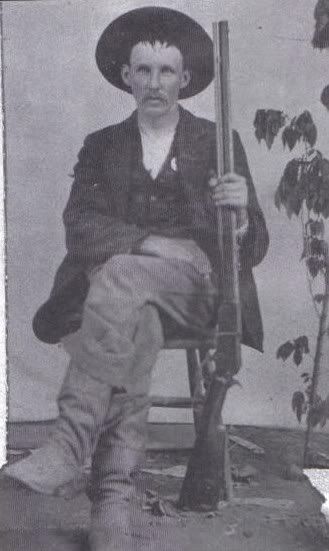
Wouldn't you love to find a rare firearm? Wouldn't you be excited? How would you prove the provenance on such a thing? How about having the rifle shown in the photo? The owner is Johnse Hatfield, of Hatfield/McCoy feud fame. The rifle is an 1876 Winchester, chambering and serial unknown. I've been in contact with the fellow who thinks he has this jewel but, no, I'm not telling who. I just think it is cool that there are still such things to discover.

Oh, for what its worth I think the image is reversed. Notice the lack of loading gate, with the rifle in this position it will twist to the correct orientation.