Thursday, February 12, 2009

Skunks and the Demon Odor

Demon odor is what one former neighbor lady called it. She must have known as her dog was not a fast learner! Let's face it though, if you have dogs, you will have to deal with skunk odor sooner or later.

When driving down the road we'd just say, "think lemonade!" Lemonade is close enough in smell that you'd kinda forget the bad implications of what you were really smelling. Maybe it is conditioning but the lemonade "trick" works for me.

While that works for the momentary exposure along the highway, it doesn't work when the odor permeates the house. That can get a bit rugged even if you have somehow acclimated yourself to the scent. Many folks say that tomato juice will neutralize the odor. Never did for me.

A better decontamination formula is this formula
For pets that have been sprayed, bathe the animal in a mixture of 1 quart of 3% hydrogen peroxide (from drug store), 1/4 cup of baking soda (sodium bicarbonate) and a teaspoon of liquid detergent. After 5 minutes rinse the animal with water. Repeat if necessary. The mixture must be used after mixing and will not work if it is stored for any length of time. DO NOT STORE IN A CLOSED CONTAINER - it releases oxygen gas so it could break the container. This mixture may bleach the pet's hair. (Paul Krebaum's Recipe from Chemical & Engineering News , October 18, 1993, p. 90).

This seems to work a slightly lighter hue of hair not withstanding...

As we approach spring and the slightly higher probability of running into one of these odifurous animals dog owners might want to print this out and have the components on hand. Just sayin'...

Tuesday, February 10, 2009

Lipsey's Exclusive, the Ruger Blackhawk Flattop .44 Special

These are out and getting into the hands of shooters. Lots of folks have one, or more, but my dealer can't get one. That means I can't get one. Seems to me I ordered early on but apparently I couldn't order early enough or my dealer is too low on the food chain to deserve to get one.

I'm not too proud to ask that if you are an employee of Lipsey's or have some pull with them you might, pretty please, ask them to ship a 4-5/8" .44 Special Flattop to Nuckols Gunworks of Staunton, VA...

Monday, February 09, 2009

Jesse Ocumpaugh now has a web site...

Jesse Ocumpaugh of Cottage Grove, OR has been re-boring rifle barrels for a while now. He's finally got a website which will make it easier for many of us to remember how to contact him. His work is good and I know of several of his .30-30 barrels which were re-bored and re-chambered to .38-55 Winchester and all shoot well.

Speed Strips, now for more than just .357/.38...


Thanks to the CylinderSmith for this lead. Tuff Products now has the Speed Strips for both the .44 & .45 cartridges and .50 cartridges. You can even get a "bonus pack" with two strips of every size. Only $8.49 for a pack of two (any size) and they will ship these first class (if you are willing to wait a bit). I've placed my order.

********
My order arrived today, 2/13/09.  These speed strips give every appearance of being fully as good as the Bianchi product.  These are made in China. 

Sunday, February 08, 2009

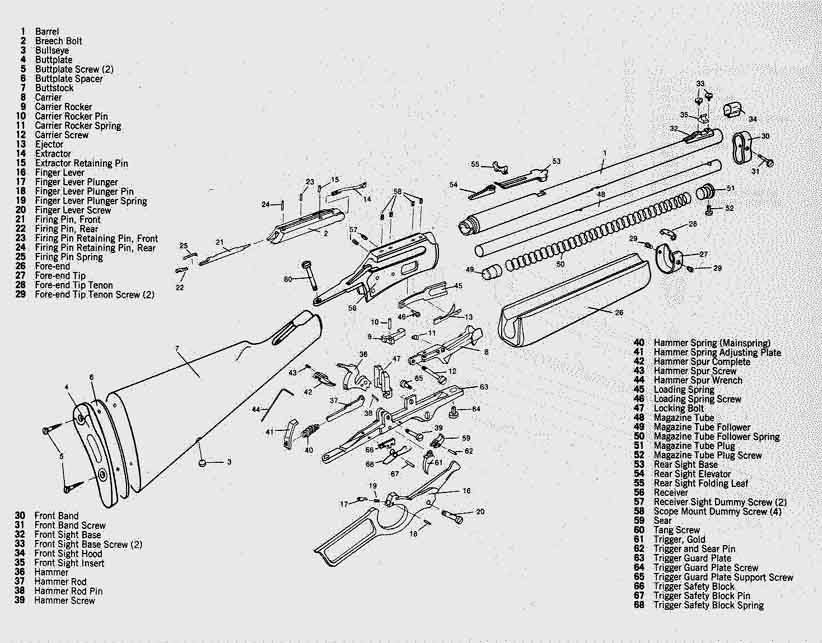
Marlin 1894 .44 Magnum Carbine

Years ago, just after I turned 18, I bought a Winchester 94 in .44 Magnum. A standard carbine, post-64 of course, that was a pretty good gun but sometimes the cartridge stop would let a cartridge in under the carrier. I'm telling you, that is a nasty jam to clear in the field. It happened enough that I traded it in on another .44 Magnum, a Marlin 1894!

Now this was a good gun. I immediately installed a Williams Foolproof receiver sight and took some of the ammo that I'd used in the Winchester with the new rifle and went to the range. Sometimes I could manage to put 3 rounds of the old Remington half-jacket SWC load into a cloverleaf. It sure shot well. I didn't actually get to hunt with it until after my first tour in Korea.
I was stationed at Fort Hunter-Liggett in California and lived in Greenfield, CA. Needing a combination of self-defense and a hunting gun, I asked Dad to send the Marlin out to me. That Marlin fed a few of us as I loaned it out for hog and goat hunts on Fort Hunter-Liggett. We used the Remington 240 gr. SJHP load exclusively. That load was both relatively cheap and effective.

When I came back to Virginia that gun went hunting for whitetails a couple of times but one day I had to sell it to raise money and it went to LBW Shooter's Supply in Staunton for cash. What a silly thing to do. I felt really badly about that decision.


I have felt very stupid for having gotten rid of that good gun and so I got another. My friend was looking for money and had this gun and he brought it to me. A deal was arranged and I have this good gun just like the old one!

Saturday, February 07, 2009

Clinging to Guns

A politician, now the President-Elect, made a statement about people clinging to God and their guns. Clinging has a specific semantic implication of desperation. I suppose that in some degree that politician was correct. Free men everywhere are strongly for the right to arm themselves particularly when they are being attacked and vilified and even persecuted by others. The Jews of Europe failed in doing this and they were killed by the millions. We have seen this persecution of people who adhere to the original values of this country, the values of hard work, independence/self-reliance, and family, for quite a while now. We've seen them attacked by "do-gooders" who thought that it was impossible for a reasonable man to choose to drink in moderation. These people have spread their belief in their God-like omniscient wisdom to firearms, knives, drugs (which they use themselves), child-raising, energy use, tobacco, automobiles, even to choice of homes and methods of communication.

Well, now is the time to start clinging.  Contact your representatives and OPPOSE HR45, Blair Holt's Firearm Licensing and Record of Sale Act of 2009 To provide for the implementation of a system of licensing for purchasers of certain firearms and for a record of sale system for those firearms, and for other purposes. Tell them that you absolutely OPPOSE ALL forms of gun control. 

Friday, January 30, 2009

Pullin Archery

I had heard of Pullin Archery but wasn't really up on everything that David Pullin (and there are about 9 David Pullins in this area but that's him in the photo) has done. I'd say he's a pretty remarkable person and seems like a nice guy in person. I can say that last because I got to meet him yesterday. I think, also, that he has to be a special person because of the little extras he does for handicapped hunters and The Physically Challenged Bowhunters of America.

E.g. Mr. Pullin gives 4-6 day hunts with use of residence and property to disabled members free of charge. This hunt takes place on Mr. Pullin's own property in Highland County in Virginia and the residence is his second home! Hunters and their assistants need only provide their own food and leave the house as clean as they found it. Mr. Pullin will even provide a bow and arrows! While it is advertised as a Pullin Archery activity, this is really Mr. Pullin's doing.

Aside from the products he's created and sells through Pullin Archery, Mr. Pullin is a long time contractor and has built many houses and worked on some major building projects in our area. He also publishes a free outdoors magazine which he is trying to grow. "My Outdoors Virginia" is on the desk in front of me and has among the articles one about a hunter who fell from a tree stand who now uses the bow tensioning system.

This is a pretty remarkable system. Mr. Pullin was telling me that he tried to sell it to every compound bow maker and all of them turned him down. Several flatly told him that such a thing was impossible. You can buy a complete bow or the system can be adapted to nearly all compound bows. Here in VA lots of handicapped hunters have used crossbows. Not all of them like crossbows even though the crossbow is now legal here (with an additional license) during archery season.

Mr. Pullin is also working to help disabled veterans. If you have any questions or comments you can e-mail Mr. Pullin at pullinarchery@gmail.com.


Mr. Pullin has reportedly sold his business.

Thursday, January 29, 2009

Need Parts? Where to look...

If you have anything mechanical and use it it will break. This includes guns, by any maker, and you will then need parts. Newer guns are usually not a problem, just go direct to the manufacturer or return the gun for warranty work. But where to go for the old ones? I've tried to bring all the good places to look first to one location. Good luck.

Bear Creek Guns
Bob's Gun Shop
Chas Jones
Evolution Gun Works
Good Guys Guns
Havlin Sales and Service
Hoosier Gun Works
Midwest Gun Works
Numrich/Gun Parts Corp.
Poppert's Gun Parts
Trapdoors Galore
VTI Replica Gun Parts
Wisner's Inc.

Monday, January 26, 2009

Armalite AR180B

I've been looking at the AR180B.

That's because there's been an AR180B at the local for over 2 years. This gun has set out on the rack all through the EBR buying craze and seen all sorts of SKSs, ARs, Keltecs, HiPoints and Mini-whatevers fly by with nary a try at a buy. I'm a sucker for orphan guns but I do have difficulty with the concept of polymer receivers, sort of an antipathy towards them. Anyway, I am pondering, pondering...

One might note that the 1:9" twist would be compatible with the Winchester 64 gr. load I've pretty much settled on pursuing. I've ordered 1000 of those bullets as the price was right and I've been using the 63 gr. Sierras anyway (in both the old AR-15 and the TC Contender). that bullet did very well for me but the Sierras are a bit pricey for quantity production.

The gun has a lot of parts in common with the AR-15 now including magazines.  That would be very important if one was counting on this as a pair with an AR-15.  With a folding stock as from Ace (see the links below) it would be as compact as a 16" AR-15, perhaps more so.  The price is right.

The design stems from an attempt to make an AR-15 type gun while both avoiding violations of patents on the AR-15 (sold to Colt) and reducing production costs and complications (hence the stamped upper receiver).  Later the AR-18 was developed to use AR-15 trigger parts and unaltered AR-15 magazines.  This is the AR180B of today. 

Links:
- ACE Sidefolding Stocks for the AR180B
- Armalite AR180B
- AR180B Manual
- AR15.com AR180 forum
- Folding stock adapter from StormWerkz
- Gunblast.com review of the AR180B
- ArmaLite AR-180B Semi-Auto 5.56mm Rifle, Revisited from Gunblast.com
- StormWerkz Folding Stock Adapter & Picatinny Rail for the ArmaLite AR-180B Semi-Auto Rifle
- Savvy Survivor article on the AR180B

Wednesday, January 21, 2009

Concealed Handgun Permit

I applied for renewal of my Concealed Handgun Permit (CHP) today.  It expires on the 9th of February.  Some folks think I'm cutting it close but the Judge will see it next Tuesday. Then the Clerk of the Circuit Court will contact me and I'll present my drivers license and pick it up. Cost was $50. No fingerprints (Which was once a standard part of the process despite every application since 1989 or 1990 being a renewal.). The countdown begins.

Some decry the CHP as an unjust imposition on what should be a right. They refuse to go through the motions. That's fine. I understand. One's life is full of choices. Every choice has consequences. Too many people are depending on me to be there for them so I can't allow my pride to cause me to put myself in a position such that I wouldn't be there. That's my choice. My consequences are that I can legally buy more than one handgun from an FFL holder in a 30-day period (still an issue here in Virginia) and I can legally carry a handgun concealed. The consequences of illegal (note that I am not saying the choice is immoral) concealed carry could be many and far reaching. Not be able to legally buy more than one handgun from an FFL holder in a 30-day period would be a relatively small consequence.

Of course, I had to empty my pockets of all the accumulated nuts, bolts, knives, keys, cell-phone, camera, etc. that I seem to have accumulated this week. You see the courthouse must be pretty scared of somebody out here. It mattered not at all that I had to walk a block from the parking lot to the courthouse stripped of my self-defense options. However, the form and process is now much simpler and I was able to fill out the form and leave it without a couple of visits to the local Police Department for fingerprints, etc. The new form is pretty much a combination of the 4473 and the state equivalent (the number escapes me at the moment). This makes sense as presumably anyone who can legally own a firearm should be able to legally carry concealed.

* * * * * * * * * *


Renewed CHP was available today. That's fast service.

Tuesday, January 20, 2009

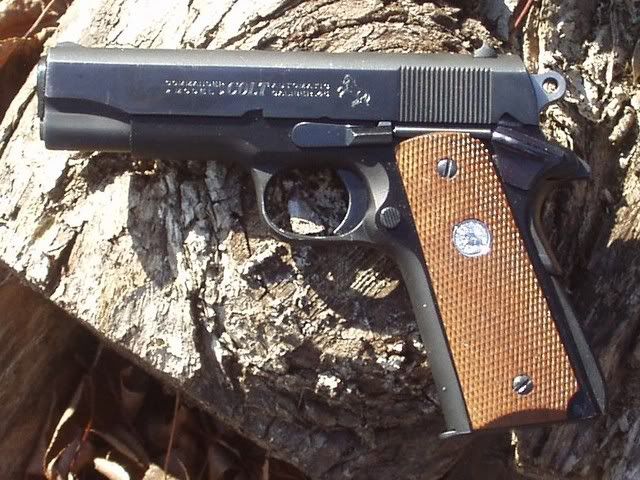
Colt Commander vintage 1969

The Colt Commander was born in 1949 of a desire to produce a lighter version of the 1911A1 or Government Model. To that end the frame was made from Coltalloy. This did result in substantial weight savings of 12.5 ounces. Guns were produced in .45 ACP, .38 Super and 9mm Luger.

Some thought that the slightly more vigorous recoil was an indicator of reduced life expectancy for the frame. However, Skeeter Skelton did a published "torture" test by running 5000 rounds of ball through a Commander with nary a bobble. If I remember correctly the most difficult part of the test was loading the magazines.

This .45 ACP gun was made in 1969 and has endured a life mostly spent in a drawer. As is with true with an unboxed life in a drawer, there are some scratches and a nick or two. Frankly, though, in person it looks much better than my poor photographic skills can show you.

I took it to Mom's for a quick shooting test (it is cold today). It ran through several magazines of hardball without a bobble. It is pretty much as accurate as my Combat Commander.  I got it home and field stripped it for a good cleaning. This gun hasn't been shot much, yet.

Of course I had to switch to a flat main spring housing of which I have an aluminum version in hand. I will install ASAP this evening.

Buying Black Powder

If you shoot percussion or blackpowder cartridge guns much you need to get powder in quantity. Most gun shops nowadays don't carry it. So, what to do? Why order on-line or by phone!

Back Creek Gun Shop, Inc.
Graf & Sons
Maine Powder House
Powder, Inc.
Powder Valley, Inc.

and courtesy of Eddie S. in Roanoke, this source of GOEX:

Bob Moates Sport Shop
10418 Hull Street (US360)
Midlothian, VA 23112

Friday, January 16, 2009

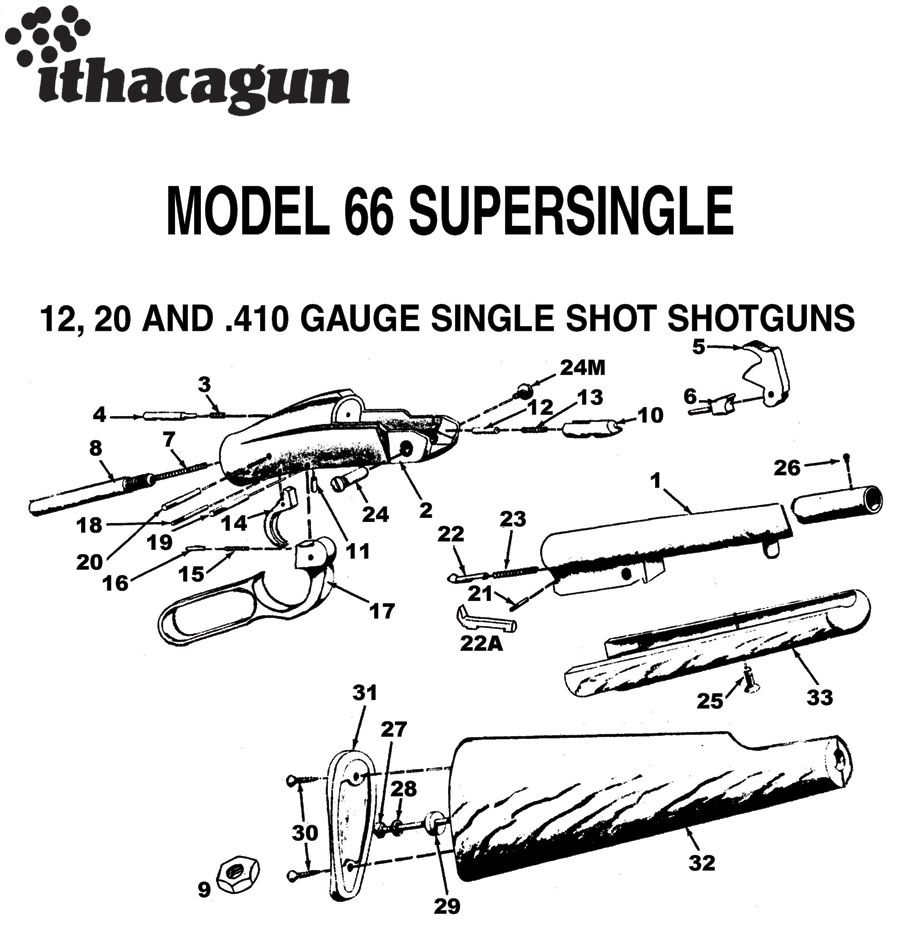
Ithaca M66 Single-Shot Shotgun

Once upon a time I was a long way from home in a town far, far away known as San Angelo, Texas. I remember very little about San Angelo except for the "no dogs and no airmen" sign on a club, two gun shops and one steak place. I spent most of my time on base, Goodfellow Air Force Base, learning the trade of voice intercept operations.

But that isn't to say that I never got out to enjoy life (the steak house is one example), I even got out to go hunting! Unfortunately I didn't have a shotgun. Fortunately I did have a friend with a shotgun. Perry Fuller and his lovely bride Angela were stationed there at the time. Perry not only showed me every gun store in close proximity to base but stored my purchase at his home until he was transferred. A true friend he even had scoped out the public hunting in the area.

Lake Nasworthy is something less than it was then, according to my sources, but it was surrounded by public land and we went out there to shoot my Lyman New Model Army reproduction and hunt quail. Got one, too, and that was with the Ithaca 66 single-shot in 20 gauge. Sadly, I got it on the first rise with the one shot and we didn't find another covey! Angela cooked that succulent morsel for me and it certainly was good food for my soul.

Just as good for the soul was a chance to walk in the "wild" with a gun and to hunt. Although it was inexpensive and simple, the M66 was a fine companion. It worked and was easily handled, it came to the shoulder well, and good stock design made recoil inconsequential. The under lever appears to be awkward especially to those accustomed to the now traditional top lever. Only the H&R button next to the hammer is handier. I liked the lever and felt it was natural and simple in operation. The mechanism is simple and seems to be pretty sturdy. Don't turn one down on appearance, these are good guns.

Thursday, January 15, 2009

Bureau of Alcohol, Tobacco, Firearms and Explosives

The Bureau of Alcohol, Tobacco, Firearms and Explosives has a troublesome website. I know this because I recently tried to navigate it looking for a particular piece of information.

You see, the recent election of an avowed anti-gunner as President of the United States has put the fear in many thousands of Americans and they've been buying guns by the many thousands above the usual rate of sales. Firearms purchases require completion of a form 4473 (as well as some other things, including the NICS check based on information provided on the form and accompanying identification). Thus, many forms more than expected were used and the BATFE can't supply the demand.

The BATFE's response to this shortage is practical and reasonable. Photocopy the forms now for use in this short-term shortage. This doesn't impede commerce, doesn't deny anyone their rights and puts reproduction costs on the dealer. Unfortunately, the open letter permitting this act is buried in the BATFE web site.
ATF Seal U.S. Department of Justice
Bureau of Alcohol, Tobacco,
Firearms and Explosives

Assistant Director
Washington, DC 20226


January 6, 2009


Notice to All Federal Firearms Licensees
Regarding ATF Form 4473 Shortage

As a result of an unprecedented increase in demand for ATF Forms 4473 (5300.9) Part I Revised August 2008, inventory of the form at the ATF Distribution Center is running low.

As a temporary measure, ATF is allowing FFLs to photocopy the form 4473 in it’s entirety until they receive their orders from the ATF Distribution Center.

A notice will be posted at the expiration of this temporary authorized change.
Thanks to poster Rimfire McNutjob at the leverguns forum for the link.

The +P Phenomenon by SaxonPig

I was a little surprised when I began visiting these Internet forums and saw so many questions regarding +P .38 Special ammo. It seems each new day brings yet another post asking about the safety of using factory +P ammo in one gun or another. I always assumed the short answer was that if you had a Star, or Ruby, or some other gun that might be questionable as far as strength is concerned, then stay away from +Ps. But many shooters seem concerned about using this ammo in quality guns of recent manufacture* and I didn’t expect that. I saw many inquiries about K frame S&Ws using +P and I found it odd that anyone would worry about using factory +P ammo in such a gun. Then I started seeing postings from owners of .357 Magnum revolvers asking if +P .38 Special ammo would harm their guns. One forum member was concerned that +Ps would damage his Model 28 S&W.

Come again? I don’t know what caused such a mystique to surround +P ammo to make people with N frame Magnums think it’s too much for their guns, but it strikes me as overblown all out of proportion. The fact is that +P isn’t “all that” anyway. Winchester, Federal and Remington list the velocity of the 125 grain +P at around 925 FPS. These velocities are actually fairly mild. I have shot many rounds of Remington 125 grain +Ps in a 1942 S&W Military & Police revolver and I can literally shake the fired cases from the gun without using the extractor. In my opinion these loads are actually pretty mild and show no sign of even moderate pressure in any of my guns.

As underpowered as I thought the Remington ammo was the PMC proved worse. I clocked a box of the El Dorado 125 JHP +Ps and from a 4" barrel I got a pathetic 890 FPS. Fired from a 2" M&P (made in 1949, BTW) this ammo ran 795 FPS. How can such puny loads cause so much hysteria among shooters? I also tried some Winchester 110 grain +P+ "Law Enforcement Only" ammo. I was expecting around 1300 FPS but all I got was 1100. Big deal! This load was very mild and easy to shoot through the 2" gun and I fail to see the reason for the fear of +P (or +P+ for that matter) that so many shooters express.

Why is everyone so terrified of +P? I believe that the reason +P exists is twofold. First, it is a marketing ploy used to sell ammo by misrepresenting it as powerful. But any perception that this ammo is powerful is a myth. Second, it gives the ammo companies legal cover should anyone blow up their inexpensive gun because they can say "We warned you not to use +P ammo!" Of course, +P is nothing more than what standard pressure ammo used to be and they created the +P moniker to protect themselves.

The factory ammo made back in the 1970s and earlier was hotter than that made today (see chart #1). I have seen the specifications for standard .38 Special ammunition from a 1940 catalog listing the velocity as 960 FPS with a 158 grain bullet. This load would clearly develop higher chamber pressure than the current +P load and yet it was used for decades in all models from Colt and S&W without incident. The current +P is really about what the .38 Special should be in standard form. But note that today's standard load is no longer what it once was, either. In 1940 it was the 158/960 that was considered standard. During most of my youth I recall the load as advertised at 158/870. I have a copy of the specifications for S&W/Fiocchi ammo that was packaged with new guns that appears to have been printed in 1970. It lists the 158 lead .38 Special load at 910 FPS. It also includes a 158 JHP at 1140 FPS (equaling the mighty 38/44 load), a 125 JHP at 1380 FPS and a 110 at 1390 FPS**. I have seen a ‘70s box of SuperVel .38s with the package labeled as containing a 158@955 load. This was the standard load in the early 1970s (although I didn’t recall SuperVel offering standard velocity ammo). Note that none of these loads were marked as +P, but were considered standard pressure and the ad bears no mention of not using this ammo in older guns or revolvers with alloy frames.

These loads are probably similar to those +P loads offered by the specialty ammo makers like Bear Claw, Cor-Bon and others that exceed the levels achieved by the mainstream ammo company loads. Bear in mind that this was ammo bearing the S&W name and sold through their dealer network for use in their guns. They are now advising against using the rather meek current +P for their revolvers when they used to advertise and sell ammo that was much hotter. Compare these velocities to those offered today and tell me they haven't reduced the loads! Current specifications on the lead 158 are pretty wimpy at 158/750 (some are now showing 730). Again, we see the ammo companies reducing the loads over the years. The current +P (which means +Pressure if you didn’t know) is really only +P when compared to current standard loads. Stacked up against past standard loads the +P looks pretty anemic and the current standard load is truly pathetic.

The fact is that +P is only called +P in comparison to the current standard .38 Special loading, not because it exceeds the pressure limits set for the caliber. I believe the SAAMI pressure limit for the .38 Special is 21,500 PSI (the .357 Magnum is 35,000 for comparison). The standard load for the .38 Special as offered by Winchester, et al, generates 16,500 PSI. This is so far below the maximum allowable as to be ridiculous but the ammo makers fear lawsuits from people using the ammo in cheap guns. The +Ps from these manufacturers run about 18,000 PSI. This is more than the standard loadings (hence the +P designation) but is still far below the maximum allowable pressure. Those "really hot +P loads" from the specialty manufacturers like Cor-Bon, etc., are simply loaded to the caliber's full potential of 21,500 PSI and should be perfectly safe in any quality arm in good condition. Sellier & Bellot sells a 158@975 load that is obviously more powerful (and therefore generates more chamber pressure) than the 125@925 +P yet this ammo isn’t labeled as +P. It’s likely simply loaded near the 21,500 PSI maximum allowed for the caliber and this company eschews the ridiculous +P label on ammo that is within industry standards.

So why are we seeing these less powerful loadings? Because there are some guns out there that are not well made. Because of liability concerns the ammo makers must load their products to pressures that are safe in these lower quality guns. They mark the "high pressure" loads as +P (even though as I noted they really aren't high pressure) to give them legal cover should someone hurt himself shooting this ammo in a cheap Spanish S&W knock-off of dubious quality.

S&W ran advertisements in the 1930s and 1940s specifically stating that the .38/44 load, which pushed a 158 grain bullet at an advertised 1125 FPS making it far more powerful than the current +P load, could be used in the K frame revolver. Colt ran similar ads for using this ammo in the Detective Special. If these 1930s-era medium frame revolvers could handle the 158/1125 Heavy Duty loads, why should anyone worry about the same guns shooting the current 125/925 loads labeled as +P? One former police officer told me that between 1958 and 1960 he fired 2,000 rounds of factory 38/44 ammo through his duty Model 10 without any effect to the gun. If all that shooting with the 158/1125 load didn't harm his K frame I don't see how the 125/925 +P can hope to do damage.

Lee Jurras started SuperVel in the 1960s. This was maybe the first of the specialty ammo companies and he offered truly high performance .38 Special loads. I have some of the 110 grain loads and they clock around 1300 FPS. Based on this I would guess his 125 loads would go around 1200 or so. This would be a true +P load but it’s still lighter than the old .38/44 load. I don’t recall seeing or hearing of guns being damaged by this ammo.

Check out a reloading manual from the early '70s. The Speer #8 from 1970 has a load listed for the .38 Special pushing a 158 JHP to 1,250 FPS, one for the 125 grain bullet at 1426 FPS and one for the 110 grain bullet at 1536 FPS! A 1971 Sierra manual shows a load for the 125 grain .38 Special at 1250 FPS. Sort of makes that factory +P at 925 seem less intimidating, doesn't it? Now, of course, new manuals don't include listings that are this hot. Now they stop at about the same levels as the factory +P. Why? Lawyers and lawsuits are the reasons why. The reloading manual publishers are just as scared as the gun and ammo makers about being sued. Fear of lawsuits is the same reason the gun makers caution against the use of +P ammo. They also say don’t use reloads. They have to say this on advice of counsel to protect themselves.

I load 125s at 1,100 FPS in my .38 Special carry guns. This load came from the 1970 Speer manual and is not the top load listed. I have shot many rounds of it through both K and J frame guns and they seem to work just fine. Recoil is slightly more pronounced than with standard ammo, but the cases fall from the cylinder with no sticking and I see no signs of excessive pressure. Just for fun I once put 6 rounds of this ammo through an old small-frame Rossi revolver. Nothing bad happened although I wouldn’t advise using this ammo in such a pistol. I once loaded some 110 JHPs to a clocked 1400 FPS from a 4" Model 10. These were hot, let me tell you, and I backed off. But the gun showed no immediate effect from having fired a small amount of this ammo.

Ask yourself this question: Would any ammo maker in today's litigious environment sell any ammunition that would be unsafe or harmful to use in the typical gun that a consumer may own? If factory +P were really hazardous would Winchester, or Federal, or Cor-Bon sell it to the general public?

With all the many, many questions regarding the safety of +P ammo, there must be many reports of blown-up guns, right? How many guns blown-up by factory +P ammo have you seen? How many guns blown-up by factory +P ammo have you heard about? I have been participating in the shooting sports and studying firearms since 1967 and I know of absolutely NONE. I have heard second and third hand accounts of one or two guns that were said to have been damaged by factory ammo but I think it more likely these guns suffered failure due to some manufacturing defect. It happens. I have a S&W .357 Magnum that was returned to the factory for a new frame. Something went wrong with it.

Certainly, using a gun causes wear. A gun is a machine and using any machine will cause it to wear. Using hotter ammo will likely accelerate the process to some degree. But a quality gun from S&W or Colt or Ruger will not blow up with +Ps. Nor will it excessively stretch the frame or split the barrel in my opinion. It will possibly wear a little faster, and I doubt if anyone could predict how much, but I think the added wear on a good gun will not be all that much. The gun would probably still last longer than the man who owns it.

I admit to some paranoia about warm loads in an alloy-framed gun but factory +P is not a warm load. I do not have any alloy revolvers but if I did I would stick to standard ammo (such as +P) and avoid my warm hand loads. In an alloy gun of good quality I have no concerns at all about +P on a regular basis since I consider factory +P to be nothing more than standard pressure (or less), anyway. Also, in 1955 Elmer Keith wrote of shooting the 38/44 load through the alloy J frame guns and he said that it did them no harm but recoil was pretty fierce. Keith favored big guns with heavy recoil so such a comment coming from him is quite meaningful.

This is just my opinion based on personal experience and research. There are differing points of view. Some replies to the +P question are quite adamant about avoiding regular use of this ammo. Others advise occasional use. Some say only carry +P for defense but don’t use it for practice at all. Some say S&W guns with model markings are OK with +P*** (what about the Colts?) while others say only use it in guns specifically approved by the factory. The fact that there are so many answers to this question tells me that there is great confusion on this matter. I’m a simple man and I take a simple course to the truth. I do basic research and try to find the facts. I have presented the facts as I see them. All one must do to find the truth about current factory +P ammo is look at the specifications. I submit that a 125/975 load is hardly high performance, and certainly nothing to cause concern for owners of quality revolvers. All are free to disagree.

Some forum members have accused me of being irresponsible in recommending the loads I mentioned. Of course, I am not recommending anything, only stating what I do. Also, all of the loads I use came from reputable reloading manuals. If the loads were safe in 1970 I don’t see why they aren’t safe now, but I don’t recommend anything to anyone. Each of us has to make our own choice. If you think any of the loads I mentioned are too hot then avoid them. If you are in any way uncomfortable with +Ps then stick with standard loads.

Notes:

* The manufacture and tempering of steel was imprecise before around 1930 or so. Any of my guns made before this date get reduced loads just to be on the safe side. Note that early S&Ws, those made before around 1918, had cylinders that were not tempered at all. A similar situation likely is true with Colt revolvers but I have no specific knowledge of when Colt began tempering their cylinders.

** This same document advertises a 125 JHP .357 Magnum load at 1775 FPS. Current factory ammo in this caliber with this bullet usually clock around 1250-1300 FPS. Apparently the Magnums have also been "downsized."

*** I never understood using the "model marking" on S&W revolvers as the cut-off for +P. As far as I can tell the last S&W made without the model number stamped on it was exactly the same as the first revolver to have the model number stamped on it. They didn't improve the steel or strengthen the guns in any way. All they did was start stamping the model numbers. Also, how could S&W have intended for the model marking to be a benchmark for +P when the ammo wasn’t invented until 25 years later?

PS:

This same situation that has affected the .38 Special occurs with the .38 Super. The original loading for the Super was a 130 FMJ at nearly 1,300 FPS. But the Super cartridge is the same physical size as the old .38 ACP, just loaded to higher pressures so the ammo makers started fretting over some yahoo stuffing Supers into his 1905 Colt in .38 ACP and spreading parts all over the range. That’s why Super cases were nickel and the .38 ACP were brass until a few years ago, so shooters could instantly recognize which ammo they had. I was curious a few years ago when I noticed that they stopped doing this and I saw Super ammo in regular brass cases. I guess there’s no need any longer since factory Super ammo now clocks about the same as .38 ACP. The last box I checked ran 1,120 FPS, only 40 more than the ACP. They have down-loaded the Super to nearly the same level as the ACP. No lawsuits. Of course, the Super isn’t so… super… any longer, is it?

Some people claim that the standard .38 Special load today is the same as 30-50 years ago and the only difference is the claimed velocities in the past were greatly exaggerated by the test barrels they used. Everyone back then knew real-world velocity would be a little lower but not as much as some would have us think. Below are some actual measured velocities of various vintage ammunition.

Chart #1:

Some .38 Special velocities actually measured (not claimed by the manufacturer) from a 4" Colt Official Police:

Remington 158 grain lead made in the late 1960s-early 70s...840 fps
Peters 158 grain lead made in the 1950s...800 fps
Western Super-X 158 grain lead made in the mid-late1960s...810 fps
Western 150 grain metal-piercing made in the mid-late 1960s...1000 fps
Remington 158 grain lead "Hi-Speed" made in the 1950s...920 fps

The 158 loads from the 1950s-1970s are clearly more potent than the current offerings that achieve a claimed 730-755 FPS velocity. The observed 800-840 FPS is consistent with the manufacturer claims at the time of 870-910 FPS since they used a 6" "pressure barrel" to achieve the claimed velocities and actual velocities from 4" revolvers ran somewhat lower. But clearly not the huge difference some people claim in their assertions that factory .38 Special ammo has not been reduced in power. Also, bear in mind that the ammo being tested was all 30-50 years old and may have exhibited some deterioration in the powder which may have caused lower velocities than the ammo developed when new.

The bottom line:

Each man must do what he thinks is best. After a great deal of research and testing I do not consider factory +P ammo to be very warm at all and it concerns me not one bit in a quality revolver.