Sunday, March 20, 2011
Shotworks Pro
Need a way to keep your shooting stuff organized and accounted for? I think everyone does. I used to use Access from Microsoft after trying Excel but lost it in a computer switch. I was looking for something else and somebody recommended Shotworks Pro. I tried it. Not happy. After entering data for five firearms and trying to find the proper place to enter current values and manufacturing date I get continuous error messages. So, I've uninstalled the program. Pretty disappointing. At least there was no apparent virus associated with the program.

Saturday, March 19, 2011
Musings on Weapons of War
Today's initiation of attacks on the forces of Moammar Gadhafi in Libya made me think about all the wars in which the U.S. has been involved in my lifetime. First, there's the Korean War (you can call it a "police action" but it is a war) which is still on-going despite the truce. Then, you had the "Cold" War, Vietnam, Panama, Grenada, the Gulf War, the Yugoslavic war(s), the Global War on Terror, the Iraq War, the Afghanistan War, and, now, the Libyan war. As I sit and think, we've not really been at "peace" in my lifetime even though there's plenty of "anti"-war protesters (who are actually agents of all our enemies and at war with the U.S.). Heck, even the current President who campaigned against "the" war has continued and even escalated the war in Afghanistan and started this war with Libya.
But what interests me for the moment and what I want to talk about here is the changes in weaponry that have occurred over that time period. Some call them improvements but...
First, there's the pistols. We've gone from the 1911A1 to the Beretta M9 (or is it M9A1?), from .45 cal to 9mm because you can carry the same ammo as our enemies and more of it (but you don't really) and because the leadership thinks close combat isn't influenced by how quickly your enemy hits the dirt and that you don't.
Second, we've had like improvements in rifles, switching from the M1 Garand .30-06 rifle to the M14 7.62mm NATO to the M16 and its derivatives in 5.56mm NATO. That was so much of an improvement that there are efforts within and without the military to modify the 5.56mm cartridge to come closer to equal-lying the old .30 caliber rounds in terminal ballistic performance.
Grenades and other individual explosive devices haven't changed that much except in shape and size with some improvement in quality or uniformity of fragmentation. We have had improvements with grenade launching moving to the M79 then M203 systems for the individual soldier and the Mk19Mod3 40mm grenade launching machine gun.
Likewise we've seen some improvements in light and general purpose machine guns with the M249 and M240 being fielded replacing the M60 and older M1919A4 guns. Some soldiers would disagree, but their just grousing as soldiers do, right?
The biggest changes have been in targeting systems for munitions delivered by artillery and aircraft. Those big changes are in Global Positioning Systems (GPS) and with the remote controlled aircraft for targeting both stand-off distances and accuracy are greatly enhanced protecting the lives of American servicemen and women. For those instances where targets are moving operators can light them up with a laser and ordnance can be flown directly into the target. These systems have been revolutionary and are THE reason that the U.S. has been militarily pre-eminent. How long this might last is in question, but for now...
But what interests me for the moment and what I want to talk about here is the changes in weaponry that have occurred over that time period. Some call them improvements but...
First, there's the pistols. We've gone from the 1911A1 to the Beretta M9 (or is it M9A1?), from .45 cal to 9mm because you can carry the same ammo as our enemies and more of it (but you don't really) and because the leadership thinks close combat isn't influenced by how quickly your enemy hits the dirt and that you don't.
Second, we've had like improvements in rifles, switching from the M1 Garand .30-06 rifle to the M14 7.62mm NATO to the M16 and its derivatives in 5.56mm NATO. That was so much of an improvement that there are efforts within and without the military to modify the 5.56mm cartridge to come closer to equal-lying the old .30 caliber rounds in terminal ballistic performance.
Grenades and other individual explosive devices haven't changed that much except in shape and size with some improvement in quality or uniformity of fragmentation. We have had improvements with grenade launching moving to the M79 then M203 systems for the individual soldier and the Mk19Mod3 40mm grenade launching machine gun.
Likewise we've seen some improvements in light and general purpose machine guns with the M249 and M240 being fielded replacing the M60 and older M1919A4 guns. Some soldiers would disagree, but their just grousing as soldiers do, right?
The biggest changes have been in targeting systems for munitions delivered by artillery and aircraft. Those big changes are in Global Positioning Systems (GPS) and with the remote controlled aircraft for targeting both stand-off distances and accuracy are greatly enhanced protecting the lives of American servicemen and women. For those instances where targets are moving operators can light them up with a laser and ordnance can be flown directly into the target. These systems have been revolutionary and are THE reason that the U.S. has been militarily pre-eminent. How long this might last is in question, but for now...
People of the Gun
 I'm not late in recognizing People of the Gun, I did so on another blog several years back, but this is new to me here as it usually isn't something I post about because this is really a journal for the grandkids. Still, it is important that we recognize that people from all parts of the country, of all ethnicities, of all professions, of all formal education levels are gun owners and advocates for the righteous ownership and use of firearms.
 I started my interests at a young age, as you can see, but such things run deep in my family. As farmers and citizen soldiers, firearms have been a tool for survival for my family from the earliest days of colonial America.
Friday, March 18, 2011
Need a Contender Barrel?
As of now, these are the best sources...
- Bellm's TCs
- Bullberry
- Dave Van Horn
- David White
- E. Arthur Brown
- Ed's Contenders
- RJ's Guns
- Stratton Custom took over from Virgin Valley
- SSK Industries
I've dealt with everybody but Stratton. Foxridge aka TC Custom shop is no more. Neither is OTT LLC who did EDM chambering of barrels.
- Bellm's TCs
- Bullberry
- Dave Van Horn
- David White
- E. Arthur Brown
- Ed's Contenders
- RJ's Guns
- Stratton Custom took over from Virgin Valley
- SSK Industries
I've dealt with everybody but Stratton. Foxridge aka TC Custom shop is no more. Neither is OTT LLC who did EDM chambering of barrels.
Thursday, March 17, 2011
From Ingot to Target: A Cast Bullet Guide for Handgunners©
If you cast your own bullets you've probably got a couple of references. There's the Lyman loading manual for cast bullets and then maybe you've got the NRA compilation by C. E. Harris on casting. Well, here's a reference you probably need! From Ingot to Target: A Cast Bullet Guide for Handgunners© by Glen E. Fryxell and Robert L. Applegate.
If there is any fault with From Ingot to Target: A Cast Bullet Guide for Handgunners© it is that there isn't a paper/print version you can have down at the loading bench for reference or to carry to the reading room for entertainment/diversion. Yes, I have a Kindle, but I still have a place in my home for the old fashioned printed work.
Mr. Fryxell and Mr. Applegate have joined forces to produce an genuinely useful reference lacking in the old wive's tales one used to read in magazine articles on casting. There is plenty of clearly and concisely presented information which, if acted on, will allow anyone to produce accurate, useful, quality bullets.
If there is any fault with From Ingot to Target: A Cast Bullet Guide for Handgunners© it is that there isn't a paper/print version you can have down at the loading bench for reference or to carry to the reading room for entertainment/diversion. Yes, I have a Kindle, but I still have a place in my home for the old fashioned printed work.
Mr. Fryxell and Mr. Applegate have joined forces to produce an genuinely useful reference lacking in the old wive's tales one used to read in magazine articles on casting. There is plenty of clearly and concisely presented information which, if acted on, will allow anyone to produce accurate, useful, quality bullets.
Wednesday, March 16, 2011
Vehicles...
Somebody asked and I tried to list all I've owned...
I had a:
- Suzuki GT185 (sold)
- Citroen ___ (sold)
- 1973 Datsun Pickup (sold to Dad)
- 1979 (I think) Subaru 4WD Wagon (traded in)
- Honda Civic (went with the ex-wife)
- 1985 Nissan Pickup (traded in)
- 1986 Aerostar (wrecked and never ran right again)
- 1987 Aerostar (a lemon)
- 1990 Aerostar (traded in)
- 1990 Mazda B2000 pickup (died after 150K+ and abuse by son and gone to the scrap yard)
- 1990 Subaru Sedan (bought from Mom for daughter and sold)
- 1995 Dodge Dakota (son is still driving it)
- 2001 Nissan Xterra (wife still driving it)
- 2004 Ford F150 (current vehicle)
I had a 3½-year hiatus from vehicle ownership. One can get by without in Seoul but I'd never try it in California.
I had a:
- Suzuki GT185 (sold)
- Citroen ___ (sold)
- 1973 Datsun Pickup (sold to Dad)
- 1979 (I think) Subaru 4WD Wagon (traded in)
- Honda Civic (went with the ex-wife)
- 1985 Nissan Pickup (traded in)
- 1986 Aerostar (wrecked and never ran right again)
- 1987 Aerostar (a lemon)
- 1990 Aerostar (traded in)
- 1990 Mazda B2000 pickup (died after 150K+ and abuse by son and gone to the scrap yard)
- 1990 Subaru Sedan (bought from Mom for daughter and sold)
- 1995 Dodge Dakota (son is still driving it)
- 2001 Nissan Xterra (wife still driving it)
- 2004 Ford F150 (current vehicle)
I had a 3½-year hiatus from vehicle ownership. One can get by without in Seoul but I'd never try it in California.
Tuesday, March 15, 2011
Kahr Arms

Links:
- Kahr Arms Facebook Page
- Kahr Arms
Monday, March 14, 2011
Notes from the gun shop...
A slow day, we only did 4 background checks and two lay-aways. However, we did have a 4" Python that walked in the door at 10AM and was sold at 2PM. We also got an old 1873 .38 WCF rifle working. I'm always amazed at how well fit the links and pins are in those old rifles. The boss man also brought his dog in to work this afternoon. Nice old golden retriever, Harley is a good old girl. She is good at begging cheese and leaning. Now that I write about it I can see that it was a really slow day. Not as slow as the $212.00 day, but pretty darn slow.
Friday, March 11, 2011
The 9.0 Earthquake in Japan
To my grandchildren,
Likely you don't, won't, remember this day or you might and that may be for reasons other than the images or for the sympathetic memories of earthquakes in other places and at other times. This morning we awoke to news of an horrific earthquake in Japan accompanied by an even more horrific tsunami which together likely killed thousands. We watched on TV as people unable to move their cars further from the flood, stepped out to meet the wall of water. We watched the mass of debris of every kind swept through town and farm, over every obstacle penetrate miles inland. We saw how little notice we get of natural disaster and how pervasive and absolute it can be. In this we saw and thought of you.
All we do and have done has been to put you in a place where you can thrive. We can only hope we have succeeded. We hope that you will honor our efforts by attempting the same for your grandchildren.
Likely you don't, won't, remember this day or you might and that may be for reasons other than the images or for the sympathetic memories of earthquakes in other places and at other times. This morning we awoke to news of an horrific earthquake in Japan accompanied by an even more horrific tsunami which together likely killed thousands. We watched on TV as people unable to move their cars further from the flood, stepped out to meet the wall of water. We watched the mass of debris of every kind swept through town and farm, over every obstacle penetrate miles inland. We saw how little notice we get of natural disaster and how pervasive and absolute it can be. In this we saw and thought of you.
All we do and have done has been to put you in a place where you can thrive. We can only hope we have succeeded. We hope that you will honor our efforts by attempting the same for your grandchildren.
Wednesday, March 09, 2011
The Kindle
Originally 12/28/10, updated 3/8/2011
I've got to say that I have been ambivalent about the Kindle with 3G service. I'm a fan of the tactile experience of reading a book or magazine and I like to see the color illustrations. Like all children, I like illustrations. After registering, my first book was Jeff Cooper's, "Art of the Rifle". One thing I like is that I am able to but the "book" down (turn it off) and come back right to where I left it. I can search for other such books from this one. I can search by author or title. Still, there is something to turning the page, smelling the ink, etc. Intangible pleasures not available in the digital version. Also, since Nana got one, I've had a bit of a problem working two Amazon accounts off one e-mail address. However, now that her account is functioning, we can let it be as she orders off the Kindle device with one-click payment. One of the biggest selling points of the Kindle for me is the accessibility of free, pre-1923, books. I am particularly interested in Theodore Roosevelt's writings. Heretofore one had to buy a print version or lug it back from the library IF you could find a copy there. This will be infinitely easier.
The 3G Kindle would seem to be a bargain as one doesn't pay for the service but can surf the net using Google and Wikipedia (which is neither awful nor exemplary but is useful) as a starting point.
We have had a problem with Nana's Kindle cover. A patent leather looking folder with what appears to be a felt lining and a hook system to secure the Kindle to the cover, it certainly doesn't have a high-tech appearance but it must be. You see as soon as I put the Kindle in the cover the device kept rebooting. Finally, it locked up and had to be manually reset. I called customer service and as soon as I explained what was happening the tech on the other end told me to take the cover off. It has worked perfectly since. We tried re-installation of the cover with the exact same problem. Another call to Amazon and I was told that the cost of the cover would be reimbursed to Nana's account and to order another cover. I did so. Knock on wood.
The new Kindle cover worked just fine, for me. Nana had it in hand for about 10 minutes and it started to reboot. I took off the cover and it worked fine. I think I've discovered the problem. It is in how she holds the Kindle when in the cover. She holds it in such a way that the power switch on the bottom of the Kindle is pushed to the right and held for over 15 seconds which causes it to reboot. She doesn't hold it the same way out of the cover and so doesn't get this effect. She's now using it without the cover but my use with the cover shows that it doesn't reboot.
My kindle reading list...
Links:
- Note on Kindle Cover Problem
I've got to say that I have been ambivalent about the Kindle with 3G service. I'm a fan of the tactile experience of reading a book or magazine and I like to see the color illustrations. Like all children, I like illustrations. After registering, my first book was Jeff Cooper's, "Art of the Rifle". One thing I like is that I am able to but the "book" down (turn it off) and come back right to where I left it. I can search for other such books from this one. I can search by author or title. Still, there is something to turning the page, smelling the ink, etc. Intangible pleasures not available in the digital version. Also, since Nana got one, I've had a bit of a problem working two Amazon accounts off one e-mail address. However, now that her account is functioning, we can let it be as she orders off the Kindle device with one-click payment. One of the biggest selling points of the Kindle for me is the accessibility of free, pre-1923, books. I am particularly interested in Theodore Roosevelt's writings. Heretofore one had to buy a print version or lug it back from the library IF you could find a copy there. This will be infinitely easier.
The 3G Kindle would seem to be a bargain as one doesn't pay for the service but can surf the net using Google and Wikipedia (which is neither awful nor exemplary but is useful) as a starting point.
We have had a problem with Nana's Kindle cover. A patent leather looking folder with what appears to be a felt lining and a hook system to secure the Kindle to the cover, it certainly doesn't have a high-tech appearance but it must be. You see as soon as I put the Kindle in the cover the device kept rebooting. Finally, it locked up and had to be manually reset. I called customer service and as soon as I explained what was happening the tech on the other end told me to take the cover off. It has worked perfectly since. We tried re-installation of the cover with the exact same problem. Another call to Amazon and I was told that the cost of the cover would be reimbursed to Nana's account and to order another cover. I did so. Knock on wood.
The new Kindle cover worked just fine, for me. Nana had it in hand for about 10 minutes and it started to reboot. I took off the cover and it worked fine. I think I've discovered the problem. It is in how she holds the Kindle when in the cover. She holds it in such a way that the power switch on the bottom of the Kindle is pushed to the right and held for over 15 seconds which causes it to reboot. She doesn't hold it the same way out of the cover and so doesn't get this effect. She's now using it without the cover but my use with the cover shows that it doesn't reboot.
My kindle reading list...
Links:
- Note on Kindle Cover Problem
Tuesday, March 08, 2011
Notes from the gun shop...
I went to work dragging from my bout with "the crud" a severe cold with some flu symptoms that started at Bob Monast's funeral and progressed apace until I was puking on Friday, breathless on Saturday and unwilling to eat until Sunday evening. Things started slow but, as predicted by a co-worker, picked right up in the afternoon.
The state police must be experiencing "the crud" as well because delayed backgrounds are much delayed, commonly taking more than a day instead of about 1½ hours to clear. This started last Monday and continued over this Monday. When we opened we had 7 backgrounds awaiting completion from Saturday. This takes up work space and otherwise complicates things for the dealer. One only hopes that the buyer(s) aren't unduly inconvenienced. Firearms ownership is a RIGHT not a privilege and if a background check is so darn important they should allocate the funds to do it correctly and protect the right rather than denying the right to legitimate buyers.
 We did have a couple of interesting guns show up. The first was this engraved Smith and Wesson Model 36 (no dash) built in 1970 (most likely judging by the serial number with information from the Standard Catalog of Smith and Wesson) and has been engraved with some gold inlay. It appears to be "signed" on the left side near the rear bow of the trigger guard. The grips appear to be some sort of after-market fake ivory, but they are better looking than most such. I think it is a very handsome piece but then I'm only comparing it to what I know which isn't much. Some of the mistakes have been pointed out to me and now I can see them. It is still ahead of the game compared to some roll-marks which pass for decoration!
The other was a relatively rare Chicago Palm Pistol, all blue and in very good to excellent condition. I'm afraid I didn't get a great photo of this one.
Antique Arms and Antique Associates at West Townsend had this description of one such in their catalog...
The state police must be experiencing "the crud" as well because delayed backgrounds are much delayed, commonly taking more than a day instead of about 1½ hours to clear. This started last Monday and continued over this Monday. When we opened we had 7 backgrounds awaiting completion from Saturday. This takes up work space and otherwise complicates things for the dealer. One only hopes that the buyer(s) aren't unduly inconvenienced. Firearms ownership is a RIGHT not a privilege and if a background check is so darn important they should allocate the funds to do it correctly and protect the right rather than denying the right to legitimate buyers.

 |
| Chicago Palm Pistol |
Antique Arms and Antique Associates at West Townsend had this description of one such in their catalog...
...This variety has no engraving around the barrel or on the frame. Most examples observed are engraved…this example is quite scarce. Peter Finnegan of Austin, Illinois purchased the patent rights for the Protector Palm pistol from the Minneapolis Firearms Company in 1892 and established a new company…The Chicago Firearms Company instituting design improvements making the gun more reliable. The improved pistol is slightly larger, the safety functioned better and the sideplate was more secure; the entire gun was sturdier. He contracted with Ames Sword Company of Chicopee Falls, Massachusetts to manufacture the weapons and deliver them to him in time for the opening of the Columbian Exhibition (The Chicago World's Fair of 1892). Ames defaulted and did not deliver until after the Exhibition had closed and even then, only a small percentage of the contract was delivered. Finnegan sued Ames eventually winning cash settlement with the Ames Sword Co. becoming the owner of 13,000 Protector Palm pistols that they sold from 1894 through 1910 although the guns themselves were all made prior to 1898.
Saturday, March 05, 2011
Black Powder Loading the .45-75
To quote Rick Bachman of Old West Reproductions,
I've been shooting and reloading the .45-75 for over 40 years. I've used all of the granulations in blackpowder and always come back to 2F. I always load to original factory specs and the 350 grain lead bullet with 72 grains of 2F black works extremely well. The 2F black is what UMC and Winchester used in manufacturing factory ammunition of this caliber. I have experience only with original '76 rifles and carbines and I reload with original Winchester bullet molds and reloading tools. The only brass that was available years ago was .348 Win., and that is what I still use today. These cases are heavy and will only hold about 72 grains of 2F when weighed on a scale, but I load by volume and slightly compress my loads under a card wad. I have never had a cartridge failure and I've never had a gun that wouldn't shoot this ammo with great accuracy.Does one need to go any further? I don't think so.
Thursday, March 03, 2011
Italian Black Powder Arms Manufacturing Codes...
I thought I'd published this here earlier. Copied from elsewhere I can find no attribution.
When you purchase either a 2nd or 3rd Generation Colt Blackpowder Arms revolver it bears the Colt patent stamping on the frame and the Colt address on the top of the barrel. There is also a serial number stamped on the bottom of the frame, again on the bottom of the barrel lug, trigger guard and buttstrap. The serialization indicates the year or period of manufacture, and this is as straightforward as model identification gets. Even though many of the Colt parts for the 2nd Generation, and all of the Colt parts for the 3rd Generation were cast in Italy, the guns were finished and assembled in the United States by Colt or the Colt Blackpowder Arms Company, and Colt pistols, regardless of the origin of their components, bear only Colt markings.
The same model gun, an 1860 Army for example, manufactured in Italy and sold by Uberti or F.LLI Pietta, is stamped with a variety of markings – Italian Proof House devices, manufacturer's symbols and an encoded date of manufacture. It is usually a combination of heraldry and letters, which need to be decoded. The same is true of flintlock and percussion lock pistols and long rifles manufactured by Uberti, F.LLI Pietta, ArmiSport, Davide Pedersoli, Armi San Paolo SRL (Euroarms), and Palmetto, which comprise the major Italian manufacturers currently in production.
The Italian proof houses in Gardone and Valtrompia have been around for a very long time but as far as reproduction black powder arms are concerned, the dating begins in 1954. Prior to 1954, the year of proof was indicated in full Arabic numerals.
Following is a chart displaying the year of proof symbols used from 1954 to 2003. These are traditionally found within a box next to the individual proof house symbols. From 1954 through 1970 Roman Numerals were used. Roman Numerals and Arabic Numerals were combined in 1971, 1972, and 1973, and Roman Numerals were used again in 1974. Since 1975 two capital letters have been used exclusively.
As to the placement of proof house symbols, it depends upon the model of gun, and the level of embellishment, the latter often dictating a discrete location on the underside of the barrel or frame on highly engraved examples.
There are two standardized proof house marks. The first is the provisional Gardone proof, consisting of a star surrounded by eight lands and grooves over a coat of arms featuring a hammer and anvil and crossed bayoneted rifles; the second is a star surround by eight lands and grooves over the capital letters PN. All firearms produced in Italy since 1950, regardless of type, receive the first stamping. The second, also instituted in 1950, is the first black powder proof for Gardone and Brescia, and is only used on black powder arms. Thus all black powder arms must bear both proof house symbols.
Finally, there is the manufacturer's mark. This is often confusing unless one is familiar with the manufacturers' insignia. Most use their logo, while some combine their name and logo, or use an abbreviation as their logo. Earlier guns generally bear only their manufacturers' mark, while more recent production has been seen using both an emblem and company name.
Davide Pedersoli, one of Italy's oldest manufacturers has had three logos since 1957. The earliest was a diamond inside a circle. This is rarely seen. This mark was followed by the image of an anvil with PEDERSOLI above it in capital letters and the initials DAP inside the anvil. This again is rarely seen, except on very early models. The company logo, a lowercase dp within an oval, has been used for more than 40 years. This logo is often followed by the DAVIDE PEDERSOLI or PEDERSOLI name in capital letters. In short, there is no mistaking a Pedersoli product!
The same is true of Aldo Uberti, S.r.l, which has used the same logo since its founding in 1959 – a capital U contained within an octagonal barrel device. For Fratelli Pietta, another of Italy's leading manufacturers of black powder pistols and long arms, the initials FAP contained within a horizontal diamond identify F.LLI Pietta; often followed by F.LLI PIETTA in capital letters.
Palmetto, which manufactures a variety of black powder arms distributed primarily through Dixie Gun Works, uses a very recognizable palm tree within a circle as their company logo.
Armi San Paolo S.r.l., established in 1970, uses the last names of the original founders Grassi, Doninelli, and Gazzola as a symbol, DGG, usually contained within a circle. Beginning December 31, 2001, Armi San Paolo officially became Euroarms Italia S.r.l. The same logo is used on all Euroarms models.
Armi Sport, which produces an exceptional line of single shot percussion pistols like the French Le Page, Sharps rifles, and the popular Spencer rifle for Taylor's & Co., uses an AC within a circle, (AC for Armi Chiappa founder Rino Chiappa's last name).
Aldo Uberti S.r.l. was founded in 1959 and has always used a capital U surrounded
by an octagonal device, which is actually the muzzle of an 1851 Navy (their first gun) with six lands and grooves and the front sight. This photo of a Paterson barrel has a boxed AZ indicating a manufacturing date of 1990.
These are the three standard stampings on every Italian-made black powder revolver, pistol, rifle and shotgun. From left to right: year of manufacture, Gardone V.T. black powder proof house stamping, and Gardone proof house stamping. Armed with this information it is now possible to identify the maker and year of manufacture on any black powder rifle, shotgun, pistol, or revolver produced since
1950.
When you purchase either a 2nd or 3rd Generation Colt Blackpowder Arms revolver it bears the Colt patent stamping on the frame and the Colt address on the top of the barrel. There is also a serial number stamped on the bottom of the frame, again on the bottom of the barrel lug, trigger guard and buttstrap. The serialization indicates the year or period of manufacture, and this is as straightforward as model identification gets. Even though many of the Colt parts for the 2nd Generation, and all of the Colt parts for the 3rd Generation were cast in Italy, the guns were finished and assembled in the United States by Colt or the Colt Blackpowder Arms Company, and Colt pistols, regardless of the origin of their components, bear only Colt markings.
The same model gun, an 1860 Army for example, manufactured in Italy and sold by Uberti or F.LLI Pietta, is stamped with a variety of markings – Italian Proof House devices, manufacturer's symbols and an encoded date of manufacture. It is usually a combination of heraldry and letters, which need to be decoded. The same is true of flintlock and percussion lock pistols and long rifles manufactured by Uberti, F.LLI Pietta, ArmiSport, Davide Pedersoli, Armi San Paolo SRL (Euroarms), and Palmetto, which comprise the major Italian manufacturers currently in production.
The Italian proof houses in Gardone and Valtrompia have been around for a very long time but as far as reproduction black powder arms are concerned, the dating begins in 1954. Prior to 1954, the year of proof was indicated in full Arabic numerals.
Following is a chart displaying the year of proof symbols used from 1954 to 2003. These are traditionally found within a box next to the individual proof house symbols. From 1954 through 1970 Roman Numerals were used. Roman Numerals and Arabic Numerals were combined in 1971, 1972, and 1973, and Roman Numerals were used again in 1974. Since 1975 two capital letters have been used exclusively.
As to the placement of proof house symbols, it depends upon the model of gun, and the level of embellishment, the latter often dictating a discrete location on the underside of the barrel or frame on highly engraved examples.
There are two standardized proof house marks. The first is the provisional Gardone proof, consisting of a star surrounded by eight lands and grooves over a coat of arms featuring a hammer and anvil and crossed bayoneted rifles; the second is a star surround by eight lands and grooves over the capital letters PN. All firearms produced in Italy since 1950, regardless of type, receive the first stamping. The second, also instituted in 1950, is the first black powder proof for Gardone and Brescia, and is only used on black powder arms. Thus all black powder arms must bear both proof house symbols.
Finally, there is the manufacturer's mark. This is often confusing unless one is familiar with the manufacturers' insignia. Most use their logo, while some combine their name and logo, or use an abbreviation as their logo. Earlier guns generally bear only their manufacturers' mark, while more recent production has been seen using both an emblem and company name.
Davide Pedersoli, one of Italy's oldest manufacturers has had three logos since 1957. The earliest was a diamond inside a circle. This is rarely seen. This mark was followed by the image of an anvil with PEDERSOLI above it in capital letters and the initials DAP inside the anvil. This again is rarely seen, except on very early models. The company logo, a lowercase dp within an oval, has been used for more than 40 years. This logo is often followed by the DAVIDE PEDERSOLI or PEDERSOLI name in capital letters. In short, there is no mistaking a Pedersoli product!
The same is true of Aldo Uberti, S.r.l, which has used the same logo since its founding in 1959 – a capital U contained within an octagonal barrel device. For Fratelli Pietta, another of Italy's leading manufacturers of black powder pistols and long arms, the initials FAP contained within a horizontal diamond identify F.LLI Pietta; often followed by F.LLI PIETTA in capital letters.
Palmetto, which manufactures a variety of black powder arms distributed primarily through Dixie Gun Works, uses a very recognizable palm tree within a circle as their company logo.
Armi San Paolo S.r.l., established in 1970, uses the last names of the original founders Grassi, Doninelli, and Gazzola as a symbol, DGG, usually contained within a circle. Beginning December 31, 2001, Armi San Paolo officially became Euroarms Italia S.r.l. The same logo is used on all Euroarms models.
Armi Sport, which produces an exceptional line of single shot percussion pistols like the French Le Page, Sharps rifles, and the popular Spencer rifle for Taylor's & Co., uses an AC within a circle, (AC for Armi Chiappa founder Rino Chiappa's last name).
Aldo Uberti S.r.l. was founded in 1959 and has always used a capital U surrounded
by an octagonal device, which is actually the muzzle of an 1851 Navy (their first gun) with six lands and grooves and the front sight. This photo of a Paterson barrel has a boxed AZ indicating a manufacturing date of 1990.
These are the three standard stampings on every Italian-made black powder revolver, pistol, rifle and shotgun. From left to right: year of manufacture, Gardone V.T. black powder proof house stamping, and Gardone proof house stamping. Armed with this information it is now possible to identify the maker and year of manufacture on any black powder rifle, shotgun, pistol, or revolver produced since
1950.
| Symbol | Year of Proof |
| X | 1954 |
| XI | 1955 |
| XII | 1956 |
| XIII | 1957 |
| XIV | 1958 |
| XV | 1959 |
| XVI | 1960 |
| XVII | 1961 |
| XVIII | 1962 |
| XIX | 1963 |
| XX | 1964 |
| XXI | 1965 |
| XXII | 1966 |
| XXIII | 1967 |
| XXIV | 1968 |
| XXV | 1969 |
| XXVI | 1970 |
| XX7 | 1971 |
| XX8 | 1972 |
| XX9 | 1973 |
| XXX | 1974 |
| AA | 1975 |
| AB | 1976 |
| AC | 1977 |
| AD | 1978 |
| AE | 1979 |
| AF | 1980 |
| AH | 1981 |
| AI | 1982 |
| AL | 1983 |
| AM | 1984 |
| AN | 1985 |
| AP | 1986 |
| AS | 1987 |
| AT | 1988 |
| AU | 1989 |
| AZ | 1990 |
| BA | 1991 |
| BB | 1992 |
| BC | 1993 |
| BD | 1994 |
| BF | 1995 |
| BH | 1996 |
| BI | 1997 |
| BL | 1998 |
| BM | 1999 |
| BN | 2000 |
| BP | 2001 |
| BS | 2002 |
| BT | 2003 |
Wednesday, March 02, 2011
Notes from the gun shop...
A little late with the report because I had some other stuff in the queue...
Monday was a lot busier than I expected. I had to leave the house early to get Bailey's dog license at City Hall. You see, I'd misplaced the rabies certificate back in November when I paid the city taxes and forgot to go back and get the license. I just received a letter threatening to send the dog catcher to the house to get my unlicensed dog so with that "pleasant" reminder I had to get that done.
Back at the shop we were busy there, too. The boss man had a booth at the Annual Western Virginia Sports Show at Augusta Expoland and it generated a lot of interest. The big seller? Smith and Wesson Sigmas. S&W has cut prices this year and we are able to offer these guns at very good prices. They don't have the cachet that others, including S&W's own M&P might have but they are good solid guns at an excellent price point. I would personally rather have one of these than a Taurus.
 Anyway... we processed 11 background checks, did about 7 lay-aways and sold some ammo and other stuff. There were two notable guns. One was a pristine Remington Model 700 in .250 Savage. The other was a Springfield 1903A3 with an M15 grenade launcher sight. That's a consignment gun and both the sight and gun and in excellent condition. The price? $700.00. Unfortunately, there is no carrying case for the M15 sight with this package.

Monday was a lot busier than I expected. I had to leave the house early to get Bailey's dog license at City Hall. You see, I'd misplaced the rabies certificate back in November when I paid the city taxes and forgot to go back and get the license. I just received a letter threatening to send the dog catcher to the house to get my unlicensed dog so with that "pleasant" reminder I had to get that done.
Back at the shop we were busy there, too. The boss man had a booth at the Annual Western Virginia Sports Show at Augusta Expoland and it generated a lot of interest. The big seller? Smith and Wesson Sigmas. S&W has cut prices this year and we are able to offer these guns at very good prices. They don't have the cachet that others, including S&W's own M&P might have but they are good solid guns at an excellent price point. I would personally rather have one of these than a Taurus.
 Anyway... we processed 11 background checks, did about 7 lay-aways and sold some ammo and other stuff. There were two notable guns. One was a pristine Remington Model 700 in .250 Savage. The other was a Springfield 1903A3 with an M15 grenade launcher sight. That's a consignment gun and both the sight and gun and in excellent condition. The price? $700.00. Unfortunately, there is no carrying case for the M15 sight with this package.
Tuesday, March 01, 2011
Interesting things at work...
I don't just work at a gun shop, I also work at a place called "The Spoils of War". We began as a gallery for the work of James Dietz whose works our parent company publishes (We now also publish Larry Selman). We have expanded, and now the store also functions as the headquarters for a minor empire of military fine art prints including those not published by ourselves. Our storefront has, since I started there in October 2001, sold a variety of military collectibles. The only thing in which we don't deal is functional firearms of newer than 1898 manufacture. Let me repeat, we don't sell firearms there...
However, we do sometimes have non-functioning, dewat, replica and reproduction arms as well as pre-1898 originals. We also keep our ears to the ground and are often aware of individual sellers who have firearms appropriate to our interest. It is a unique benefit of this job to have access to some wonderful things because sometimes people bring things by just to show off. Among those things recently were those items shown following.

The Model 1941 Johnson Rifle
 The 1941 Johnson Rifle was an American made, short recoil, 10-round rotary magazine, semi-automatic rifle designed prior to WWII. The designer was Melvin Johnson. Made in .30-06 and 7x57mm Mauser, the rifle was used by the U.S. Marines, who used rifles originally ordered by the Netherlands for issue to the KNIL in the Dutch East Indies and by the anti-Castro Brigade 2506 in the Bay of Pigs invasion of Cuba. Only about 20,000 of these were produced and an unknown number were lost in combat. I have personally only seen 5 or 6 of these and only had an opportunity to handle two of them including the one here which recently passed by the shop.
The Johnson rifle competed with the Garand but lost out for various reasons. It has some faults and in some ways is better than the Garand. I'm sure that the Marines liked that it could be loaded with the same clipped ammunition as the M1903 rifles that were so prevalent in the Corps until later in the war. Some liked that it held two more rounds than the Garand.
There is, as one might expect a web site dedicated to the rifle, http://www.johnsonautomatics.com/.
However, we do sometimes have non-functioning, dewat, replica and reproduction arms as well as pre-1898 originals. We also keep our ears to the ground and are often aware of individual sellers who have firearms appropriate to our interest. It is a unique benefit of this job to have access to some wonderful things because sometimes people bring things by just to show off. Among those things recently were those items shown following.

The Model 1941 Johnson Rifle
 The 1941 Johnson Rifle was an American made, short recoil, 10-round rotary magazine, semi-automatic rifle designed prior to WWII. The designer was Melvin Johnson. Made in .30-06 and 7x57mm Mauser, the rifle was used by the U.S. Marines, who used rifles originally ordered by the Netherlands for issue to the KNIL in the Dutch East Indies and by the anti-Castro Brigade 2506 in the Bay of Pigs invasion of Cuba. Only about 20,000 of these were produced and an unknown number were lost in combat. I have personally only seen 5 or 6 of these and only had an opportunity to handle two of them including the one here which recently passed by the shop.
 The Johnson rifle competed with the Garand but lost out for various reasons. It has some faults and in some ways is better than the Garand. I'm sure that the Marines liked that it could be loaded with the same clipped ammunition as the M1903 rifles that were so prevalent in the Corps until later in the war. Some liked that it held two more rounds than the Garand.
There is, as one might expect a web site dedicated to the rifle, http://www.johnsonautomatics.com/.
 |
| The German MG-08 |
 |
| MG-42 |
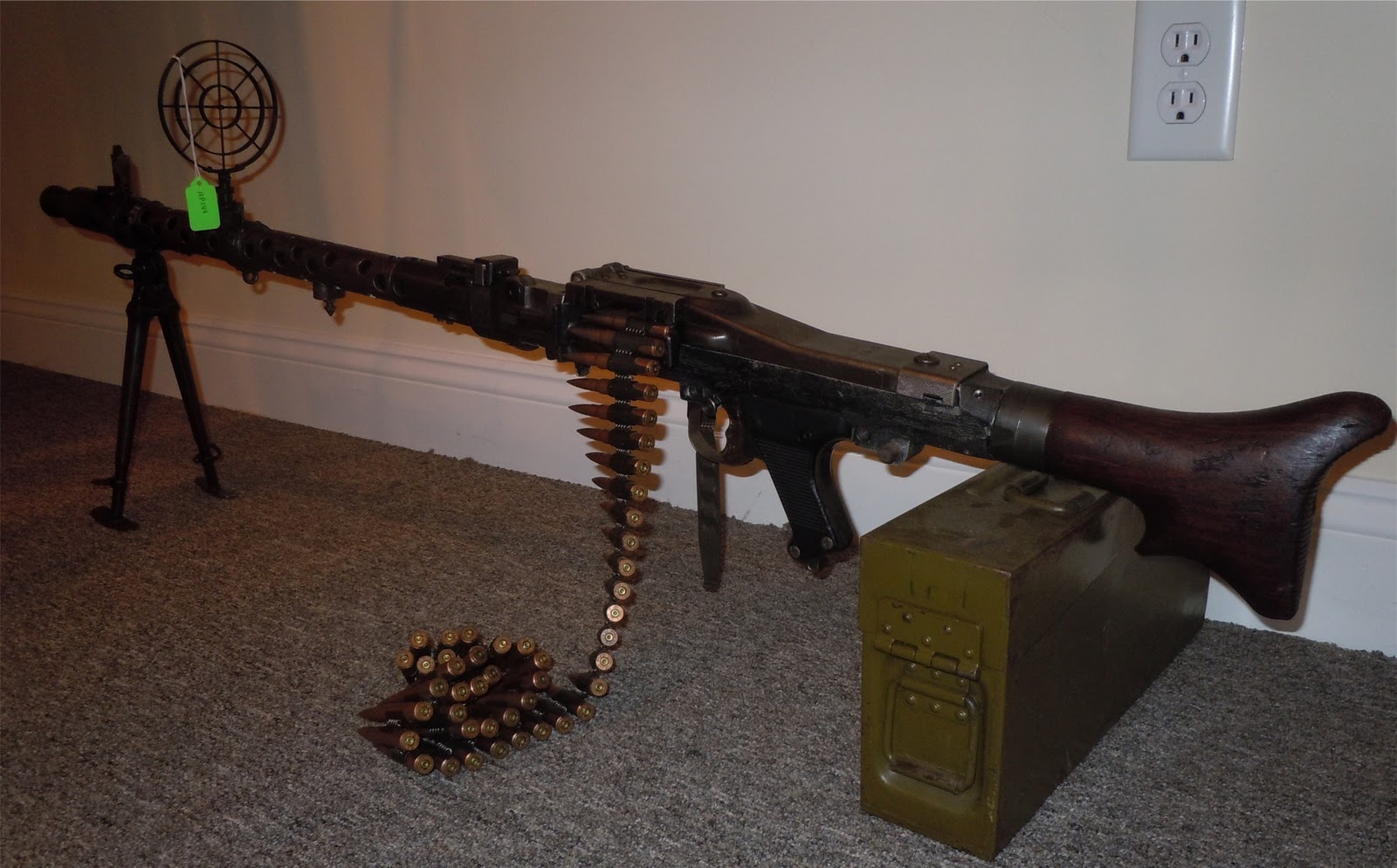 |
| The German MG-34 |
 |
| The Luger or German P-08 |
Subscribe to:
Posts (Atom)