By Francis Scott Key 1814  |
Oh, say can you see by the dawn's early light What so proudly we hailed at the twilight's last gleaming? Whose broad stripes and bright stars thru the perilous fight, O'er the ramparts we watched were so gallantly streaming? And the rocket's red glare, the bombs bursting in air, Gave proof through the night that our flag was still there. Oh, say does that star-spangled banner yet wave O'er the land of the free and the home of the brave? On the shore, dimly seen through the mists of the deep, Where the foe's haughty host in dread silence reposes, What is that which the breeze, o'er the towering steep, As it fitfully blows, half conceals, half discloses? Now it catches the gleam of the morning's first beam, In full glory reflected now shines in the stream: 'Tis the star-spangled banner! Oh long may it wave O'er the land of the free and the home of the brave! And where is that band who so vauntingly swore That the havoc of war and the battle's confusion, A home and a country should leave us no more! Their blood has washed out their foul footsteps' pollution. No refuge could save the hireling and slave From the terror of flight, or the gloom of the grave: And the star-spangled banner in triumph doth wave O'er the land of the free and the home of the brave! Oh! thus be it ever, when freemen shall stand Between their loved home and the war's desolation! Blest with victory and peace, may the heav'n rescued land Praise the Power that hath made and preserved us a nation. Then conquer we must, when our cause it is just, And this be our motto: "In God is our trust." And the star-spangled banner in triumph shall wave O'er the land of the free and the home of the brave! |
Thursday, June 09, 2011
The Star Spangled Banner Lyrics
Somebody mentioned that people don't sing along with the National Anthem. Now I know that some singers over stylize their performance. They see it as a performance, not as reverential thing as I do. But, that does not mean that I, or you, can not sing the National Anthem. It does help to know the lyrics, so here they are.

Tuesday, June 07, 2011
Notes from the gun shop...
Another slow day in the gun shop yesterday. We really didn't have many customers until about 2:00 PM and then it went pretty fast with 5 background checks by the end of the day. No new cool guns, no neat accessories, some interesting conversations.
This brings us to the subject of false veterans. Yesterday was a peach. The fellow came in and was wearing a medical mask. Allowed as to how it was a medical necessity to protect him from our (i.e. other people's) contagious diseases. Quite a bit overweight this fellow had no problem talking but to his story. To sum it up he had a disqualifying medical condition such that he couldn't enlist in the service (Vietnam era). So, in looking for work he applied to several companies and also to the CIA (THE company). Calling to check on his application he was given a referral to the State Department and then, after several courses at Fort Benning, he found himself sniping at truck drivers on the Ho Chi Minh Trail. Said he killed several "Russian" truck drivers.
Pretty disappointing when somebody feels so badly about themselves that they will do/say such things.
This brings us to the subject of false veterans. Yesterday was a peach. The fellow came in and was wearing a medical mask. Allowed as to how it was a medical necessity to protect him from our (i.e. other people's) contagious diseases. Quite a bit overweight this fellow had no problem talking but to his story. To sum it up he had a disqualifying medical condition such that he couldn't enlist in the service (Vietnam era). So, in looking for work he applied to several companies and also to the CIA (THE company). Calling to check on his application he was given a referral to the State Department and then, after several courses at Fort Benning, he found himself sniping at truck drivers on the Ho Chi Minh Trail. Said he killed several "Russian" truck drivers.
Pretty disappointing when somebody feels so badly about themselves that they will do/say such things.
Sunday, June 05, 2011
James Arness Interview
I first posted this on October 6, 2009. May God comfort his family in their loss.
James Arness who Played Matt Dillon on the TV show "Gunsmoke" for many, many years is of interest to many shooters who grew up watching the show and whose interests were thus influenced. There is about 2½ hours of video. Hope you enjoy.
James Arness who Played Matt Dillon on the TV show "Gunsmoke" for many, many years is of interest to many shooters who grew up watching the show and whose interests were thus influenced. There is about 2½ hours of video. Hope you enjoy.
Saturday, June 04, 2011
A Rifleman Went to War by Captain Herbert Wesley McBride
 I recently re-read "The Emma Gees" on my Kindle and was reminded thereby of this book, "A Rifleman Went to War" by Captain Herbert Wesley McBride in 1935, just prior to his death.
 The first part of the book is almost a verbatim repetition of "The Emma Gees" but it soon takes a different path and the tone changes from the earlier book. CPT McBride manages to weave his experiences, the stories of his fellow soldiers and the war into one neatly written account of this bitterly fought war. He says that he doesn't want the book to be nor is it a history of the war but indeed it is, a very personal history.
McBride touches on his background and how his previous training as an artillery and Gatling battery officer helped him in his service with the Canadians in France during the 1915-1917 period.
His is the only first person account of use of the Warner-Swasey sight that I've read. I only wish he had written in greater detail about it. What he does say can be summed up by saying that the sight took a bit to get zeroed, had to be checked and wasn't the best but was the best for the time. To put it another way, he took the available technology and made it work.
He also talks about the practical use of the various pistols in the trenches. I had previously read that the French were using .32 ACP Browning and Ruby pistols in their trench raids and wondered how that really worked for them. By McBride's account, one wouldn't think they did so well. He strongly felt that the .45 ACP Model 1911 (which was the issue pistol for the Canadians) was the best of the lot. However, he wasn't averse to anything of .40-something caliber. He wasn't fond of the smaller caliber guns but part of that was due to the actions in which they were chambered. He also recounts how the pistols were best carried in the trench raids and security patrols between the lines.
He discusses the various artillery pieces at length. My feeling is that he felt very qualified to comment on the various pieces, their application and effectiveness. He also discussed at some length how the soldier should react to shelling and how the use of the various pieces gave indication of what the enemy intended to do. Very interesting stuff.
McBride doesn't limit himself to comments on firearms and explosives. He also talks about the edged weapons used and mentions that the Lebel ("the French bayonet") bayonet used as a sword (rather than on the rifle) was one of the best of the lot.
 |
| 21" French Lebel bayonet was McBride's trench raid favorite edged weapon |
CPT McBride even manages to discuss the espirit of the various armies involved. This is about the worst part of the book and seemed a bit disjointed to me. I think he was trying to be profound but got a bit verbose. Although he doesn't really reach beyond his personal experience some of his opinions were very similar to those I heard in the 1970s!
I really enjoyed the book and thought it was full of useful information. I was fortunate to find a Kindle version of the edition that included a prologue by that eminent expert on combat pistolcraft, COL Jeff Cooper. In that prologue he obliquely comments on the importance of CPT McBride's book on his own life and career while denying that it was the sole source of his opinions on the subject.
I think it is safe to say that every soldier (and Marine) should read this book. The practical content applies even in these days of the GPS guided munitions and the personal expressions about the war will be forever timeless.
Friday, June 03, 2011
Bicycles
 |
| Larry vs Harry Bullitt Classic |
 |
| European Sperm Bank's "Sperm Bullitt" |
Thursday, June 02, 2011
Lipsey's does it again...

We are proud to announce the newest member of the Lipsey's Exclusive family of guns, the Ruger Blackhawk Flattop 45 Colt / 45 ACP Convertible.
This is the first Ruger Blackhawk Flattop chambered in the classic 45 Colt cartridge. As a bonus, we are including an additional 45 ACP cylinder. These highly anticipated revolvers will feature a blue finish, simulated ivory "gunfighter" style grips and adjustable sights. They will be built on the mid-size 357 Magnum frame and offered with a 5-1/2" barrel. A stainless steel version of the same revolver will follow shortly.
View them on the Lipseys.com Dealer website:
Blue - http://www.lipseys.com/itemdetail.aspx?itemno=RUKNVB-455X&items=exclusives
Stainless - Announcement to come
Read the full article explaining the thought process behind our newest Ruger Revolver
http://www.lipseysguns.com/post/Ruger-Blackhawk-Flattop-45-Colt-45-ACP-Convertible.aspx
Read the Gunblast.com article at http://www.gunblast.com/Ruger-Lipseys45Flattop.htm
Wednesday, June 01, 2011
Notes from the gun shop...
Due to the Memorial Day Holiday I worked today instead of Monday. It was a very slow day. Only did a couple of background checks. Not much other business either. No great guns came in. Had some good conversations though! Worked on THE S&W 586 some more.
That is interesting, the hammer hangs up on the rebound slide and won't fully reset. Lewis hasn't figured out what is up yet. How did it come to be this way? Let's just say, "if it works, don't fix it." A previous owner took it apart "just 'cause" and when he put it back together it didn't work. I think he has an incorrect part in it that won't work with the given geometry of the L-frame. Then again, I don't know. Anyhow the current owner bought the gun for $50 and wants to avoid the cost of sending it back to S&W to get it repaired. If it was mine it would be gone and back by now...
That is interesting, the hammer hangs up on the rebound slide and won't fully reset. Lewis hasn't figured out what is up yet. How did it come to be this way? Let's just say, "if it works, don't fix it." A previous owner took it apart "just 'cause" and when he put it back together it didn't work. I think he has an incorrect part in it that won't work with the given geometry of the L-frame. Then again, I don't know. Anyhow the current owner bought the gun for $50 and wants to avoid the cost of sending it back to S&W to get it repaired. If it was mine it would be gone and back by now...
Tuesday, May 31, 2011
Thompson Center Arms Contender and G2 Answers
I've had to deal with a number of questions about the Thompson Center Contender and G2 regarding interchangeability of parts including barrels, stocks and such. I'm going to give it a go to have the whole deal in one place to which I can refer without having to write it all out again.
The pistol/rifle barrel interchangeability thing was addressed in a case before the Supreme Court of the United States and one can switch the original Contender back and forth, most frames have been changed so often through dealers that one can't know how they were first sold. However, there may be questions about the G2 and Encore frames because they were sold after the decision and it is possible that somebody would think they weren't covered by the decision... Yes, I know it is confusing but the only way anyone would ever know is if they get you for something else and then do an investigation to make their case stick. In practical terms it is a non-starter so long as you don't assemble a sub 16" barrel on a rifle stocked frame.
As to barrels. ALL Contender barrels will work on all frames with only a couple of caveats. First is that many years ago TC switched to the split locking bolt in conjunction with the "easy opening" frame and newer frames are SOMETIMES problematic with the old solid locking bolt.
Second is that isn't including G2 barrels which have a little stud off the bottom of the lug for some calibers (.375 JDJ and .45 ML come to mind). That stud has clearance in a little cut in the G2 frame that doesn't exist in the Contender frame. Folks are just cutting the stud off the bottom of the lug. TC did this to avoid liability issues with cleaning on the ML barrels and with frame stretching on the .375 JDJ barrels. This is because it is very easy to load the .375 JDJ to the point that pressures exceed limits of the Contender frame.
Third is that the Armor Alloy (a plating system used by TCA) barrels might not interchange. The critical dimension is the link pin hole. Carefully polish it out and voila! Many have already been so altered which is why I say "maybe". All it takes is some crocus cloth wrapped around a dowel (some folks use a pencil) and spun in the link pin hole. Not so sure about the Armor Alloy FRAMES as I can't remember anyone trying a blued barrel on the frame but I think (might, might not work) using a blue link pin on the Armor Alloy frame with the blue barrel will work. Just can't remember anyone doing that. The AA barrels are MUCH more common than the frames but not that common. TC quickly changed to stainless. I imagine that if the pin hole is too small for the blue pin it could be opened up. The problem stemmed from using mostly standard dimensions but adding the plating after final dimensions had been achieved.
The Encore is NOT the Contender/G2. It is a larger frame and will handle higher pressure cartridges. However it won't handle the short magnums because the breach thrust will stretch the frame. This is due to the larger case head on those cartridges. All Encore barrels will work on all Encores.
All CONTENDER and G2 frames have switchable hammer faces to fire rimfire, not so for the Encores. Various schemes have been concocted to put the rimfire barrels on Encores but it seems that not many have pursued that as I've yet to see a rimfire Encore barrel.
The stocks can be confusing in that it seems that forearms (which have had many different variations for the Contender) are useable on the G2 as well. However, the changes to the frame have required a different buttstock for the G2 and these do not interchange between the two actions.
One more point, the original Contender is not referred to as the "G1".
The pistol/rifle barrel interchangeability thing was addressed in a case before the Supreme Court of the United States and one can switch the original Contender back and forth, most frames have been changed so often through dealers that one can't know how they were first sold. However, there may be questions about the G2 and Encore frames because they were sold after the decision and it is possible that somebody would think they weren't covered by the decision... Yes, I know it is confusing but the only way anyone would ever know is if they get you for something else and then do an investigation to make their case stick. In practical terms it is a non-starter so long as you don't assemble a sub 16" barrel on a rifle stocked frame.
As to barrels. ALL Contender barrels will work on all frames with only a couple of caveats. First is that many years ago TC switched to the split locking bolt in conjunction with the "easy opening" frame and newer frames are SOMETIMES problematic with the old solid locking bolt.
Second is that isn't including G2 barrels which have a little stud off the bottom of the lug for some calibers (.375 JDJ and .45 ML come to mind). That stud has clearance in a little cut in the G2 frame that doesn't exist in the Contender frame. Folks are just cutting the stud off the bottom of the lug. TC did this to avoid liability issues with cleaning on the ML barrels and with frame stretching on the .375 JDJ barrels. This is because it is very easy to load the .375 JDJ to the point that pressures exceed limits of the Contender frame.
Third is that the Armor Alloy (a plating system used by TCA) barrels might not interchange. The critical dimension is the link pin hole. Carefully polish it out and voila! Many have already been so altered which is why I say "maybe". All it takes is some crocus cloth wrapped around a dowel (some folks use a pencil) and spun in the link pin hole. Not so sure about the Armor Alloy FRAMES as I can't remember anyone trying a blued barrel on the frame but I think (might, might not work) using a blue link pin on the Armor Alloy frame with the blue barrel will work. Just can't remember anyone doing that. The AA barrels are MUCH more common than the frames but not that common. TC quickly changed to stainless. I imagine that if the pin hole is too small for the blue pin it could be opened up. The problem stemmed from using mostly standard dimensions but adding the plating after final dimensions had been achieved.
The Encore is NOT the Contender/G2. It is a larger frame and will handle higher pressure cartridges. However it won't handle the short magnums because the breach thrust will stretch the frame. This is due to the larger case head on those cartridges. All Encore barrels will work on all Encores.
All CONTENDER and G2 frames have switchable hammer faces to fire rimfire, not so for the Encores. Various schemes have been concocted to put the rimfire barrels on Encores but it seems that not many have pursued that as I've yet to see a rimfire Encore barrel.
The stocks can be confusing in that it seems that forearms (which have had many different variations for the Contender) are useable on the G2 as well. However, the changes to the frame have required a different buttstock for the G2 and these do not interchange between the two actions.
One more point, the original Contender is not referred to as the "G1".
Monday, May 30, 2011
Sunday, May 29, 2011
Memorial Day 2011

There are many who have served. Many bear scars or rest forever in foreign soil as a result of their service. Many families are forever changed by the loss of these men and women. It is for these cherished national heroes that we take time this day to mark their graves and remember their names.
In Flanders FieldsThose who have been lost in the Global War on Terror.
By: Lieutenant Colonel John McCrae, MD (1872-1918) Canadian Army
In Flanders Fields the poppies blow
Between the crosses row on row,
That mark our place; and in the sky
The larks, still bravely singing, fly
Scarce heard amid the guns below.
We are the Dead. Short days ago
We lived, felt dawn, saw sunset glow,
Loved and were loved, and now we lie
In Flanders fields.
Take up our quarrel with the foe:
To you from failing hands we throw
The torch; be yours to hold it high.
If ye break faith with us who die
We shall not sleep, though poppies grow
In Flanders fields.
In remembrance of those of my own family who have served...
| PVT | John Balch | American Revolution | |
| Johan Joost Becker | American Revolution | ||
| CPT | Jonathan Bixby | Connecticut Continentals | American Revolution |
| Smith & Farrier | Francis Boole | 17th Light Dragoons (GB) | American Revolution |
| PVT | Lawrence Broderick | Cold War | |
| CPT | Orrin Lawrence Brodie | WWI, WWII | |
| Archibald Campbell | American Revolution | ||
| Seaman 1st | John Elton Davis | USS Princeton | WWII |
| SPC | Justin Lee Davis | 10th Mtn | GWOT |
| PVT | Erasmus Dortch* | 21st Alabama Infantry Regiment | Civil War |
| T4 | John Clarence Dortch | ADA | WWII |
| CPL | Daniel Ford | 6th Connecticut Regiment | American Revolution |
| Horatio Grant | US Army | 1823 | |
| PVT | Charles Henry Flint | H/194th New York Infantry | Civil War |
| Jacob Heens | American Revolution | ||
| LT | Nathaniel Herrick | Frye's Regiment | American Revolution |
| MAJ | Ephraim Hildreth | Chelmsford County Militia | |
| PFC | Gano H. Jewell* | 2d Bn 116th Inf Regt | WWII |
| PVT | Hiram H. Kimball | 10th Hvy Arty & E/69th NYSV | Civil War |
| 1LT | Barney Alonzo Parslow | D/134th New York Infantry | Civil War |
| SGT | Donald Fancher Parslow | 16th IN 1st ID | WWII, Korea |
| PVT/Drummer | Henry Parslow | 1st and 3rd Regts, COLs Snyder,Pawling | American Revolution |
| PVT | Henry Parslow* | 1812 | |
| QM SGT | Henry Parslow | 2nd NY Hvy Artillery | Civil War |
| GEN | Freegift Patchin | Connecticut & New York Militias | American Revolution |
| Private | Chapman R Philen* | 38th Alabama Infantry | Civil War |
| Artificer | Peter V. Race | 15th & 50th New York Engineers | Civil War |
| CPT | George Richtmeyer | 3rd Co. 15th Regt. Albany Cty Militia | American Revolution |
| PVT | Jacob Schaeffer | 15th Regt Albany Cty Militia | American Revolution |
| Matross | Koert Van Schaick | CPT Barnes Artillery | American Revolution |
| Adam Swart | American Revolution | ||
| LT | Adam Thayer | Massachusetts Militia | American Revolution |
| PVT | Pelitiah Thayer | Massachusetts Militia | American Revolution |
| 2LT | Leonard Boole Van Cott* | 119th NY Infantry Regt. | Civil War |
| 1LT | Theodore Sedgewick Van Cott | 71st NYVI | Civil War |
| 1LT | William Hathaway Van Cott | 102nd Regt US Volunteers | Civil War |
| Jacob Van Dyke | American Revolution | ||
| PVT | Johan Joost Warner | American Revolution |
* - died in service

Saturday, May 28, 2011
The Emma Gees - Captain Herman W. McBride

I thought there was much to learn beyond the recounting of his activities and actions. There is a certain attitude of expressed indifference that seemed to prevail at that time. Expressed not actual indifference. I think that he was anything BUT indifferent is shown in his efforts to avenge the deaths of his fellow soldiers or, later, to mark the death place of his friend, LCPL William Emmanuel Bouchard. One thing for certain, while McBride recounts his experiences, it is not done in a way to promote himself as in the way that a certain public figure has done with regards to the death of a terrorist leader. In truth, most comments about his own actions seem intended only to show how he was there and how he knows what happened. Neither does McBride attempt to account for activities outside his immediate location except for what he heard about those actions at that time. I found that refreshing.
The book has a number of quality photos of action at the front and maps of the trenches. Unfortunately, I am read this on my Kindle and if Kindle has a weakness it is that one can't see page size maps easily. However, the book is so good that I think one should have a hardbound copy.
Captain McBride was one of those men whose life excited the young men in the past. It was fully adventurous and exciting (before we fully understood what "adventurous" and "exciting" really meant!). An obituary for Herbert McBride from the May 1933 American Rifleman as follows:
Capt. Herbert W. McBride, Indiana National Guard, has passed away at the age of 59 years, and in his passing the shooting game has lost one of its staunchest veteran supporters. His death, which came suddenly at his home in Indianapolis, was attributed to heart trouble. Not long before, he had suffered a fractured shoulder in an automobile accident while on duty in the troublous mining area of his state. From boyhood Captain McBride, a son of the late Judge Robert W. McBride of the Indiana Supreme Court, was devoted to the outdoors and to small arms. He had a varied and colorful career. Gold mining in Alaska, logging, railroad construction work in the Yukon and northern British Columbia, exploring, hunting and fishing widely, wars - all these formed interesting chapters of activity in his life. Biology, geology, ethnology, anthropology, botany and entomology, in addition to his long devotion to shooting, all claimed his attention. As a writer, too, Captain McBride was not unknown, in which connection it might be mentioned that a story written by him "Dog Eat Dog," a narrative of one of his sniping experiences in the World War, will appear in an early issue of The American Rifleman. Captain McBride had handled about every type of small arms extant during his lifetime. His fondness for guns was acquired in his tender years, and he had shot his first deer and wild turkey before he was 10 years old. As a member of the Indiana National Guard Team he shot at the National Matches from 1905 to 1911 inclusive, and he won the Indiana State Championship in 1905, 1906 and 1907. Also, he attended six National Matches after 1919. He was the organizer of the Indiana State Rifle Association and many rifle clubs, and served as N.R.A. State Secretary for Indiana for a number of years. Captain McBride always maintained a close association with some military organization from March, 1888, up until the time of his death. He was associated with the Military Smokeless Powder Division of the Du Pont Company from 1907 to 1912, going back to British Columbia in 1912, where he ranged all along the Upper Frazer in connection with the building of the Grand Trunk Pacific Railroad. In 1914 he was in command of a company of the Indiana National Guard, but resigned and went to Canada where he served as captain and military instructor in the 38th and 21st Battalions until the latter was sent overseas in May, 1915. He then resigned his commission and accompanied the battalion as a private machine gunner. He served overseas until early in 1917, when he was invalided home. Reaching this country late in April, he was assigned to duty as an instructor. He served throughout the remainder of the war in that capacity. when the Small Arms Firing School was organized at Camp Perry in May, 1918, he was one of the first instructors. Captain McBride, before wounds cut short his was service, was decorated with the British Military Medal for capturing 12 machine guns at the Battle of St. Eloi in Flanders in 1916, the Medaille Militaire for invading the German lines and capturing a German flag, and the Croix de Guerre. He was wounded seven times. In addition to his service in the World War, Captain McBride also saw service in the South African Boer War. Following the war, Captain McBride spent most of his time in Washington and Oregon, returning to Indianapolis about 18 months ago.

Friday, May 27, 2011
Hopkins and Allen .22 Rimfire Vest Pocket Derringer
 |
| This vest pocket sold for $2500 |
Less than 1400 of the .22 r.f. short caliber vest pocket derringers, 1 3/4" tip-down barrel, birdhead grips, spur trigger were produced between 1911 and 1915 and it was also known as the "Parrot Beak" derringer. Value of these runs from about $950-4000 depending on condition. Obviously a .22 Short (and this would NOT be the High Velocity round) is not a man-stopper but at the time any wound was potentially deadly. This gun filled the same role as today's North American Arms .22 mini-revolvers.
I have never owned one of these little guns. In fact, I hadn't seen one until this morning at the gun shop. It is cute but one wonders just how one is supposed to hold the gun AND see the front sight much less aim. That front sight might be prominent but it is useless and there is no rear reference. While it is a small and uncomplicated firearm the impression one has in handling it is that it is precisely fit and has an attractive finish.
Below is the one from the shop. It has had a brazed repair to the frame (I'd like to hear about why that was necessary.) and the mother-of-pearl stocks seem to have shrunk a bit...


Thursday, May 26, 2011
Alzheimer's
We've been through all these symptoms with Mom (who died Jan 23, 2010). We should have known but didn't. The problem is that, while there are a number of support agencies, groups, and people there is no dissemination of this information. Also, it differs from area to area. For far too long we ascribed certain behaviors to "age" or "eccentricities" and were too comfortable with them, given our experiences with other family members over the years (none of whom we know to have had Alzheimer's). Mom exhibited each of these symptoms and she knew something was wrong. Still, it required my intervention to have her evaluated and prescribed medication to deal with it. Even though her doctor saw her regularly, he did nothing about this. Even though the nurses told me they had "been worried about Eleanor for a while," nothing had been done. As it stands now researchers apparently believe that there are both genetic and environmental reasons for the build-up of plaque on the neural receptors which is the cause of Alzheimer's. There are some drugs which do seem to mitigate the progress of the disease but no cure. Those of us who have lived with and/or cared for those who have the disease understand just how terrible it is. Fortunately, the disease doesn't directly cause discomfort or pain for the victim. With the proper care it is possible for someone so afflicted to live out their life in complete physical comfort. However, it is important for family and friends to properly recognize the signs of the disease. Here are 8 symptoms you should look for.
Alzheimer's symptom #1: Memory lapses
1. Does the person ask repetitive questions or retell stories within minutes of the first mention?
2. Does she forget the names of recent acquaintances or younger family members, such as grandchildren?
3. Are memory lapses growing progressively worse (such as affecting information that was previously very well known)?
4. Are they happening more frequently (several times a day or within short periods of time)?
5. Is this forgetfulness unusual for the person (such as sudden memory lapses in someone who prided herself on never needing grocery lists or an address book)?
Alzheimer's symptom #2: Confusion over words
1. Does the person have difficulty finding the "right" word when she's speaking?
2. Does she forget or substitute words for everyday things (such as "the cooking thingamajig" for pot or "hair fixer" for comb)?
3. Of course it's normal for anyone to occasionally "blank" on a word, especially words not often used. But it's considered a red flag for Alzheimer's if this happens with growing frequency and if the needed words are simple or commonplace ones.
Alzheimer's symptom #3: Marked changes in mood or personality
1. Is the person who's usually assertive more subdued (or vice versa)? 2 Has the person who's reserved become less inhibited (or vice versa)?
2. Does she withdraw, even from family and friends, perhaps in response to problems with memory or communication?
3. Has she developed mood swings, anxiety, or frustration, especially in connection with embarrassing memory lapses or noticeable communication problems?
4. Has she developed uncharacteristic fears of new or unknown environments or situations, or developed a distrust of others, whether strangers or familiar people?
5. Do you see signs of depression (including changes in sleep, appetite, mood)?
Alzheimer's symptom #4: Trouble with abstract thinking
1. How well does the person handle relatively simple mathematical tasks, such as balancing a checkbook?
2. Is she having trouble paying bills or keeping finances in order, tasks she previously had no problem completing?
3. Does she have trouble following along with a discussion, understanding an explanation, or following instructions?
Alzheimer's symptom #5: Difficulty completing familiar activities
1. Has the person begun to have trouble preparing meals?
2. Is she less engaged in a hobby that once absorbed her (bridge, painting, crossword puzzles)?
3. Does she stop in the middle of a project, such as baking or making a repair, and fail to complete it?
4. Has she stopped using a particular talent or skill that once gave her pleasure (sewing, singing, playing the piano)?
5. Activities with various different steps, however routine and familiar, can become difficult to complete for a person with Alzheimer's. Your parent might become distracted or lose track of where she is in the process, feeling confused. Or she might just lose interest altogether and leave a project unfinished.
Alzheimer's symptom #6: Disorientation
1. Has the person begun to be disoriented in new or unfamiliar environments (such as a hospital or airport), 2. asking where she is, how she got there, or how to get back to a place she recognizes?
2. Has she become disoriented in an environment she knows well?
3. Does she wander off and get lost in public (or get lost when driving or after parking)?
4. Does she lose track of the time, day, month, or year? For example, after being reminded about a future doctor's appointment over the phone, she may start getting ready for the appointment right away. Or she may have trouble keeping appointments and remembering other events or commitments.
Alzheimer's symptom #7: Misplacing items
1. Does the person "lose" items often?
2. Do they turn up in unusual places (such as finding a wallet in the freezer)?
Alzheimer's symptom #8: Poor or impaired judgment
1. Has the person recently made questionable decisions about money management?
2. Has she made odd choices regarding self-care (such as dressing inappropriately for the weather or neglecting to bathe)?
3. Is it hard for her to plan ahead (such as figuring out what groceries are needed or where to spend a holiday)?
As you can see, these are not symptoms conducive to safe shooting. With the apparent tremendous increase in the incidence of Alzheimer's and the preponderance of older shooters in some disciplines it might be a good thing for us to cast a more critical eye on some of our more "eccentric" fellow shooters.
Alzheimer's symptom #1: Memory lapses
1. Does the person ask repetitive questions or retell stories within minutes of the first mention?
2. Does she forget the names of recent acquaintances or younger family members, such as grandchildren?
3. Are memory lapses growing progressively worse (such as affecting information that was previously very well known)?
4. Are they happening more frequently (several times a day or within short periods of time)?
5. Is this forgetfulness unusual for the person (such as sudden memory lapses in someone who prided herself on never needing grocery lists or an address book)?
Alzheimer's symptom #2: Confusion over words
1. Does the person have difficulty finding the "right" word when she's speaking?
2. Does she forget or substitute words for everyday things (such as "the cooking thingamajig" for pot or "hair fixer" for comb)?
3. Of course it's normal for anyone to occasionally "blank" on a word, especially words not often used. But it's considered a red flag for Alzheimer's if this happens with growing frequency and if the needed words are simple or commonplace ones.
Alzheimer's symptom #3: Marked changes in mood or personality
1. Is the person who's usually assertive more subdued (or vice versa)? 2 Has the person who's reserved become less inhibited (or vice versa)?
2. Does she withdraw, even from family and friends, perhaps in response to problems with memory or communication?
3. Has she developed mood swings, anxiety, or frustration, especially in connection with embarrassing memory lapses or noticeable communication problems?
4. Has she developed uncharacteristic fears of new or unknown environments or situations, or developed a distrust of others, whether strangers or familiar people?
5. Do you see signs of depression (including changes in sleep, appetite, mood)?
Alzheimer's symptom #4: Trouble with abstract thinking
1. How well does the person handle relatively simple mathematical tasks, such as balancing a checkbook?
2. Is she having trouble paying bills or keeping finances in order, tasks she previously had no problem completing?
3. Does she have trouble following along with a discussion, understanding an explanation, or following instructions?
Alzheimer's symptom #5: Difficulty completing familiar activities
1. Has the person begun to have trouble preparing meals?
2. Is she less engaged in a hobby that once absorbed her (bridge, painting, crossword puzzles)?
3. Does she stop in the middle of a project, such as baking or making a repair, and fail to complete it?
4. Has she stopped using a particular talent or skill that once gave her pleasure (sewing, singing, playing the piano)?
5. Activities with various different steps, however routine and familiar, can become difficult to complete for a person with Alzheimer's. Your parent might become distracted or lose track of where she is in the process, feeling confused. Or she might just lose interest altogether and leave a project unfinished.
Alzheimer's symptom #6: Disorientation
1. Has the person begun to be disoriented in new or unfamiliar environments (such as a hospital or airport), 2. asking where she is, how she got there, or how to get back to a place she recognizes?
2. Has she become disoriented in an environment she knows well?
3. Does she wander off and get lost in public (or get lost when driving or after parking)?
4. Does she lose track of the time, day, month, or year? For example, after being reminded about a future doctor's appointment over the phone, she may start getting ready for the appointment right away. Or she may have trouble keeping appointments and remembering other events or commitments.
Alzheimer's symptom #7: Misplacing items
1. Does the person "lose" items often?
2. Do they turn up in unusual places (such as finding a wallet in the freezer)?
Alzheimer's symptom #8: Poor or impaired judgment
1. Has the person recently made questionable decisions about money management?
2. Has she made odd choices regarding self-care (such as dressing inappropriately for the weather or neglecting to bathe)?
3. Is it hard for her to plan ahead (such as figuring out what groceries are needed or where to spend a holiday)?
As you can see, these are not symptoms conducive to safe shooting. With the apparent tremendous increase in the incidence of Alzheimer's and the preponderance of older shooters in some disciplines it might be a good thing for us to cast a more critical eye on some of our more "eccentric" fellow shooters.
Monday, May 23, 2011
Notes from the gun shop...
Today's work at the shop appeared to be off to a slow start. The contractors have moved down West Beverly to directly in front of the store as they work to repair the sewer line. It was hard to get into the lot from either direction and not much easier to drive around and come in on Waverly Street. Also, the heavy equipment seemed to be in the parking lot much of the day. However, we ended the day with 8 background checks completed and a good bit of business done, albeit in four hectic spurts throughout the morning and afternoon.
There weren't really any interesting firearms new to the shop since last Monday. We did have some interesting conversations though.
 One fellow is looking for the correct receiver/aperture sight for the Stevens 414 Armory rifle. He apparently has a tang peep sight but wants the correct sight. Lyman made a couple of sights that are correct for the gun but I believe that the one illustrated is the correct "as issued" sight. This is an extremely simple sight completely in keeping with the price point of the rifle. I'm not surprised that many were later replaced with more sophisticated sights of one kind or another. Such a sight would be completely serviceable, but other sights would give many shooters much more confidence. I'm looking, but if you know of or have one for sale, let me know and I'll get him to contact you.
 Likewise interested in hard to find sights is another fellow looking for the anti-aircraft insert for the Lyman 48C sight used on the .22LR military training rifles. I noticed that Brophy's book mentions but doesn't show the aperture. I looked in TM 9-280 and you can see it there on page 106 as shown here. I'm going out on a limb and saying that I think these are going to be hard to find. I doubt that anyone took the time or went to the effort to switch to this aperture unless given strict orders to do so. Changing would have been a real pain for any half-day training exercise!
The only other interesting thing is that the boss man auctioned his PMR-30 on Gunbroker. It sold for $580+! I was astonished but a quick review of completed auctions shows that some of these guns have sold, new, for as much as $685! That's roughly 2-times the MSRP.
PS - for the sights it was suggested that we recommend Gary Fellers.
There weren't really any interesting firearms new to the shop since last Monday. We did have some interesting conversations though.


The only other interesting thing is that the boss man auctioned his PMR-30 on Gunbroker. It sold for $580+! I was astonished but a quick review of completed auctions shows that some of these guns have sold, new, for as much as $685! That's roughly 2-times the MSRP.
PS - for the sights it was suggested that we recommend Gary Fellers.
Friday, May 20, 2011
Time to mind the watches...
I've inherited 3 watches but never done a thing about or with them to this point as I thought it might be too much money or time or effort and not worth it. I don't know much about watches, I'm no horologist, but I do know a bit about nostalgia and sentimentality so now is the time to wind this up. I'll keep adding info as I learn...
Watch #1 - I have no idea to whom this belonged but it did come from my maternal side of the family. Apparently this open face cased watch is a Waltham with a 15-jewel movement, made by American Waltham Watch Co. (AWWCo). The serial number is 23812186 and this tells us the watch movement was made in 1920. The works diameter is 1-7/16" or size 12.
Watch #2 - The 14K gold hunting case is marked "Gruen" but the works are, again, "Waltham". I finally managed to open it up to look at the works. It is marked as above, "AWWCo" and "Riverside". The serial is 7274502 indicating it was made 1895. The works diameter is 1-7/16" or size 12. It is shown with the watch chain and knife/fob as it came to me. I believe this is the one that belonged to "Uncle" Dave Fancher (on the paternal side of the family). I was told that he bought the watch 2nd hand from somebody else and that he needed it for his work on the railroad (he was a railroad detective at one time).
Watch #3 - This one, if I remember correctly, came from the maternal side of the family. Note the neat box. It is key wound and has a neat key. The works diameter is 1-1/2".The maker is apparently A. R. Schmid. Neuchatel is in Switzerland but whether this mark applies to the case or works or both I don't know. The case mark is "AE" and the case is 18K gold.
Links:
- National Pocket Watch Database
- Lee Feldman (WatchRepair.com)
- Swiss Straight Line Lever Escapment
 |
| Watch #1 Face |
 |
| Watch #1 Works |
 |
| Watch #2 Case " Front" |
 |
| Watch #2 Case Reverse |
 |
| Watch #2 Face |
 |
| Watch #2 Inscription (presumably a former owner) |
 |
| Watch #2 Case Marks |
 |
| Watch #2 Works |
 |
| Watch #3 Face |
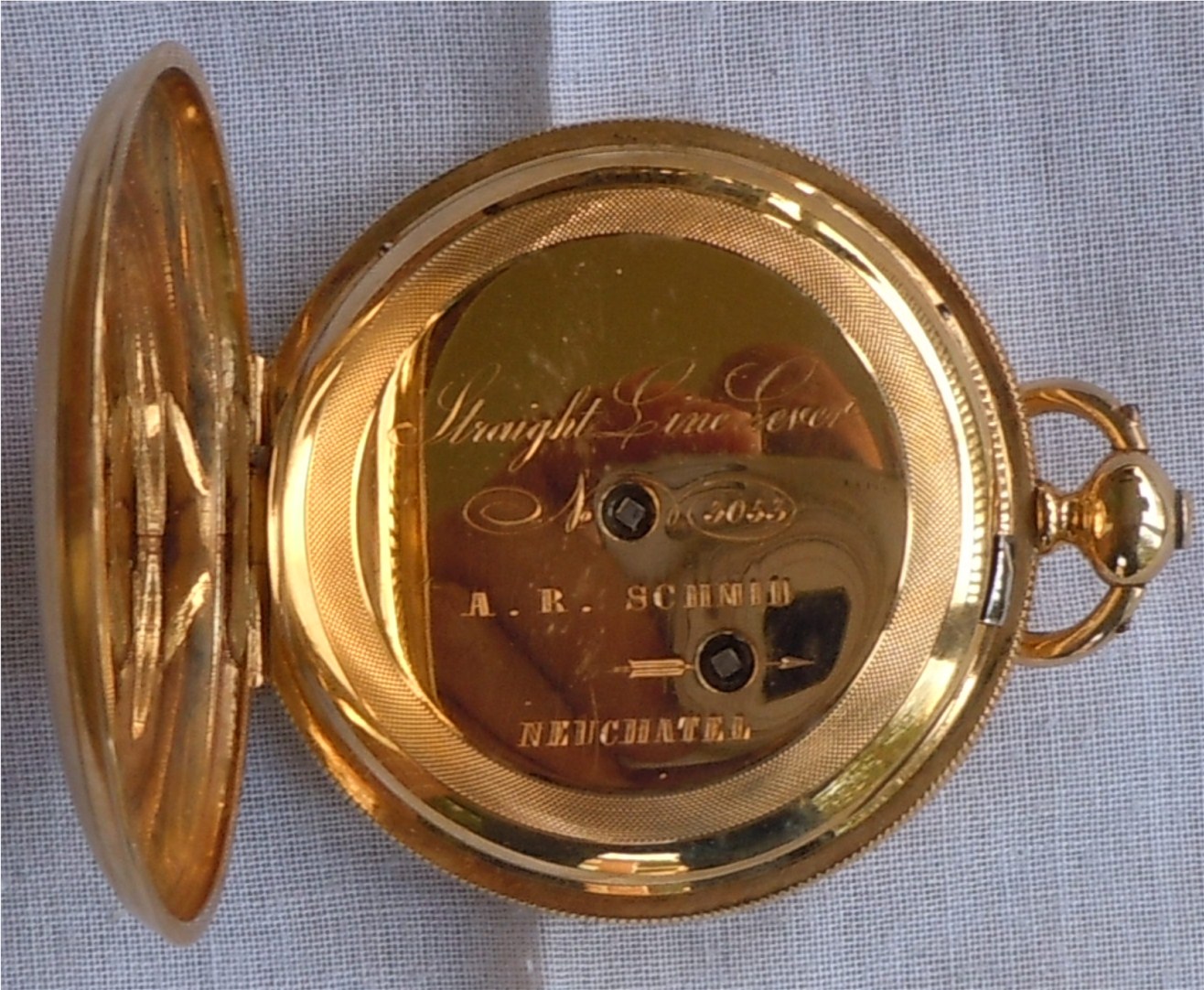 |
| Watch #3 Back |
 |
| Watch #3 in box |
 |
| Close-up of Key for Watch #3 |
 |
| Watch #3 Works |
Links:
- National Pocket Watch Database
- Lee Feldman (WatchRepair.com)
- Swiss Straight Line Lever Escapment
Subscribe to:
Posts (Atom)