I thought that I would document the military arms I personally used during my time in service. I also served as an instructor within my unit and/or a range NCOIC or Safety NCO for these firearms. Many are still in use. Just thought my grandson might be interested!
 M1911A1
: The M1911 Colt Automatic Pistol is one of the most successful designs in the history of firearms, serving as the primary U.S. military sidearm for about 80 years through two World Wars, Korea, Vietnam and countless other engagements. The commercial .45 automatic pistol was designed by John Moses Browning. It won fame in WWI and was re-designated as the "Pistol, U.S. Caliber .45 Model 1911A1" in 1926 when some minor design improvements were introduced. About 150,000 were produced before World War II. Colt, Remington-Rand, Union Switch & Signal and the Ithaca Gun Company manufactured 1,800,000 pistols during WWII. Production ended in 1945 but the substantial inventories were in service for decades afterward until replaced in 1990 by the M9 Beretta 9mm automatic pistol.
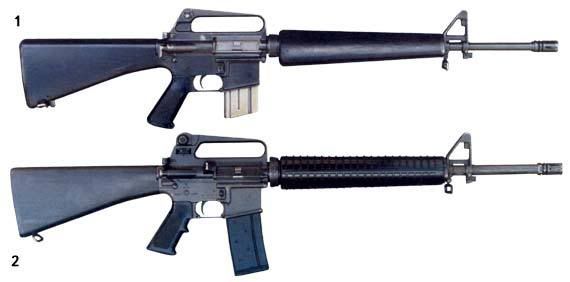 M16A1 and M16A2
: In 1962, early in the Vietnam War, Colt brought the Armalite AR-15 to the Advanced Research Projects Agency (ARPA, now DARPA). Impressed, ARPA sponsored a combat demonstration of the AR-15 in Vietnam. The AR-15 was chambered for the .223 cal. (5.56 mm) cartridge, far smaller than the then standard 7.62 NATO round or the classic .30-06 but promoted as just as lethal due to its high velocity and tumbling on impact.
According to a report on the matter by the SFTT website:
In October 1961, ARPA provided ten Colt AR-15s to Vietnamese Forces in Saigon to conduct a limited test. The Black Rifle remarks of this test, "The number of rifles might have been small, but the enthusiastic reaction of the Vietnamese and their American advisors alike who handled and fired the AR-15s was just as [Colt's marketing agent] had predicted." Armed with these positive results, ARPA succeeded in expanding the Project AGILE study by procuring 1,000 AR-15s for distribution among select Vietnamese units for field testing. Ezell and Stevens wrote that this approval resulted in " … saving Colt's from almost sure financial disaster and also setting the stage for the most influential yet controversial document so far in the history of the already controversial AR-15."
Although controversial, in 1963 the US Army began purchasing the M16 for use in Vietnam where it was issued to Sepcial Forces. The Army ordered 85,000 rifles in 1963, 35,000 more in 1964, 100,000 in 1965, and 100,000 in 1966. At first they were issued to Special Forces, Airborne, helicopter crews, Air Commando and other special category troops in Vietnam as well as forces in the Dominican Republic.
In 1965 the M-16 became the military’s basic service rifle and was in widespread use by 1966. Troops generally liked the light weight rifle and the ability to carry more ammo, but complained about insufficient range and lethality. Despite Colt's claims that it was maintenance free, there were early problems due to poor maintenance training, and to the jungle climate of Southeast Asia. It has also been claimed that a change in the 5.56 ammo propellant caused fouling until chrome plating was introduced to offset the problem.
Through 2003, the total quantity produced in all models world-wide was about 7 million.
The M-16 is selectable for full and automatic fire. The M16 was to have had the same effective range as the M-14 rifle it replaced, but it was most effective at a range of 215 yards (200m) or less. The M-16 used a 5.56mm (.223 cal.) cartridge in 20- or 30-round magazines.
The M-16A2 was introduced in 1982 with improvements over the M-16 and M-16A1. In the M-16A2 each pull of the trigger fires one shot if single shots are selected. In automatic fire, the M-16A2 automatically fires a three-shot burst for each trigger-pull, considered optimum from Army research. The M-16A2 also incorporates an adjustable dual-aperture rear sight that corrects for both windage and elevation, a heavier barrel to increase accuracy, 1-in-7 rifling, and an effective muzzle compensator to prevent muzzle climb during auto fire.
In 2003 the U.S. Army issued limited numbers of the M-16A3 and M-16A4, which incorporate a rail mounting system similar to the M-4A1 Carbine. The M4 Carbine, a shortened version of the M-16A2 is replacing the longer standard rifle with some troops.
 M60
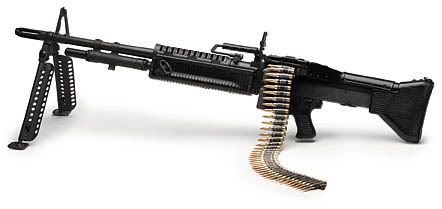
M60: The Machine Gun, 7.62mm, M60 series (Medium Machine Gun) was type classified in 1957 as a companion to the 7.62mm M14 rifle. The M60 is lighter than the .30 cal. M-1919A6 and only slightly heavier than the .30 cal. M-1918A2 Browning Automatic Rifle (BAR) it replaced. The M60 7.62mm machine gun has been the U.S. Army's general purpose medium machine gun since the late 1950s. The M60 fires standard NATO 7.62mm ammunition and is used as a general support crew-served weapon.
The M60 has a removable barrel which can be easily changed to prevent overheating. The weapon has an integral, folding bipod and can also be mounted on a folding tripod. The M60 has a rate of fire of 600 spm. The M60C and M60D are aircraft versions of the basic M60 machine gun. The M60 series is being replaced by the M240B 7.62mm medium machine gun.
 M2
M2: Developed at the very end of World War I as the M1918 aircraft machine gun, the Browning M2 'Ma Deuce' fires a .50 caliber round effectively out to ranges in excess of 2,200 meters and can be mounted in most vehicles, on aircraft, or on a tripod. Originally called United States Machine Gun M1921, after a series of early water-cooled, aircraft and tank models were tested in the 1920s, an improved version was adopted in 1933 as the Browning M2 water-cooled machine gun.
Subsequent models, using the same receiver, were adopted by the various services in both air and water-cooled versions. During World War II, nearly two million M2 machine guns of all variations were produced.
When mounted in a four-gun configuration, the M2 was known as the Quad-50, a highly effective anti-aircraft weapon in World War II. It was used extensively in Vietnam for antipersonnel purposes. Click here for the Olive-Drab page on the Quad-50.
The M2 .50 cal. Machine Gun went out of production in the 1970s, and by the early 1990s the capability to manufacture the M2 barrel had virtually disappeared from the U.S. industrial base. An Army inventory of 13,000 "unserviceable" M2s were stockpiled, although they required some level of repair or maintenance before they could be used. With combat operations in Iraq and Afthanistan, the Army identified a requirement for an additional 8,000 M2s for fielding in FY2005. During the summer of 2004, Anniston Army Depot began to repair M2s at the rate of 100 per month, with a ramp up to 700 per month by early 2005, once new barrels and other parts were procured.
Description of the Browning M2 .50 Caliber Machine Gun: The Browning M2 .50 Caliber Machine Gun, Heavy Barrel is an automatic, recoil operated, air-cooled machine gun with adjustable headspace and is crew transportable with limited amounts of ammunition over short distances. By repositioning some of the component parts, ammunition may be fed from either the left or right side. A disintegrating metallic link-belt is used to feed the ammunition into the weapon.
The M2 has a back plate with spade grips, trigger, and bolt latch release. This gun may be mounted on ground mounts and most vehicles as an anti-personnel and anti-aircraft weapon. The gun is equipped with leaf-type rear sight, flash suppressor and a spare barrel assembly. Associated components are the M63 antiaircraft mount and the M3 tripod mount.
Over the years since its introduction, the M2 had been manufactured by a number of different suppliers, most recently Saco Defense.
 M202A1 (FLASH)
: The M202A1 multishot rocket launcher (Flash) is a lightweight, reusable, four-tube rocket launcher. It is half as heavy as the M9A1-7 and M2A1-7 portable flamethrowers, has five times the range against point targets, and requires less servicing and maintenance.
The Flash can be used in both an offensive and defensive role because it is lightweight, has an extended range, and has a minimal maintenance requirement. Due to the weapon's accuracy and the trajectory of the rocket, it can get into areas and enclosures which other weapons cannot enter. It can produce personnel casualties in bunkers, buildings, and covered or open foxholes, as well as damage unarmored vehicles and destroy combustible supplies, ammunition, and materiel.
The M202A1 produces a psychological effect -- the brilliant splash of the bursting warhead makes it an excellent weapon to suppress RPG and Sagger missile firing sites and when fired near armored vehicles, will normally make the crew button-up.
The Flash may be employed like other direct fire weapons with the assault element or with a supporting element as a supporting or covering weapon. The M74 rocket is normally employed by infantry elements in the assault for the same purpose as flamethrowers; however, targets can be engaged at a greater range and with greater accuracy with this weapon than with the portable flamethrowers. Thus, the M202A1 gunner is less vulnerable to enemy fire than flamethrower operators.
The lightweight, shoulder-fired, four-tube launcher is equipped with front and rear hinged protective covers. A folding sight and trigger handle assembly provide compact carrying and storage capabilities. An adjustable sling is used to carry the launcher over the shoulder.
The launcher is loaded with a clip (M74), which contains four 66mm rockets. It can fire one to four rockets semi-automatically at a rate of one rocket per second and can be reloaded with a new clip. The basic load for each launcher is three M74 rocket clips.
Ammunition for the M202A1 rocket launcher is issued in rocket clips of fixed ammunition (the rocket motor propelling charge is not adjustable). The rocket clip consists of four aluminum tubes each preloaded with one 66mm rocket.
Each rocket consists of an M235 warhead, containing approximately 1.34 pounds (0.61 kg) of thickened pyrophoric agent (TPA), an M434 fuze, and an adapter, which adapts an M54 rocket motor to the warhead.
The TPA is triethylaluminum (TEA), a substance similar to white phosphorus, which burns spontaneously when exposed to air at temperatures between 1400-2200 degrees Fahrenheit.
The M434 fuze is a basedetonating (BD), nondelay-action type. It incorporates a graze functioning element which, upon deceleration due to impact, causes the fuze to detonate the burster in the warhead.
 LAW
LAW: Prior to the fielding of the AT-4 the M-72 Light Anti-tank Weapon (LAW) was the Army's primary shoulder-fired, man-portable, light anti-tank rocket. The M72 66mm LAW (Light Anti-armor Weapon) was developed in the 1960s. It was a revolutionary idea: a pre-packaged rocket which could be fired and the launcher then thrown away. Like the RPG-7, the M72 is capable of penetrating a foot of armor, but its effective range is only 170 to 220 meters. Manufactured by Talley Industries in the U.S. and under license in Norway, it not only became a NATO standard but was copied and produced in Czechoslovakia and Russia (as the RPG-18 and RPG-26). Early versions were frequently inaccurate, corrected by an improved sight and a more powerful rocket motor.
The M72-series LAW is a lightweight, self-contained, antiarmor weapon consisting of a rocket packed in a launcher. It is man-portable, may be fired from either shoulder, and is issued as a round of ammunition. It requires little from the user--only a visual inspection and some operator maintenance. The launcher, which consists of two tubes, one inside the other, serves as a watertight packing container for the rocket and houses a percussion-type firing mechanism that activates the rocket.
Outer Tube. The trigger housing assembly (which contains the trigger assembly) is on the upper surface of the outer tube. So are the trigger arming handle, front and rear sight assemblies, and the launcher's rear cover.
Inner Tube. The inner tube telescopes outward toward the rear, guided by a channel assembly that rides in an alignment slot in the outer tube's trigger housing assembly. The channel assembly also houses the firing pin rod assembly, which includes a detent lever assembly. The detent lever assembly moves under the trigger assembly in the outer tube, locking the inner tube in the extended position and cocking the weapon. All this must occur before the weapon can be fired.
Rocket. The rocket is a percussion-ignited, fin-stabilized, fixed munition. It is attached by the igniter to the inside of the launcher. The rocket consists of a 66-mm HEAT warhead, a point-initiating, base-detonating fuze, and a rocket motor. Six spring-loaded fins are attached to the rear of the rocket motor. These fins are folded forward along the motor when the rocket is in the launcher. When ignited, the propellant in the rocket motor burns completely, producing gasses about 1,400F(760C). The gas pressure pushes the rocket toward the target and exits to the rear of the launcher as the backblast.
The M72-series LAW is issued as a round of ammunition. It contains a nonadjustable propelling charge and a rocket. Every M72-series LAW has an integral high-explosive antitank (HEAT) warhead. The warhead is in the rocket's head (or body) section. The fuze and booster are in the rocket's closure section. The propellant, its igniter, and the fin assembly are in the rocket's motor. No inert versions are available. Appendix B provides information about appropriate gunnery training devices and ammunition. Although the M72-series LAW is mainly used as an antiarmor weapon, it may be used with limited success against secondary targets such as gun emplacements, pillboxes, buildings, or light vehicles.
 MK 19 MOD III
: The Machine Gun, Grenade, 40mm, MK19 Mod3 is a self-powered, air-cooled, belt-fed, blowback operated weapon, the MK19 is designed to deliver accurate, intense, and decisive firepower against enemy personnel and lightly armored vehicles.
The MK19 is classified as a heavy machine gun and is used in offensive and defensive operations and will be the primary suppressive weapon for combat support and combat service support units. A Product Improvement Program (PIP) was initiated in the late 1970s resulting in the MK19 Mod3.
Because of its weight, it is crew transportable only over short distances with limited amounts of ammunition. The MK19-3 shoots a 40mm grenade, which can kill in a 32-foot (5-meter) circle and wound in a 100-foot (30-meter) circle (48 feet). The grenade can penetrate two inches of armor.
The MK19 was originally developed to provide the U.S. Navy with an effective Riverine patrol weapon in Vietnam. The Army was first equipped with this weapon in 1989. The MK19 can be mounted on the HMMWV, M113 FOV, 5-ton trucks, and selected M88A1 recovery vehicles. It is manufactured by General Dynamics, Saco Defense Industries in Saco, ME.
 M203
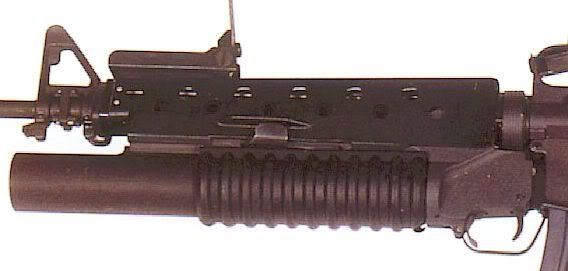
M203: The M203 was designed and procured as the replacement for the M79 grenade launcher, designed to be mounted on the M16 rifle. It consists of a hand guard and sight assembly with an adjustable metallic, folding, short-range blade sight assembly, and an aluminum receiver assembly which houses the barrel latch, barrel stop and firing mechanism. The launcher also has a quadrant sight attachable to the M16A2 carrying handle, used when precision is required out to the maximum effective range of the weapon. Although similar in appearance, the 40mm ammunition for the M203 and M79 are
not the same as the 40mm ammunition for the MK 19 Mod 3.
 M79
M79: The M79 Grenade Launcher was a short single barrel gun designed to accurately fire a 40mm grenade. It was used extensively during the Vietnam War, giving U.S. troops the capability to engage enemy point targets to 150 meters and area targets to 350 meters.
 M9
M9: The M9 Beretta replaced the M1911A1 (‘Colt .45’) as the military’s standard sidearm in 1990-1991. The M9 semi-automatic pistol weighs two pounds and has a maximum effective range of 50 meters. It has a staggered 15 round magazine with a reversible magazine release button that can be positioned for either right- or left-handed shooters.
The M9 is a semiautomatic, magazine-fed, recoil-operated, double action pistol, chambered for the NATO 9mm cartridge. The service pistol is a close personal defense weapon. Rifle company headquarters and the gunners of crew served weapons are armed with the M9.
The M9 front sight is a blade, integral with slide. The rear sight is a notched bar, fixed to slide. Its safety Features are an ambidextrous safety and firing pin block.
The M9 was carried by most of the troops in the Persian Gulf War, but not without controversy. The Army investigated reports of slide failures and frame cracks that led to an unofficial return to the M1911A1, especially by Special Forces and other units who could choose their sidearm. In Iraq and Afghanistan there have been reports of other problems, such as inferior magazines produced by vendors other than Beretta. While redesign and better quality controls have solved most of the M9 reliability problems, there is one lingering issue with no clear answer: is the Beretta 9mm handgun as effective a weapon as the M1911A1 .45 ACP?
In August 2005, the DoD issued specifications for the Military Forces Joint Combat Pistol (JCP), a possible replacement for the M9 Pistol. The specification requires the JCP to be chambered for .45 ACP ammunition. The JCP procurement was postponed in 2006, but it seemed clear that the days of the M9 9mm pistol were coming to an end.
 M249 SAW
: The Belgian Fabrique Nationale XM249 "Minimi" was standardized as the M249 Squad Automatic Weapon System in 1982. The Machine Gun, 5.56mm, M249 Squad Automatic Weapon System (SAW) is gas-operated, magazine or disintegrating metallic link-belt fed, individually portable machine gun capable of delivering a large volume of effective fire to support infantry squad operations at ranges up to 800 meters.
The M249 fires the improved NATO Standard SS109 type 5.56mm ammunition. The M249 replaces the two automatic M16A1 rifles in the rifle squad on a one-for-one basis in all infantry type units and in other units requiring high firepower.
The M249 filled the void created by the retirement of the M-1918A2 Browning Automatic Rifle (BAR) during the 1950s because interim automatic weapons (M14 series and M16A1 rifles) had failed as viable "base of fire" weapons.
Chambered in 5.56 mm NATO, the SAW is fed from a 200 round box of linked ammunition, and also accepts standard 30 round box magazines from the M16 family of rifles.
 M21
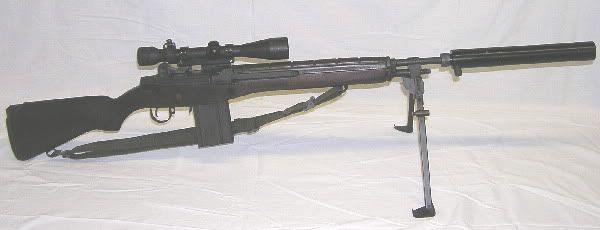
M21: The M21 was the primary Army sniper rifle of the Vietnam War and remained standard until replaced by the bolt-action M24 Sniper Weapon System beginning in 1988.
The XM21 was developed jointly by the Army Weapons Command (Rock Island, IL), Combat Development Command (Ft. Benning, GA), and the Limited Warfare Agency (Aberdeen, MD). The XM21 was an accurized M14 National Match (NM) semi-automatic rifle equipped with a Leatherwood 3X-9X Adjustable Ranging Telescope (ART).
The Rock Island Arsenal converted 1,435 M14NM rifles to XM21 sniper rifles for initial fielding to Vietnam in 1969. The rifle originally had a hardwood stock, walnut impregnated with an epoxy, which was later replaced with a fiberglass stock. The XM21 was officially type classified M21 in 1975, though it had been informally called the M21 since December 1969. It was the primary Army sniper rifle of the Vietnam war and remained standard until formally replaced by the bolt-action M24 Sniper Weapon System beginning in 1988. The M21 remained in use in the Army and other services long after the introduction of the M24.
The M21 was accurate to 750 yards (690m) due to hand-made improvements over the standard M14. The changes and upgrades included:
- The barrel was gauged and selected to ensure correct specification tolerances. The bore was not chromium plated.
- The receiver was individually custom fitted to the stock with a fiberglass compound.
- The firing mechanism was reworked and polished to provide for a crisp hammer release. - - - - - Trigger weight was between 4.5 to 4.75 pounds.
- The suppressor was fitted and reamed to improve accuracy and eliminate any misalignment.
- The gas cylinder and piston were reworked and polished to improve operation and to reduce carbon buildup.
- The gas cylinder and lower band were permanently attached to each other.
- Other parts were carefully selected, fitted, and assembled.
The M21 is described in TM 9-1005-223-10 and other manuals for the M14 rifle, as well as in Appendix B of FM 23-10 "Sniper Training".
Ammunition Used with the M21 Sniper Rifle
The M21 Sniper Rifle used U.S. match grade M118 NATO 7.62mm cartridges, in five-round or 20-round magazines. The M21 can fire long-range ball, ball/tracer and armor piercing (AP) ammunition. Long-range ammunition is produced to stringent tolerances to ensure superior accuracy. AP ammunition enables snipers to penetrate hard cover, such as urban terrain and light armor. The AP (black tip) round can penetrate 20mm of hardened steel at 100 meters.
The long-range ball ammunition uses the M118 bullet, a special 173 grain boat-tailed ball bullet consisting of a lead slug with a gilding metal jacket. The tip of the bullet is not colored. The base of the cartridge is stamped with the year of manufacture and a circle that has vertical and horizontal lines, sectioning it into quarters. Its spread for a 10-shot group is no more than 12 inches at 550 meters (fired from an accuracy barrel in a test cradle).
Scopes and Optics Used with the M21 Sniper Rifle: The M21 sniper weapon system is equipped with National Match rear sights, normally replaced by the telescope.
The M21 Sniper Rifle was equipped with a Leatherwood 3X-9X Adjustable Ranging Telescope (ART). The ART telescope featured adjustable ranging between 300m and 900m. This adjustable ranging feature removed much of the guesswork from aiming at the target. The ART was ballistically matched with U.S. M118 NATO ammunition.
The ART is based on a commercially procured telescopic scopesight, modified for use with the sniper rifle. This scope has a modified reticle with a ballistic earn mounted to the power adjustment ring on the ART I. The ART II has a separate ballistic cam and power ring. The ART is mounted on a spring-loaded base mount that is adapted to fit the M21.
 M3A1
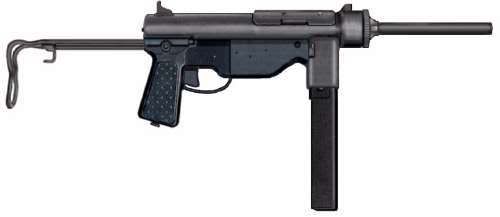
M3A1: The M-3, introduced in December 1942, was a blow back submachine gun that could only be fired on fully-automatic. Often called the "grease gun" because of the resemblance, it used the .45 cal. ACP cartridge in 30-round magazines. It's cyclic rate of fire was 350-450 spm. The M-3A1 was used during both World War II and Korea.
Following World War II, the role of submachine guns was greatly diminished with the introduction of assault rifles and light portable machine guns. Submachine guns are still used by Special Forces, air crews, armored vehicles, counter-terrorist units, and Naval personnel. About 679,200 of the M-3 were produced.
The M-3 was designed specifically to simplify production, compared to the Thompson SMG, by making use of stamped metal parts. A number of deficiencies were found during the initial two years of use, corrected in the model M-3A1.
The M-3A1, introduced in 1944, had a larger ejection port and a stronger cover spring. It was also designed so it could fire 9mm Parabellum cartridges by changing the barrel and bolt and adding an adapter to the magazine. Following World War II, a curved barrel was made for use with the M-3A1. A flash hider was developed for use with both the M-3 and M-3A1.
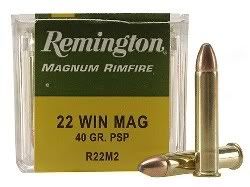 Right now I'm using the Remington 40 gr. PSP (Pointed Soft Point). Somewhere along the line I picked up a box and it shot pretty well so the other day I bought a brick. Not sure it is my favorite .22 WRFM load but we'll see.
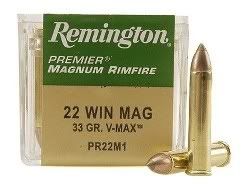 I'd already used most of a box of this really expensive Remington fodder with the VMAX bullets. Oh, it did a number on the groundhogs and it is accurate but it sure is expensive. Hard to justify a quantity of this as it is nearly $50 a brick more expensive than the PSP ammo.
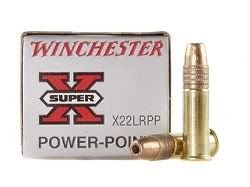
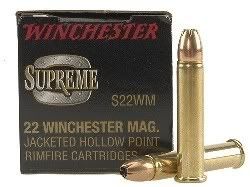 Some time ago I got a promotional box of 200 rounds of the Winchester 34 gr. HP ammo as shown here. It came in a plastic, MTM type box but the latch broke when I first opened it. It will also do a number on Mr. Woodchuck. However, with the Winchester rimfire plant in East Alton, IL not yet replaced by their Oxford, MS plant, you just have to get what you can where you can find it. A friend reported buying 1000 rounds for $50, I'd say he got a great deal as this ammo is retailing for more than $10 a box of 50.
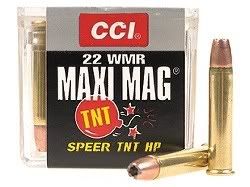 Both CCI and Federal are producing a premium .22 WRFM load using the Speer 30 gr. TNT bullet. The Federal load is pretty darn accurate in my contender carbine but I've never used the CCI product pictured here so can't report on it. I'm sure the bullet works well but a good load is more than a bullet. The price of the CCI is comparable to other premium .22 WRFM ammo or about $10 a box of 50 rounds.