I've been reading Lewis Grizzard's book, "When My Love Returns From The Ladies Room, Will I Be Too Old to Care?" Some time past, Nana or I bought it for $.25. I don't know why. Back in 1987 or so when it was published I didn't care much for Mr. Grizzard. As he writes, one's outlook does change as one ages. His book reads well for me now. It ought to. His observations are pretty much mine and, I think, they are the observations of a man of a certain age.
I feel pretty blessed. For one thing, I've lived past the age of 50, Mr. Grizzard didn't. I've had only two wives and the second has stuck with me. (I'm not sure why though and I'm hesitant to open up that can o'worms and find out.) I've lived a lot of places and met a lot of people and just enough were bad enough I know a bad person when I meet one but I haven't had to live around or with bad people much at all. In other words, most were pretty nice, perhaps nicer than they needed to be to me.
I have three kids. One will talk to me, another has my grandkids and the third is alive. I love them all and I hope they know it.
As I said, I was just in the reading room reading Mr. Grizzard's book and it made me think a bit and that those thoughts were important enough to type up. Here they are. I might have to reconsider.
Sunday, January 30, 2011

Friday, January 28, 2011
The 310 Shop and the Lyman Ideal 310 Tool
The 310 Shop is something I ran across on a forum and it is nifty indeed.
Lots of folks enjoy using the tong type tools to reload and for loading for certain of their collection. It is very calming. It used to be the way that many started in reloading because the tools were less expensive than the bench mounted stuff. The dies have a smaller diameter and different thread pitch than the now standard 7/8"x14tpi dies. One doesn't full-length size in these dies but you can produce some very good ammunition.
Links:
- How to Reload with the 310 Tool by Ric Bowman
- Lyman's 310 Tool page
Lots of folks enjoy using the tong type tools to reload and for loading for certain of their collection. It is very calming. It used to be the way that many started in reloading because the tools were less expensive than the bench mounted stuff. The dies have a smaller diameter and different thread pitch than the now standard 7/8"x14tpi dies. One doesn't full-length size in these dies but you can produce some very good ammunition.
Links:
- How to Reload with the 310 Tool by Ric Bowman
- Lyman's 310 Tool page
Wednesday, January 26, 2011
A load for the AR-15 Carbine...
 I've been loading (finally) for the AR-15 carbine. Finished off the 63 grain Sierra SPs and now working on the Winchester 64 gr. PPs (which look an awful lot like the Sierra bullet). I tried the Sierra 77 gr. BTHP and it stabilizes in the supposed 1:9" twist of my carbine when loaded over 24.9 gr. of BL-C(2). Why all this effort when the old M193 round is out there in quantity (and I have a supply of the 55 gr. BTFMJs in house)? Because there is something better and I want it. Because I like heavier bullets for any particular cartridge. Passed on to me from the "ammo Oracle" by Byron L______ is this:
Q. What about Mk262 or Mk262 Mod1?
Due to the poor performance of M855 ammunition, particularly in short-barreled carbines of 10.5-14.5" in length, Navy SEALs, and eventually other SOCOM units, began experimenting with using loads originally designed for marksmanship units for combat. It was soon discovered that while these loads were both very accurate and had excellent terminal ballistics even from short barrels, the loads weren't quite ideal for combat. The target bullets had no cannelure, and the bullets weren't crimped in place, which could allow bullet set-back during feeding and raise chamber pressures to dangerous levels. Further, most loads were of somewhat mild velocities, as the load was chosen with accuracy, not terminal ballistics, in mind.
Sierra was asked to produce a bullet cannelured version, but they intially refused.
Nosler did not have any problems putting a cannelure on their 77 gr bullet. Black Hills Ammunition was approached to make a slightly modified version of these loads for combat use. A cannelure was specified, the bullets were to be crimped, and the load was to be up to military chamber pressures, with maximum safe velocity being desired. The primers were to be crimped and sealed, and of course, overall length had allow for loading in standard magazines.
The Marines (in conjunction with a large Federal LE agency) did extensive testing of this large experimental batch of BH loaded Nosler 77 gr cannelured OTM's in the Fall of 2002. It offered outstanding terminal performance out to the maximum test distance of 300 yards. They then ordered 1.1 million rounds of cannelured 77 gr OTM's via the existing Mk262 SOCOM contract (which did not specify a manufacturer) administered through Crane. The cannelured 77 gr load was designated Mk262 Mod 1, and the orginal Mk262 was re-designated Mk262 Mod 0.
According to one observer: "At this point bureaucracy, nepostism, and capitalism converged. Sierra realized they were about to lose a VERY LARGE contract and suddenly they agreed to make the 77 gr SMK with a cannelure. Crane pushed for Sierra to get the contract over Nosler, although the Nosler offered better terminal performance. On the other hand, in all fairness, the Sierra bullet was slightly more accurate out of government test barrels than the Nosler--both shoot nearly the same out of real rifles, such as the by then type classified Mk12 SPR."
Therefore, while a few hundred-thousand rounds of 77 gr Nosler OTM was manufactured and used primarily for testing, the cannelured 77 gr SMK was used in the the multi-million round contract for the Mk262 Mod 1.
Recently, Sierra agreed to add a minimal crimp to their bullet, and this has since replaced the Nosler bullet in the current versions of Mk262 Mod1. As of April 2004, Mk 262 Mod1 has seen extensive use in Afghanistan and Iraq, in carbines with barrels as short as 10.5", and has proven to be very effective at ranges that M855 is woefully inadequate from the same weapons. It is also commonly used in the Army's "Special Purpose Rifles" (SPRs), which are accurized 18"-barreled rifles used by soldiers with additional combat marksmanship training in a squad sharp-shooter role.
The bullet will work like a charm on thin skinned finely boned creatures under a 100 kilos easily within a 1/4 mile even with 14-16" barrels....a good full length M16 with a good telescope fired by an expert shot will be dead bang on an unarmored man in the open at 1/2 mile.

Tuesday, January 25, 2011
Notes from the gun shop...
Yesterday was the slowest day I've ever experienced in working the gun shop. It was so slow that we went through almost half the day "short" a clerk and had no problems keeping up. We barely grossed enough to pay the manpower bill. We did only one transfer but it was for a straight trade and no money, other than the $2.00 background check fee, changed hands. Even the number of stool sitters was down.
Interesting guns? Unfortunately, no. The owner of the Remington rolling block is still waiting on a firing pin and for a stock repair but he has cleaned the gun, in and out.
One thing I thought was interesting, as I wiped down the guns in the case for the second time yesterday, was that the High Standard HD Military (with hammer) has yet to sell.
High Standard was originally in Hamden, Connecticutt but the assets have been purchased by High Standard Manufacturing Company, Inc. of Houston, Texas. High Standard had an extensive line of firearms which included handguns and shotguns but was particularly noted, in my youth, for the .22 rimfire semi-auto pistols.
I haven't shot it, only handled it in the store. I've shot other High Standard pistols and they were accurate and pleasant to shoot. This one has fairly good finish but has clearly been used. It comes without a box or spare magazine. I had thought it would be an interesting gun but I'm a bit leery of buying it if only because I don't know enough about these guns to recognize whether or not it might have a problem. I do know that one shouldn't dry fire these guns and an examination of the chamber would seem to indicate that it hasn't been dry fired much if at all. That's good. The grips/stocks aren't cracked. It doesn't seem to have major problems. However, some say that these guns are very magazine sensitive. It is hard to determine if this magazine is defective or not without firing the gun.
Of course, there's a video on YouTube!
And a parts list...

Links:
- High Standard Serial Number Data
- High Standard: A Collector's Guide to the Hamden & Hartford Target Pistols by Tom Dance
- High Standard Collectors' Association
- High Standard Manufacturing Company
Interesting guns? Unfortunately, no. The owner of the Remington rolling block is still waiting on a firing pin and for a stock repair but he has cleaned the gun, in and out.
One thing I thought was interesting, as I wiped down the guns in the case for the second time yesterday, was that the High Standard HD Military (with hammer) has yet to sell.
 |
| Another HD Military (Hammer) Pistol |
I haven't shot it, only handled it in the store. I've shot other High Standard pistols and they were accurate and pleasant to shoot. This one has fairly good finish but has clearly been used. It comes without a box or spare magazine. I had thought it would be an interesting gun but I'm a bit leery of buying it if only because I don't know enough about these guns to recognize whether or not it might have a problem. I do know that one shouldn't dry fire these guns and an examination of the chamber would seem to indicate that it hasn't been dry fired much if at all. That's good. The grips/stocks aren't cracked. It doesn't seem to have major problems. However, some say that these guns are very magazine sensitive. It is hard to determine if this magazine is defective or not without firing the gun.
Of course, there's a video on YouTube!
And a parts list...

Links:
- High Standard Serial Number Data
- High Standard: A Collector's Guide to the Hamden & Hartford Target Pistols by Tom Dance
- High Standard Collectors' Association
- High Standard Manufacturing Company
Saturday, January 22, 2011
Friday, January 21, 2011
Dry Firing
Dry firing is a time tested and valid method for practicing trigger control on all sorts of firearms. It has been done for years and many firearms have "survived" thousands or perhaps millions of cycles. To do so safely one must be absolutely certain that the gun is unloaded and that it is pointed in a safe direction. Keep the "Four Rules" uppermost in your mind when conducting dry fire practice.
I don't care to snap old double shotguns or rimfires (the Ruger Single-Six is an exception to the rule). Older guns have a combination of a design that might not have taken dry firing into consideration and might have been fabricated from metals which don't take kindly to the shock of dry firing. Some have parts which are more than merely hard to find. Rimfires are often so designed that the firing pin strikes the chamber when dry firing and either or both the firing pin and chamber can be deformed by the firing pin striking the chamber directly rather than being cushioned by a cartridge rim. After all these years I have come to prefer a snap cap as it takes the place, with some certainty, of a live cartridge and might provide some cushion for the firing pin in the guns I shoot.
This is the place to note that Ruger revolvers are particularly hardy platforms for dry firing. However, Ruger specifically says that one must remove that little plastic ring they ship with the revolvers before doing so.
The one more shot syndrome can affect anyone. This is when somebody who has been dry firing ends the session, reloads the firearm and then, in a moment of mental lapse takes just "one more shot" and fires a live round. People have shot TVs and other people in doing this. I've come so close that I'm still a bit upset about it many years later, however...
The Army (and I presume other services) use dry-firing with other people in the line of fire as a standard marksmanship training tool. ANYONE who has been in the Army has done this at least once. So far as I can tell this was started at least back when the 1903 was the issue rifle and has been used with 1903, 1903A3, M1, M14 and M16 series rifles. The big caveat here is that the Army strictly controls availability of ammunition and one is constantly clearing weapons. I know that when I conducted this training I personally checked every weapon in use.
 The first is the Target Box and Paddle Exercise. This exercise incorporates the soldier's position and breathing while aiming at a target 25 meters away, simulating a live fire 25-meter engagement. This exercise reinforces the basic fundamentals while refining the soldier's muscle memory during the integrated act of dry firing. This exercise specifically focuses on the soldier's position, breathing and sight picture. Please note that dry-firing doesn't necessarily actually occur. I have seen instructors use the sound of the falling hammer as a cue to mark the "bullet" strike.
The second is the Dime and Washer Exercise. This exercise incorporates the soldier's position; breathing and trigger squeeze at a target 25 meters away, simulating a live fire 25-meter engagement. The soldier must successfully dry-fire his weapon six consecutive times without the washer falling to the ground. This exercise specifically focuses on all four of the soldier's fundamentals. This training is almost always conducted in a classroom or barracks area and not on the range.
The Four Rules
1. All guns are always loaded.
2. Never let the muzzle cover anything you are not willing to destroy.
3. Keep your finger off the trigger until your sights are on the target.
4. Be sure of your target and what is behind it.
I don't care to snap old double shotguns or rimfires (the Ruger Single-Six is an exception to the rule). Older guns have a combination of a design that might not have taken dry firing into consideration and might have been fabricated from metals which don't take kindly to the shock of dry firing. Some have parts which are more than merely hard to find. Rimfires are often so designed that the firing pin strikes the chamber when dry firing and either or both the firing pin and chamber can be deformed by the firing pin striking the chamber directly rather than being cushioned by a cartridge rim. After all these years I have come to prefer a snap cap as it takes the place, with some certainty, of a live cartridge and might provide some cushion for the firing pin in the guns I shoot.
This is the place to note that Ruger revolvers are particularly hardy platforms for dry firing. However, Ruger specifically says that one must remove that little plastic ring they ship with the revolvers before doing so.
The one more shot syndrome can affect anyone. This is when somebody who has been dry firing ends the session, reloads the firearm and then, in a moment of mental lapse takes just "one more shot" and fires a live round. People have shot TVs and other people in doing this. I've come so close that I'm still a bit upset about it many years later, however...
The Army (and I presume other services) use dry-firing with other people in the line of fire as a standard marksmanship training tool. ANYONE who has been in the Army has done this at least once. So far as I can tell this was started at least back when the 1903 was the issue rifle and has been used with 1903, 1903A3, M1, M14 and M16 series rifles. The big caveat here is that the Army strictly controls availability of ammunition and one is constantly clearing weapons. I know that when I conducted this training I personally checked every weapon in use.

The second is the Dime and Washer Exercise. This exercise incorporates the soldier's position; breathing and trigger squeeze at a target 25 meters away, simulating a live fire 25-meter engagement. The soldier must successfully dry-fire his weapon six consecutive times without the washer falling to the ground. This exercise specifically focuses on all four of the soldier's fundamentals. This training is almost always conducted in a classroom or barracks area and not on the range.
Thursday, January 20, 2011
Inspirational Stuff
A collection of short inspirational stories collected over time...
Woman and a Fork
There was a young woman who had been diagnosed with a terminal illness and had been given three months to live. So as she was getting her things 'in order,' she contacted her Pastor and had him come to her house to discuss certain aspects of her final wishes. She told him which songs she wanted sung at the service, what scriptures she would like read, and what outfit she wanted to be buried in. Everything was in order and the Pastor was preparing to leave when the young woman suddenly remembered something very important to her.
'There's one more thing,' she said excitedly.
'What's that?' came the Pastor's reply.
'This is very important,' the young woman continued. 'I want to be buried with a fork in my right hand.'
The Pastor stood looking at the young woman, not knowing quite what to say.
That surprises you, doesn't it?' the young woman asked.
'Well, to be honest, I'm puzzled by the request,' said the Pastor.
The young woman explained. 'My grandmother once told me this story, and from that time on I have always tried to pass along its message to those I love and those who are in need of encouragement. In all my years of attending socials and dinners, I always remember that when the dishes of the main course were being cleared, someone would inevitably lean over and say, 'Keep your fork.' It was my favorite part because I knew that something better was coming...like velvety chocolate cake or deep-dish apple pie. Something wonderful, and with substance!'
So, I just want people to see me there in that casket with a fork in my hand and I want them to wonder 'What's with the fork?' Then I want you to tell them: 'Keep your fork ..the best is yet to come.'
The Pastor's eyes welled up with tears of joy as he hugged the young woman good-bye. He knew this would be one of the last times he would see her before her death. But he also knew that the young woman had a better grasp of heaven than he did. She had a better grasp of what heaven would be like than many people twice her age, with twice as much experience and knowledge. She KNEW that something better was coming.
At the funeral people were walking by the young woman's casket and they saw the cloak she was wearing and the fork placed in her right hand. Over and over, the Pastor heard the question, 'What's with the fork?' And over and over he smiled.
During his message, the Pastor told the people of the conversation he had with the young woman shortly before she died. He also told them about the fork and about what it symbolized to her. He told the people how he could not stop thinking about the fork and told them that they probably would not be able to stop thinking about it either.
He was right. So the next time you reach down for your fork let it remind you, ever so gently, that the best is yet to come. Friends are a very rare jewel, indeed. They make you smile and encourage you to succeed. Cherish the time you have, and the memories you share .... being friends with someone is not an opportunity but a sweet responsibility.
And keep your fork.
The Seed
A successful business man was growing old and knew it was time to choose a successor to take over the business.
Instead of choosing one of his Directors or his children, he decided to do something different. He called all the young executives in his company together.
He said, "It is time for me to step down and choose the next CEO. I have decided to choose one of you." The young executives were Shocked, but the boss continued. "I am going to give each one of you a SEED today - one very special SEED. I want you to plant the seed, water it, and come back here one year from today with what you have grown from the seed I have given you. I will then judge the plants that you bring, and the one I choose will be the next CEO."
One man, named Jim, was there that day and he, like the others, received a seed. He went home and excitedly, told his wife the story. She helped him get a pot, soil and compost and he planted the seed. Everyday, he would water it and watch to see if it had grown. After about three weeks, some of the other executives began to talk about their seeds and the plants that were beginning to grow.
Jim kept checking his seed, but nothing ever grew.
Three weeks, four weeks, five weeks went by, still nothing.
By now, others were talking about their plants, but Jim didn't have a plant and he felt like a failure.
Six months went by -- still nothing in Jim's pot. He just knew he had killed his seed. Everyone else had trees and tall plants, but he had nothing. Jim didn't say anything to his colleagues, however, he just kept watering and fertilizing the soil - He so wanted the seed to grow.
A year finally went by and all the young executives of the company brought their plants to the CEO for inspection.
Jim told his wife that he wasn't going to take an empty pot. But she asked him to be honest about what happened. Jim felt sick to his stomach, it was going to be the most embarrassing moment of his life, but he knew his wife was right. He took his empty pot to the board room. When Jim arrived, he was amazed at the variety of plants grown by the other executives. They were beautiful -- in all shapes and sizes. Jim put his empty pot on the floor and many of his colleagues laughed, a few felt sorry for him!
When the CEO arrived, he surveyed the room and greeted his young executives.
Jim just tried to hide in the back. "My, what great plants, trees and flowers you have grown," said the CEO. "Today one of you will be appointed the next CEO!"
All of a sudden, the CEO spotted Jim at the back of the room with his empty pot. He ordered the Financial Director to bring him to the front. Jim was terrified. He thought, "The CEO knows I'm a failure! Maybe he will have me fired!"
When Jim got to the front, the CEO asked him what had happened to his seed - Jim told him the story.
The CEO asked everyone to sit down except Jim. He looked at Jim, and then announced to the young executives, "Behold your next Chief Executive Officer! His name is Jim!" Jim couldn't believe it. Jim couldn't even grow his seed.
"How could he be the new CEO?" the others said.
Then the CEO said, "One year ago today, I gave everyone in this room a seed. I told you to take the seed, plant it, water it, and bring it back to me today. But I gave you all boiled seeds; they were dead - it was not possible for them to grow.
All of you, except Jim, have brought me trees and plants and flowers. When you found that the seed would not grow, you substituted another seed for the one I gave you. Jim was the only one with the courage and honesty to bring me a pot with my seed in it. Therefore, he is the one who will be the new Chief Executive Officer!"
* If you plant honesty, you will reap trust
* If you plant goodness, you will reap friends
* If you plant humility, you will reap greatness
* If you plant perseverance, you will reap contentment
* If you plant consideration, you will reap perspective
* If you plant hard work, you will reap success
* If you plant forgiveness, you will reap reconciliation
So,be careful what you plant now; it will determine what you will reap later.
If you are kind, people may accuse you of selfish, ulterior motives; be kind anyway.
If you are successful, you will win some false friends and true enemies; succeed anyway.
If you are honest and frank, people may cheat you; be honest and frank anyway.
If you find serenity and happiness, they may be jealous; be happy anyway.
The good you do today, people will often forget tomorrow; do good anyway…
You see, in the final analysis, it is between you and God; it was never between you and them anyway.
— Mother Teresa
Rule 1 : Life is not fair - get used to it!
Rule 2 : The world doesn't care about your self-esteem. The world will expect you to accomplish something BEFORE you feel good about yourself.
Rule 3 : You will NOT make $60,000 a year right out of high school. You won't be a vice-president with a car phone until you earn both.
Rule 4 : If you think your teacher is tough, wait till you get a boss.
Rule 5 : Flipping burgers is not beneath your dignity. Your Grandparents had a different word for burger flipping: They called it opportunity.
Rule 6 : If you mess up, it's not your parents' fault, so don't whine about your mistakes, learn from them.
Rule 7 : Before you were born, your parents weren't as boring as they are now. They got that way from paying your bills, cleaning your clothes and listening to you talk about how cool you thought you were: So before you save the rain forest
from the parasites of your parent's generation, try delousing the closet in your own room.
Rule 8 : Your school may have done away with winners and losers, but life HAS NOT. In some schools, they have abolished failing grades and they'll give you as MANY TIMES as you want to get the right answer. *This doesn't bear the slightest resemblance to ANYTHING in real life.
Rule 9 : Life is not divided into semesters. You don't get summers off and very few employers are interested in helping you FIND YOURSELF. *Do that on your own time.
Rule 10 : Television is NOT real life. In real life people actually have to leave the coffee shop and go to jobs.
Rule 11 : Be nice to nerds. Chances are you'll end up working for one..
Woman and a Fork
There was a young woman who had been diagnosed with a terminal illness and had been given three months to live. So as she was getting her things 'in order,' she contacted her Pastor and had him come to her house to discuss certain aspects of her final wishes. She told him which songs she wanted sung at the service, what scriptures she would like read, and what outfit she wanted to be buried in. Everything was in order and the Pastor was preparing to leave when the young woman suddenly remembered something very important to her.
'There's one more thing,' she said excitedly.
'What's that?' came the Pastor's reply.
'This is very important,' the young woman continued. 'I want to be buried with a fork in my right hand.'
The Pastor stood looking at the young woman, not knowing quite what to say.
That surprises you, doesn't it?' the young woman asked.
'Well, to be honest, I'm puzzled by the request,' said the Pastor.
The young woman explained. 'My grandmother once told me this story, and from that time on I have always tried to pass along its message to those I love and those who are in need of encouragement. In all my years of attending socials and dinners, I always remember that when the dishes of the main course were being cleared, someone would inevitably lean over and say, 'Keep your fork.' It was my favorite part because I knew that something better was coming...like velvety chocolate cake or deep-dish apple pie. Something wonderful, and with substance!'
So, I just want people to see me there in that casket with a fork in my hand and I want them to wonder 'What's with the fork?' Then I want you to tell them: 'Keep your fork ..the best is yet to come.'
The Pastor's eyes welled up with tears of joy as he hugged the young woman good-bye. He knew this would be one of the last times he would see her before her death. But he also knew that the young woman had a better grasp of heaven than he did. She had a better grasp of what heaven would be like than many people twice her age, with twice as much experience and knowledge. She KNEW that something better was coming.
At the funeral people were walking by the young woman's casket and they saw the cloak she was wearing and the fork placed in her right hand. Over and over, the Pastor heard the question, 'What's with the fork?' And over and over he smiled.
During his message, the Pastor told the people of the conversation he had with the young woman shortly before she died. He also told them about the fork and about what it symbolized to her. He told the people how he could not stop thinking about the fork and told them that they probably would not be able to stop thinking about it either.
He was right. So the next time you reach down for your fork let it remind you, ever so gently, that the best is yet to come. Friends are a very rare jewel, indeed. They make you smile and encourage you to succeed. Cherish the time you have, and the memories you share .... being friends with someone is not an opportunity but a sweet responsibility.
And keep your fork.
The Seed
A successful business man was growing old and knew it was time to choose a successor to take over the business.
Instead of choosing one of his Directors or his children, he decided to do something different. He called all the young executives in his company together.
He said, "It is time for me to step down and choose the next CEO. I have decided to choose one of you." The young executives were Shocked, but the boss continued. "I am going to give each one of you a SEED today - one very special SEED. I want you to plant the seed, water it, and come back here one year from today with what you have grown from the seed I have given you. I will then judge the plants that you bring, and the one I choose will be the next CEO."
One man, named Jim, was there that day and he, like the others, received a seed. He went home and excitedly, told his wife the story. She helped him get a pot, soil and compost and he planted the seed. Everyday, he would water it and watch to see if it had grown. After about three weeks, some of the other executives began to talk about their seeds and the plants that were beginning to grow.
Jim kept checking his seed, but nothing ever grew.
Three weeks, four weeks, five weeks went by, still nothing.
By now, others were talking about their plants, but Jim didn't have a plant and he felt like a failure.
Six months went by -- still nothing in Jim's pot. He just knew he had killed his seed. Everyone else had trees and tall plants, but he had nothing. Jim didn't say anything to his colleagues, however, he just kept watering and fertilizing the soil - He so wanted the seed to grow.
A year finally went by and all the young executives of the company brought their plants to the CEO for inspection.
Jim told his wife that he wasn't going to take an empty pot. But she asked him to be honest about what happened. Jim felt sick to his stomach, it was going to be the most embarrassing moment of his life, but he knew his wife was right. He took his empty pot to the board room. When Jim arrived, he was amazed at the variety of plants grown by the other executives. They were beautiful -- in all shapes and sizes. Jim put his empty pot on the floor and many of his colleagues laughed, a few felt sorry for him!
When the CEO arrived, he surveyed the room and greeted his young executives.
Jim just tried to hide in the back. "My, what great plants, trees and flowers you have grown," said the CEO. "Today one of you will be appointed the next CEO!"
All of a sudden, the CEO spotted Jim at the back of the room with his empty pot. He ordered the Financial Director to bring him to the front. Jim was terrified. He thought, "The CEO knows I'm a failure! Maybe he will have me fired!"
When Jim got to the front, the CEO asked him what had happened to his seed - Jim told him the story.
The CEO asked everyone to sit down except Jim. He looked at Jim, and then announced to the young executives, "Behold your next Chief Executive Officer! His name is Jim!" Jim couldn't believe it. Jim couldn't even grow his seed.
"How could he be the new CEO?" the others said.
Then the CEO said, "One year ago today, I gave everyone in this room a seed. I told you to take the seed, plant it, water it, and bring it back to me today. But I gave you all boiled seeds; they were dead - it was not possible for them to grow.
All of you, except Jim, have brought me trees and plants and flowers. When you found that the seed would not grow, you substituted another seed for the one I gave you. Jim was the only one with the courage and honesty to bring me a pot with my seed in it. Therefore, he is the one who will be the new Chief Executive Officer!"
* If you plant honesty, you will reap trust
* If you plant goodness, you will reap friends
* If you plant humility, you will reap greatness
* If you plant perseverance, you will reap contentment
* If you plant consideration, you will reap perspective
* If you plant hard work, you will reap success
* If you plant forgiveness, you will reap reconciliation
So,be careful what you plant now; it will determine what you will reap later.
If you are kind, people may accuse you of selfish, ulterior motives; be kind anyway.
If you are successful, you will win some false friends and true enemies; succeed anyway.
If you are honest and frank, people may cheat you; be honest and frank anyway.
If you find serenity and happiness, they may be jealous; be happy anyway.
The good you do today, people will often forget tomorrow; do good anyway…
You see, in the final analysis, it is between you and God; it was never between you and them anyway.
— Mother Teresa
Rule 1 : Life is not fair - get used to it!
Rule 2 : The world doesn't care about your self-esteem. The world will expect you to accomplish something BEFORE you feel good about yourself.
Rule 3 : You will NOT make $60,000 a year right out of high school. You won't be a vice-president with a car phone until you earn both.
Rule 4 : If you think your teacher is tough, wait till you get a boss.
Rule 5 : Flipping burgers is not beneath your dignity. Your Grandparents had a different word for burger flipping: They called it opportunity.
Rule 6 : If you mess up, it's not your parents' fault, so don't whine about your mistakes, learn from them.
Rule 7 : Before you were born, your parents weren't as boring as they are now. They got that way from paying your bills, cleaning your clothes and listening to you talk about how cool you thought you were: So before you save the rain forest
from the parasites of your parent's generation, try delousing the closet in your own room.
Rule 8 : Your school may have done away with winners and losers, but life HAS NOT. In some schools, they have abolished failing grades and they'll give you as MANY TIMES as you want to get the right answer. *This doesn't bear the slightest resemblance to ANYTHING in real life.
Rule 9 : Life is not divided into semesters. You don't get summers off and very few employers are interested in helping you FIND YOURSELF. *Do that on your own time.
Rule 10 : Television is NOT real life. In real life people actually have to leave the coffee shop and go to jobs.
Rule 11 : Be nice to nerds. Chances are you'll end up working for one..
Wednesday, January 19, 2011
Kimber Master Dealer Program and Kimber Policies...
Some things I just don't understand. I guess I'm slow or something. Maybe it is just the advancing years, maybe I'm in the early stages of Alzheimer's (and I'm not making light of this, it is a genuine concern), I just don't understand some things.
One of those things is the Kimber Master Dealer Program. As I understand the basics, the dealer has to buy $20K in product each year to get a certain discount AND priority on production. However, Kimber doesn't treat all Master Dealers the same. E.g. Gander Mountain pays their $20K and gets pistols, the boss man (that's my boss man) pays his $20K and gets nothing for 2 years. Now, the boss man finds out that there is ONE dealer who actually does get product and he can get the pistols from him albeit at a slightly higher price (which cuts into his markup as he can't sell them for more than anyone) but he can finally get pistols to meet customer demand. It is very hard to judge such things but in the 3 years I've been there I myself might have lost about 50-100 sales because we didn't have the product and I'm only working 1 day a week. That might be 300-600 sales lost to the shop. I would suppose that Kimber didn't lose any sales but that is impossible to say. I know I did sell a couple of Springfields to people who initially asked about Kimber.
So, what I don't understand is how Kimber can justify this, what would amount to fraud if I understand it correctly, Master Dealer program? What sort of management supports this system?
The whole gun marketing system in this country is a bit wonky, or so it seems to me. The ins and outs and such seem to be subject to endless variation/complication.
One of those things is the Kimber Master Dealer Program. As I understand the basics, the dealer has to buy $20K in product each year to get a certain discount AND priority on production. However, Kimber doesn't treat all Master Dealers the same. E.g. Gander Mountain pays their $20K and gets pistols, the boss man (that's my boss man) pays his $20K and gets nothing for 2 years. Now, the boss man finds out that there is ONE dealer who actually does get product and he can get the pistols from him albeit at a slightly higher price (which cuts into his markup as he can't sell them for more than anyone) but he can finally get pistols to meet customer demand. It is very hard to judge such things but in the 3 years I've been there I myself might have lost about 50-100 sales because we didn't have the product and I'm only working 1 day a week. That might be 300-600 sales lost to the shop. I would suppose that Kimber didn't lose any sales but that is impossible to say. I know I did sell a couple of Springfields to people who initially asked about Kimber.
So, what I don't understand is how Kimber can justify this, what would amount to fraud if I understand it correctly, Master Dealer program? What sort of management supports this system?
The whole gun marketing system in this country is a bit wonky, or so it seems to me. The ins and outs and such seem to be subject to endless variation/complication.
30-30 ammo point of impact comparison by Joseph A. Riekers
Paladin initiated a way to get some 30-30 ammo to feed the Leverguns.com Ranch Rifle and ARJunky got a ton of ammo to us. Ricky and I ran it through the rifle to see what we had. The current rear sight setting is dead on at 50 yards with a "hold on" sight picture. The standard 150 gr loads at 2390 fps (book) would not sight in because the rear sight did not have enough movement. We received Federal Premium Barnes 150 grain X @ 2220 (book); Remington Managed Recoil 125 grain RNSP @ 2170 (book); and Federal Hi-Power 125 grain HP @ 2550 (book). The comparison load is the 170 grain Speer FP handloads that are going 2170 fps. 3 shot groups were fired at 50 yds in kneeling or sitting position:
Speer 170 gr load for calibration - dead on, 2 1/2" group
Federal Hi- Power 125's - 2" high, 7/8" group
Federal Premium Barnes 150 - dead on, 1 1/8" group
Remington Managed Recoil 125 gr - 2 3/4" low, 2 1/4" group

Here's what happened at 100 yards and 150 yds - 3 shot groups off shooting sticks resting front edge of receiver:
Speer 170 load for calibration - 100 = -1 1/4" 150 = -6" (3 1/2" groups)
Federal Hi- Power 125 - 100 = +3" 150 = +1 1/4" (2" groups)
Federal Barnes 150 gr - 100 = -2" 150 = -5" (2 1/2" groups)
Rem Manag. Recoil 125 - 100 = -5" 150 = -8 1/2" (5 " groups)
There is a significant noticable increase in recoil shooting the Federal Barnes 150 gr (most recoil). Next in decending order of felt recoil is the Federal 125 gr, Speer 170 gr handload and the least recoil of all the Remington Managed Recoil 125's.
Here's how were going to use these: Kids usually shoot from a fixed blind where they can rest the gun. We try to limit the range to 50 yards. Most commonly they are shooting smallish animals like rams, goats or blackbucks. In this case we'll use the Rem Man. Recoil rounds. For teens, and smaller hunters we'll shoot Rem Man Recoil at the range for familiarity. When actually hunting we'll pull a switcheroo and load the Fed 125's for appropriate smaller game up to 100 yds. If the smaller shooter is targeting something larger like a hog, or who knows what exotic we will do the switcheroo with the Federal Barnes 150 gr. I am confident we can judge the situation and use the more potent ammo when called for without anything noticable by the shooter.
_________________Speer 170 gr load for calibration - dead on, 2 1/2" group
Federal Hi- Power 125's - 2" high, 7/8" group
Federal Premium Barnes 150 - dead on, 1 1/8" group
Remington Managed Recoil 125 gr - 2 3/4" low, 2 1/4" group
Here's what happened at 100 yards and 150 yds - 3 shot groups off shooting sticks resting front edge of receiver:
Speer 170 load for calibration - 100 = -1 1/4" 150 = -6" (3 1/2" groups)
Federal Hi- Power 125 - 100 = +3" 150 = +1 1/4" (2" groups)
Federal Barnes 150 gr - 100 = -2" 150 = -5" (2 1/2" groups)
Rem Manag. Recoil 125 - 100 = -5" 150 = -8 1/2" (5 " groups)
There is a significant noticable increase in recoil shooting the Federal Barnes 150 gr (most recoil). Next in decending order of felt recoil is the Federal 125 gr, Speer 170 gr handload and the least recoil of all the Remington Managed Recoil 125's.
Here's how were going to use these: Kids usually shoot from a fixed blind where they can rest the gun. We try to limit the range to 50 yards. Most commonly they are shooting smallish animals like rams, goats or blackbucks. In this case we'll use the Rem Man. Recoil rounds. For teens, and smaller hunters we'll shoot Rem Man Recoil at the range for familiarity. When actually hunting we'll pull a switcheroo and load the Fed 125's for appropriate smaller game up to 100 yds. If the smaller shooter is targeting something larger like a hog, or who knows what exotic we will do the switcheroo with the Federal Barnes 150 gr. I am confident we can judge the situation and use the more potent ammo when called for without anything noticable by the shooter.
http://www.TARSPORTING.com
"Worldwide Hunting Adventures"
Co-Proprietor
Professional Hunters Association of South Africa. - Member
SCI - Life Member
NRA - Life Member
NAHC - Trophy Life Member
DWWC - Member
Professional Guides and Outfitters Association - Member
Tuesday, January 18, 2011
Notes from the gun shop...
Yesterday's stint in the gun shop was busy but nothing hugely noteworthy happened. We did do about 7 background checks but didn't buy any guns, an unusual thing lately. Only 3 of the 7 were delayed.
Interesting guns? There was the cased pair of Great Western derringers in .38 S&W (not Special). They were very nice and seemed better made than the average Remington Derringer copy. There was the 1897 Rolling Block rifle. It was about the best condition of any I've seen but the firing pin was broken (at the tip). I'd kinda like to have it, but don't know why. I've just always wanted one, but might well like a .50-70 gun more. Not that it matters for this gun now, a stool sitter at the shop traded into it.
Spent a lot of time with 3 customers. One guy was looking for a holographic sight for his Ruger MKII. Had a long discussion about the prices, etc for the Leupold, Eotech and Burris offerings. None in stock and he went home to ponder some more.
Second was a lady whose father is suffering from dementia and she's pricing the guns she isn't keeping. Should be some interesting pieces there. Colt 1911, Enfield No2 MKI revolver, Baby Browning .25 ACP, Colt Model 1908 .380 ACP, and some others. She was the FIRST woman who had memorized, correctly it seemed, the marks on the various firearms. Of course, she LIKES to shoot and was keeping, she made that very clear, a Winchester Model 62 and Model 63 for her own use.
Third was a couple, the lady was buying, who were looking for a revolver to carry to and from work and while out walking the dog, etc. Looked at everything and finally decided on the Smith and Wesson Bodyguard .38 Special revolver. The deciding factors were grip shape, weight and the laser sight. She bought THREE boxes of ammunition and two holsters (a IWB and a pocket holster) for the gun.
That took us right up to closing.
Interesting guns? There was the cased pair of Great Western derringers in .38 S&W (not Special). They were very nice and seemed better made than the average Remington Derringer copy. There was the 1897 Rolling Block rifle. It was about the best condition of any I've seen but the firing pin was broken (at the tip). I'd kinda like to have it, but don't know why. I've just always wanted one, but might well like a .50-70 gun more. Not that it matters for this gun now, a stool sitter at the shop traded into it.
Spent a lot of time with 3 customers. One guy was looking for a holographic sight for his Ruger MKII. Had a long discussion about the prices, etc for the Leupold, Eotech and Burris offerings. None in stock and he went home to ponder some more.
 |
| One like the Enfield that I hope she has... |
Third was a couple, the lady was buying, who were looking for a revolver to carry to and from work and while out walking the dog, etc. Looked at everything and finally decided on the Smith and Wesson Bodyguard .38 Special revolver. The deciding factors were grip shape, weight and the laser sight. She bought THREE boxes of ammunition and two holsters (a IWB and a pocket holster) for the gun.
That took us right up to closing.
Monday, January 17, 2011
Ivory Grips/Stocks
I don't know much about ivory. I knew there was "pre-ban" ivory, I knew it came from elephants and some related dentin materials were called ivory and that there were various ivory substitutes or fake ivories. I did NOT know all the jargon associated with the trade and I didn't know a lot specifics on legality, cost, etc. Ivory is really a very interesting material and there's lots to learn.
Most shooters are at least modestly interested in the use of ivory as handgun grip or stock material. It is dense, attractive, contrasts well with blued steel, and is associated with elegance and "class".
- WHERE DOES IVORY COME FROM?
- Ivoryhound articles on ivory...
- Working With Pre-Ban Ivory
Most shooters are at least modestly interested in the use of ivory as handgun grip or stock material. It is dense, attractive, contrasts well with blued steel, and is associated with elegance and "class".
- WHERE DOES IVORY COME FROM?
- Ivoryhound articles on ivory...
- Working With Pre-Ban Ivory
Sunday, January 16, 2011
It can happen at any time...
I stuck a case in a die. I know I didn't likely lube it enough but it FELT like it had enough lube. And I was being extra careful as well. Think I'll upgrade from the Lee dies for the .223 I was using to RCBS or Redding. Unless I can manage to drill the hole for the stuck case remover without running the bit into the pin. I think I like the RCBS set up better for when you stick a case.
After trying any number of things without budging the decapping pin in the pin collet I put it in the freezer for about 10 hours. I was then able to wack the pin and thus the cartridge case out of the die. I have already bought an RCBS die set and am using that to decap but I'm seating bullets with the Lee die because I'm too lazy to take the time to set up the RCBS seating die.
After trying any number of things without budging the decapping pin in the pin collet I put it in the freezer for about 10 hours. I was then able to wack the pin and thus the cartridge case out of the die. I have already bought an RCBS die set and am using that to decap but I'm seating bullets with the Lee die because I'm too lazy to take the time to set up the RCBS seating die.
Bullet Casting
This might once again be the only way we shooters will be able to afford or maybe get at all any of the bullets we know and love. What with lead everywhere but lead bans popping up in many state legislatures (as a back door way to ban guns), it may be an act of civil disobedience to cast bullets. Still, the alternative, no bullets, is unacceptable.
Do you cast now? Have you ever thought about casting? There are a number of references and molds are for sale from a number of sources. Bullet casters are among the most helpful of any hobbyists. If you have a question there's somebody out there to help you. They even have their own forum, Cast Boolits. If you have a problem, it is likely somebody there has the solution.
There are any number of print references as well. Here are some I recommend:
- Lyman Cast Bullet Handbook
- NRA Cast Bullet Book by COL E.H. Harrison, (ISBN 0-935998-49-7) (Note: hard to find and out of print)
- Jacketed Performance with Cast Bullets by Veral Smith
-
Links:
- Ballisticast Products (Hensley and Gibbs mold designs AND quality)
- Lead Bullets Technology
Do you cast now? Have you ever thought about casting? There are a number of references and molds are for sale from a number of sources. Bullet casters are among the most helpful of any hobbyists. If you have a question there's somebody out there to help you. They even have their own forum, Cast Boolits. If you have a problem, it is likely somebody there has the solution.
There are any number of print references as well. Here are some I recommend:
- Lyman Cast Bullet Handbook
- NRA Cast Bullet Book by COL E.H. Harrison, (ISBN 0-935998-49-7) (Note: hard to find and out of print)
- Jacketed Performance with Cast Bullets by Veral Smith
-
Links:
- Ballisticast Products (Hensley and Gibbs mold designs AND quality)
- Lead Bullets Technology
Saturday, January 15, 2011
.25-35 Winchester
 The .25-35 Winchester was introduced in 1895 in the Model 1894 Winchester rifle. Developed with and from the .30-30 Winchester (itself a development from the .38-55 Winchester/Ballard case), the .25-35 helped to bring on modern high velocity, small bore, rifle cartridges.
Ballistics of the .25-35 Winchester are normally a 117 grain flat point bullet at a muzzle velocity of about 2300 fps with a muzzle energy of about 1375 fpe. At 100 yards the numbers were about 1900 fps and 940 fpe. One can duplicate the original 2300 fps load with Hornady's 117 grain Round Nose bullet over 25.7 grains of IMR 3031 powder or 28.1 grains of IMR 4320 powder. Hornady's figures show that at 100 yards this bullet is doing 1965 fps/1003 fpe with 1668 fps/723 fpe at 200 yards. The mid-range trajectory over 200 yards is a reasonable 4.5 inches. This isn't impressive today but in the day it was great for deer and pronghorn antelope and it will still work.
The load has the added advantage of light recoil and the barrels of Winchester 94s, being the same OD as a .30 barrel, are stiffer and the guns often more accurate. My gun is a Thompson-Center custom shop barrel. I've scoped it with a ____ . That's a story in and of itself.
Loads used...
| Bullet | Weight | Powder | Charge | Velocity | Energy |
| Factory | 117 gr. | Unknown | Unknown | Velocity | Energy |
| Hornady RN | 117 gr. | BLC(2) | 27.0 gr. | 2282 | 1353 |
| Hornady VMAX | 75 gr. | BLC(2) | 27.0 gr. | 2282 | 1353 |
| Remington JHP | 86 gr. | IMR SR4759 | 8.0 gr. | 1191 | 261 |
Friday, January 14, 2011
M1 Garand Sights
What about the rear sights. Collectors are always fussing about the rear sights on the M1 Garand. The rear sight assembly has five parts you need to worry about 1) aperture, 2) base, 3) cover, 4) windage knob and 5) elevation knob and pinion. See Figure 3 for both the windage (A) and elevation knobs (B) which are the most important elements.
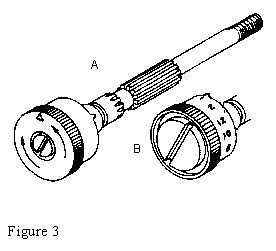 How do you know your rifle has the correct rear sight particularly when you realize that neither drawing number nor the serial number was marked on the individual parts. Basically, there are four combinations of these parts to make the rear sight and they are distinguished primarily, but not completely, by the way the windage knob was manufactured and secured. In the early rear sight, the windage knob could be removed by screwing out the windage knob flush nut. Soldiers complained that the knob often came loose and allowed changes in windage, or else fell off altogether and it or its spring or lost.
To remedy this, the Ordnance Department replaced the flush nut with a lock bar that could be tightened down and held in position by a spring. The problem with this arrangement was that if a soldier had to make a windage adjustment quickly, he often could not do without a tool to loosen the lock bar.
To solve this problem, the Ordnance Department ordered the locking bar to be replaced with the original flush nut but one that was held captive on the windage knob shaft so that it could not fall off. This solved the problem but this fix was not applied until World War II had ended.
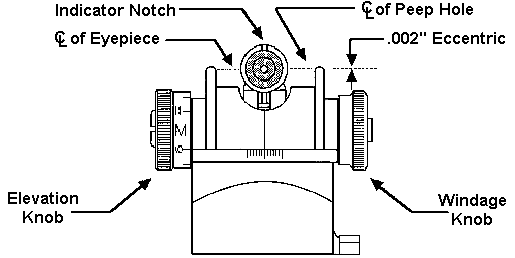
The fourth type of rear sight, by the way, was that developed for the National Match M1 Garands. It has the captive flush nut but windage adjustments are made in increments of 1/2 minute of angle. To accomplish this, the thread on the shaft is double that on the normal M1 windage knob shaft.
Each click of either elevation or windage changes the strike of the bullet approximately one inch on the target for every 100 yards of range, over its effective range.
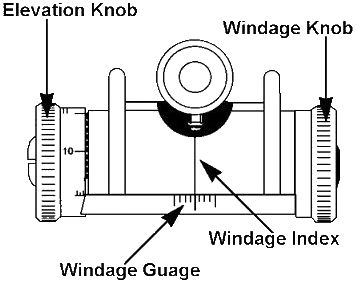
Windage can be adjusted 16 clicks to the right or to the left of center index, and elevation can be adjusted from 0 to 72 clicks.
Sighting-In
1. Windage zero.
Center your rear sight according to the index marks on the receiver and sight base. Center the front sight in the dovetail. Under no-wind conditions, fire a group at 100 yards. If the group is not centered, loosen the front sight and move it opposite to the direction of the group error. Repeat as necessary.
2. Elevation
For simple "Battle-Zero," Zero-in at 25 yards, then come up 1 click. This effectively zeros-in for 200 yards. This should result in groups centered on a 4" diameter from 0 to 400 yards.

How do you know your rifle has the correct rear sight particularly when you realize that neither drawing number nor the serial number was marked on the individual parts. Basically, there are four combinations of these parts to make the rear sight and they are distinguished primarily, but not completely, by the way the windage knob was manufactured and secured. In the early rear sight, the windage knob could be removed by screwing out the windage knob flush nut. Soldiers complained that the knob often came loose and allowed changes in windage, or else fell off altogether and it or its spring or lost.To remedy this, the Ordnance Department replaced the flush nut with a lock bar that could be tightened down and held in position by a spring. The problem with this arrangement was that if a soldier had to make a windage adjustment quickly, he often could not do without a tool to loosen the lock bar.
To solve this problem, the Ordnance Department ordered the locking bar to be replaced with the original flush nut but one that was held captive on the windage knob shaft so that it could not fall off. This solved the problem but this fix was not applied until World War II had ended.
The fourth type of rear sight, by the way, was that developed for the National Match M1 Garands. It has the captive flush nut but windage adjustments are made in increments of 1/2 minute of angle. To accomplish this, the thread on the shaft is double that on the normal M1 windage knob shaft.
Each click of either elevation or windage changes the strike of the bullet approximately one inch on the target for every 100 yards of range, over its effective range.
Windage can be adjusted 16 clicks to the right or to the left of center index, and elevation can be adjusted from 0 to 72 clicks.
Sighting-In
1. Windage zero.
Center your rear sight according to the index marks on the receiver and sight base. Center the front sight in the dovetail. Under no-wind conditions, fire a group at 100 yards. If the group is not centered, loosen the front sight and move it opposite to the direction of the group error. Repeat as necessary.
2. Elevation
For simple "Battle-Zero," Zero-in at 25 yards, then come up 1 click. This effectively zeros-in for 200 yards. This should result in groups centered on a 4" diameter from 0 to 400 yards.
Standard Issue Rear Sight
National Match Rear Sight
Start zeroing by ensuring the windage index on the rear sight base is aligned with the center line of the witness marks on the base of the service rifle's receiver.
Subscribe to:
Posts (Atom)